Market Overview
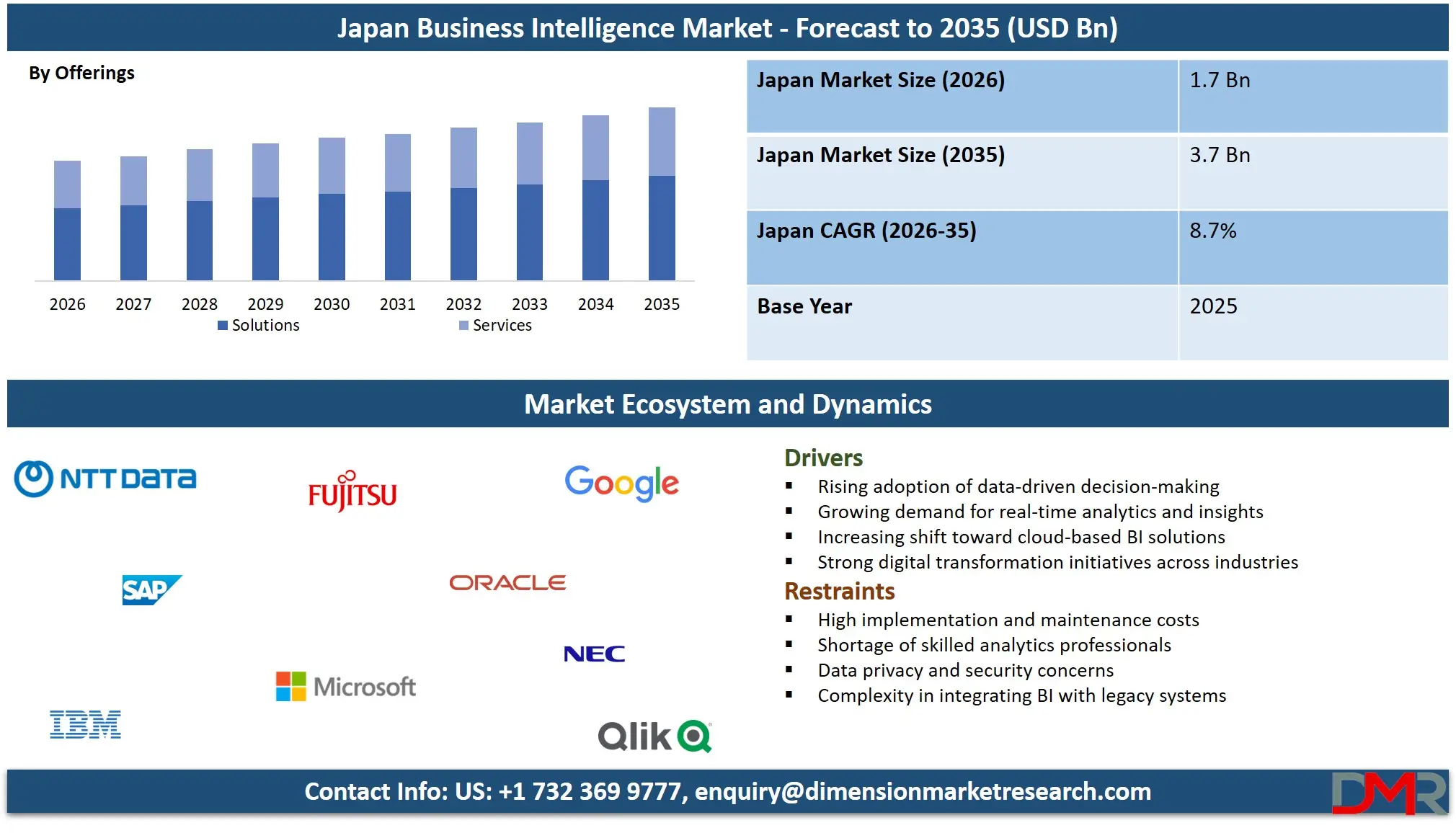
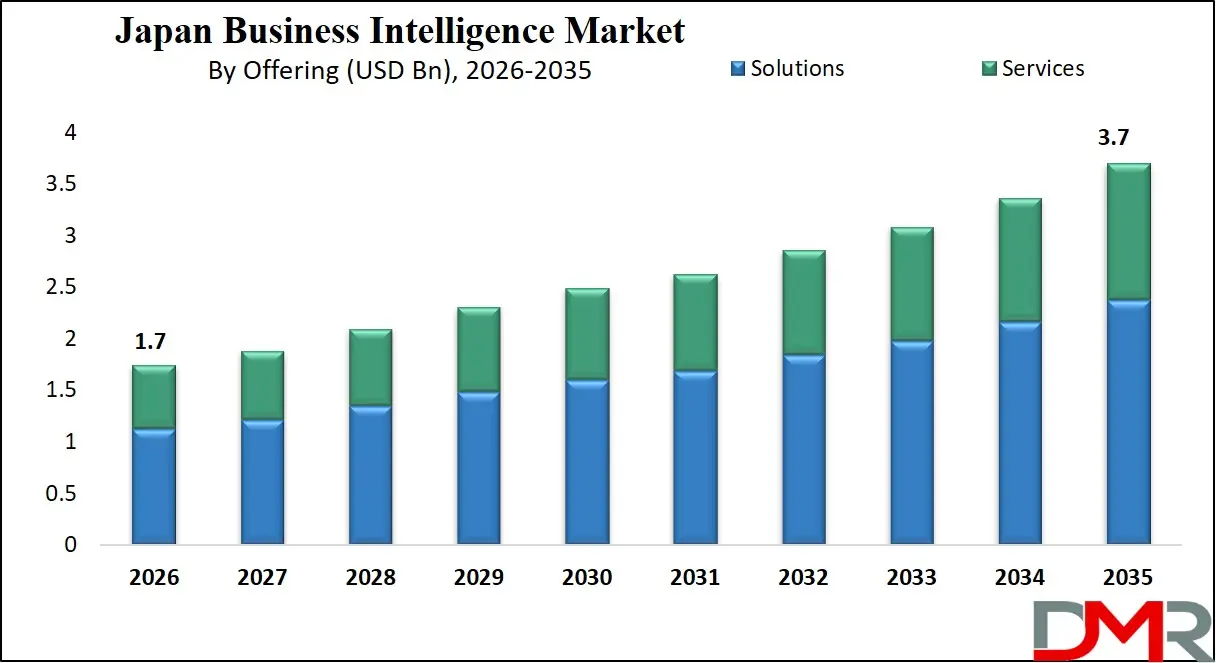
Japan Business Intelligence Market size is projected to reach USD 1.7 billion in 2026 and grow at a compound annual growth rate of 8.7% to reach a value of USD 3.7 billion in 2035.
ℹ
To learn more about this report –
Download Your Free Sample Report Here
Business Intelligence refers to a comprehensive ecosystem of tools, platforms, and methodologies that enable organizations to collect, process, analyze, and visualize data for informed decision-making. It includes software solutions such as dashboards, reporting tools, data warehousing systems, and advanced analytics platforms, along with associated services like consulting and system integration. These components transform raw data into actionable insights, enhancing operational efficiency and strategic planning across industries.
In Japan, rapid digital transformation is accelerating demand for advanced analytics solutions, as organizations leverage real-time data processing and predictive modeling to improve efficiency and customer engagement. Cloud adoption plays a critical role by offering scalable and cost-effective deployments, particularly for small and medium enterprises seeking flexibility. At the same time, regulatory frameworks around data protection and governance are shaping adoption patterns, pushing companies to prioritize secure and compliant platforms. The growing importance of ESG reporting is further encouraging the use of analytics tools capable of tracking sustainability metrics and performance indicators effectively.
ℹ
To learn more about this report –
Download Your Free Sample Report Here
The market in Japan is evolving with a shift toward interactive, AI-driven analytics platforms and self-service BI tools that democratize data access across organizations. Cloud-native platform launches are enabling faster deployment and scalability, while AI and machine learning integration enhance predictive capabilities and automates data preparation. Strategic collaborations between technology providers and enterprises are delivering customized solutions, especially in manufacturing and finance. Additionally, increased investments in cloud infrastructure, along with mergers, acquisitions, and regulatory changes in data privacy, are driving continuous innovation and shaping the future trajectory of business intelligence in Japan.
Japan Business Intelligence Market: Key Takeaways
- Market Growth: Japan Business Intelligence Market size is expected to grow by USD 1.8 billion, at a CAGR of 8.7%, during the forecasted period of 2027 to 2035.
- By Offering: Solutions are anticipated to get the majority share of the Japan Business Intelligence market in 2026.
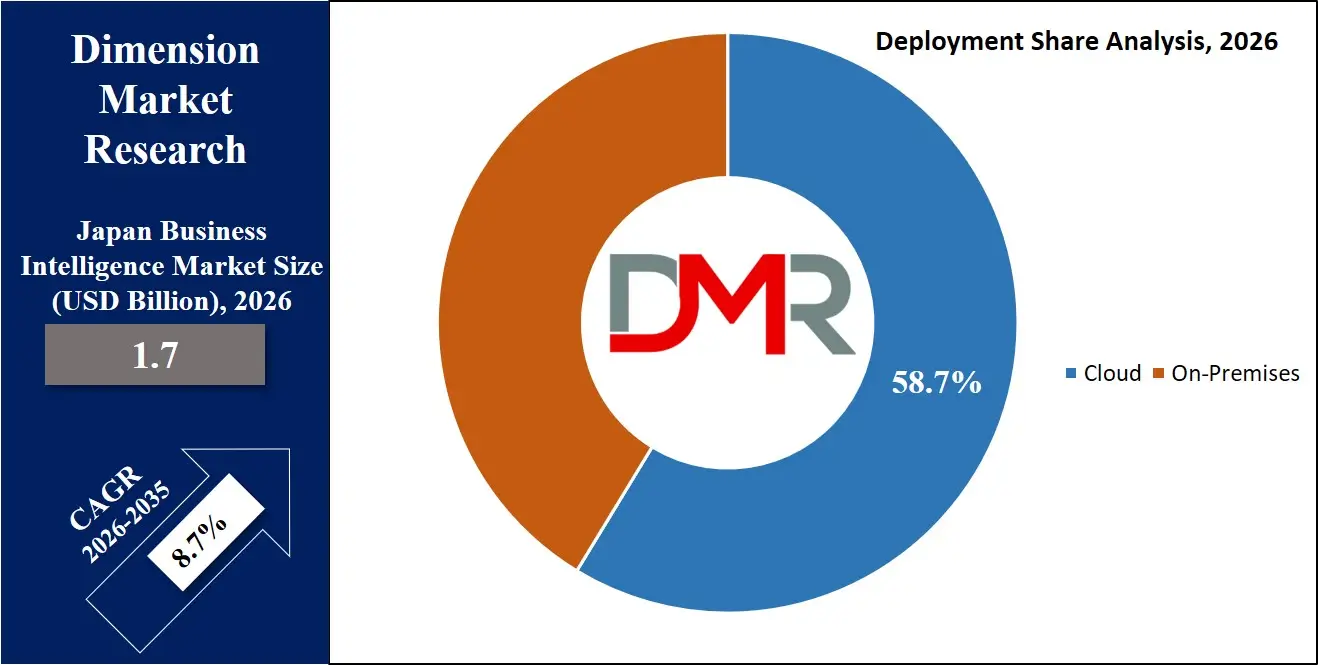
- By Deployment: The cloud segment is expected to get the largest revenue share in 2026 in the Japan Business Intelligence market.
- Use Cases: Some of the use cases of Business Intelligence include HR Analytics, Retail Sales Forecasting, and more.
Japan Business Intelligence Market: Use Cases:
- Supply Chain Optimization: BI tools help organizations analyze logistics data, identify bottlenecks, and improve inventory management. This leads to enhanced efficiency and reduced operational costs across supply chains.
- Customer Behavior Analysis: Companies utilize analytics platforms to study consumer preferences and purchasing patterns, enabling personalized marketing strategies and improved customer retention.
- Financial Performance Monitoring: BI solutions provide real-time financial insights, supporting budgeting, forecasting, and risk management for better strategic planning.
- Manufacturing Process Improvement: Data-driven insights help manufacturers optimize production lines, reduce downtime, and maintain quality standards.
- Healthcare Data Management: BI tools assist healthcare providers in analyzing patient data, improving treatment outcomes, and streamlining administrative processes.
- Retail Sales Forecasting: Retailers use BI platforms to predict demand trends, manage stock levels, and enhance sales performance.
- HR Analytics: Organizations leverage BI for workforce planning, performance tracking, and employee engagement analysis.
Stats & Facts
- Ministry of Economy, Trade and Industry states that over 68% of Japanese enterprises increased investment in digital transformation initiatives in 2024.
- Statistics Bureau of Japan reports that cloud service adoption among businesses reached approximately 72% in 2025.
- Ministry of Internal Affairs and Communications notes that data usage in enterprises grew by nearly 25% year-on-year in 2024.
- Japan External Trade Organization indicates that IT spending in analytics solutions rose by 14% in 2025.
- Digital Agency of Japan highlights that over 60% of SMEs adopted data analytics tools by 2025.
- World Bank reports that Japan’s digital economy contributed around 9% to GDP in 2024.
- OECD states that Japan ranks among the top 10 countries in enterprise data utilization maturity in 2025.
- Ministry of Health, Labour and Welfare reports that healthcare analytics adoption increased by 18% in 2024.
- Bank of Japan notes that financial institutions increased analytics spending by 12% in 2025.
- United Nations Conference on Trade and Development highlights that Japan’s ICT imports grew by 10% in 2024.
- International Data Corporation indicates that AI-driven analytics adoption in Japan exceeded 40% of enterprises in 2025.
- Asian Development Bank reports that digital infrastructure investments in Japan rose by 15% in 2024.
Market Dynamic
Driving Factors in the Japan Business Intelligence Market
Growing Adoption of Cloud-Based Analytics Solutions
The major shift toward cloud computing is a primary driver of the Japan Business Intelligence market. Organizations are transitioning from traditional on-premises systems to cloud-based platforms due to their scalability, flexibility, and cost-effectiveness. Cloud BI enables real-time data access, remote collaboration, and faster deployment, making it particularly attractive for SMEs and large enterprises alike. Additionally, cloud solutions reduce infrastructure maintenance costs and support seamless integration with other digital tools. As Japanese companies prioritize digital transformation, the adoption of cloud-based analytics continues to accelerate, enhancing data-driven decision-making capabilities across industries.
Rising Demand for Data-Driven Decision Making
Japanese enterprises are increasingly recognizing the importance of data in driving strategic decisions. With growing competition and evolving consumer expectations, businesses are leveraging BI tools to gain actionable insights and improve operational efficiency. Advanced analytics, including predictive and prescriptive models, enable organizations to anticipate market trends and respond proactively. The integration of BI into core business functions such as finance, marketing, and supply chain management is further boosting its adoption. This shift toward data-centric operations is strengthening the role of BI as a critical component of enterprise strategy.
Restraints in the Japan Business Intelligence Market
High Implementation and Integration Costs
Despite its benefits, the adoption of BI solutions can be hindered by high initial investment costs. Implementing advanced analytics platforms requires significant spending on software, hardware, and skilled personnel. Integration with legacy systems also poses challenges, particularly for traditional enterprises with complex IT infrastructures. These factors can discourage small and medium-sized businesses from adopting BI solutions, limiting market growth. Additionally, ongoing maintenance and upgrade costs add to the financial burden, making cost management a critical concern for organizations.
Data Privacy and Security Concerns
Data security remains a major challenge in the Japan Business Intelligence market. With increasing reliance on digital platforms, organizations face risks related to data breaches, cyberattacks, and unauthorized access. Strict regulatory requirements around data protection further complicate implementation, requiring companies to invest in robust security measures. Compliance with local and international standards can be complex and time-consuming, especially for organizations operating across multiple regions. These concerns may slow down adoption rates and necessitate continuous investment in cybersecurity solutions.
Opportunities in the Japan Business Intelligence Market
Expansion of AI-Driven Analytics
The integration of artificial intelligence with BI platforms presents significant growth opportunities. AI-powered analytics enable automated data processing, predictive modeling, and advanced insights generation. Japanese companies are increasingly adopting these technologies to enhance decision-making and operational efficiency. The ability to analyze large volumes of data quickly and accurately is particularly valuable in sectors such as manufacturing and finance. As AI technologies continue to evolve, their integration with BI solutions is expected to unlock new capabilities and drive market expansion.
Increasing Adoption Among SMEs
Small and medium enterprises in Japan are emerging as a key growth segment for BI solutions. With the availability of cost-effective cloud-based platforms, SMEs can now access advanced analytics tools without significant capital investment. This democratization of BI is enabling smaller businesses to compete with larger enterprises by leveraging data-driven insights. Government initiatives supporting digital transformation further encourage adoption among SMEs, creating a favorable environment for market growth.
Trends in the Japan Business Intelligence Market
Shift Toward Self-Service Analytics
Self-service BI is gaining traction as organizations aim to empower employees with direct access to data insights. These platforms allow non-technical users to create reports, dashboards, and visualizations without relying on IT teams. This trend is enhancing productivity and accelerating decision-making processes. Japanese companies are increasingly adopting user-friendly BI tools to promote data literacy and collaboration across departments.
Integration of Real-Time Data Analytics
Real-time analytics is becoming a key trend in the market, enabling organizations to respond quickly to changing business conditions. BI platforms are evolving to support continuous data processing and instant insights generation. This capability is particularly important in industries such as retail and finance, where timely decisions can significantly impact performance. The growing demand for real-time insights is driving innovation in BI technologies and shaping the future of the market.
Impact of Artificial Intelligence in Japan Business Intelligence Market
- Automated Data Processing: AI streamlines data collection and preparation, reducing manual effort and improving efficiency.
- Predictive Analytics Enhancement: Machine learning models enable accurate forecasting of trends and business outcomes.
- Personalized Insights Generation: AI tailors analytics outputs based on user roles and preferences.
- Natural Language Querying: Users can interact with BI tools using conversational language for easier data access.
- Anomaly Detection: AI identifies unusual patterns in data, helping organizations mitigate risks.
- Real-Time Decision Support: AI-powered BI delivers instant insights for faster decision-making.
- Improved Data Visualization: Advanced algorithms enhance the clarity and relevance of visual analytics.
- Operational Efficiency Optimization: AI identifies inefficiencies and recommends process improvements.
Impact of Iran War on Japan Business Intelligence Market
The Iran war has created indirect but notable effects on the Japan Business Intelligence (BI) market by disrupting macroeconomic stability. Rising oil prices and energy supply uncertainty have increased operational costs across Japanese industries, leading to cautious IT spending and delayed analytics investments in the short term. At the same time, inflation volatility and economic uncertainty are pushing enterprises to focus on cost control, risk management, and operational efficiency, supporting targeted demand for BI solutions. Supply chain disruptions and weaker business confidence are slowing large-scale digital transformation initiatives. However, the situation is also accelerating the need for real-time data insights, predictive analytics, and scenario planning tools, which is expected to support steady long-term growth of the BI market in Japan.
Research Scope and Analysis
By Offering Analysis
Solutions dominate the Japan Business Intelligence market, accounting for an estimated 64.2% share in 2026. This leadership position is primarily driven by the rising demand for advanced analytics tools, including dashboards, reporting platforms, and data integration systems that enable organizations to consolidate and interpret large volumes of data efficiently. Enterprises across industries are prioritizing investments in solutions that offer real-time insights, enhanced visualization, and seamless user interfaces. The integration of artificial intelligence and machine learning further strengthens these offerings by enabling predictive and prescriptive analytics capabilities. Additionally, the growing emphasis on self-service BI tools allows non-technical users to generate insights independently, further accelerating adoption. As organizations continue to focus on digital transformation and data-driven strategies, solutions remain central to operational and strategic decision-making processes.
Services are emerging as the fastest growing segment in the Japan Business Intelligence market, driven by the increasing complexity of deploying and managing advanced analytics systems. Organizations often require specialized expertise for consulting, system integration, customization, and ongoing maintenance to ensure optimal performance of BI platforms. As enterprises adopt more sophisticated tools, the demand for professional services to manage implementation challenges and ensure seamless integration with legacy systems continues to rise. Managed services are also gaining traction, as companies prefer outsourcing BI operations to reduce internal workload and focus on core business functions. Furthermore, continuous updates, training, and technical support services are becoming essential to maximize return on investment. This sustained demand is expected to significantly expand the services segment in the coming years.
By Deployment Analysis
Cloud deployment is projected to hold a 58.7% share in 2026, making it the leading segment in the Japan Business Intelligence market. This dominance is attributed to the scalability, flexibility, and cost-efficiency offered by cloud-based platforms. Organizations increasingly prefer cloud BI solutions because they enable real-time data access, remote collaboration, and faster deployment without requiring significant upfront infrastructure investment. The shift toward hybrid and remote work models has further accelerated cloud adoption, as businesses need accessible and centralized data systems. Additionally, cloud platforms support seamless integration with other enterprise applications, enhancing overall operational efficiency. Continuous advancements in cloud security and compliance frameworks are also addressing earlier concerns, encouraging more organizations to transition from traditional on-premises systems to cloud-based analytics solutions.
ℹ
To learn more about this report –
Download Your Free Sample Report Here
On-premises deployment is witnessing steady growth, particularly among organizations with stringent data security and regulatory compliance requirements. Industries such as banking, financial services, and healthcare often prefer on-premises BI solutions to maintain full control over sensitive data and ensure adherence to strict governance policies. Despite the growing popularity of cloud solutions, on-premises systems remain relevant due to their ability to provide enhanced data privacy and customization capabilities. Technological advancements in hardware infrastructure and cybersecurity are further supporting the adoption of on-premises deployments. Additionally, enterprises with established legacy systems find it more practical to upgrade existing infrastructure rather than migrate entirely to the cloud. This combination of security, control, and compatibility is driving the continued growth of the on-premises segment.
By Organization Size Analysis
Large enterprises lead the Japan Business Intelligence market with a projected 61.5% share in 2026, primarily due to their extensive IT budgets and complex data management needs. These organizations generate vast amounts of structured and unstructured data, requiring advanced BI tools to extract meaningful insights and maintain a competitive edge. They often invest in comprehensive analytics platforms that integrate with multiple business functions, including finance, operations, and customer relationship management. The ability to deploy customized and scalable solutions further strengthens their adoption of BI technologies. Additionally, large enterprises are early adopters of emerging innovations such as AI-driven analytics and real-time data processing. Their focus on optimizing operational efficiency and strategic planning continues to drive the dominance of this segment.
Small and medium enterprises are rapidly emerging as the fastest growing segment in the Japan Business Intelligence market, fueled by increasing access to affordable and scalable cloud-based solutions. Unlike traditional systems that required significant capital investment, modern BI platforms offer subscription-based models that make advanced analytics accessible to smaller organizations. SMEs are increasingly recognizing the value of data-driven decision-making in improving competitiveness, customer engagement, and operational efficiency. Government-led digital transformation initiatives and support programs are also encouraging adoption among smaller businesses. Additionally, user-friendly interfaces and self-service capabilities reduce the need for specialized technical expertise, making BI tools more practical for SMEs. This growing awareness and accessibility are driving strong growth in this segment.
By Application Analysis
Financial Performance and Strategy Management is the leading application segment, accounting for 27.8% of the Japan Business Intelligence market in 2026. Organizations prioritize financial analytics to enhance budgeting accuracy, optimize resource allocation, and manage risks effectively. BI tools enable real-time monitoring of financial metrics, providing insights into revenue trends, cost structures, and profitability. This capability allows businesses to make informed strategic decisions and respond quickly to market changes. Additionally, the integration of predictive analytics helps organizations forecast financial outcomes and identify potential risks before they occur. The growing complexity of financial operations and regulatory requirements further drives the adoption of BI solutions in this segment, reinforcing its dominant position.
CRM Analytics Operations is the fastest growing application segment, driven by the increasing emphasis on customer-centric strategies across industries. Businesses are leveraging BI tools to analyze customer behavior, preferences, and engagement patterns, enabling them to deliver personalized experiences and improve customer satisfaction. The rise of digital channels and e-commerce platforms has further amplified the need for advanced analytics in customer relationship management. Organizations are using these insights to optimize marketing campaigns, enhance customer retention, and identify new growth opportunities. Additionally, integration with AI technologies allows for real-time recommendations and predictive customer insights. This growing focus on customer experience and data-driven marketing is accelerating the expansion of this segment.
By End User Analysis
Manufacturing is the leading end-user segment in the Japan Business Intelligence market, holding a 23.6% share in 2026. The sector’s strong reliance on precision, efficiency, and quality control drives the adoption of BI solutions for data-driven process optimization. Manufacturers utilize analytics tools to monitor production performance, reduce downtime, and improve supply chain efficiency. Real-time data insights enable better decision-making and support predictive maintenance strategies, minimizing operational disruptions. Additionally, the integration of IoT devices with BI platforms enhances data collection and analysis capabilities. Japan’s advanced manufacturing ecosystem further contributes to the widespread adoption of BI technologies, solidifying this segment’s leading position in the market.
Healthcare is emerging as the fastest-growing end-user segment, driven by the increasing adoption of data analytics for improving patient care and operational efficiency. BI tools enable healthcare providers to analyze patient data, optimize treatment plans, and streamline administrative processes. The growing demand for personalized medicine and value-based care is further encouraging the use of advanced analytics solutions. Additionally, BI platforms help in resource allocation, hospital management, and disease trend analysis. Regulatory requirements and the need for accurate reporting also support the adoption of these tools. As the healthcare sector continues to digitize, the demand for business intelligence solutions is expected to grow significantly.
The Japan Business Intelligence Market Report is segmented on the basis of the following:
By Offerings
- Solutions
- Dashboards & Scorecards
- Data Integration & ETL
- Reporting & Visualization
- Query & Analysis
- Services
- Consulting
- Deployment & Integration
- Support & Maintenance
By Deployment
By Organization Size
By Application
- Supply Chain Analytic Applications
- CRM Analytics Operations
- Financial Performance & Strategy Management
- Production Planning Analytic Operations
- Others
By End User
- BFSI
- IT & Telecom
- Retail & Consumer Goods
- Manufacturing
- Healthcare
- Others
Competitive Landscape
The Japan Business Intelligence market is characterized by intense competition and continuous innovation. Market participants focus on enhancing product capabilities through research and development, particularly in AI-driven analytics and cloud-based solutions. Strategic partnerships and collaborations are common, enabling companies to expand their customer base and deliver customized solutions.
ℹ
To learn more about this report –
Download Your Free Sample Report Here
High entry barriers, including technological expertise and infrastructure requirements, limit new entrants. Established players maintain competitive advantages through strong brand presence, extensive service portfolios, and long-term client relationships. Continuous investment in advanced technologies and customer-centric strategies remains key to sustaining market position.
Some of the prominent players in the Japan Business Intelligence are:
- NEC Corporation
- Fujitsu
- NTT Data
- Hitachi Vantara
- Rakuten Group
- SoftBank Group
- SCSK Corporation
- TIS Inc.
- INTEC Inc.
- ISID (Information Services International-Dentsu)
- Yayoi Co., Ltd.
- SERAKU Co., Ltd.
- Nippon Joho Tsushin (NJK)
- Domo Japan K.K.
- Microsoft
- SAP SE
- Qlik
- Oracle Corporation
- IBM
- Google
- Other Key Players
Recent Developments
- In March 2025, NEC Corporation announced a strategic partnership with a leading global cloud provider to enhance its business intelligence offerings. The collaboration aims to develop scalable BI solutions tailored to Japanese enterprises, focusing on data security and regulatory compliance. NEC plans to leverage this partnership to expand its cloud-based analytics portfolio and provide customized solutions for various industries.
- In January 2025, Fujitsu Limited launched an advanced cloud-based business intelligence platform integrated with AI-driven analytics capabilities. The platform focuses on real-time data processing and predictive insights, enabling enterprises to optimize operations and improve decision-making. It includes enhanced data visualization tools and supports seamless integration with existing enterprise systems. Fujitsu emphasized its commitment to digital transformation in Japan, targeting industries such as manufacturing and finance.
Report Details
| Report Characteristics |
| Market Size (2026) |
USD 1.7 Bn |
| Forecast Value (2035) |
USD 3.7 Bn |
| CAGR (2026–2035) |
8.7% |
| Historical Data |
2021 – 2025 |
| Forecast Data |
2027 – 2035 |
| Base Year |
2025 |
| Estimate Year |
2026 |
| Report Coverage |
Market Revenue Estimation, Market Dynamics, Competitive Landscape, Growth Factors and etc. |
| Segments Covered |
By Offerings (Solutions, Services), By Deployment (Cloud, On-premises), By Organization Size (SMEs, Large Enterprises), By Application (Supply Chain Analytic Applications, CRM Analytics Operations, Financial Performance & Strategy Management, Production Planning Analytic Operations, Others), By End User (BFSI, IT & Telecom, Retail & Consumer Goods, Manufacturing, Healthcare, Others) |
| Country Coverage |
Japan |
| Prominent Players |
NEC Corporation, Fujitsu, NTT Data, Hitachi Vantara, Rakuten Group, SoftBank Group, SCSK Corporation, TIS Inc., INTEC Inc., ISID (Information Services International-Dentsu), Yayoi Co., Ltd., SERAKU Co., Ltd., Nippon Joho Tsushin (NJK), Domo Japan K.K., Microsoft, SAP SE, Qlik, Oracle Corporation, IBM, Google, and Other Key Players |
| Purchase Options |
We have three licenses to opt for: Single User License (Limited to 1 user), Multi-User License (Up to 5 Users) and Corporate Use License (Unlimited User) along with free report customization equivalent to 0 analyst working days, 3 analysts working days and 5 analysts working days respectively. |
Frequently Asked Questions
How big is the Japan Business Intelligence Market?
▾ Japan Business Intelligence Market size is expected to reach USD 1.7 billion by 2026 and is projected to reach USD 3.7 billion by the end of 2035.
Who are the key players in the Japan Business Intelligence Market?
▾ Some of the major key players in the Japan Business Intelligence Market include IBM, Google, SAP and others.
What is the growth rate in the Japan Business Intelligence Market?
▾ The market is growing at a CAGR of 8.7 percent over the forecasted period.