Market Overview
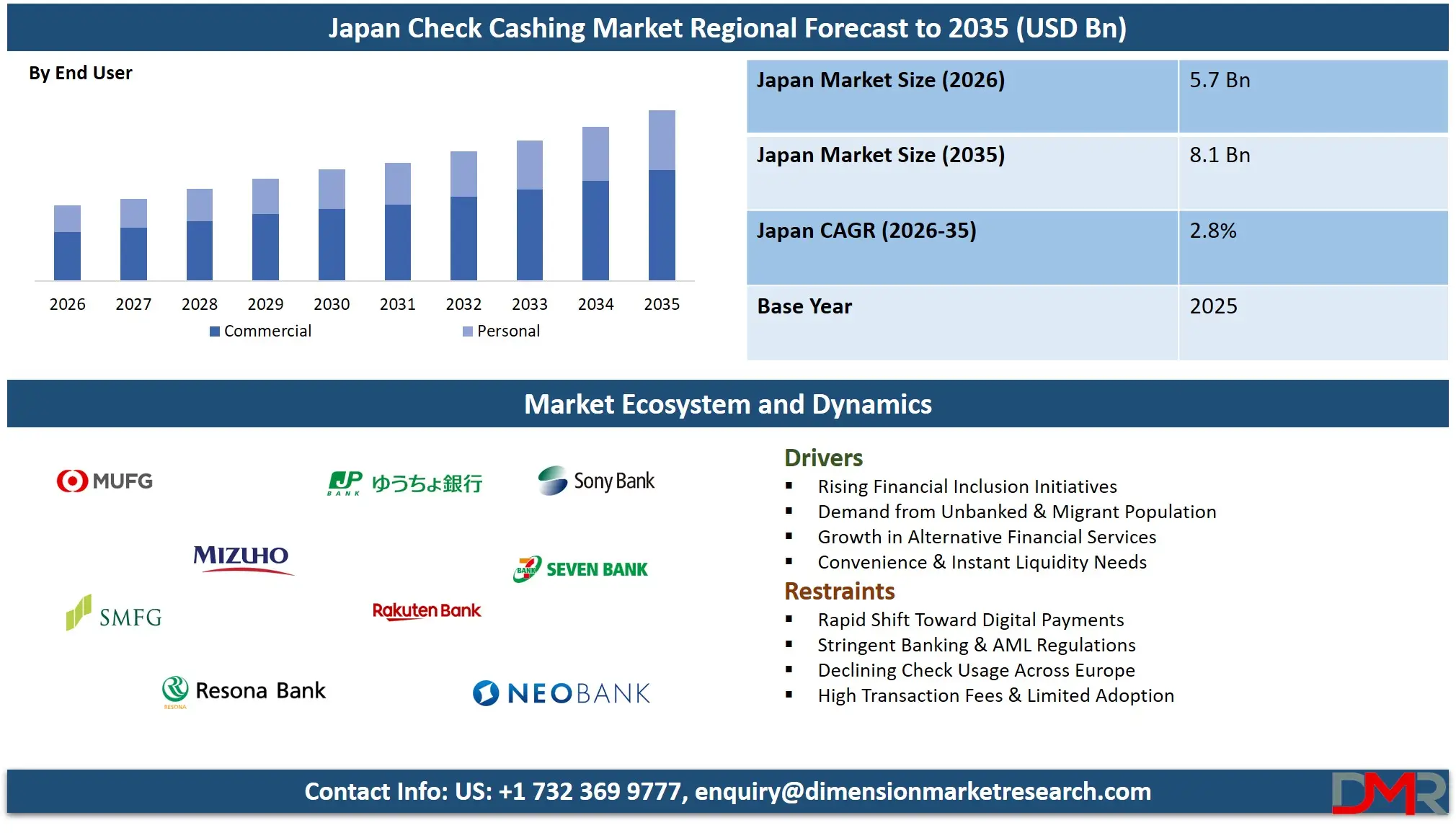
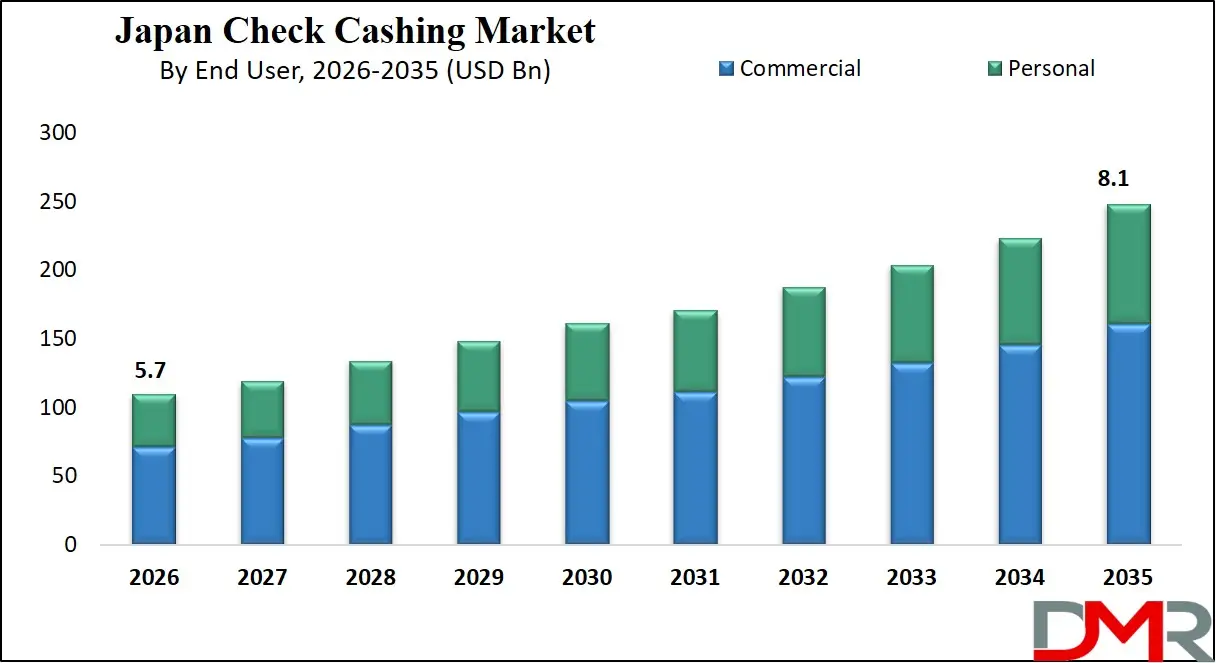
The Japan check cashing market size is estimated to reach USD 5.7 billion in 2026 and is expected to grow at a CAGR of 2.8%, attaining a value of USD 8.1 billion by 2035, driven by stable demand for alternative financial services, institutional payment processing, and legacy paper based transactions within a highly regulated banking ecosystem.
ℹ
To learn more about this report –
Download Your Free Sample Report Here
Check cashing refers to a financial service that allows individuals or businesses to convert a paper check into immediate cash without necessarily depositing it into a bank account. This service is typically offered by banks, credit unions, and alternative financial service providers, enabling quick access to funds from payroll checks, government disbursements, tax refunds, and commercial payments. It plays a critical role for individuals who require instant liquidity or who may not have access to traditional banking channels. The process involves verification of the check’s authenticity, identity validation, and the deduction of a service fee before funds are released. Check cashing services also support financial flexibility by bridging short term cash flow gaps and facilitating transactions in economies where paper based payment instruments are still in use.
The Japan check cashing market represents a highly structured and institution driven segment within the country’s broader financial services ecosystem, where traditional banking institutions dominate service provision. Unlike markets with a strong presence of independent check cashing outlets, Japan relies heavily on established banks, regional financial institutions, and cooperative credit organizations to process and verify checks. The market is influenced by the country’s advanced banking infrastructure, high trust in financial institutions, and stringent regulatory environment that emphasizes compliance, fraud prevention, and secure transaction processing. Although the usage of checks has declined due to widespread adoption of electronic payments and bank transfers, check cashing services remain relevant for corporate settlements, government disbursements, and certain legacy financial transactions.
ℹ
To learn more about this report –
Download Your Free Sample Report Here
The market is also shaped by evolving payment trends, including the growth of digital banking platforms, fintech integration, and increasing preference for cashless transactions among consumers and businesses. Despite this shift, the presence of international transactions, cross border business dealings, and specific institutional payment requirements continues to sustain demand for check related services. Additionally, demographic factors such as an aging population and the persistence of traditional financial practices in certain sectors contribute to ongoing utilization. Overall, the Japan check cashing market reflects a transition phase where legacy payment methods coexist with modern financial technologies, supported by a stable regulatory framework and a strong institutional backbone.
Japan Check Cashing Market: Key Takeaways
- Strong Market Growth Outlook: The market is projected to grow from USD 5.7 billion in 2026 to USD 8.1 billion by 2035, reflecting steady expansion despite declining check usage.
- Moderate Growth Rate Reflecting Market Maturity: A CAGR of 2.8% indicates a stable and mature market, driven by institutional demand rather than rapid consumer adoption.
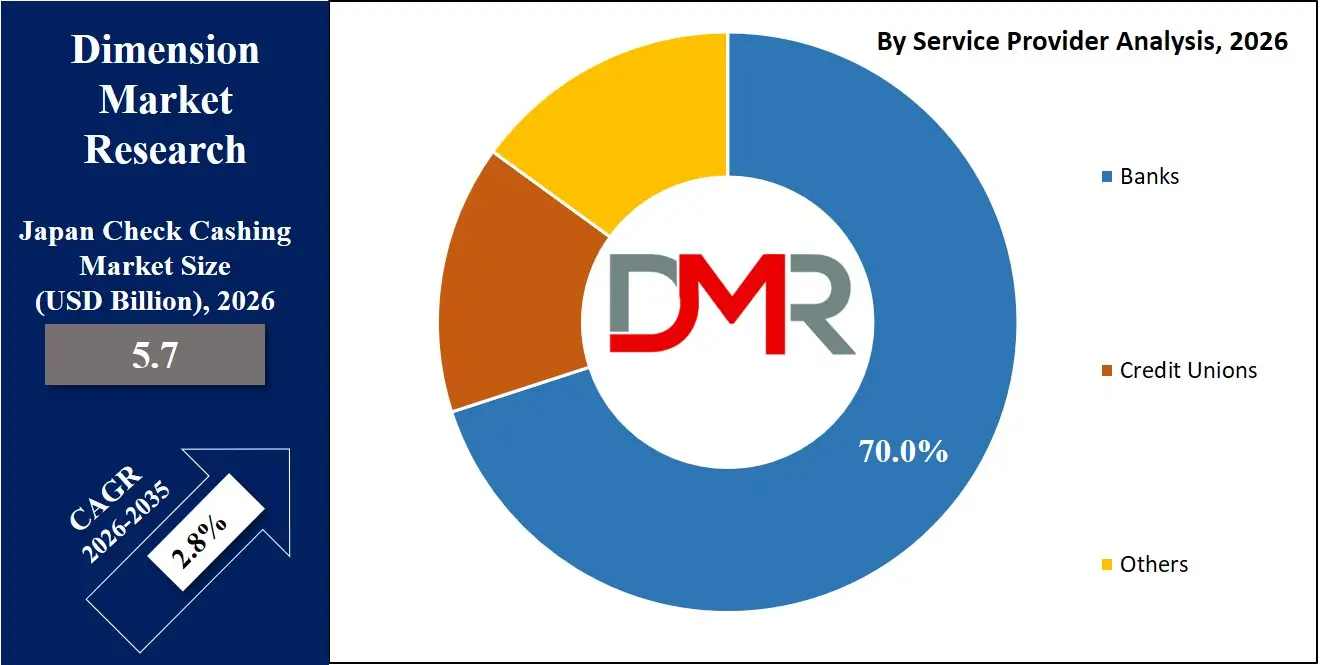
- Dominance of Banking Institutions: Banks hold approximately 70.0% market share, highlighting strong institutional control and limited presence of independent service providers.
- Commercial Segment Leads Demand: The commercial segment accounts for around 65.0% share, driven by corporate transactions, B2B payments, and working capital needs.
- Rising Cashless Economy Impact: Cashless payments exceeded 42.8% in 2024, signaling a structural shift that is gradually reducing reliance on check based transactions.
Japan Check Cashing Market: Use Cases
- Corporate Transactions: Used by businesses for invoice settlements and vendor payments, supporting cash flow and secure fund verification in traditional sectors.
- Government Payments: Enables quick access to tax refunds, subsidies, and welfare checks with regulated processing and identity verification.
- Cross Border Transactions: Facilitates conversion of foreign checks into local currency, supporting international trade and remittance needs.
- Financial Inclusion Support: Provides liquidity access for individuals with limited reliance on digital banking or formal account based transactions.
Japan Check Cashing Market: Stats & Facts
- Ministry of Economy, Trade and Industry (METI)
- 2023: Cashless payment ratio reached 39.3% of total consumer payments
- 2023: Total cashless payment value stood at ¥126.7 trillion
- 2023: Credit cards accounted for 83.5% of cashless transactions
- 2023: Debit cards contributed 2.9% of cashless payments
- 2023: Electronic money share was 5.1%
- 2023: QR and code payments accounted for 8.6%
- 2024: Cashless payment ratio increased to 42.8%
- 2024: Total cashless payment value reached ¥141.0 trillion
- 2024: Japan exceeded its government target of 40% cashless ratio
- 2025 Target: Government aims to raise cashless ratio to 80% in the future
- Bank of Japan (BOJ)
- 2025: Zengin system daily average transactions reached 6.42 million
- 2025: Daily payment value averaged ¥152.3 trillion
- 2025: Payment transaction volume grew 8.2% year on year
- 2025: Payment value increased 5.4% year on year
- 2025: Large value BOJ NET payments grew 3.1% in volume
- 2025: Large value payment value rose 4.8%
- 2025: Bank transfers accounted for 72.3% of total transactions
- 2025: Credit card payments reached ¥9.2 trillion
- 2025: Electronic money payments totaled ¥842 billion
- 2025: QR code payments reached ¥1.2 trillion
- 2025: QR payments recorded highest growth of 42.3%
- 2025: Retail cashless payment ratio reached 52.3%
- 2025: Tokyo cashless ratio stood at 48.2%
- 2025: Lowest regional cashless ratio recorded at 28.4%
- Bank of Japan (Currency Circulation Data)
- 2023: First decline in banknote circulation in 14 years observed
- 2024: Over 7 billion new banknotes issued
- 2024: New banknotes accounted for 42.8% of total circulation
- 2025: Total banknotes in circulation estimated at ¥120.6 trillion
- 2024: Cashless payments exceeded 50% of personal consumption
Japan Check Cashing Market: Market Dynamic
Driving Factors in the Japan Check Cashing Market
Strong Institutional Banking Ecosystem
Japan’s check cashing market is supported by a highly developed banking infrastructure where banks and cooperative financial institutions dominate payment processing. The presence of secure fund verification systems, strict compliance frameworks, and reliable financial services encourages continued use of check based transactions in corporate settlements and institutional payments.
Continued Use in Corporate and B2B Transactions
Despite digital transformation, checks are still used in business to business payments, supplier settlements, and promissory note financing. Corporate entities rely on paper based instruments for working capital management and transaction traceability, sustaining demand for check clearing and liquidity services.
Restraints in the Japan Check Cashing Market
Rapid Shift toward Cashless and Digital Payments
Japan is witnessing a strong transition toward digital payments, with cashless transactions exceeding 40% (as per The Japan Times) of consumer spending and continuing to grow. This reduces dependency on traditional instruments like checks and limits the growth potential of check cashing services.
Declining Check Usage and Bank Phase Out Initiatives
The volume of paper based checks has been steadily declining, and major banks are planning to discontinue check issuance in favor of electronic transfers. This structural shift significantly constrains long term market expansion and reduces service relevance.
Opportunities in the Japan Check Cashing Market
Cross Border Payments and Legacy Financial Instruments
Check cashing services continue to find relevance in international transactions, foreign check processing, and legacy payment systems. Businesses engaged in global trade or dealing with international clients still require conversion and clearing services, creating niche growth opportunities.
Integration with Digital Banking and Hybrid Financial Services
Financial institutions can integrate check processing with digital banking platforms, enabling faster clearing, mobile deposit solutions, and hybrid payment services. This modernization can enhance operational efficiency and extend the lifecycle of check related services within a digital ecosystem.
Trends in the Japan Check Cashing Market
Transition toward a Cashless Economy
Japan is steadily moving toward a cashless society, driven by increasing adoption of QR payments, credit cards, and e commerce transactions. This shift is reshaping the overall payment landscape and gradually reducing reliance on paper based financial instruments.
Decline of Physical Cash and Paper Instruments
The circulation of physical cash and traditional payment methods is declining as digital alternatives gain traction. Even though cash remains culturally significant, the long term trend indicates reduced usage of both cash and checks due to convenience and efficiency of electronic payments.
Japan Check Cashing Market: Research Scope and Analysis
By Service Provider Analysis
Banks are expected to dominate the service provider segment in the Japan check cashing market, accounting for around 70.0% of the total market share in 2026, primarily due to their strong institutional presence, extensive branch networks, and highly trusted financial infrastructure. In Japan, check cashing services are largely integrated within traditional banking operations rather than being offered by standalone providers, which strengthens the position of major commercial banks and regional banks. These institutions provide secure fund verification, compliance driven processing, and seamless access to liquidity, making them the preferred choice for both corporate clients and individuals handling payroll checks, government disbursements, and business transactions. Their ability to offer end to end financial services, including account management, payment clearing, and risk management, further reinforces their dominance in this segment.
ℹ
To learn more about this report –
Download Your Free Sample Report Here
Credit unions, particularly cooperative financial institutions such as Shinkin banks, play a complementary yet important role in the market by catering to small and medium sized enterprises, local businesses, and community based customers. While their overall market share is comparatively lower, they contribute significantly to regional financial inclusion and localized payment processing. These institutions provide personalized financial services, easier access to check cashing for smaller clients, and support for community level economic activities. Their presence is especially relevant in areas where relationship banking and trust based financial interactions are prioritized, allowing them to maintain a steady share within the broader service provider landscape despite the dominance of large banking institutions.
By Type Analysis
Others are expected to dominate the type segment in the Japan check cashing market, accounting for around 30.0% of the total market share in 2026, as this category includes a mix of nonstandard and less frequent but still relevant financial instruments. These typically cover cashier checks, certified checks, foreign checks, business issued drafts, and legacy paper based payment instruments used in specific corporate or cross border transactions. The dominance of this segment is driven by niche yet essential use cases such as international trade settlements, institutional payments, and specialized financial operations where alternative instruments are preferred over conventional payroll or preprinted checks. Additionally, some traditional industries and older business practices continue to rely on such instruments, supporting steady demand despite the broader shift toward digital payments.
Government checks also hold a significant share within the type segment due to their role in distributing public funds such as tax refunds, social security benefits, subsidies, and other official disbursements. These checks are typically issued by government bodies and require secure and regulated processing, making banks and authorized financial institutions the primary channels for cashing them. The reliability and authenticity associated with government issued payments encourage their continued use, particularly among certain population groups and in specific administrative processes. Although digital transfer methods are gradually replacing paper based disbursements, government checks remain relevant in ensuring accessibility, transparency, and controlled fund distribution within Japan’s financial ecosystem.
By End User Analysis
Commercial end users are expected to dominate the end user segment in the Japan check cashing market, accounting for around 65.0% of the total market share in 2026, driven by the continued use of checks in business transactions, supplier payments, and institutional settlements. Many corporations, especially small and medium enterprises and traditional industries, still utilize paper based payment instruments for managing working capital, ensuring transaction traceability, and maintaining formal financial documentation. Check cashing services enable these businesses to convert received payments into immediate liquidity, supporting operational efficiency and short term cash flow requirements. The involvement of banks in processing high value and secure transactions further strengthens commercial reliance on these services within a regulated financial environment.
The personal segment, while smaller in comparison, continues to play a role in the market by serving individuals who require access to funds from payroll checks, government disbursements, or occasional financial instruments. This segment includes users who may prefer cash based transactions or have limited engagement with fully digital banking systems. Check cashing services provide convenience, quick fund access, and financial flexibility for such individuals, particularly in cases involving tax refunds or official payments. Although the adoption of digital payments and direct bank transfers is reducing reliance on checks among consumers, the personal segment remains relevant due to specific use cases and the need for accessible and secure fund conversion options.
The Japan Check Cashing Market Report is segmented on the basis of the following:
By Service Provider
- Banks
- Credit Unions
- Others
By Type
- Pre-Printed Checks
- Payroll Checks
- Government Checks
- Tax Checks
- Others
By End User
Impact of Artificial Intelligence in the Japan Check Cashing Market
Artificial intelligence is gradually transforming the Japan check cashing market by enhancing operational efficiency, fraud detection, and transaction accuracy within a highly regulated financial ecosystem. AI powered systems are being used for automated check verification, signature recognition, and image processing, enabling faster clearing of paper based instruments while reducing manual intervention. Machine learning algorithms help financial institutions identify suspicious patterns, detect forged checks, and ensure compliance with strict regulatory standards. This not only improves security but also minimizes processing time, allowing banks and financial service providers to offer quicker access to funds and a more streamlined customer experience.
In addition, AI is supporting the integration of traditional check cashing services with digital banking platforms, enabling hybrid financial solutions such as mobile check deposits and intelligent transaction monitoring. Advanced analytics are being used to assess customer behavior, optimize risk management, and improve decision making in payment processing. While the overall use of checks is declining due to digital payment adoption, AI is helping extend the relevance of check related services by modernizing legacy systems and aligning them with evolving fintech trends. This technological shift is expected to drive greater efficiency, cost reduction, and service innovation within Japan’s transitioning financial landscape.
Japan Check Cashing Market: Competitive Landscape
The competitive landscape of the Japan check cashing market is characterized by a high level of consolidation, with dominance by established financial institutions operating within a tightly regulated banking framework. The market is largely controlled by traditional banks and regional financial entities that offer integrated payment processing, fund verification, and liquidity services as part of their broader financial offerings. Competition is primarily based on service reliability, processing speed, regulatory compliance, and the ability to integrate check related services with digital banking platforms.
ℹ
To learn more about this report –
Download Your Free Sample Report Here
The presence of cooperative financial institutions and community based providers adds a layer of localized competition, particularly in serving small businesses and regional customers. Additionally, the gradual shift toward cashless payments and fintech innovation is encouraging institutions to enhance operational efficiency and adopt hybrid service models, shaping a competitive environment that balances legacy payment systems with modern financial technologies.
Some of the prominent players in the Japan Check Cashing Market are:
- MUFG Bank
- Mizuho Bank
- Sumitomo Mitsui Banking Corporation
- Resona Bank
- Saitama Resona Bank
- Japan Post Bank
- Rakuten Bank
- SBI Sumishin Net Bank
- Sony Bank
- Seven Bank
- Aeon Bank
- Lawson Bank
- PayPay Bank
- Aozora Bank
- Shinkin Central Bank
- Yokohama Shinkin Bank
- Bank of Kyoto
- Hokkoku Bank
- Toho Bank
- Bank of Fukuoka
- Other Key Players
Recent Developments in the Japan Check Cashing Market
- March 2026: PayPay expanded its fintech platform capabilities following its NASDAQ debut, strengthening its digital payments, banking, and financial services ecosystem to support cashless transactions and alternative payment processing in Japan.
- September 2025: Japan Post Bank announced the launch of its blockchain based digital currency DCJPY aimed at enabling instant financial transactions and modernizing traditional banking and payment processing systems.
- March 2025: SoftBank Group entered into an agreement to acquire Ampere Computing to enhance its AI and digital infrastructure capabilities, supporting the evolution of financial and payment technologies.
Report Details
| Report Characteristics |
| Market Size (2026) |
USD 5.7 Bn |
| Forecast Value (2035) |
USD 8.1 Bn |
| CAGR (2026–2035) |
2.8% |
| Historical Data |
2021 – 2025 |
| Forecast Data |
2027 – 2035 |
| Base Year |
2025 |
| Estimate Year |
2026 |
| Report Coverage |
Market Revenue Estimation, Market Dynamics, Competitive Landscape, Growth Factors and etc. |
| Segments Covered |
By Service Provider (Banks, Credit Unions, and Others), By Type (Pre-Printed Checks, Payroll Checks, Government Checks, Tax Checks, and Others), and By End User (Commercial, Personal) |
| Country Coverage |
Japan |
| Prominent Players |
MUFG Bank, Mizuho Bank, Sumitomo Mitsui Banking Corporation, Resona Bank, Saitama Resona Bank, Japan Post Bank, Rakuten Bank, SBI Sumishin Net Bank, Sony Bank, Seven Bank, Aeon Bank, Lawson Bank, PayPay Bank, Aozora Bank, Shinkin Central Bank, Yokohama Shinkin Bank, Bank of Kyoto, Hokkoku Bank, Toho Bank, Bank of Fukuoka, and Other Key Players |
| Purchase Options |
We have three licenses to opt for: Single User License (Limited to 1 user), Multi-User License (Up to 5 Users) and Corporate Use License (Unlimited User) along with free report customization equivalent to 0 analyst working days, 3 analysts working days and 5 analysts working days respectively. |
Frequently Asked Questions
How big is the Japan Check Cashing Market?
▾ The Japan Check Cashing Market size is estimated to have a value of USD 5.7 billion in 2026 and is expected to reach USD 8.1 billion by the end of 2035.
What is the growth rate in the Japan Check Cashing Market in 2026?
▾ The market is growing at a CAGR of 2.8% over the forecasted period of 2026.
Who are the key players in the Japan Check Cashing Market?
▾ Some of the major key players in the Japan Check Cashing Market are MUFG Bank, Mizuho Bank, Sumitomo Mitsui Banking Corporation, Resona Bank, Saitama Resona Bank, Japan Post Bank, Rakuten Bank, SBI Sumishin Net Bank, Sony Bank, and many others.