What is the Japan Cloud Migration Services Market Size?
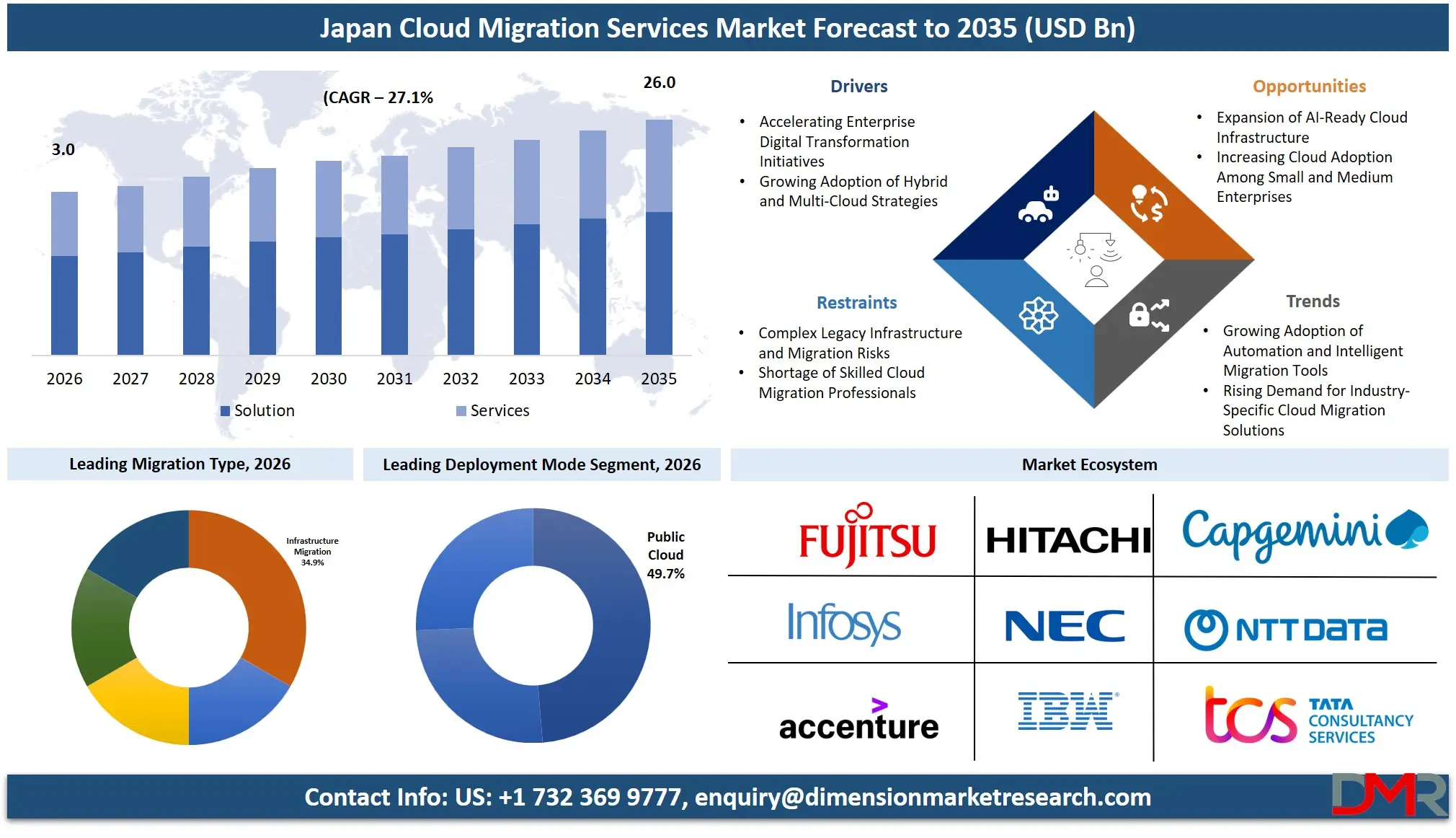
The Japan Cloud Migration Market size is expected to be USD 3.0 billion in 2026 and increase at a compound annual growth rate of 27.1% to USD 26.0 billion in 2035 owing to Accelerating Enterprise Digital Transformation Initiatives.
ℹ
To learn more about this report –
Download Your Free Sample Report Here
The Japan Cloud Migration Services Market is witnessing steady growth as organizations accelerate digital transformation and modernize legacy IT infrastructure. Enterprises across sectors, including BFSI, manufacturing, healthcare, retail, and government, are increasingly adopting cloud migration services to improve scalability, operational efficiency, cybersecurity, and regulatory compliance. Rising investments in hybrid and multi-cloud environments, AI-enabled cloud platforms, and business continuity solutions are further driving market expansion. Additionally, Japan's focus on technological innovation, automation, and secure cloud adoption is encouraging demand for consulting, migration, integration, and managed cloud services across organizations of all sizes.
Key Takeaways
- Market Size & Forecast: The Japan Cloud Migration Market size is projected to reach USD 3.0 billion in 2026 and is anticipated to have a value of USD 26.0 billion in 2035.
- Growth Rate & Outlook: The Japan Cloud Migration Market size is set to grow at a compound annual growth rate of 27.1% during the forecast period of 2026 to 2035.
- Primary Growth Drivers: Some of the major growth drivers in the market are Accelerating Enterprise Digital Transformation Initiatives, and more.
- Key Market Trends: Some of the major trends in the market are Rising Demand for Industry-Specific Cloud Migration Solutions, and more.
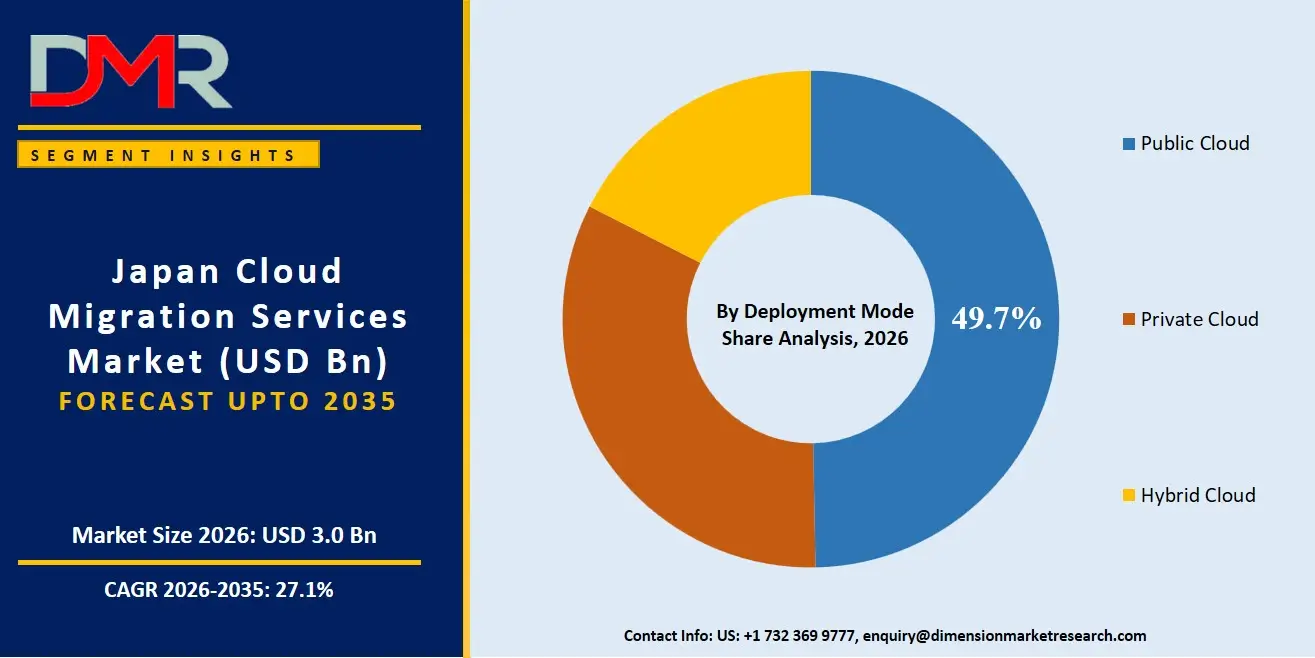
- By Deployment: Public Cloud segment is anticipated to get the majority share of the Japan Cloud Migration Market in 2026.
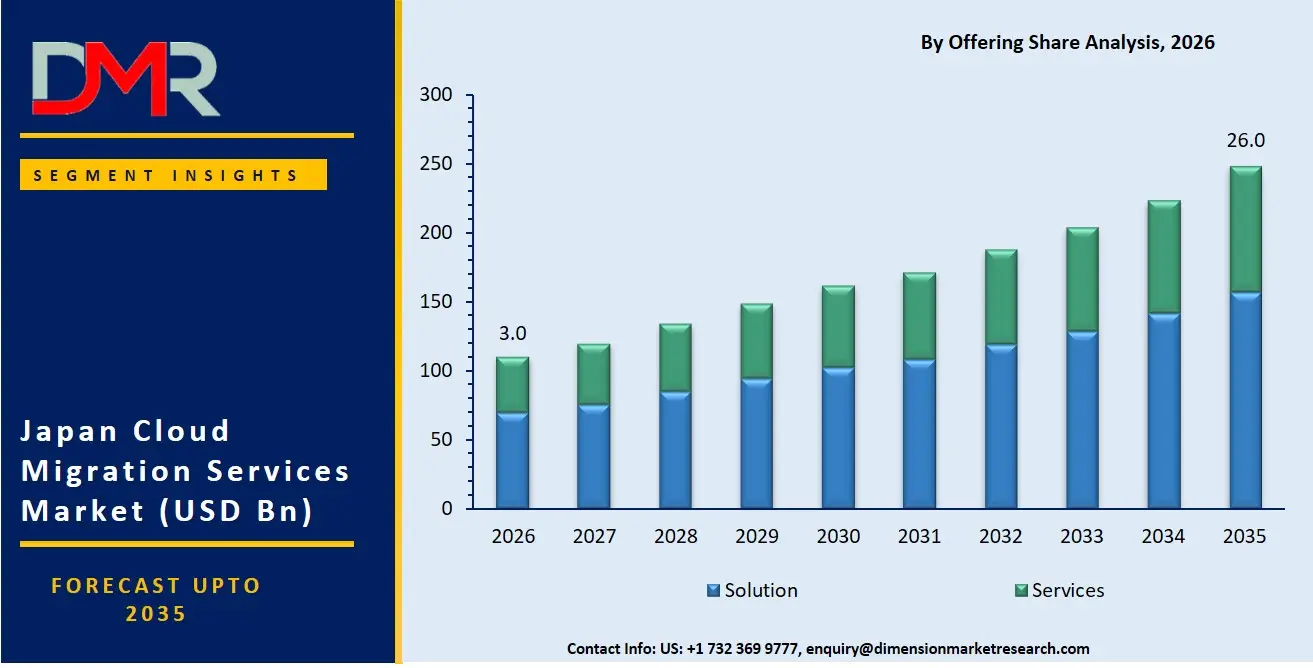
- By Offering Type: Solution is expected to get the largest revenue share in 2026 in the Japan Cloud Migration Market.
- By Migration Type: Infrastructure Migration segment is expected to get the largest revenue share in 2026 in the Japan Cloud Migration Market.
What is the Japan Cloud Migration Services?
Cloud migration services comprise consulting, planning, execution, optimization, and managed support solutions that help organizations transfer applications, databases, workloads, storage, and IT infrastructure from on-premises environments or legacy systems to cloud platforms. These services improve operational agility, scalability, security, and cost efficiency while enabling digital transformation initiatives across industries.
Use Cases
- Enterprise IT Modernization: Large enterprises leverage cloud migration services to replace aging on-premises infrastructure with scalable cloud environments. This enables faster application deployment, reduced maintenance costs, improved disaster recovery capabilities, and greater flexibility in supporting digital transformation initiatives across multiple business units and locations.
- Business Continuity & Disaster Recovery: Organizations migrate mission-critical workloads to cloud platforms to strengthen resilience against cyber threats, natural disasters, and operational disruptions. Cloud-based backup, automated failover, and geographically distributed infrastructure improve data availability while minimizing downtime and recovery time objectives.
- Data Analytics & AI Enablement: Businesses migrate databases and enterprise applications to cloud environments to support advanced analytics, machine learning, and AI-driven decision-making. Cloud migration provides scalable computing resources, centralized data management, and seamless integration with AI services that improve operational insights and innovation.
- Regulatory Compliance & Security Enhancement: Financial institutions, healthcare providers, and government agencies utilize cloud migration services to strengthen security frameworks while meeting evolving compliance requirements. Modern cloud environments offer enhanced encryption, identity management, continuous monitoring, and governance tools that simplify regulatory adherence.
How AI Is Transforming the Japan Cloud Migration Services Market
Artificial intelligence is transforming cloud migration services by automating workload discovery, infrastructure assessment, dependency mapping, migration planning, and resource optimization. AI-powered analytics enable service providers to identify migration risks, estimate costs, optimize cloud resource allocation, and recommend the most suitable migration pathways, significantly improving project efficiency and reducing operational disruptions.
AI also enhances post-migration operations through predictive monitoring, automated performance optimization, cybersecurity threat detection, anomaly identification, and intelligent capacity management. AI-driven virtual assistants streamline customer support, while machine learning algorithms continuously optimize cloud environments based on workload behavior. These capabilities enable organizations to achieve faster migration timelines, improved security, higher infrastructure utilization, and lower long-term operational costs.
Market Dynamic
Driving Factors in the Japan Cloud Migration Services Market
Accelerating Enterprise Digital Transformation Initiatives
Organizations across Japan are increasingly modernizing legacy IT environments to improve operational efficiency, business agility, and customer experience. Cloud migration services enable enterprises to consolidate infrastructure, automate IT operations, and rapidly deploy digital applications while lowering maintenance complexity. The growing need for scalable computing resources, remote collaboration, and faster innovation continues to encourage enterprises to migrate mission-critical workloads to cloud platforms, making digital transformation one of the strongest growth drivers for the market.
Restraints in the Japan Cloud Migration Services Market
Complex Legacy Infrastructure and Migration Risks
Many organizations continue to operate mission-critical legacy applications that are difficult to migrate without disrupting business operations. Compatibility issues, application dependencies, data integrity concerns, and prolonged migration timelines increase project complexity and implementation costs. These challenges often require customized migration approaches and extensive testing, limiting adoption among organizations with highly specialized IT environments.
Opportunities in the Japan Cloud Migration Services Market
Expansion of AI-Ready Cloud Infrastructure
The rapid deployment of AI, machine learning, and advanced analytics solutions is creating substantial opportunities for cloud migration service providers. Organizations increasingly require scalable cloud infrastructure capable of supporting high-performance computing and large-scale data processing. Migration projects focused on AI readiness are expected to generate new consulting, modernization, integration, and managed service opportunities across multiple industry sectors.
Trends in the Japan Cloud Migration Services Market
Rising Demand for Industry-Specific Cloud Migration Solutions
Organizations are seeking migration services tailored to industry-specific operational and regulatory requirements. Providers are developing specialized frameworks for sectors such as BFSI, healthcare, manufacturing, retail, and government. These customized offerings include compliance-focused migration methodologies, security controls, workload optimization strategies, and application modernization services that address sector-specific business challenges while improving overall cloud adoption success.
Research Scope and Analysis
The research evaluates the Japan Cloud Migration Services Market across key segments, including offering, deployment mode, migration type, application, and vertical. It examines market trends, adoption patterns, growth drivers, competitive dynamics, technological advancements, and demand outlook, providing insights into leading and emerging segments shaping future market development.
ℹ
To learn more about this report –
Download Your Free Sample Report Here
By Offering Analysis
The Solution segment is projected to dominate the Japan Cloud Migration Services Market with an estimated 58.4% market share in 2026, driven by growing enterprise demand for comprehensive migration platforms that simplify infrastructure modernization, application transfer, database migration, and storage optimization. Organizations increasingly prefer integrated solutions that automate migration planning, execution, testing, and monitoring while minimizing operational disruptions and reducing project timelines.
ℹ
To learn more about this report –
Download Your Free Sample Report Here
Infrastructure migration and application migration continue to account for significant adoption as enterprises modernize legacy systems and support digital transformation initiatives. Meanwhile, the Services segment is expected to register the fastest growth throughout the forecast period. Rising demand for assessment and planning, security and compliance services, managed cloud operations, integration and customization, DevOps integration, and post-migration optimization is encouraging organizations to engage specialized service providers that can ensure successful cloud adoption while addressing regulatory requirements, cybersecurity concerns, and evolving business needs.
By Deployment Mode Analysis
The Public Cloud segment is expected to account for an estimated 49.7% market share in 2026, making it the leading deployment mode in the Japan Cloud Migration Services Market. Public cloud adoption continues to expand because it offers cost efficiency, rapid scalability, simplified infrastructure management, and access to advanced technologies such as artificial intelligence, analytics, and automation services. Organizations across industries increasingly migrate customer-facing applications, development environments, and business workloads to public cloud platforms to accelerate innovation while reducing capital investment. The Hybrid Cloud segment is anticipated to experience the fastest growth during the forecast period as enterprises seek greater flexibility by combining private infrastructure with public cloud resources. Hybrid deployments support regulatory compliance, workload portability, business continuity, and optimized resource allocation, making them particularly attractive for highly regulated industries including financial services, healthcare, and government organizations.
By Migration Type Analysis
The Infrastructure Migration segment is anticipated to lead the Japan Cloud Migration Services Market with an estimated 34.9% market share in 2026. Enterprises continue prioritizing migration of virtual machines, network configurations, and logging infrastructure to improve operational efficiency, enhance scalability, and reduce maintenance costs associated with aging on-premises environments. Infrastructure migration also serves as the foundation for broader cloud transformation initiatives by enabling organizations to modernize core IT operations before migrating applications and data. The Application Migration segment is projected to witness the fastest growth owing to increasing modernization of enterprise software, customer engagement platforms, and business-critical applications. Organizations are investing in cloud-native architectures, microservices, and containerized applications to improve agility, enhance user experiences, and support continuous software development while maximizing long-term cloud investment returns.
By Application Analysis
The Business Intelligence & Analytics segment is projected to capture an estimated 27.6% market share in 2026, making it the largest application segment in the Japan Cloud Migration Services Market. Enterprises increasingly migrate analytics platforms and reporting systems to cloud environments to process growing data volumes, improve decision-making capabilities, and leverage advanced AI-powered analytical tools. Cloud-based analytics solutions provide scalability, real-time insights, enhanced collaboration, and seamless integration with enterprise applications, supporting strategic business planning across multiple industries. The Data Warehouse Management segment is expected to record the fastest growth due to increasing investments in centralized data repositories, cloud-native databases, and enterprise-wide analytics initiatives. Organizations continue modernizing data infrastructure to improve performance, support predictive analytics, enable data sharing, and facilitate digital transformation across increasingly data-driven business operations.
By Vertical Analysis
The BFSI segment is expected to dominate the Japan Cloud Migration Services Market with an estimated 24.8% market share in 2026. Financial institutions are accelerating cloud migration initiatives to strengthen cybersecurity, improve regulatory compliance, modernize legacy banking platforms, enhance digital customer experiences, and support real-time financial services. The industry's growing investments in cloud-native banking applications, fraud detection systems, disaster recovery capabilities, and AI-enabled financial analytics continue driving demand for migration services. The Healthcare & Life Sciences segment is forecast to exhibit the fastest growth during the forecast period as healthcare providers increasingly migrate electronic medical records, clinical applications, diagnostic systems, and research platforms to secure cloud environments. Rising adoption of telemedicine, digital health technologies, AI-assisted diagnostics, and data-driven healthcare delivery is further accelerating cloud migration investments throughout the sector.
The Japan Cloud Migration Services Market Report is segmented on the basis of the following:
By Offering
- Solution
- Infrastructure Migration
- Platform Migration
- Database Migration
- Application Migration
- Storage Migration
- Services
- Assessment & Planning Services
- Readiness Assessment
- Dependency Mapping
- Migration Roadmap
- Migration & Deployment Services
- Lift & Shift Migration
- DevOps Integration
- Integration & Customization Services
- Application Integration
- Customization & Configuration
- System Interoperability
- Data Migration & Management Services
- Data Mapping & Cleansing
- Large-Scale Data Migration
- Data Lifecycle Management
- Security & Compliance Services
- Security Assessment & Remediation
- Compliance Adherence
- Identity & Access Management (IAM)
- Training & Support Services
- User Training & Adoption
- Ongoing Support
- Knowledge Transfer
- Managed Cloud Services
- Cloud Infrastructure Management
- Security Management
- Performance Optimization
- Other Services
By Deployment Mode
- Public Cloud
- Private Cloud
- Hybrid Cloud
By Migration Type
- Infrastructure Migration
- Virtual Machines
- Network Configurations
- Logging Infrastructure
- Platform Migration
- Data Center
- DevOps and Testing
- Access Control
- Identity & Access Management (IAM)
- Data Migration
- Application Migration
- Web Applications
- Enterprise Applications
- Custom Applications
- Other Migration Types
By Application
- Supply Chain Management
- Order Management
- Inventory Management
- Procurement Management
- Logistics & Fulfilment Management
- Other Supply Chain Management Applications
- Project Management
- Task Management
- Workflow Automation
- Issue Tracking & Reporting
- Collaboration & Communication
- Other Project Management Applications
- Content Management
- Content Authoring & Publishing
- Website Building & Maintenance
- User Management
- Other Content Management Applications
- Data Warehouse Management
- Performance Optimization
- Data Analytics
- Data Integration
- Data Sharing & Collaboration
- Other Data Warehouse Management Applications
- Business Intelligence & Analytics
- Data Visualization
- Embedded Analytics
- Data Modeling & Preparation
- Self-Service Analytics
- Other Applications
By Vertical
- BFSI
- Healthcare & Life Sciences
- Telecom
- Government & Public Sector
- Manufacturing
- Retail & Consumer Goods
- Media & Entertainment
- Automotive & Transportation
- Other Verticals
Competitive Landscape
The Japan Cloud Migration Services Market is characterized by intense competition driven by technological expertise, industry specialization, and comprehensive service portfolios rather than pricing alone. Service providers strengthen their market position through continuous investments in cloud-native capabilities, automation platforms, cybersecurity solutions, and managed services that simplify complex migration projects. Strategic collaborations with hyperscale cloud providers, expansion of consulting capabilities, and development of industry-specific migration frameworks remain common competitive strategies. High technical expertise, strong regulatory compliance capabilities, established customer relationships, and the ability to deliver end-to-end migration, modernization, and post-deployment support create significant entry barriers for new participants, while ongoing investments in AI-enabled migration tools and hybrid cloud expertise continue to reshape competitive differentiation.
Some of the prominent players in the Japan Cloud Migration Services are:
- NTT DATA
- Fujitsu
- NEC Corporation
- Hitachi
- IBM
- Accenture
- Capgemini
- Deloitte
- Kyndryl
- Tata Consultancy Services
- Infosys
- Wipro
- DXC Technology
- Amazon Web Services
- Microsoft
- Google Cloud
- Oracle
- Rackspace Technology
- SoftBank
- SCSK Corporation
- Other Key Players
Recent Developments
- In July 2025, Macnica and GMO Internet announced a strategic collaboration to accelerate enterprise adoption of generative AI through the GMO GPU Cloud platform powered by NVIDIA technologies. Under the partnership, Macnica contributes its expertise in AI infrastructure design and enterprise IT implementation, while GMO Internet provides advanced cloud computing capabilities. Together, the companies aim to help businesses modernize their digital infrastructure, develop AI applications, and improve cloud utilization through scalable GPU-accelerated services. The partnership reflects growing enterprise demand for cloud-native AI environments and strengthens Japan's broader cloud transformation ecosystem by supporting migration, modernization, and AI workload deployment.
- In April 2025, Cloud4C entered a strategic partnership with ORIX Rentec Corporation to introduce GPU Cloud services for enterprises across Japan. The collaboration aims to support organizations implementing AI-driven digital transformation by providing secure private and hybrid cloud infrastructure optimized for high-performance computing workloads. The offering enables enterprises to integrate GPU resources with existing IT environments while benefiting from managed cloud services, security-first architecture, and scalable infrastructure. The initiative supports increasing demand for AI applications, research, product development, and cloud modernization, while expanding cloud migration opportunities for organizations transitioning from conventional on-premises infrastructure to advanced cloud ecosystems.
- In February 2025, Fujitsu announced the Fujitsu Cloud Service Generative AI Platform, designed to help organizations securely deploy generative AI workloads while accelerating cloud transformation initiatives. The platform combines Fujitsu's Takane large language model, Private AI infrastructure, GPU servers, and advanced security technologies to enable organizations to process confidential enterprise data without compromising compliance requirements. Initially introduced in Japan with trial applications opening during fiscal 2025, the solution targets enterprises seeking secure AI adoption alongside cloud modernization, particularly within regulated industries such as financial services, healthcare, and government. The launch also strengthens Fujitsu's portfolio supporting enterprise migration from traditional infrastructure to AI-enabled cloud environments.
Report Details
| Report Characteristics |
| Market Size (2026) |
USD 3.0 Bn |
| Forecast Value (2035) |
USD 26.0 Bn |
| CAGR (2026–2035) |
27.1% |
| Historical Period |
2021 – 2025 |
| Forecast Period |
2027 – 2035 |
| Base Year |
2025 |
| Estimate Year |
2026 |
| Segments Covered |
By Offering, By Deployment Mode, By Migration Type, By Application, By Vertical |
| Country Coverage |
Japan |
Frequently Asked Questions
How big is the Japan Cloud Migration Market?
▾ The Japan Cloud Migration Market size is expected to reach USD 3.0 billion by 2026 and is projected to reach USD 26.0 billion by the end of 2035.
What is the CAGR of the Japan Cloud Migration Market from 2026 to 2035?
▾ The market is growing at a CAGR of 27.1 percent over the forecasted period.
What factors are driving the growth of the Japan Cloud Migration Market?
▾ Accelerating Enterprise Digital Transformation Initiatives, and more are the factors driving the growth of the Japan Cloud Migration Market.
What are the major trends in the Japan Cloud Migration Market?
▾ Rising Demand for Industry-Specific Cloud Migration Solutions, and more are some of the major trends in the market.
Who are the key players in the Japan Cloud Migration Market?
▾ Some of the key players in the Japan Cloud Migration Market include NEC, IBM, TCS, and more.
How is the Japan Cloud Migration Market segmented?
▾ The Japan Cloud Migration Market is segmented by offering, deployment mode, migration type, application, vertical.