Market Snapshot
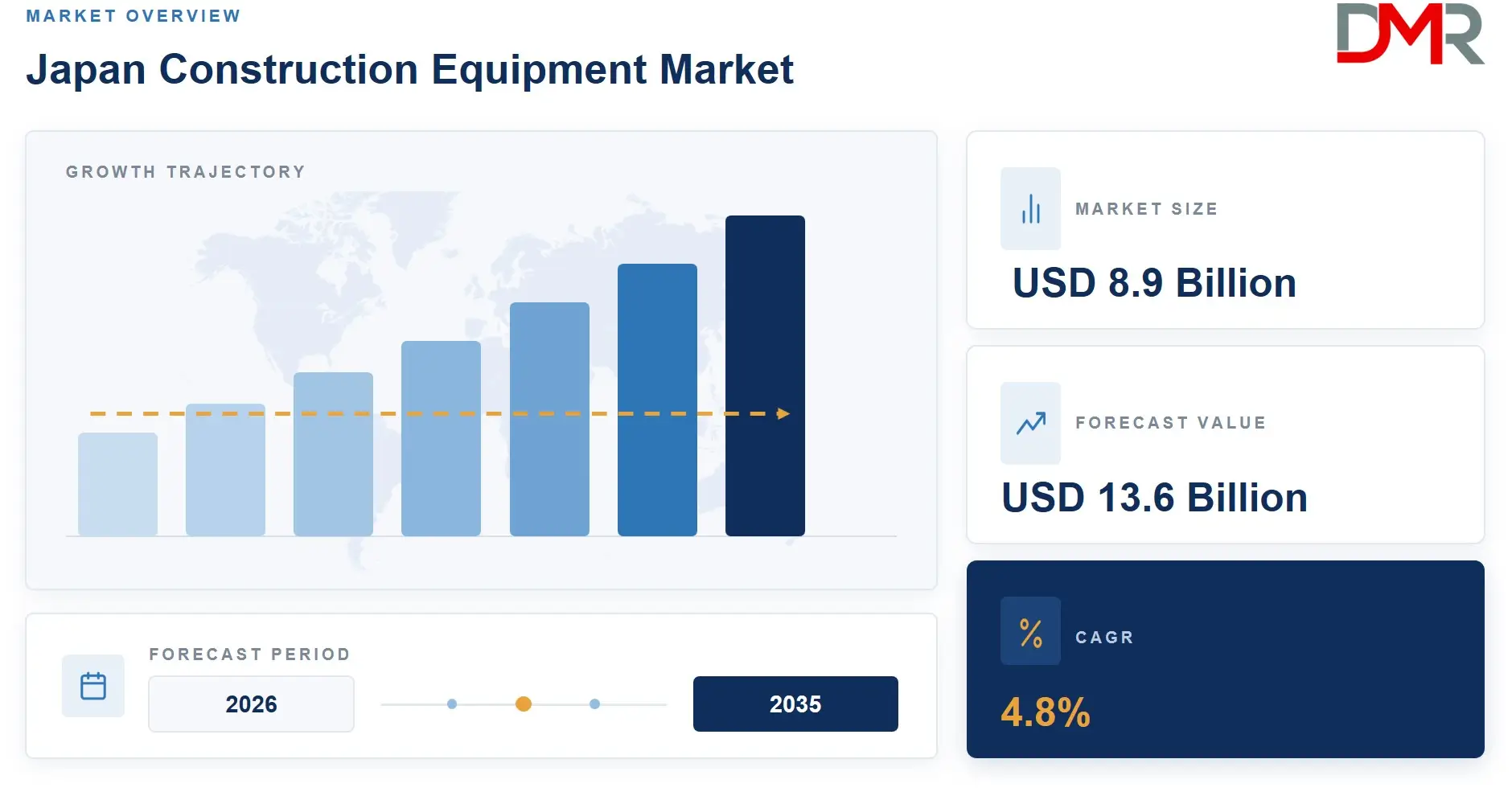
- Market Size (2026): USD 8.9 Bn
- Forecast Value (2035): USD 13.6 Bn
- CAGR (2026-2035): 4.8%
- Leading Equipment Type (2026): Excavators, around 38%
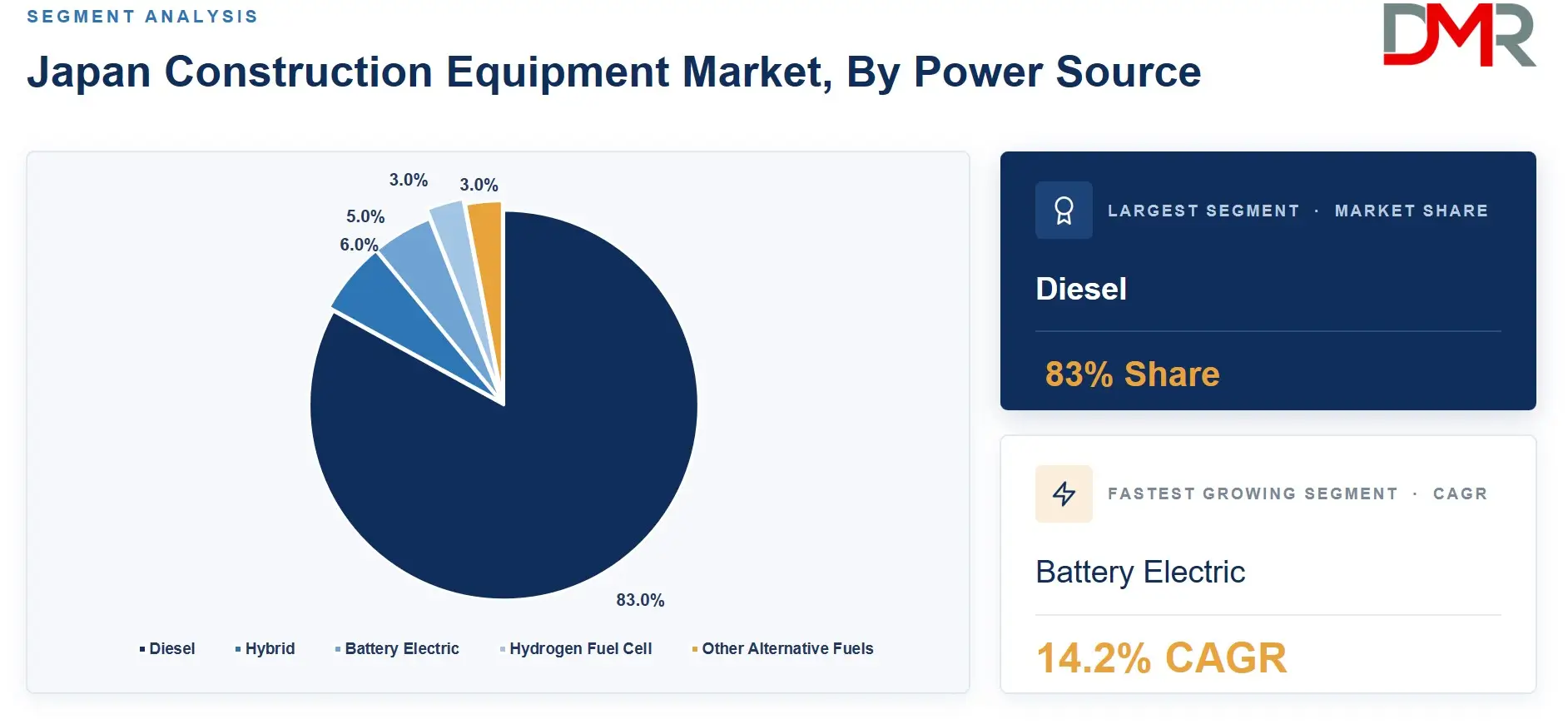
- Leading Power Source (2026): Diesel, close to 83%
- Key Players: Komatsu Ltd., Hitachi Construction Machinery Co., Ltd., Kobelco Construction Machinery Co., Ltd., and others
What is Japan Construction Equipment Market and its Market Size?
The Japan Construction Equipment Market size is estimated to reach USD 8.9 Bn in 2026 and is further anticipated to reach USD 13.6 Bn by 2035, at a CAGR of 4.8%.
This market covers equipment purchased, leased, rented, and commercially deployed inside Japan for civil engineering, building construction, demolition, utility work, road development, site preparation, and related infrastructure activity. The sizing reflects demand within Japan rather than the worldwide revenue generated by Japanese manufacturers.
ℹ
To learn more about this report –
Download Your Free Sample Report Here
Demand is anchored by replacement of an aging installed base, public infrastructure renewal, disaster-resilience work, urban redevelopment, transport upgrades, and labor-saving investment. Labor scarcity increases the value of intelligent control, remote operation, telematics, grade guidance, and digital twins.
The competitive boundary is changing from mechanical performance alone toward productivity per operator and lifecycle economics. Manufacturers are combining hydraulic efficiency, electric drivetrains, battery systems, machine guidance, connected maintenance, and jobsite software. GX construction machinery certification and carbon-reduction targets are encouraging electric and lower-emission equipment, although diesel remains dominant because many outdoor sites still lack dependable high-capacity charging or hydrogen infrastructure.
Use Cases
- Urban Redevelopment and Constrained Excavation: General contractors and specialist subcontractors deploy compact and short-tail excavators on dense metropolitan projects where restricted swing radius, noise control, and precise trenching matter. Smaller machines improve access around existing utilities and structures, while attachments let one carrier perform digging, grading, breaking, and material sorting.
- Road, Bridge and River Infrastructure Renewal: Civil engineering contractors use excavators, cranes, loaders, pavers, rollers, and dozers to rebuild aging transport assets and reinforce river or slope protection. The equipment shortens earthmoving and placement cycles, improves repeatability, and allows contractors to sequence work inside tight closure windows with fewer manual handling steps.
- Disaster Recovery and Slope Stabilization: Public agencies, contractors, and equipment rental companies mobilize hydraulic excavators, crawler carriers, cranes, and remote-capable machines after earthquakes, landslides, floods, and rockfall events. Equipment expands safe working distance in unstable terrain and accelerates debris removal, access-road restoration, material transport, and emergency reinforcement.
- Utility and Underground Network Work: Municipal contractors and infrastructure operators use mini excavators, compact loaders, trenching attachments, and lifting equipment for water, sewer, power, and communication network projects. Precise machine control reduces over-excavation near existing assets and supports faster restoration of streets and sidewalks after maintenance or network replacement.
Key Takeaways
- Market Size & Share: The domestic industry is forecast to add about USD 4.7 Bn in annual market value between 2026 and 2035 as replacement demand and technology content raise spending per machine.
- Equipment Type Analysis: Excavators are expected to account for roughly 38% of 2026 revenue, supported by their role across earthmoving, utility, demolition, road, and disaster-recovery work.
- Demand Concentration: Japan is estimated to represent about 5.6% of the worldwide construction equipment parent market in 2026, reflecting a large installed base but slower unit growth than developing infrastructure markets.
- Electrification: Battery electric equipment is projected to expand at a CAGR of 14.2% during 2026-2035 as urban projects, rental fleets, and low-noise applications create early commercial niches.
- Channel Shift: Rental and leasing is anticipated to grow at 7.2% annually through 2035 as contractors seek flexible access to higher-value machines and technology without full ownership exposure.
- Workforce Response: Compact construction equipment is forecast to grow at 6.8% annually, benefiting from labor constraints, urban jobsites, attachment versatility, and easier transport between projects.
How AI/Gen AI is Transforming the Japan Construction Equipment Market?
AI adoption is moving construction equipment from isolated machines toward coordinated production systems. The most practical impact is operational rather than conversational: machine perception, path planning, predictive maintenance, remote supervision, and digital site reconstruction can reduce operator workload while increasing consistency. Japan is particularly receptive because contractors must maintain output despite an aging workforce and limited availability of experienced machine operators.
Generative AI has a narrower but useful role around documentation, work planning, maintenance knowledge, and interaction with jobsite data. Safety-critical machine motion still depends on deterministic controls, sensor fusion, computer vision, GNSS, LiDAR, and validated autonomy software rather than an unconstrained language model.
- Computer Vision and Sensor Fusion: Cameras, LiDAR, radar, and positioning data can identify people, vehicles, terrain changes, and exclusion zones to support collision avoidance and semi-autonomous work.
- Digital Twins: Real-time 3D site models can combine terrain, machine position, progress, and remote-control feeds so managers and operators share the same operational picture.
- Predictive Maintenance: Telematics and machine-learning models can prioritize inspections based on hydraulic pressure, temperature, vibration, fuel use, and operating patterns instead of fixed service intervals alone.
- Generative Work Support: Language models can assist with fault-code interpretation, maintenance documentation, operator training materials, and shift handover summaries when connected to approved technical knowledge.
Key Drivers in the Japan Construction Equipment Market
Demand is supported by two structural forces: sustained renewal of physical infrastructure and the need to produce more construction output with fewer skilled workers. Both favor equipment that reduces cycle time, increases precision, and supports safer operation.
- Infrastructure Renewal and Resilience Spending: Japan must maintain roads, bridges, tunnels, river systems, ports, public buildings, and disaster-protection assets that were built across several investment cycles. This creates recurring demand for excavators, cranes, compaction machinery, loaders, and specialized attachments even when greenfield construction is modest. Civil engineering contractors are expected to account for approximately 35% of 2026 end-user revenue because public works and infrastructure maintenance require large fleets with high utilization.
- Labor Shortages Accelerating Mechanization and Remote Operation: Contractor economics increasingly depend on output per worker. Machine guidance, intelligent control, teleoperation, automated cycle functions, and connected fleet management reduce reliance on scarce specialist skills while allowing experienced operators to supervise more work from safer locations. Earthmoving is expected to represent around 44% of 2026 application revenue, making excavation and grading the largest target for productivity technology. As labor availability tightens, buyers are more willing to pay for software, sensors, machine-control packages, and support services that reduce rework and make performance less dependent on a single highly experienced operator.
Restraints in the Japan Construction Equipment Market
Growth is moderated by a mature installed base and by the practical cost of deploying advanced equipment across fragmented jobsites. Electrification also faces an infrastructure gap between demonstration success and routine commercial operation.
- High Acquisition Cost and Conservative Replacement Economics: Advanced hydraulic systems, batteries, sensors, telematics, machine control, and safety packages increase upfront prices. Smaller contractors often evaluate purchases against utilization rates and resale value rather than technology alone, which can delay adoption when work pipelines are uncertain. Direct OEM sales are projected to hold close to 42% of 2026 channel revenue, but high-ticket transactions increasingly require financing, leasing, or rental alternatives to close the affordability gap.
- Charging, Hydrogen and Site-Power Constraints: Diesel remains the default because it can be refueled quickly at almost any outdoor project. Battery machines fit indoor, urban, low-noise, and predictable-duty applications, but larger equipment requires substantial power, charging windows, or mobile energy storage. Hydrogen adds refueling, storage, regulation, and supply-chain complexity. Diesel is therefore expected to represent about 83% of 2026 power-source revenue.
Growth Opportunities in the Japan Construction Equipment Market
The strongest white space sits where equipment suppliers solve a site-level operating problem rather than simply replacing one diesel machine with another. Rental fleets and urban utility projects offer especially attractive entry points for new technology.
- Electric Equipment Bundled with Mobile Energy Services: Battery machinery becomes more useful when suppliers also address charging, temporary power, battery scheduling, and emergency energy delivery. Battery electric equipment is forecast to grow at 14.2% during 2026-2035, creating room for bundled offers that combine machine rental, mobile storage, chargers, telemetry, and energy-management software. Urban demolition, interior construction, rail work, landscaping, and municipal maintenance can adopt earlier because quiet operation and zero tailpipe emissions have direct site value.
- Rental-Led Access to Automation and Compact Machines: Contractors may want the productivity of intelligent machinery without owning every technology generation. Rental providers can rotate fleets faster, standardize operator training, bundle attachments, and offer short-term access to remote-control or machine-guidance systems for projects that need them. Rental and leasing is expected to account for about 17% of 2026 channel revenue and then expand faster than the overall market.
Trends in the Japan Construction Equipment Market
Technology priorities are shifting toward lower-emission operation, connected fleets, compact machine versatility, and a gradual separation of the operator from hazardous work zones. These trends are changing both product design and aftermarket value.
- From Standalone Machines to Connected Jobsite Systems: Telematics is evolving from location tracking toward utilization analysis, predictive service, digital progress measurement, and coordination between equipment and site models. Dealers and distributors are expected to represent around 31% of 2026 sales-channel revenue, giving the channel a central role in installing technology, training users, supporting subscriptions, and maintaining mixed fleets. This favors suppliers that can connect machines to contractor workflows without forcing every fleet asset into one closed ecosystem.
- Compact, Low-Noise and Alternative-Power Equipment Gains Share: Dense cities, renovation work, underground utilities, indoor demolition, and neighborhood noise limits favor smaller machines with zero-tail-swing designs, quick couplers, electric drivetrains, and lower acoustic output. Compact construction equipment is expected to hold roughly 7% of 2026 equipment-type revenue but grow faster than the market. Manufacturers are therefore competing on versatility, transportability, energy efficiency, and ease of operation as much as on raw digging force.
Research Scope and Analysis
Segment performance is assessed across equipment type, power source, application, end user and sales channel. Each axis identifies where 2026 revenue is concentrated and which sub-segment is expected to expand fastest through 2035, with the commercial mechanism behind both positions.
ℹ
To learn more about this report –
Download Your Free Sample Report Here
By Equipment Type
Excavators are projected to hold the largest equipment-type position in 2026, accounting for approximately 38% of revenue because hydraulic excavators span civil engineering, utilities, demolition, road work, landscaping, and disaster recovery. Japan's dense urban environment also supports short-tail and compact excavator configurations that can work near structures and traffic. Growth, however, is concentrated in Compact Construction Equipment, which is forecast to expand at a CAGR of 6.8% between 2026 and 2035. Mini excavators, compact loaders, crawler carriers, and versatile attachment platforms fit smaller crews and constrained jobsites. Easier transport between projects, lower operating cost, attachment interchangeability, and the ability to work in neighborhoods or indoor settings give compact equipment a stronger growth profile than heavier conventional categories.
By Power Source
Diesel is expected to retain the highest power-source share in 2026 at around 83%, supported by fuel availability, proven durability, rapid refueling, high energy density, and suitability for long shifts at remote or power-constrained worksites. Large excavators, cranes, loaders, and road machinery still depend heavily on combustion engines because charging logistics can disrupt utilization. The steeper trajectory sits with Battery Electric equipment, which is projected to grow at 14.2% annually through 2035. Electric machines gain where zero tailpipe emissions, low noise, and reduced vibration have measurable site value. Broader adoption depends on mobile charging, temporary storage, energy-management systems, and rental models that lower the risk of purchasing technology before charging practices are standardized.
By Application
Earthmoving is set to remain the largest application in 2026 with close to 44% of revenue because excavation, grading, trenching, loading, and site preparation are required across nearly every infrastructure and building project. The category also captures frequent replacement of excavators and dozers used in demanding duty cycles. Growth, however, is concentrated in Utility Construction, advancing at a CAGR of 6.9% between 2026 and 2035. Water, sewer, electricity, communications, and urban network upgrades favor compact excavators, trenching attachments, precision guidance, and machines that can work around existing assets. Utility projects also reward low-noise and electric equipment because many jobs occur near occupied buildings, roads, rail corridors, and neighborhoods.
By End User
Civil Engineering Contractors are projected to lead end-user demand in 2026, representing roughly 35% of revenue as road, bridge, river, slope, port, rail, and public-works projects require broad equipment fleets and high machine utilization. These contractors also adopt machine control and remote systems when they can reduce rework or improve safety. The faster-growing customer group is Rental Companies, expected to expand at 6.4% annually through 2035. Rental operators can absorb high equipment acquisition costs across many users, refresh fleets faster, and expose smaller contractors to electric, compact, and digitally enabled machines without requiring ownership. Their scale also supports centralized maintenance, telematics, attachment inventories, and standardized operator support.
By Sales Channel
Direct OEM Sales are expected to hold the largest channel share in 2026 at approximately 42%, particularly for larger fleets, cranes, specialized machines, and contractors that require configuration, financing, maintenance agreements, and direct technical support. OEM relationships remain important where equipment uptime directly affects project schedules. Growth, however, is concentrated in Rental and Leasing, forecast to expand at a CAGR of 7.2% during 2026-2035. Leasing protects cash flow while rental gives contractors access to project-specific equipment, attachments, and newer technologies without long holding periods. The model is especially suited to electric machinery and advanced control systems, where utilization patterns and residual values are still evolving faster than traditional diesel equipment.
The Japan Construction Equipment Market Report is Segmented Based on the Following
By Equipment Type
- Excavators
- Loaders
- Cranes
- Dozers
- Road Construction Machinery
- Compact Construction Equipment
- Others
By Power Source
- Diesel
- Hybrid
- Battery Electric
- Hydrogen Fuel Cell
- Other Alternative Fuels
By Application
- Earthmoving
- Material Handling
- Road Construction
- Demolition
- Utility Construction
- Tunneling
- Others
By End User
- Civil Engineering Contractors
- Building Contractors
- Rental Companies
- Mining and Quarry Operators
- Municipalities and Utilities
- Industrial Users
- Others
By Sales Channel
- Direct OEM Sales
- Dealers and Distributors
- Rental and Leasing
- Used Equipment Channels
- Online and Digital Channels
Competitive Landscape
Competition in Japan combines large domestic OEMs, international manufacturers, specialist equipment makers, and powerful rental channels. Komatsu, Hitachi Construction Machinery, Kobelco Construction Machinery, Kubota, Yanmar, Sumitomo Construction Machinery, Tadano, and Takeuchi provide deep domestic product, service, and dealer coverage. International brands compete selectively in loaders, road machinery, compact equipment, access platforms, and specialized applications. Differentiation increasingly rests on lifecycle cost, machine uptime, fuel or energy efficiency, attachment ecosystems, telematics, intelligent machine control, remote operation, safety systems, financing, and residual value. Rental companies influence specification decisions because their fleet purchases expose many contractors to new machine categories. Strategic activity is moving toward compact-equipment partnerships, electrification, mobile charging, open automation, and digital jobsite platforms rather than capacity expansion alone.
Some of the Prominent Players in the Japan Construction Equipment Market Are
- Komatsu Ltd.
- Hitachi Construction Machinery Co., Ltd.
- Kobelco Construction Machinery Co., Ltd.
- Kubota Corporation
- Yanmar Holdings Co., Ltd.
- Sumitomo Construction Machinery Co., Ltd.
- Tadano Ltd.
- KATO WORKS CO., LTD.
- Takeuchi Mfg. Co., Ltd.
- Sakai Heavy Industries, Ltd.
- Morooka Co., Ltd.
- Furukawa Rock Drill Co., Ltd.
- Aichi Corporation
- Maeda Seisakusho Co., Ltd.
- Hokuetsu Industries Co., Ltd. (AIRMAN)
- Denyo Co., Ltd.
- NIKKO CO., LTD.
- Maruzen Kogyo Co., Ltd.
- Caterpillar Japan LLC
- Volvo Construction Equipment
- Liebherr-Japan Co., Ltd.
- Wirtgen Japan Co., Ltd.
- JCB Japan
- Bobcat Japan
- SANY Japan Co., Ltd.
- XCMG Japan
- Zoomlion Japan
- HD Hyundai Construction Equipment
- DEVELON
- Manitou Group
- Kanamoto Co., Ltd.
- AKTIO Corporation
- Nishio Rent All Co., Ltd.
- Rent Corporation
- Taiyo Kenki Rental Co., Ltd.
- Nikken Corporation
- Kyushu Kenki Center Co., Ltd.
- Taguchi Industrial Co., Ltd.
- Marubeni Construction Machinery Sales Co., Ltd.
- ITOCHU Construction Machinery Co., Ltd.
- Other Key Players
Recent Developments
- In July 2026, Yanmar Holdings and Hitachi Construction Machinery signed a letter of intent to explore collaboration in compact construction equipment, signaling potential portfolio and development synergies in a segment where scale, electrification, and product breadth are becoming more important.
- In June 2026, Hitachi Construction Machinery expanded its RBT remote-operation excavator offering in Japan with additional cockpit and portable control systems, widening the range of worksites that can separate operators from hazardous or difficult operating zones.
- In May 2026, Hitachi Construction Machinery demonstrated simultaneous operation of two battery-powered excavators with a mobile energy storage and management system in Gunma Prefecture, addressing the practical challenge of running multiple electric machines where fixed high-capacity power is limited.
- In May 2026, Komatsu and Bell Energy verified mobile power supply to six battery-electric excavator models certified under Japan's GX construction machinery framework, strengthening the operating case for electric equipment on jobsites without permanent charging infrastructure.
- In February 2026, Komatsu, Obayashi and Iwatani reported an on-site proof test of a hydrogen fuel-cell hydraulic excavator at an expressway construction project, demonstrating diesel-comparable work performance while highlighting refueling speed and onboard hydrogen capacity as commercialization issues.
- In September 2025, Komatsu, EARTHBRAIN and TIER IV began collaboration on autonomous operation technology for articulated and rigid dump trucks used at Japanese civil engineering and quarry sites, extending automation efforts beyond machine guidance toward practical driverless operation.
Report Details
| Report Characteristics |
| Market Size (2026) |
USD 8.9 Bn |
| Forecast Value (2035) |
USD 13.6 Bn |
| CAGR (2026-2035) |
4.8% |
| Historical Data |
2021 - 2025 |
| Forecast Data |
2026 - 2035 |
| Base Year |
2025 |
| Segments Covered |
By Equipment Type, By Power Source, By Application, By End User, and By Sales Channel |
| Regional Coverage |
Japan |
Frequently Asked Questions
How big is the Japan Construction Equipment Market?
▾ The Japan Construction Equipment Market is estimated at USD 8.9 Bn in 2026. Demand is supported by infrastructure renewal, construction labor shortages, equipment replacement, disaster-resilience work, and adoption of productivity technologies. The market includes machines commercially deployed inside Japan across civil engineering, building, utility, demolition, road, and related construction activities.
What is the growth rate of the Japan Construction Equipment Market?
▾ Market revenue is projected to expand at a CAGR of 4.8% from 2026 to 2035. Growth is moderate because Japan has a mature installed base, but spending per machine is increasing as buyers adopt intelligent control, telematics, remote operation, electric drivetrains, advanced safety systems, attachments, and lifecycle service packages.
What is driving demand in the Japan Construction Equipment Market?
▾ Demand is being driven by recurring infrastructure maintenance, resilience projects, urban redevelopment, and a shortage of skilled construction labor. Contractors are investing in equipment that raises output per operator, reduces rework, improves site safety, and supports remote or semi-automated operation. Rental availability also makes advanced equipment accessible to smaller contractors and project-specific users.
Which equipment type holds the largest share in the Japan Construction Equipment Market?
▾ Excavators are expected to remain the leading equipment type, with an estimated share of around 38% in 2026. Their position reflects broad use in earthmoving, utility construction, demolition, road projects, landscaping, slope work, and disaster recovery. Japan also has strong demand for compact and short-tail excavators suited to constrained urban jobsites.
Which power source is growing fastest in the Japan Construction Equipment Market?
▾ Battery electric equipment is expected to record the fastest power-source growth at a CAGR of 14.2% during 2026-2035. Early adoption is concentrated in low-noise, urban, indoor, municipal, and controlled-duty applications. Expansion depends on mobile charging, temporary storage, energy management, rental models, and dependable site-power planning.
Who are the key players in the Japan Construction Equipment Market?
▾ Key participants include Komatsu Ltd., Hitachi Construction Machinery Co., Ltd., Kobelco Construction Machinery Co., Ltd., Kubota Corporation, Yanmar Holdings Co., Ltd., Sumitomo Construction Machinery Co., Ltd., and Tadano Ltd. Competition centers on equipment performance, lifecycle cost, service coverage, electrification, intelligent control, remote operation, rental support, and connected fleet solutions.
What technology trend will have the greatest commercial impact through 2035?
▾ The most important commercial shift is the convergence of machine automation, remote operation, telematics, digital twins, and lower-emission power systems. These technologies help contractors address labor constraints while improving consistency and safety. For the Japan Construction Equipment Market, adoption will be strongest where suppliers can prove uptime, productivity, charging feasibility, and lifecycle savings under real jobsite conditions.