Market Overview
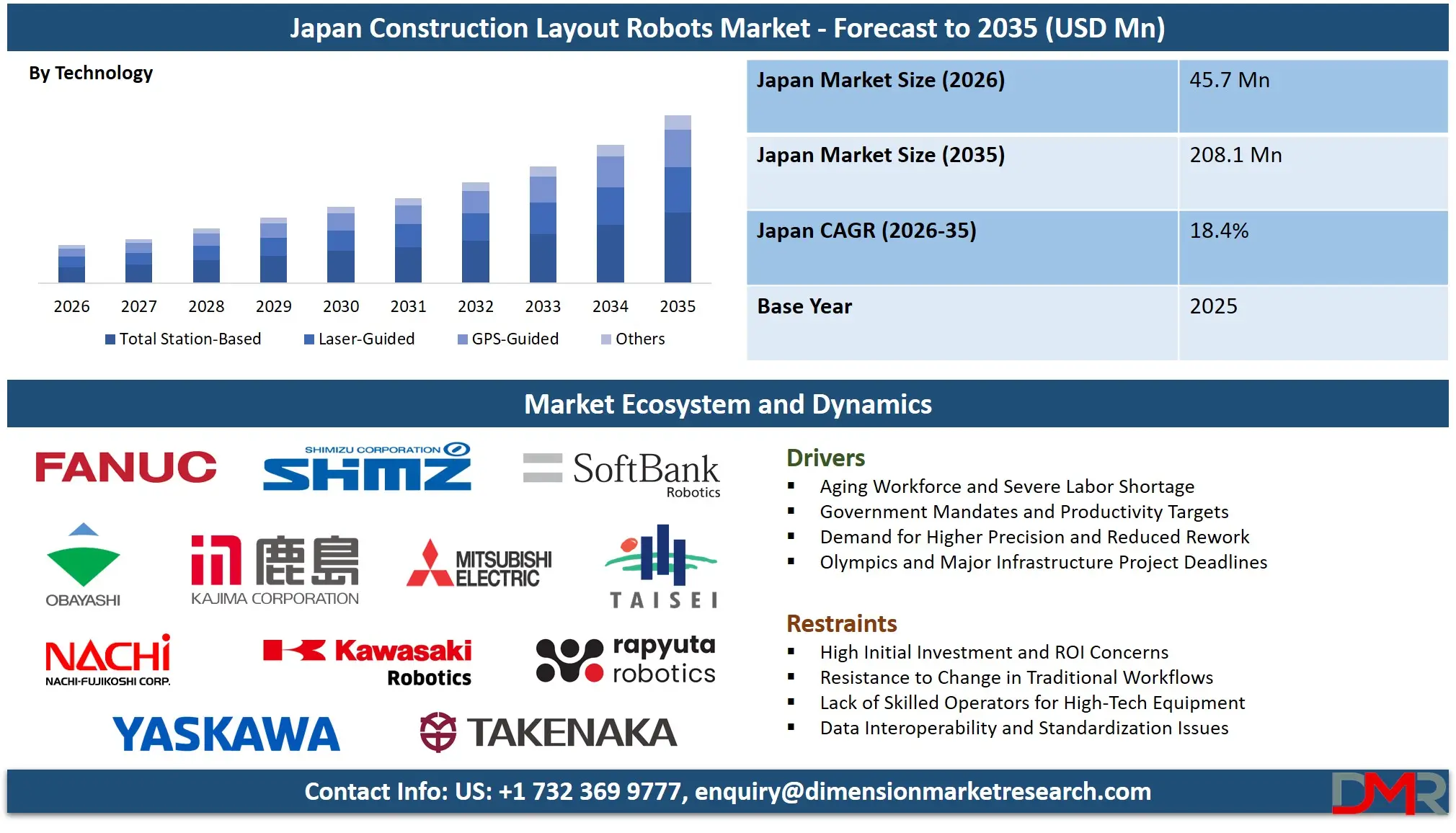
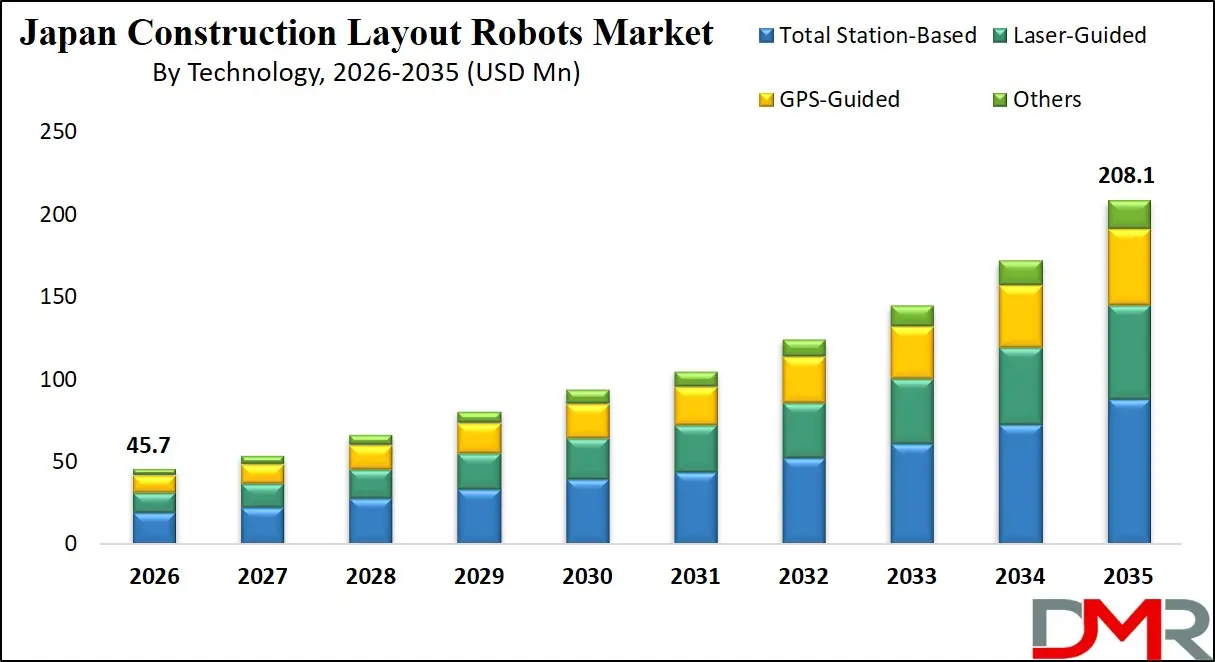
The Japan Construction Layout Robots Market is projected to attain a valuation of USD 45.7 million in 2026 and is expected to expand significantly, reaching USD 208.1 million by 2035, advancing at a robust compound annual growth rate (CAGR) of 18.4% during the forecast period. This growth reflects Japan's world-leading position in robotics innovation, precision engineering, and construction technology. The demand for automated layout systems, robotic total stations, and intelligent marking solutions is accelerating across the construction industry to address chronic labor shortages, enhance precision, and accelerate project timelines.
ℹ
To learn more about this report –
Download Your Free Sample Report Here
Japan has historically been a global pioneer in robotics and automation. The integration of embodied artificial intelligence, AI systems that interact physically with the environment, into construction equipment is becoming central to the country's next-generation infrastructure development. Japan's aging construction workforce, declining number of skilled laborers, and strong technological ecosystem are pushing the industry to adopt robotic layout and surveying solutions at an unprecedented pace.
Government initiatives such as the Society 5.0 strategy, the i-Construction promotion, and the MLIT's productivity improvement programs aim to position Japan as a leader in construction automation. These programs promote research in autonomous surveying, robotic total stations, and AI-driven project management, creating a favorable ecosystem for construction layout robot innovation.
Japan's demographic trends also strongly support adoption. According to national demographic projections, nearly 30% of Japan's population is over the age of 65, and the construction sector faces a severe shortage of young engineers and skilled surveyors. This creates strong demand for automated layout robots capable of performing precise marking and measurements without human intervention, reducing the physical burden on remaining workers.
ℹ
To learn more about this report –
Download Your Free Sample Report Here
The preparation for major infrastructure projects, including the redevelopment of the Tokyo metropolitan area and the Chuo Shinkansen maglev line, further accelerates the need for high-precision, efficient layout technologies. Construction companies are increasingly adopting GPS-guided and laser-guided robotic systems to maintain productivity and accuracy on these large-scale endeavors.
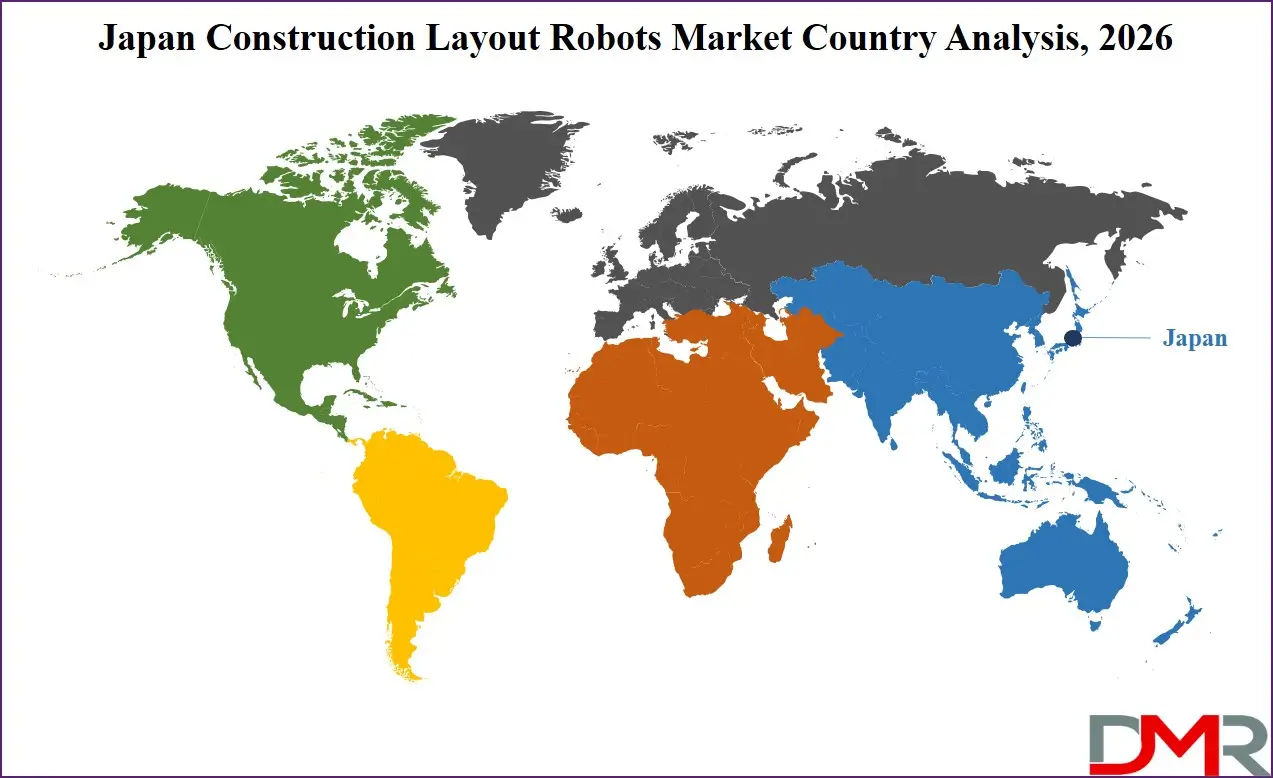
Japan's unique combination of technological leadership, demographic necessity, infrastructure investment, and government-backed innovation programs positions the country as one of the most influential markets for construction layout robots globally.
Japan Construction Layout Robots Market: Key Takeaways
- Market Size Insights: The Japan Construction Layout Robots Market is estimated at USD 45.7 million in 2026 and is expected to reach USD 208.1 million by 2035.
- Market Growth Rate: The market is projected to grow at a CAGR of 18.4% from 2026 to 2035.
- Key Players: Major players in the Japan Construction Layout Robots Market include Shimizu Corporation, Obayashi Corporation, Kajima Corporation, Taisei Corporation, Takenaka Corporation, and Fanuc Corporation.
- Fully Autonomous Robots as the Core Growth Driver: Fully autonomous robots are expected to dominate the market due to their ability to operate continuously without human oversight, dramatically improving efficiency on large construction sites.
- Infrastructure Construction as the Leading Application: Japan's massive investment in renewing aging infrastructure (bridges, tunnels, roads) and building new rail networks makes this the largest application segment.
- Government Policy as a Catalyst: Programs such as i-Construction and Society 5.0 actively promote the adoption of automation and robotics to solve labor shortages and improve construction productivity.
Japan Construction Layout Robots Market: Use Cases
- High-Precision Layout for Large-Scale Commercial Buildings: In Japan's major cities like Tokyo and Osaka, construction companies are using fully autonomous layout robots to mark the complex floor plans of high-rise commercial buildings. These robots, guided by BIM data and robotic total stations, can print precise layout lines for walls, columns, and MEP penetrations on raw concrete slabs, reducing errors and rework.
- Automated Marking for Bridge and Tunnel Rehabilitation: Japan's extensive aging infrastructure requires constant maintenance and rehabilitation. Surveyors and contractors deploy semi-autonomous and GPS-guided layout robots to mark drilling points, anchor locations, and repair zones on bridge decks and tunnel walls, ensuring structural integrity and worker safety in hazardous environments.
- Residential Foundation and Framing Layout: In residential construction, layout robots are used to quickly and accurately mark foundation footings and wall locations. This speeds up the construction process for housing developers facing labor shortages, ensuring that framing crews can work immediately without waiting for manual surveys.
- Industrial Facility Expansion and Equipment Positioning: For industrial construction projects, such as factory expansions or power plant maintenance, layout robots are used to precisely position heavy machinery and equipment bases. Laser-guided systems ensure that installations meet the exact specifications required for operational safety and efficiency.
- Infrastructure Construction for Rail and Roadways: In the construction of new transportation links, such as the Chuo Shinkansen maglev line, layout robots are essential for marking alignments, tunnel portals, and bridge pier locations over long distances. GPS-guided systems provide the accuracy and efficiency needed for these linear, large-scale projects.
Japan Construction Layout Robots Market: Stats & Facts
Ministry of Land, Infrastructure, Transport and Tourism (MLIT)
- Japan's i-Construction initiative aims to increase productivity on construction sites by 20% through the use of ICT and automation.
- The ministry reports that over 30% of the construction workforce is aged 55 or older, highlighting the urgent need for automation.
- MLIT has set targets to fully implement BIM/CIM principles on all public works projects over a certain scale, driving demand for digital layout tools.
Ministry of Economy, Trade and Industry (METI)
- Japan's Society 5.0 initiative aims to create a trillion-dollar AI and robotics economy, with construction as a key focus area.
- Robotics and artificial intelligence are key components of Japan's industrial modernization strategy and national competitiveness agenda.
Japan Federation of Construction Contractors
- The construction industry in Japan employs over 3 million workers, but this number has been declining steadily for decades.
- Major general contractors are investing billions of yen in R&D for construction robots and automation technologies.
World Bank
- Japan's working-age population is projected to decline substantially by 2040, increasing the need for automation technologies across all industries, including construction.
- Infrastructure investment remains a key pillar of Japan's economic policy.
International Labour Organization (ILO)
- The construction industry is consistently ranked among the most dangerous sectors for worker safety. Robotics and automation are seen as key tools for reducing workplace accidents.
OECD
- Automation technologies are expected to significantly impact the construction industry, potentially automating many manual and repetitive tasks that are currently performed by human laborers.
Japan Construction Layout Robots Market: Market Dynamics
Driving Factors in the Japan Construction Layout Robots Market
Aging Workforce and Severe Labor Shortage
Japan's demographic transition is one of the strongest drivers for construction layout robot adoption. As the number of young people entering the construction trades declines sharply, and a significant portion of the skilled workforce retires, the industry is increasingly turning to robotic systems to maintain productivity. Layout robots can perform the physically demanding and precision-critical tasks of surveying and marking, which are traditionally done by skilled, older workers. By automating these processes, construction companies can keep projects on schedule despite having fewer human resources, making robotic technology essential for business continuity.
Government Mandates and Productivity Targets
The Japanese government, through MLIT's i-Construction program, is actively mandating and incentivizing the use of Information and Communication Technology (ICT) on public works projects. Contractors are encouraged or required to use technologies like 3D data, UAVs, and automated construction equipment to win bids for public infrastructure projects. This policy push creates a strong market driver, as companies must invest in layout robots to remain competitive for government contracts, which represent a significant portion of Japan's construction spending.
Restraints in the Japan Construction Layout Robots Market
High Initial Investment and ROI Concerns
The development and implementation of advanced layout robots, including fully autonomous models and robotic total stations, require substantial capital investment. For the numerous small and medium-sized construction companies that form the backbone of the Japanese industry, these costs can be prohibitive. The high purchase price, combined with the need for operator training and integration with existing BIM/CIM workflows, creates a significant barrier to entry, making companies hesitant to adopt the technology without a clear and rapid return on investment.
Resistance to Change in Traditional Workflows
Japan's construction industry is deeply rooted in traditional practices and craftsmanship. Integrating new robotic technologies requires a fundamental shift in site workflows and team coordination. Surveyors, site managers, and carpenters must learn to trust and collaborate with automated systems. This cultural and operational resistance can slow adoption timelines and increase implementation complexity for businesses transitioning toward technology-enabled operations.
Opportunities in the Japan Construction Layout Robots Market
Expansion into Facility Management and As-Built Documentation
Beyond initial construction layout, there is a significant opportunity for these robots in the facility management phase. Robots equipped with laser scanners and sensors can be used throughout a building's lifecycle to create accurate "as-built" models, verify dimensional compliance, and monitor structural movement over time. As Japan focuses on maintaining and extending the life of its existing building stock, layout robots could be repurposed for inspection, renovation, and digital twinning applications, opening up new service-based revenue streams for construction technology companies.
Integration with BIM/CIM and Autonomous Heavy Machinery
The future of construction lies in a fully connected digital workflow. A major opportunity exists for layout robots to act as the critical link between the Building Information Model (BIM) in the office and the autonomous heavy machinery on site. By receiving data directly from the BIM model, a layout robot can precisely mark the terrain. This information can then be used to guide autonomous excavators, bulldozers, and concrete finishers. Deepening the integration between layout robots and the broader ecosystem of construction automation creates a powerful value proposition for tech-forward construction companies.
Trends in the Japan Construction Layout Robots Market
Shift Towards Fully Autonomous Operation
Japan continues to lead global innovation in automation, and the construction sector is seeing a clear trend from semi-autonomous, operator-guided machines to fully autonomous systems. These next-generation robots can navigate complex site environments, avoid obstacles, and execute entire layout plans with minimal human intervention. Equipped with advanced sensors and AI, they can start, stop, and recharge autonomously, operating 24/7 to meet tight construction deadlines, making them highly attractive for large-scale projects.
Convergence of Surveying and Robotic Technologies
The traditional boundary between surveying equipment and construction robotics is blurring. Major surveying equipment manufacturers are evolving into robotics companies. Robotic total stations are no longer just measurement tools but are becoming the "eyes" for autonomous layout robots. This trend sees the integration of high-precision GPS, laser scanning, and robotic drive systems into single, multi-functional platforms that can survey, mark, and inspect, streamlining site operations and data management.
Japan Construction Layout Robots Market: Research Scope and Analysis
By Product Type Analysis
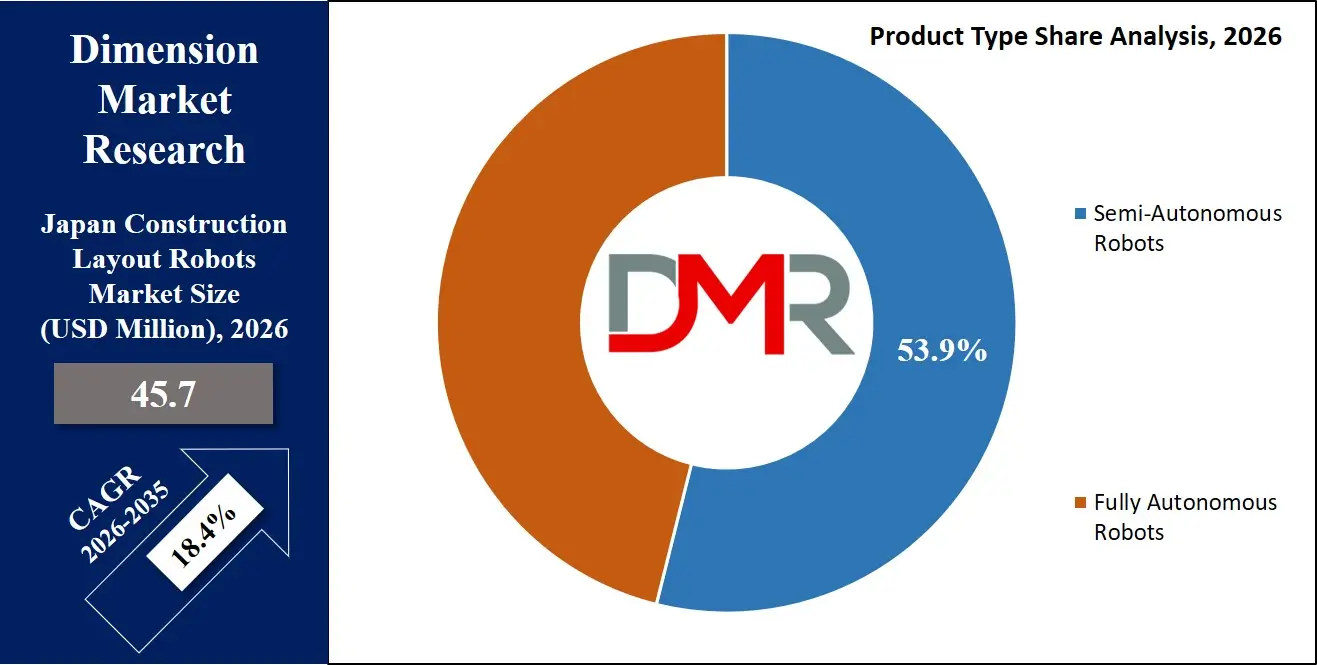
Semi-Autonomous Robots are expected to hold a significant share of the Japan Construction Layout Robots Market as they provide a balanced combination of automation and human supervision. These robots typically work alongside surveyors or site engineers and are connected with robotic total stations and digital design files to mark layout points accurately on construction surfaces. Semi-autonomous systems are widely used because they integrate easily with existing construction workflows and require relatively lower investment compared to fully autonomous systems.
ℹ
To learn more about this report –
Download Your Free Sample Report Here
Japan’s construction sector increasingly relies on such solutions to reduce manual surveying tasks while maintaining high precision levels required in complex building projects. Semi-autonomous layout robots help construction teams transfer digital floor plans and BIM-based coordinates directly onto site surfaces, minimizing human errors and reducing rework. Their flexibility and compatibility with existing site equipment make them a practical solution for both large contractors and mid-sized construction firms. As the industry gradually transitions toward greater automation, semi-autonomous robots remain an important bridge technology in Japan’s construction robotics ecosystem.
By Technology Analysis
Total Station-Based Technology is projected to dominate the Japan Construction Layout Robots Market due to its high precision and strong compatibility with modern surveying equipment. Robotic layout systems often rely on robotic total stations to determine exact coordinates and guide the robot while marking layout points on construction surfaces. This technology allows robots to translate digital design data from CAD or BIM systems into precise real-world measurements with millimeter-level accuracy.
The adoption of total station-based systems is particularly important in Japan, where construction projects demand extremely high precision, especially in dense urban environments and high-rise developments. These systems allow continuous tracking of robotic movement and ensure accurate positioning even in confined construction sites. Additionally, many Japanese construction companies already use total station equipment for surveying, making integration with robotic layout systems relatively seamless. As a result, total station-based technology continues to form the backbone of robotic layout solutions across the Japanese construction industry.
By Application Analysis
Commercial Construction is expected to represent the largest application segment in the Japan Construction Layout Robots Market. Japan’s urban centers continue to experience strong demand for commercial infrastructure such as office buildings, retail complexes, hotels, and mixed-use developments. These projects involve complex architectural designs and require extremely precise layout work for structural components, interior walls, and mechanical systems.
Layout robots significantly improve efficiency in such projects by automatically marking layout points and construction lines based on digital design models. This automation reduces manual measurement tasks, shortens project timelines, and improves consistency across large construction sites. In addition, commercial construction projects often operate under strict deadlines and quality standards, encouraging contractors to adopt advanced technologies that enhance accuracy and productivity. As urban redevelopment projects continue to expand in major Japanese cities, commercial construction is expected to remain the primary application area for layout robots.
By End User Analysis
Construction Companies are anticipated to be the leading end-user segment in the Japan Construction Layout Robots Market. Major general contractors in Japan are actively investing in robotics and automation technologies to improve productivity and manage the country’s ongoing labor shortages in the construction sector. These companies deploy layout robots to automate repetitive surveying tasks, reduce project delays, and maintain consistent accuracy across large and complex construction projects.
Construction companies typically integrate layout robots into broader digital construction strategies that include BIM platforms, site management software, and other automation technologies. By incorporating robotics into their workflows, contractors can streamline layout operations, reduce costly errors, and improve project coordination. Additionally, robotic layout systems help companies maintain higher safety standards by limiting the need for workers to perform manual measurements in potentially hazardous construction environments. As Japan continues to promote smart construction practices and digital transformation in the industry, construction companies will remain the primary adopters of layout robot solutions.
The Japan Construction Layout Robots Market Report is segmented on the basis of the following:
By Product Type
- Semi-Autonomous Robots
- Fully Autonomous Robots
By Technology
- Total Station-Based
- Laser-Guided
- GPS-Guided
- Others
By Application
- Commercial Construction
- Residential Construction
- Industrial Construction
- Infrastructure Construction
By End-User
- Construction Companies
- Contractors
- Surveyors
- Architects
- Others
Japan Construction Layout Robots Market: Competitive Landscape
The competitive landscape of the Japan Construction Layout Robots Market is characterized by the presence of globally recognized construction machinery manufacturers, precision measurement technology leaders, and innovative robotics startups that are continuously advancing intelligent construction systems. Japan has one of the most mature construction and robotics ecosystems in the world, supported by strong industrial capabilities, extensive research infrastructure, and government-backed innovation programs. Leading companies such as Komatsu Ltd. and Topcon Corporation dominate the market by integrating AI-driven perception, machine learning, and advanced control technologies into automated construction solutions, often through their strategic partnerships.
ℹ
To learn more about this report –
Download Your Free Sample Report Here
In addition to industrial leaders, major general contractors like Shimizu Corporation, Obayashi Corporation, Takenaka Corporation, and Kajima Corporation are not just end-users but active developers of construction robotics. These organizations operate their own R&D divisions, creating proprietary layout and automation robots tailored to their specific construction methodologies. Their innovations focus on seamless integration with BIM/CIM, human-robot collaboration, and real-time data synchronization to allow robots to operate effectively in dynamic site environments.
Japan's construction robotics innovation is further strengthened by collaboration between corporations, research institutions, and government agencies. Universities and national research laboratories frequently partner with private companies to accelerate advancements in machine learning, robotics engineering, and sensor technologies. Programs under the i-Construction initiative and national AI development strategies encourage the commercialization of next-generation construction robotics platforms.
Overall, Japan's competitive landscape combines established industrial leaders with tech-forward construction firms and emerging robotics developers, creating a highly dynamic ecosystem that supports innovation, commercialization, and large-scale deployment of construction layout robots across the country.
Some of the prominent players in the Japan Construction Layout Robots Market are:
- Shimizu Corporation
- Obayashi Corporation
- Kajima Corporation
- Taisei Corporation
- Takenaka Corporation
- Fanuc Corporation
- Yaskawa Electric Corporation
- Mitsubishi Electric Corporation
- Kawasaki Robotics
- Cyberdyne Inc.
- Daihen Corporation
- Nachi-Fujikoshi Corp.
- Tmsuk Co., Ltd.
- ZMP Inc.
- Preferred Robotics
- Rapyuta Robotics
- Mujin Inc.
- RT Corporation
- THK Co., Ltd.
- SoftBank Robotics
- Other Key Players
Recent Developments in the Japan Construction Layout Robots Market
- December 2025: SoftBank Corp. and Yaskawa Electric Corporation signed a collaboration agreement to develop and deploy “Physical AI” robots, combining SoftBank’s AI-RAN infrastructure with Yaskawa’s robotics technologies to enable robots to analyze sensor data and perform complex autonomous tasks.
- December 2025: Fanuc Corporation showcased its next-generation intelligent industrial robots at the International Robot Exhibition (iREX 2025) in Tokyo, highlighting AI-enabled automation systems designed to improve precision and efficiency across industrial and infrastructure applications.
- September 2024: Shimizu Corporation collaborated with Nabtesco to deploy a Stage-Scaffold Movable Cart using autonomous mobility technology, enabling scaffolding structures to move automatically across construction floors to improve productivity and reduce labor requirements.
- July 2024: Obayashi Corporation established the Obayashi Construction-Tech Lab Singapore, a regional R&D hub focused on developing next-generation construction technologies including robotics, automation, and AI-driven productivity solutions for the construction sector.
- July 2024: Tmsuk Co., Ltd., in collaboration with Kajima Corporation, developed an AI-powered swarm robot system for suspended ceiling construction, where multiple robots coordinate tasks such as installing bolts, assembling ceiling frames, and positioning ceiling boards on construction sites.
- July 2025: Rapyuta Robotics expanded its robotics solutions for industrial automation, strengthening the development of AI-driven robotic systems for logistics and automation, supporting broader adoption of intelligent robotics technologies in Japan’s industrial ecosystem.
Report Details
| Report Characteristics |
| Market Size (2026) |
USD 45.7 Mn |
| Forecast Value (2035) |
USD 208.1 Mn |
| CAGR (2026–2035) |
18.4% |
| Historical Data |
2021 – 2025 |
| Forecast Data |
2027 – 2035 |
| Base Year |
2025 |
| Estimate Year |
2026 |
| Report Coverage |
Market Revenue Estimation, Market Dynamics, Competitive Landscape, Growth Factors and etc. |
| Segments Covered |
By Product Type (Semi-Autonomous Robots and Fully Autonomous Robots), By Technology (Total Station-Based, Laser-Guided, GPS-Guided and Others), By Application (Commercial Construction, Residential Construction, Industrial Construction and Infrastructure Construction), By End-User (Construction Companies, Contractors, Surveyors, Architects and Others) |
| Country Coverage |
Japan |
| Prominent Players |
Shimizu Corporation, Obayashi Corporation, Kajima Corporation, Taisei Corporation, Takenaka Corporation, Fanuc Corporation, Yaskawa Electric Corporation, Mitsubishi Electric Corporation, Kawasaki Robotics, Cyberdyne Inc., Daihen Corporation, Nachi-Fujikoshi Corp., Tmsuk Co., Ltd., ZMP Inc., Preferred Robotics, Rapyuta Robotics, Mujin Inc., RT Corporation, THK Co., Ltd., SoftBank Robotics, and Other Key Players |
| Purchase Options |
We have three licenses to opt for: Single User License (Limited to 1 user), Multi-User License (Up to 5 Users), and Corporate Use License (Unlimited User) along with free report customization equivalent to 0 analyst working days, 3 analysts working days and 5 analysts working days respectively. |
Frequently Asked Questions
How big is the Japan Construction Layout Robots Market?
▾ The Japan Construction Layout Robots Market size is estimated to have a value of USD 45.7 million in 2026 and is expected to reach USD 208.1 million by the end of 2035.
What is the growth rate in the Japan Construction Layout Robots Market in 2026?
▾ The market is growing at a CAGR of 18.4% over the forecasted period of 2026.
Who are the key players in the Japan Construction Layout Robots Market?
▾ Some of the major key players in the Japan Construction Layout Robots Market are Shimizu Corporation, Obayashi Corporation, Kajima Corporation, Taisei Corporation, Takenaka Corporation, and Fanuc Corporation, and many others.