What is the Construction Market Size?
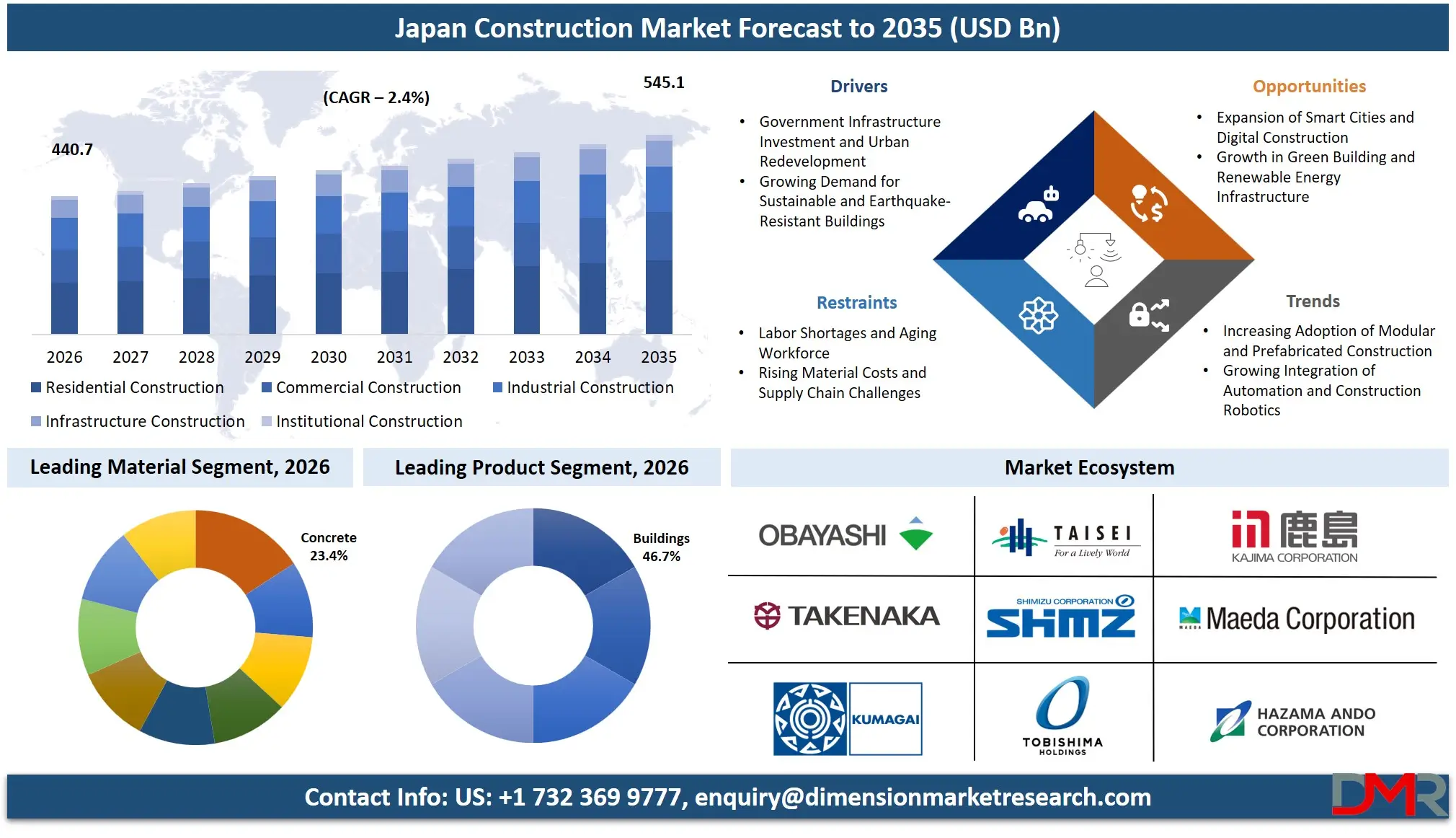
The Japan Construction Market is expected to reach a value of USD 440.7 billion in 2026, and it is further anticipated to reach USD 545.1 billion by 2035, growing at a steady CAGR of 2.4% during the forecast period.
ℹ
To learn more about this report –
Download Your Free Sample Report Here
The construction market in Japan is undergoing a significant transformation, driven by the nation's commitment to technological leadership and the pressing need to address its super-aging society and shrinking workforce. The market encompasses a wide spectrum of activities, from advanced infrastructure renewal and disaster-resilient urban development to the construction of next-generation semiconductor and data center facilities. The demand for sustainable and intelligent buildings, alongside the government's robust public spending on infrastructure and decarbonization initiatives, is fueling a new era of growth. Key players from general contractors to specialized real estate developers are the primary drivers, with a focus on integrating digital tools and advanced materials to overcome labor shortages and enhance productivity.
Key Takeaways
- Market Size & Forecast: Based on forecasts, the size of the market for Japan's construction industry will experience sustained growth and will attain a value of USD 440.7 billion by 2026, expanding steadily to USD 545.1 billion by 2035 due to two crucial factors: the execution of massive infrastructure projects like the Linear Chuo Shinkansen and Osaka World Expo 2025 legacy developments, and a robust pipeline of urban redevelopment.
- Growth Rate & Outlook: It is predicted that the market will register a CAGR of 2.4%, which will be attributed to the presence of important growth drivers, such as a critical mass of public and private investment in green building technologies and an increased need to retrofit and rebuild an aging national infrastructure stock from the post-war economic boom.
- Primary Growth Drivers: Important growth factors will include the government's "Society 5.0" vision promoting smart cities, a surge in private-sector capital expenditure on semiconductor fabs and logistics centers to fortify economic security, and the widespread adoption of modular and prefabricated methods to combat a chronic labor shortage.
- Key Market Trends: The market trends are mainly related to the adoption of digital transformation (DX) across the supply chain using Building Information Modeling (BIM) and construction management software; a strong pivot toward net-zero energy buildings (ZEB) and the use of low-carbon concrete; and the application of autonomous construction equipment and drones for surveying to improve on-site safety and efficiency.
- By Construction Type Analysis: The construction market in Japan is driven by non-residential and civil engineering sectors, with infrastructure construction witnessing a surge due to aging bridges and tunnels. Residential construction is pivoting towards high-end, durable condominium towers and single-family smart homes, while industrial construction is booming on the back of data center and advanced logistics facility investments.
- By Construction Method Analysis: The Japan construction market is projected to be dominated by a rapid shift from conventional methods to modular and prefabricated construction, as these methods allow for a significant reduction in on-site labor, shorten project timelines, and improve quality control in a factory setting, directly addressing the construction sector's severe manpower crisis
What is the Japan Construction Market?
The Japan construction market can be described as the specific economic sector that involves the planning, design, financing, building, and maintenance of physical structures, ranging from residential homes to mega-infrastructure projects. Unlike other manufacturing industries, construction is highly project-based and site-specific, deeply intertwined with government policy on land use, economic stimulus, and environmental regulation. This is executed through various approaches: conventional cast-in-place methods remain relevant, but there is a massive shift toward industrialized construction, which uses prefabricated components and 3D printing to build net-zero buildings or seismic-isolated condominiums off-site. Considering the fast-track approval process for innovative building technologies in Japan, new construction methods and materials require robust performance verification, leading to close collaboration between the public and private sectors.
Use Cases
- Construction of Semiconductor Fabrication Plants: A high-tech industrial construction project involving the use of deep foundation work, vibration-controlled superstructures, and ultra-clean room fit-outs, adopted by major electronics conglomerates and foreign chipmakers to secure domestic production of advanced logic and memory semiconductors.
- Redevelopment of Urban Transit Hubs: A commercial construction project that applies mixed-use development models, integrating office buildings, retail spaces, and hospitality sectors above renovated railway stations, executed by real estate developers in partnership with private railway companies to create resilient, transit-oriented communities.
- Aging Bridge and Tunnel Renewal: An infrastructure maintenance project that utilizes advanced structural steel reinforcement, carbon fiber wrapping, and non-destructive testing technologies to extend the service life of thousands of bridges and expressway tunnels built during Japan's period of high economic growth.
- Net-Zero Energy High-Rise Residences: A green building construction project where real estate developers apply prefabricated, high-insulation panelized systems, triple-glazed glass, and integrated renewable energy technologies to achieve net-zero energy consumption in multi-family housing towers.
How AI is Transforming the Construction Market?
The impact of AI on the Japanese construction market is transformative, covering the acceleration of project design, optimization of complex supply chains, and automation of on-site execution to mitigate the acute labor shortage. In the design phase, AI-driven generative design tools explore thousands of configurations for structural elements and MEP (Mechanical, Electrical, Plumbing) systems to create conflict-free BIM models that optimize for seismic resilience and energy efficiency. AI is also being used to predict equipment failure and manage the just-in-time delivery of materials like precast concrete and reinforcement steel, dramatically reducing on-site storage needs and delays.
Furthermore, the role of AI in site management is becoming mission-critical. Computer vision systems fed by drone and fixed camera feeds analyze worker activity to detect safety violations and unsafe conditions in real time. AI algorithms help superintendents simulate project phasing for complex renovations on operational transport infrastructure, evaluating post-contract performance data and providing an overview of project schedule and cost risks to prevent cost overruns.
Market Dynamics
Key Drivers in the Japan Construction Market
Government Infrastructure Investment and Urban Redevelopment
The Japanese government continues to invest heavily in infrastructure modernization, disaster resilience, and urban redevelopment, making public spending a major driver of the construction market. Large-scale projects involving highways, railways, bridges, airports, flood control systems, and public facilities generate sustained demand for construction services. Redevelopment initiatives in metropolitan areas such as Tokyo, Osaka, and Nagoya also support commercial and residential construction. Additionally, investments in smart cities and resilient infrastructure strengthen long-term project pipelines. These initiatives encourage private-sector participation, stimulate employment, improve regional connectivity, and ensure continuous growth across multiple construction segments throughout Japan.
Growing Demand for Sustainable and Earthquake-Resistant Buildings
Japan's strict seismic regulations and sustainability goals are accelerating demand for modern construction techniques and high-performance buildings. Developers increasingly prioritize earthquake-resistant structures, energy-efficient designs, and environmentally friendly construction materials to meet evolving building standards. Green building certifications, net-zero energy buildings, and smart building technologies are gaining widespread adoption across residential, commercial, and institutional projects. Rising awareness of climate resilience and carbon reduction further supports investments in sustainable infrastructure. These factors encourage innovation, improve building quality, extend infrastructure lifespan, and create continuous opportunities for construction companies specializing in advanced engineering and environmentally responsible development.
Restraints in the Japan Construction Market
Labor Shortages and Aging Workforce
Japan's construction industry faces persistent labor shortages due to its aging workforce and declining working-age population. Many experienced construction workers are approaching retirement, while fewer young professionals are entering the industry. This imbalance creates project delays, increases labor costs, and limits the industry's capacity to undertake multiple large-scale developments simultaneously. Construction companies are increasingly investing in automation, robotics, and digital technologies to offset workforce shortages, but adoption requires significant capital investment. Without sufficient skilled labor availability, project execution efficiency may decline, posing long-term challenges to the industry's sustainable growth.
Rising Material Costs and Supply Chain Challenges
Fluctuating prices of construction materials such as steel, cement, timber, glass, and asphalt continue to impact project profitability across Japan. Global supply chain disruptions, higher transportation costs, and inflationary pressures have increased procurement expenses for contractors and developers. Extended delivery timelines for imported materials may also delay project completion schedules and increase financial risks. Contractors must carefully manage procurement strategies while balancing contractual obligations and budget constraints. These cost pressures reduce profit margins, complicate project planning, and create uncertainty for both public and private construction investments throughout the Japanese market.
Growth Opportunities in the Japan Construction Market
Expansion of Smart Cities and Digital Construction
Japan's increasing focus on smart city development presents significant opportunities for construction companies adopting advanced digital technologies. Projects integrating intelligent transportation systems, smart utilities, connected buildings, and digital infrastructure require innovative engineering expertise. Building Information Modeling (BIM), digital twins, artificial intelligence, robotics, and Internet of Things technologies improve planning accuracy, construction efficiency, and lifecycle asset management. Government initiatives supporting digital transformation further encourage technology adoption throughout the construction industry. Companies capable of delivering technologically advanced infrastructure solutions are expected to benefit from expanding investment across both public and private development projects.
Growth in Green Building and Renewable Energy Infrastructure
Japan's commitment to carbon neutrality creates strong opportunities for sustainable construction and renewable energy infrastructure development. Demand continues rising for energy-efficient residential buildings, commercial facilities, solar power plants, offshore wind projects, hydrogen infrastructure, and environmentally responsible industrial developments. Green construction materials, low-carbon concrete, and energy-efficient building systems are increasingly incorporated into new developments. Government incentives supporting decarbonization encourage investment in environmentally sustainable projects across multiple sectors. Construction companies with expertise in green engineering and renewable infrastructure are well positioned to capture growing market opportunities during the coming decade.
Trends in the Japan Construction Market
Increasing Adoption of Modular and Prefabricated Construction
Modular and prefabricated construction methods are becoming increasingly popular across Japan due to labor shortages, faster project completion, and improved quality control. Off-site manufacturing enables greater construction precision while reducing material waste and minimizing weather-related delays. Residential housing, healthcare facilities, hotels, and commercial buildings increasingly utilize modular components to improve productivity and lower construction costs. Technological advancements continue enhancing the structural performance and design flexibility of prefabricated buildings. As developers seek greater efficiency and sustainability, modular construction is expected to gain wider acceptance throughout Japan's evolving construction industry.
Growing Integration of Automation and Construction Robotics
Automation and robotics are transforming Japan's construction sector as companies address workforce shortages and improve operational efficiency. Construction firms increasingly deploy autonomous machinery, robotic welding systems, drone-based inspections, AI-powered project management, and automated surveying technologies across infrastructure and building projects. These innovations improve worker safety, reduce construction errors, accelerate project delivery, and enhance productivity. Major contractors continue investing in digital transformation initiatives to strengthen competitiveness while addressing labor constraints. The growing adoption of advanced construction technologies is expected to reshape project execution and improve overall industry performance across Japan.
Research Scope and Analysis
The Japan Construction Market is segmented by Construction Type, Project Type, Material, Construction Method, Application, and End User. The study covers residential, commercial, industrial, infrastructure, and institutional construction; new, renovation, and maintenance projects; major construction materials; conventional and advanced building methods; diverse infrastructure applications; and both private and public sector construction activities across Japan.
ℹ
To learn more about this report –
Download Your Free Sample Report Here
By Construction Type Analysis
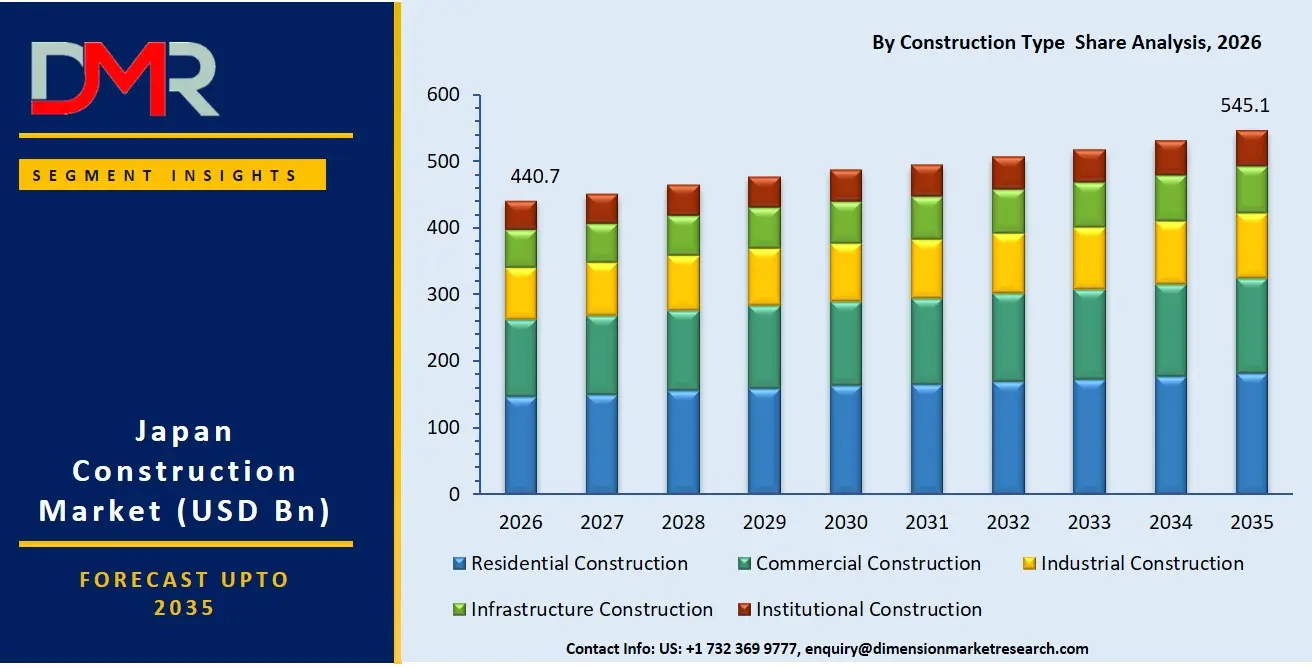
Residential Construction is projected to dominate the Japan construction market due to continuous housing demand, urban redevelopment, earthquake-resilient building requirements, and government initiatives supporting residential renewal.
ℹ
To learn more about this report –
Download Your Free Sample Report Here
Japan's aging housing stock requires extensive reconstruction and renovation, while redevelopment projects in major metropolitan areas such as Tokyo, Osaka, and Nagoya continue to generate strong demand for new residential units. Multi-family housing remains particularly significant because of high urban population density and limited land availability. In addition, energy-efficient homes, smart housing technologies, and disaster-resistant construction standards encourage sustained investments. Large domestic developers and construction companies maintain a strong pipeline of residential projects, making this the largest construction type across Japan.
By Project Type Analysis
New Construction is anticipated to dominate the market as Japan continues investing heavily in urban redevelopment, transportation infrastructure, logistics facilities, semiconductor manufacturing plants, and sustainable residential developments. Government-backed infrastructure modernization programs and private-sector investments support the construction of commercial buildings, industrial facilities, and public infrastructure. Rapid technological advancements, growing demand for green buildings, and redevelopment of aging structures further strengthen new construction activity. Although renovation and maintenance remain important due to Japan's aging building stock, large-scale new developments generate significantly higher project values and material demand. Continuous investment from both public authorities and private developers ensures new construction remains the dominant project category.
By Material Analysis
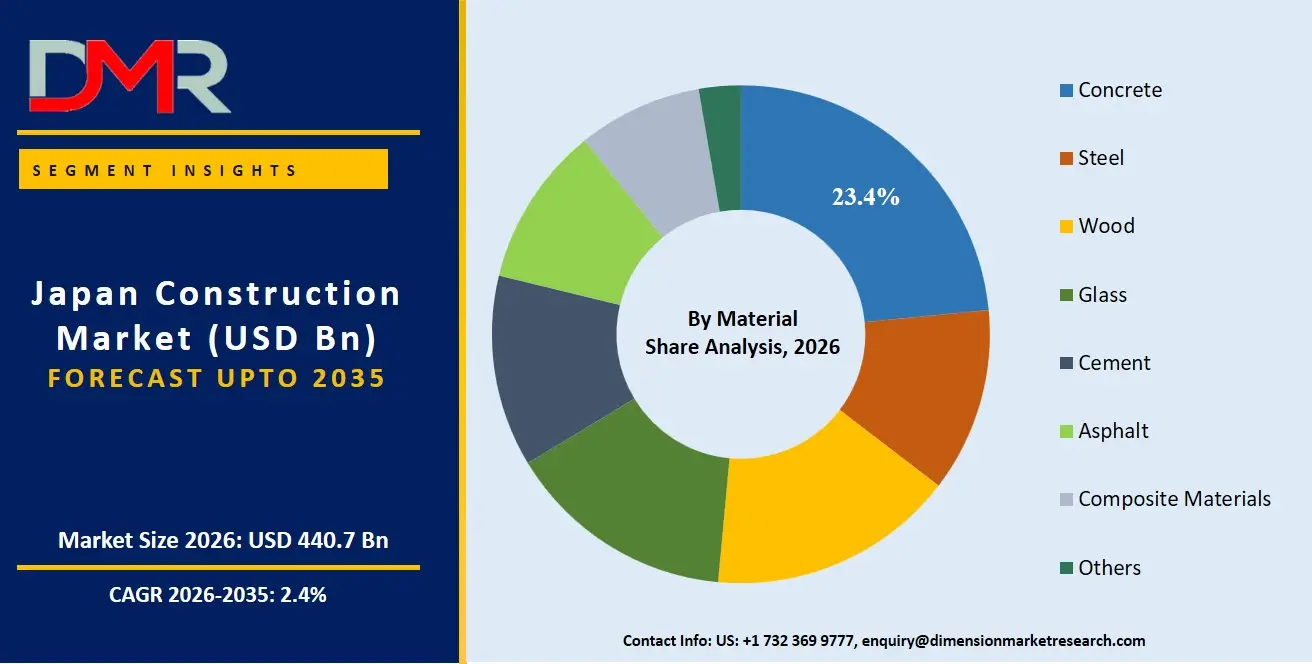
Concrete is poised to dominate the Japan construction market because it is the primary material used across residential buildings, commercial complexes, transportation infrastructure, tunnels, bridges, dams, and public facilities. Japan's strict seismic safety regulations require durable, high-strength reinforced concrete capable of withstanding earthquakes and extreme weather conditions. Ready-mix and precast concrete are widely adopted to improve construction efficiency, quality control, and project timelines. Extensive government infrastructure investment and ongoing urban redevelopment further increase concrete consumption. Its long service life, structural strength, cost-effectiveness, and compatibility with modern construction techniques make concrete the most widely utilized construction material throughout the Japanese market.
By Construction Method Analysis
Conventional Construction projected to remains the dominant construction method in Japan because it provides flexibility for complex architectural designs, large infrastructure projects, and customized commercial developments. Most high-rise buildings, transportation infrastructure, industrial facilities, and public-sector projects continue utilizing traditional on-site construction techniques supported by experienced contractors and established supply chains. Although modular, prefabricated, and 3D printing technologies are expanding, conventional construction maintains widespread acceptance due to regulatory familiarity, engineering adaptability, and proven structural performance under Japan's strict seismic standards. Large-scale public works and urban redevelopment projects continue relying primarily on conventional construction, reinforcing its leading position across the market.
By Application Analysis
Buildings are expected to represent the largest application segment in Japan's construction market, driven by continuous demand for residential housing, office buildings, commercial complexes, healthcare facilities, educational institutions, and mixed-use developments. Urban redevelopment initiatives, replacement of aging structures, and investments in energy-efficient buildings significantly contribute to market growth. Population concentration within major metropolitan regions supports ongoing residential and commercial construction despite demographic changes. Green building certifications, smart building technologies, and stringent seismic safety regulations further stimulate investment across building projects. Compared with other application categories, building construction consistently generates the highest construction expenditure, making it the dominant application segment.
By End User Analysis
Private Sector is projected to dominate the Japan construction market owing to substantial investments from real estate developers, manufacturing companies, logistics operators, commercial enterprises, and institutional investors. Private capital continues driving residential housing, office developments, shopping centers, hotels, industrial facilities, logistics parks, semiconductor manufacturing plants, and data centers. Growing foreign direct investment and corporate expansion further strengthen private-sector construction activity. While government spending remains essential for infrastructure development, private-sector projects account for a larger share of total construction value through continuous investment in profitable commercial and residential developments. Strong developer participation firmly establishes the private sector as the leading end-user segment.
The Japan Construction Market Report is segmented on the basis of the following:
By Construction Type
- Residential Construction
- Single-Family Housing
- Multi-Family Housing
- Affordable Housing
- Commercial Construction
- Office Buildings
- Retail Spaces
- Hospitality
- Mixed-Use Developments
- Industrial Construction
- Manufacturing Facilities
- Warehouses & Logistics Centers
- Data Centers
- Infrastructure Construction
- Roads & Highways
- Railways
- Bridges & Tunnels
- Airports
- Ports & Harbors
- Institutional Construction
- Educational Buildings
- Healthcare Facilities
- Government Buildings
- Public Safety Facilities
By Project Type
- New Construction
- Renovation & Remodeling
- Residential Renovation
- Commercial Renovation
- Repair & Maintenance
- Structural Repairs
- Facility Maintenance
By Material
- Concrete
- Ready-Mix Concrete
- Precast Concrete
- Steel
- Structural Steel
- Reinforcement Steel
- Wood
- Bricks & Blocks
- Glass
- Cement
- Asphalt
- Composite Materials
- Others
By Construction Method
- Conventional Construction
- Modular Construction
- Permanent Modular Construction
- Relocatable Modular Construction
- Prefabricated Construction
- Panelized Systems
- Volumetric Systems
- 3D Printing Construction
- Green Building Construction
- Net-Zero Buildings
- Energy-Efficient Buildings
By Application
- Buildings
- Transportation Infrastructure
- Energy & Utilities
- Water & Wastewater Infrastructure
- Mining & Industrial Facilities
- Others
By End User
- Private Sector
- Real Estate Developers
- Industrial Enterprises
- Commercial Organizations
- Public Sector
- Central Government
- Local Governments
- Public Infrastructure Agencies
Competitive Landscape
The nature of competition in the Japan construction market is consolidated among dominant general contractors but has become very dynamic, given the diverse range of challenges from digitalization and decarbonization. Strategic alliances between the major super general contractors (super-zenekon) and specialized technology firms are crucial for success, as they help gain access to AI-based site management platforms and secure early validation of new modular construction systems. The trend of vertical integration is growing, as real estate developers are acquiring prefabricated component plants to secure their pipeline of net-zero building products. IP differentiators such as proprietary low-carbon concrete mixes, advanced seismic damping systems, and fully integrated BIM-to-factory digital workflows are playing an increasingly significant role compared to a traditional bidding process or earth-moving capability.
Some of the prominent players in the Japan Construction Market are:
- Obayashi Corporation
- Kajima Corporation
- Shimizu Corporation
- Taisei Corporation
- Takenaka Corporation
- Maeda Corporation
- Hazama Ando Corporation
- Kumagai Gumi Co., Ltd.
- Tobishima Corporation
- Penta-Ocean Construction Co., Ltd.
- Toda Corporation
- Nishimatsu Construction Co., Ltd.
- Tekken Corporation
- Fujita Corporation
- Sumitomo Mitsui Construction Co., Ltd.
- Tokyu Construction Co., Ltd.
- Mitsui Sumitomo Construction Co., Ltd.
- Asanuma Corporation
- Yahagi Construction Co., Ltd.
- Daiwa House Industry Co., Ltd.
- Other Key Players
Recent Developments
- May 2026: Mitsui Fudosan Co., Ltd. announced its first participation in data center projects in India through an investment in an approximately 200 MW portfolio across Mumbai, Chennai, and Hyderabad, reflecting the company's expanding focus on digital infrastructure and sustainable real estate investments.
- June 2026: Obayashi Corporation announced the acquisition of Multiplex Global Limited, strengthening its international building construction business across Australia, the United Kingdom, and Canada while expanding its global construction capabilities.
- April 2026: Mitsui Fudosan Co., Ltd. signed a basic agreement with Koshi City and Kumamoto Prefecture to launch the Kumamoto Science Park Project, supporting semiconductor-related industries and advanced industrial infrastructure development in Japan.
Report Details
| Report Characteristics |
| Market Size (2026) |
USD 440.7 Bn |
| Forecast Value (2035) |
USD 545.1 Bn |
| CAGR (2026–2035) |
2.4% |
| Historical Data |
2021 – 2025 |
| Forecast Data |
2027 – 2035 |
| Base Year |
2025 |
| Estimate Year |
2026 |
| Segments Covered |
By Construction Type, By Project Type, By Material, By Construction Method, By Application, By End User |
| Country Coverage |
Japan |
Frequently Asked Questions
How big is the Japan Construction Market?
▾ The Japan Construction market is poised to be valued at USD 440.7 billion in 2026 and is projected to reach USD 545.1 billion by 2035, driven by the universal need for national resilience upgrades, digital infrastructure, and sustainable urban redevelopment for an aging society.
What is the CAGR of the Japan Construction Market from 2026 to 2035?
▾ The market is expected to grow at a CAGR of 2.4% from 2026 to 2035, reflecting the sustained and stable public investment pipeline and the accelerating private-sector shift toward technology-driven project execution to beat the labor crisis.
What factors are driving the growth of the Japan Construction Market?
▾ Key drivers include Japan’s mandated program to renew its aging 20th-century infrastructure, the escalating need to build energy-efficient buildings in compliance with carbon neutrality targets, and a deep capital expenditure cycle in advanced industrial facilities like data centers and semiconductor fabs.
What are the major trends in the Japan Construction Market?
▾ Major trends include the shift to permanent modular and volumetric off-site construction for safer, faster delivery, the development of digital twins for entire mixed-use urban districts, and a strong focus on applying autonomous equipment and AI to solve the structural labor shortage.
Who are the key players in the Japan Construction Market?
▾ Key players in the Japan Construction Market include Obayashi, Kajima, Taisei, Shimizu, Daiwa House Industry, Sekisui House, and Mitsui Fudosan, driving innovation through R&D, digital transformation, industrialized construction factories, and large-scale urban redevelopment activities.
How is the Japan Construction Market segmented?
▾ The market is segmented by Construction Type, Project Type, Material, Construction Method, Application, and End User.