Market Overview
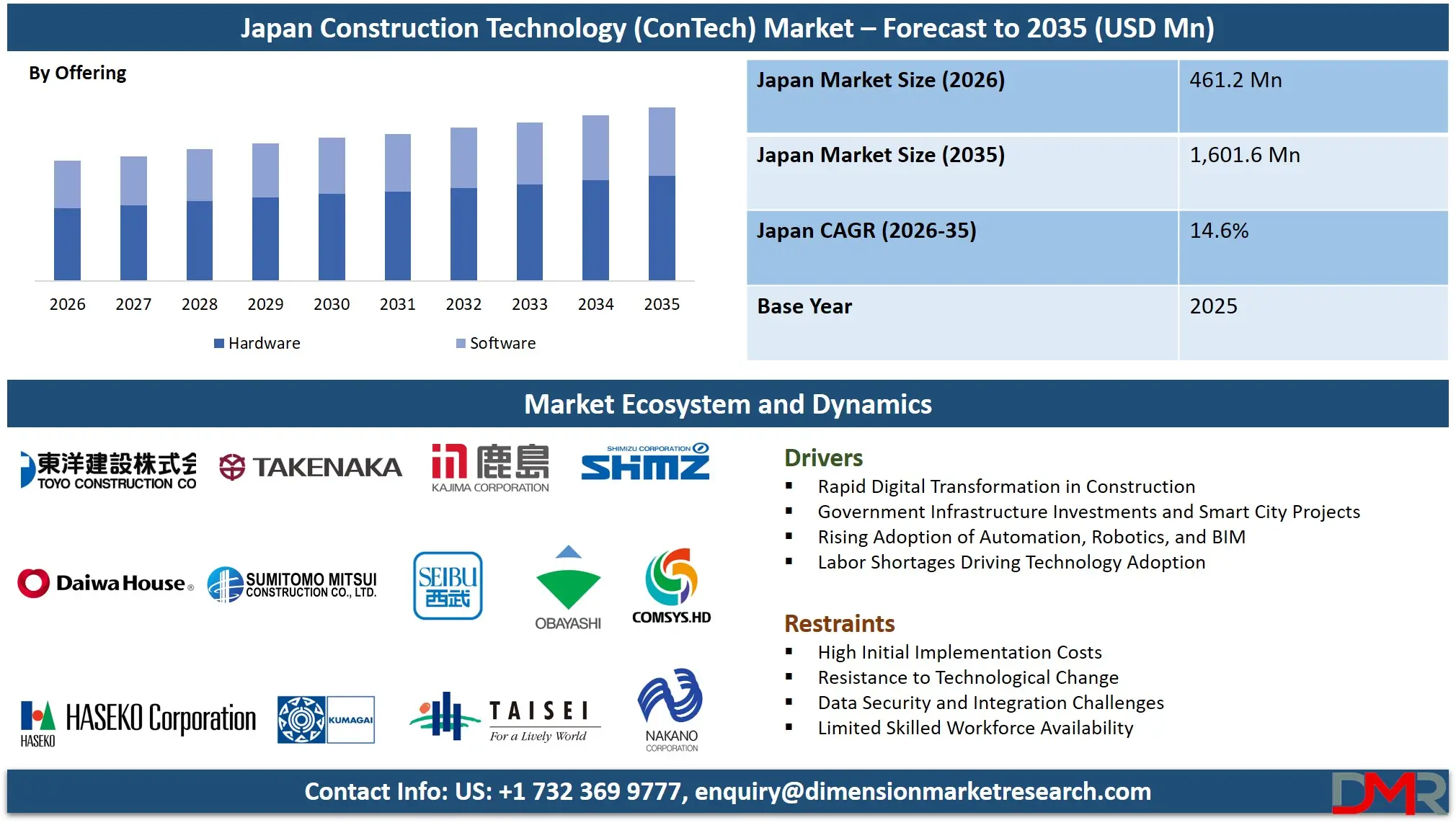
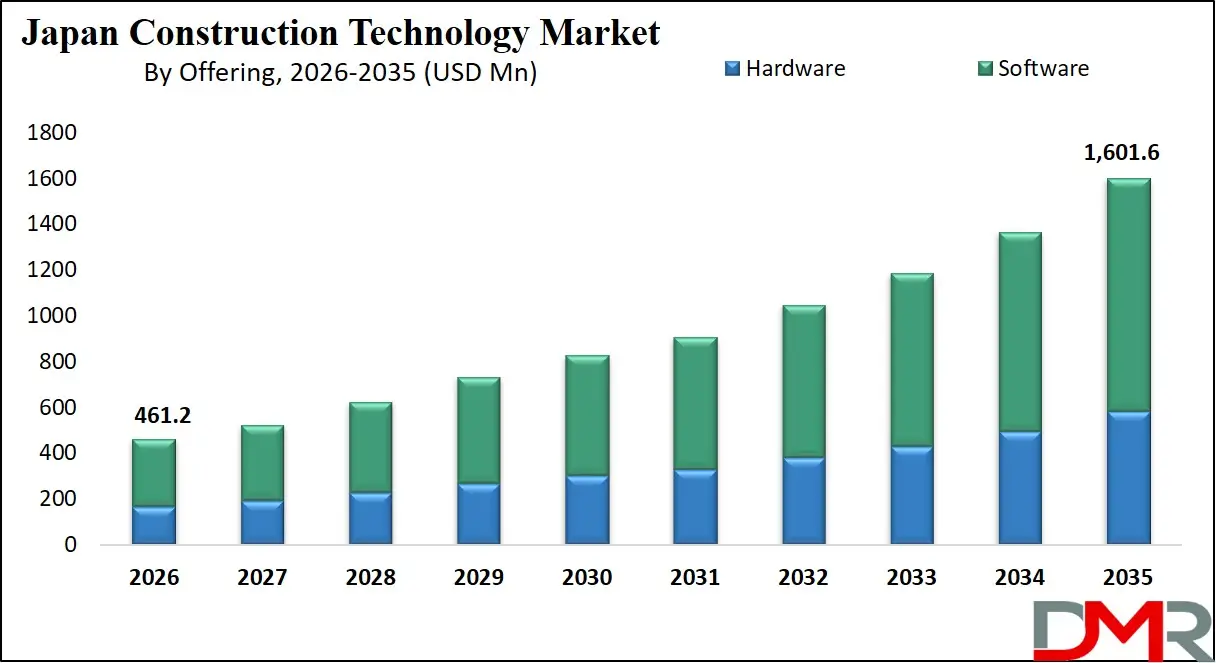
The Japan Construction Technology (ConTech) market is projected to reach USD 461.2 million in 2026 and surge to USD 1,601.6 million by 2035, expanding at a remarkable CAGR of 14.6%. This rapid growth underscores ConTech's critical role in Japan's infrastructure modernization strategy, particularly as the nation addresses aging assets and a shrinking construction workforce. With a declining pool of skilled kenshi and increasing project complexity, Japan is accelerating the adoption of advanced construction technologies, including robotics, automation, and digital engineering platforms, to enhance productivity and operational efficiency.
ℹ
To learn more about this report –
Download Your Free Sample Report Here
The industry is undergoing a structural transformation from labor-intensive practices to digitally enabled, data-driven construction ecosystems. Technologies such as Building Information Modelling (BIM), Digital Twins, Internet of Things (IoT) sensors, and AI-powered project management systems are streamlining workflows across design, execution, and maintenance phases. Government initiatives like "i-Construction" are catalyzing widespread ICT integration, encouraging both large contractors and SMEs to adopt smart construction methodologies. This transition is essential for ensuring precision engineering, improved safety standards, and long-term infrastructure resilience.
Key trends shaping the Japanese ConTech landscape include mandatory BIM adoption for large-scale public infrastructure projects, driving lifecycle integration and real-time collaboration. AutonomoJapan Construction equipment and smart machinery are gaining traction, particularly in hazardous and remote environments, reducing dependency on manual labor. Additionally, augmented reality (AR) and virtual reality (VR) applications are enhancing workforce training, simulation, and remote site monitoring. Modular construction, prefabrication techniques, and sustainable building solutions are also gaining prominence, aligning with green construction goals and circular economy principles.
ℹ
To learn more about this report –
Download Your Free Sample Report Here
Significant growth opportunities are emerging from large-scale infrastructure redevelopment, including bridges, tunnels, and transportation networks built during Japan's post-war boom. Mega projects and smart city initiatives are fostering innovation and creating demand for advanced construction software, robotics, and sensor-based solutions. However, challenges persist, including high capital investment requirements and a widening digital skills gap among construction professionals. Despite these constraints, the ConTech sector remains pivotal to Japan's economic stability, supporting infrastructure development while enabling a transition toward smarter, safer, and more sustainable construction practices.
Japan Construction Technology (ConTech) Market: Key Takeaways
- Market Value: The Japan Construction Technology (ConTech) Market size is estimated to have a value of USD 461.2 million in 2026 and is expected to reach USD 1,601.6 million by the end of 2035.
- By Offering Segment Analysis: Hardware is anticipated to dominate this segment due to high demand for autonomous equipment and robotics, holding a significant market share in 2026.
- By Project Type Segment Analysis: Mega Projects are projected to dominate this segment, driven by large-scale infrastructure developments and urban redevelopment initiatives.
- By Technology Segment Analysis: Robotics & Automation is anticipated to dominate the technology segment, reflecting Japan's leadership in industrial robotics and its application to construction.
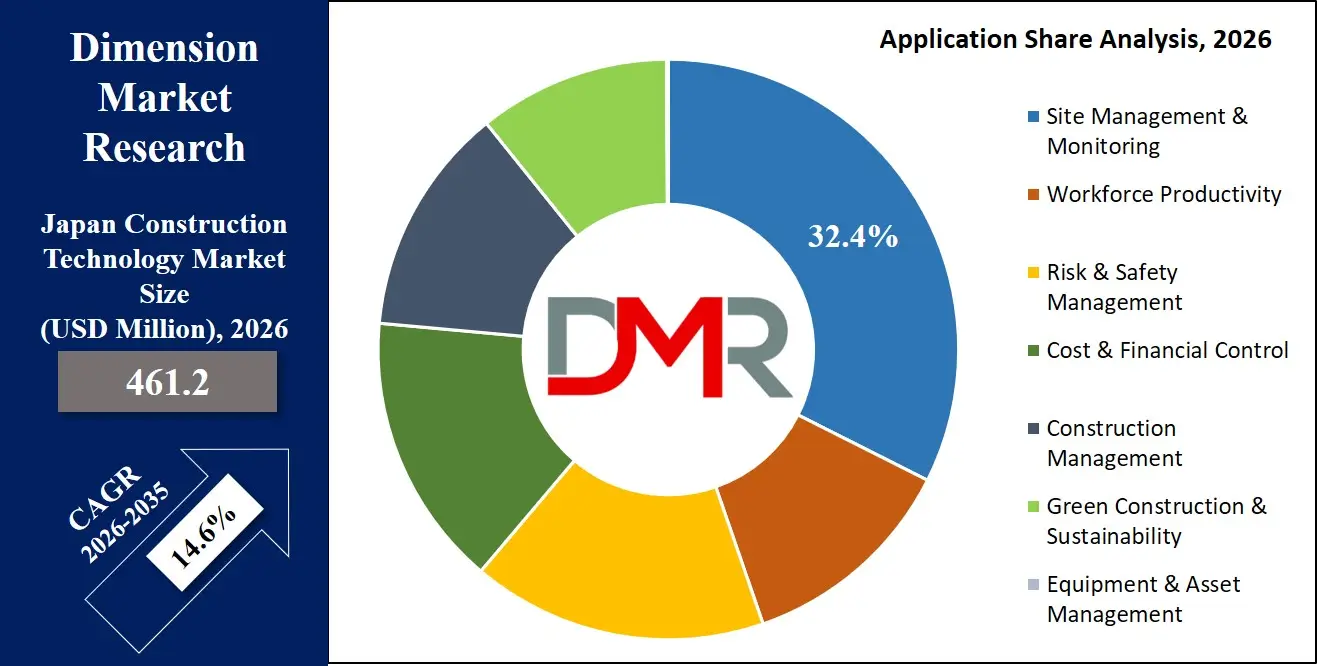
- By Application Segment Analysis: Construction Management is projected to hold the leading position, as integrated software platforms become essential for overseeing complex, tech-enabled projects.
- By End-User Segment Analysis: Contractors, particularly the major general contractors, are projected to dominate the end-user segment as the primary adopters of on-site technologies.
- Key Players: Some of the major key players in the Japan ConTech Market are Komatsu Ltd., Shimizu Corporation, Obayashi Corporation, Kajima Corporation, Takenaka Corporation, Fujita Corporation, TOPCON Corporation, and many others.
- Market Growth Rate: The market is growing at a robust CAGR of 14.6 percent over the forecasted period.
Japan Construction Technology (ConTech) Market: Use Cases
- Mega Project Management: Utilizing Digital Twin technology and AI for complex, multi-billion dollar projects like the Chuo Shinkansen maglev line, allowing for virtual simulation of construction sequences and logistics before physical work begins.
- Workforce Augmentation: Deploying autonomous dump trucks and robotic bricklayers on sites to perform repetitive or dangerous tasks, allowing a smaller, aging workforce to focus on skilled supervision and quality control.
- Disaster-Resilient Infrastructure: Using IoT sensors and AI-powered analytics for the continuous, real-time structural health monitoring of aging bridges, tunnels, and dams, enabling predictive maintenance and preventing failures.
- Safety & Risk Management: Implementing wearable technologies (smart vests, bands) that monitor workers' vital signs and detect falls, combined with computer vision on site cameras to identify unsafe behaviors or conditions instantly.
Japan Construction Technology (ConTech) Market: Stats & Facts
Ministry of Land, Infrastructure, Transport and Tourism (MLIT) / Government Data
- Total construction investment reached ~USD 470 billion in FY2023
- Public works investment accounted for ~USD 155 billion
- Construction contributes ~12% to Japan's GDP
- "i-Construction" implemented in 78% of large public projects
- BIM adoption increased from 48.4% to 58.7% between 2022 and 2024
General Construction & Economic Indicators
- Construction market size reached ~USD 342 billion in 2023
- Construction contributed ~USD 61 billion to GDP
- Residential construction holds 41% market share
- Infrastructure accounts for 27% of construction activity
- Workforce stands at ~4.8–6.1 million workers
Labor & Demographics
- 62% of construction workers are aged 50+
- 36% of workforce is aged 55+
- Only 12% of workers are under 29
- Foreign workers account for 18.7% of workforce
- Average monthly wage reached ~USD 2,800
Technology Adoption (Industry Bodies / Associations)
- 68% of large firms use BIM as of 2023
- BIM adoption ranges between 50–54% among large contractors
- 19% of infrastructure projects use 4D BIM
- 21–23% of projects use AI for cost estimation
- 28% adoption of AI in project management systems
Automation, Robotics & Digital Construction
- Robot usage increased to 28% in demolition activities
- Construction robotics market reached ~USD 8 billion in 2023
- Robots deployed at over 8,000 construction sites
- Autonomous systems reduced tunneling time by 20%
- Autonomous machinery used in 12% of construction sites
Market Dynamic
Driving Factors in Japan Construction Technology (ConTech) Market
Critical Labor Shortage and Aging Workforce
Japan's demographic crisis is the most powerful driver of ConTech adoption. With the construction workforce shrinking and aging, fewer young people entering the trades, the industry faces a stark choice: automate or decline. The demand for robots, automated equipment, and productivity-enhancing software is not just for competitive advantage but for survival. Companies are investing heavily in technology to do more with less, making every worker more productive through exoskeletons, remote operation centers, and AI-assisted project management.
Government-Led Infrastructure Renewal
The Japanese government's commitment to maintaining and upgrading its national infrastructure is a massive growth driver. With much of its infrastructure built 50+ years ago, a "renewal cycle" has begun, requiring sophisticated technologies for inspection, repair, and reinforcement. Furthermore, public investment in disaster prevention and mitigation (e.g., raising seawalls, reinforcing river embankments) continues to be a high priority. These are not simple construction jobs; they require the precision and safety that only modern ConTech can provide.
Restraints in Japan Construction Technology (ConTech) Market
High Initial Investment Costs
The upfront capital required for advanced robotics, drone fleets, and enterprise-wide BIM software remains a significant barrier, particularly for the thousands of small and medium-sized construction firms that dominate the residential and small commercial building sectors. Without significant subsidies or leasing models, this could lead to a two-tiered industry where only large players can afford the efficiency gains of ConTech.
Cybersecurity Vulnerabilities
As construction sites become digitized and connected, they become potential targets for cyberattacks. A ransomware attack on a project's central BIM model or the control systems for autonomous equipment could cause millions in damages and halt work for weeks. This growing threat requires significant investment in cybersecurity measures, which adds another layer of cost and complexity, potentially slowing down the adoption of certain IoT and cloud-based technologies.
Opportunities in Japan Construction Technology (ConTech) Market
Integration of AI and Big Data in Project Management
There is a massive opportunity for software providers offering AI-powered analytics platforms that can predict project delays, optimize supply chains, and manage risk. By integrating data from various sources weather forecasts, material delivery schedules, worker attendance, and equipment telematics these platforms can provide project managers with actionable insights, moving decision-making from reactive to predictive. This is a largely untapped market compared to physical robotics.
Expansion of Green ConTech Solutions
With Japan's pledge to achieve carbon neutrality by 2050, there is a growing opportunity for technologies that enable green construction. This includes software for optimizing material use to reduce waste, platforms for tracking and verifying the carbon footprint of a building, and new hardware for prefabricating highly energy-efficient building modules. Technologies that facilitate the use of sustainable materials like cross-laminated timber (CLT) in place of steel and concrete are also poised for significant growth.
Trends in Japan Construction Technology (ConTech) Market
Mandate for BIM and Digital Workflows
The Japanese construction sector is undergoing a profound digital transformation, largely driven by MLIT mandates requiring the use of BIM for all major public works projects. This is moving the industry from 2D drawings to collaborative, data-rich 3D models. This trend is forcing a cultural shift across the supply chain, requiring subcontractors, material suppliers, and even architects to standardize their workflows around a single digital source of truth. This enhances clash detection, improves cost estimation, and provides a detailed digital record for facility management, cementing Japan's move toward fully integrated project delivery.
Autonomous Machinery and "Smart Construction"
Pioneered by equipment manufacturers like Komatsu, "Smart Construction" is rapidly becoming the standard, not the exception. This trend involves the use of autonomous or semi-autonomous heavy machinery (dozers, excavators, dump trucks) guided by GPS and 3D data. This allows for 24/7 operation in controlled environments, drastically reduces human error in grading and excavation, and enhances safety by removing workers from high-risk zones. The trend is extending from large earthmoving projects to more specialized tasks like automated rebar tying and concrete finishing.
Research Scope and Analysis
By Offering Analysis
Software is projected to dominate Japan's ConTech market, with Building Information Modeling (BIM) platforms acting as the central driver of digital transformation. In Japan, BIM adoption is strongly supported by government policies and guidelines from the Ministry of Land, Infrastructure, Transport and Tourism, particularly for public infrastructure and large-scale urban development projects. BIM enables seamless collaboration among multiple stakeholders, improves design accuracy, reduces rework, and enhances lifecycle asset management critical in a country focused on infrastructure resilience and disaster preparedness.
Cloud-based BIM solutions further strengthen software dominance by enabling real-time collaboration across dispersed teams and integration with enterprise systems, IoT sensors, and digital twin platforms. As Japan emphasizes energy-efficient buildings and sustainable urban planning, BIM plays a crucial role in energy modeling, carbon footprint analysis, and material optimization. Complementary tools such as Common Data Environments (CDEs), digital estimating platforms, and reality capture solutions are also gaining traction. With labor shortages and rising construction complexity, software solutions that enhance productivity, transparency, and cost efficiency are becoming indispensable, ensuring software remains the leading offering segment.
By Project Type Analysis
Commercial and Industrial (C&I) projects are expected to dominate Japan's ConTech market due to their scale, complexity, and strong return-on-investment requirements. This segment includes offices, logistics centers, manufacturing facilities, healthcare infrastructure, and data centers sectors experiencing significant expansion in Japan. The growth of e-commerce and logistics infrastructure, along with increasing demand for data centers and smart manufacturing facilities, is driving adoption of advanced construction technologies. BIM, digital twins, AI-driven scheduling, and modular construction techniques are widely used to enhance efficiency and reduce project timelines. Additionally, strict energy efficiency regulations and sustainability goals are encouraging the use of smart building technologies. The combination of high capital investment, technological complexity, and performance expectations ensures that the commercial and industrial segment remains the primary driver of ConTech innovation in Japan.
By Technology Analysis
Artificial Intelligence (AI) and Machine Learning (ML) are expected to lead the technology landscape in Japan's ConTech market due to their ability to address productivity challenges and workforce shortages. AI-driven solutions are widely used for predictive scheduling, automated design optimization, safety monitoring, and cost forecasting, enabling contractors to improve efficiency and reduce risks.
Japan's advanced technological ecosystem, supported by strong R&D capabilities and leading industrial players, accelerates AI adoption in construction. Integration of AI with BIM and IoT enables real-time decision-making, predictive maintenance of equipment, and enhanced site safety. AI-powered generative design tools allow engineers to explore multiple design alternatives quickly, improving structural performance and sustainability outcomes. Additionally, automation of administrative tasks and documentation reduces operational burdens. With proven efficiency gains and scalability through cloud-based platforms, AI and ML are becoming central to Japan's smart construction ecosystem.
By Application Analysis
Project Management, Scheduling, and Coordination are projected to dominate the application segment in Japan's ConTech market. Construction projects in Japan involve complex stakeholder networks, requiring precise coordination to ensure timely and cost-effective delivery. Digital project management platforms centralize communication, documentation, and workflows, reducing errors and improving accountability.
ℹ
To learn more about this report –
Download Your Free Sample Report Here
Modern cloud-based solutions integrate with BIM for 4D scheduling, enabling real-time visualization of construction sequences. Mobile-enabled tools support field data collection, issue tracking, and performance monitoring, enhancing operational efficiency. These platforms also facilitate lean construction practices, efficient material management, and compliance with strict safety and quality standards. As project complexity increases, the demand for integrated project management solutions continues to grow, reinforcing this segment's dominance.
By End User Analysis
The Japan ConTech market is shaped by diverse end users adopting digital technologies to address specific operational needs. General contractors and construction managers represent the largest segment, utilizing integrated platforms for project planning, cost control, and safety compliance. Their focus on efficiency and risk management drives widespread adoption of ConTech solutions. Owners and developers are increasingly investing in digital technologies to enhance project predictability, lifecycle asset management, and sustainability performance. Specialty trade contractors, including electrical and mechanical firms, are adopting technologies such as BIM detailing, prefabrication tools, and layout automation to improve precision and productivity. Meanwhile, engineering and architectural firms rely heavily on advanced design software, generative design tools, and performance analysis systems to drive innovation and meet regulatory requirements. This diverse adoption landscape supports sustained market growth.
The Construction Technology (ConTech) Market Report is segmented on the basis of the following:
By Offering
- Hardware
- Drones
- 3D Printing
- Autonomous Equipment
- Robotic Bricklaying
- Others
- Software
- Building Information Modelling (BIM)
- Construction Automation
- Wearable Technologies
- Visual Technologies
By Project Type
- Residential
- Commercial
- Industrial
- Mega Projects
By Technology
- Artificial Intelligence (AI) & Machine Learning
- Robotics & Automation
- Internet of Things (IoT) & Smart Sensors
- Augmented Reality (AR) & Virtual Reality (VR)
- Prefabrication & Modular Construction
- Digital Twin Technology
- Blockchain & Smart Contracts
By Application
- Site Management & Monitoring
- Workforce Productivity
- Risk & Safety Management
- Cost & Financial Control
- Construction Management
- Green Construction & Sustainability
- Equipment & Asset Management
By End User
- Contractors
- Builders & Owners
- Architects & Designers
- Government & Public Sector
- Material Suppliers & OEMs
- Facilities Managers
Impact of AI on the Japan ConTech Market
- Predictive Analytics for Project Optimization: AI is revolutionizing project planning and execution by enabling predictive analytics that forecast potential delays, cost overruns, and resource bottlenecks. Machine learning algorithms analyze historical project data, weather patterns, material lead times, and workforce availability to generate accurate predictions. This allows contractors like Kajima Corporation and Shimizu Corporation to proactively adjust schedules, optimize resource allocation, and mitigate risks before they materialize, significantly improving on-time and on-budget project delivery.
- Enhanced Site Safety through Computer Vision: AI-powered computer vision systems are transforming safety management on construction sites across Japan. Cameras and drones equipped with AI algorithms continuously monitor site activities to detect unsafe behaviors such as workers not wearing hard hats, unauthorized entry into hazardous zones, or unsafe equipment operation. These systems provide real-time alerts to site managers, enabling immediate intervention. Given Japan's stringent safety culture and aging workforce, this application is critical for reducing workplace accidents and ensuring compliance with occupational safety standards.
- Quality Control and Defect Detection: AI is significantly enhancing quality assurance processes through automated defect detection and structural integrity analysis. Using image recognition and deep learning, AI systems can identify cracks, uneven surfaces, or deviations from BIM models with greater accuracy and speed than manual inspections. This capability is particularly valuable for Japan's extensive infrastructure renewal projects, where AI-powered drones and cameras inspect aging bridges, tunnels, and dams, enabling early detection of deterioration and facilitating predictive maintenance that extends asset life and ensures public safety.
Competitive Landscape
The competitive landscape in the Japan Construction Technology (ConTech) Market is a dynamic mix of established industrial giants, innovative startups, and the construction firms themselves who are developing in-house solutions. The market is characterized by strong domestic players with deep technological expertise and long-standing client relationships. Major companies are strategizing around developing integrated platforms that combine hardware and software, such as Komatsu's Smart Construction, which links its autonomous machinery with drone-based surveying and AI-powered analytics.
ℹ
To learn more about this report –
Download Your Free Sample Report Here
Leading players include construction giants like Shimizu Corporation, Obayashi Corporation, Kajima Corporation, and Takenaka Corporation, which are not only adopters but also developers of robotics and BIM systems. In the hardware and equipment space, Komatsu Ltd. and TOPCON Corporation are dominant, providing the autonomous machinery and precision positioning technology that power modern sites. Global software providers like Autodesk and Bentley Systems are key players in the BIM and project management software space, while a growing ecosystem of specialized Japanese startups is emerging in areas like AI-powered site monitoring and robotics.
Mergers, partnerships, and strategic alliances are common and crucial for success. For instance, technology companies often partner with construction firms to test and refine new robotics on actual job sites. The strong governmental support for "i-Construction" and related initiatives encourages collaboration between public research institutions and private enterprises. While established giants have the advantage of scale and capital, the market is becoming increasingly competitive as nimble startups offer niche, innovative solutions. The intense competitive landscape provides ample opportunities for both established players and new entrants, with the ultimate goal of solving Japan's most pressing construction challenges through technology.
Some of the prominent players in Japan Construction Technology (ConTech) Market are:
- Kajima Corporation
- Shimizu Corporation
- Taisei Corporation
- Takenaka Corporation
- Obayashi Corporation
- Sumitomo Mitsui Construction
- Kumagai Gumi
- Haseko Corporation
- COMSYS Holdings
- Nakano Corporation
- Daiwa House Industry
- Toyo Construction
- Seibu Construction
- Oriental Shiraishi Corporation
- Totetsu Kogyo
- Nihon Sekkei
- Fujitsu
- NEC Corporation
- Autodesk Japan
- Trimble Japan
- Other Key Players
Recent Developments in Japan Construction Technology (ConTech) Market
- November 2024: Komatsu Ltd. unveiled a new generation of fully autonomous excavators for its Smart Construction fleet, capable of performing complex digging and loading tasks without any human operator in the cab, controlled remotely from a centralized command center.
- September 2024: Shimizu Corporation announced a strategic partnership with a leading AI startup to develop a predictive analytics platform that forecasts potential delays and safety hazards on construction sites by analyzing real-time data from IoT sensors and site cameras.
- August 2024: The MLIT announced an expansion of its BIM mandate, requiring its use for all public building projects over a certain size, further accelerating the digital transformation of the country's construction sector.
- December 2023: Obayashi Corporation successfully demonstrated the use of a large-scale 3D printer to manufacture and install a complex, curved pedestrian bridge component, showcasing the potential of additive manufacturing in infrastructure.
- October 2023: TOPCON Corporation launched a new GNSS receiver and positioning system specifically designed for construction, offering centimeter-level accuracy for machine control and autonomous vehicle guidance, even in challenging urban canyons.
- May 2023: Kajima Corporation developed a new robotic system for automated rebar arrangement and tying, aimed at significantly reducing the manual labor required for reinforced concrete structures, a critical bottleneck in many projects.
Report Details
| Report Characteristics |
| Market Size (2026) |
USD 461.2 Mn |
| Forecast Value (2035) |
USD 1,601.6 Mn |
| CAGR (2026–2035) |
14.6% |
| Historical Data |
2021 – 2025 |
| Forecast Data |
2027 – 2035 |
| Base Year |
2025 |
| Estimate Year |
2026 |
| Report Coverage |
Market Revenue Estimation, Market Dynamics, Competitive Landscape, Growth Factors and etc. |
| Segments Covered |
By Offering (Hardware, Software), By Technology (Artificial Intelligence (AI) & Machine Learning, Robotics & Automation, Internet of Things (IoT) & Smart Sensors, Augmented Reality (AR) & Virtual Reality (VR), Prefabrication & Modular Construction, Digital Twin Technology, Blockchain & Smart Contracts), By Application (Site Management & Monitoring, Workforce Productivity, Risk & Safety Management, Cost & Financial Control, Construction Management, Green Construction & Sustainability, Equipment & Asset Management), By End User (Contractors, Builders & Owners, Architects & Designers, Government & Public Sector, Material Suppliers & OEMs, Facilities Managers), By Project Type (Residential, Commercial, Industrial, Mega Projects) |
| Country Coverage |
Japan |
| Prominent Players |
Kajima Corporation, Shimizu Corporation, Taisei Corporation, Takenaka Corporation, Obayashi Corporation, Sumitomo Mitsui Construction, Kumagai Gumi, Haseko Corporation, COMSYS Holdings, Nakano Corporation, Daiwa House Industry, Toyo Construction, Seibu Construction, Oriental Shiraishi Corporation, Totetsu Kogyo, Nihon Sekkei, Fujitsu, NEC Corporation, Autodesk Japan, Trimble Japan, and Other Key Players |
| Purchase Options |
We have three licenses to opt for: Single User License (Limited to 1 user), Multi-User License (Up to 5 Users) and Corporate Use License (Unlimited User) along with free report customization equivalent to 0 analyst working days, 3 analysts working days and 5 analysts working days respectively. |
Frequently Asked Questions
How big is the Japan Construction Technology (ConTech) Market?
▾ The Japan Construction Technology (ConTech) Market size is estimated to have a value of USD 461.2 million in 2026 and is expected to reach USD 1,601.6 million by the end of 2035.
Who are the key players in the Japan Construction Technology (ConTech) Market?
▾ Some of the major key players in the Japan Construction Technology (ConTech) Market are Komatsu Ltd., Shimizu Corporation, Obayashi Corporation, Kajima Corporation, Takenaka Corporation, TOPCON Corporation, and many others.
What is the growth rate in the Japan Construction Technology (ConTech) Market?
▾ The market is growing at a CAGR of 14.6 percent over the forecasted period.