What is the Consumer Electronics Market Size?
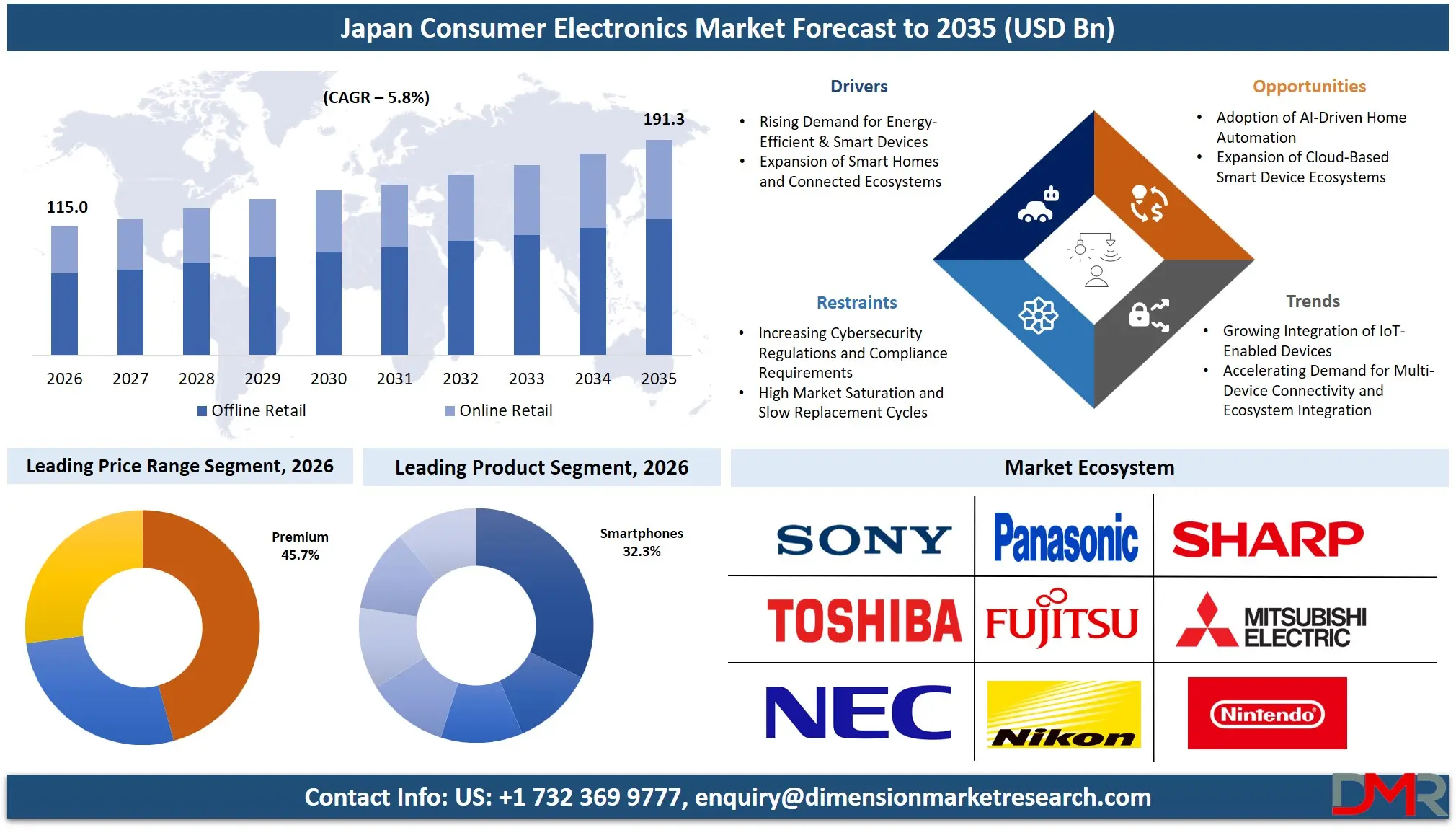
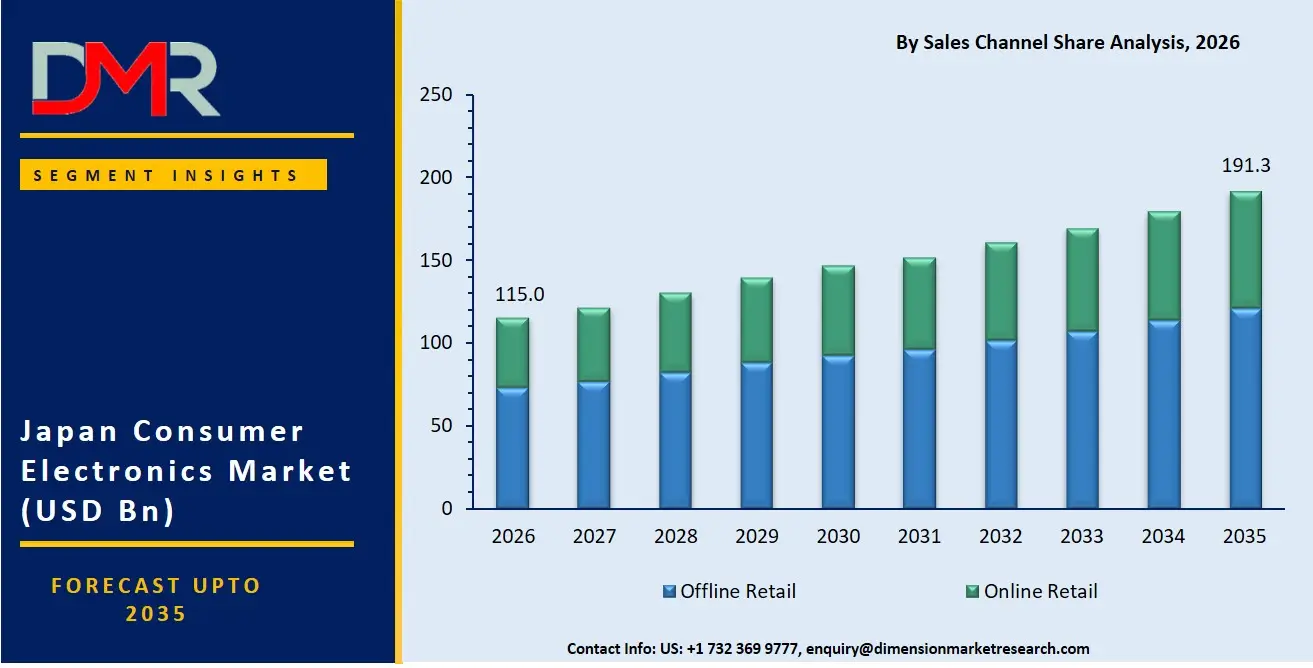
The Japan Consumer Electronics (FCV) Market is expected to reach a value of USD 115.0 billion in 2026, and it is further anticipated to reach USD 191.0 billion by 2035, growing at a CAGR of 5.8% during the forecast period.
ℹ
To learn more about this report –
Download Your Free Sample Report Here
The consumer electronics market has been showing consistent growth due to Japan's rising dependence on resilient, intelligent, and connected devices for effective, secure, and scalable digital lifestyles. This includes several product platforms and expert services that help consumers and enterprises deploy smart solutions for residential, commercial, and industrial purposes. There has been a rising need for professional services owing to the requirements for implementing advanced smart home infrastructure, securing operational continuity against supply disruptions, and delivering high-performance automation systems to customers. Large enterprises have emerged as the largest consumer segment for consumer electronics services, with smart technology products being the most popular choice due to their wide availability and reliability, while there has been rapid growth in hybrid technology platforms and analytics services.
ℹ
To learn more about this report –
Download Your Free Sample Report Here
Key Takeaways
- Market Size & Forecast: The Japan Consumer Electronics market is forecasted to be valued at USD 115.0 billion in 2026, growing incrementally to USD 191.3 billion by 2035, due to the joint efforts of digital strategy deployment on the part of enterprises as well as the obligatory deployment of zero-emission and energy-efficient technologies.
- Growth Rate & Outlook: Japan market is expected to grow at 5.8% CAGR, propelled by the urgent need to mitigate emerging renewable energy intermittency vulnerabilities in device charging, alongside increasing challenges in orchestrating multi-directional power flows from residential solar, commercial buildings, and industrial facilities.
- Primary Growth Drivers: Major driving factors comprise the transition from traditional standalone electronics towards modern intelligent connected systems, the necessity to deploy secure and robust communication networks for IoT devices, as well as the implementation of device management APIs necessitating unique platform & services expertise.
- Key Market Trends: Major trends encompass the introduction of AI-driven home automation through commercial channels, usage of machine learning within wide area networks for demand forecasting and preventing power waste in electronics, and increased focus on cybersecurity amidst rising consumer safety considerations of regulators.
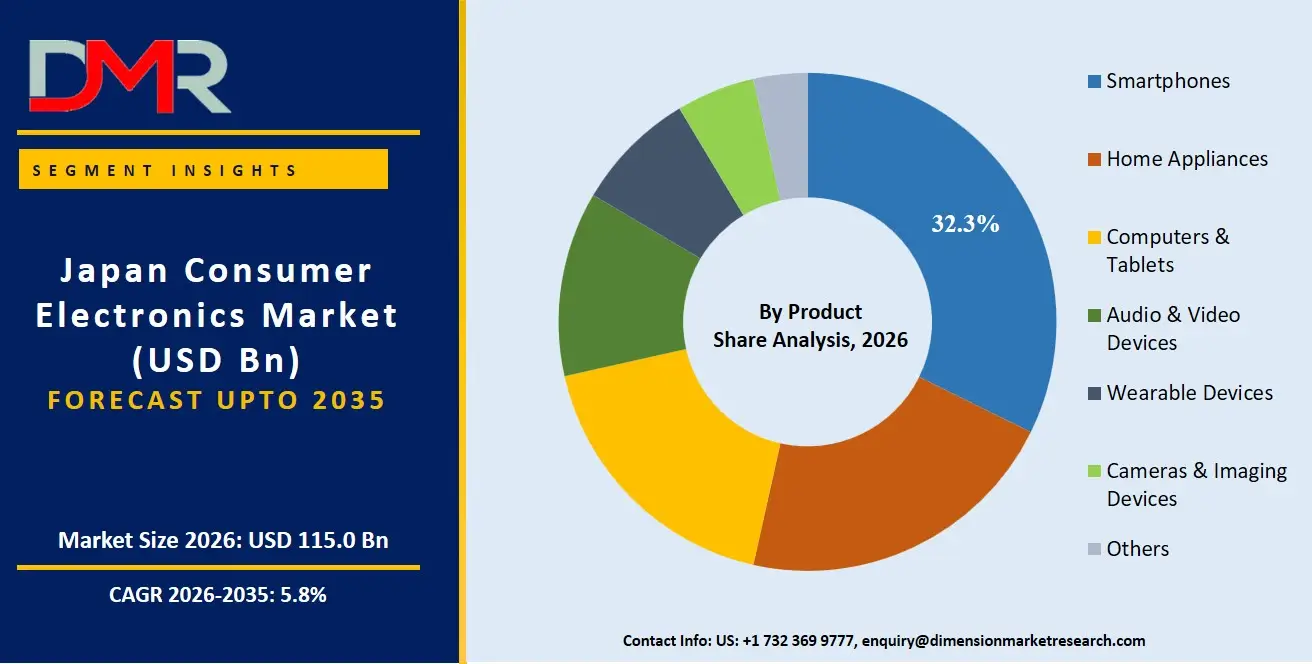
- By Product Analysis: The smartphones segment is projected to dominate the Japan Consumer Electronics Market due to high demand for scalable connectivity and sensing platforms by individual consumers, with capabilities like real-time monitoring, fault detection, and remote control, which offer daily operations, regional balancing, and real-time performance monitoring activities within digital life management.
- By Technology Type Analysis: The Smart Technology segment is projected to dominate the Japan Consumer Electronics Market due to its high bandwidth, reliability, capability for long-distance communication, and use in home automation, enterprise device management, and conservation voltage reduction for metropolitan areas, industrial zones, and government infrastructure.
- By End-User Analysis: The Individual Consumers segment is anticipated to dominate in the Japan Consumer Electronics Market as households adopt systems that are scalable, flexible, efficient, accessible for real-time billing, provide AI-based consumption analytics, telematics integration, business continuity, and grid operations at a higher resolution.
What is Consumer Electronics?
Consumer electronics are about the unique set of platforms and expertise involved in operating intelligent, digitally-enabled personal and household devices. These electronics, unlike conventional devices, pertain to "the how and where" of high-reliability, real-time energy and data management. It entails having a smart platform to provide the means through which devices are monitored and controlled for optimal performance, and services to help integrate home management, manage demand response costs, and optimize load balancing. As companies take charge of their decarbonization commitments, it is important to have services that ensure that electronics will be operated successfully while maintaining cost and safety measures.
Use Cases
- Smart Home Resilience: Individual consumers employ Consumer Electronics Services for the installation of home automation solutions that include real-time fault detection and outage notifications to avoid supply interruptions and increase operational trust.
- Hospital Device Reliability: Hospital networks rely on Consumer Electronics Platforms for deploying uninterruptible power supply integration for medical devices, ensuring stable, zero-outage operation, and maintaining compliance with regional health and safety mandates.
- Public Infrastructure Services: Municipal authorities incorporate device management APIs to push voltage schedules and grid adherence notifications to central control centers in real-time for public electronics.
- Industrial Demand Response: Manufacturing organizations leverage energy analytics platforms in a cloud-based telematics suite to initiate geo-targeted load shedding for electronics during peak energy pricing seasons.
How AI is Transforming the Consumer Electronics Market?
AI is revolutionizing the consumer electronics industry through increased demand forecasting and predictive maintenance capabilities. The analytics platform suite includes AI-based systems that detect consumption anomalies and device inefficiencies in order to resolve them instantaneously, thereby preventing any financial losses and operational damage. In addition, the AI-driven functions of device management services help organizations assess usage behavior, determine optimal power schedules, and customize their outage planning. AI forms an essential part of governance and customer trust initiatives. Professional services involve intelligent agents that monitor compliance and keep device maintenance logs free of any non-compliant entries while ensuring that all operations comply with regulations and the stringent cybersecurity protocols in Japan.
Market Dynamics
Key Drivers in the Japan Consumer Electronics Market
Rising Demand for Energy-Efficient & Smart Devices
The AI industry is revolutionizing the Japanese consumer electronics industry through improved efficiency, intelligence, and personalization of the products. The current consumer electronics include phones, smart TVs, home appliances, and wearables that are becoming more sophisticated and advanced through artificial intelligence technology to enhance their functionality, extend their battery life, and make the overall user experience better. Smart devices can understand customer behaviors, automate controls, and increase performance without any effort from customers. Due to Japanese consumers' emphasis on high quality and innovation, energy efficient and AI-powered electronics are being adopted rapidly. Manufacturers are also adding predictive diagnostic and maintenance features in their products to reduce failure rates and prolong product life span.
Expansion of Smart Homes and Connected Ecosystems
Smart home ecosystems are one of the biggest growth drivers in the consumer electronics market in Japan. Today, there are a lot of connected gadgets like smart TVs, speakers, refrigerators, air conditioners, wearables, which are all functioning within an ecosystem where they can communicate with each other for automation and remote control of various processes. Smart home solutions can be beneficial especially when taking into account the increasing elderly demographic in Japan. Moreover, with the rise of digitalization and urbanization, consumers have started to opt for integrated solutions rather than separate gadgets. The development of IoT consumer electronics helps to make homes smarter and more convenient for residents.
Restraints in the Japan Consumer Electronics Market
Increasing Cybersecurity Regulations and Compliance Requirements
The consumer electronics market in Japan is under growing pressure because of the stringent laws and regulations concerning cybersecurity and data protection. With consumer electronics increasingly becoming connected and based on cloud computing technology, issues like data security, data breaches, and cybersecurity threats have gained prominence. Companies producing consumer electronics must ensure the use of advanced encryption technology, secure authentication, and clear data management policies. This makes the manufacture and launch of consumer electronics challenging, lengthy, and costly processes. Also, regular updates of regulations in Japan mean that there will be continual updates and improvements in the systems used in consumer electronics. Failure to adhere to the regulations leads to consequences such as product recalls and losses in reputation.
High Market Saturation and Slow Replacement Cycles
The Japanese market is among the most developed consumer electronics markets due to high levels of product saturation in various segments including mobile phones, TVs, laptops, and household appliances. This makes it difficult for companies operating in this environment to attract new customers; instead, they will have to rely mainly on replacement sales since consumers prefer using their products for extended periods of time because of their superior quality and high durability. Some products also enjoy continuous innovation, which makes it less urgent for people to replace them. The market is therefore constrained by high saturation, making rapid growth unlikely.
Growth Opportunities in the Japan Consumer Electronics Market
Adoption of AI-Driven Home Automation
Home automation driven by AI technology is a potential growth area in the Japan consumer electronics market. With rising consumer adoption of smart systems that enable them to control everything from their lights to their security system, entertainment appliances, and other home appliances using their phones or voice assistants, there is a growing trend toward intelligent homes that offer convenience and energy efficiency. In Japan, the limited space and efficiency of urban housing units makes the use of automation technology even more appealing. Moreover, recent developments in artificial intelligence and machine learning have allowed systems to have predictive capabilities such as automated temperature regulation.
Expansion of Cloud-Based Smart Device Ecosystems
Ecosystems that run in the cloud represent an upcoming area of opportunities within the consumer electronics industry in Japan. Modern devices like smartphones, wearables, and household appliances have become connected to cloud systems that can provide synchronization, remote monitoring, and constant software updates. This helps increase the functionality of such devices, improve their performance, and create tailored solutions for the users. The connection of devices to the cloud can also provide for preventive maintenance. Japanese consumers appreciate a smooth experience in the digital world, which makes cloud-based ecosystems very appealing to them. The popularity of the digital subscription model in Japan and the development of cloud-linked devices help drive the ecosystem trend.
Trends in the Japan Consumer Electronics Market
Growing Integration of IoT-Enabled Devices
The incorporation of IoT-based products is a crucial development that has been driving the consumer electronics market in Japan. Consumers are relying heavily on connected products that can easily be managed through smartphones, home appliances, and entertainment devices. The use of IoT technology has facilitated real-time tracking and control of multiple devices from anywhere and at any time. This has brought about a lot of efficiency in managing devices in the consumer's house. In Japan, the presence of good digital networks and high technology usage among individuals has made IoT adoption faster among consumer electronics.
Accelerating Demand for Multi-Device Connectivity and Ecosystem Integration
Another notable trend in the consumer electronics market in Japan involves the rising need for multi-device connectivity. Consumers nowadays desire a system whereby the various gadgets such as smartphones, laptops, tablets, and other smart devices work together in harmony. The integration provides convenience to consumers through features such as data exchange and connectivity across various devices. Leading companies have embraced their own ecosystems in order to ensure that customers remain on their interconnected products. The consumer electronics market in Japan is greatly characterized by this trend because of the high level of preference among Japanese customers for sophisticated technologies.
Research Scope and Analysis
The Japan Consumer Electronics Market is segmented by product, technology type, price range, sales channel, and end-user. The market supports residential device management, commercial demand response, industrial automation, and government infrastructure across individual consumers, small businesses, large enterprises, educational institutions, and government agencies through cloud-based and on-premise device management solutions.
ℹ
To learn more about this report –
Download Your Free Sample Report Here
By Product Analysis
Smartphones are expected to lead the Japan Consumer Electronics Market in 2026 with a projected market share of 32.3% as a result of individual consumers' growing preference for scalable connectivity and sensing platforms. Japanese consumers have developed a preference for smartphones, computers & tablets, and home appliances for performing such functions as consumption tracking, outage detection, and real-time voltage control. Computers & Tablets are likely to occupy the second place due to the rising trend in favor of AI-driven analytics and device optimization across home networks. Home Appliances, though currently growing steadily, is expected to continue its growth as a consequence of increased knowledge about system integration and ongoing maintenance requirements, particularly for smart home modernization projects in Tokyo, Osaka, and Nagoya. Audio & Video Devices, Wearable Devices, Cameras & Imaging Devices, and Others collectively account for the remaining share, with Wearable Devices experiencing the fastest growth due to health-conscious aging demographics in Japan.
By Technology Type Analysis
Smart Technology is projected to dominate the Japan Consumer Electronics Market in 2026, with an estimated share of 45.3%, owing to its widespread adoption in home automation, enterprise device management, and government infrastructure monitoring. Japanese consumers and energy aggregators favor smart technology because it provides reliable long-distance communication along with high bandwidth and low latency. Traditional Technology follows, driven by persistent demand for basic, low-cost electronics in rural households and among price-sensitive elderly populations. Hybrid Technology is primarily used by residential prosumers with rooftop solar systems and home energy management systems that require both offline and online capabilities. Other technology types are growing rapidly due to increased sensor deployments for grid-edge monitoring and distributed energy resource aggregation in rural and semi-urban areas with limited existing infrastructure.
By Price Range Analysis
The Premium segment is expected to lead with 45.7% share in 2026, driven by strong demand for high-quality, durable, and technologically advanced devices. Consumers prefer flagship smartphones, premium home appliances, high-end audio systems, and advanced wearables offering superior performance, innovation, and longer lifecycles. Demand is concentrated in major cities such as Tokyo, Osaka, and Yokohama, where higher purchasing power supports premium adoption. The Mid-Range segment follows, supported by consumers seeking a balance between affordability and advanced features. Japanese households and professionals prefer mid-priced electronics with smart functions, energy efficiency, and reliable performance, making it a strong segment across smartphones, laptops, and home appliances. The Budget segment holds a smaller share, driven by students, part-time workers, and secondary device users. Demand is mainly for entry-level smartphones, basic appliances, and accessories, with purchases largely replacement-driven rather than primary ownership.
By Sales Channel Analysis
Offline Retail is anticipated to dominate the Japan Consumer Electronics Market in 2026 with an estimated share of 62.3%, owing to Japanese consumers' strong preference for in-person product inspection, after-sales service, and same-day purchase fulfillment. Major electronics chains such as Yodobashi Camera, Bic Camera, and Yamada Denki continue to attract consumers through loyalty programs, hands-on demonstration areas, and integrated repair services. Online Retail is expected to grow at a rapid rate, driven by the expansion of Amazon Japan, Rakuten, and manufacturer direct-to-consumer platforms, as well as increasing digital literacy among younger Japanese consumers and the convenience of home delivery for bulky home appliances.
By End-User Analysis
Individual Consumers is set to dominate the Japan Consumer Electronics Market in 2026 with a projected share of 39.3%, thanks to its high deployment penetration, government-backed rollout programs for smart home incentives, and low complexity for end-users. Consumer electronics enable real-time billing, remote disconnect capabilities, and granular consumption analytics that do not necessitate additional hardware investment. Small Businesses will experience robust growth in the coming years because of heightened preference for fault detection and service restoration reliability in retail, hospitality, and local services. Large Enterprises are driven by bulk procurement for office automation, remote work infrastructure, and energy management systems across corporate campuses. Educational Institutions are growing rapidly as schools and universities adopt tablets, computers, and smart classroom devices under Japan's GIGA School Program. Government Agencies primarily deploy electronics for public safety, municipal services, and disaster response communication systems in densely populated prefectures to reduce peak demand and improve operational efficiency.
The Japan Consumer Electronics Market Report is segmented based on the following:
By Product
- Smartphones
- Computers & Tablets
- Home Appliances
- Audio & Video Devices
- Wearable Devices
- Cameras & Imaging Devices
- Others
By Technology Type
- Smart Technology
- Traditional Technology
- Hybrid Technology
- Others
By Price Range
By Sales Channel
- Offline Retail
- Online Retail
By End-User
- Individual Consumers
- Small Businesses
- Large Enterprises
- Educational Institutions
- Government Agencies
- Others
Competitive Landscape
The dynamics of competition in the Japan Consumer Electronics marketplace have developed to become increasingly dynamic, with a wide range of multinational technology providers and Japanese electronics companies specializing in various niche device categories such as smartphones, home appliances, imaging systems, and audio devices. The essential ingredient for success is found in deep-seated strategic partnerships with component suppliers, retail distributors, and platform ecosystem partners in Japan, which strengthen supply chains and enable premium device services to be delivered alongside core products. Market consolidation trends are moving rapidly ahead, with established players in the consumer electronics industry acquiring specialized AI, software, and analytics capability providers to enhance smart device functionality and predictive performance features. Proprietary intellectual property rights, with AI-based optimization algorithms and smart device ecosystem integration, hold increasing importance compared to just competitive hardware pricing and standalone device performance.
Some of the prominent players in the Japan Consumer Electronics Market are:
- Sony Group Corporation
- Panasonic Holdings Corporation
- Sharp Corporation
- Toshiba Corporation
- Hitachi, Ltd.
- Mitsubishi Electric Corporation
- Fujitsu Limited
- NEC Corporation
- Nintendo Co., Ltd.
- Canon Inc.
- Nikon Corporation
- Seiko Epson Corporation
- JVCKENWOOD Corporation
- Casio Computer Co., Ltd.
- Yamaha Corporation
- Kyocera Corporation
- Alps Alpine Co., Ltd.
- FUJIFILM Holdings Corporation
- Pioneer Corporation
- Ricoh Company, Ltd.
- Other Key Players
Recent Developments
- May 2026: Sony Group Corporation announced its new Bravia 9 II and Bravia 7 II premium television lineup ahead of the planned integration of its home entertainment business into a joint venture with TCL Electronics Holdings, strengthening its premium TV and home audio portfolio strategy in the global consumer electronics market.
- May 2026: Panasonic Holdings Corporation introduced its next-generation Fire TV-integrated 4K OLED VIERA "Z95C Series" televisions featuring upgraded Primary RGB Tandem OLED panel technology and enhanced immersive audio capabilities, reinforcing its premium smart television product ecosystem in Japan.
- May 2026: Sharp Corporation unveiled its 2026 AQUOS television lineup, including OLED and Mini-LED models integrated with the company's new "AQUOS AI" generative AI platform, expanding AI-enabled smart home entertainment offerings in the Japanese consumer electronics market.
- May 2026: Nintendo Co., Ltd. increased the domestic price of Nintendo Switch 2 by JPY 10,000 due to rising semiconductor memory costs and global supply chain pressures, highlighting ongoing component cost inflation across the gaming hardware and consumer electronics industry.
Report Details
| Report Characteristics |
| Market Size (2026) |
USD 115.0 Bn |
| Forecast Value (2035) |
USD 191.3 Bn |
| CAGR (2026–2035) |
5.8% |
| Historical Data |
2021 – 2025 |
| Forecast Data |
2027 – 2035 |
| Base Year |
2025 |
| Estimate Year |
2026 |
| Segments Covered |
By Product, By Technology Type, By Price Range, By Sales Channel, By End-User |
| Country Coverage |
Japan |
Frequently Asked Questions
How big is the Japan Consumer Electronics Market?
▾ The Japan Consumer Electronics Market is valued at around USD 115.0 billion in 2025 and is expected to reach USD 191.3 billion in 2026, driven by strong demand for premium devices, smart electronics, and steady replacement cycles.
What is the CAGR of the Japan Consumer Electronics Market from 2026 to 2035?
▾ The market is projected to grow at a CAGR of around 5.8% from 2026 to 2033, supported by premiumization, smart device adoption, and consistent replacement demand in a mature consumer electronics ecosystem.
What factors are driving the growth of the Japan Consumer Electronics Market?
▾ Growth is driven by rising demand for smart devices, AI-enabled electronics, premium products, and smart home systems. Japan’s aging population and strong preference for high-quality, durable electronics also support steady replacement-driven market expansion.
What are the major trends in the Japan Consumer Electronics Market?
▾ Key trends include IoT-enabled devices, AI integration in electronics, smart home ecosystem expansion, and increasing demand for interconnected devices. Consumers prefer seamless connectivity across smartphones, wearables, laptops, and home entertainment systems.
Who are the key players in the Japan Consumer Electronics Market?
▾ Key players include Sony Group Corporation, Panasonic Holdings Corporation, Sharp Corporation, Toshiba Corporation, Hitachi, Ltd., Mitsubishi Electric Corporation, Fujitsu Limited, NEC Corporation, and many more.
How is the Japan Consumer Electronics Market segmented?
▾ The market is segmented by product, technology type, price range, sales channel, and end-user.