Japan Content Delivery Network Market Size
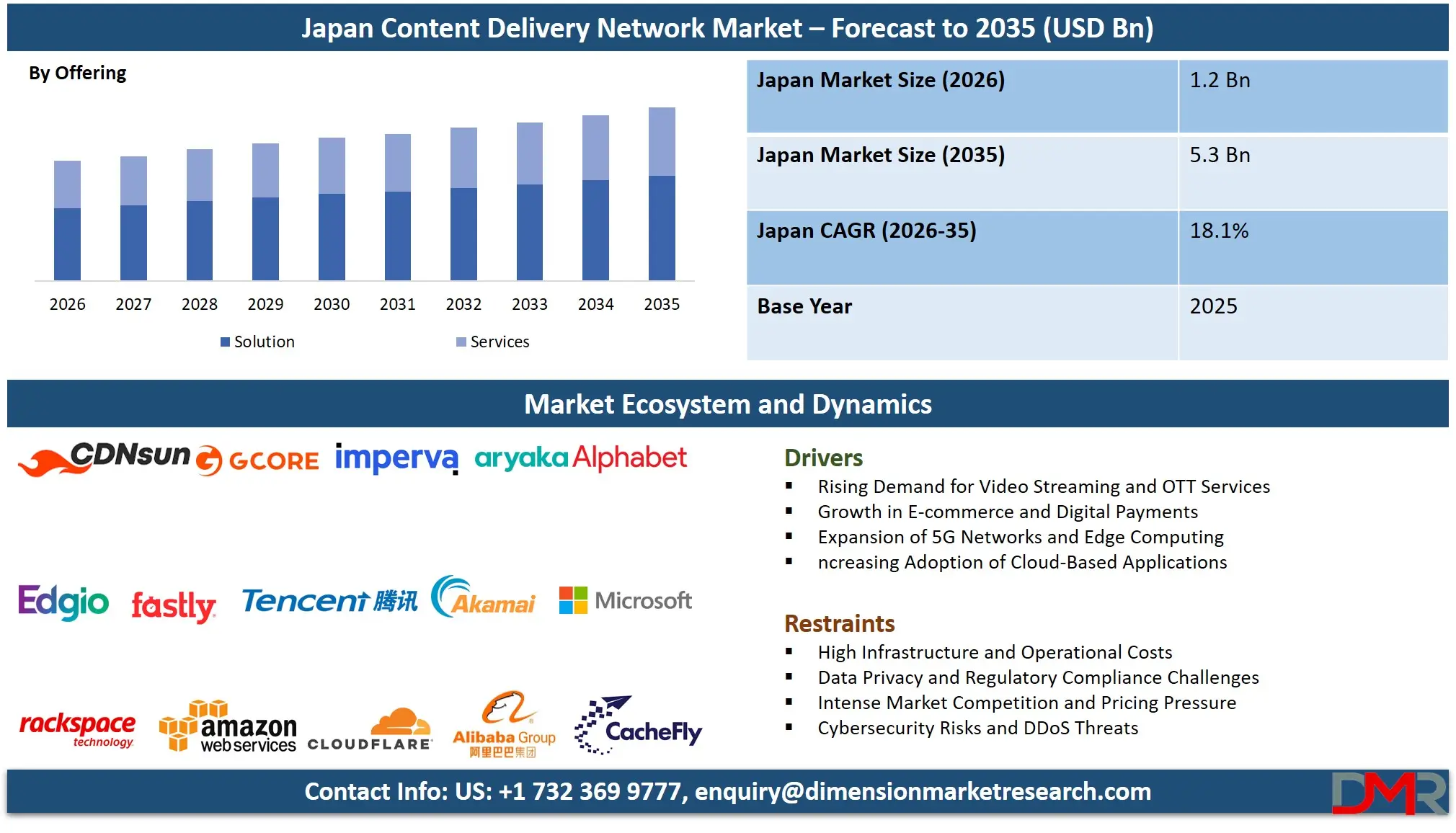
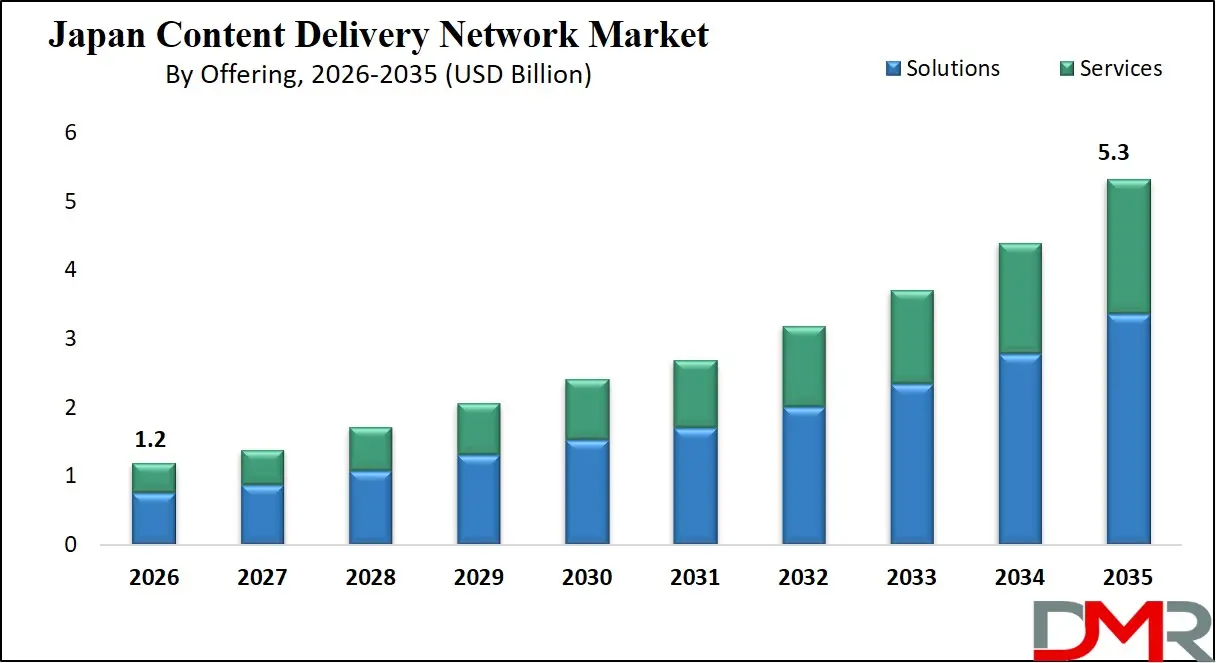
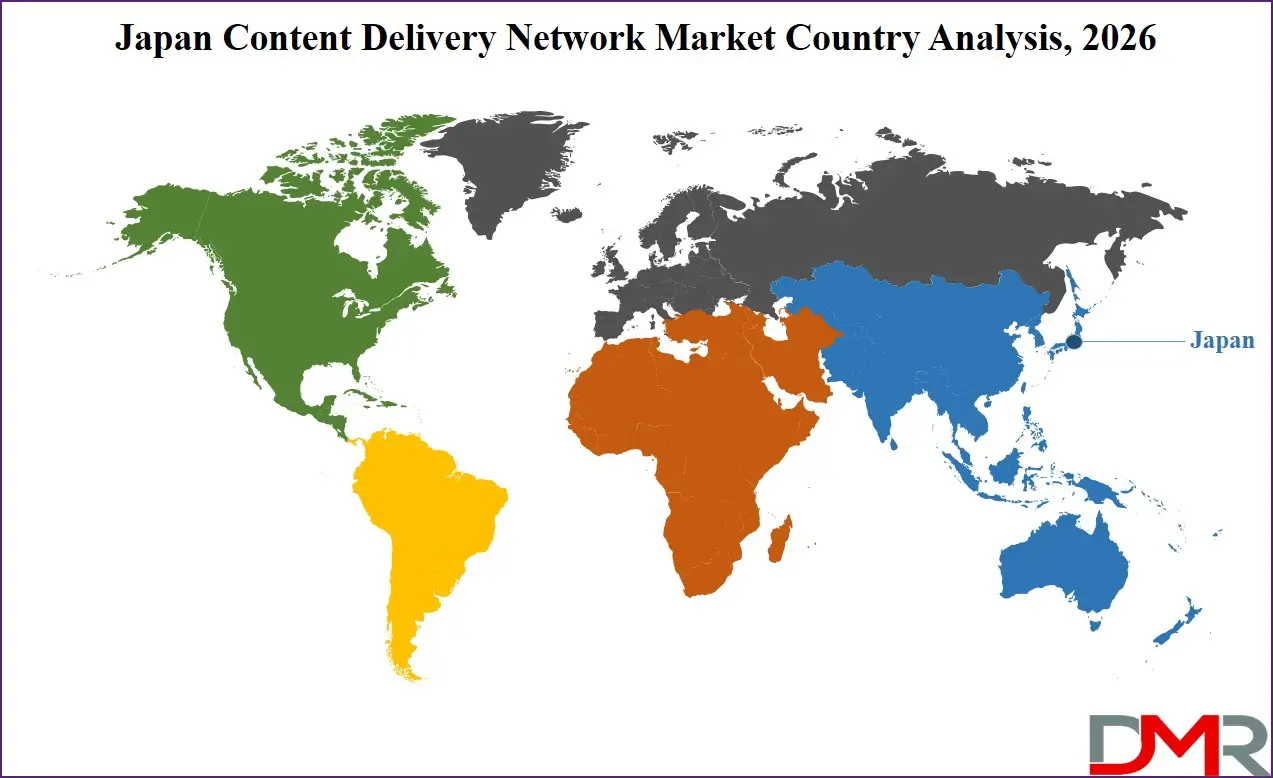
The Japan Content Delivery Network (CDN) market is expected to reach a value of USD 1.2 billion in 2026, and it is further anticipated to expand significantly to USD 5.3 billion by 2035, growing at a CAGR of 18.1% during the forecast period.
ℹ
To learn more about this report –
Download Your Free Sample Report Here
The Content Delivery Network environment within Japan involves the implementation of distributed server systems that are meant to speed up the process of delivering web-based content, streaming media and secure applications to a digitally advanced group of consumers. The need to deliver low-latency high-availability content due to Japan having one of the highest mobile broadband penetration rates and a well-established e-commerce environment is unquestionable.
The rapid shift to 4K, and 8K video streaming, following the rise of immersive gaming, and the government-driven trend of moving to Society 5.0 are putting a massive structural burden on older network architectures. The main centers of innovation of edge computing and CDN infrastructure are Tokyo and Osaka, which are important peering points of international internet traffic.
ℹ
To learn more about this report –
Download Your Free Sample Report Here
The market ecosystem is a combination of global hyperscale cloud providers, domestic telecommunication giants using their fiber assets and specialized security vendors who protect against the increasing wave of Distributed Denial-of-Service (DDoS) attacks. Also, the digital transformation (DX) projects in Japanese businesses and the impending 5G standalone networks rollouts are placing pressure on content providers to adopt enhanced edge delivery and zero-trust security systems.
Key Takeaways
- Market Size & Forecast: The Japan Content Delivery Network Market is projected to reach USD 1.2 billion by 2026 and surge to USD 5.3 billion by 2035, fueled by the explosive demand for high-definition video streaming and the critical need for cloud security in the financial and e-commerce sectors.
- Growth Rate & Outlook: The market is projected to grow by 18.1% driven by the shift of terrestrial broadcasting content to Over-The-Top (OTT) applications and the shift to secure API management of the cashless payment infrastructure in the country.
- Primary Growth Drivers: The key drivers are the huge bandwidth demands of domestic live-streaming solutions, the introduction of the amended Telecommunications Business Act in terms of network resilience, and the shift of Japanese business organizations to multi-cloud solutions that demand sophisticated traffic management.
- Key Market Trends: The main market trends include the convergence of edge computing with local 5G base stations, the introduction of Web Application Firewall (WAF) and bot mitigation that is immediately embedded into CDN fabrics, and the use of Peer-to-Peer (P2P) CDN solutions to offload traffic during major entertainment events such as Kohaku Uta Gassen.
- By Offering Analysis: Solutions is projected to take the lead in the offering segment, where Cloud Security and Media Delivery are the most demanded because of the strict data localization requirements of Japanese companies and the quantity of mobile game downloads.
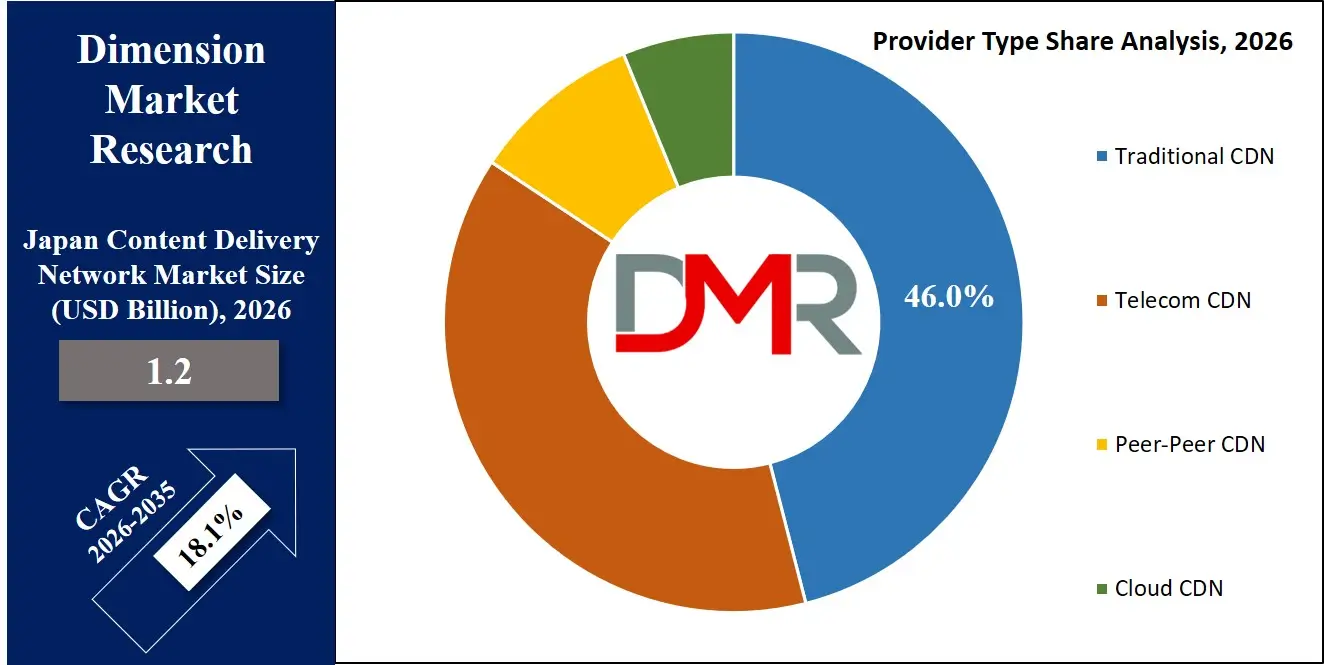
- By Provider Type Analysis: The Traditional CDN Providers is expected to dominate this segment in this market as the model continue to play a critical role in local ISPs wishing to make their last-mile network investments profitable in the rural depopulating areas.
- By Application Analysis: Media and Entertainment Delivery is poised to dominate this market in context of application but Web and E-commerce Acceleration is the most rapidly expanding segment because the OMO (Online Merges with Offline) retail strategy is requiring sub-second page load times.
What is a Content Delivery Network?
A Content Delivery Network (CDN) is a distributed network of proxy servers and their data centers that aims to offer high availability and high performance through spatially distributing service in relation to end-users. A CDN does not fetch content centrally on a single source server, such as one in Tokyo, but instead copies the content onto edge nodes that are nearer to users in Hokkaido or Kyushu. This drastically lowers latency, removes buffering in video streams, and speeds up the load times of a webpage. In the contemporary world, CDNs are no longer caching but critical security boundaries, taking on the role of absorbing DDoS attacks, authenticating API calls, and implementing access policies in the network boundary. CDNs play a critical role to Japanese businesses in overcoming the local internet topography, where most traffic resides in major exchange points in major metropolitan areas to provide a consistent and reliable digital experience, independent of geographic location or network overload.
Use Cases
- Live Commerce & Fashion E-commerce: Live commerce platforms such as Zozo and Rakuten use CDN-based image optimization and dynamic acceleration to provide high-resolution product imagery, which loads in real-time when there are high selling events or influencer live streams.
- Mobile Gaming Rollouts: Japanese game publishers use CDN edge node to provide near-instant distribution of large application binaries and real-time synchronization of in-game events of titles with millions of simultaneous players.
- Broadcaster OTT Migration: Commercial broadcasters migrating linear TV content to OTT platforms use the CDN multi-format transcoding and origin shield capabilities to support large simultaneous viewership during prime-time drama finales.
- Financial Services API Security: Japanese banks and fintech companies use security-oriented CDNs with built-in bot management to secure customer-facing APIs against credential stuffing attacks and to maintain uptime when surges happen in furusato nozei (hometown tax) portal rushes.
Market Dynamic
Key Drivers of the Japan Content Delivery Network Market
The Shift to Ultra-High-Definition (UHD) and Immersive Media
Japan is also on the leading edge in 4K/8K broadcasting, virtual reality (VR), and augmented reality (AR) content development. These formats have massive bandwidth and storage demands that make conventional origin-pull delivery models less feasible. This has made CDN providers, which offer on-the-fly packaging, ultra-low-latency streaming solutions like WebRTC and CMAF, and edge computing-based real-time rendering providers immediate needs of the media and entertainment industry in Japan. Japanese consumers are also demanding seamless high-quality viewing experiences on mobile devices, and therefore, it is critical to invest continuously in edge infrastructure.
Acceleration and Conversion Optimization of E-Commerce
The e-commerce market in Japan is very competitive and the performance of websites directly influences the percentage of customer conversions. Laggish loading pages can be a major cause of cart abandonment, so retailers and advertising agencies should focus on state-of-the-art Web Performance Optimization tools. These services are no longer limited to the traditional caching services, but have evolved to image compression, mobile-specific acceleration, and real-user monitoring (RUM). With online and offline retail coming together in a hybrid model known as Online Merges with Offline (OMO) model, CDNs are essential in providing fast, media-rich, and consistent customer experience.
Restraints in the Japan Content Delivery Network Market
Complexities in Local Peering and Interconnection Costs
Despite having a well-developed fiber-optic network, the network interconnection economics is problematic in Japan. The cost of bandwidth between the data centers and the last-mile delivery charges imposed by some domestic internet service providers can lower profitability of standalone CDN operators. Forming a good relationship with the key telecommunications companies like NTT and KDDI may need thorough local knowledge and good business development skills. This setting is inclined to prefer hybrid telecom-CDN solutions to the fully global and cloud-based vendors.
Data Sovereignty and Concerns around Cloud Security
Japanese companies are also still wary of the location of their data, particularly those that are involved in the manufacturing, government and core infrastructure business. In spite of the increased use of cloud, cloud security solutions that will guarantee that traffic is discontinued and controlled in Japan are extremely popular. To overcome these issues, the global CDN providers should invest in local Points of Presence (PoPs), edge infrastructure and in-country security scrubbing facilities. Such investments aid in reassuring the clients that sensitive customer information and intellectual property are under trusted jurisdictions.
Growth Opportunities in the Japan Content Delivery Network Market
5G Edge Computing for Industry 4.0
The growth of independent and private 5G networks, especially Local 5G deployments by large businesses, is providing CDN providers with big opportunities. The increased demand of manufacturers is network optimization and edge computing to handle the data of the industrial IoT locally and also to support real-time applications like AR-based maintenance and remote monitoring. The combination of CDN edge nodes and carrier-based Multi-access Edge Computing (MEC) infrastructure is a high-growth area, particularly within the Industry 4.0 ecosystem of Japan.
Integrated Website and API Security for the Digital Yen Era
With Japan transitioning towards a more cashless society and still debating the possibility of a future Digital Yen, the security concerns of payment and financial systems are increasingly complicated. This generates high demand on integrated website and API security solutions embedded in CDN platforms. Businesses are requesting more all-encompassing products which integrate DDoS security, bot management, web application firewalls, and API schema assessment at the network boundary. These features are fast becoming indispensable in meeting financial regulations and enterprise risk management standards.
Trends in the Japan Content Delivery Network Market
The Emergence of Peer-to-Peer (P2P) CDN for Large-Scale Live Events
The high population of Japan in urban areas, as well as the high penetration rates of high-speed fiber networks are encouraging a renewed focus on peer-to-peer CDN technology. Instead of completely depending on centralized edge servers, P2P CDN enables viewers to share bits of live streams with each other. This type of model can particularly work well during events of high-density, high-traffic events like New Year countdowns, large esports events, and national entertainment events. Traffic distribution among end users enables broadcasters to save a lot of delivery cost and enhance scalability.
AI-Driven Analytics and Advanced Observability
Japanese businessmen attach much importance to the accuracy of data, clarity of operations, and comprehensive reporting. Consequently, there is growing demand of sophisticated analytics and performance monitoring services that are driven by artificial intelligence. New CDN vendors are launching AI-based solutions that can predict congestion, detect service degradation even before it impacts users, and automatically optimize delivery routes. These platforms also map technical performance measures to business results i.e. bounce rates, conversion rates and time spent watching videos, which can be of great importance to the IT and marketing teams.
Research Scope and Analysis
By Offering Analysis
The Solution is expected to dominate the offering segment in the Content Delivery Network Market in Japan due to the high demand of low-latency media delivery and a secure cloud solution. As Japanese customers insist on perfect 4K/8K streaming on such platforms as ABEMA and TVer, fundamental CDN solutions comprising media delivery engines, caching layers, and DDoS mitigation are necessary. Businesses in e-commerce and games apply Web Performance Optimization and built-in Web Application Firewalls (WAF) to ensure high-performance and local user demands to achieve sub-second load times and data security beyond doubt. In the meantime, the fastest-growing category is the Services segment, which is driven by the complexity of multi-CDN orchestration in the unique carrier ecosystem in Japan.
By Content Type Analysis
The Static Content is poised to lead this segment in Japan content delivery market as it act as the backbone of the high-volume web infrastructure in Japan, which, through efficient image and script caching in edge nodes in Tokyo and Osaka, provide high-performance basic building blocks to news portals and corporate websites. Nevertheless, this segment is not a growth spurt, but rather a steady-state revenue as optimization has already been achieved. On the other hand, the Dynamic Content segment is the powerhouse of commercial value as it is propelled by the advanced e-commerce platforms in Japan such as Rakuten and Zozo. Individualized product suggestions, live inventory APIs, and live commerce interactive events cannot be cached and require advanced routing and edge logic.
By Provider Type Analysis
Traditional CDN Providers are projected to dominate this segment as they maintain a strong presence in Japan with a network of globally distributed Points of Presence (PoPs) and proven security stacks needed to handle high-volume workloads of media giants and game publishers. Their infrastructure is geared towards the peaks of traffic that is involved during major Japanese cultural events. Telecom/CDN Hybrid The ownership of the last-mile fiber and mobile networks is a strategic advantage of Telecom/CDN Hybrid providers, such as NTT Communications and KDDI.
ℹ
To learn more about this report –
Download Your Free Sample Report Here
This convergence enables them to ensure high Quality of Service (QoS) to the latency-sensitive applications and minimize hops to the end-users of local carriers. Cloud CDN Providers is the fastest-growing segment, due to the high rate of cloud-native adoption by Japanese startups and enterprises using AWS and Azure regions in Osaka and Tokyo.
By Application Analysis
The Media & Entertainment Delivery is expected to dominate this segment as it accounts for the highest commercial adoption in Japan, which is due to the high consumption of OTT video, anime streaming, and mobile gaming. Live sporting or virtual concert streaming platforms require very high scalability and very low-latency to avoid buffering at peak concurrent viewership. Web & E-commerce Acceleration is also essential because the Japanese customers are highly sensitive to the delay in page loads. CDNs play an important role in streamlining the product images and ensuring the checkout processes during peaks such as end-of-year shopping and furusato nozei season. Also, Website & API Security is a fast-growing area of application. As the number of cashless payments increases, and the Digital Yen project gains traction, financial institutions are now focusing on CDN-based DDoS protection and bot management to ensure the security of sensitive transactional information and ensure confidence in the digital infrastructure of Japan.
By End-User Analysis
Media & Entertainment Companies is poised to remain the most dominant end-users in Japan, as they fully depend on CDN infrastructure to provide the audience with continuous access to 4K content and high-quality game updates in mobile-first mode. The key factor is quality of experience, and broadcasters are taking advantage of CDNs to provide OTT simulcasts with the reliability needed to be broadcast-grade. Another significant user base is Retail & E-commerce Businesses, and milliseconds of load time difference have a direct conversion rate impact in the competitive Japanese online market. CDNs speed up dynamic shopping carts and protect personal data on complicated omnichannel shopping experiences. The fastest-growing industries are Financial Services (BFSI) and Healthcare.
The Content Delivery Network Market Report is segmented on the basis of the following:
By Offering
- Solutions
- Media Delivery
- Web Performance Optimization
- Cloud Security
- Services
- Design & Consulting Services
- Storage Services
- Analytics & Performance Monitoring
- Website & API Management
- Network Optimization Services
- Digital Rights Management
- Others
By Content Type
- Static Content
- Dynamic Content
By Provider Type
- Traditional CDN Provider
- Cloud CDN Provider
- Telecom/CDN Hybrid
- Peer-to-Peer (P2P) CDN
By Application
- Media & Entertainment Delivery
- Web & E-commerce Acceleration
- Website & API Security
- Cloud Security & DDoS Mitigation
- Online Gaming & Software Distribution
- Other Application
By End User
- Media & Entertainment
- E-commerce
- Advertising
- Healthcare
- Financial Services
- Research & Education
- Others
Competitive Landscape
The industry of the Japan Content Delivery Network Market is very fragmented and competitive with global cloud providers, domestic telecom operators and niche cybersecurity vendors. Akamai Technologies, Cloudflare, and Amazon Web Services international companies are competing based on their massive PoP networks, sophisticated DDoS protection, and extensive investment in edge computing. Nevertheless, the domestic companies still have an advantage in terms of having better relations with the Japanese ISPs, domesticized support, and enterprise-oriented billing patterns.
ℹ
To learn more about this report –
Download Your Free Sample Report Here
Providers of CDN made available by telecom also have the advantage of closer integration with local infrastructure, and reduced costs of interconnection. The ability to be successful in competition is increasingly based on adherence to Japanese data sovereignty laws and collaboration with system integrators like NTT Data and Fujitsu.
Some of the prominent players in Japan Content Delivery Network Market are:
- Akamai Technologies
- Cloudflare
- Amazon
- Microsoft
- Alphabet
- Alibaba Group
- Tencent Holdings
- Fastly
- Lumen Technologies
- Edgio
- Imperva
- Aryaka
- CacheFly
- CDNsun
- Gcore
- IBM
- AT&T
- NTT Communications
- Comcast Technology Solutions
- Rackspace Technology
- Other Key Players
Recent Developments
- March 2026: NTT Communications has announced the extension of its Flexible InterConnect service, allowing enterprise data centers to connect to major cloud CDN edge nodes in Osaka at very high speeds, to deliver generative AI content.
- August 2025: The Japan Network Security Association (JNSA) published revised guidelines emphasizing the importance of CDN-based Web Application Firewalls (WAF) to counterattacks on digital transformation portal websites of local governments.
- May 2024: Cloudflare added Tokyo and Osaka to its network with new edge locations that optimize around GPU compute to inference of AI models that run on the edge to power Japanese e-commerce recommendation engines.
Report Details
| Report Characteristics |
| Market Size (2026) |
USD 1.2 Bn |
| Forecast Value (2035) |
USD 5.3 Bn |
| CAGR (2026–2035) |
17.9% |
| Historical Data |
2021 – 2025 |
| Forecast Data |
2027 – 2035 |
| Base Year |
2025 |
| Estimate Year |
2026 |
| Segments Covered |
By Offering (Solutions and Services), By Content Type (Static Content and Dynamic Content), By Provider Type (Traditional CDN, Telecom CDN, Peer-to-Peer CDN, and Cloud CDN), By Application (Media & Entertainment Delivery, Web & E-commerce Acceleration, Website & API Security, Cloud Security & DDoS Mitigation, Online Gaming & Software Distribution, Other Applications), By End User (Media & Entertainment, E-commerce, Advertising, Healthcare, Financial Services, Research & Education, Others) |
| Country Coverage |
The US |
Frequently Asked Questions
How big is the Japan Content Delivery Network Market?
▾ Japan’s Content Delivery Network market is poised to be valued at USD 1.2 billion in 2026 and is projected to reach USD 5.3 billion by 2035, driven by high-definition streaming, mobile gaming dominance, and advanced e-commerce adoption.
What is the CAGR of the Japan Content Delivery Network Market from 2026 to 2035?
▾ The Japan Content Delivery Network Market is expected to grow at a CAGR of 18.1% from 2026 to 2035, reflecting strong expansion due to increased adoption of edge security and 5G content optimization.
What factors are driving the growth of the Japan Content Delivery Network Market?
▾ Key growth drivers include Japan’s appetite for 4K/8K video, the expansion of OTT platforms, the need for DDoS protection in financial services, and the government's Society 5.0 digital infrastructure goals.
What are the major trends in the Japan Content Delivery Network Market?
▾ Major trends include the convergence of CDN with edge computing for AI inference, the use of P2P technology for massive live events, and the integration of bot management into core CDN security stacks.
Who are the key players in the Japan Content Delivery Network Market?
▾ Key players include Amazon, Microsoft, Alphabet, Alibaba Group, Tencent Holdings, Fastly, Lumen Technologies, Edgio, Imperva, Aryaka, CacheFly, along with emerging startups and new technology solution providers.
How is the Japan Content Delivery Network Market segmented?
▾ The Japan Content Delivery Network market is segmented by offering, content type, provider type, application, and end user, reflecting varied deployment requirements, service models, and industry-specific demand patterns.