What is the Japan Conversational AI in Healthcare Market Size?
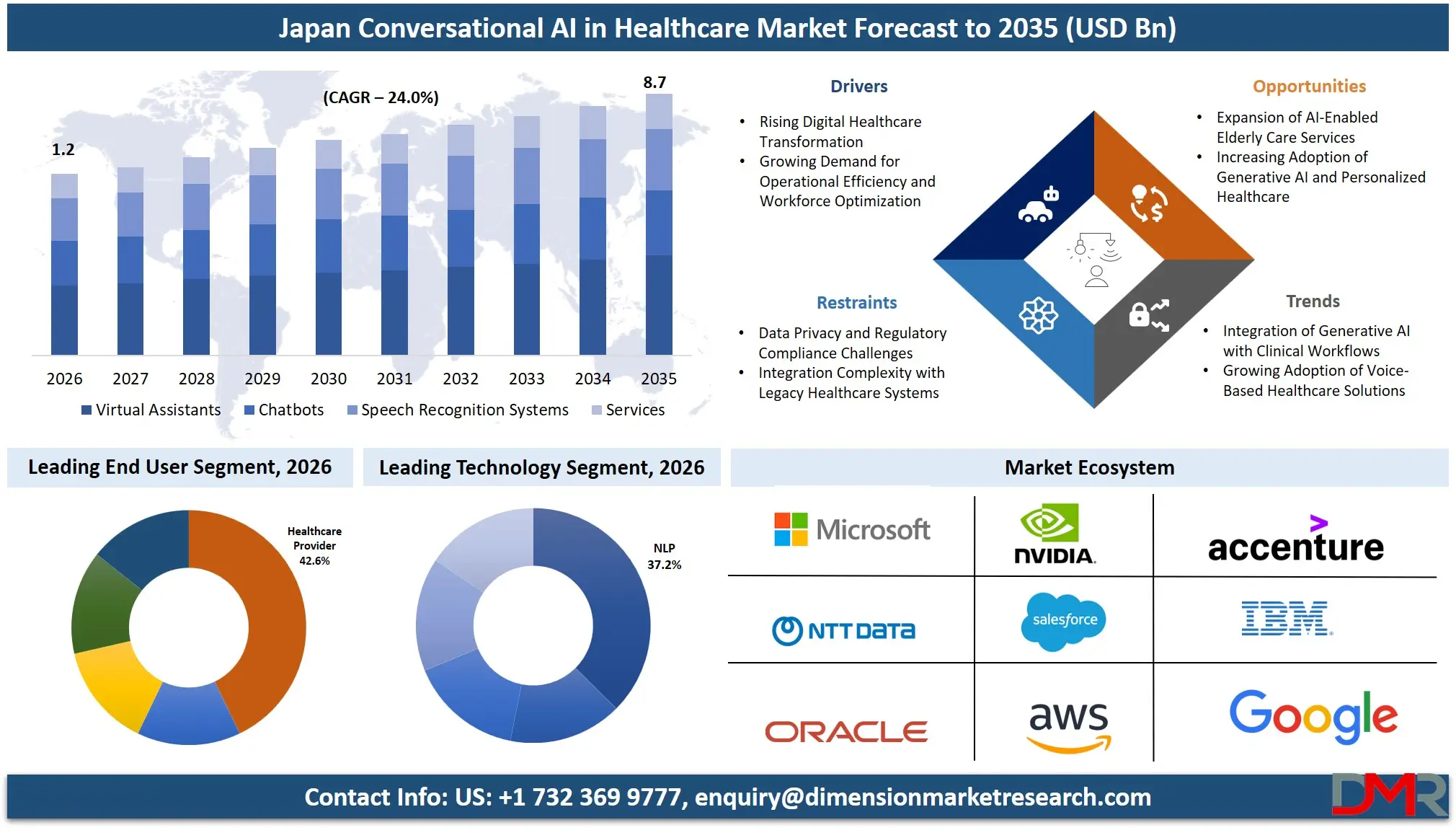
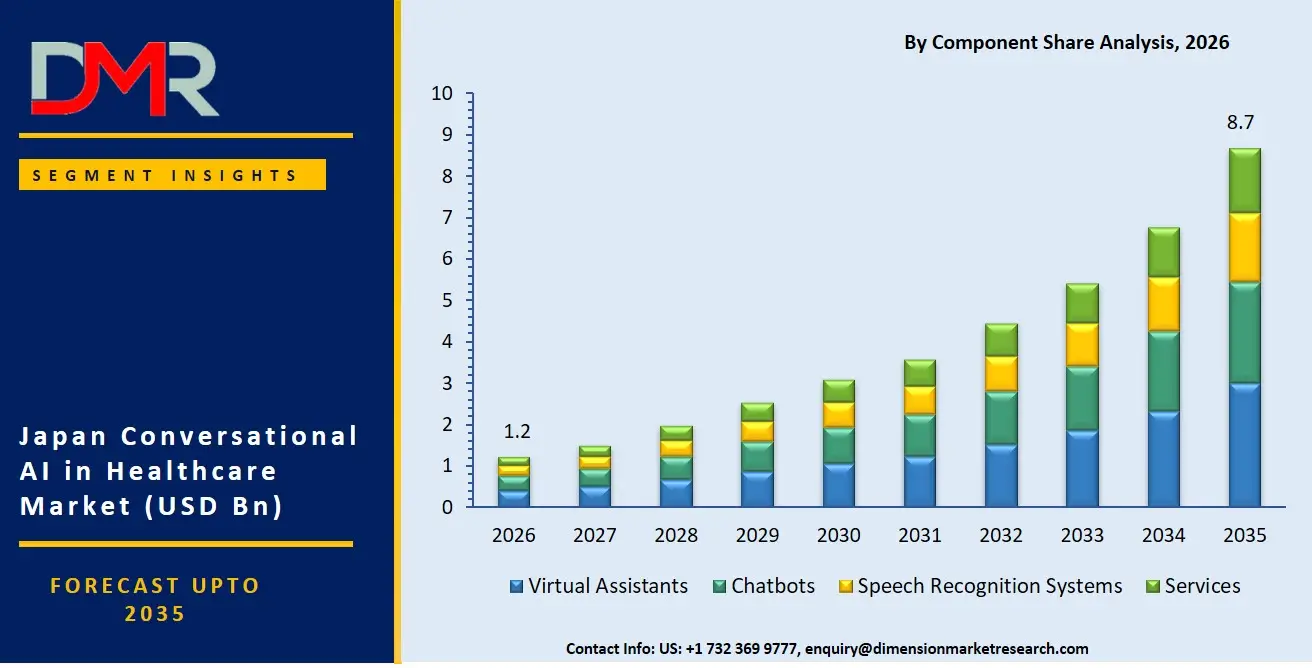
The Japan Conversational AI in Healthcare Market size is expected to be USD 1.2 billion in 2026 and increase at a compound annual growth rate of 24.0% to USD 8.7 billion in 2035 owing to growing demand for operational efficiency and workforce optimization.
ℹ
To learn more about this report –
Download Your Free Sample Report Here
The Japan Conversational AI in Healthcare Market comprises intelligent conversational technologies designed to improve communication, clinical workflows, patient engagement, and healthcare service delivery through natural language interactions. The market includes AI-powered chatbots, virtual assistants, speech recognition platforms, natural language processing engines, and associated implementation services used across hospitals, clinics, pharmaceutical companies, telemedicine platforms, and healthcare organizations. Increasing digital transformation, expanding telehealth adoption, growing elderly population, rising demand for personalized healthcare, and continuous advancements in artificial intelligence are accelerating market expansion, while integration of generative AI and multilingual healthcare solutions continues to reshape industry innovation.
Key Takeaways
- Market Size & Forecast: The Japan Conversational AI in Healthcare Market size is projected to reach USD 1.2 billion in 2026 and is anticipated to have a value of USD 8.7 billion in 2035.
- Growth Rate & Outlook: The Japan Conversational AI in Healthcare Market size is set to grow at a compound annual growth rate of 24.0% during the forecast period of 2026 to 2035.
- Primary Growth Drivers: Some of the major growth drivers in the market are Growing Demand for Operational Efficiency and Workforce Optimization, and more.
- Key Market Trends: Some of the major trends in the market are Growing Adoption of Voice-Based Healthcare Solutions and more.
- By Component Type: Virtual Assistants is expected to get the largest revenue share in 2026 in the Japan Conversational AI in Healthcare Market.
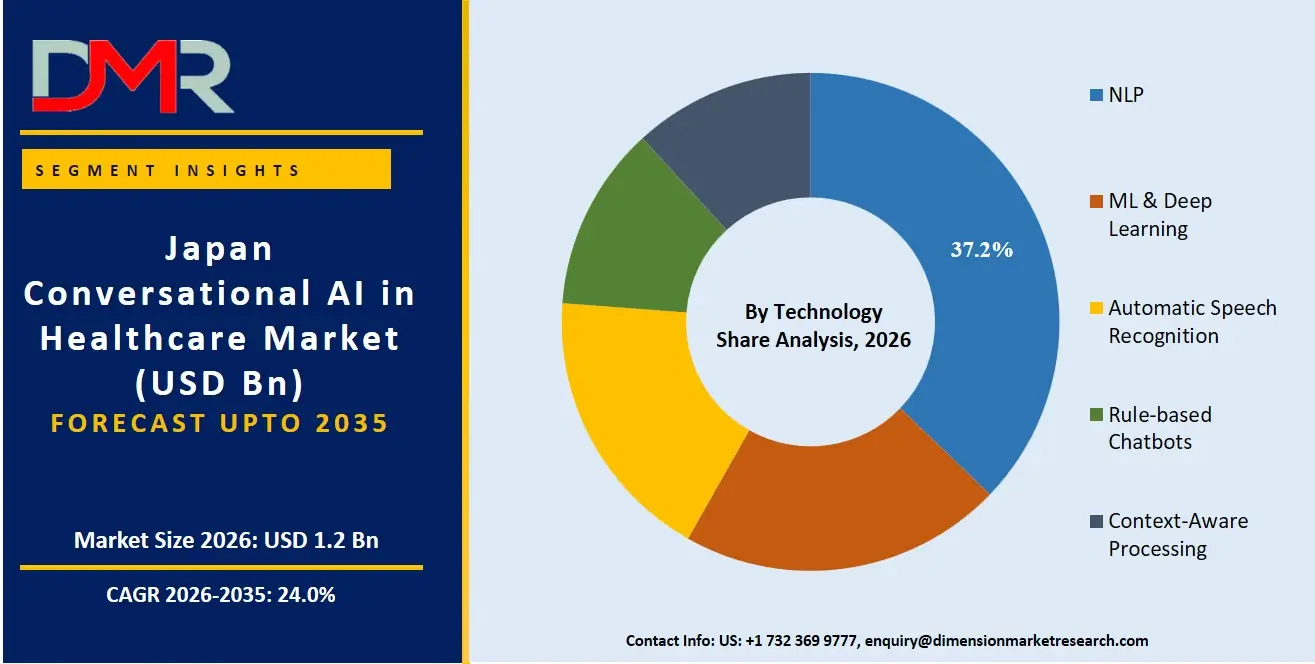
- By Technology Type: NLP is expected to get the largest revenue share in 2026 in the Japan Conversational AI in Healthcare Market.
- By End User Type: Healthcare Provider segment is expected to get the largest revenue share in 2026 in the Japan Conversational AI in Healthcare Market.
What is the Japan Conversational AI in Healthcare?
Conversational AI in healthcare refers to artificial intelligence technologies that enable computers to communicate with patients, caregivers, clinicians, and healthcare professionals using natural language through text or voice interactions. These solutions combine natural language processing, machine learning, speech recognition, and contextual understanding to automate communication, deliver healthcare information, support clinical decision-making, schedule appointments, monitor patients remotely, improve patient engagement, and streamline administrative processes while enhancing healthcare accessibility and operational efficiency.
Use Cases
- Patient Engagement and Virtual Assistance: Healthcare providers utilize conversational AI to answer patient queries, schedule appointments, provide medication reminders, deliver post-treatment instructions, and assist with hospital navigation. These virtual assistants operate around the clock, improving patient satisfaction while reducing the workload on healthcare staff and ensuring timely communication throughout the patient journey.
- Remote Patient Monitoring: Conversational AI supports patients with chronic diseases by collecting symptoms, monitoring health conditions, reminding users about medications, and generating alerts for healthcare professionals when abnormalities are detected. Continuous engagement enables proactive interventions and reduces unnecessary hospital admissions while improving treatment adherence.
- Clinical Decision Support: AI-powered conversational platforms assist physicians by retrieving medical information, summarizing patient histories, documenting consultations, and recommending evidence-based treatment options. These capabilities reduce administrative burden, improve diagnostic efficiency, and allow clinicians to devote greater attention to patient care.
- Mental Health Support: Conversational AI applications provide psychological support through guided conversations, emotional assessments, stress management exercises, and cognitive behavioral therapy techniques. These digital tools improve access to mental healthcare, particularly for patients seeking confidential, convenient, and continuous support outside traditional clinical settings.
How AI Is Transforming the Japan Conversational AI in Healthcare Market
Artificial intelligence significantly enhances conversational healthcare platforms by enabling accurate natural language understanding, intelligent patient interactions, predictive analytics, automated documentation, and personalized recommendations. AI-powered systems improve appointment scheduling, symptom assessment, medication management, and clinical decision support while reducing manual administrative tasks and improving healthcare accessibility across hospitals and remote care environments.
Advanced AI algorithms also strengthen operational efficiency by continuously learning from patient interactions, optimizing workflow automation, identifying potential health risks, and delivering context-aware responses. Integration of generative AI, machine learning, and speech recognition technologies enables healthcare providers to deliver faster, more personalized, and scalable services while improving patient satisfaction, treatment adherence, and overall healthcare outcomes.
Market Dynamic
Driving Factors in the Japan Conversational AI in Healthcare Market
Growing Demand for Operational Efficiency and Workforce Optimization
Healthcare providers continue facing workforce shortages, increasing patient volumes, and growing administrative complexity. Conversational AI enables healthcare organizations to automate repetitive tasks such as appointment scheduling, patient triage, documentation, insurance verification, and follow-up communication. By improving resource utilization, reducing operational costs, and minimizing clinician burnout, these technologies deliver measurable productivity improvements while supporting sustainable healthcare delivery across Japan.
Restraints in the Japan Conversational AI in Healthcare Market
Integration Complexity with Legacy Healthcare Systems
Many healthcare facilities continue operating legacy electronic medical record systems and fragmented IT infrastructure that were not originally designed for AI integration. Achieving seamless interoperability between conversational AI platforms and existing healthcare applications requires significant technical expertise, customization, and financial investment. These integration challenges may delay deployment and discourage adoption among smaller healthcare organizations with limited digital capabilities.
Opportunities in the Japan Conversational AI in Healthcare Market
Expansion of AI-Enabled Elderly Care Services
Japan's rapidly aging population creates substantial demand for intelligent healthcare solutions that support independent living, chronic disease management, medication adherence, and continuous patient engagement. Conversational AI platforms designed specifically for elderly care present significant opportunities for healthcare providers, insurers, and technology companies seeking to improve long-term care quality while reducing pressure on healthcare infrastructure.
Trends in the Japan Conversational AI in Healthcare Market
Growing Adoption of Voice-Based Healthcare Solutions
Voice-enabled conversational AI applications are gaining momentum across hospitals, telemedicine services, and home healthcare environments. Advanced speech recognition technologies facilitate hands-free clinical documentation, voice-assisted patient communication, multilingual support, and accessible healthcare services for elderly populations. This trend is improving healthcare accessibility while supporting more efficient and intuitive clinical workflows.
Research Scope and Analysis
The research scope analyzes the Japan Conversational AI in Healthcare Market by evaluating key segments, technologies, applications, end users, growth drivers, challenges, emerging trends, competitive dynamics, and technological advancements. The analysis provides insights into market opportunities, adoption patterns, and future growth prospects.
ℹ
To learn more about this report –
Download Your Free Sample Report Here
By Component Analysis
The Japan Conversational AI in Healthcare Market is segmented by component into chatbots, virtual assistants, speech recognition systems, and services. Among these, virtual assistants are estimated to hold the leading market share of approximately 34.5% in 2026, driven by their expanding adoption across hospitals, clinics, and digital healthcare platforms for patient communication, appointment management, clinical support, and workflow automation.
ℹ
To learn more about this report –
Download Your Free Sample Report Here
Virtual assistants provide more advanced contextual interactions compared with basic chatbot solutions, making them suitable for complex healthcare environments. The fastest-growing segment is expected to be speech recognition systems, supported by increasing demand for voice-enabled healthcare solutions, clinical documentation automation, and hands-free interaction technologies. Growing adoption among physicians for voice-based medical record creation and patient consultation support is expected to accelerate segment expansion during the forecast period.
By Technology Analysis
The Japan Conversational AI in Healthcare Market is categorized by technology into natural language processing (NLP), machine learning and deep learning, automatic speech recognition, rule-based chatbots, and context-aware processing. Among these technologies, natural language processing (NLP) is projected to dominate with an estimated market share of around 37.2% in 2026, owing to its essential role in enabling accurate language interpretation, patient query understanding, and intelligent healthcare conversations. NLP-based solutions are increasingly integrated into healthcare applications to analyze medical terminology, understand patient concerns, and deliver personalized responses. The fastest-growing technology segment is expected to be context-aware processing, as healthcare providers increasingly require AI systems capable of understanding patient history, clinical conditions, and conversational context. Advancements in large language models and generative AI are further supporting the development of more accurate and adaptive healthcare communication platforms.
By Application Analysis
Based on application, the Japan Conversational AI in Healthcare Market is segmented into patient engagement and support, mental health support and therapy bots, medical diagnosis and clinical decision support, remote patient monitoring, administrative and workflow automation, telemedicine and virtual consultations, medical training and education, and pharmaceutical and drug information assistance. Among these applications, patient engagement and support is expected to account for the largest market share of approximately 31.8% in 2026, supported by increasing demand for digital healthcare access, automated patient communication, appointment assistance, and personalized healthcare guidance. Healthcare organizations are prioritizing patient-focused AI solutions to improve service quality and reduce administrative workload. The fastest-growing application segment is anticipated to be remote patient monitoring, driven by Japan's aging population, rising prevalence of chronic diseases, and increased demand for continuous healthcare management outside traditional hospital settings. Integration with wearable devices and home healthcare platforms is further accelerating adoption.
By End User Analysis
The market is segmented by end user into healthcare providers, patients and individuals, pharmaceutical and life sciences companies, healthcare IT and research organizations, and others. Among these, healthcare providers are expected to represent the leading segment with an estimated market share of approximately 42.6% in 2026, due to increasing investments by hospitals and clinics in AI-powered solutions for operational efficiency, patient communication, clinical assistance, and healthcare workflow optimization. Healthcare providers are adopting conversational AI to address staff shortages, improve service delivery, and enhance patient experiences. The fastest-growing segment is expected to be pharmaceutical and life sciences companies, as these organizations increasingly use AI assistants for drug information services, patient education, clinical research support, and healthcare professional engagement. Expanding digital health initiatives and increasing use of AI in pharmaceutical communication strategies are expected to support rapid growth within this segment.
The Japan Conversational AI in Healthcare Market Report is segmented on the basis of the following:
By Component
- Chatbots
- Virtual Assistants
- Speech Recognition Systems
- Services
By Technology
- NLP
- ML & Deep Learning
- Automatic Speech Recognition
- Rule-based Chatbots
- Context-Aware Processing
By Application
- Patient Engagement & Support
- Mental Health Support & Therapy Bots
- Medical Diagnosis & Clinical Decision Support
- Remote Patient Monitoring
- Administrative & Workflow Automation
- Telemedicine & Virtual Consultations
- Medical Training & Education
- Pharmaceutical & Drug Information Assistance
By End User
- Healthcare Providers
- Patients & Individuals
- Pharmaceutical & Life Sciences Companies
- Healthcare IT & Research Organizations
- Others
Competitive Landscape
The competitive environment of the Japan Conversational AI in Healthcare Market is shaped by continuous innovation, technology partnerships, AI research investments, and efforts to develop healthcare-specific conversational platforms. Market participants are focusing on improving natural language understanding, enhancing data security, integrating advanced analytics, and developing solutions compatible with existing healthcare infrastructure. High entry barriers include regulatory compliance requirements, healthcare data protection standards, and the need for specialized medical AI capabilities. Companies are strengthening market positions through strategic collaborations with healthcare providers, investment in generative AI technologies, customization of solutions for Japanese language requirements, and expansion of cloud-based healthcare platforms. Competitive differentiation is increasingly based on accuracy, interoperability, scalability, and the ability to deliver personalized healthcare experiences.
Some of the prominent players in the Japan Conversational AI in Healthcare are:
- NTT DATA
- Fujitsu Limited
- NEC Corporation
- Hitachi, Ltd.
- SoftBank Corp.
- LY Corporation
- PKSHA Technology Inc.
- Ubie, Inc.
- MICIN, Inc.
- FRONTEO, Inc.
- TIS Inc.
- SCSK Corporation
- IBM
- Microsoft
- Google Cloud
- Amazon Web Services
- Oracle Health
- Salesforce
- NVIDIA
- Accenture
- Other Key Players
Recent Developments
- In June 2025, NEC Corporation expanded its healthcare AI initiatives by advancing solutions focused on intelligent communication, medical data utilization, and healthcare process automation. The company continued investing in artificial intelligence technologies designed to improve interactions between healthcare providers and patients while supporting efficient information processing across medical institutions.
- In April 2025, Fujitsu Limited announced advancements in its generative AI and healthcare digital transformation initiatives, focusing on improving healthcare workflows, information management, and operational efficiency. The company continued developing AI-powered solutions that support healthcare organizations through natural language processing, data analysis, and intelligent automation capabilities. Fujitsu's healthcare AI strategy emphasized secure handling of medical information, integration with existing healthcare systems, and improving productivity for medical professionals.
- In March 2025, Microsoft strengthened its healthcare artificial intelligence initiatives by expanding cloud-based AI capabilities and supporting healthcare organizations with advanced digital solutions. The company continued developing AI-powered assistants, healthcare data analytics tools, and generative AI applications designed to improve clinical workflows, administrative automation, and patient engagement. Microsoft focused on responsible AI implementation, healthcare data security, and interoperability with healthcare platforms.
Report Details
| Report Characteristics |
| Market Size (2026) |
USD 1.2 Bn |
| Forecast Value (2035) |
USD 8.7 Bn |
| CAGR (2026–2035) |
24.0% |
| Historical Period |
2021 – 2025 |
| Forecast Period |
2027 – 2035 |
| Base Year |
2025 |
| Estimate Year |
2026 |
| Segments Covered |
By Component, By Technology, By Application, By End User |
| Country Coverage |
Japan |
Frequently Asked Questions
How big is the Japan Conversational AI in Healthcare Market?
▾ The Japan Conversational AI in Healthcare Market size is expected to reach USD 1.2 billion by 2026 and is projected to reach USD 8.7 billion by the end of 2035.
What is the CAGR of the Japan Conversational AI in Healthcare Market from 2026 to 2035?
▾ The market is growing at a CAGR of 24.0 percent over the forecasted period.
What factors are driving the growth of the Japan Conversational AI in Healthcare Market?
▾ Growing Demand for Operational Efficiency and Workforce Optimization, and more are the factors driving the growth of the Japan Conversational AI in Healthcare Market.
What are the major trends in the Japan Conversational AI in Healthcare Market?
▾ Growing Adoption of Voice-Based Healthcare Solutions, and more are some of the major trends in the market.
Who are the key players in the Japan Conversational AI in Healthcare Market?
▾ Some of the key players in the Japan Conversational AI in Healthcare Market include AWS, Google, IBM, and more.
How is the Japan Conversational AI in Healthcare Market segmented?
▾ The Japan Conversational AI in Healthcare Market is segmented component, technology, application, end user.