Market Overview
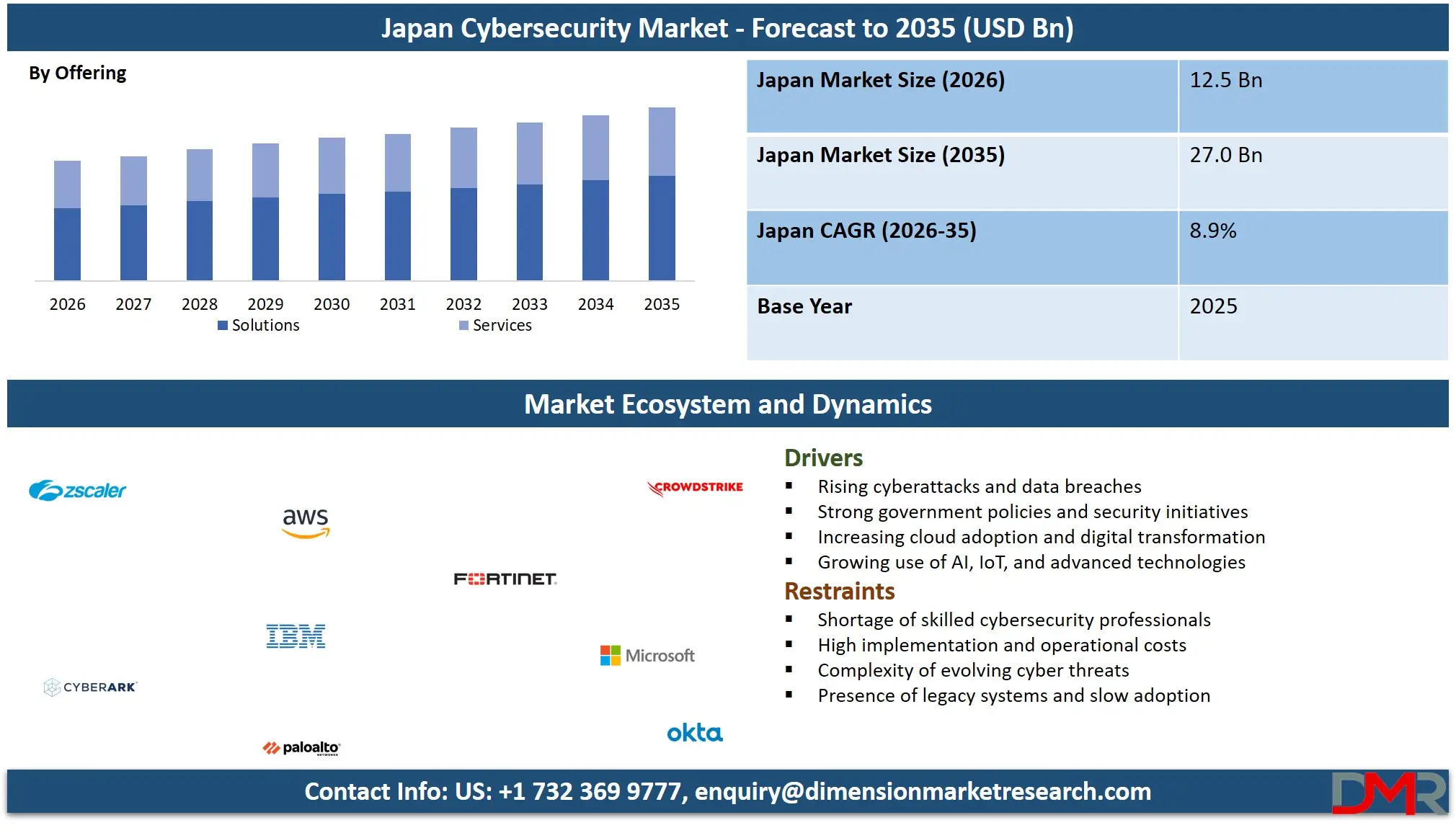
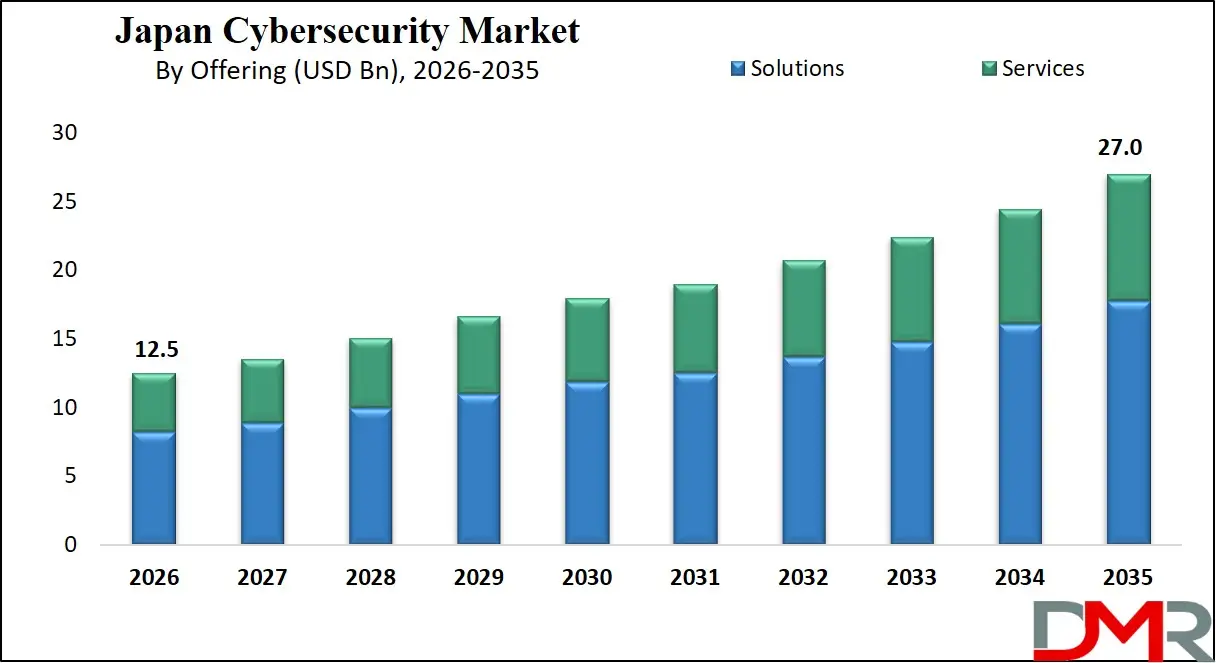
The Japan Cybersecurity Market size is projected to reach USD 12.5 billion in 2026 and grow at a compound annual growth rate of 8.9% to reach a value of USD 27.0 billion in 2035.
ℹ
To learn more about this report –
Download Your Free Sample Report Here
Cybersecurity is defined as the process of securing and protecting computer systems from cyber-attacks and damage. The issue of cybersecurity is vital in Japan because the country is highly dependent on advanced technologies, connected infrastructure, and cyber ecosystems. The government is putting in place robust cybersecurity measures to combat cyber threats, ensure business continuity, and protect information.
ℹ
To learn more about this report –
Download Your Free Sample Report Here
Japan Cybersecurity Market: Key Takeaways
- Market Growth: The Japan Cybersecurity Market size is expected to grow by USD 13.5 billion, at a CAGR of 8.9%, during the forecasted period of 2027 to 2035.
- By Offering: The solutions segment is anticipated to get the majority share of the Japan Cybersecurity market in 2026.
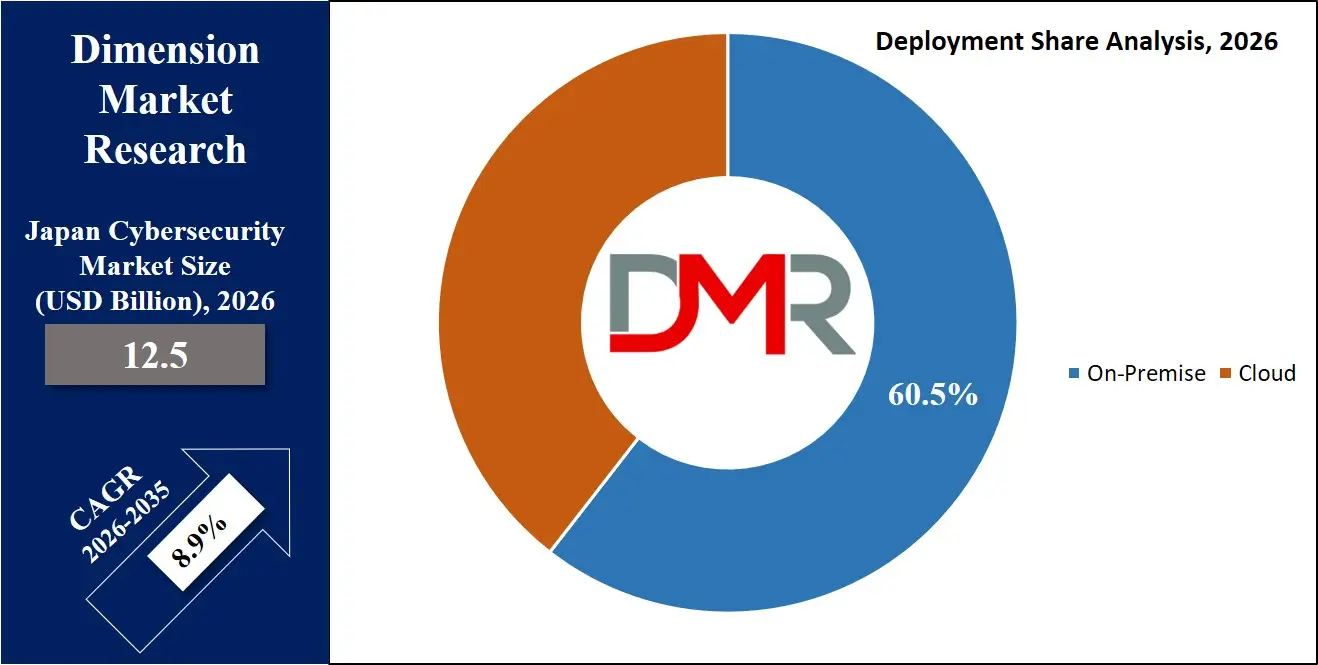
- By Deployment: The on-premise segment is expected to get the largest revenue share in 2026 in the Japan Cybersecurity market.
- Use Cases: Some of the use cases of Cybersecurity include health data protection, govt & defense systems, and more.
Japan Cybersecurity Market: Use Cases
- Critical Infrastructure Protection: Cybersecurity protects Japan's energy grids, transportation systems, and smart city infrastructure from cyber-attacks. It enables real-time monitoring and quick response to threats, ensuring operational continuity.
- Financial Services Security: Cybersecurity helps banks and financial institutions secure digital transactions, prevent fraud, and maintain trust in Japan's highly digitized financial ecosystem.
- Government and Defense Systems: Cybersecurity safeguards sensitive national data, prevents cyber espionage, and strengthens communication systems within Japan's government and defense sectors.
- Healthcare Data Protection: Cybersecurity ensures the protection of patient data and medical systems, supporting the secure adoption of electronic health records and connected healthcare devices.
Market Dynamic
Driving Factors in the Japan Cybersecurity Market
Increasing Cyber Threat Landscape
Japan is witnessing a rise in sophisticated cyber threats including ransomware, phishing, and nation-state attacks. This has pushed organizations to adopt advanced cybersecurity solutions to safeguard digital assets and ensure operational resilience.
Government Initiatives and Regulatory Frameworks
Japan has implemented strong cybersecurity policies and frameworks to strengthen national security. Regulatory compliance requirements are encouraging organizations to invest in advanced cybersecurity technologies to maintain data integrity and trust.
Restraints in the Japan Cybersecurity Market
High Implementation and Maintenance Costs
The cost of deploying and maintaining advanced cybersecurity infrastructure is high, posing challenges especially for small and medium-sized enterprises with limited budgets.
Shortage of Skilled Cybersecurity Professionals
Japan faces a significant shortage of trained cybersecurity professionals, which limits the ability of organizations to effectively manage and respond to complex cyber threats.
Opportunities in the Japan Cybersecurity Market
Growth of Cloud Computing and Digital Transformation
The rapid adoption of cloud technologies and digital transformation initiatives across industries is creating strong demand for cybersecurity solutions to protect digital environments.
Adoption of AI and Advanced Technologies
The integration of artificial intelligence, machine learning, and automation in cybersecurity is opening new opportunities by enhancing threat detection, response efficiency, and predictive security capabilities.
Trends in the Japan Cybersecurity Market
Adoption of Zero Trust Security Models
Organizations in Japan are increasingly adopting zero trust frameworks, which emphasize continuous verification of users and devices to strengthen security against evolving cyber threats.
Expansion of Managed Security Services
There is growing demand for managed security services as organizations seek cost-effective and scalable solutions to handle complex security requirements and compensate for talent shortages.
Impact of Artificial Intelligence in Japan Cybersecurity Market
The Artificial Intelligence system is changing the cybersecurity landscape in Japan through the early warning system for potential threats, prediction, and response mechanisms. The system improves endpoint security, fraud response, as well as network monitoring. The appearance of AI-based cyberattacks is also creating complexities, hence the need for more adaptable security systems.
Impact of Iran War on Japan Cybersecurity Market
The Artificial Intelligence system is changing the security environment in Japan by helping in the early detection of threats, prediction, and response. Artificial Intelligence solutions help in improving endpoint security, fraud detection, and network security. However, the development of AI-based cyberattacks has made the environment more complex, thus necessitating more adaptive security solutions.
Research Scope and Analysis
By Offering Analysis
Based on offering, the solutions segment is expected to lead the Japan cybersecurity market in 2026 with a share of 65.8%, driven by rising cyber threats, rapid digital transformation, increasing cloud adoption, and regulatory requirements. The services segment is also growing rapidly due to increasing threat complexity, shortage of skilled professionals, and demand for continuous monitoring and managed services.
By Deployment Analysis
The on-premise segment is projected to dominate the market with a share of 60.5% in 2026, due to the need for data control, compliance requirements, and protection of critical infrastructure.
ℹ
To learn more about this report –
Download Your Free Sample Report Here
Meanwhile, the cloud segment is expanding rapidly, supported by growing cloud adoption, scalability requirements, and remote work trends.
By Organization Size Analysis
Large enterprises are expected to dominate the market with a share of 67.2% in 2026, driven by high exposure to cyber threats, large volumes of sensitive data, and strong financial capabilities. SMEs are also witnessing significant growth due to increasing cyberattacks, digital adoption, and demand for cost-effective security solutions.
By End User Analysis
The IT & Telecommunication segment is anticipated to be at the forefront, accounting for a share of 27.6% in 2026, because of increased data traffic, 5G technology, and an increase in cyber attacks on infrastructure. The healthcare segment is also expanding at a fast pace, mainly because of increased acceptance of digital health systems and rising security concerns for patient data.
The Japan Cybersecurity Market Report is segmented on the basis of the following:
By Offering
- Solutions
- Application Security
- Cloud Security
- Data Security
- Identity and Access Management
- Infrastructure Protection
- Integrated Risk Management
- Network Security Equipment
- Consumer Security
- Other Solutions
- Services
- Professional Services
- Managed Services
By Deployment
By Organization Size
By End User
- BFSI
- Healthcare
- Construction
- Government & Defense
- IT and Telecommunication
- Retail
- Energy and Utilities
- Manufacturing
- Other End Users
Competitive Landscape
The Japan cybersecurity industry is a competitive one, with both international players and domestic players in the industry. Companies in Japan are competing on innovation, localization, and threat detection capabilities.
ℹ
To learn more about this report –
Download Your Free Sample Report Here
Strategic partnerships, mergers, and investments in AI-based cybersecurity solutions are some of the key trends in Japan's cybersecurity industry, along with managed services due to labor constraints.
Some of the prominent players in the Japan Cybersecurity are:
- NTT Security
- Fujitsu
- NEC Corporation
- Hitachi Systems
- Trend Micro
- IBM Security
- Cisco
- Palo Alto Networks
- Fortinet
- Microsoft
- Amazon Web Services
- Google
- CrowdStrike
- CyberArk
- Zscaler
- Okta
- Proofpoint
- SentinelOne
- Rapid7
- Qualys
- Other Key Players
Recent Developments
- In November 2025, National Center of Incident Readiness and Strategy for Cybersecurity strengthened Japan's national cybersecurity strategy by expanding public-private partnerships to enhance threat intelligence sharing and protect critical infrastructure.
- In September 2025, leading technology providers such as Fujitsu, NEC Corporation, and Trend Micro introduced AI-powered cybersecurity platforms to improve real-time threat detection, automate response mechanisms, and strengthen enterprise security frameworks.
Report Details
| Report Characteristics |
| Market Size (2026) |
USD 12.5 Bn |
| Forecast Value (2035) |
USD 27.0 Bn |
| CAGR (2026–2035) |
8.9% |
| Historical Data |
2021 – 2025 |
| Forecast Data |
2027 – 2035 |
| Base Year |
2025 |
| Estimate Year |
2026 |
| Report Coverage |
Market Revenue Estimation, Market Dynamics, Competitive Landscape, Growth Factors and etc. |
| Segments Covered |
By Offering (Solutions and Services), By Deployment (Cloud and On-Premise), By Organization Size (SMEs and Large Enterprises), By End User (BFSI, Healthcare, Construction, Government & Defense, IT and Telecommunication, Retail, Energy and Utilities, Manufacturing, and Other End Users) |
| Country Coverage |
Japan |
| Prominent Players |
NTT Security, Fujitsu, NEC Corporation, Hitachi Systems, Trend Micro, IBM Security, Cisco, Palo Alto Networks, Fortinet, Microsoft, Amazon Web Services, Google, CrowdStrike, CyberArk, Zscaler, Okta, Proofpoint, SentinelOne, Rapid7, Qualys, and Other Key Players |
| Purchase Options |
We have three licenses to opt for: Single User License (Limited to 1 user), Multi-User License (Up to 5 Users) and Corporate Use License (Unlimited User) along with free report customization equivalent to 0 analyst working days, 3 analysts working days and 5 analysts working days respectively. |
Frequently Asked Questions
How big is the Japan Cybersecurity Market?
▾ The Japan Cybersecurity Market size is expected to reach USD 12.5 billion by 2026 and is projected to reach USD 27.0 billion by the end of 2035.
Who are the key players in the Japan Cybersecurity Market?
▾ Some of the major key players in the Japan Cybersecurity Market include IBM, Google, Microsoft, and others.
What is the growth rate in the Japan Cybersecurity Market?
▾ The market is growing at a CAGR of 8.9 percent over the forecasted period.