What is the Japan Data Center Infrastructure Market Size?
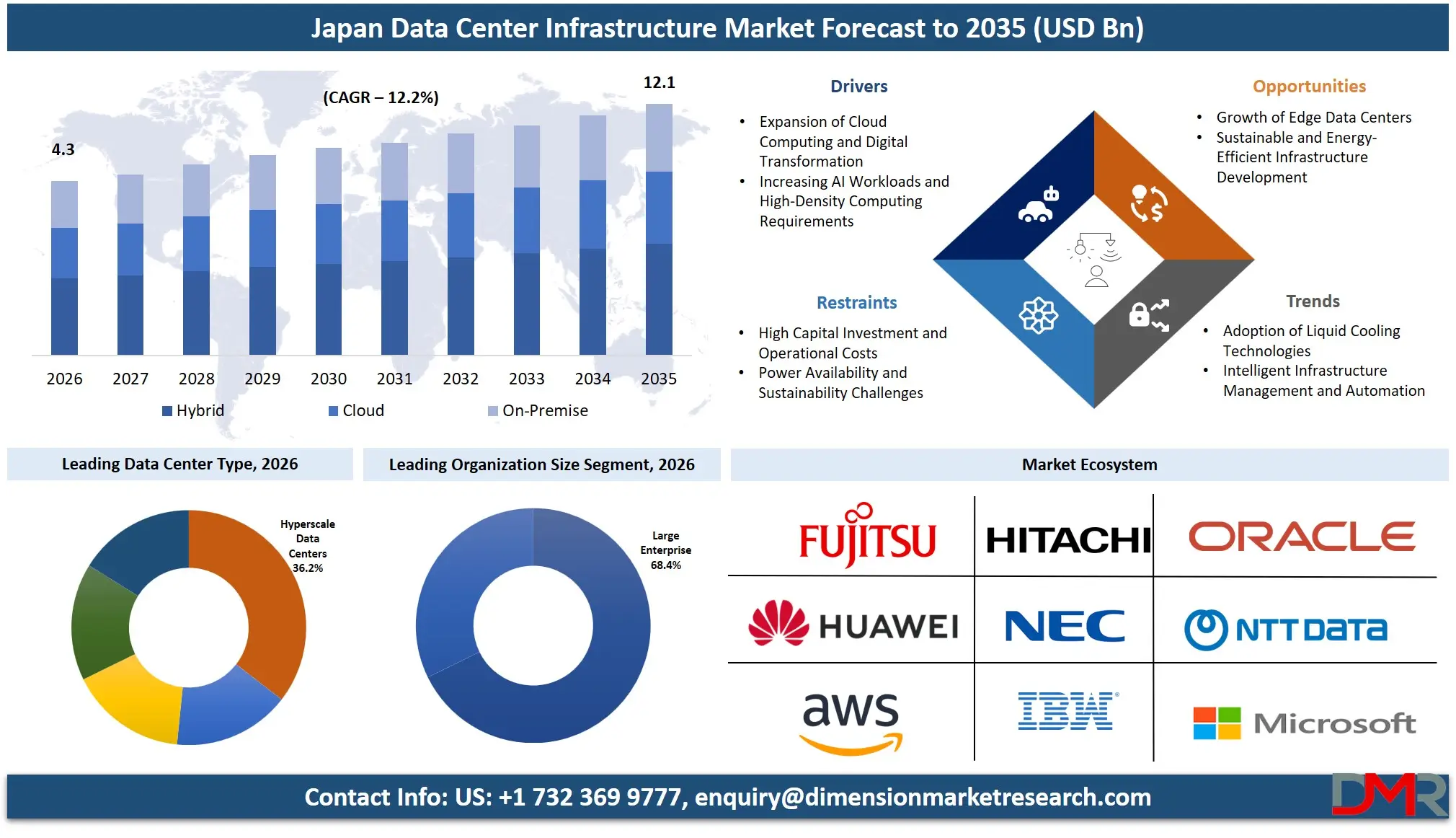
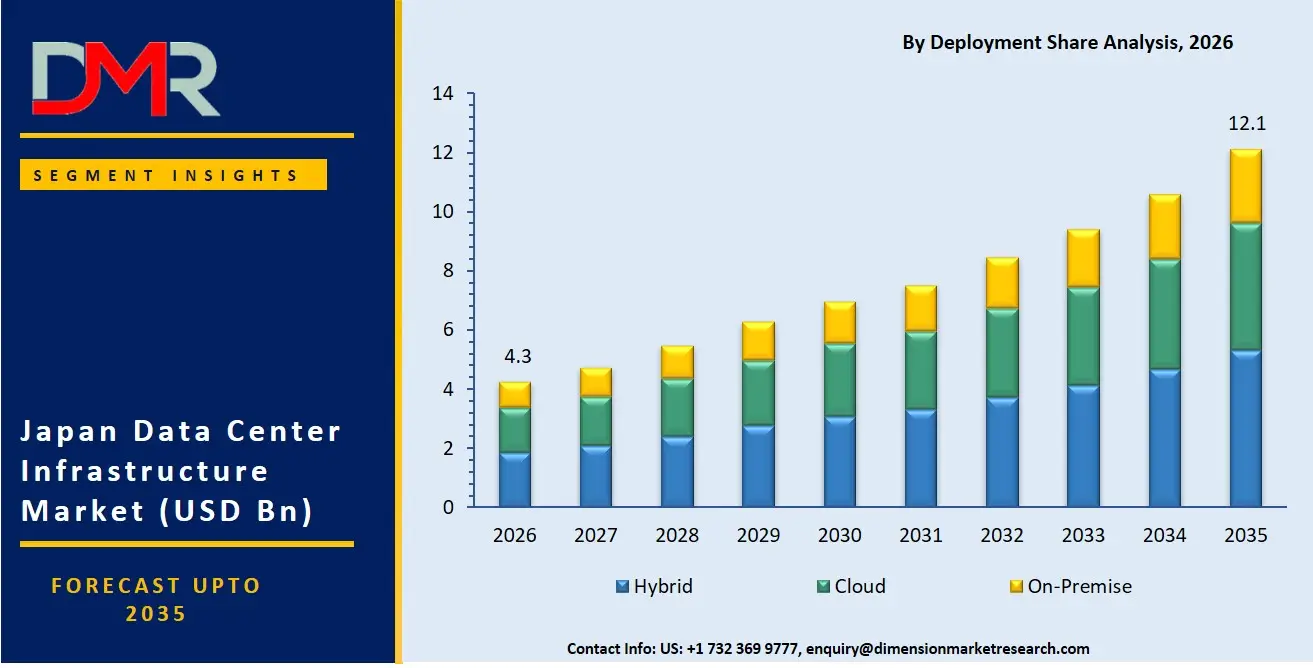
The Japan Data Center Infrastructure Market size is expected to be USD 4.3 billion in 2026 and increase at a compound annual growth rate of 12.2% to USD 12.1 billion in 2035 owing to expansion of cloud computing and digital transformation.
ℹ
To learn more about this report –
Download Your Free Sample Report Here
The Japan Data Center Infrastructure Market is witnessing steady expansion, supported by rising enterprise digitalization, cloud migration, artificial intelligence adoption, and increasing demand for secure, high-performance computing environments. Investments in hyperscale and edge data centers are accelerating as organizations seek lower latency and improved disaster recovery capabilities. Energy-efficient cooling systems, advanced power management solutions, and modular infrastructure are becoming central to new deployments. Government initiatives promoting digital transformation, together with growing demand from BFSI, healthcare, manufacturing, and telecommunications sectors, continue to strengthen infrastructure modernization and encourage innovation across the country's rapidly evolving data center ecosystem.
Key Takeaways
- Market Size & Forecast: The Japan Data Center Infrastructure Market size is projected to reach USD 4.3 billion in 2026 and is anticipated to have a value of USD 12.1 billion in 2035.
- Growth Rate & Outlook: The Japan Data Center Infrastructure Market size is set to grow at a compound annual growth rate of 12.2% during the forecast period of 2026 to 2035.
- Primary Growth Drivers: Some of the major growth drivers in the market are Expansion of Cloud Computing and Digital Transformation, and more.
- Key Market Trends: Some of the major trends in the market are Intelligent Infrastructure Management and Automation, and more.
- By Deployment: Hybrid segment is anticipated to get the majority share of the Japan Data Center Infrastructure Market in 2026.
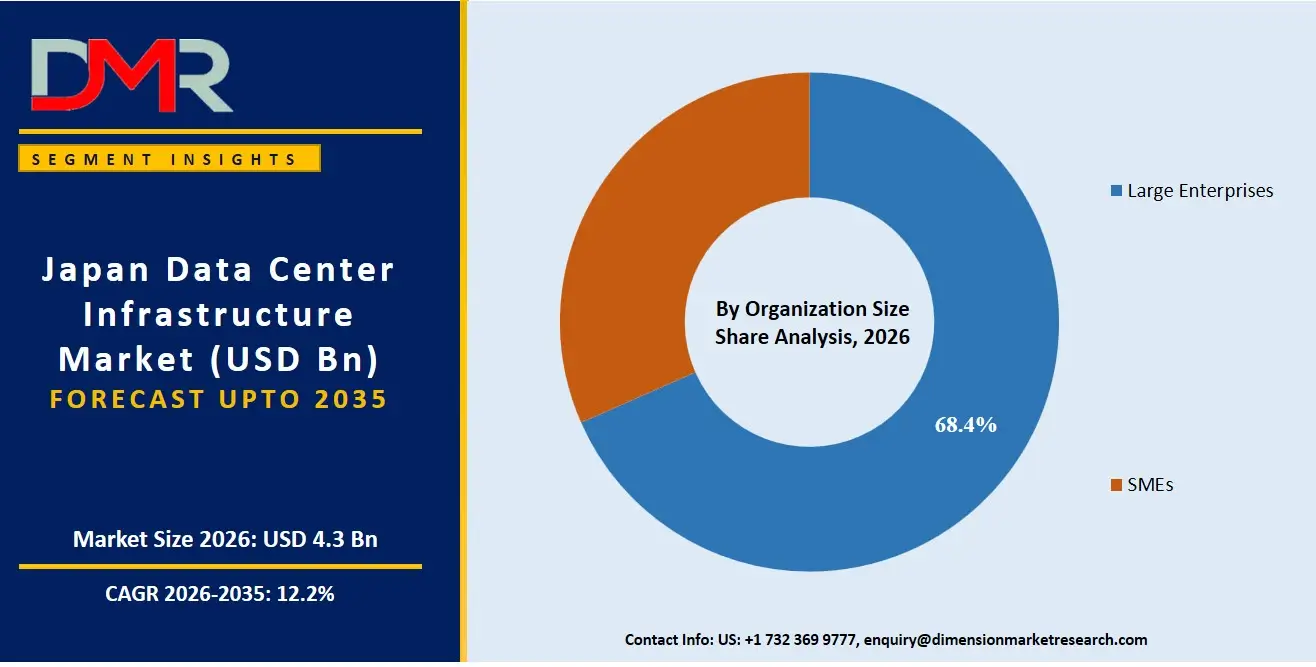
- By Organization Size Type: Large Enterprises is expected to get the largest revenue share in 2026 in the Japan Data Center Infrastructure Market.
- By Data Center Type: Hyperscale Data Centers segment is expected to get the largest revenue share in 2026 in the Japan Data Center Infrastructure Market.
What is the Japan Data Center Infrastructure?
Data center infrastructure comprises the physical and digital foundation required to support data storage, processing, networking, power management, cooling, security, and facility operations for computing environments. It includes servers, storage systems, networking equipment, power distribution units, uninterrupted power supplies, cooling technologies, racks, cabling, and monitoring solutions that ensure reliable and efficient data center performance.
Use Cases
- Cloud Computing Infrastructure: Cloud service providers deploy advanced servers, networking equipment, and cooling systems to support scalable computing resources for enterprises and consumers. Modern infrastructure enables high availability, rapid resource provisioning, and reliable performance while accommodating increasing cloud workloads and data storage requirements.
- Artificial Intelligence and High-Performance Computing: AI model training and high-performance computing applications require dense computing environments supported by high-capacity power systems and advanced liquid cooling technologies. Data center infrastructure enables efficient processing of complex workloads while maintaining operational reliability and energy efficiency.
- Disaster Recovery and Business Continuity: Organizations implement geographically distributed data center infrastructure to ensure uninterrupted business operations during natural disasters or cyber incidents. Redundant power supplies, backup generators, secure networking, and resilient storage systems minimize downtime and safeguard critical business information.
- Edge Computing Applications: Edge data centers deploy compact infrastructure closer to end users to reduce latency for applications including autonomous systems, industrial automation, smart cities, and 5G services. These facilities improve real-time processing capabilities while reducing bandwidth requirements and enhancing user experiences.
How AI Is Transforming the Japan Data Center Infrastructure Market
Artificial intelligence is transforming data center infrastructure by optimizing workload allocation, energy management, predictive maintenance, and infrastructure monitoring. AI-powered analytics improve server utilization, reduce power consumption, identify equipment failures before they occur, and automate operational decision-making, resulting in improved facility reliability and lower operating costs.
AI is also accelerating demand for high-density computing environments that require advanced GPU servers, liquid cooling systems, intelligent networking, and scalable power infrastructure. Infrastructure providers are increasingly integrating AI-based management platforms to improve operational efficiency, strengthen cybersecurity, enhance resource allocation, and support the growing computational requirements of next-generation enterprise and cloud applications.
Market Dynamic
Driving Factors in the Japan Data Center Infrastructure Market
Expansion of Cloud Computing and Digital Transformation
Growing adoption of cloud computing across public and private organizations continues to drive demand for modern data center infrastructure in Japan. Enterprises are migrating business-critical applications to cloud environments while expanding hybrid IT architectures. Increasing investments in digital transformation, business continuity planning, cybersecurity, and enterprise software modernization are encouraging organizations to upgrade power, cooling, networking, and storage infrastructure, thereby creating sustained market growth opportunities for infrastructure vendors and service providers.
Restraints in the Japan Data Center Infrastructure Market
High Capital Investment and Operational Costs
Developing advanced data center infrastructure requires significant investments in land acquisition, power systems, cooling technologies, networking equipment, physical security, and facility construction. Additionally, rising electricity prices, maintenance costs, and skilled workforce requirements increase operational expenditures. These financial challenges may discourage small organizations from deploying large-scale infrastructure projects and encourage greater dependence on colocation or cloud-based facilities instead of building proprietary data centers.
Opportunities in the Japan Data Center Infrastructure Market
Sustainable and Energy-Efficient Infrastructure Development
Growing emphasis on carbon reduction and environmental sustainability presents significant opportunities for advanced cooling technologies, intelligent energy management platforms, renewable power integration, and highly efficient electrical systems. Organizations increasingly prioritize infrastructure capable of reducing operational costs while meeting environmental targets. Vendors investing in innovative sustainability solutions are likely to strengthen their competitive position as green data center development accelerates across Japan.
Trends in the Japan Data Center Infrastructure Market
Intelligent Infrastructure Management and Automation
Organizations increasingly deploy AI-enabled monitoring platforms, predictive maintenance systems, digital twins, and automated infrastructure management software to improve operational efficiency. Intelligent infrastructure enables proactive equipment maintenance, optimized power utilization, enhanced asset visibility, and reduced downtime. Automation also helps operators minimize operational expenses while improving reliability across increasingly complex data center environments.
Research Scope and Analysis
The research evaluates the Japan Data Center Infrastructure Market across infrastructure components, data center types, deployment models, organization sizes, and end-user industries. It analyzes market size, growth drivers, restraints, opportunities, competitive dynamics, technological advancements, and emerging trends. The study also assesses investment patterns, AI adoption, sustainability initiatives, and future demand to provide a comprehensive outlook for stakeholders and strategic decision-making.
ℹ
To learn more about this report –
Download Your Free Sample Report Here
By Infrastructure Component Analysis
Among infrastructure components, IT Infrastructure is estimated to account for 38.7% of the Japan Data Center Infrastructure Market in 2026, making it the leading segment. The dominance of this segment is driven by continuous investments in high-performance servers, scalable storage systems, and advanced networking equipment required to support cloud computing, artificial intelligence, big data analytics, and enterprise digital transformation initiatives. Enterprises and hyperscale operators are increasingly replacing legacy hardware with energy-efficient, high-density computing platforms to improve processing capabilities and operational reliability. The growing adoption of GPU-based servers and high-speed interconnect technologies further strengthens demand for IT infrastructure. Meanwhile, Cooling Infrastructure is expected to be the fastest-growing segment, supported by rising deployment of AI workloads that generate significantly higher heat densities. Increasing adoption of liquid cooling, immersion cooling, and intelligent thermal management systems is enabling operators to improve energy efficiency, reduce operational costs, and accommodate next-generation computing environments.
By Data Center Type Analysis
Hyperscale Data Centers are projected to hold the largest market share of 36.2% in 2026, supported by expanding investments from cloud service providers and global technology companies establishing large-scale facilities across Japan. These facilities require substantial infrastructure investments in power distribution, networking, cooling, and physical security to support rapidly growing cloud workloads and artificial intelligence applications. Their ability to deliver economies of scale, operational efficiency, and high computing capacity continues to reinforce market leadership. At the same time, Edge Data Centers are anticipated to register the fastest growth throughout the forecast period. Expansion of 5G networks, industrial automation, connected devices, and latency-sensitive digital services is driving deployment of distributed computing facilities closer to end users, creating strong demand for compact, resilient, and energy-efficient infrastructure solutions.
By Deployment Analysis
Hybrid Deployment is expected to command the leading market share of 44.1% in 2026 owing to increasing enterprise preference for combining on-premises infrastructure with cloud resources to achieve greater flexibility, security, and workload optimization. Organizations across financial services, healthcare, manufacturing, and government sectors increasingly adopt hybrid environments to balance regulatory compliance with scalable cloud capabilities.
ℹ
To learn more about this report –
Download Your Free Sample Report Here
The model enables efficient disaster recovery, business continuity, and application modernization while optimizing infrastructure investments. Cloud-Based Deployment is forecast to be the fastest-growing segment as enterprises accelerate digital transformation and migrate business-critical applications to scalable cloud platforms. Growing adoption of AI services, software-as-a-service applications, and remote business operations continues to strengthen demand for cloud-connected infrastructure, while advancements in networking and cybersecurity further support long-term market expansion.
By Organization Size Analysis
Based on organization size, Large Enterprises are anticipated to dominate the Japan Data Center Infrastructure Market with an estimated 68.4% market share in 2026. Large organizations continue investing heavily in advanced data center infrastructure to support enterprise-wide digital transformation, AI deployment, mission-critical applications, cybersecurity, and business continuity. Their substantial IT budgets enable modernization of servers, storage, networking, cooling, and power infrastructure while facilitating migration toward hybrid cloud environments. Conversely, Small & Medium Enterprises (SMEs) are expected to register the fastest growth during the forecast period as affordable cloud services, managed infrastructure solutions, digital transformation initiatives, and government support encourage technology adoption. Increasing awareness of cybersecurity, remote work, SaaS applications, and scalable infrastructure solutions enables SMEs to modernize their IT environments without making extensive capital investments in dedicated facilities.
By End User Analysis
Among end users, the IT & Telecommunications segment is expected to account for an estimated 30.7% market share in 2026, making it the leading contributor to market revenue. The sector continues expanding digital infrastructure to support cloud computing, 5G deployment, AI applications, streaming services, enterprise connectivity, and hyperscale computing environments. Continuous investments in network modernization and increasing internet traffic further reinforce demand for high-performance infrastructure. Meanwhile, the Healthcare segment is projected to experience the fastest growth due to rapid digitalization of healthcare services, electronic medical records, AI-assisted diagnostics, telemedicine, and medical imaging applications. Growing regulatory requirements regarding secure patient data management and increasing adoption of digital healthcare platforms are driving investments in resilient, secure, and energy-efficient data center infrastructure.
The Japan Data Center Infrastructure Market Report is segmented on the basis of the following:
By Infrastructure Component
- IT Infrastructure
- Servers
- Storage Systems
- Networking Equipment
- Power Infrastructure
- UPS Systems
- Power Distribution Units (PDUs)
- Backup Generators
- Cooling Infrastructure
- Air Cooling
- Liquid Cooling
- Immersion Cooling
- Physical Infrastructure
- Racks & Enclosures
- Cabling
- Physical Security Systems
By Data Center Type
- Enterprise Data Centers
- Colocation Data Centers
- Hyperscale Data Centers
- Edge Data Centers
- Modular Data Centers
By Deployment
- On-Premises
- Cloud-Based
- Hybrid
By Organization Size
- Small & Medium Enterprises (SMEs)
- Large Enterprises
By End User
- IT & Telecommunications
- BFSI
- Government & Defense
- Healthcare
- Manufacturing
- Retail & E-commerce
- Energy & Utilities
- Media & Entertainment
- Other End Users
Competitive Landscape
The Japan Data Center Infrastructure Market is characterized by intense competition driven by continuous investments in technology innovation, energy-efficient infrastructure, sustainability initiatives, and capacity expansion. Market participants emphasize advanced cooling technologies, intelligent infrastructure management, strategic partnerships with cloud providers, and expansion of hyperscale and edge facilities to strengthen their market positions. High capital requirements, stringent operational standards, reliable power availability, and regulatory compliance create substantial entry barriers for new participants. Companies also prioritize research and development, renewable energy integration, modular infrastructure deployment, and long-term customer contracts to enhance competitiveness while addressing increasing demand for AI-ready and cloud-enabled infrastructure solutions.
Some of the prominent players in the Japan Data Center Infrastructure are:
- NTT DATA
- Equinix
- Digital Realty
- Fujitsu
- NEC Corporation
- Hitachi
- Mitsubishi Electric
- Schneider Electric
- Vertiv
- Eaton
- Legrand
- Cisco
- Huawei
- Dell Technologies
- Hewlett Packard Enterprise
- IBM
- Oracle
- Amazon Web Services
- Microsoft
- Other Key Players
Recent Developments
- In October 2025, SoftBank Corp. and Oracle Corporation entered into a strategic alliance to deliver sovereign AI and cloud services for enterprises in Japan using Oracle Alloy technology. The partnership enables SoftBank to deploy Oracle Cloud Infrastructure-based AI services through locally operated data centers while supporting stringent data sovereignty, cybersecurity, and regulatory compliance requirements. The initiative also strengthens domestic AI infrastructure by enabling scalable cloud deployment, enhanced computing capacity, and enterprise access to advanced AI platforms designed for mission-critical applications across both public and private sectors.
- In June 2025, KDDI Corporation announced a strategic partnership with Hewlett Packard Enterprise (HPE) to develop AI-ready data center infrastructure across Japan, targeting commercial operations beginning in early 2026. The collaboration combines KDDI's data center operational expertise with HPE's AI infrastructure, high-performance computing, networking, and system integration capabilities. The initiative focuses on supporting rapidly expanding enterprise AI workloads while improving energy efficiency, infrastructure scalability, and high-density computing capabilities. The partnership reflects growing investment in next-generation digital infrastructure required to accommodate generative AI adoption across Japanese industries.
- In February 2025, SoftBank Group and OpenAI announced the formation of SB OpenAI Japan, a joint venture established to accelerate enterprise AI adoption throughout Japan. The venture focuses on delivering advanced enterprise AI solutions while supporting large-scale deployment of AI infrastructure across corporate environments. SoftBank also committed significant annual investment to integrate advanced AI capabilities throughout its business ecosystem, increasing demand for high-performance data centers, GPU infrastructure, networking capacity, and energy-efficient facilities required to support expanding generative AI workloads and enterprise digital transformation initiatives.
Report Details
| Report Characteristics |
| Market Size (2026) |
USD 4.3 Bn |
| Forecast Value (2035) |
USD 12.1 Bn |
| CAGR (2026–2035) |
12.2% |
| Historical Period |
2021 – 2025 |
| Forecast Period |
2027 – 2035 |
| Base Year |
2025 |
| Estimate Year |
2026 |
| Segments Covered |
By Infrastructure Component, By Data Center Type, By Deployment, By Organization Size, By End User |
| Country Coverage |
Japan |
Frequently Asked Questions
How big is the Japan Data Center Infrastructure Market?
▾ The Japan Data Center Infrastructure Market size is expected to reach USD 4.3 billion by 2026 and is projected to reach USD 12.1 billion by the end of 2035.
What is the CAGR of the Japan Data Center Infrastructure Market from 2026 to 2035?
▾ The market is growing at a CAGR of 12.2 percent over the forecasted period.
What factors are driving the growth of the Japan Data Center Infrastructure Market?
▾ Expansion of Cloud Computing and Digital Transformation, and more are the factors driving the growth of the Japan Data Center Infrastructure Market.
What are the major trends in the Japan Data Center Infrastructure Market?
▾ Integration of Artificial Intelligence with Connected Vehicles, and more are some of the major trends in the market.
Who are the key players in the Japan Data Center Infrastructure Market?
▾ Some of the key players in the Japan Data Center Infrastructure Market include NEC, AWS, Hitachi, and more.
How is the Japan Data Center Infrastructure Market segmented?
▾ The Japan Data Center Infrastructure Market is segmented by infrastructure component, data center type, deployment, organization size, end user.