What is the Japan Data Center Rack Market Size?
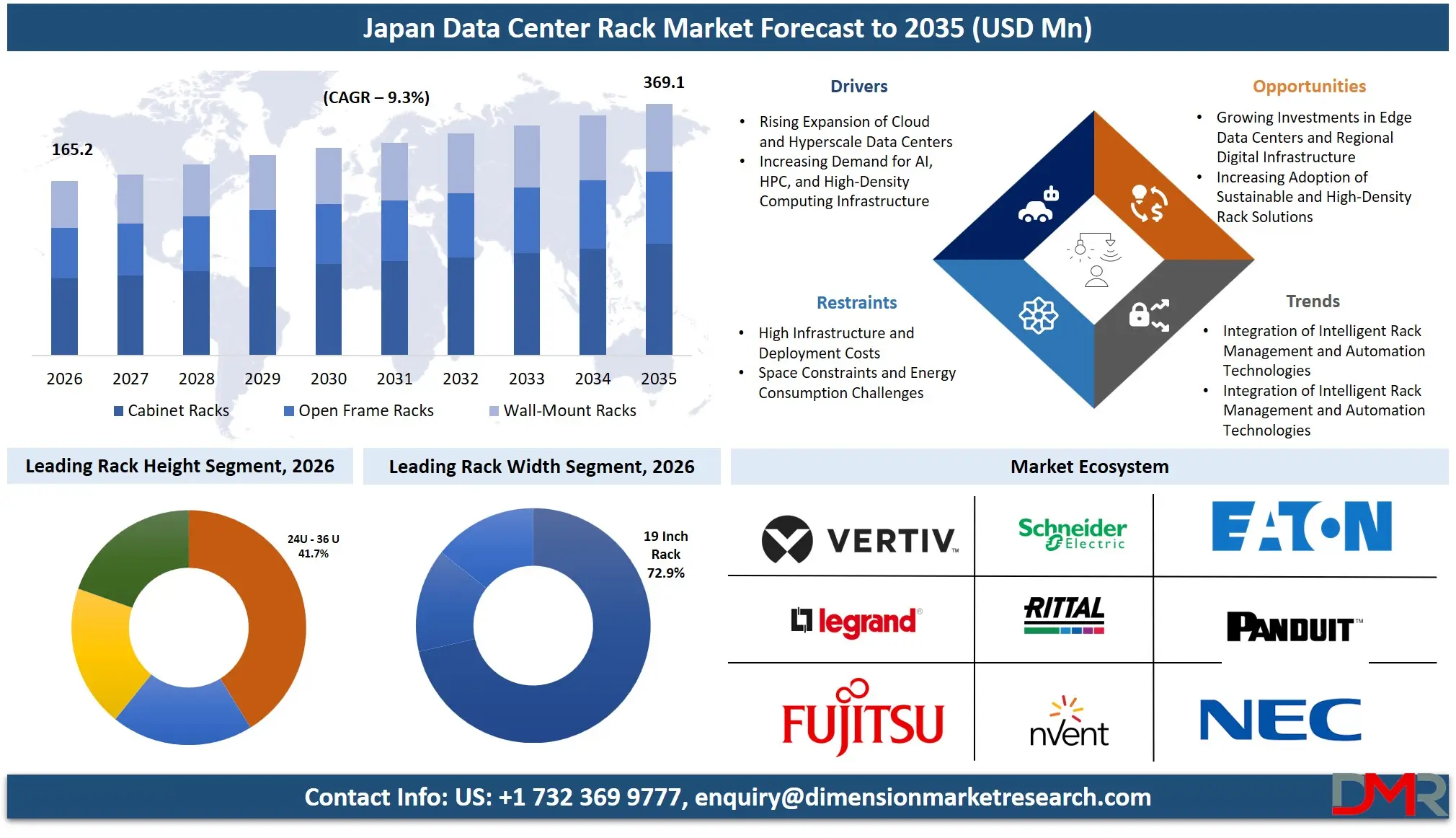
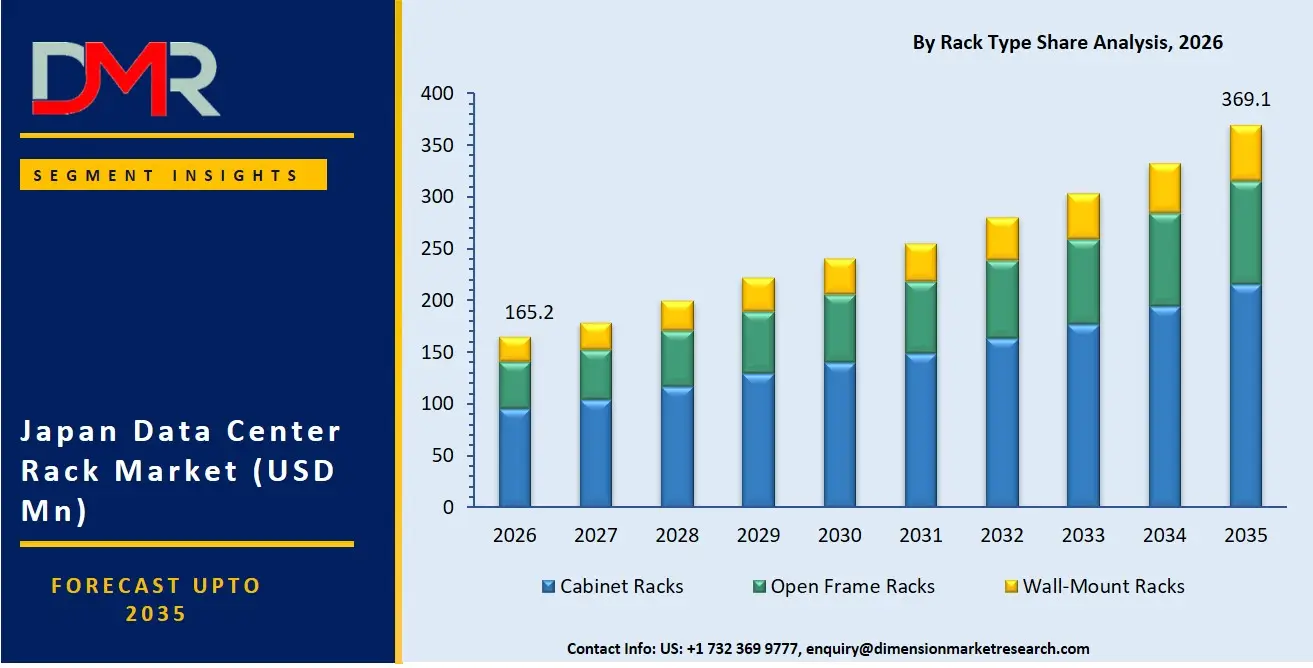
The Japan Data Center Rack Market size is expected to be USD 165.2 million in 2026 and increase at a compound annual growth rate of 9.3% to USD 369.1 million in 2035 owing to rising expansion of cloud and hyperscale data centers.
ℹ
To learn more about this report –
Download Your Free Sample Report Here
The Japan Data Center Rack Market is witnessing steady expansion owing to increasing investments in hyperscale and colocation data centers, widespread cloud adoption, rapid digital transformation, and the growing deployment of artificial intelligence and high-performance computing infrastructure. Rising demand for secure, scalable, and energy-efficient server environments is encouraging organizations to upgrade rack systems with enhanced cooling compatibility and cable management capabilities. Government initiatives supporting digital infrastructure modernization, alongside increasing enterprise workloads and edge computing deployments, continue to strengthen market demand. Furthermore, sustainability goals and the adoption of modular data center designs are driving innovation in rack configurations, supporting long-term market growth across Japan.
Key Takeaways
- Market Size & Forecast: The Japan Data Center Rack Market size is projected to reach USD 165.2 million in 2026 and is anticipated to have a value of USD 369.1 million in 2035.
- Growth Rate & Outlook: The Japan Data Center Rack Market size is set to grow at a compound annual growth rate of 9.3% during the forecast period of 2026 to 2035.
- Primary Growth Drivers: Some of the major growth drivers in the market are Rising Expansion of Cloud and Hyperscale Data Centers, and more.
- Key Market Trends: Some of the major trends in the market are Rising Adoption of Modular and Liquid Cooling-Compatible Rack Designs and more.
- By Rack Height Type: 24U – 36 U is expected to get the largest revenue share in 2026 in the Japan Data Center Rack Market.
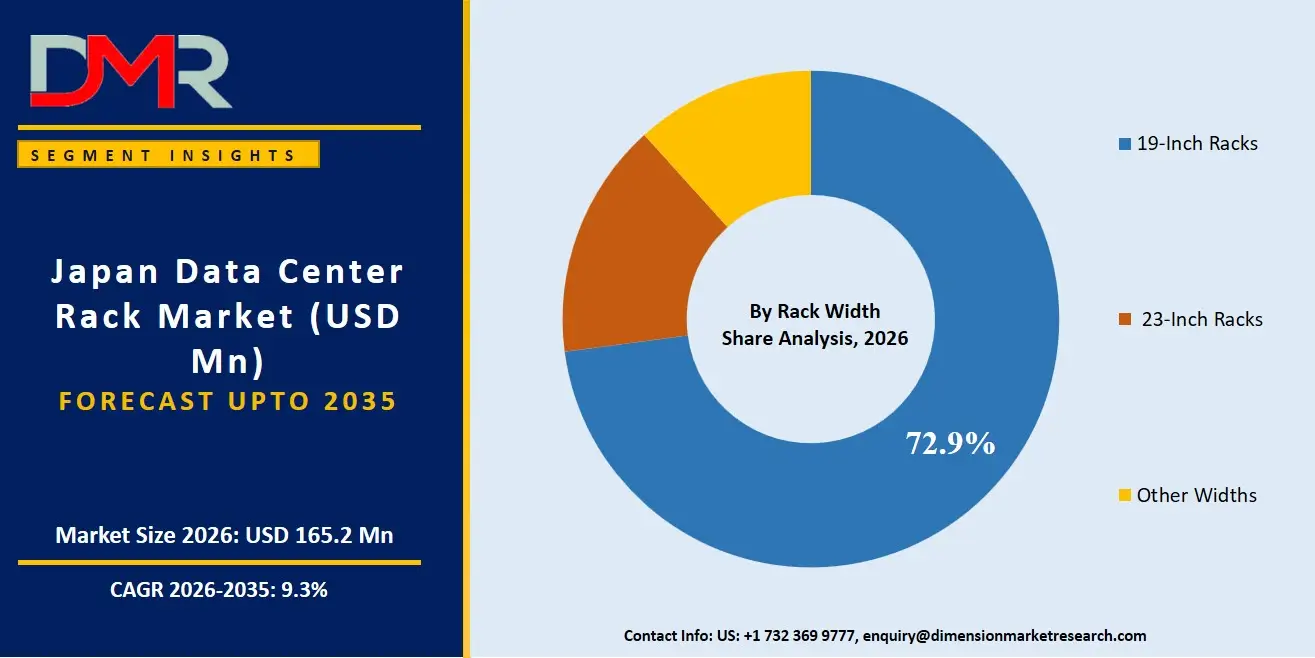
- By Rack Width Type: 19 inch Rack is expected to get the largest revenue share in 2026 in the Japan Data Center Rack Market.
- By Rack Type: Cabinet Racks segment is expected to get the largest revenue share in 2026 in the Japan Data Center Rack Market.
What is the Data Center Rack?
A data center rack is a standardized physical framework designed to securely house, organize, and support servers, storage systems, networking equipment, power distribution units, and other IT hardware within a data center. Typically manufactured in standardized dimensions such as 19-inch or 23-inch widths and measured in rack units (U), these racks facilitate efficient equipment installation, airflow management, cable organization, and maintenance accessibility. Available in cabinet, open-frame, and wall-mount configurations, data center racks enhance equipment protection, optimize space utilization, improve cooling efficiency, and enable scalable infrastructure deployment for modern computing environments.
Use Cases
- Hyperscale Cloud Data Centers: Data center racks are extensively deployed in hyperscale cloud facilities to accommodate high-density servers, storage systems, and networking equipment. Their modular design supports scalability, efficient airflow, and organized cable management, enabling cloud providers to expand computing capacity while maintaining operational efficiency and reducing infrastructure downtime.
- Colocation Data Centers: Colocation operators utilize standardized rack solutions to securely host IT equipment for multiple customers within shared facilities. Advanced rack configurations with integrated locking systems, power distribution, and cable management improve equipment security, simplify maintenance, and maximize floor space utilization while meeting varying customer infrastructure requirements.
- Enterprise IT Infrastructure: Large enterprises across sectors such as banking, manufacturing, healthcare, and retail deploy data center racks to centralize servers and networking hardware. These racks facilitate structured equipment organization, simplify system upgrades, improve cooling performance, and support business continuity through reliable infrastructure management.
- Edge Computing Facilities: As edge computing expands across Japan, compact and high-performance data center racks are increasingly installed in distributed facilities closer to end users. These racks support low-latency applications, industrial automation, IoT deployments, and AI-enabled workloads while enabling efficient use of limited installation space and simplified remote infrastructure management.
How AI Is Transforming the Japan Data Center Rack Market
Artificial intelligence is transforming the Japan Data Center Rack Market by improving infrastructure monitoring, predictive maintenance, and energy optimization. AI-powered analytics continuously monitor rack temperature, airflow, power consumption, and equipment performance, enabling operators to identify potential failures before they disrupt operations. This improves infrastructure reliability while reducing maintenance costs and unplanned downtime.
AI is also driving demand for next-generation rack systems capable of supporting GPU-intensive computing environments and advanced cooling technologies. Intelligent rack management platforms optimize equipment placement, automate workload distribution, enhance thermal efficiency, and improve overall resource utilization. As AI workloads continue to expand across cloud, enterprise, and research facilities, rack manufacturers are developing higher-density, scalable, and automation-ready solutions to meet evolving infrastructure requirements.
Market Dynamic
Driving Factors in the Japan Data Center Rack Market
Rising Expansion of Cloud and Hyperscale Data Centers
The continuous expansion of cloud computing services and hyperscale data center investments is a major driver of the Japan Data Center Rack Market. Increasing enterprise migration toward cloud platforms has created substantial demand for high-density rack systems capable of supporting advanced computing infrastructure. Hyperscale facilities require standardized, scalable, and energy-efficient rack solutions that can accommodate growing server deployments while ensuring effective thermal management and cable organization. As digital transformation accelerates across industries, demand for modern rack infrastructure continues to strengthen throughout Japan.
Restraints in the Japan Data Center Rack Market
High Infrastructure and Deployment Costs
Deploying advanced data center rack systems requires considerable investment in supporting infrastructure, including cooling systems, power distribution, cable management, and physical security. High-density racks designed for AI and hyperscale environments often involve additional installation and maintenance expenses. These capital-intensive requirements can discourage smaller enterprises and regional operators from upgrading existing facilities, thereby limiting broader market adoption despite growing digital infrastructure demand.
Opportunities in the Japan Data Center Rack Market
Growing Investments in Edge Data Centers and Regional Digital Infrastructure
The expansion of edge computing infrastructure across Japan presents significant opportunities for data center rack manufacturers and solution providers. Increasing deployment of localized data centers to support 5G networks, smart manufacturing, autonomous technologies, and Internet of Things (IoT) applications is creating demand for compact, modular, and highly efficient rack systems. Organizations are seeking flexible rack solutions that can be rapidly deployed in distributed environments while maintaining high reliability, simplified maintenance, and optimized cooling performance. This trend is expected to broaden the addressable market beyond traditional hyperscale facilities.
Trends in the Japan Data Center Rack Market
Rising Adoption of Modular and Liquid Cooling-Compatible Rack Designs
The growing deployment of AI servers and high-performance computing infrastructure is accelerating demand for modular rack designs compatible with advanced cooling technologies. Operators are increasingly selecting rack systems that support liquid cooling, rear-door heat exchangers, and higher power densities to efficiently manage thermal loads. Modular architectures also simplify future capacity expansion, enabling organizations to respond quickly to changing computing requirements while improving energy efficiency and optimizing valuable data center floor space.
Research Scope and Analysis
The research scope of the Japan Data Center Rack Market covers detailed segmentation across rack type, rack height, rack width, end user, and industry vertical, analyzing demand patterns and adoption trends. It evaluates technological advancements, including high-density and AI-ready rack systems, and their impact on infrastructure efficiency. The analysis highlights market dynamics, competitive strategies, and growth drivers. It also assesses 2026 segment share estimates, identifying leading and fastest-growing categories across enterprise, cloud, and colocation deployments.
ℹ
To learn more about this report –
Download Your Free Sample Report Here
By Rack Type Analysis
The Japan Data Center Rack Market by rack type is segmented into cabinet racks, open frame racks, and wall-mount racks. Cabinet racks dominate the market with an estimated 58.4% share in 2026, driven by their strong adoption in hyperscale and colocation data centers due to superior security, cooling efficiency, and structured cable management.
ℹ
To learn more about this report –
Download Your Free Sample Report Here
These racks are widely preferred for mission-critical workloads and high-density server environments. Open frame racks are witnessing steady demand in enterprise and lab environments where accessibility and cost efficiency are prioritized. Meanwhile, wall-mount racks are gaining traction in edge computing and small IT setups due to compact design and space optimization needs, making them the fastest-growing sub-segment.
By Rack Height Analysis
The market is segmented into below 24U, 24U–36U, 37U–48U, and above 48U. The 24U–36U segment holds the leading share at 41.7% in 2026, supported by balanced capacity and flexibility for enterprise and colocation deployments. These racks offer optimal space utilization while accommodating moderate-to-high server density requirements. The above 48U segment is expanding rapidly due to hyperscale data center expansion and AI workload adoption, which require high-density rack infrastructure. Smaller racks below 24U continue to serve edge computing and distributed IT environments, particularly in retail and telecom installations.
By Rack Width Analysis
By rack width, the market includes 19-inch racks, 23-inch racks, and other widths. The 19-inch rack segment dominates with an estimated 72.9% share in 2026, owing to its global standardization and widespread compatibility with servers, switches, and storage systems. Its dominance is reinforced by strong adoption across cloud providers, enterprises, and colocation facilities. The 23-inch segment is gradually expanding, particularly in telecommunications and specialized infrastructure deployments requiring higher equipment density. Other widths remain niche but are used in customized industrial applications.
By End User Analysis
The end user segmentation includes colocation providers, cloud service providers, enterprises, and government organizations. Cloud service providers hold the leading share at 46.3% in 2026, driven by rapid cloud migration, AI workload growth, and hyperscale infrastructure expansion across Japan. Colocation providers are also experiencing strong demand due to increasing outsourcing of IT infrastructure. Enterprises are steadily modernizing legacy data centers, while government organizations are investing in secure and resilient digital infrastructure for public services and defense applications.
By Industry Vertical Analysis
Key industry verticals include IT & telecommunications, BFSI, healthcare, government & defense, manufacturing, retail & e-commerce, energy & utilities, media & entertainment, and others. The IT & telecommunications segment leads with 33.8% share in 2026, supported by 5G expansion, cloud integration, and increasing data traffic. BFSI is another major contributor due to secure transaction processing needs and regulatory compliance requirements. Healthcare and government sectors are growing steadily with digitalization and data security initiatives, while manufacturing is emerging strongly with Industry 4.0 and smart factory adoption.
The Japan Data Center Rack Market Report is segmented on the basis of the following:
By Rack Type
- Cabinet Racks
- Open Frame Racks
- Wall-Mount Racks
By Rack Height
- Below 24U
- 24U–36U
- 37U–48U
- Above 48U
By Rack Width
- 19-Inch Racks
- 23-Inch Racks
- Other Widths
By End User
- Colocation Providers
- Cloud Service Providers
- Enterprises
- Government Organizations
By Industry Vertical
- IT & Telecommunications
- BFSI
- Healthcare
- Government & Defense
- Manufacturing
- Retail & E-commerce
- Energy & Utilities
- Media & Entertainment
- Other Industries
Competitive Landscape
The Japan Data Center Rack Market is characterized by strong competition driven by innovation, customization, and energy efficiency improvements. Market participants are focusing on developing high-density, modular, and AI-compatible rack solutions to meet the evolving requirements of hyperscale and edge data centers. Strategic emphasis is placed on enhancing thermal management capabilities, supporting liquid cooling integration, and improving structural flexibility for scalable deployments. Companies are also investing in advanced materials, smart rack monitoring systems, and sustainable manufacturing practices. Partnerships with cloud providers, colocation operators, and telecom firms are increasingly shaping competitive positioning, while high entry barriers exist due to technical complexity, certification standards, and infrastructure integration requirements.
Some of the prominent players in the Japan Data Center Rack are:
- Schneider Electric
- Vertiv
- Rittal
- Legrand
- Eaton
- Panduit
- nVent
- Fujitsu Limited
- NEC Corporation
- Hitachi, Ltd.
- Mitsubishi Electric Corporation
- NTT Ltd.
- NTT DATA
- Dell Technologies
- Hewlett Packard Enterprise
- Cisco Systems
- IBM
- Oracle
- Lenovo
- Supermicro
- Other Key Players
Recent Developments
- In September 2025, Huawei launched a new generation of high-density rack systems tailored for AI and cloud data centers in Japan. These racks are engineered to support ultra-high computing loads with improved airflow design and liquid cooling compatibility. The solution targets hyperscale operators managing large-scale AI training and inference workloads. The launch reflects increasing demand for scalable infrastructure capable of handling exponential data growth. The company emphasized energy optimization features and intelligent management systems to reduce operational costs while improving computing efficiency in advanced Japanese data center environments.
- In May 2025, Vertiv expanded its edge data center infrastructure offerings in Japan with new compact rack systems designed for distributed computing environments. The development focuses on supporting telecom operators and enterprises deploying 5G-enabled edge nodes. These racks incorporate intelligent thermal management and remote monitoring capabilities, enabling efficient operation in space-constrained environments. The expansion supports Japan's rapid adoption of edge computing for IoT, smart manufacturing, and low-latency applications. The company also enhanced its service network to ensure faster deployment and maintenance support across regional Japanese markets.
- In January 2025, Schneider Electric announced the expansion of its AI-optimized data center rack solutions in Japan, targeting hyperscale and enterprise facilities. The company introduced enhanced modular rack systems designed to support high-density GPU workloads and advanced liquid cooling integration. These solutions aim to improve energy efficiency, reduce carbon footprint, and support AI-driven computing environments. The initiative aligns with Japan's growing demand for sustainable digital infrastructure and increasing AI adoption across cloud and industrial sectors. The rollout includes partnerships with local data center operators to deploy next-generation infrastructure across major urban hubs.
Report Details
| Report Characteristics |
| Market Size (2026) |
USD 165.2 Mn |
| Forecast Value (2035) |
USD 369.1 Mn |
| CAGR (2026–2035) |
9.3% |
| Historical Period |
2021 – 2025 |
| Forecast Period |
2027 – 2035 |
| Base Year |
2025 |
| Estimate Year |
2026 |
| Segments Covered |
By Rack Type, By Rack Height, By Rack Width, By End User, By Industry Vertical |
| Country Coverage |
Japan |
Frequently Asked Questions
How big is the Japan Data Center Rack Market?
▾ The Japan Data Center Rack Market size is expected to reach USD 165.2 million by 2026 and is projected to reach USD 369.1 million by the end of 2035.
What is the CAGR of the Japan Data Center Rack Market from 2026 to 2035?
▾ The market is growing at a CAGR of 9.3 percent over the forecasted period.
What factors are driving the growth of the Japan Data Center Rack Market?
▾ Rising Expansion of Cloud and Hyperscale Data Centers, and more are the factors driving the growth of the Japan Data Center Rack Market.
What are the major trends in the Japan Data Center Rack Market?
▾ Rising Adoption of Modular and Liquid Cooling-Compatible Rack Designs, and more are some of the major trends in the market.
Who are the key players in the Japan Data Center Rack Market?
▾ Some of the key players in the Japan Data Center Rack Market include Eaton, Vertiv, NEC, and more
How is the Japan Data Center Rack Market segmented?
▾ The Japan Data Center Rack Market is segmented by rack type, rack height, rack width, end user, industry vertical.