Market Overview
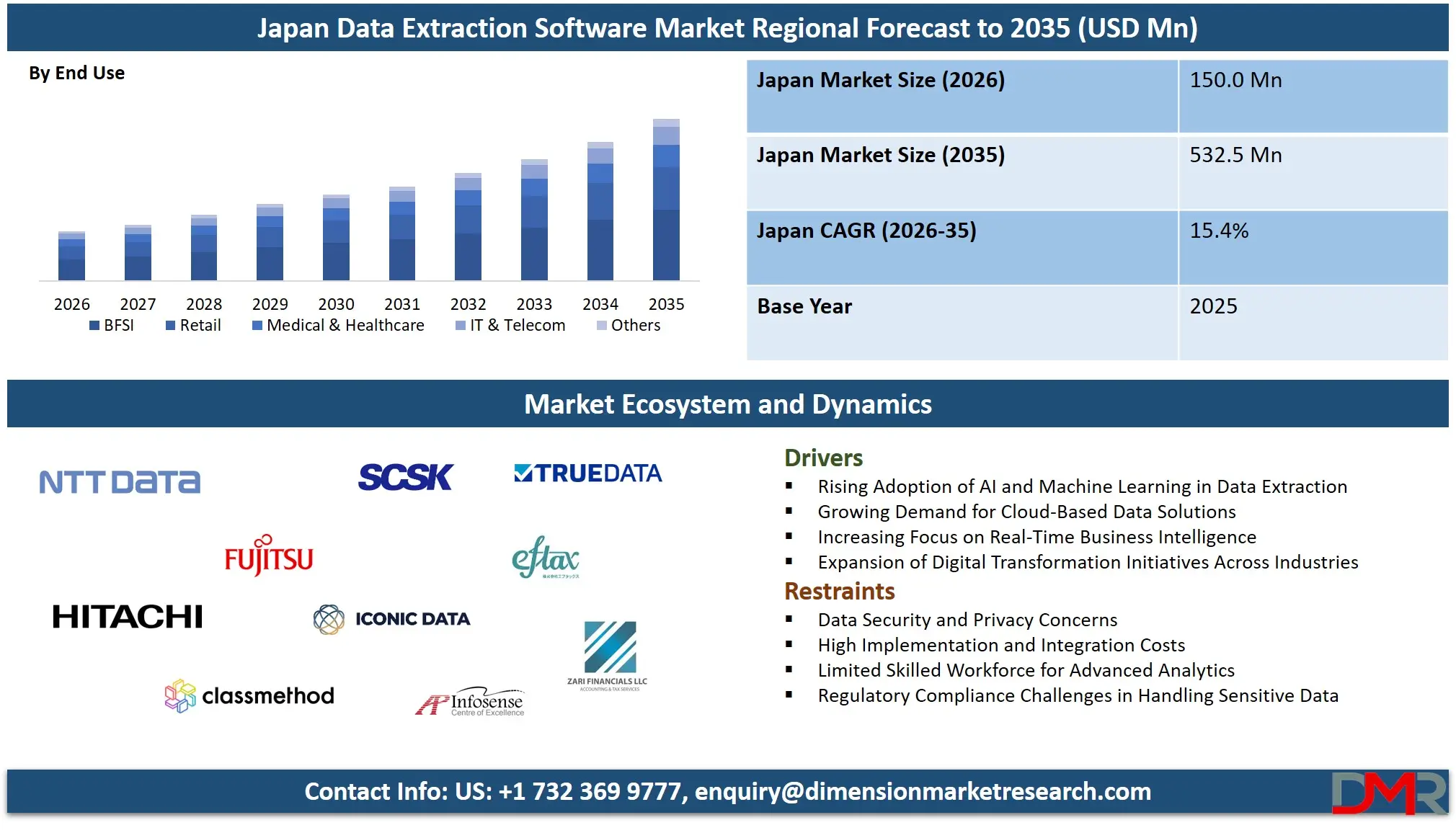
The Japan data extraction software market is projected to grow from USD 150.0 million in 2026 to USD 532.5 million by 2035, registering a robust CAGR of 15.4%. Rising adoption of automated data collection, AI-driven analytics, cloud-based solutions, and demand for real-time business intelligence are driving market expansion across enterprises in finance, healthcare, manufacturing, and e-commerce sectors.
ℹ
To learn more about this report –
Download Your Free Sample Report Here
Data extraction software is a specialized type of application designed to collect, retrieve, and transform data from various sources into structured formats that can be easily analyzed and utilized for business intelligence. These solutions enable organizations to automate the process of gathering information from databases, websites, documents, and other digital repositories, reducing manual effort and minimizing errors. Advanced data extraction tools leverage artificial intelligence, machine learning, and natural language processing to identify patterns, extract relevant content, and integrate it seamlessly with analytics platforms or enterprise systems. By converting unstructured or semi-structured data into actionable insights, these tools empower decision-makers to improve operational efficiency, optimize resource allocation, and enhance strategic planning across multiple industries.
The Japan data extraction software market has witnessed significant growth driven by the increasing adoption of digital transformation initiatives and the proliferation of big data analytics across enterprises. Organizations in sectors such as finance, healthcare, manufacturing, and e-commerce are investing heavily in automated data collection solutions to streamline workflows and enhance decision-making capabilities. The market is characterized by the presence of both global technology providers and domestic companies offering localized solutions tailored to Japanese business requirements. Rising demand for cloud-based extraction tools and AI-powered analytics platforms is further fueling the market expansion while improving data accuracy and reducing processing time.
ℹ
To learn more about this report –
Download Your Free Sample Report Here
Furthermore, regulatory compliance and data security considerations have become critical factors influencing the adoption of data extraction software in Japan. Enterprises are increasingly focusing on secure data handling, GDPR-aligned privacy practices, and audit-ready reporting functionalities while integrating extraction tools into their existing IT infrastructure. The market is also witnessing innovation in natural language processing and optical character recognition technologies to handle complex document formats and multilingual data. As businesses continue to prioritize data-driven strategies, the Japan data extraction software market is expected to evolve rapidly with an emphasis on scalable, efficient, and intelligent solutions that cater to the growing demand for real-time analytics and predictive insights.
Japan Data Extraction Software Market: Key Takeaways
- Market Value: The Japan Data Extraction Software market size is expected to reach a value of USD 532.5 million by 2035 from a base value of USD 150.0 million in 2026 at a CAGR of 15.4%.
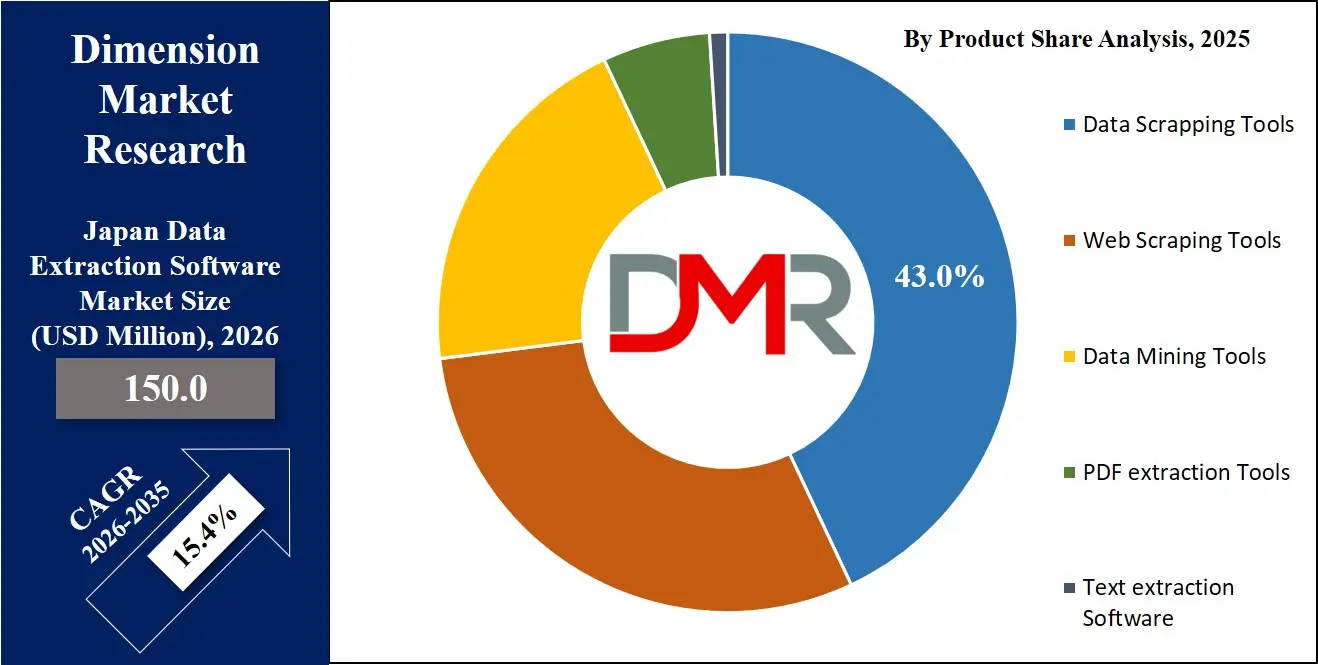
- By Product Segment Analysis: Data Scrapping Tools are expected to maintain their dominance in the product segment, capturing 43.0% of the total market share in 2026.
- By Deployment Segment Analysis: Cloud-based deployment is expected to capture the maximum market share with a value of 65.0% in the deployment segment.
- By Organization Size Segment Analysis: Large Enterprises will dominate the organization size segment, capturing 69.0% of the market share in 2026.
- By Application Segment Analysis: Lead Generation applications will dominate the application segment, capturing 53.0% of the market share in 2026.
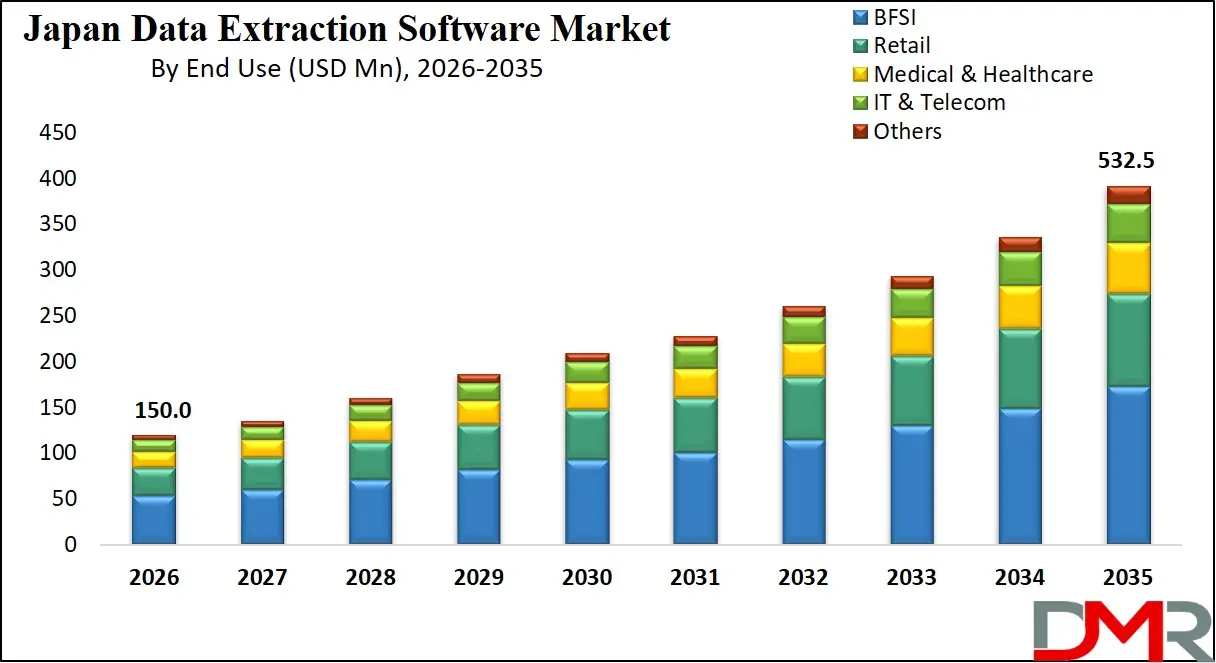
- By End-Use Segment Analysis: BFSI will account for the maximum share in the end-use segment, capturing 44.0% of the market share in 2026.
- Key Players: Some key players in the Japan Data Extraction Software market include NTT Data Corporation, Fujitsu, Hitachi, Ltd., Classmethod, Inc., SCSK Corporation, ICONIC DATA Japan, True Data, eftax Co. Ltd., DataStrategy Inc., Japan Business Data Processing Center, Toor, Link Processing, Infosense, Zari Financials, Finatext Ltd., SDKI Analytics, Report Consultant, NITTO TECHNO BRAIN, Integral System Engineering, and Others.
Japan Data Extraction Software Market: Use Cases
- Financial Data Management and Fraud Detection: Enterprises in Japan's financial sector are increasingly deploying data extraction software to streamline large-scale financial data processing and enhance fraud detection mechanisms. These solutions automate the extraction of transactional records, customer profiles, and market data from multiple sources, enabling accurate reconciliation, risk analysis, and regulatory compliance. By integrating AI and machine learning capabilities, organizations can identify unusual patterns, detect anomalies in real-time, and improve decision-making efficiency while minimizing operational errors and manual intervention.
- Healthcare Analytics and Patient Data Integration: Healthcare providers and research institutions leverage data extraction tools to consolidate patient records, lab results, and medical imaging data into structured formats suitable for analytics. This enables hospitals and clinics to enhance patient care, track treatment outcomes, and optimize resource allocation. Additionally, pharmaceutical companies use these tools for drug research by extracting relevant information from clinical trials, electronic health records, and medical publications, facilitating faster insights and evidence-based decision-making in a secure and compliant environment.
- Supply Chain Optimization and Inventory Management: Manufacturing and retail organizations in Japan utilize data extraction software to capture information from invoices, shipment logs, and supplier databases. This data is transformed into actionable insights to optimize inventory levels, improve demand forecasting, and streamline procurement processes. Integration with enterprise resource planning systems and cloud analytics platforms allows businesses to identify inefficiencies, reduce operational costs, and enhance overall supply chain transparency, supporting agile and data-driven operations.
- Market Research and Competitive Intelligence: Companies across industries deploy data extraction tools to gather competitive intelligence, customer sentiment, and market trends from websites, social media, and public databases. By converting unstructured online data into structured insights, businesses can perform competitor benchmarking, analyze consumer behavior, and identify emerging opportunities in real-time. AI-powered analytics embedded in these solutions enable predictive modeling, helping enterprises in Japan make informed strategic decisions and maintain a competitive edge in fast-evolving markets.
Impact of Iran Conflict on the Japan Data Extraction Software market
- Rising Energy Costs Increasing IT Infrastructure Expenses: Japan is highly dependent on Middle East energy imports, making it vulnerable to disruptions. The conflict has led to higher fuel and electricity costs, increasing operational expenses for data centers, cloud platforms, and AI systems that support data extraction software, thereby affecting profitability and enterprise adoption.
- Supply Chain Disruptions Affecting Tech Hardware & Semiconductors: Global supply chain instability, including shortages of critical materials used in semiconductor manufacturing, is impacting Japan’s advanced technology ecosystem. This delays deployment of servers, storage systems, and data processing infrastructure required for large scale data extraction and analytics solutions.
- Economic Slowdown Reducing IT and Digital Investment: The conflict is increasing inflationary pressure and slowing economic growth due to rising import costs and uncertainty. This can lead enterprises to delay spending on digital transformation initiatives, including investments in data extraction software, AI driven automation, and enterprise data integration platforms.
Japan Data Extraction Software Market: Stats & Facts
- Statistical Handbook of Japan 2025
- Japan's Information and Communications Technology (ICT) industry employed approximately 1.2 million individuals in 2024.
- The number of enterprises in the ICT sector increased by 2.5% from 2023 to 2024.
- The ICT industry's contribution to Japan's GDP was estimated at 7.8% in 2024.
- Expenditure on software development in the private sector rose by 3.2% in 2024 compared to the previous year.
- The number of enterprises utilizing cloud computing services increased by 6.5% from 2023 to 2024.
- The adoption rate of big data analytics tools among large enterprises was approximately 45% in 2024.
- The number of data centers in Japan grew by 4.1% in 2024 compared to the previous year.
- The average annual salary for IT professionals in Japan was ¥6.5 million in 2024.
- The number of startups in the AI and data analytics sector increased by 8.3% from 2023 to 2024.
- The percentage of enterprises implementing data-driven decision-making processes was 38% in 2024.
- Statistical Handbook of Japan 2024
- Japan's ICT industry employed approximately 1.1 million individuals in 2023.
- The number of enterprises in the ICT sector increased by 2.3% from 2022 to 2023.
- The ICT industry's contribution to Japan's GDP was estimated at 7.5% in 2023.
- Expenditure on software development in the private sector rose by 2.9% in 2023 compared to the previous year.
- The number of enterprises utilizing cloud computing services increased by 5.8% from 2022 to 2023.
- The adoption rate of big data analytics tools among large enterprises was approximately 42% in 2023.
- The number of data centers in Japan grew by 3.8% in 2023 compared to the previous year.
- The average annual salary for IT professionals in Japan was ¥6.3 million in 2023.
- The number of startups in the AI and data analytics sector increased by 7.9% from 2022 to 2023.
- The percentage of enterprises implementing data-driven decision-making processes was 35% in 2023.
Japan Data Extraction Software Market: Market Dynamics
Japan Data Extraction Software Market: Driving Factors
Rising Adoption of AI-Powered Data Extraction
The integration of artificial intelligence and machine learning into data extraction software is a key growth driver in Japan. Enterprises are leveraging AI-powered tools to automate the extraction of unstructured data from diverse sources such as financial records, healthcare documents, and e-commerce transactions. This reduces manual effort, improves data accuracy, and accelerates business intelligence processes. The increasing reliance on predictive analytics and real-time insights further strengthens demand for intelligent extraction solutions across multiple sectors.
Growing Demand for Cloud-Based and Scalable Solutions
Organizations in Japan are increasingly adopting cloud-based data extraction platforms to handle large volumes of information efficiently. Cloud deployment offers flexibility, scalability, and cost-effectiveness, allowing businesses to process data from multiple locations and integrate it seamlessly with analytics and ERP systems. The trend toward digital transformation and remote operations is driving enterprises to invest in cloud-enabled extraction tools that enhance operational efficiency and support data-driven decision-making.
Japan Data Extraction Software Market: Restraints
Data Security and Privacy Concerns
Strict data protection regulations and growing concerns over sensitive information handling pose a challenge to the adoption of data extraction software in Japan. Companies must comply with local privacy laws and international standards such as GDPR, which may require additional investments in secure infrastructure and compliance frameworks. These considerations can slow down deployment and limit the scalability of extraction solutions.
High Implementation and Integration Costs
Deploying advanced data extraction software often involves significant upfront costs, including licensing fees, integration with existing IT infrastructure, and employee training. Small and medium enterprises may find these expenses prohibitive, hindering market penetration. Additionally, ensuring seamless interoperability with legacy systems can increase complexity and delay ROI, acting as a restraint on market growth.
Japan Data Extraction Software Market: Opportunities
Expansion in Healthcare and Life Sciences
The Japanese healthcare sector presents a significant opportunity for data extraction software, particularly in electronic health records management, clinical research, and patient data analytics. Automated extraction solutions can streamline workflows, enhance patient care, and facilitate drug development processes. Growing investments in AI-driven medical analytics and personalized healthcare strategies create further avenues for market expansion.
Integration with Predictive and Advanced Analytics
Enterprises are increasingly looking to combine data extraction software with predictive analytics, business intelligence platforms, and AI-driven insights. This integration allows organizations to generate actionable intelligence, anticipate market trends, and improve strategic decision-making. The rising importance of real-time analytics across finance, manufacturing, and e-commerce sectors offers significant growth potential for extraction solution providers.
Japan Data Extraction Software Market: Trends
AI-Enhanced Intelligent Automation
The market is witnessing a trend toward intelligent automation where AI algorithms are embedded into extraction workflows. These tools can process complex unstructured data such as PDFs, scanned documents, and social media content, automatically categorizing and analyzing it for business insights. This trend is driving efficiency, reducing manual labor, and improving decision-making accuracy.
Shift towards Self-Service Data Extraction Platforms
Organizations are adopting self-service extraction tools that empower business users to access and analyze data without relying on IT teams. These platforms offer intuitive interfaces, customizable workflows, and seamless integration with analytics software, enabling faster adoption and democratizing access to business intelligence. The shift toward self-service solutions is enhancing operational agility and supporting data-driven strategies across enterprises.
Japan Data Extraction Software Market: Research Scope and Analysis
By Product Analysis
Data scraping tools are expected to maintain their dominance in the Japan data extraction software market, capturing 43.0% of the total market share in 2026. These tools are widely adopted across industries such as finance, e-commerce, healthcare, and manufacturing due to their ability to automatically collect structured and unstructured data from multiple sources, including websites, documents, and databases. By automating repetitive data collection tasks, organizations can significantly reduce manual effort, minimize errors, and accelerate business intelligence processes. Advanced data scraping solutions leverage artificial intelligence, machine learning, and natural language processing to extract relevant information efficiently while handling large datasets and complex formats. Their popularity is further reinforced by the growing demand for real-time analytics, predictive insights, and integration with enterprise applications such as ERP and CRM systems, making them a critical component of digital transformation initiatives in Japanese enterprises.
ℹ
To learn more about this report –
Download Your Free Sample Report Here
Web scraping tools form a significant subset of data extraction software and are designed specifically to extract information from websites and online platforms. In the Japanese market, these tools are increasingly being adopted by organizations to gather competitive intelligence, monitor market trends, track customer sentiment, and collect product pricing and inventory data. They enable businesses to convert unstructured web content into structured datasets that can be analyzed using analytics or AI-powered platforms. Modern web scraping tools incorporate features such as automated scheduling, anti-blocking mechanisms, and data cleaning capabilities, ensuring that organizations can efficiently gather large volumes of online data without manual intervention. With the growth of e-commerce, online services, and digital marketing initiatives in Japan, web scraping tools are becoming indispensable for enterprises aiming to gain actionable insights, enhance operational efficiency, and support strategic decision-making.
By Deployment Analysis
Cloud-based deployment is expected to capture the maximum market share in the Japan data extraction software market, accounting for 65.0% of the deployment segment in 2026. The increasing adoption of cloud infrastructure is driven by its flexibility, scalability, and cost-effectiveness, allowing enterprises to manage and process large volumes of data from multiple locations without significant upfront investment in IT infrastructure. Cloud-based data extraction solutions enable seamless integration with analytics platforms, enterprise resource planning systems, and customer relationship management applications, providing real-time insights and enhancing decision-making capabilities. Organizations can leverage AI-powered features, automated workflows, and remote access offered by cloud platforms to improve operational efficiency and support digital transformation initiatives. Additionally, cloud deployment ensures continuous updates, robust data backup, and disaster recovery options, which are critical for businesses handling sensitive information and adhering to regulatory compliance in Japan.
On-premises deployment, while capturing a smaller portion of the market, remains relevant for enterprises that require greater control over data security, privacy, and regulatory compliance. This deployment model involves installing and managing data extraction software directly within the organization’s own IT infrastructure, allowing full control over sensitive data and internal workflows. On-premises solutions are preferred by financial institutions, healthcare providers, and government organizations in Japan where strict data protection regulations demand localized data handling and storage. While the initial setup and maintenance costs are higher compared to cloud-based solutions, on-premises deployment offers customization capabilities and direct integration with legacy systems, making it suitable for organizations that prioritize security, compliance, and tailored software configurations.
By Organization Size Analysis
Large enterprises are expected to dominate the organization size segment in the Japan data extraction software market, capturing 69.0% of the market share in 2026. These organizations typically deal with massive volumes of structured and unstructured data across multiple departments and geographies, making automated data extraction solutions essential for efficient operations. Large enterprises invest heavily in AI-powered and cloud-enabled extraction tools to streamline business intelligence, enhance decision-making, and maintain a competitive edge. Integration with enterprise systems such as ERP, CRM, and analytics platforms allows these companies to consolidate data from diverse sources, enabling real-time insights and predictive analytics. Additionally, large organizations have the resources to implement advanced security measures, compliance frameworks, and scalable solutions, ensuring reliable data management and supporting digital transformation initiatives across various industries including finance, healthcare, manufacturing, and e-commerce.
Small and medium-sized enterprises (SMEs), while accounting for a smaller portion of the market, are increasingly adopting data extraction software to improve operational efficiency and data-driven decision-making. SMEs use these solutions to automate routine data collection tasks, reduce manual errors, and gain actionable insights from limited resources. Cloud-based and cost-effective extraction tools are particularly appealing to SMEs as they require minimal infrastructure investment and provide scalable solutions to accommodate business growth. By leveraging these tools, SMEs in Japan can enhance market research, monitor customer behavior, optimize supply chain operations, and compete effectively with larger enterprises while maintaining agility and flexibility in their operations.
By Application Analysis
Lead generation applications are expected to dominate the application segment in the Japan data extraction software market, capturing 53.0% of the market share in 2026. These applications help organizations automate the collection of potential customer information from multiple digital sources such as websites, social media platforms, and business directories. By extracting and organizing data on prospects’ contact details, preferences, and engagement patterns, lead generation tools enable sales and marketing teams to target the right audience more effectively. Integration with CRM systems and marketing automation platforms allows enterprises to streamline campaign management, track conversion rates, and generate actionable insights for improving customer acquisition strategies. The rising focus on personalized marketing, customer retention, and data-driven decision-making across industries in Japan is further fueling the demand for lead generation-focused data extraction solutions.
Data aggregation applications, while representing a smaller portion of the market, play a critical role in consolidating information from diverse sources into a unified format for analysis and reporting. Businesses in finance, healthcare, and e-commerce use these applications to gather data from internal databases, third-party platforms, and public repositories, enabling comprehensive insights and strategic planning. Advanced data aggregation tools leverage AI and machine learning to clean, categorize, and normalize data, ensuring accuracy and usability. This allows enterprises to identify trends, monitor performance metrics, and generate actionable intelligence without manual intervention. As companies in Japan increasingly prioritize real-time analytics and evidence-based decision-making, data aggregation applications are becoming essential for managing complex datasets efficiently and supporting scalable business operations.
By End-Use Analysis
The BFSI (Banking, Financial Services, and Insurance) sector is expected to account for the maximum share in the end-use segment of the Japan data extraction software market, capturing 44.0% of the market share in 2025. Financial institutions rely heavily on data extraction tools to manage large volumes of transactional data, customer information, and regulatory reports. These solutions enable banks, insurance companies, and investment firms to automate data collection, improve risk assessment, detect fraudulent activities, and ensure compliance with stringent regulatory requirements. Integration with analytics platforms and AI-driven tools allows BFSI organizations to generate real-time insights, optimize decision-making, and enhance operational efficiency. The sector’s growing emphasis on digital transformation, predictive analytics, and personalized customer services further drives the adoption of advanced data extraction software in Japan.
The retail sector, while capturing a smaller portion of the market, is increasingly leveraging data extraction software to enhance customer insights, optimize inventory, and improve supply chain efficiency. Retailers use these solutions to gather information from e-commerce platforms, social media, and point-of-sale systems, enabling them to track consumer behavior, monitor market trends, and personalize marketing campaigns. Cloud-based extraction tools allow retailers to access real-time data and integrate it with CRM and analytics platforms, supporting data-driven strategies for sales growth and customer engagement. With the expansion of online shopping and omnichannel retailing in Japan, data extraction software is becoming essential for retailers to gain actionable insights, improve operational agility, and maintain a competitive edge.
The Japan Data Extraction Software Market Report is segmented on the basis of the following:
By Product
- Data Scrapping Tools
- Web Scraping Tools
- Data Mining Tools
- PDF extraction Tools
- Text extraction Software
- By Deployment
- Cloud
- On-Premises
By Deployment
By Organization Size
By Application
- Lead Generation
- Data Aggregation
- Content Generation
By End Use
- BFSI
- Retail
- Medical & Healthcare
- IT & Telecom
- Others
Impact of Artificial Intelligence on the Japan Data Extraction Software market
- Artificial intelligence has become a transformative force in the Japan data extraction software market, significantly enhancing the efficiency and accuracy of data collection processes. AI-powered tools leverage machine learning algorithms and natural language processing to automatically identify, extract, and categorize relevant data from complex and unstructured sources such as documents, websites, and emails. This reduces manual intervention, minimizes errors, and accelerates data processing cycles, enabling businesses to generate actionable insights faster. Additionally, AI integration allows for adaptive learning, where extraction models continuously improve accuracy based on historical data and evolving patterns, making solutions more intelligent and reliable for enterprise applications.
- The adoption of AI in the Japanese market is also driving innovation in predictive analytics and real-time decision-making. Enterprises across finance, healthcare, manufacturing, and e-commerce are using AI-enabled extraction software to identify trends, detect anomalies, and forecast outcomes, improving operational efficiency and strategic planning. Furthermore, AI helps enhance data security and compliance by automatically detecting sensitive information and ensuring proper handling according to regulatory standards. As organizations increasingly prioritize digital transformation and data-driven strategies, AI continues to expand the capabilities of data extraction software, positioning the Japan market for sustained growth and technological advancement.
Japan Data Extraction Software Market: Competitive Landscape
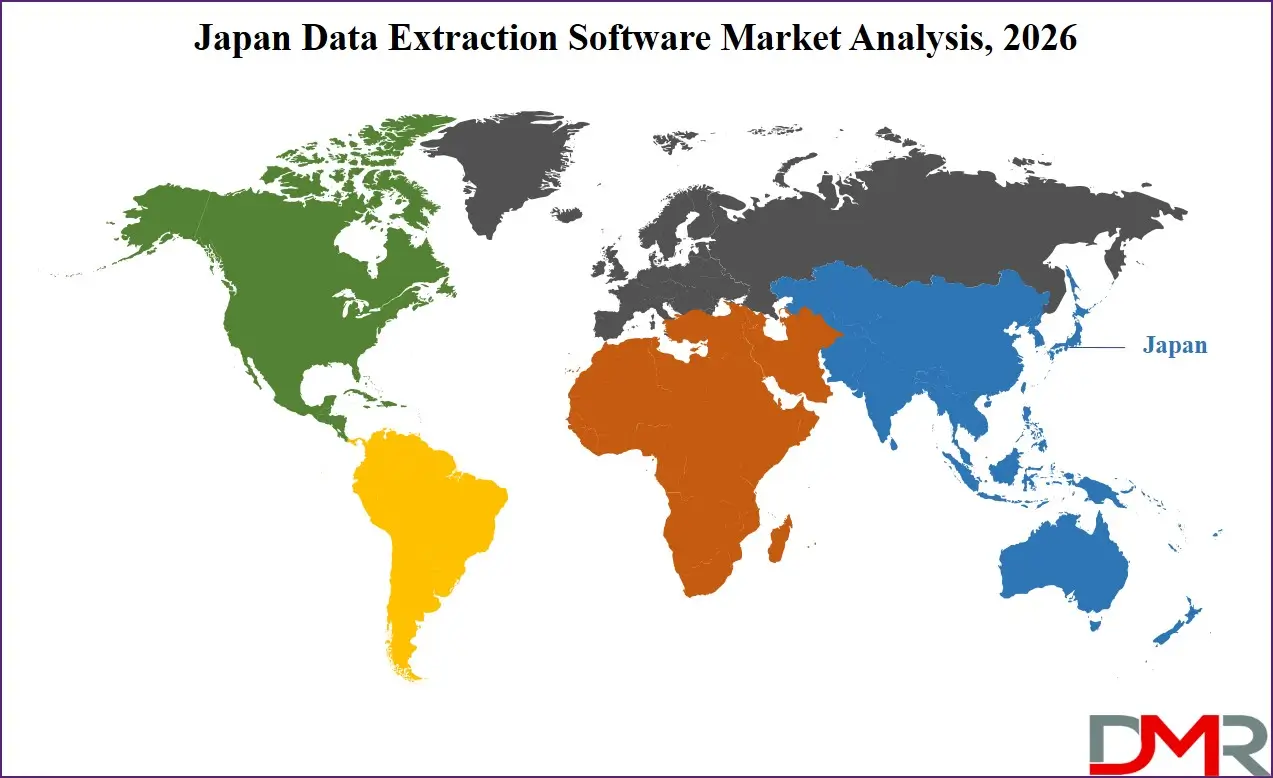
The Japan data extraction software market is characterized by a dynamic competitive landscape, featuring a blend of established domestic technology giants and innovative international startups. Leading Japanese companies leverage their deep industry expertise and robust infrastructure to offer tailored solutions across sectors such as BFSI, healthcare, and manufacturing. These players emphasize integration with existing enterprise systems, compliance with local regulations, and support for Japanese language processing.
ℹ
To learn more about this report –
Download Your Free Sample Report Here
On the other hand, global software providers bring advanced capabilities, including AI-driven analytics and cloud-native architectures, appealing to enterprises seeking cutting-edge technologies. The market is also witnessing the emergence of specialized startups focusing on niche applications like web scraping, data aggregation, and real-time analytics. This diverse ecosystem fosters healthy competition and drives continuous innovation, ensuring that organizations in Japan have access to a wide range of data extraction solutions to meet their evolving needs.
Some of the prominent players in the Japan Data Extraction Software market are:
- NTT Data Corporation
- Fujitsu
- Hitachi, Ltd.
- Classmethod, Inc.
- SCSK Corporation
- ICONIC DATA Japan
- True Data
- eftax Co. Ltd.
- DataStrategy Inc.
- Japan Business Data Processing Center
- Toor
- Link Processing
- Infosense
- Zari Financials
- Finatext Ltd.
- SDKI Analytics
- Report Consultant
- NITTO TECHNO BRAIN
- Integral System Engineering
- Synapse Innovation Inc.
- Other Key Players
Japan Data Extraction Software Market: Recent Developments
- October 2025: Fujitsu introduced a generative AI-driven software analysis and visualization service in Japan. This tool aids enterprises in modernizing legacy applications by visualizing complex code structures and automating design documentation, facilitating smoother digital transformation.
- October 2025: Cloud data firm Veeam announced its acquisition of Securiti AI for approximately USD 1.73 billion. This acquisition aims to enhance Veeam's data privacy management capabilities, integrating advanced AI-driven data extraction and compliance features.
- August 2025: Accenture completed the acquisition of SI&C, a Japanese IT services firm. This strategic move strengthens Accenture's data-driven transformation capabilities in Japan, expanding its service offerings in the data extraction and analytics domain.
- July 2025: ExtractAlpha launched its Toyo Keizai Japanese Data platform, offering investors and analysts structured access to Japanese financial data. This service enhances predictive modeling and financial analysis capabilities, catering to the growing demand for localized data solutions.
Report Details
| Report Characteristics |
| Market Size (2026) |
USD 150.0 Mn |
| Forecast Value (2035) |
USD 532.5 Mn |
| CAGR (2026–2035) |
15.4% |
| Historical Data |
2021 – 2025 |
| Forecast Data |
2027 – 2035 |
| Base Year |
2025 |
| Estimate Year |
2026 |
| Report Coverage |
Market Revenue Estimation, Market Dynamics, Competitive Landscape, Growth Factors and etc. |
| Segments Covered |
By Product (Data Scraping Tools, Web Scraping Tools, Data Mining Tools, PDF Extraction Tools, Text Extraction Software), By Deployment (Cloud, On-Premises), By Organization Size (Large Enterprises, SMEs), By Application (Lead Generation, Data Aggregation, Content Generation), and By End Use (BFSI, Retail, Medical & Healthcare, IT & Telecom, Others) |
| Country Coverage |
Japan |
| Prominent Players |
NTT Data Corporation, Fujitsu, Hitachi, Ltd., Classmethod, Inc., SCSK Corporation, ICONIC DATA Japan, True Data, eftax Co. Ltd., DataStrategy Inc., Japan Business Data Processing Center, Toor, Link Processing, Infosense, Zari Financials, Finatext Ltd., SDKI Analytics, Report Consultant, NITTO TECHNO BRAIN, Integral System Engineering, and Others. |
| Purchase Options |
We have three licenses to opt for: Single User License (Limited to 1 user), Multi-User License (Up to 5 Users) and Corporate Use License (Unlimited User) along with free report customization equivalent to 0 analyst working days, 3 analysts working days and 5 analysts working days respectively. |
Frequently Asked Questions
What is the size of the Japan Data Extraction Software market?
▾ The Japan Data Extraction Software market size is estimated to have a value of USD 150.0 million in 2026 and is expected to reach USD 532.5 million by the end of 2035, with a CAGR of 15.4%.
Who are the key players in the Japan Data Extraction Software market?
▾ Some of the major key players in the Japan Data Extraction Software market are NTT Data Corporation, Fujitsu, Hitachi, Ltd., Classmethod, Inc., SCSK Corporation, ICONIC DATA Japan, True Data, eftax Co. Ltd., DataStrategy Inc., Japan Business Data Processing Center, Toor, Link Processing, Infosense, Zari Financials, Finatext Ltd., SDKI Analytics, Report Consultant, NITTO TECHNO BRAIN, Integral System Engineering, and Others.