What is the DeepFake AI Market Size?
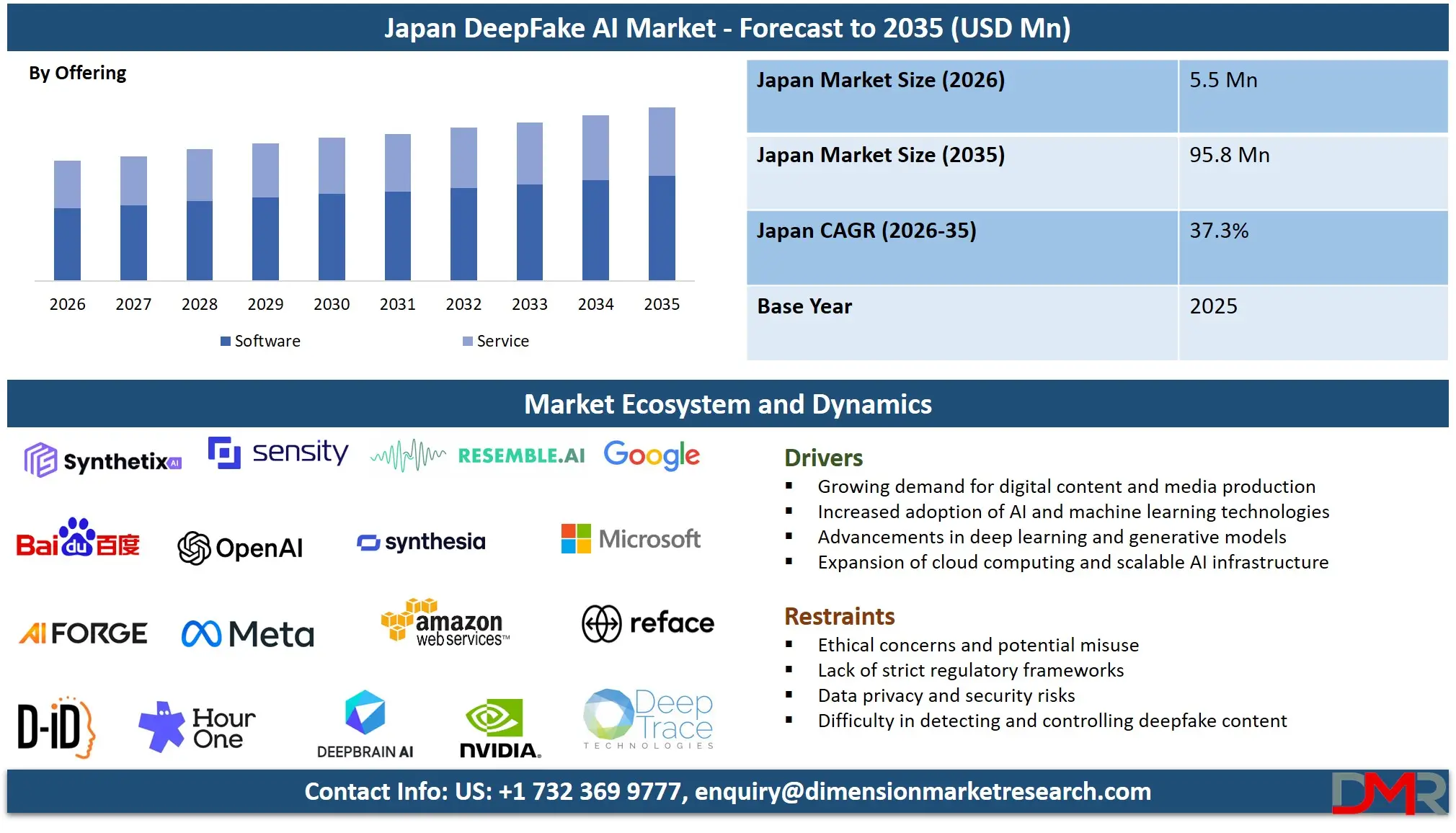
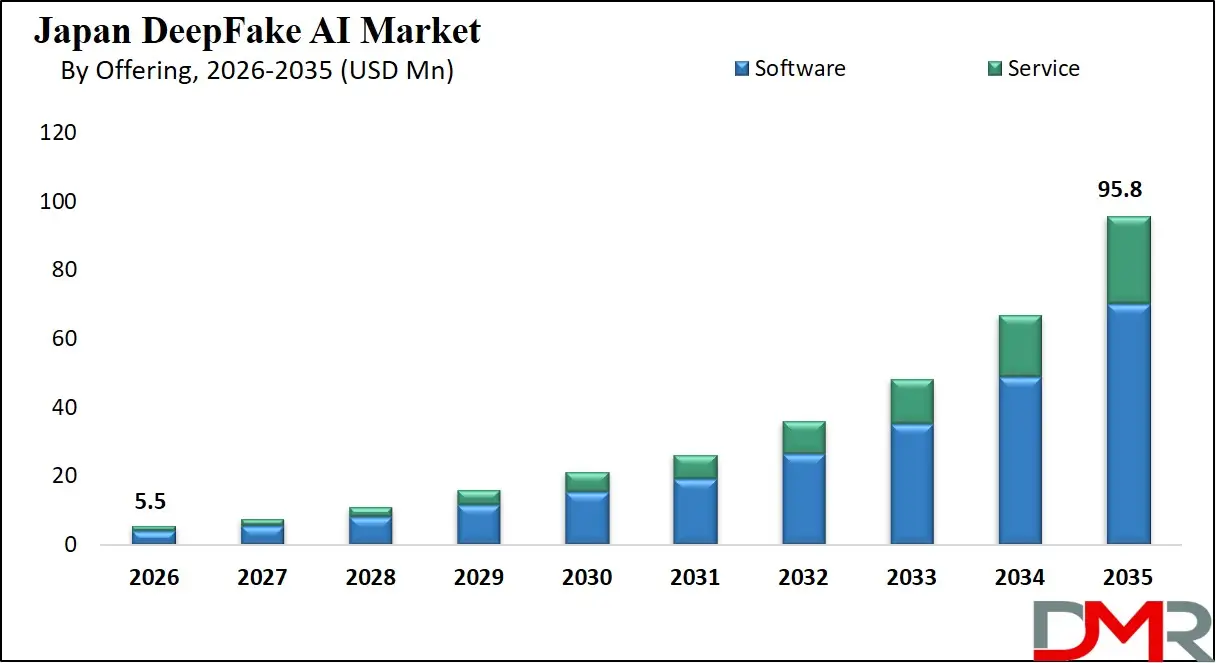
Japan DeepFake AI market is expected to reach a value of USD 5.5 million in 2026, and it is further anticipated to reach USD 95.8 million by 2035, growing at a CAGR of 37.3% during the forecast period. Japan is among the nations that have adopted the use of deepfake AI technologies to create synthetic media through GANs and autoencoders.
ℹ
To learn more about this report –
Download Your Free Sample Report Here
The country has also been working on advanced detection tools to deal with the emerging trend of hyper-realistic media. The growth forecast of the market indicates the unique position of Japan as a technology pioneer and a nation experiencing social challenges related to the increasing synthetic media, including incidents where explicit content was created without consent and impersonation fraud against corporate and financial entities.
Tokyo, Osaka, Nagoya, and Fukuoka are key hubs where research is carried out concerning deepfakes and the development of countermeasures. The deepfake market in Japan comprises of leading educational institutions such as the University of Tokyo, Institute of Science Tokyo, and Keio University, along with private companies such as Fujitsu and NEC.
ℹ
To learn more about this report –
Download Your Free Sample Report Here
The ecosystem consists of companies manufacturing detection software, digital forensics firms, and telecom companies providing authentication services. The government has established task forces at the Ministry of Internal Affairs and Communications to provide measures against false information. NEDO has also invested considerable amounts of money to develop a system to analyze disinformation.
Key Takeaways
- Market Size & Forecast: Japan DeepFake AI market is projected to reach USD 5.5 million by 2026 and expand dramatically to USD 95.8 million by 2035, due to two driving factors the commercialization of generative AI technology and increased awareness of national security threats related to deepfake media.
- Growth Rate & Outlook: The market is anticipated to grow at a CAGR of 37.3% due to growing cases of deepfake-facilitated identity fraud in banking sector, greater expenditure on technology for identifying deepfakes, and the adoption of biometrics authentication system that need protection against spoof attacks.
- Primary Growth Drivers: Some important drivers include Japan being ranked third in the world in terms of traffic to websites that create explicit deepfake videos, increased risks of phishing and vishing attacks utilizing advanced AI technology against Japanese enterprises, and the initiative taken by the government of Japan to invest in indigenous counter-disinformation capabilities by collaboration between government, industry, and academia.
- Key Market Trends: Some of the major market trends observed are development of advanced multi-modal deepfake detection solutions that use technology based on text, images, audio and video. AI-based verification techniques by telecommunications providers for ensuring the security of their call centers, and cross-border collaboration that allows detection solutions from abroad to be deployed in the Japanese market by localization.
- By Offering Type Analysis: The Software category is poised to dominate the Japanese market, with deepfake detection software and media authentication solutions being adopted at a significant rate by social media companies, news agencies, and banks to ensure automated verification.
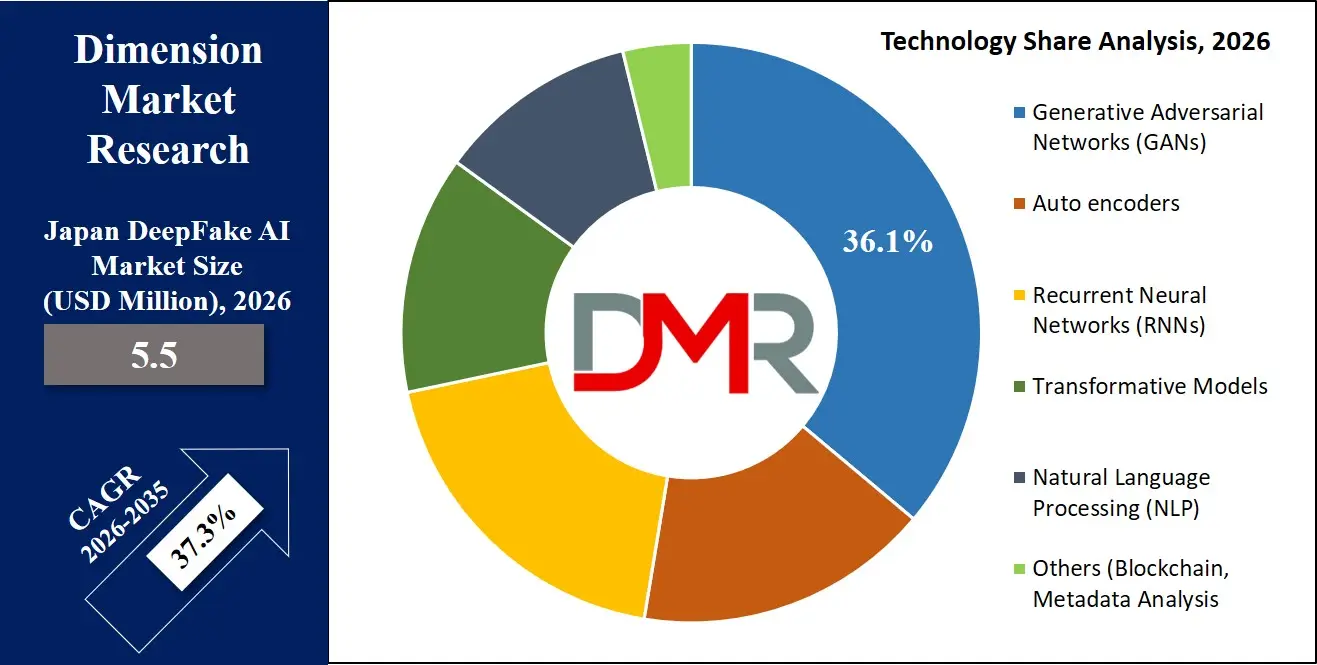
- By Technology Analysis: Generative Adversarial Networks (GANs) is projected to dominate the technology segment in this market with highest market share due to its significant interest in the implementation of multichannel detection technology that integrates analysis of visual artifacts with NLP for audio authentication, along with blockchain-powered traceability technologies.
- By End User Analysis: BFSI is predicted to dominate the Japanese market for deepfake artificial intelligence technology due to the high demand for protection of the remote ID process and protection from deepfakes in wire transfers.
What is the DeepFake AI?
DeepFake AI entails the utilization of modern AI and machine learning algorithms like GANs, autoencoders, and diffusion models to generate and alter videos, audios, and images through artificial means, thereby providing unparalleled realism to such digital media. In the context of Japan, there exists a clear dichotomy with regard to DeepFake AI. While, on one hand, there exist several legitimate applications of the technology in the entertainment industry, virtual human development, and digital artistry, on the other hand, there are numerous societal problems in Japan due to nefarious use of the deepfakes technology. Japan ranks third globally in visits to websites dedicated to creating explicit deepfake pornography.
Japan's unique deepfake AI situation can be attributed to the country's concerted efforts and approach towards developing effective countermeasures. Instead of isolated actions being carried out by companies or individuals, Japan is developing its disinformation infrastructure with the help of a coalition of nine major organizations including Fujitsu, NEC, the National Institute of Informatics, and top universities all working within a project funded by the NEDO for building disinformation infrastructure by the 2025 fiscal year.
Use Cases
- Financial Sector KYC and Liveness Authentication: In order to ensure the safety of remote KYC procedures and online account opening, the Japanese financial sector employs technology which authenticates that the person presenting themselves in video or audio form is indeed the rightful account holder. This prevents any instances where artificial intelligence is used to impersonate customers.
- Telecom Call Center Voice Fraud Mitigation: Japan's largest telecoms company KDDI has adopted new technology which identifies the presence of voice clones made through artificial intelligence technology within their call centers. This prevents fraudsters from pretending to be the legitimate account holder in order to carry out financial transactions.
- National Disinformation Analysis Infrastructure: The National Research and Development Agency of Japan has developed a four-stage process that verifies cases of AI-generated disinformation, which is harmful to the national security of Japan. This technology translates multimedia into text format, detects AI deepfake videos and audio, compares information with government releases, and analyzes societal impact.
- Virtual Human Development and Rights Protection: Companies such as Cynthialy in Japan are working on highly advanced virtual humans that use artificial intelligence technology to create digital avatars based on real individuals. These applications need to have secure authentication systems to differentiate between legitimate and fake videos.
Market Dynamics
Key Drivers of Japan DeepFake AI Market
Escalating Non-Consensual Content and Societal Harm
The society of Japan has encountered a serious social problem in terms of explicit content generated using AI, as according to survey statistics, over 18 million visits occur annually on sites that use AI to produce sexually explicit deepfakes without consent in Japan, placing Japan third globally, only after the US and India. The concerning issue, which, according to experts, affects the youth more through apps accessible via smartphone, has resulted in an increased need for technology to prevent such problems from happening. The National Institute of Informatics has advocated for legislation and improvements to digital literacy programs, resulting in investment by both private and government entities.
Government-Led Counter-Disinformation Initiatives
The national efforts being made by Japan to combat deepfakes constitute one of the main factors shaping the market in the country. The project, sponsored by government funds through NEDO, involves companies like Fujitsu and NEC, the National Institute of Informatics, and six prominent universities for developing a disinformation analysis infrastructure. The government investment in such research provides a foundation for the emergence of the market for detection technology solutions while ensuring sovereign capability of handling synthetic media.
Restraints in Japan DeepFake AI Market
Constitutional and Free Expression Considerations
Regulations on deepfake technologies in Japan should take into consideration the constitutional protection of the freedom of expression in Article 21 of the Japanese Constitution. In discussions by government officials, it was recognized that there needs to be a proper balance between addressing the problems caused by harmful deepfakes without crossing the boundaries of potential censorship because not all videos that are misleading or even false may be considered illegal. According to the Ministry of Internal Affairs and Communications, it is better to create conditions for independent evaluation of information instead of restricting content directly.
Rapid Evolution of Generative AI Models
Japanese detection solutions providers find themselves constantly fighting against new versions of adversarial AI. While every time a new detection solution appears, adversaries improve their generation algorithms. The National Institute of Informatics has found out that during only six months, the amount of fakes has risen ten times, while at the same time, detection continues to pose a problem due to highly advanced diffusion models. The technological competition leads to enormous research and development expenditures and also poses questions of legal responsibility for false positives.
Growth Opportunities in Japan DeepFake AI Market
Cross-Border Technology Transfer and Localization
In Japan, the possibility of cooperation between international detection solution suppliers and local integration firms as well as telecom operators appears promising. The investment made by KDDI in Resemble AI follows such a pattern. International systems and technologies capable of detecting fraud are modified in terms of linguistic specifics, cultural peculiarities, and legal frameworks relevant for the Japanese market. In other sectors such as banking, public administration, and enterprises, similar possibilities exist in terms of cross-border collaboration with foreign providers of detection systems.
Biometric Authentication Integration
The implementation of facial authentication systems for governmental purposes, as well as banking and business transactions, gives rise to the need for advanced technologies that can counter spoof attacks and identify fake faces. The contract for the supply of Hancom products to Cyberlinks proves this point. Foreign companies that offer anti-spoofing software and liveness detection algorithms in line with the ISO 30107-3 standard can expect success when bidding for orders in the country.
Trends in Japan DeepFake AI Market
Multi-Modal Detection Infrastructure Development
The Japanese market features investment in the development of complete detection solutions that can analyze several media at once. The Fujitsu consortium has been working on creating software that would disassemble the content of social media posts and analyze their text, images, videos, and audios separately for the signs of being created by an artificial intelligence. Therefore, this technology reflects the modern tendency towards using comprehensive systems to detect the manipulation, which requires analyzing text, image, audio, and video.
Evidence-Based Authentication with Endorsement Graphs
Japanese scientists have introduced an interesting concept of "endorsement graph," which assesses the authenticity of information based on the analysis of relations between different evidence. Consistencies and inconsistencies of information claims, dates, geographical locations, and records of authorities are compared in order to verify the authenticity of data. While the majority of detection solutions offer either detection or non-detection of a post as output, this approach produces explainable conclusions backed up by evidence.
Research Scope and Analysis
By Offering
It is anticipated that software will hold a prominent position within the Japan DeepFake AI market during the forecast period, as deepfake detection algorithms will see widespread implementation in social media sites that require automatic content moderation, financial firms that perform KYC checks, and governmental authorities with disinformation monitoring systems. The software solution category includes detection algorithms using multiple AI technologies, media authentication software that authenticates media content origin, and forensic analysis software used for detailed investigations of media content. The software solution category will be favored due to the necessity to provide scalable solutions able to analyze large amounts of user-generated content on Japanese social media channels. There will be considerable growth of professional and managed service categories, driven by companies' demand for expertise for implementing deepfake detection infrastructure.
By Technology
GANs technology is expected to lead the segment in this market since these are the foundational creation technology and a primary detection focus within Japanese market. The detection technologies should have the ability to detect the minor discrepancies created by the GANs which are hard for the naked eye to detect a feat that becomes even more challenging since Japanese scientists report exponential improvement in the quality of fake media produced using GANs technology.
ℹ
To learn more about this report –
Download Your Free Sample Report Here
Natural Language Processing (NLP) has become crucial in the detection of audio deepfakes which can be used in corporate frauds and phishing attacks and require customized linguistic knowledge since NLP technologies should be tailored in the language being used. Blockchain and metadata analysis technology has gained relevance in the "verify-not-detect" approach which ensures there is verifiable immutability of the digital chain of the media.
By End User
The BFSI vertical is poised to account for the most significant end-user sector within Japan's deepfake AI technology market end user segment, owing to mandatory customer verification requirements and the rising danger of AI-assisted financial fraud. The telecoms industry is witnessing considerable growth due to the introduction of voice fraud detection systems in call centers, as well as investments in comprehensive AI cybersecurity solutions. Government and military sectors form an essential segment where Japan's national disinformation response strategy supported by NEDO funding has created Japan's sovereign capability in this domain. Media houses, legal professionals, and healthcare establishments constitute the remaining categories of end-users that require specific applications of deepfake AI technology, such as content validation, evidence authentication, and training simulations.
Japan DeepFake AI Market Report is segmented based on the following:
By Offering
- Software
- DeepFake Detection Algorithms
- Media Authentication Tools
- Forensic Analysis Software
- Service
- Professional Services
- Managed Services
By Technology
- Generative Adversarial Networks (GANs)
- Auto encoders
- Recurrent Neural Networks (RNNs)
- Transformative Models
- Natural Language Processing (NLP)
- Others (Blockchain, Metadata Analysis)
By End User
- BFSI
- Customer Verification & Authentication
- Anti-Money Laundering & Fraud Detection
- Telecom
- Call Center Security
- Fraud Detection
- Government
- Election Campaigns
- National Security
- Government Communications
- Content Verification & Moderation
- Ethical Hacking & Digital Security
- Enforcement Agencies
- Healthcare
- Medical Training & Simulation
- Patient Case Simulations
- Telemedicine & Virtual Healthcare
- Legal
- Digital Evidence Authentication
- Intellectual Property Protection
- Legal & Ethical Consultation
- Media & Entertainment
- CGI Character Creation
- De-aging Actors
- Special Effects & Visual Enhancements
- Digital Content Creation
- Celebrity & Influencer Marketing
- News Agencies
- Social Media
- Retail & E-commerce
- Customer Service & Personalization
- Visual Merchandising
- Security & Fraud Prevention
- Others
Competitive Landscape
The Japan Deepfake AI market is marked by a unique competitive structure where the local tech conglomerates, start-ups, and international players entering through partnerships have a distinct role to play. The leading Japanese firms such as Fujitsu, NEC, and KDDI use their connections with the government, existing customer base among the enterprises, and robust research and development capabilities to create all-round solutions for detection and authentication.
ℹ
To learn more about this report –
Download Your Free Sample Report Here
Foreign technology firms such as Resemble AI and FacePhi are creating their foothold in the Japanese market through partnerships with local telecom service providers and system integrators. Through such collaborations, the foreign firms can work their way around the peculiarities of the Japanese business and regulatory landscape while offering proven solutions for detection.
Some of the prominent players in the DeepFake AI Market are:
- Synthesia Ltd.
- DeepBrain AI
- Reface AI
- Hour One AI
- D-ID
- Resemble AI
- Sensity AI
- Deeptrace Labs
- Microsoft Corporation
- Google LLC
- Amazon Web Services
- OpenAI
- Meta Platforms Inc.
- NVIDIA Corporation
- Baidu Inc.
- Deepware
- AI Forge
- Synthetix AI
- DeepVision
- FauxReal
- Other Key Players
Recent Developments
- December 2025: Resemble AI received investment from KDDI Corporation through the company's KDDI Open Innovation Fund V for the development of deepfake detection technology to counter AI-powered phishing and impersonation threats. The deal seeks to localize Resemble AI’s DETECT-3B Omni platform, which promises a 98% detection accuracy rate.
- September 2025: According to reports from the National Institute of Informatics, the use of deepfake videos in Japan skyrocketed by tenfold within half a year, owing to the ease of accessing models and the proliferation of smartphones. There is an acute need for research capacity and automated fact-checking capabilities at home.
- October 2024: Fujitsu Ltd. and eight partner entities, including NEC, the National Institute of Informatics, and six major universities announced a joint initiative to develop a comprehensive disinformation detection system. The project, supported by NEDO funding, aims to create operational counter-disinformation infrastructure by fiscal 2025, incorporating multi-modal analysis and evidence-based authenticity determination.
Report Details
| Report Characteristics |
| Market Size (2026) |
USD 5.5 Mn |
| Forecast Value (2035) |
USD 95.8 Mn |
| CAGR (2026–2035) |
37.3% |
| Historical Period |
2021 – 2025 |
| Forecast Period |
2027 – 2035 |
| Base Year |
2025 |
| Estimate Year |
2026 |
| Segments Covered |
By Offering (Software and Service), By Technology (Generative Adversarial Networks (GANs), Auto encoders, Recurrent Neural Networks (RNNs), Transformative Models, Natural Language Processing (NLP), and Others (Blockchain, Metadata Analysis)), By End User (BFSI, Telecom, Government, Healthcare, Legal, Media & Entertainment, Retail & E-commerce, and Others) |
| Country Coverage |
Japan |
Frequently Asked Questions
How big is Japan DeepFake AI Market?
▾ Japan DeepFake AI market is projected to be valued at USD 5.5 million in 2026 and is expected to reach USD 95.8 million by 2035, reflecting sustained and exponential expansion driven by escalating synthetic media threats and corporate fraud concerns.
What is the CAGR of the Japan DeepFake AI Market from 2026 to 2035?
▾ The Japan DeepFake AI market is expected to grow at a CAGR of 37.3% from 2026 to 2035, indicating robust long-term growth fueled by the accelerating adoption of detection software across Japanese financial institutions, telecommunications providers, and public sector agencies.
What factors are driving the growth of the Japan DeepFake AI Market?
▾ Escalating deepfake-enabled impersonation fraud targeting Japanese banks and corporations, substantial government investment in sovereign counter-disinformation capabilities through NEDO-funded consortium projects, and growing demand for voice fraud prevention in Japanese call center operations.
What are the major trends in the Japan DeepFake AI Market?
▾ Development of multi-modal detection systems integrating text, image, audio, and video analysis through public-private-academic partnerships, and adoption of blockchain-based provenance tracking aligned with Japanese evidentiary standards, and cross-border technology transfer enabling localization of international detection solutions.
Who are the key players in the Japan DeepFake AI Market?
▾ Fujitsu Ltd., NEC Corporation, KDDI Corporation, the National Institute of Informatics, Resemble AI, Cyberlinks Co., Ltd., Hancom, FacePhi, Citadel AI, Cynthialy, and major academic institutions including the University of Tokyo and Institute of Science Tokyo are prominent participants in the Japan DeepFake AI market landscape.
How is the Japan DeepFake AI Market segmented?
▾ This market is segmented by offering (software and services), technology (GANs, autoencoders, RNNs, transformative models, NLP, and blockchain-based metadata analysis), and end user (BFSI, telecom, government, healthcare, legal, media and entertainment, and retail and e-commerce and other end users).