What is the Japan Digital Advertising Market Size?
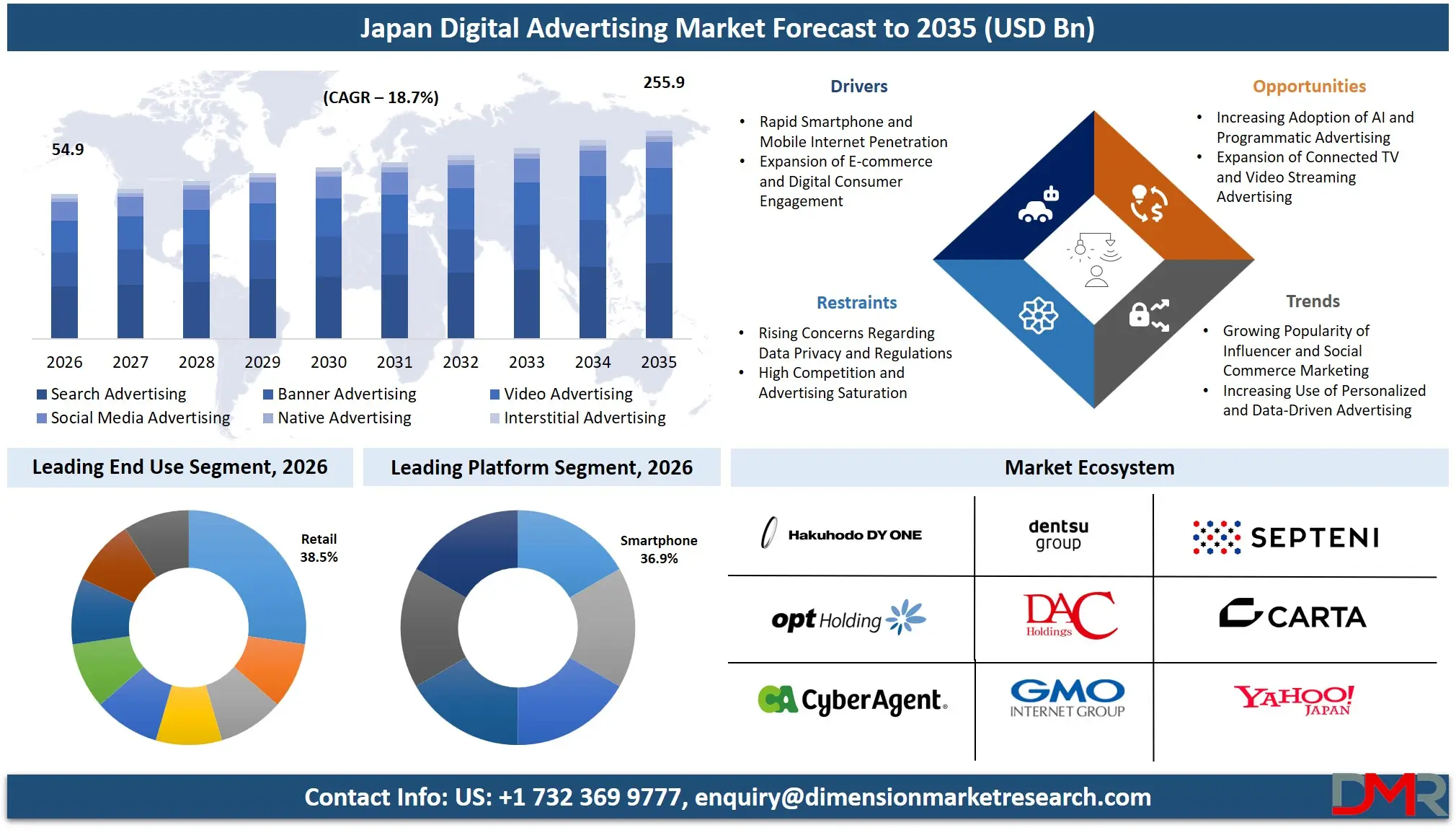
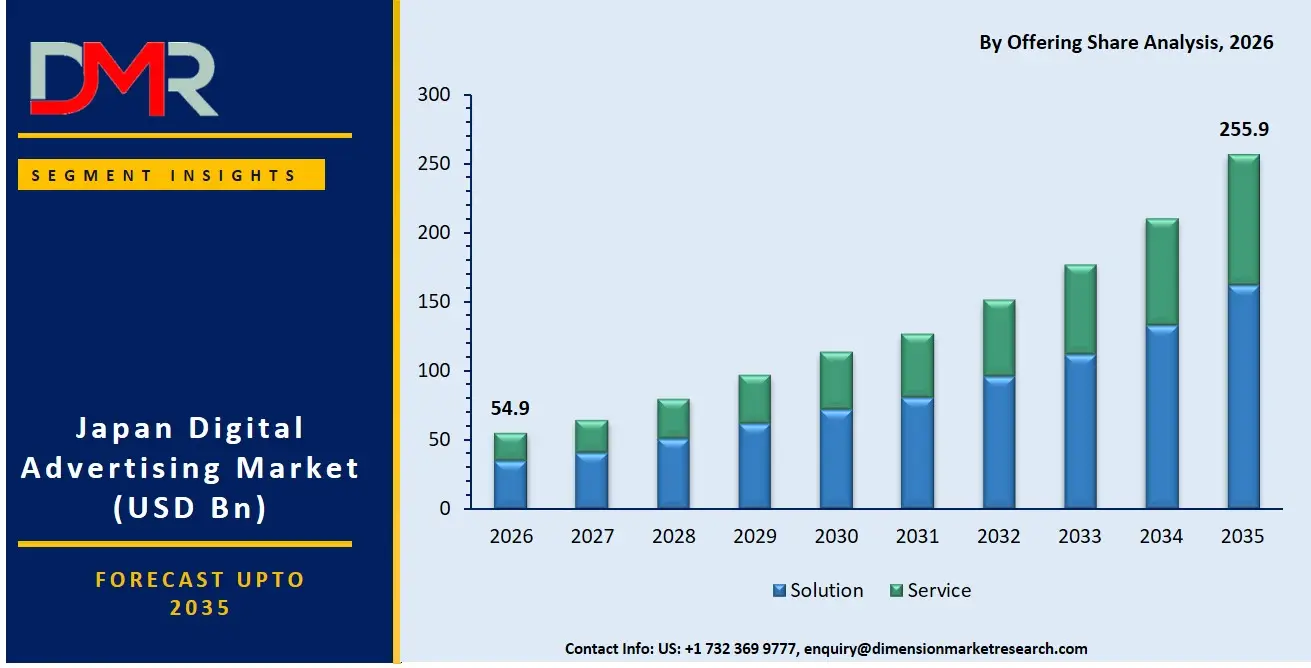
The Japan Digital Advertising Market is expected to reach a value of USD 54.9 billion in 2026, and it is further anticipated to reach USD 255.9 billion by 2035, growing at a CAGR of 18.7% during the forecast period.
ℹ
To learn more about this report –
Download Your Free Sample Report Here
Japan's digital advertising industry is seeing rapid growth in the form of a significant increase in the number of companies moving away from the use of mass media advertising towards advanced forms of digital advertising. The industry encompasses programmatic platforms, mobile-first approaches, social media campaigns, and analytical tools, which help companies navigate through an ecosystem where local players have equal power to compete with major foreign platforms. As more companies feel the pressure to use AI-based personalization tools, cookieless targeting techniques, and immersive video advertisement formats, there arises a need for specialized services within the industry. Retail and BFSI have been identified as the key sectors using the service, while smartphones and videos remain dominant due to the country's mobile-first nature.
ℹ
To learn more about this report –
Download Your Free Sample Report Here
Key Takeaways
- Market Size & Forecast: The market size for Japan Digital Advertising is forecasted to be valued at USD 54.9 billion in 2026 and grow sharply to USD 255.9 billion by 2035, largely owing to the dual catalysts of increasing adoption of mobile commerce and digitization of traditional television advertising budgets.
- Growth Rate & Outlook: It is estimated that market growth will occur at a compound annual growth rate (CAGR) of 18.7%, primarily due to a severe lack of in-house data scientists and rising complexity surrounding omnichannel campaigns, ranging from smart TVs to smartphones.
- Primary Growth Drivers: These are the transition from reach-oriented terrestrial television towards precision-oriented programmatic advertising platforms, the requirement of analytics & consulting services amid signal loss from third party cookies, and the requirement of managed advertising services for integrating retail media data.
- Key Market Trends: Major trends are the advent of smart TVs & connected devices as a new medium for performance marketing, the implementation of AI-driven tools in creative & content services to create ad versions automatically, and the adoption of native in-feed placement on domestic super apps.
- By Platform Analysis: Smartphones is projected to dominate this segment because of the rising usage of QR codes and mobile wallet services. It has become imperative to incorporate professional services in order to achieve seamless cross-device measurement, linking consumer behavior from research on Desktop & Laptop to purchase on Tablets and Smartphones.
- By End Use Analysis: BFSI and Retail are the two sectors that hold immense value owing to rising e-commerce competition and the need to create localized campaigns in order to create a brand identity. The automotive industry is growing at the fastest rate, since it requires video advertising solutions due to an increase in electric vehicle launches.
What is the Digital Advertising?
Japan Digital Advertising refers to the tailored strategic and technical solutions provided by agencies, trading desks, and consulting firms to support organizations throughout their entire journey within the digital advertising process. Such solutions, which differ from media buying, refer to the "how" behind executing advertisements. This is because there are Managed Advertising Solutions for overseeing programmatic and social media advertising, Creative & Content Solutions for setting the tone of cultural narrative in ads, and finally Analytics & Consulting Solutions to make sure campaigns optimize with respect to the changing consumer behavior on Japan-specific digital channels. Given that nearly all of its population relies on smartphones for daily communications, such professional solutions are necessary for ensuring that digital advertising investments convert into customer lifetime value.
Use Cases
- B2C Retail Media Networks: Large retail organizations contract advertising service providers to develop retail media networks in order to allow consumer packaged goods brands to reach consumers through Programmatic Advertising Platforms using point-of-sale loyalty information.
- Automotive Virtual Showroom: Automotive OEMs utilize Video Advertising Solutions and Interactive & Rich Media Advertising solutions to stream personalized virtual vehicle walkarounds on Smart TV & Connected Devices, thus connecting digital configurations and brick-and-mortar dealer experiences.
- Consumer Electronics Mobile Gaming IP: Consumer electronics brands utilize Social Media Advertising Solutions in mobile games across social networking sites such as TikTok and YouTube through In-App Interstitial Advertising solutions to create pre-order leads for upcoming devices.
- Fintech Implementation in BFSI: Banks use Search Advertising Solutions and SEO & Social Media Marketing Services to simplify investment processes through the promotion of automated robo-advisory services through landing pages targeted at Smartphones.
How AI is Transforming the Digital Advertising Market?
The impact of AI in Japan on digital advertising is reflected in the speedup of creativity creation process and the effectiveness of campaigns. In Creative & Content Services, thanks to generative AI tools, it would be possible to automate the conversion of basic brand materials into multiple localized versions of ad materials, thus significantly reducing time and effort required for localization of the content. In the Programmatic Advertising Platform, thanks to the implementation of AI-based technologies, companies will be able to more efficiently manage their budgets by detecting fraudulent clicks and forecasting future impression costs.
AI technologies are being widely implemented in business transformation initiatives as well. Thus, in consulting services, intelligent compliance monitoring tools will help to monitor ad copy and landing pages looking for regulatory nonconformities or brand safety issues. Also, due to generative AI assistants' use in conjunction with Campaign Management Services, it will be possible to visualize consumers' emotional responses to various ad messages.
Market Dynamics
Key Drivers in the Japan Digital Advertising Market
Rapid Smartphone and Mobile Internet Penetration
The popularity of smartphones and fast mobile internet connectivity is one of the most prominent catalysts behind the rise in digital advertising market in Japan. More consumers continue to spend a great deal of time using mobile apps, social media sites, online content, and shopping via their smartphones, and this has made it easier for marketers to emphasize digital marketing instead of conventional media. The rise in demand for digital marketing has been fueled by consumer habits and behaviors that favor mobile usage.
Expansion of E-commerce and Digital Consumer Engagement
The accelerated growth of the number of e-commerce websites and consumer activity on the Internet is a powerful driving force behind the development of the Japanese digital advertising market. More people are using the Internet not only for purchasing goods and services but also for entertainment, financial operations, and research purposes, which necessitates that corporations pay special attention to Internet-based marketing tactics. Search, social media, influencer, and programmatic advertising have been gaining prominence recently due to the growing competition.
Restraints in the Japan Digital Advertising Market
Rising Concerns Regarding Data Privacy and Regulations
One major issue that is restraining the growth of the digital advertising market in Japan is the increasing privacy issues related to consumer data. There are stringent regulations with respect to the collection, storage, and use of customer information for targeting. This has resulted in increased compliance costs for businesses and digital companies that are involved in advertising. Companies will be required to implement advanced security measures, privacy control mechanisms, and ethical advertising policies. The use of third-party cookies could be limited by such regulations.
High Competition and Advertising Saturation
There is strong competition in Japan's digital advertisement market, posing difficulties for brands in terms of reaching their target audiences. Large corporations, e-commerce websites, and foreign digital platforms constantly battle over ad spaces on search engines, social media platforms, and even streaming services. The stiff competition has seen the costs of advertisements increase, especially in regard to popular keywords and premium digital ad spaces. Consumers are also bombarded with large numbers of ads every day, resulting in ad fatigue.
Growth Opportunities in the Japan Digital Advertising Market
Increasing Adoption of AI and Programmatic Advertising
The increasing implementation of artificial intelligence and programmatic technology offers great potential in the digital advertisement market in Japan. Advertisers are now making use of AI analysis, machine learning techniques, and automatic bidding processes to enhance their campaigns. With programmatic technology, advertisements can be placed immediately based on consumer habits, demographics, and web activities to improve marketing effectiveness and conversions. Companies in Japan are increasingly utilizing digital advertising technology for better personalized marketing experiences. Moreover, the use of content recommendations through AI technology allows companies to make targeted advertisements online.
Expansion of Connected TV and Video Streaming Advertising
The increased usage of connected TV services and video streaming websites opens up substantial growth prospects in the digital advertising industry in Japan. The trend towards greater consumer preference for on-demand digital entertainment via smart TV screens, video streaming apps, and video-on-demand websites provides a strong rationale for advertisers to invest more resources in digital video advertisements rather than TV commercials. Connected TV advertising allows brands to integrate the high-impact visuals of television ads with precise digital targeting and analysis.
Trends in the Japan Digital Advertising Market
Growing Popularity of Influencer and Social Commerce Marketing
An important trend in the Japanese digital advertising industry is the increased application of influencer marketing and social commerce tactics. Businesses are working with social media personalities and influencers to increase their brand awareness and customer trust. Japanese customers use social media recommendations and reviews to make decisions regarding their purchases. Instagram, Tiktok, Youtube, and LINE have emerged as key platforms through which businesses can advertise their offerings in various industries, including fashion, beauty, gaming, and electronics.
Increasing Use of Personalized and Data-Driven Advertising
The digital advertising market in Japan has started implementing personalized marketing campaigns in order to enhance their performance and create better relationships with consumers. Through the application of analytics, artificial intelligence, and consumer insights, businesses are now able to target their ads based on individual preferences, purchase history, and online activities. The result is an increase in click-through rate, customer retention, conversion performance, and user experience.
Research Scope and Analysis
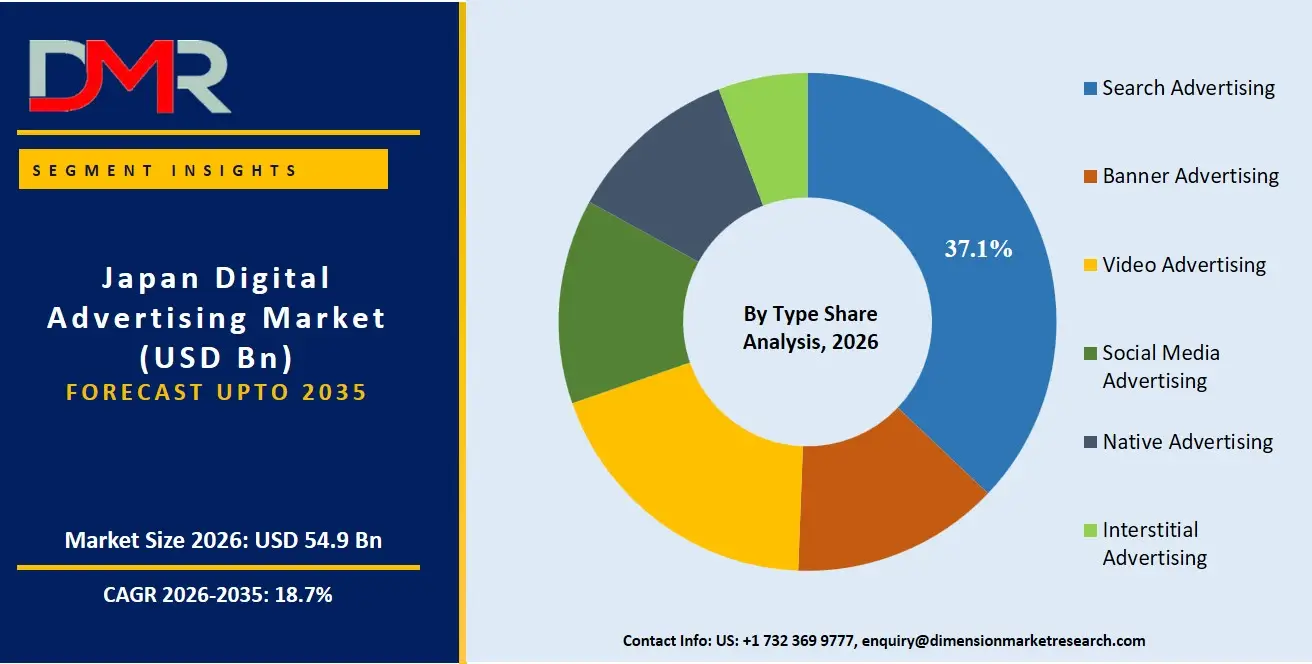
The Japan Digital Advertising Market is segmented by offering into solutions and services; by type into search, banner, video, social media, native, and interstitial advertising; by platform into smartphones, desktops, tablets, and connected devices; by format into video, text, image, audio, and rich media; and by end-use industries.
ℹ
To learn more about this report –
Download Your Free Sample Report Here
By Offering Analysis
Solutions is projected to hold a dominant position within the offerings category in the digital advertising market in Japan due to the rising preference among enterprises for technology-oriented digital advertising solutions that help automate processes, reach target audiences, optimize campaigns, and perform analytics on real time basis. Enterprises operating out of Japan are making huge investments into programmatic advertising solutions, artificial intelligence powered campaign management, social media advertising solutions, and mobile advertising platforms to enhance their marketing processes. With the increasing prevalence of e-commerce, digital media consumption, and smartphone usage among individuals in Japan, there is a rising need for efficient advertising technologies that can help deliver personalized content to the audience.
By Type Analysis
Search advertising are anticipated to dominate the type segment owing to the fact that Japanese individuals widely use search engines to discover products, shop online, travel, conduct transactions, and gain local insights about businesses. This is the reason why brands focus on search advertising, owing to the high conversion rates associated with it, performance-measurement capabilities, and effectiveness in reaching consumers that are highly motivated to make purchases. Businesses from various verticals including retail, automotive, BFSI, and healthcare continue investing in paid search ads in order to enhance their online presence and acquire new customers. Moreover, the maturity of e-commerce in Japan and digitally empowered population contribute to increased demand for search ads in Japan.
By Platform Analysis
Smartphones is projected to lead the platform category, owing to the fact that mobile internet usage is extremely prevalent in Japan, coupled with high consumer reliance on mobile apps, social media, entertainment, and shopping. Consumers utilize a great deal of time on smartphones for web surfing, communication, watching videos, playing games, and shopping, thereby making mobile phones the most effective medium for engaging customers through digital advertisements. More advertisers are optimizing campaigns for mobile phones, by leveraging mobile app promotions, mobile video advertisements, location-based advertising, and social media advertising. The presence of 5G network further enhances mobile content consumption and advertisements. Moreover, the young Japanese population, along with urban consumers, use mobile platforms extensively, prompting companies to invest more in digital advertisement campaigns targeting smartphones.
By Format Analysis
Video advertising is predicated to dominate the format segment since the Japanese market prefers digital videos that are both interesting and entertaining. Video ads are the best tool for brands that want to enhance their storytelling, customer engagement, and even product awareness. The rise in popularity of video-based platforms like YouTube, TikTok, Instagram, and connected TVs is responsible for an increase in demand for video ads in all industries, whether it be retail, automotive, consumer electronics, and entertainment. The progress in smartphone and internet infrastructure in Japan has boosted the popularity of video content.
By End Use Analysis
Retail is predicted to account for the majority share of end-user applications since Japan boasts a well-established e-commerce market and a competitive consumer base that necessitates regular advertising spend online to lure and retain consumers. This is evident as retailers invest in such digital advertising methods as search ads, social media marketing, influencer marketing, and personalized advertisements in order to generate more web traffic and convert it into actual purchases. With the rise of omni-channel retail and mobile commerce, the use of digital marketing by retailers to connect with tech-savvy consumers has increased. Consumers in Japan usually conduct research about the products online prior to the purchase, making it imperative for retailers to engage in digital advertising.
The Japan Digital Advertising Market Report is segmented on the basis of the following:
By Offering
- Solution
- Programmatic Advertising Platforms
- Mobile Advertising Solutions
- Social Media Advertising Solutions
- Search Advertising Solutions
- Video Advertising Solutions
- Analytics & Automation Solutions
- Services
- Managed Advertising Services
- Campaign Management Services
- Creative & Content Services
- SEO & Social Media Marketing Services
- Analytics & Consulting Services
- Support & Integration Services
By Type
- Search Advertising
- Banner Advertising
- Video Advertising
- Social Media Advertising
- Native Advertising
- Interstitial Advertising
By Platform
- Smartphone
- Desktop & Laptop
- Tablet
- Smart TV & Connected Devices
- Others
By Format
- Video Advertising
- Text Advertising
- Image/Display Advertising
- Audio Advertising
- Interactive & Rich Media Advertising
- Others
By End Use
- Retail
- BFSI
- Automotive
- IT & Telecommunication
- Healthcare
- Consumer Electronics
- Media & Entertainment
- Education
- Others
Competitive Landscape
The level of competitiveness in the Japanese digital advertising industry has become very intense due to the presence of a diverse range of multinational agency holding companies, local conglomerates such as Dentsu and Hakuhodo DY Group, and specific performance digital agencies. For a company to succeed in the market, it needs to have strategic partnerships with local super-apps like LINE since these will create avenues for collaboration as well as provide unique proprietary data. There is increasing consolidation within the market, and the acquisition by traditional advertising agencies of specialist analytics and influencer marketing agencies is becoming common in order for them to stay relevant. Unique intellectual property is becoming a more important source of competitive advantage than mere media markups and basic campaign management solutions.
Some of the prominent players in the Japan Digital Advertising Market are:
- Dentsu Group Inc.
- CyberAgent, Inc.
- Hakuhodo DY Holdings Inc.
- GMO Internet Group, Inc.
- LINE Yahoo Japan Corporation
- Septeni Holdings Co., Ltd.
- DAC Holdings Co., Ltd.
- CARTA HOLDINGS, INC.
- Opt Holding Inc.
- Vector Inc.
- Adways Inc.
- FreakOut Holdings, Inc.
- UNITED, Inc.
- Digital Holdings, Inc.
- Nikkei Inc.
- Recruit Holdings Co., Ltd.
- Transcosmos Inc.
- Macromill, Inc.
- iREP Co., Ltd.
- Speee, Inc.
- Other Key Players
Recent Developments
- May 2026: Dentsu Group Inc. enhanced their advertising optimization platform powered by AI which allows Japanese advertisers to target customers, automate campaigns and increase real-time analytics performance. The expansion will boost efficiency of digital advertising, customer engagement and digital campaign performance on different digital advertising networks.
- April 2026: CyberAgent, Inc. developed the capabilities of connected TV advertising by increasing cooperation with streaming and smart TV service providers in Japan. This expansion will boost video advertisement reach, audience targeting accuracy and programmatic advertising services due to growing customer interest in digital entertainment services.
- March 2026: LINE Yahoo Japan Corporation extended their personalized advertising platform leveraging first-party data from customers and machine learning algorithms. The expansion will enhance performance of targeted advertising, customer engagement and e-commerce marketing services while promoting privacy-focused digital advertising solutions in Japan.
Report Details
| Report Characteristics |
| Market Size (2026) |
USD 54.9 Bn |
| Forecast Value (2035) |
USD 255.9 Bn |
| CAGR (2026–2035) |
18.7% |
| Historical Data |
2021 – 2025 |
| Forecast Data |
2027 – 2035 |
| Base Year |
2025 |
| Estimate Year |
2026 |
| Segments Covered |
By Offering, By Type, By Platform, By Format, and By End Use |
| Country Coverage |
Japan |
Frequently Asked Questions
How big is the Digital Advertising Market?
▾ The Japan Digital Advertising market is poised to be valued at USD 54.9 billion in 2026 and is projected to reach USD 255.9 billion by 2035, driven by the universal need for specialized skills in mobile-first campaign execution, programmatic trading, and culturally nuanced creative localization.
What is the CAGR of the Digital Advertising Market from 2026 to 2035?
▾ The market is expected to grow at a CAGR of 18.7% from 2026 to 2035, reflecting the accelerating complexity of Japan’s unique platform ecosystem spanning domestic giants like LINE and Yahoo! JAPAN alongside global players and the persistent shortage of internal data science and ad operations talent.
What factors are driving the growth of the Digital Advertising Market?
▾ Key drivers include the critical digital skills gap in programmatic trading and marketing automation, the imperative to navigate a fragmented domestic platform landscape, the management complexity of cookieless identity solutions, and the surge in demand for Analytics & Consulting Services amid evolving privacy regulations like Japan’s APPI.
What are the major trends in the Digital Advertising Market?
▾ Major trends include the integration of Generative AI into Creative & Content Services for automated ad variation generation, the rise of Connected TV programmatic infrastructure as broadcasters launch ad-supported streaming, the development of cookieless first-party data identity solutions, and the emergence of immersive Audio Advertising targeting commuter audiences on podcasts and music streaming platforms.
Who are the key players in the Digital Advertising Market?
▾ Key players include domestic advertising powerhouses like Dentsu and Hakuhodo DY Group, multinational agency holding companies, trading desks attached to major technology platforms, and specialized digital-native performance agencies and analytics consultancies that compete on proprietary cross-platform measurement frameworks and retail media capabilities.
How is the Digital Advertising Market segmented?
▾ The market is segmented by Offering, by Type, by Platform, by Format, and by End Use.