What is the Japan Digital Banking Market Size?
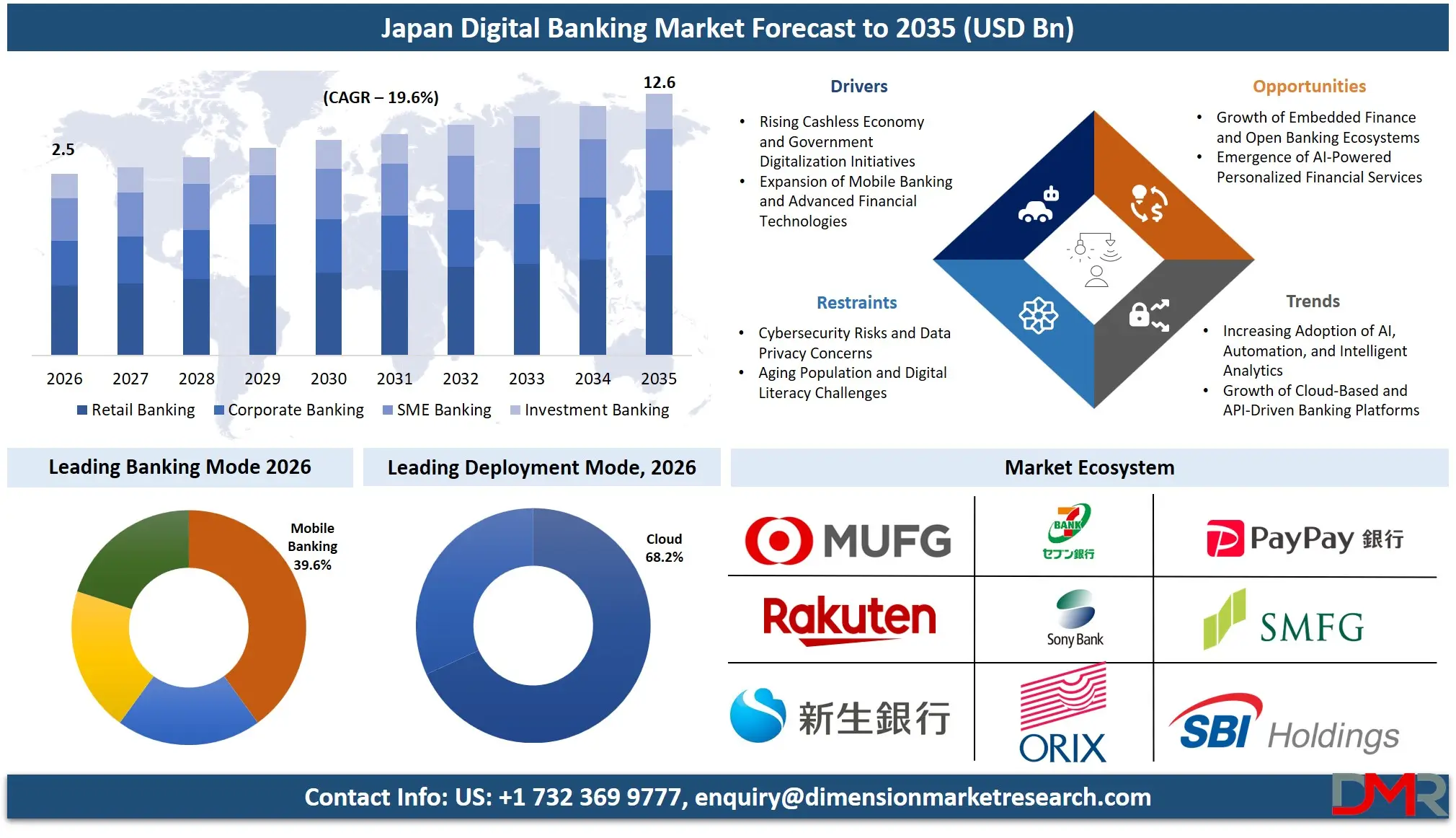
The Japan Digital Banking Market size is expected to be USD 2.5 billion in 2026 and increase at a compound annual growth rate of 19.6% to USD 12.6 billion in 2035, owing to Japan's move towards a cashless economy.
ℹ
To learn more about this report –
Download Your Free Sample Report Here
The Japan Digital Banking industry includes internet banking, mobile banking systems, digital payment methods, online lending services, wealth management software, open banking initiatives, and cloud-based banking systems that facilitate customers in accessing banking services with minimal dependence on traditional physical bank branches. The industry is an important one for transforming the country's financial ecosystem through greater accessibility and improved efficiencies. Growing smartphone usage, regulatory backing for digital payment options, increasing use of artificial intelligence and cloud technologies, and rising demand for customized financial services are driving growth in the market.
ℹ
To learn more about this report –
Download Your Free Sample Report Here
Key Takeaways
- Market Size & Forecast: The Japan Digital Banking Market size is projected to reach USD 2.5 billion in 2026 and is anticipated to have a value of USD 12.6 billion in 2035.
- Growth Rate & Outlook: The Japan Digital Banking Market size is set to grow at a compound annual growth rate of 19.6% during the forecast period of 2026 to 2035.
- Primary Growth Drivers: Some of the major growth drivers in the market are Increased Growing Trend of Cashless Economy and Government Efforts to Digitize, and more.
- Key Market Trends: Some of the major trends in the market are More Usage of AI, Automation, and Intelligent Analytics, and more.
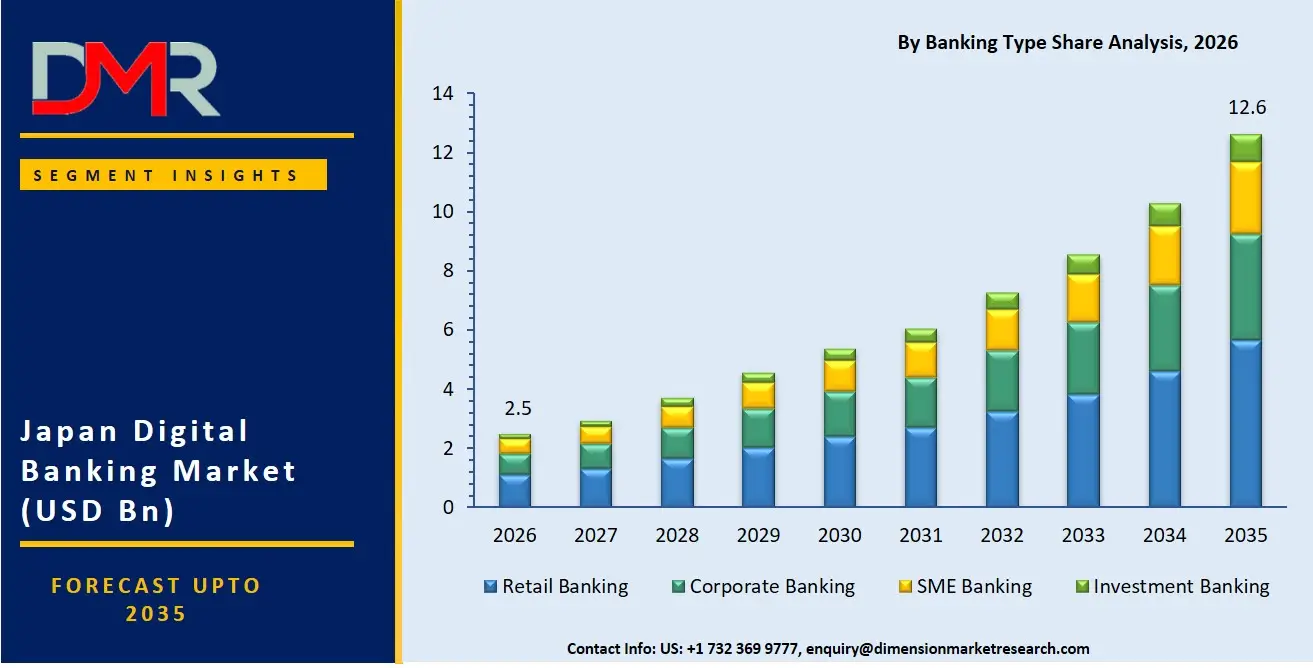
- By Banking Type: Retail banking segment is anticipated to get the majority share of the Japan Digital Banking Market in 2026.
- By Banking Mode: Mobile Banking is expected to get the largest revenue share in 2026 in the Japan Digital Banking Market.
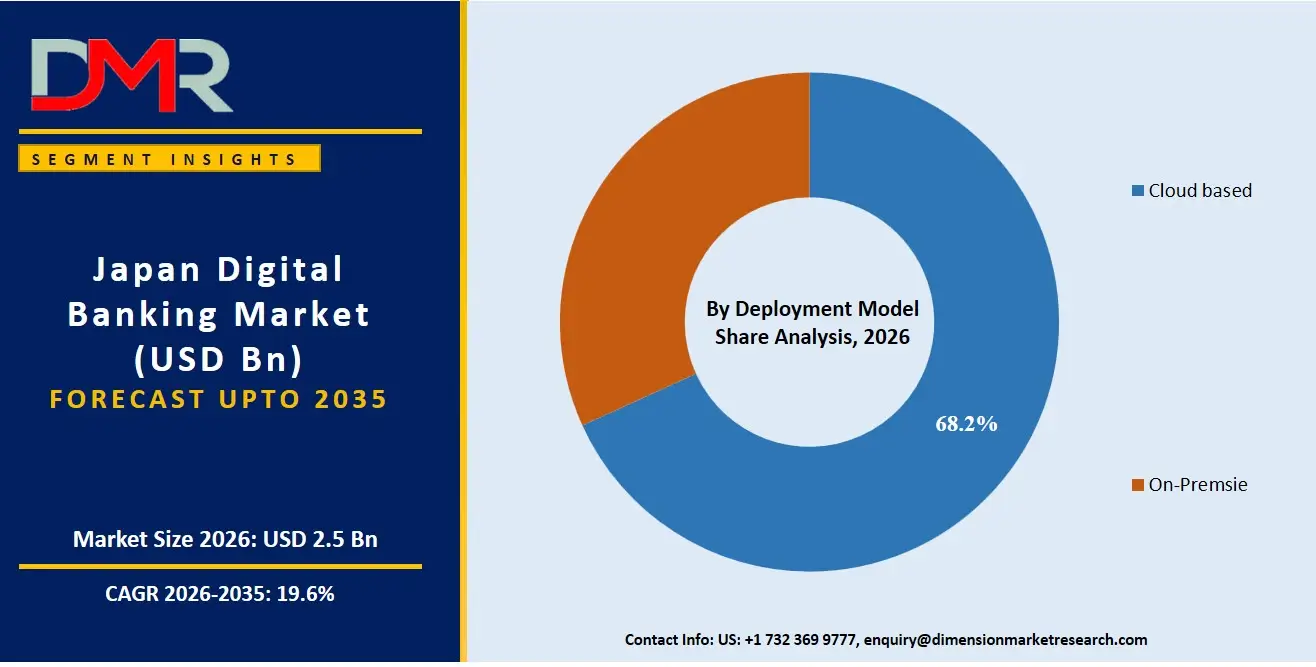
- By Deployment Mode: Cloud segment is expected to get the largest revenue share in 2026 in the Japan Digital Banking Market.
What is the Digital Banking?
Digital banking involves the provision of banking operations and financial dealings through digital means, including through the use of mobile applications and online banking channels. This makes it possible for customers to engage in operations including payments, money transfers, account management, loans, and investment deals in real-time through the application of digital means of security.
Use Cases
- Digital Payments & Transfer: Users can use digital banking systems for immediate domestic and international fund transfer, QR code-based payment, utility payments, and other e-commerce services. Such mechanisms help users minimize their reliance on cash payments while improving convenience and efficiency.
- Online Lending & Credit Products: AI algorithms enable the creation of automated loan origination, credit evaluation, and credit assessment processes. Online lending and credit services allow customers to get personal loans, SME loans, and other financial services with the least documentation and more convenience.
- Wealth Management & Investments: Digital banking platforms have incorporated various robo-advisors, portfolio management tools, and investment services into them. These services make it possible for users to receive custom investment and financial advice with the help of these services.
- Open Banking and Ecosystems: Banks can connect with various fintech companies, merchants, and other providers of services using API technology. This way, banks ensure that users can enjoy various integrated financial services via these ecosystems.
How AI Is Transforming the Japan Digital Banking Market
The emergence of artificial intelligence has been an essential factor for the revolution of the Japanese digital banking environment, especially when considering issues of detecting fraud, risk evaluation, offering automatic customer support, and offering tailor-made suggestions within the financial industry.
Artificial intelligence can help banks make more informed decisions, improve their operations, and enhance customer interaction through analytical tools. Machine learning technologies may help in credit evaluation, transaction monitoring, behavior analysis, enhancing the pace of processes, and reducing expenses.
Market Dynamic
Driving Factors in the Japan Digital Banking Market
Growing Trend of Cashless Economy and Government Efforts to Digitize
The move towards a cashless economy continues to be the main source of growth in digital banking in Japan. Efforts by the government aimed at promoting cashless payments, inclusion, and digitalization have increased the use of digital banking by individuals and organizations alike. Support for payment systems like QR code-based and other digital wallet systems is contributing to an enabling environment.
Restraints in the Japan Digital Banking Market
Information Privacy Risks and Challenges Associated with Cyber Security
With more people using digital banking, there is bound to be an increased vulnerability to different forms of cyber security threats such as phishing attacks, malware, and identity fraud. For the bank to remain safe, it should continue improving its cyber security measures as well as training the consumers on how to avoid cyber threats. Implementation of cyber security measures could be too costly for small banks. There could also be challenges associated with information privacy.
Opportunities in the Japan Digital Banking Market
Embedded Finance & Open Banking Ecosystem Growth
Growth in open banking ecosystems provides an avenue for collaboration between banks and fintech firms, retailers, and tech companies. Embedded finance solutions provide the ability to embed banking services onto digital applications, offering convenience for customers. Adoption of API technology helps to provide innovation, revenue generation, and increased engagement with customers.
Trends in the Japan Digital Banking Market
More Usage of AI, Automation, and Intelligent Analytics
There is increasing deployment of AI and machine learning technologies among banking firms when it comes to matters related to customer services, security measures for protecting customers' financial transactions from fraud, and other tasks such as lending. For instance, there is increasing usage of automated chatbots, intelligent credit scoring models, and financial advice bots.
Research Scope and Analysis
Japan digital banking market analysis provides a comprehensive review of market performance with respect to banking type, banking mode, services offered, mode of deployment, technology used, types of institutions involved, and end users. Trends, adoption, technology advancements, competitive landscape, and regulatory factors influencing the market have been reviewed. Growth potential, innovative offerings, consumer preferences, and strategies are also included in the assessment.
ℹ
To learn more about this report –
Download Your Free Sample Report Here
By Banking Type Analysis
Retail banking segment will hold the largest share of about 44.8% by 2026 due to the growing use of mobile apps for retail banking, payments online, savings products, and personal loans. The growing popularity of mobile phones and the need for convenient ways to manage finances contribute significantly to the dominance of the segment in the market. Meanwhile, the SME banking segment is forecasted to record the highest CAGR due to the growing adoption of digital banking technology in the payment process by small enterprises.
By Banking Mode Analysis
Mobile Banking is predicted to have a 39.6% share of the market by 2026 owing to an increase in the use of smartphones, advanced application features, and customers' preference for mobile banking. The Mobile Banking channel enables users to conduct various functions including account management, payments, lending, and investments via one application, hence increasing its usage. Open Banking is projected to be the fastest-growing segment over the forecast period due to the role played by regulations, API integration activities, and collaborations between banks and fintech companies.
By Service Type Analysis
The Payments & Money Transfer segment will hold around 31.4% of the market share in 2026 due to an increase in cashless payments, e-commerce growth, and usage of mobile wallets. Consumers and businesses will seek easy and reliable online payment options, thereby leading to market dominance. The Wealth Management Services segment is likely to grow at the fastest pace owing to the increasing need for digital investment tools, robo advisory systems, and customized financial planning services. Financial institutions have been encouraged to adopt more digitization in the wealth management service offering because of AI advancements and customer participation in investments.
By Deployment Model Analysis
Deployment on Clouds is predicted to capture about 68.2% market share in 2026 owing to banks' rising inclination toward scalable, cost-effective, and flexible technological infrastructure. This deployment provides innovation, efficient data management, and operational efficiency. In this segment, hybrid cloud adoption has been gaining traction because of its security and scalability attributes. Deployment On-premise is suitable for banks that require stringent compliance but cloud solutions will continue to be dominant and allow for quick adoption of AI, analytics, and digital banking solutions.
By Technology Analysis
AI and ML are anticipated to hold around 24.7% of the market share in 2026 due to their growing deployment for the purposes of fraud detection, customer engagement, financing, and risk management. Many financial organizations are utilizing artificial intelligence technologies in order to become more efficient and provide individualized services. The fastest-growing segment of the industry is Blockchain and Distributed Ledger technology because of the advantages of secure transactions and smart contracts. Further growth of investment in fintech and need for secure online platforms are propelling both AI and blockchain.
By Institution Type Analysis
The Traditional Banks are projected to constitute a market share of about 71.5% in 2026 on the back of their large consumer base, established brands, regulatory know-how, and significant investments in digital transformation. Such banks have continued to evolve in terms of digitalization through innovations in mobile banking, the use of cloud technology, and artificial intelligence. On the other hand, Digital Only Banks, or simply Neobanks, are the quickest growing market segment due to the increasing number of customers who are opting for branchless services, convenient mobile apps, and cheaper banking options.
The Japan Digital Banking Market Report is segmented on the basis of the following:
By Banking Type
- Retail Banking
- Corporate Banking
- SME Banking
- Investment Banking
By Banking Mode
- Online Banking
- Mobile Banking
- Neo Banking / Digital-Only Banking
- Open Banking
By Service Type
- Payments & Money Transfer
- Savings & Deposit Services
- Lending & Credit Services
- Wealth Management Services
- Insurance & Bancassurance
- Trade Finance Services
By Deployment Model
- Cloud-Based
- Public Cloud
- Private Cloud
- Hybrid Cloud
- On-Premises
By Technology
- Artificial Intelligence & Machine Learning
- Blockchain & Distributed Ledger Technology
- Big Data & Analytics
- Robotic Process Automation (RPA)
- Biometric Authentication
- API & Open Banking Platforms
- Cybersecurity & Fraud Detection
By Institution Type
- Traditional Banks
- Digital-Only Banks / Neobanks
- Non-Banking Financial Institutions (NBFIs)
Competitive Landscape
The Japan digital banking market is defined by fierce competition due to technological innovation, customer experience improvements, enhanced security and protection, and growing ecosystems. Companies in this market make efforts towards partnership initiatives with tech companies, fintechs, and cloud providers to speed up the process of digital transformation. Large investments in artificial intelligence, open banking, and data analytics technologies help to improve the competitive position. Strict rules for regulation and security, high costs of investments in technology, and the need to earn trust from customers are considered important entry barriers in this market.
Some of the prominent players in the Japan Digital Banking are:
- Mitsubishi UFJ Financial Group
- Sumitomo Mitsui Financial Group
- Mizuho Financial Group
- Rakuten Bank
- SBI Holdings
- PayPay Bank
- Sony Bank
- au Jibun Bank
- Japan Post Bank
- Resona Holdings
- Seven Bank
- Aozora Bank
- Shinsei Bank
- ORIX Bank
- Monex Group
- Nomura Holdings
- GMO Aozora Net Bank
- LINE Bank
- Fukuoka Financial Group
- Concordia Financial Group
- Other Key Players
Recent Developments
- In March 2026, NCR Voyix agreed to sell its Japan bank technology business, NCR Commerce Japan Ltd., to NTT DATA, closing expected by end 2026. The unit provides FX, loan, call center, video teller, and network services to financial institutions. The deal ensures continuity and integrates into NTT DATA's financial IT services portfolio. NCR Voyix will focus on retail and restaurant businesses and AI-driven cloud platform offerings.
- In October 2025, Sony Bank and Fujitsu Limited have incorporated generative AI in the creation of Sony Bank's next-generation core banking system, which is powered by Fujitsu's core banking system. After moving the entire platform to the cloud in May 2025, the cloud-based platform enhances scalability and flexibility. This project will kick-start an AI-driven development strategy, whereby generative AI will be incorporated in all core system projects by April 2026.
- In July 2025, MUFG Bank has adopted the core banking platform offered by Minna Bank, which has been deployed through cloud infrastructure for the first time outside the bank. The cloud solution has been created by Zerobank Design Factory (ZDF), a unit within Fukuoka Financial Group, by combining multi-cloud infrastructure, microservices, and DevSecOps with technologies such as Kubernetes Engine, Spanner, and Vertex AI. The new bank, established in 2021, currently supports 1.3 million accounts.
Report Details
| Report Characteristics |
| Market Size (2026) |
USD 2.5 Bn |
| Forecast Value (2035) |
USD 12.6 Bn |
| CAGR (2026–2035) |
19.6% |
| Historical Period |
2021 – 2025 |
| Forecast Period |
2027 – 2035 |
| Base Year |
2025 |
| Estimate Year |
2026 |
| Segments Covered |
By Banking Type, By Banking Mode, By Service Type, By Deployment Model, By Technology, By Institution Type |
| Country Coverage |
Japan |
Frequently Asked Questions
How big is the Japan Digital Banking Market?
▾ The Japan Digital Banking Market size is expected to reach USD 2.5 billion by 2026 and is projected to reach USD 12.6 billion by the end of 2035.
What is the CAGR of the Japan Digital Banking Market from 2026 to 2035?
▾ The market is growing at a CAGR of 19.6 percent over the forecasted period.
What factors are driving the growth of the Japan Digital Banking Market?
▾ Increased Utilization of Digital Commerce & Cashless Payment Solutions, and more are the factors driving the growth of the Japan Digital Banking Market.
What are the major trends in the Japan Digital Banking Market?
▾ More Usage of AI, Automation, and Intelligent Analytics, and more are some of the major trends in the market.
Who are the key players in the Japan Digital Banking Market?
▾ Some of the key players in the Japan Digital Banking Market include ORIX, SBI Holding, Sony Bank, and more.
How is the Japan Digital Banking Market segmented?
▾ The Japan Digital Banking Market is segmented by banking type, banking mode, service type, deployment model, technology, institution type.