What is the Japan Digital Payment Market Size?
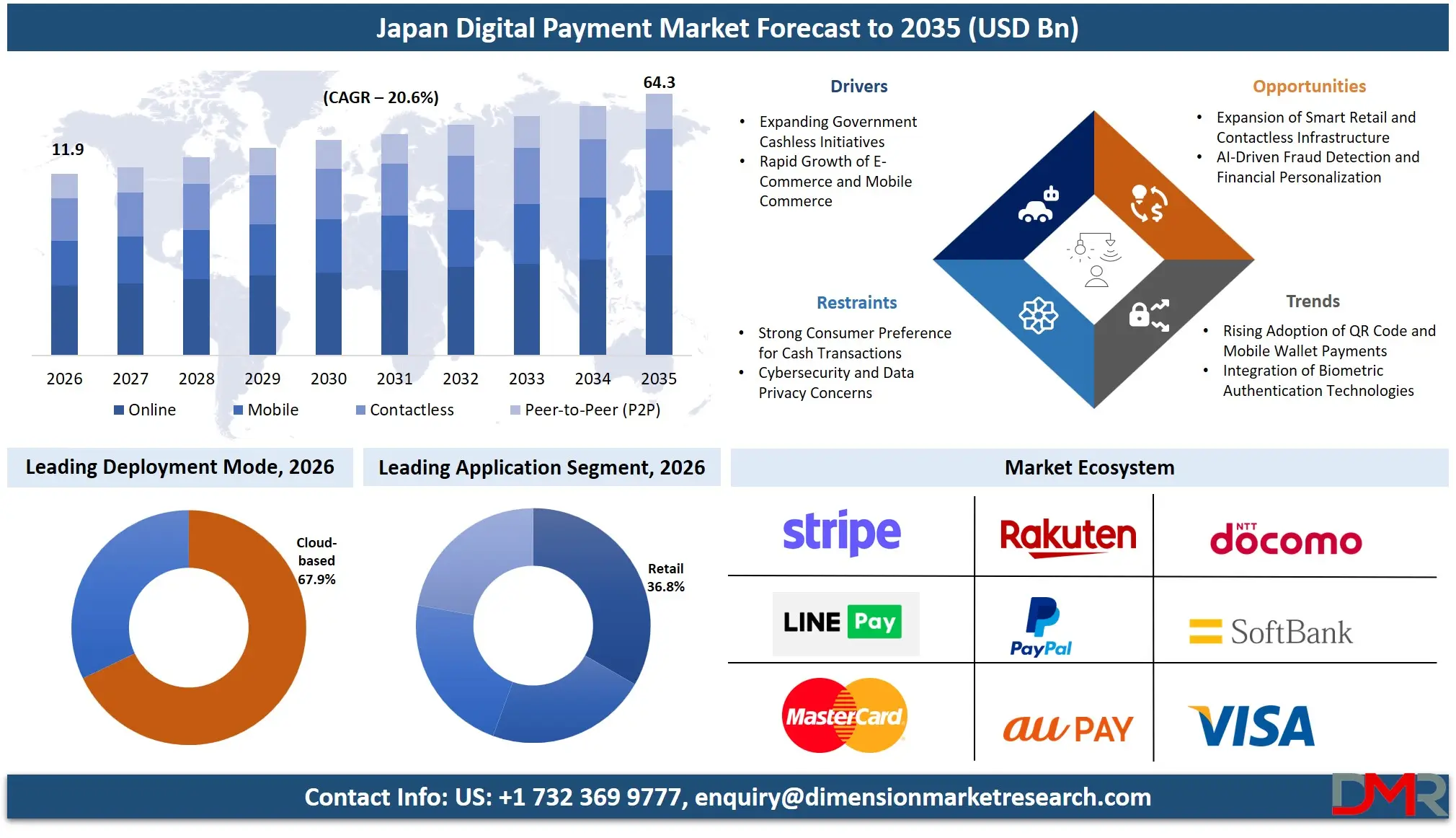
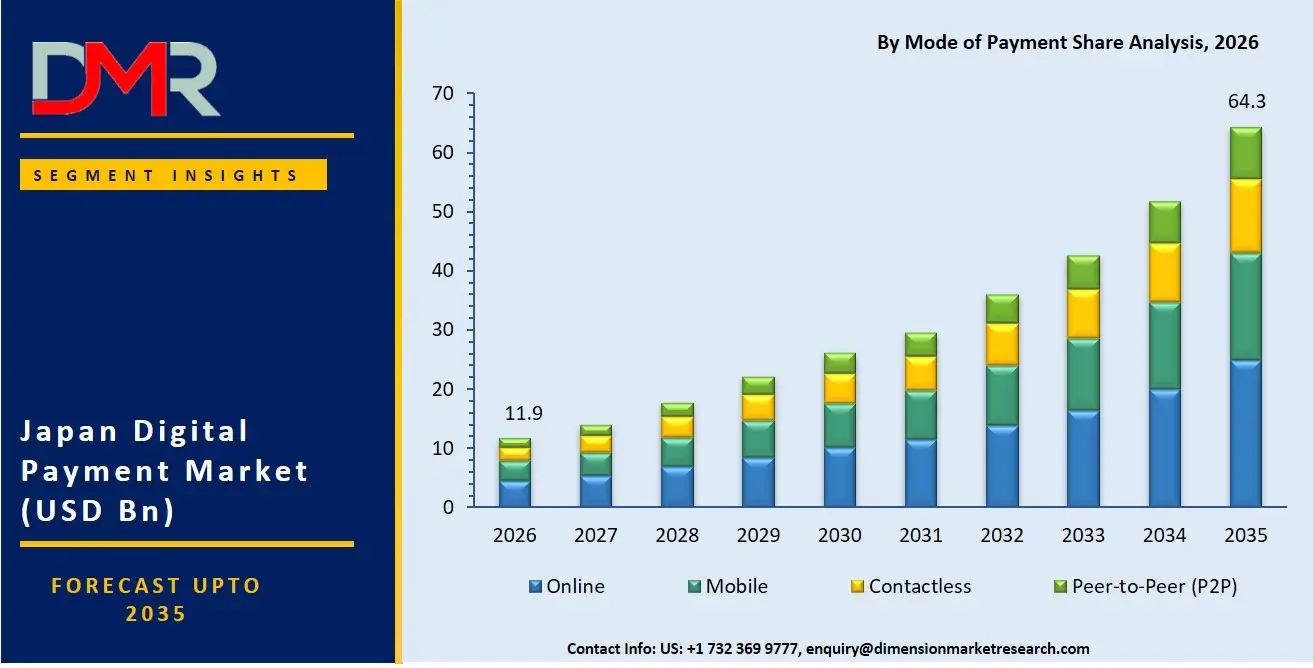
The Japan Digital Payment Market size is expected to be USD 11.9 billion in 2026 and increase at a compound annual growth rate of 20.6% to USD 64.3 billion in 2035 owing to Japan's financial policies focused on increasing transparency and efficiency in economic activities.
ℹ
To learn more about this report –
Download Your Free Sample Report Here
Japan Digital Payment Market is the set of digital-based electronic money transactions that are made through digital channels such as mobile wallets, online banking, contactless cards, QR code payments, and peer-to-peer transaction platforms. The Japan Digital Payment Market involves making cashless payments through various channels, which includes retail shops, online shopping, transportation services, and even government services. The increase in the use of smartphones, technology, and consumer preferences is changing the face of the Japan Digital Payment Market.
ℹ
To learn more about this report –
Download Your Free Sample Report Here
Key Takeaways
- Market Size & Forecast: The Japan Digital Payment Market size is projected to reach USD 11.9 billion in 2026 and is anticipated to have a value of USD 64.3 billion in 2035.
- Growth Rate & Outlook: The Japan Digital Payment Market size is set to grow at a compound annual growth rate of 20.6% during the forecast period of 2026 to 2035.
- Primary Growth Drivers: Some of the major growth drivers in the market are Expansion of Government Cashless Policies, and more.
- Key Market Trends: Some of the major trends in the market are Increase in Usage of QR Code Payments and Mobile Wallets, and more.
- By Deployment Mode: Cloud nm segment is anticipated to get the majority share of the Japan Digital Payment Market in 2026.
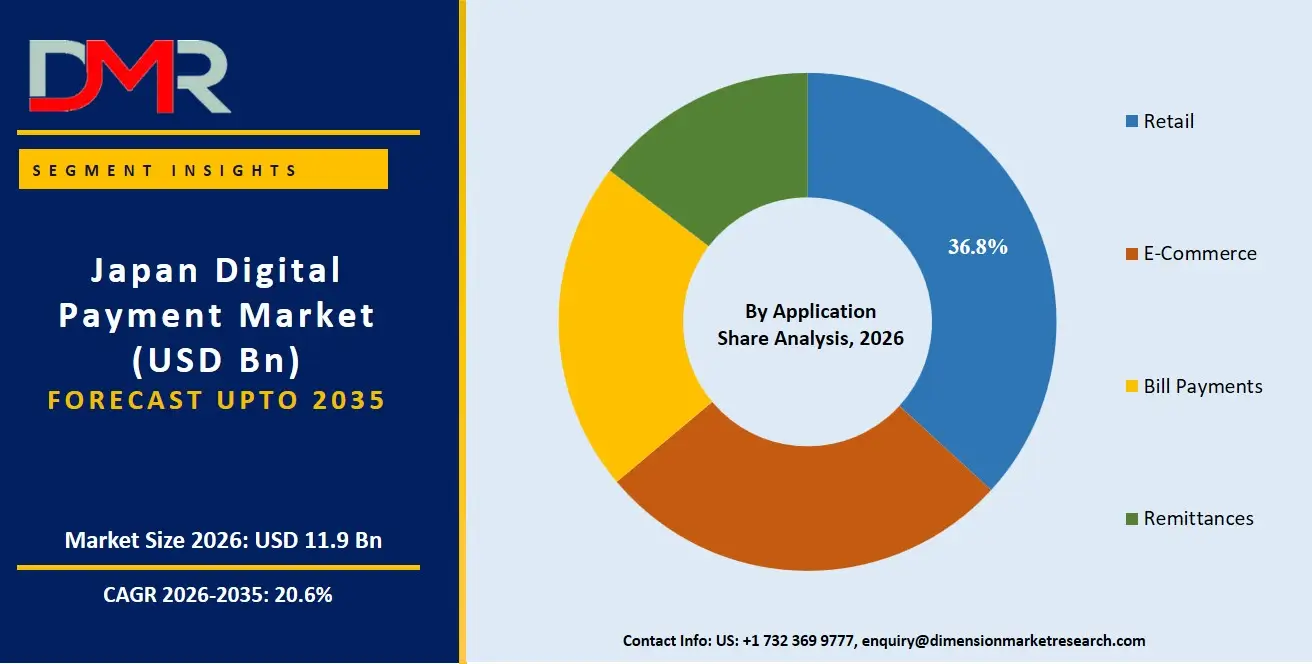
- By Application: Retail is expected to get the largest revenue share in 2026 in the Japan Digital Payment Market.
- By Mode of Payment: Online segment is expected to get the largest revenue share in 2026 in the Japan Digital Payment Market.
What is the Digital Payment?
Digital payments involve the process of making payments through the use of electronic means without involving any actual handling of physical cash by using methods like mobile wallets, contactless cards, QR code-based payments, online banking services, and peer-to-peer payments. This sector is very significant in facilitating and improving financial transactions by promoting efficiency, speed, and security of transactions. Growth in smartphone usage, innovative technological solutions within the fintech space, and changes in the way consumers prefer payment methods will lead to more adoption of this technology in future.
Use Cases
- Retail Payment Systems: The use of digital payment systems is common in supermarkets, convenience stores, restaurants, and shopping complexes to facilitate seamless transactions. Contactless cards and QR code payments have helped reduce transaction time and made it convenient for consumers as well as business owners who wish to track their transactions more effectively.
- E-Commerce Transactions: E-commerce websites make use of payment gateways for the security of transactions from various parts of the world. The increasing trend involves the use of mobile wallets and digital banking systems to buy subscriptions, purchase retail products, or engage in digital entertainment.
- Public Transport: Metro rail transit, bus systems, and railways involve the use of NFC cards and mobile apps to facilitate easy boarding and reduce transaction costs for commuters.
- Government Payments: Digital payment systems also help in making tax payments, utility bill payments, and insurance payments. There are several digitalization drives from the government that are encouraging people to embrace digital transactions.
How AI Is Transforming the Japan Digital Payment Market
AI technology in Japan has revolutionized the digital payment sector through enhanced fraud detection capabilities, improved transaction monitoring, and real-time risk assessment. AI algorithms will assess the behavior patterns exhibited by users to help detect any suspicious behavior in order to prevent instances of payment fraud and cyber insecurity within financial institutions.
Moreover, AI technology plays a key role in providing personalization of services for customers, by assessing their purchasing patterns and offering recommendations on how they can save money. Additionally, chatbots and virtual assistants make transactions more efficient and responsive through predictive analytics.
Market Dynamic
Driving Factors in the Japan Digital Payment Market
Expansion of Government Cashless Policies
The government of Japan remains focused on making its economy more cashless by implementing various regulatory measures and building technological infrastructure to encourage the use of electronic money transactions. Financial policies focused on increasing transparency and efficiency in economic activities have resulted in the increased use of electronic payments systems by businesses, banks, and citizens.
Restraints in the Japan Digital Payment Market
Strong Preference for Cash-based Transactions by Consumers
Even in the face of growing digitization, there remains a deep-rooted culture that favors cash-based transactions in Japan. Most consumers find cash to be much more secure than using technology to make payments, hindering fast uptake of digital means of payments. This poses a challenge to fintech firms wanting to expand their reach.
Opportunities in the Japan Digital Payment Market
Smart Retail and Contactless Growth Opportunities
Retail modernization efforts have opened up considerable scope for digital payment solution providers in supermarkets, vending, transport, and hospitality sectors. The greater adoption of contactless devices and mobile payments systems is motivating customers to embrace digital payment technologies. Growing tourism industry too helps in developing multi-language, globalized payment systems.
Trends in the Japan Digital Payment Market
Increase in Usage of QR Code Payments and Mobile Wallets
The use of payment solutions using QR codes is steadily increasing in convenience stores, restaurants, pharmacies, and public transport companies. Mobile wallets have started to become popular owing to loyalty programs, ease of use, and integration with loyalty programs. Companies are adopting multiplatform payment systems to reach technology-savvy customers and tourists.
Research Scope and Analysis
The scope of the research on the Japan Digital Payment Market includes important segments such as mode of payment, payment method, technology, deployment model, application, and end user. Some of the critical parameters evaluated in the report include market trends, growth factors, constraints, opportunities, competitive forces, technological changes, and more. Additionally, the report studies the consumer adoption patterns, innovations in fintech, regulations, and contactless payments enabled by AI.
ℹ
To learn more about this report –
Download Your Free Sample Report Here
By Mode of Payment Analysis
It is anticipated that online payments will lead the Japan digital payment market by generating 38.7% of the market shares in 2026 owing to the rising number of e-commerce sites, subscription services, and digital banks. Consumers are increasingly favoring online payment gateways connected to mobile phones and banking apps. Companies are spending large amounts of money on omnichannel payment systems to make the process easy and efficient for users. On the other hand, mobile payments are set to grow at a fast pace owing to the rising usage of smartphones, acceptance of QR code payments, and preference for contactless payments in retail and transportation industry sectors.
By Payment Method Analysis
Wallets are expected to make up an estimated 34.2% share of Japan's digital payments industry in 2026 on the back of their ease of use, incentives features, and seamless integration into e-commerce and retail channels. People are gradually becoming fond of the use of wallets for transactions like transportation, food delivery services, utilities payments, and e-commerce transactions. The incorporation of loyalty features, as well as AI personalization, enhances consumer interaction. Digital payment solutions using cryptocurrencies are expected to experience the highest rate of growth, considering the rising acceptance of regulation and growing popularity of decentralized finance.
By Technology Analysis
Technology based on Near Field Communication (NFC) is predicted to dominate the Japanese digital payment market by securing 41.5% market share in 2026 thanks to the proliferation of contactless payment cards, transportation means, and mobile wallets using this type of payment technology. NFC payment technology has fast transaction rate, increased security, and high convenience in terms of payments at retail outlets. The largest retailers and public transportation operators have continued to expand their NFC-based network across the country. QR-code technology is predicted to register the highest growth rate owing to its low installation cost and widespread use in SMEs.
By Deployment Mode Analysis
Cloud deployment is expected to be the leading deployment approach in the digital payment space in Japan, with a forecast market share of 67.9% in 2026, owing to factors such as scalability, low costs, and real-time transactions. Banks and fintech companies have increasingly adopted cloud technology in deploying their digital banking systems, artificial intelligence, and enhanced cybersecurity. Cloud technology also offers easy updates and integrations with external applications. While on-premises is still relevant in banks that require secure storage of client information, adoption of cloud technology is growing at a rapid pace.
By Application Analysis
The retail application is expected to account for around 36.8% of the Japanese digital payment market in 2026 because of the widespread use of contactless payments, mobile wallets, and integrated checkouts at supermarkets, department stores, and convenience stores. The emphasis by retailers in the sector is on making transactions faster and enhancing the customer experience with the help of digital payments. Online commerce is expected to record the highest growth as more people of all generations opt for online shopping. With the increased use of "buy now pay later," subscriptions, and cross-border digital commerce services, the trend towards digital payments is gaining momentum.
By End User Analysis
The consumers are projected to continue to dominate the user segment in the digital payments industry of Japan with a projected market share of 46.3% in 2026 owing to rising adoption of smartphones, digital banking services, and the use of contactless payment solutions. The younger demographic groups are playing a key role in the adoption of mobile wallet and peer-to-peer payments platforms in their daily activities. On the other hand, merchants are forecasted to be the fastest-growing segment with firms adopting digitization in their operations. Financial institutions have been engaging in digital payment collaborations and developing payment security technologies through AI.
The Japan Digital Payment Market Report is segmented on the basis of the following:
By Mode of Payment
- Online Payment
- Mobile Payment
- Contactless Payment
- Peer-to-Peer (P2P) Payment
By Payment Method
- Credit Cards
- Debit Cards
- E-Wallets
- Bank Transfers
- Cryptocurrency
By Technology
- Near Field Communication (NFC)
- QR Code
- Magnetic Stripe Cards
- EMV Chip Cards
By Deployment Mode
By Application
- Retail
- E-Commerce
- Bill Payments
- Remittances
By End User
- Consumer
- Merchant
- Financial Institution
- Government
Competitive Landscape
Japan's digital payments industry experiences stiff competition owing to innovation in the finance technology sector, technology innovations, and increased investments in the digital infrastructure space. Stakeholders in this sector pay considerable attention to making strategic collaborations with retailers, transportation companies, banks, and online commerce platforms. There is a strong emphasis on incorporating artificial intelligence (AI) in fraud prevention, adopting cloud payment processing services, and integrating loyalty solutions to improve customer engagement. Regulatory compliance, cyber security concerns, and the cost of infrastructure investment represent key entry barriers.
Some of the prominent players in the Japan Digital Payment are:
- PayPay Corporation
- Rakuten Pay, Inc.
- Line Pay Corporation
- NTT DOCOMO, Inc. (d Payment)
- au PAY Corporation
- SoftBank Corp.
- GMO Payment Gateway, Inc.
- SBI Holdings, Inc.
- Square Japan Inc.
- Stripe, Inc.
- Adyen N.V.
- Visa Association
- Mastercard Co., Ltd.
- JCB Co., Ltd.
- American Express Japan Ltd.
- Merpay, Inc.
- Japan Post Bank Co., Ltd.
- Mitsubishi UFJ Financial Group, Inc.
- Sumitomo Mitsui Financial Group, Inc.
- NEC Corporation
- Other Key Players
Recent Developments
- In April 2026, A leading Buddhist association in Kyoto has rolled out a new program called "Omairi Pay," a payment method that can be used at temples and shrines without disclosing users' religious preferences. It was created by a partnership between a Buddhist association in Kyoto and a Tokyo company. It allows people to pay for their visit and amulet electronically. The new service has been offered by the Kyoto Buddhist Association that consists of 1,100 temples.
- In February 2026, The PayPay Corp has registered its intention to have an initial public offering on the Nasdaq, thereby indicating its strategy of expanding internationally from Japan in order to become stronger in the international field of digital payment systems. The company that operates the top QR code payment system in Japan filed papers with the Securities and Exchange Commission in the United States and can become valued at more than one trillion yen.
- In February 2026, PayPay Corporation and Visa Inc. have formed a strategic alliance centered around increasing payment capabilities and fostering rapid global expansion. Under the terms of this partnership, the two companies have discussed plans for the entry of PayPay into the United States, which is the first step in its plan for international expansion, as well as improving coordination in their Japanese operations.
Report Details
| Report Characteristics |
| Market Size (2026) |
USD 11.9 Bn |
| Forecast Value (2035) |
USD 64.3 Bn |
| CAGR (2026–2035) |
20.6% |
| Historical Period |
2021 – 2025 |
| Forecast Period |
2027 – 2035 |
| Base Year |
2025 |
| Estimate Year |
2026 |
| Segments Covered |
By Mode of Payment, By Payment Method, By Technology, By Deployment Mode, By Application, By End User |
| Country Coverage |
Japan |
Frequently Asked Questions
How big is the Japan Digital Payment Market?
▾ The Japan Digital Payment Market size is expected to reach USD 11.9 billion by 2026 and is projected to reach USD 64.3 billion by the end of 2035.
What is the CAGR of the Japan Digital Payment Market from 2026 to 2035?
▾ The market is growing at a CAGR of 20.6 percent over the forecasted period.
What factors are driving the growth of the Japan Digital Payment Market?
▾ Expansion of Government Cashless Policies, and more are the factors driving the growth of the Japan Digital Payment Market.
What are the major trends in the Japan Digital Payment Market?
▾ Increase in Usage of QR Code Payments and Mobile Wallets, and more are some of the major trends in the market.
Who are the key players in the Japan Digital Payment Market?
▾ Some of the key players in the Japan Digital Payment Market include Stripe, Paypal, Visa, and more
How is the Japan Digital Payment Market segmented?
▾ The Japan Digital Payment Market is segmented by mode of payment, payment method, technology, deployment mode, application, end user.