Market Overview
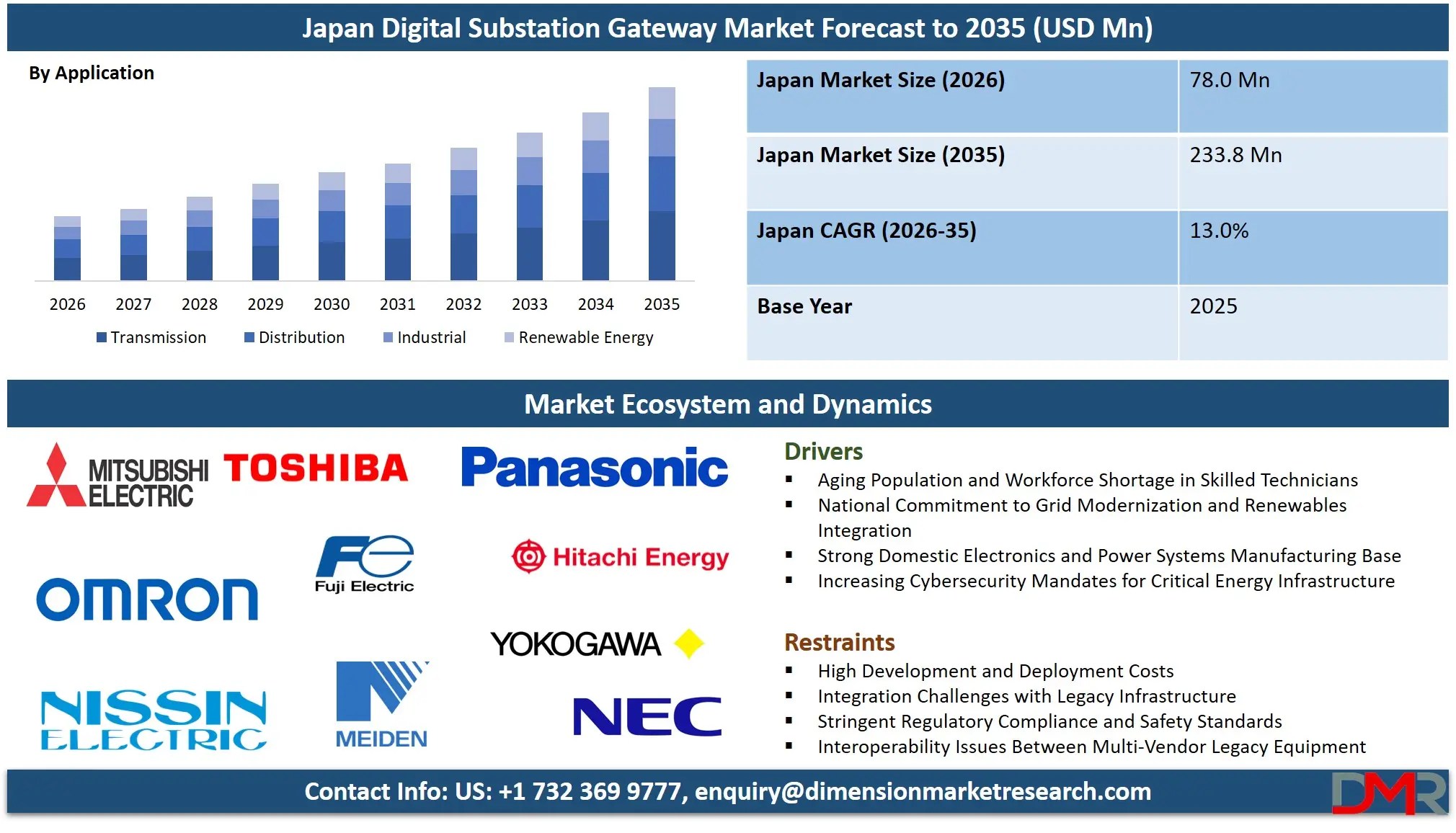
The Japan Digital Substation Gateway Market is anticipated to be valued at USD 78.0 billion in 2026 and is expected to attain nearly USD 233.8 billion by 2035, expanding at a CAGR of about 13.0% during the forecast period. This growth reflects Japan's proactive approach to modernizing its national power grid through digital transformation, smart grid technologies, and advanced automation systems. The demand for intelligent substation gateways, protocol converters, and cybersecurity solutions is accelerating across segments including transmission and distribution utilities, renewable energy integration, and industrial power management.
ℹ
To learn more about this report –
Download Your Free Sample Report Here
Japan has historically been a global pioneer in electronics and industrial automation. The integration of digital substation gateways, intelligent systems that enable seamless communication and data aggregation within power substations, is becoming central to the country's next-generation energy infrastructure. Japan's aging power grid infrastructure, the rapid expansion of renewable energy sources, and a strong technological ecosystem are pushing utilities and industrial enterprises to adopt digital substation technologies at an unprecedented pace.
Government initiatives such as the Green Growth Strategy, the Carbon Neutrality Declaration, and the Grid Modernization Program aim to position Japan as a leader in energy efficiency and resilient grid infrastructure. These programs promote investment in IEC 61850-based substations, advanced communication protocols, and cybersecurity for critical energy infrastructure, creating a favorable ecosystem for digital substation gateway innovation.
Japan's energy policy also strongly supports adoption. Following the energy challenges of the past decade, Japan is focused on creating a more decentralized, digitalized, and resilient power grid. The integration of variable renewable energy sources like solar and wind necessitates advanced grid management capabilities, where digital substation gateways play a crucial role by enabling real-time data aggregation, monitoring, and control. Utilities are deploying these systems to enhance grid visibility, improve operational efficiency, and ensure stable power supply.
The transmission and distribution sector remains another major growth pillar. Japan is home to world-class power utilities and electronics conglomerates. The need to replace aging electromechanical protection systems with modern, software-defined digital substations is driving significant investment. Digital gateways facilitate this transition by enabling legacy equipment to communicate with modern control centers via protocols like DNP3 and Modbus, ensuring a smooth and cost-effective retrofit process.
ℹ
To learn more about this report –
Download Your Free Sample Report Here
In the renewable energy sector, digital substation gateways are transforming how power from solar farms and wind parks is integrated into the national grid. These gateways ensure compliance with grid codes, provide critical data for forecasting and balancing, and enhance the cybersecurity of distributed energy resources. Meanwhile, industrial enterprises are deploying these technologies in their private substations to improve power reliability and energy management for their manufacturing processes.
Japan's unique combination of technological leadership, energy security needs, industrial strength, and government-backed decarbonization programs positions the country as one of the most influential markets for digital substation gateways globally.
Japan Digital Substation Gateway Market: Key Takeaways
- Market Size Insights: The Japan Digital Substation Gateway Market is estimated at USD 78.0 million in 2026 and is expected to reach USD 233.8 million by 2035.
- Market Growth Rate: The market is projected to grow at a CAGR of 13.0% from 2026 to 2035.
- Key Players: Major players in the Japan Digital Substation Gateway Market include Toshiba Energy Systems & Solutions Corporation, Hitachi Energy Ltd., Mitsubishi Electric Corporation, Fuji Electric Co., Ltd., Nissin Electric Co., Ltd., Yokogawa Electric Corporation, Omron Corporation, and NEC Corporation.
- Hardware as the Core Growth Driver: Hardware components, particularly protocol gateways and communication interfaces, are expected to dominate the market due to the foundational need for physical devices to enable digitalization in new and retrofit substation projects.
- Utilities as the Leading End-User: Japan's major power utilities are the primary drivers of market growth as they lead the charge in modernizing the nation's transmission and distribution grid infrastructure to enhance resilience and integrate renewables.
- Government Policy as a Catalyst: Programs such as the Green Growth Strategy and Grid Modernization Program mandate grid upgrades and promote investment in digital technologies, accelerating the adoption of digital substation gateways.
Impact of the Iran Conflict on the Japan Digital Substation Gateway Market
- Supply Chain Disruptions in Semiconductors and Electronic Components: The digital substation gateway ecosystem relies heavily on semiconductors, microprocessors, and advanced communication modules. The Iran conflict has raised concerns about disruptions in the supply of critical materials such as helium and specialty chemicals used in semiconductor manufacturing. Shortages or delays in chip production can slow the development and delivery schedules for gateways and related hardware in Japan.
- Rising Energy Costs Affecting Manufacturing: The conflict has triggered volatility in global oil and gas markets, with energy prices increasing due to disruptions in Middle Eastern supply routes. Higher energy costs increase operational expenses for electronics manufacturing facilities in Japan, potentially raising the cost of producing digital substation gateways and related components, which could be passed on to utilities and industrial end-users.
- Logistics and Trade Route Risks: Shipping routes in the Persian Gulf are critical for global trade between Asia, Europe, and the Middle East. Instability around the Strait of Hormuz creates risks for global logistics networks. Disruptions can delay the delivery of specialized electronic components, communication interfaces, and industrial materials needed for gateway production and project deployment in Japan.
- Increased Focus on Energy Security and Grid Independence: Geopolitical tensions often accelerate a nation's focus on energy security and self-sufficiency. This could lead to increased investment in domestic energy infrastructure, including the modernization and digitalization of the power grid to make it more resilient against external shocks, indirectly benefiting the digital substation gateway market in Japan.
Japan Digital Substation Gateway Market: Use Cases
- Utility T&D Grid Modernization: Japan's major utilities are deploying digital substation gateways across their transmission and distribution networks. These gateways aggregate data from intelligent electronic devices (IEDs), such as protection relays and circuit breakers, converting diverse communication protocols (e.g., Modbus to IEC 61850) for seamless integration with modern SCADA systems. This provides grid operators with enhanced real-time visibility, enabling faster fault detection, isolation, and service restoration.
- Renewable Energy Integration: As Japan expands its solar and wind power capacity, digital substation gateways are critical for connecting these variable energy sources to the grid. At a solar farm substation, gateways collect data on power output, grid status, and weather conditions, transmitting it to the utility control center. They ensure the plant complies with stringent grid connection codes by enabling rapid response to frequency and voltage fluctuations, thus maintaining overall grid stability.
- Industrial Plant Power Management: Large industrial enterprises, such as steel mills and chemical plants, use digital substation gateways to manage their private, high-voltage power distribution networks. These gateways provide a centralized platform to monitor power quality, track energy consumption, and manage the protection systems within the facility. This helps prevent costly downtime, optimize energy usage for sustainability goals, and ensure the safety and reliability of the plant's power supply.
- Retrofit of Aging Brownfield Substations: Many of Japan's substations are decades old and use legacy equipment with proprietary communication protocols. Instead of a costly full replacement, utilities deploy digital substation gateways in brownfield upgrades. These gateways act as a bridge, collecting data from old relays and meters via serial protocols like DNP3 or PROFIBUS and converting it to modern Ethernet-based IP protocols for transmission to a modern control center, effectively digitalizing the substation without a complete overhaul.
- Cybersecurity Enhancement for Critical Infrastructure: Digital substation gateways are increasingly deployed with integrated cybersecurity software to protect the nation's critical energy infrastructure. They serve as a secure perimeter defense point, monitoring network traffic for anomalies, enforcing access control policies, and creating encrypted tunnels for secure data communication between the substation and the utility's core network, thereby safeguarding against cyber threats.
Japan Digital Substation Gateway Market: Stats & Facts
Ministry of Economy, Trade and Industry (METI)
- Japan's Green Growth Strategy aims to create a carbon-neutral society by 2050, with grid modernization as a core pillar.
- Digitalization of the power grid, including substation automation, is a key component of Japan's energy infrastructure resilience and national competitiveness agenda.
- METI supports several smart grid demonstration projects and technology development programs for advanced grid components.
Agency for Natural Resources and Energy (ANRE)
- Japan aims to increase the share of renewable energy in its power mix to 36-38% by 2030, necessitating significant grid upgrades.
- The agency's Grid Modernization Program provides guidelines and incentives for utilities to adopt IEC 61850 and other digital technologies.
- Investment in digital substations is critical for managing the intermittency of large-scale renewable energy integration.
Fuji Keizai Group
- The Japanese market for substation automation and digitalization is projected to grow at a CAGR of over 10% through the early 2030s.
- The retrofit of aging substations represents the largest market opportunity, accounting for a significant share of demand for communication gateways.
International Energy Agency (IEA)
- Japan's electricity grid is one of the most reliable in the world, but faces challenges from an aging asset base and the need for more flexible operation.
- Digital technologies, including substation automation, are essential for enhancing grid resilience and accommodating distributed energy resources.
World Bank
- Japan's infrastructure investment as a percentage of GDP remains significant, with a focus on upgrading and modernizing existing assets, including the power grid.
- Smart grid technologies are crucial for improving energy efficiency and supporting sustainable economic growth.
Japan Electric Manufacturers' Association (JEMA)
- Japanese manufacturers are global leaders in power systems and automation technologies, holding a significant share of the international substation equipment market.
- Over 50 companies in Japan are actively involved in developing components and systems for digital substations, from sensors and gateways to software and services.
Japan Digital Substation Gateway Market: Market Dynamics
Driving Factors in the Japan Digital Substation Gateway Market
Aging Population and Workforce Shortage in Skilled Technicians
Japan's demographic transition toward an aging population is a significant driver for substation digitalization. As the working-age population declines, utilities face a shortage of skilled technicians to manually inspect and maintain a vast network of aging substations. Digital substation gateways enable remote monitoring and diagnostics, reducing the need for on-site visits. This allows a smaller workforce to manage a larger, more complex grid more effectively. By automating data collection and control, these technologies are becoming essential tools for maintaining grid reliability and operational stability in the face of workforce challenges.
National Commitment to Grid Modernization and Renewables Integration
Japan's ambitious goals for carbon neutrality by 2050 and a significantly higher share of renewable energy are forcing a fundamental shift in how the power grid is operated. Legacy substations lack the communication capabilities needed to manage the bidirectional power flows and variability introduced by solar and wind. Digital substation gateways are the foundational technology for this modernization. They provide the real-time data, advanced control functions, and protocol interoperability required to create a smarter, more flexible grid capable of handling the complexities of a decarbonized energy system.
Restraints in the Japan Digital Substation Gateway Market
High Development and Deployment Costs
The development and implementation of digital substation gateways require sophisticated hardware, secure software, and specialized engineering expertise. These technologies involve substantial investment in research, certification, and system integration. As a result, initial deployment costs remain relatively high, particularly for smaller utilities or industrial enterprises with limited capital budgets. Organizations must also invest in workforce training, system integration, and ongoing maintenance, which can further increase the total cost of ownership.
Integration Challenges with Legacy Infrastructure
A vast majority of Japan's substations operate using legacy protection and control equipment that was not designed for digital communication. Retrofitting these brownfield sites with modern gateways often requires overcoming challenges related to physical space, wiring, and the integration of disparate, proprietary protocols. While gateways are designed to bridge this gap, ensuring seamless and reliable communication with decades-old equipment can be complex, time-consuming, and may require customized engineering solutions, slowing down adoption timelines.
Opportunities in the Japan Digital Substation Gateway Market
Expansion of Cybersecurity Consulting and Monitoring Services
As substations become more digitized and connected, they also become more vulnerable to cyberattacks. Japan's critical infrastructure is a prime target, creating a substantial opportunity for specialized cybersecurity services. Beyond selling hardware gateways with built-in security features, vendors can offer high-value cybersecurity consulting to assess vulnerabilities in substation architectures. Furthermore, recurring revenue streams can be built around managed security services, providing continuous network monitoring, threat detection, and incident response for utility clients, helping them comply with stringent government security guidelines.
Synergy with Smart City and Distributed Energy Resource Development
Digital substation gateways are expected to play an important role in the development of smart cities and the management of distributed energy resources (DERs) across Japan. As more solar panels, battery storage systems, and electric vehicle charging stations connect to the distribution grid, intelligent gateways at secondary substations become crucial for managing local power flows. These systems align with Japan's Society 5.0 vision by enabling data-driven urban services. They can analyze real-time grid data to manage local congestion, optimize the use of DERs, and support new business models like local energy trading, improving mobility services and optimizing city operations.
Trends in the Japan Digital Substation Gateway Market
Expansion of Software-Defined Functionality in Gateways
Japan continues to lead in the integration of advanced software with industrial hardware. A key trend is the move towards software-defined substation gateways. Instead of having fixed, proprietary functions, these gateways are becoming more open and programmable. This allows utilities to deploy new functions, such as advanced data analytics, edge computing-based fault prediction, or updated cybersecurity protocols, simply by updating software rather than replacing hardware. This trend offers greater operational flexibility, longer equipment lifespans, and faster adaptation to evolving grid requirements, making it a key focus for Japanese vendors.
Growth of Managed Services for Substation Digitalization
As the technology becomes more complex, there is a growing trend among utilities, especially smaller ones, to outsource aspects of their substation digitalization. Instead of solely purchasing hardware, they are entering into managed service contracts with vendors. These contracts bundle the supply of gateways with installation and commissioning, ongoing maintenance, and cybersecurity monitoring. This provides utilities with predictable operational costs and access to specialist expertise, while creating long-term, recurring revenue streams for solution providers. This shift from a pure product sale to a service-oriented model is a rapidly growing trend within Japan's market.
Japan Digital Substation Gateway Market: Research Scope and Analysis
By Component Analysis
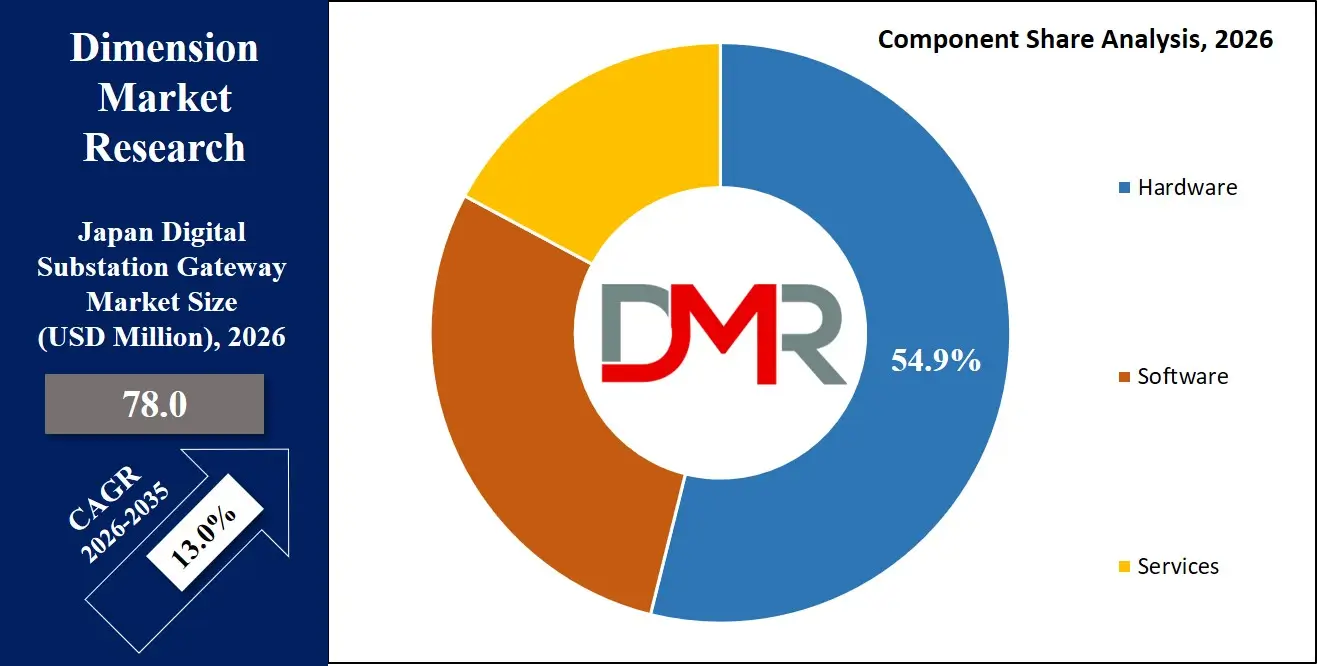
Hardware components, particularly Protocol Gateways, are projected to dominate the component segment in this market as they will hold 54.9% of market share in 2026. The dominance of hardware gateways in the component segment of the Japan Digital Substation Gateway Market is owing to stringent grid modernization mandates from METI and high utility demand for reliable communication infrastructure in the region. Utilities in Japan, including TEPCO, Kansai Electric Power, and Chubu Electric Power, are heavily investing in integrating protocol gateways and communication interfaces across their substation networks; hence, advanced solutions are being used to smooth data operations, ranging from high-speed processors and redundant communication modules to ruggedized enclosures designed to withstand Japan's seismic activity.
ℹ
To learn more about this report –
Download Your Free Sample Report Here
Japan's Grid Modernization Program underlines the emphasis on mandating technology for the enhancement of grid reliability following the lessons learned from past natural disasters. It therefore raises demand for hardware gateways that help in seamless protocol conversion with real-time data processing and build system reliability, critical to maintaining grid performance in this highly competitive market. Such huge volumes of transmission substation upgrades across Japan's interconnected grid spur demand for high-class digital gateway hardware from domestic manufacturers like Toshiba, Hitachi Energy, and Mitsubishi Electric.
By Communication Protocol Analysis
IEC 61850 is anticipated to dominate the share in the communication protocol segment of the digital substation gateway market in Japan, owing to the strategic reliance on standardized, interoperable communication protocols for advanced grid automation applications. Japan has vast energy infrastructure capabilities with a supply chain connecting important manufacturing regions for easier distribution of compliant components to utilities across the Kanto, Kansai, and Chubu regions. IEC 61850 offers a proven balance of performance and interoperability that no other protocol can match for functions like substation automation and protection. First-generation digitalization functions, being very essential, do happen with transmission substations operated by Japan's major power companies and also in distribution network applications. There is an unparalleled growth in the number of grid regulations following Japan's energy policy reforms, as with a growing demand for higher levels of automation, utilities would want to expect reliable data communication under all conditions, including during seismic events.
The protocol technology investments involve the expansion of production capacity for IEC 61850-compliant gateways and software tools, adding testing facilities along major development hubs in Tokyo and Osaka, and furthering protocol conversion algorithms tailored for Japan's unique grid characteristics. This development also aligns with Japan's Society 5.0 initiative in positioning the country as a leader in grid communication electronics. The proximity of energy R&D centers, such as those operated by METI and NEDO, to gateway production facilities further cements their position as the main protocol enabler for digital substations. Among many factors, interoperability comes forward. Compared with proprietary protocols, IEC 61850 offers lower integration costs for multi-vendor applications, thus making it perfectly fit for meeting regulatory requirements across grid segments. The increased use of technologies for protocol conversion, like AI-based data mapping developed by Japanese technology firms, improves the operational efficiency, further enhancing IEC 61850 dominance in Japan's market.
By Deployment Type Analysis
. The deployment segment in the Japan Digital Substation Gateway Market is projected to be dominated by Retrofit Brownfield Upgrades, having become essential for extending asset life, regulatory compliance, and seamless grid modernization. Due to the increased adoption of stringent digitalization standards by utilities in Japan, retrofit solutions offer deterministic performance and robust architecture support for complex substation automation operations. This is also aligned with the aim of grid reliability standards from the Agency for Natural Resources and Energy toward ensuring system interoperability and embracing technological rigor, especially given that much of Japan's substation infrastructure was constructed during the post-war economic boom. Retrofit solutions make the existing infrastructure adaptable for modern communication protocols, enabling better data exchange and automation without complete replacement, which would be prohibitively expensive and disruptive in densely populated urban areas like Tokyo and Osaka. This becomes even more important in a region like Japan, where aging grid assets and varied infrastructure conditions across different prefectures require cost-effective upgrades. Moreover, retrofit deployments reduce capital expenditure associated with greenfield construction, appealing to utilities of all sizes, who are a growth segment in Japan's energy ecosystem.
Not to say that the capability for advanced incremental modernization of the retrofit platforms stands in their favor, too. Interoperability, high-integrity communication, and real-time data processing integrated with these retrofit systems further enable utilities in grid operations relevant to achieving high levels of automation, particularly for managing distributed energy resources. This dream is partly driven by initiatives from METI aimed at improving grid resilience and partnering with major global and domestic technology manufacturers. This will enable them to support dynamic grid demands and ensure operational integrity, hence remaining the dominant deployment method within the digital substation gateway market in Japan.
By Voltage Level Analysis
High Voltage (HV) and Extra High Voltage (EHV) are projected to lead in the Japan Digital Substation Gateway Market due to their highly transformative effect in achieving immediate grid reliability improvements and widespread application across transmission networks. These voltage levels power backbone transmission infrastructure, respectively, and, most importantly, provide stepping stones toward full grid digitalization in solving the complexity brought along by modern energy scenarios following the liberalization of Japan's electricity market. Japan's Green Growth Strategy focuses on mandating digitalization functions across all high-voltage networks to accommodate the integration of large-scale renewable energy from solar farms in Hokkaido and Tohoku. All these objectives also align with HV and EHV applications focused on improved outage prevention and grid operator convenience. Firms utilize HV and EHV technologies to meet regulatory requirements, reduce transmission losses, and create better asset value.
Transmission system operator adoption has gained momentum in Japan, particularly with the establishment of the Organization for Cross-regional Coordination of Transmission Operators (OCCTO), thus increasing the need for HV and EHV solutions. For example, digital gateways improve real-time monitoring of power flows between regions, and protocol conversion prevents communication failures that could lead to widespread disruptions. HV and EHV functions enhance the end-user experience for grid operators, which is an important factor in the competitive energy market following Japan's electricity system reform. Government-backed digitalization mandates and partnerships with global tech leaders further fuel HV and EHV adoption. These are increasingly being integrated into interconnections between the eastern and western grids (50 Hz and 60 Hz), packaging what is to be expected in the future. Having already proven their potential through improvement in reliability, efficiency, and scalability, HV and EHV remain among the major voltage levels that will still dominate in the Japanese digital substation gateway sector.
By Application Analysis
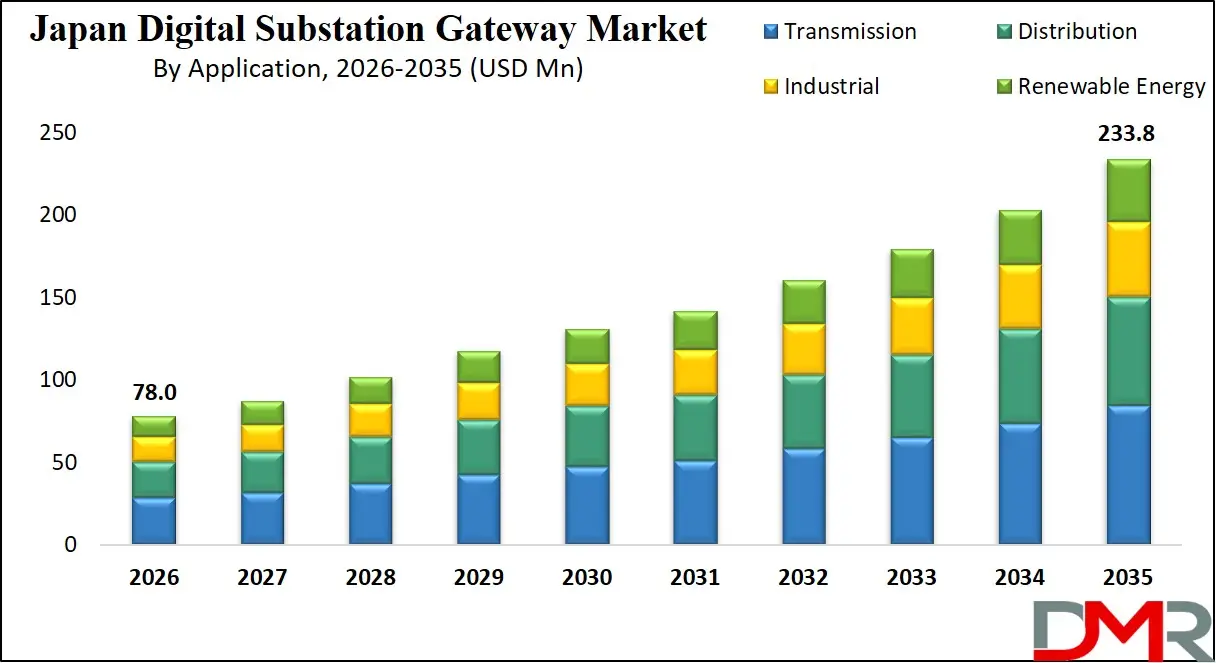
Transmission Substations are projected to dominate the application segment in this market as they will hold 37.2% of market share in 2026. The dominance of transmission substations in the application segment of the Japan Digital Substation Gateway Market is owing to stringent grid stability mandates from OCCTO and high utility demand for advanced monitoring capabilities in the region. Transmission system operators in Japan, including the general electricity transmission and distribution utilities, are heavily investing in integrating digital gateways across their high-voltage networks; hence, advanced solutions are being used to smooth automation operations, ranging from high-speed data processors and redundant communication modules to cybersecurity software tailored for critical infrastructure protection. Japan's cross-regional grid expansion guidelines under the Cabinet Office's infrastructure strategy underline the emphasis on mandating technology for the enhancement of grid reliability following the 2011 earthquake and subsequent power challenges. It therefore raises demand for gateway systems that help in seamless data exchange with real-time monitoring and build system interoperability, critical to maintaining transmission performance in this highly competitive market. Such huge volumes of interconnector projects, such as the Hokkaido-Honshu HVDC link expansion, spur demand for high-class digital gateway applications.
It will help in the complete interconnectivity of grid automation and energy market functions within the transmission network, thus making its future in the market indispensable. Renewable integration from Japan's growing offshore wind pipeline, load balancing between frequency zones, and frequency control completely depend on this basic application infrastructure for gathering and synchronizing data within their systems. Growth in the offshore grid development around Japan's coastline also adds to the contribution of advanced gateway applications integrated with SCADA systems that optimize the processes of remote control. Government-backed interconnection programs and initiatives under the Strategic Energy Plan advocate the use of the latest available technology to reduce transmission losses and enhance resilience, thus supporting the market of transmission substation applications. Hence, transmission substations remain an integral factor as they provide the foundational automation skeleton for modern grid digitalization in Japan.
By End-User Analysis
Utilities are projected to dominate the end-user segment in this market as they will hold 66.8% of market share in 2026. The dominance of utilities in the end-user segment of the Japan Digital Substation Gateway Market is owing to their ownership and operation of the majority of transmission and distribution infrastructure across the country. Utilities in Japan, including the ten major general electricity utilities and the newly formed transmission and distribution divisions, are heavily investing in integrating digital gateways across their asset base; hence, advanced solutions are being used to smooth grid operations, ranging from high-speed communication processors and protocol conversion software to cybersecurity monitoring tools that protect against threats to critical national infrastructure. Japan's energy policy framework under the Strategic Energy Plan underlines the emphasis on mandating technology for the enhancement of grid reliability following the increased penetration of renewable energy sources. It therefore raises demand from utilities for gateway systems that help in seamless data exchange with real-time monitoring and build system interoperability, critical to maintaining grid performance in this highly competitive market following full retail liberalization. Such huge volumes of network assets under utility ownership, including over 50,000 substations across the archipelago, spur demand for high-class digital gateway solutions.
It will help in the complete interconnectivity of grid automation and energy market functions within the utility network, thus making its future in the market indispensable. Renewable integration from FIT-eligible solar and wind projects, load balancing across interconnected regions, and outage management during typhoon and earthquake seasons completely depend on this basic end-user infrastructure for gathering and synchronizing data within their systems. Growth in the smart meter rollout, targeting 80 million installations by the mid-2020s, also adds to the contribution of advanced gateway solutions integrated with distribution management systems that optimize the processes of demand response. Government-backed grid modernization programs under the Green Growth Strategy and initiatives from METI advocate the use of the latest available technology by utilities to reduce operational costs and enhance resilience against natural disasters, thus supporting the market of utility end-users. Hence, utilities remain an integral factor as they provide the foundational investment skeleton for modern grid digitalization in Japan.
The Japan Digital Substation Gateway Market Report is segmented on the basis of the following:
By Component
- Hardware
- Protocol Gateways
- Communication Interfaces
- Embedded Data Aggregators
- Software
- Protocol Conversion Software
- Data Aggregation Tools
- Cybersecurity Software
- Services
- Installation and Commissioning
- Cybersecurity Consulting and Monitoring
- Maintenance and Support Contracts
By Communication Protocol
- IEC 61850
- DNP3
- Modbus
- PROFIBUS/PROFINET
- Others
By Deployment Type
- New Installations
- Retrofit Brownfield Upgrades
By Voltage Level
- Low Voltage (LV)
- Medium Voltage (MV)
- High Voltage (HV)
- Extra High Voltage (EHV)
By Application
- Transmission Substations
- Distribution Substations
- Industrial Substations
- Renewable Energy Substations
By End-User
- Utilities
- Independent Power Producers (IPPs)
- Industrial Enterprises
- Commercial Establishments
Japan Digital Substation Gateway Market: Competitive Landscape
The competitive landscape of the Japan Digital Substation Gateway Market is characterized by the presence of globally recognized electronics conglomerates, specialized power systems companies, and advanced software developers that are continuously innovating to enable the smart grid. Japan has one of the most mature energy infrastructure ecosystems in the world, supported by strong industrial capabilities, extensive R&D infrastructure, and government-backed modernization programs. Leading companies such as Toshiba Energy Systems & Solutions Corporation, Hitachi Energy Ltd., Mitsubishi Electric Corporation, and Fuji Electric Co., Ltd. dominate the market by integrating advanced communication protocols, cybersecurity features, and grid-edge intelligence into their substation automation solutions.
ℹ
To learn more about this report –
Download Your Free Sample Report Here
In addition to these heavyweights, specialized automation and technology companies such as Yokogawa Electric Corporation, Meidensha Corporation, and Nissin Electric Co., Ltd. are actively developing advanced gateway solutions and communication interfaces tailored for specific utility and industrial applications. These organizations focus on reliability, interoperability with legacy systems, and real-time data processing capabilities that allow for seamless digitalization of both new and retrofit substation projects.
Japan's innovation in this field is further strengthened by collaboration between corporations, research institutions, and government agencies. Universities and national laboratories frequently partner with private companies to accelerate advancements in power system communication, cybersecurity, and embedded systems. Programs under the Green Growth Strategy and national energy security initiatives encourage the commercialization of next-generation digital substation technologies.
Overall, Japan's competitive landscape combines established industrial leaders with specialized automation and software developers, creating a highly dynamic ecosystem that supports innovation, commercialization, and large-scale deployment of digital substation gateway technologies across the country's critical energy infrastructure.
Some of the prominent players in the Japan Digital Substation Gateway Market are
- Mitsubishi Electric Corporation
- Toshiba Energy Systems & Solutions Corporation
- Hitachi Energy Ltd.
- Fuji Electric Co., Ltd.
- Yokogawa Electric Corporation
- Omron Corporation
- NEC Corporation
- Panasonic Corporation
- Nissin Electric Co., Ltd.
- Meidensha Corporation
- Kyosan Electric Manufacturing Co., Ltd.
- Oki Electric Industry Co., Ltd.
- Takebishi Corporation
- TMEIC Corporation
- Daihen Corporation
- Siemens AG
- ABB Ltd.
- Schneider Electric SE
- Other Key Players
Recent Developments in the Japan Digital Substation Gateway Market
- December 2025: Kioxia Corporation partnered with Google to increase procurement of clean electricity from a hydropower retrofit project operated by the Chubu Electric Power Group in Japan, supporting grid decarbonization and renewable integration initiatives.
- October 2025: Yokogawa Electric Corporation announced the acquisition of Intellisync and WiSNAM to strengthen its cybersecurity and advanced grid-management capabilities, expanding digital solutions for renewable energy systems and power infrastructure monitoring.
- June 2025: Nissin Electric Co., Ltd. collaborated with Tata Power-DDL to commission a micro-substation using Power Voltage Transformer technology under a NEDO demonstration project, enabling direct conversion of high-voltage transmission power to low-voltage supply for distributed electricity networks.
- February 2025: Yokogawa Electric Corporation enhanced the OpreX Collaborative Information Server, adding improved IT/OT connectivity and RESTful API access to enable integration of operational technology data with IT applications for digital infrastructure systems.
- May 2024: Meidensha Corporation expanded its focus on digital power infrastructure under its medium-term management strategy, emphasizing substation automation, transformers, and grid modernization technologies.
Report Details
| Report Characteristics |
| Market Size (2026) |
USD 78.0 Mn |
| Forecast Value (2035) |
USD 233.8 Mn |
| CAGR (2026–2035) |
13.0% |
| Historical Data |
2021 – 2025 |
| Forecast Data |
2027 – 2035 |
| Base Year |
2025 |
| Estimate Year |
2026 |
| Report Coverage |
Market Revenue Estimation, Market Dynamics, Competitive Landscape, Growth Factors and etc. |
| Segments Covered |
By Component (Hardware, Software and Services), By Communication Protocol (IEC 61850, DNP3, Modbus, PROFIBUS/PROFINET, Others), By Deployment Type (New Installations and Retrofit Brownfield Upgrades), By Voltage Level (Low Voltage (LV), Medium Voltage (MV), High Voltage (HV) and Extra High Voltage (EHV)), By Application (Transmission Substations, Distribution Substations, Industrial Substations and Renewable Energy Substations), By End-User (Utilities, Independent Power Producers (IPPs), Industrial Enterprises and Commercial Establishments) |
| Country Coverage |
Japan |
| Prominent Players |
Mitsubishi Electric Corporation, Toshiba Energy Systems & Solutions Corporation, Hitachi Energy Ltd., Fuji Electric Co., Ltd., Yokogawa Electric Corporation, Omron Corporation, NEC Corporation, Panasonic Corporation, Nissin Electric Co., Ltd., Meidensha Corporation, Kyosan Electric Manufacturing Co., Ltd., Oki Electric Industry Co., Ltd., Takebishi Corporation, TMEIC Corporation, Daihen Corporation, Siemens AG, ABB Ltd., Schneider Electric SE, and Other Key Players |
| Purchase Options |
We have three licenses to opt for: Single User License (Limited to 1 user), Multi-User License (Up to 5 Users), and Corporate Use License (Unlimited User) along with free report customization equivalent to 0 analyst working days, 3 analysts working days and 5 analysts working days respectively. |
Frequently Asked Questions
How big is the Japan Digital Substation Gateway Market?
▾ The Japan Digital Substation Gateway Market size is estimated to have a value of USD 78.0 million in 2026 and is expected to reach USD 233.8 million by the end of 2035.
What is the growth rate in the Japan Digital Substation Gateway Market in 2026?
▾ The market is growing at a CAGR of 13.0% over the forecasted period of 2026.
Who are the key players in the Japan Digital Substation Gateway Market?
▾ Some of the major key players in the Japan Digital Substation Gateway Market are Toshiba Energy Systems & Solutions Corporation, Hitachi Energy Ltd., Meidensha Corporation, Kyosan Electric Manufacturing Co., Ltd., Oki Electric Industry Co., Ltd., and many others.