Market Snapshot
- Market Size (2026): USD 8.6 Bn
- Forecast Value (2035): USD 23.7 Bn
- CAGR (2026-2035): 11.9%
- Leading Offering (2026): Software platforms, around 58%
- Leading Deployment (2026): Cloud, approximately 52%
- Key Players: Microsoft, Fujitsu, NTT DATA and others
What is Japan Digital Workplace Market and its Market Size?
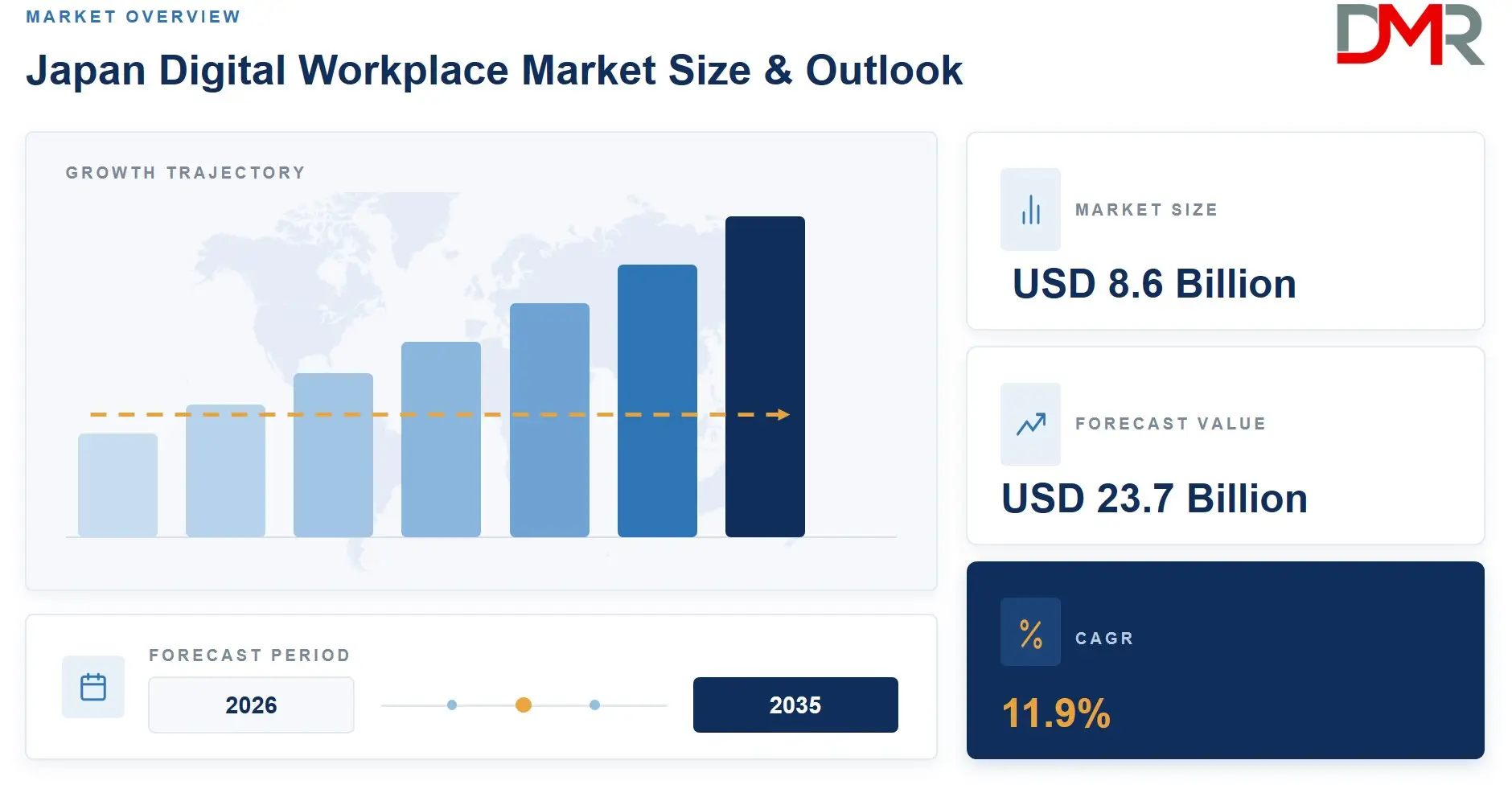
The Japan Digital Workplace Market size is estimated to reach USD 8.6 Bn in 2026 and is further anticipated to reach USD 23.7 Bn by 2035, at a CAGR of 11.9%.
ℹ
To learn more about this report –
Download Your Free Sample Report Here
This assessment covers software and services that connect employees with business applications, communications, documents, workflows, identity controls and workplace analytics. It includes collaboration suites, intranets, content services, employee experience tools, workflow platforms, secure access and implementation support. Hardware sold independently, general-purpose telecommunications revenue and consumer productivity subscriptions are excluded.
The figures represent demand generated inside Japan, including spending by domestic enterprises, public bodies and local operations of multinational companies. They do not represent worldwide revenue earned by Japanese-headquartered vendors. Buyers are chief information officers, human resources teams, operations leaders and line-of-business managers seeking to reduce fragmented tools, preserve institutional knowledge and support distributed work.
Japan's market is shaped by a mature installed base and a gradual migration from file servers, email-heavy processes and custom applications toward cloud services and integrated employee portals. Ageing workforces, labour scarcity, data governance and the need to modernize legacy systems make productivity measurable, but procurement remains attentive to Japanese-language support, security, interoperability and long service continuity.
Use Cases
- Manufacturing Operations: Factory groups connect production, engineering and corporate teams through shared workspaces and controlled documents. The objective is to reduce version conflicts across plants and suppliers, so supervisors can circulate work instructions and quality decisions without rebuilding local file repositories.
- Public Administration: Municipal and national agencies deploy authenticated collaboration environments for cross-department casework. Standardized permissions and retention rules replace ad hoc email exchanges, improving traceability for approvals while allowing officials to work across offices and approved remote locations.
- Financial Services: Banks and insurers use digital workplace platforms to coordinate relationship managers, compliance specialists and back-office teams. Structured content libraries keep policy updates visible, while workflow routing reduces manual handoffs for customer servicing and internal control reviews.
- Healthcare Networks: Hospital groups provide secure staff portals for shift communication, training material and administrative coordination. The deployment addresses fragmented information between facilities and gives clinicians and managers a common source for non-clinical operating guidance.
Key Takeaways
- Market Size & Share: Japan demand is estimated at USD 8.6 Bn in 2026 and is forecast to reach USD 23.7 Bn by 2035.
- Offering Analysis: Software platforms are expected to represent around 58% of 2026 revenue.
- Demand Concentration: Large enterprises are projected to hold close to 61% of 2026 demand.
- Cloud Migration: Cloud deployment is set to account for approximately 52% in 2026 as integration and security practices mature.
- AI Adoption: Knowledge management is expanding at a CAGR of 17.2% between 2026 and 2035 as firms turn unstructured content into searchable guidance.
- Channel Shift: Cloud marketplaces are growing at a CAGR of 19.0% through 2035, supported by repeatable procurement and partner-led implementation.
How AI/Gen AI is Transforming the Japan Digital Workplace Market?
AI is moving the digital workplace from a collection of destinations to a layer that interprets work context. Japanese organizations are applying retrieval-augmented generation to internal policies, meeting records and technical manuals, while access controls and Japanese-language evaluation determine whether an assistant can be used beyond experimentation.
The near-term value is operational rather than theatrical. Models summarize long records, classify requests and draft routine content, but human review remains necessary for regulated decisions, confidential information and ambiguous instructions.
- LLM document processing: Extracts obligations, owners and deadlines from Japanese contracts, notices and manuals.
- Semantic enterprise search: Links questions to approved content across intranets, cloud drives and ticketing systems.
- Workflow copilots: Drafts service responses and routes requests to the correct function using policy context.
- Digital twins: Connects workplace occupancy and facility data to planning dashboards for large campuses.
Key Drivers in the Japan Digital Workplace Market
Two forces are widening the addressable buyer base, one tied to labour economics and the other to infrastructure renewal.
- Labour scarcity and productivity pressure: Japan's shrinking working-age population makes duplicated data entry and expert-dependent processes more expensive. Employers therefore fund shared knowledge, workflow automation and employee portals that preserve operating know-how when experienced staff retire or move roles. Large enterprises are expected to account for close to 61% of 2026 demand because they can standardize across subsidiaries and absorb integration costs. The commercial mechanism is straightforward: a platform becomes easier to justify when it replaces several local tools, supports audit trails and reduces the time managers spend locating authoritative information.
- Legacy modernization and cloud adoption: Corporate systems built around file shares, bespoke databases and email often lack mobile access, unified identity and searchable content. Cloud workplace suites provide a migration path, while hybrid architecture protects applications that cannot be moved quickly. Cloud deployment is projected to represent approximately 52% of 2026 revenue, reflecting the preference for recurring services and managed updates. Spending rises when vendors pair migration with Japanese support, security monitoring and connectors to ERP, HR and manufacturing systems rather than selling collaboration as an isolated application.
Restraints in the Japan Digital Workplace Market
Adoption is not frictionless. Procurement teams face technical debt, governance exposure and uneven user readiness.
- Integration and data-governance friction: A workplace suite must coexist with mainframe applications, domestic groupware, identity directories and sector-specific records. Mapping permissions and retention policies can cost more than the subscription itself, especially when business units use different taxonomies. Sensitive employee, customer and government information also raises questions about residency, encryption keys and model training. Projects slow when legal, security and works councils review each connector separately. Vendors that cannot show granular administration, audit evidence and reversible data export lose momentum even when their user interface is attractive.
- Skills gaps and change resistance: A license does not create a digital process. Department leaders must redesign approvals, teach staff new search habits and remove duplicate repositories. Smaller firms may lack administrators who can manage identity, workflow rules and lifecycle policies, while older processes remain comfortable for users. Japanese-language quality and local service responsiveness matter in training and support. These constraints lengthen deployment cycles and keep professional services important, but they also cap expansion when implementation fees appear disproportionate to the visible productivity benefit.
Growth Opportunities in the Japan Digital Workplace Market
White space is concentrated where platform adoption meets a specific operating constraint rather than a generic collaboration request.
- SME-ready industry packages: Mid-sized manufacturers, construction firms and regional service businesses need preconfigured workflows, Japanese templates and predictable pricing. Packaging identity, document control, task management and support into a single service can reduce the specialist burden that blocks smaller deployments. Cloud marketplaces and local resellers are well placed to sell these bundles.
- Healthcare and public-sector knowledge services: Hospitals and agencies hold large volumes of fragmented guidance, forms and internal notices. Retrieval-based assistants, human approval controls and sector-specific retention policies can turn that content into usable workflows without exposing it to open consumer systems. The strongest opportunity is not a generic chatbot, but a governed information layer tied to a measurable service queue.
- Regional data and AI infrastructure: Domestic cloud capacity, sovereign controls and Japanese-language models create room for providers that combine secure hosting with workplace applications. Buyers that cannot place sensitive information in an uncontrolled environment may still adopt assistants if inference, logging and administrative access remain within approved boundaries.
Trends in the Japan Digital Workplace Market
Buyer behaviour is shifting from app accumulation toward governed work orchestration. Technology decisions increasingly combine collaboration, content, identity, automation and analytics.
- Assistant-led information access: Search is becoming conversational, but enterprise buyers are demanding citations to approved documents, permission-aware retrieval and clear escalation to humans. Japanese-language accuracy is becoming a procurement filter rather than a product bonus.
- Hybrid architecture by design: Cloud-first deployments coexist with private environments and legacy systems. Integration platforms, single sign-on and data-loss prevention are therefore sold as core workplace infrastructure.
- Outcome-based buying: Procurement teams increasingly ask vendors to link adoption to reduced handling time, faster onboarding, fewer duplicate records or higher completion rates. Usage analytics is moving from an administrative report to a renewal argument.
- Partner-led consolidation: System integrators and telecommunications groups package software with migration, connectivity, security and managed operations. This lowers execution risk for firms that prefer one accountable supplier.
Research Scope and Analysis
Segment performance is assessed across offering, deployment, organization size, application, end use industry and distribution channel. Each axis identifies where 2026 revenue is concentrated and which buyer or delivery pattern is moving fastest through 2035, helping readers separate installed-base strength from expansion potential.
ℹ
To learn more about this report –
Download Your Free Sample Report Here
By Offering
Software platforms is projected to hold the largest share by offering in 2026, accounting for around 58% of revenue because it benefits from established procurement patterns and broad compatibility. Growth, however, is concentrated in Employee experience and workflow automation, expanding at a CAGR of 16.8% between 2026 and 2035 as Japanese buyers seek lower deployment friction, stronger automation and more measurable productivity. This contrast shows why current revenue leadership does not automatically identify the next source of market growth.
By Deployment
Cloud is projected to hold the largest share by deployment in 2026, accounting for approximately 52% of revenue because it benefits from established procurement patterns and broad compatibility. Growth, however, is concentrated in Hybrid deployment, expanding at a CAGR of 15.9% between 2026 and 2035 as Japanese buyers seek lower deployment friction, stronger automation and more measurable productivity. This contrast shows why current revenue leadership does not automatically identify the next source of market growth.
By Organization Size
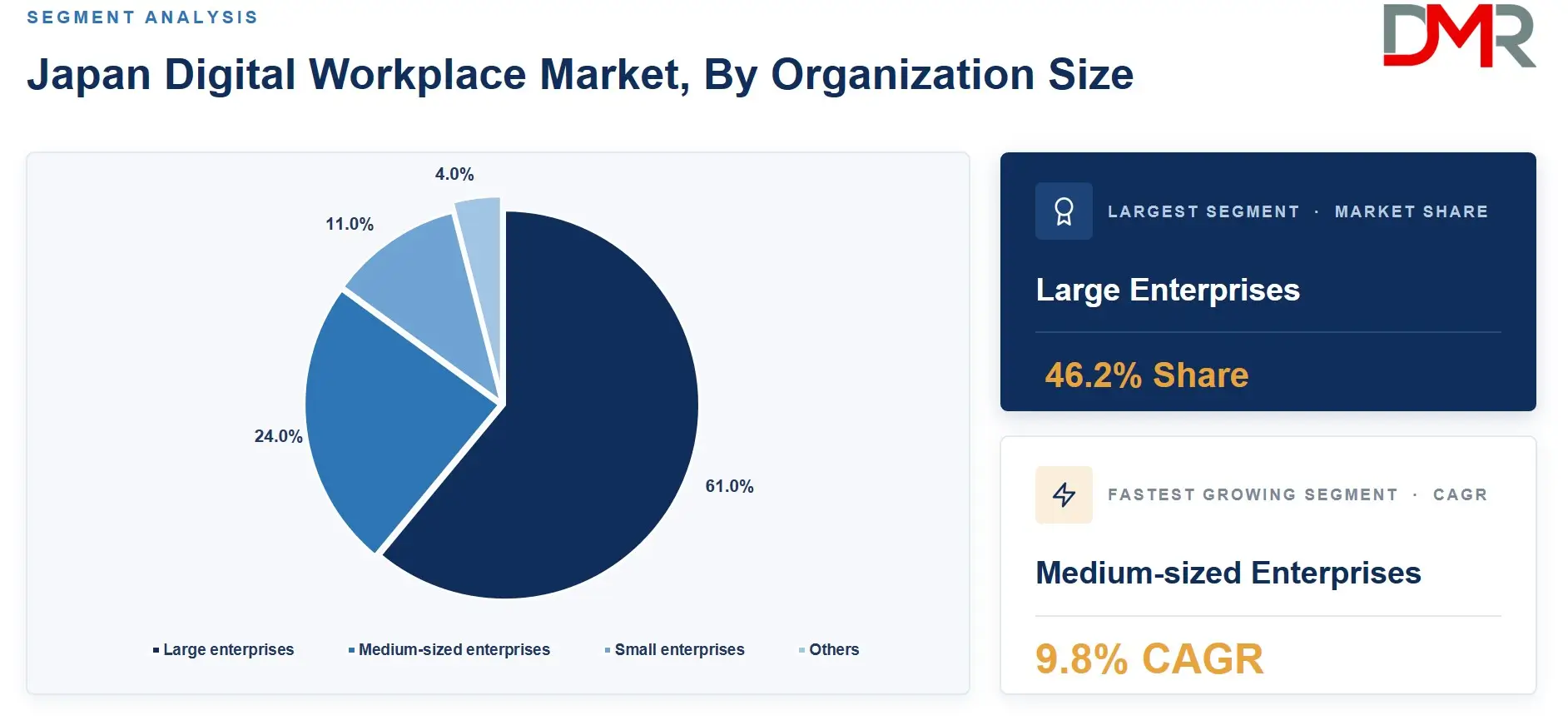
Large enterprises is projected to hold the largest share by organization size in 2026, accounting for close to 61% of revenue because it benefits from established procurement patterns and broad compatibility. Growth, however, is concentrated in Small and medium-sized enterprises, expanding at a CAGR of 18.1% between 2026 and 2035 as Japanese buyers seek lower deployment friction, stronger automation and more measurable productivity. This contrast shows why current revenue leadership does not automatically identify the next source of market growth.
By Application
Collaboration and communication is projected to hold the largest share by application in 2026, accounting for nearly 31% of revenue because it benefits from established procurement patterns and broad compatibility. Growth, however, is concentrated in Knowledge management, expanding at a CAGR of 17.2% between 2026 and 2035 as Japanese buyers seek lower deployment friction, stronger automation and more measurable productivity. This contrast shows why current revenue leadership does not automatically identify the next source of market growth.
By End Use Industry
Manufacturing is projected to hold the largest share by end use industry in 2026, accounting for just over 22% of revenue because it benefits from established procurement patterns and broad compatibility. Growth, however, is concentrated in Healthcare, expanding at a CAGR of 18.4% between 2026 and 2035 as Japanese buyers seek lower deployment friction, stronger automation and more measurable productivity. This contrast shows why current revenue leadership does not automatically identify the next source of market growth.
By Distribution Channel
Direct sales is projected to hold the largest share by distribution channel in 2026, accounting for on the order of 63% of revenue because it benefits from established procurement patterns and broad compatibility. Growth, however, is concentrated in Cloud marketplaces, expanding at a CAGR of 19.0% between 2026 and 2035 as Japanese buyers seek lower deployment friction, stronger automation and more measurable productivity. This contrast shows why current revenue leadership does not automatically identify the next source of market growth.
The Japan Digital Workplace Market Report is Segmented Based on the Following
By Offering
- Software platforms
- Services
- Support and maintenance
- Others
By Deployment
- Cloud
- On-premises
- Hybrid deployment
- Others
By Organization Size
- Large enterprises
- Medium-sized enterprises
- Small enterprises
- Others
By Application
- Collaboration and communication
- Document and content management
- Workflow automation
- Knowledge management
- Employee engagement
- Others
By End Use Industry
- Manufacturing
- BFSI
- IT and telecommunications
- Healthcare
- Government
- Others
By Distribution Channel
- Direct sales
- System integrators
- Value-added resellers
- Cloud marketplaces
- Others
Competitive Landscape
Competition combines global productivity suites, Japanese system integrators, domestic groupware vendors and specialist software companies. Large suppliers compete through breadth, identity integration, security and partner ecosystems, while local providers differentiate through language support, compliance knowledge and compatibility with established enterprise systems. Consolidation is likely to continue around managed services, AI governance and migration projects. Buyers commonly shortlist vendors that can supply both software and implementation accountability.
Some of the Prominent Players in the Japan Digital Workplace Market are
- Microsoft
- Google
- Amazon Web Services
- Cisco Systems
- Zoom Video Communications
- Salesforce
- ServiceNow
- Adobe
- Atlassian
- Oracle
- IBM
- SAP
- Fujitsu
- NEC
- Hitachi
- NTT DATA
- SoftBank
- Rakuten Group
- SCSK
- TIS
- NRI
- Ricoh
- Konica Minolta
- Oki Electric Industry
- Cybozu
- Sansan
- Chatwork
- HENNGE
- freee
- Money Forward
- Works Applications
- ObotAI
- LayerX
- SmartHR
- Mujin
- Nexway
- CACHATTO
- HULFT
- Tenable Japan
- KDDI
- Other Key Players
Recent Developments
- In April 2026, Microsoft outlined a major Japan investment focused on cloud and AI infrastructure, cybersecurity and workforce development, strengthening the local delivery base for workplace assistants and managed services.
- In January 2026, Japan's Digital Agency expanded the use of a protected generative AI environment for government employees, creating a visible reference case for governed workplace AI in the public sector.
- In November 2025, Fujitsu received Microsoft Japan recognition for AI innovation and SAP migration work, reinforcing its role as an implementation partner for enterprise workplace modernization.
- In October 2025, Fujitsu and Japan Airlines demonstrated a generative AI reporting application for cabin crew, showing how role-specific assistants can reduce administrative workload in a frontline setting.
Report Deatils
| Report Characteristics |
| Market Size (2026) |
USD 8.6 Bn |
| Forecast Value (2035) |
USD 23.7 Bn |
| CAGR (2026-2035) |
11.9% |
| Historical Data |
2021 - 2025 |
| Forecast Data |
2026 - 2035 |
| Base Year |
2025 |
| Segments Covered |
By Component, By Deployment, By Application, By Function, and By End Use Industry |
| Regional Coverage |
Japan |
Frequently Asked Questions
How big is the Japan Digital Workplace Market?
▾ The Japan Digital Workplace Market is estimated to reach USD 8.6 Bn in 2026. This figure covers domestic demand for workplace software, supporting services, secure access, collaboration, content, workflow and employee experience capabilities across private and public organizations operating in Japan.
What is the growth rate of the Japan Digital Workplace Market?
▾ The market is forecast to expand at a CAGR of 11.9% from 2026 to 2035, reaching USD 23.7 Bn by 2035. Growth reflects cloud migration, workforce constraints, workflow standardization, stronger AI governance and modernization of fragmented legacy environments.
What is driving demand in the Japan Digital Workplace Market?
▾ Demand is being driven by labour scarcity, the need to retain institutional knowledge and the modernization of legacy IT. Enterprises also seek secure Japanese-language collaboration and workflow tools that support hybrid work while connecting with identity, ERP, HR and industry systems.
Who are the key players in the Japan Digital Workplace Market?
▾ Key participants include Microsoft, Fujitsu, NTT DATA, NEC, Hitachi, Cybozu and Salesforce. The competitive field also includes cloud infrastructure providers, telecommunications groups, system integrators, specialist groupware vendors and implementation partners serving different organization sizes and regulated industries.
Which offering leads the Japan Digital Workplace Market?
▾ Software platforms are expected to lead by offering, holding around 58% of 2026 revenue. Their position reflects recurring subscription economics, the need to coordinate multiple workplace functions and the ability to add workflow, analytics and AI features without replacing every underlying business system.