What is the Japan Electric Vehicle Market Size?
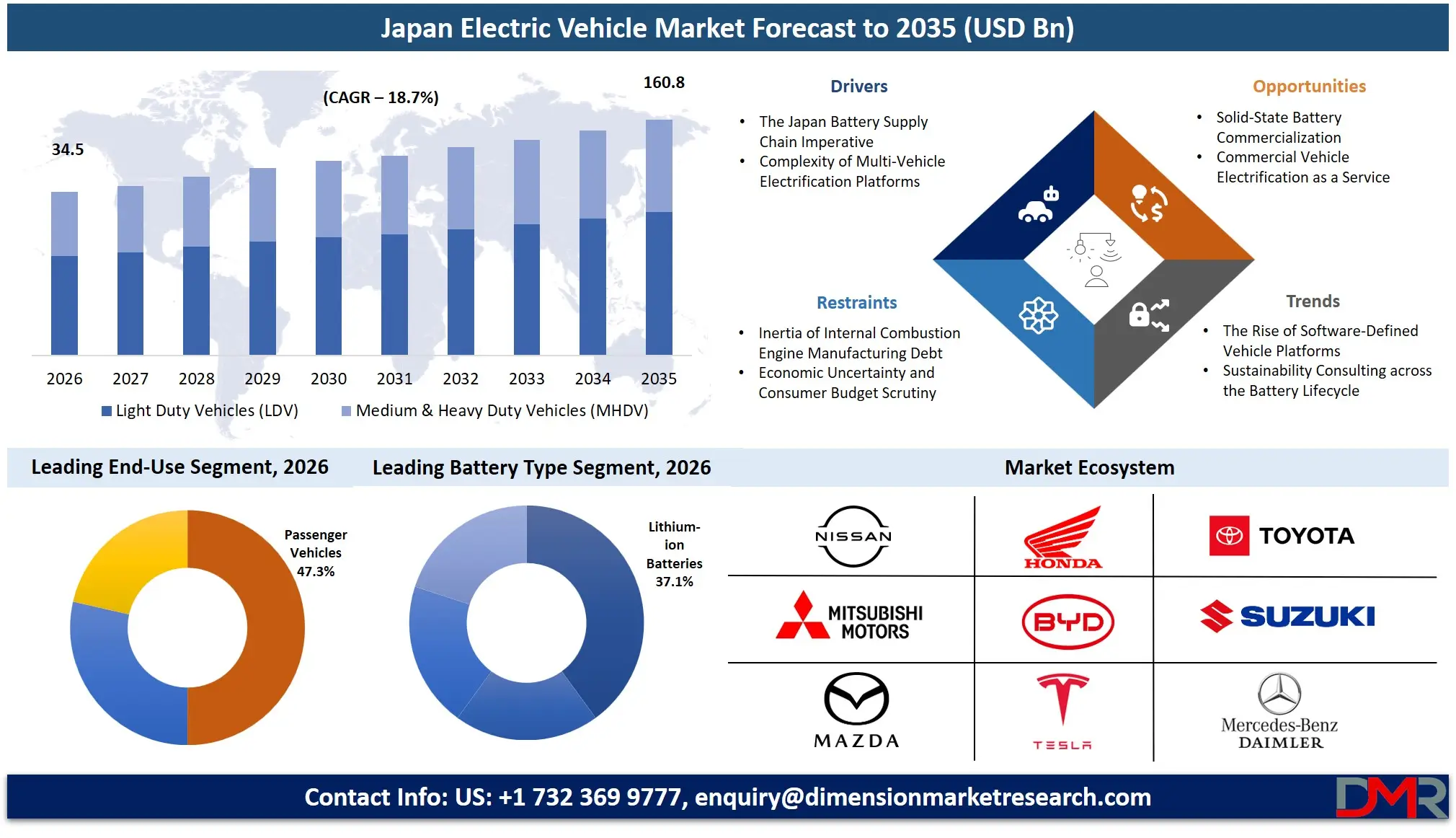
The Japan Electric Vehicle Market is expected to reach a value of USD 34.5 billion in 2026, and it is further anticipated to reach USD 160.8 billion by 2035, growing at a CAGR of 18.7% during the forecast period.
ℹ
To learn more about this report –
Download Your Free Sample Report Here
There has been an increase in the growth rate of the EV market as consumers and companies have fastened the pace of moving from internal combustion engine vehicles to electric vehicles. The EV market comprises Battery EVs, Plug-in Hybrid EVs, Hybrid EVs, and Fuel Cell EVs that help the country attain carbon neutrality and energy security. There has been an increase in the requirement for advanced battery technology, lightweight vehicle architecture, and a charging infrastructure across the country, making it necessary for a manufacturing process and energy solution. It is seen that the passenger vehicle segment is the highest adopter, with lithium-ion batteries being the preferred choice owing to its energy density and decreasing cost curve.
ℹ
To learn more about this report –
Download Your Free Sample Report Here
Key Takeaways
- Market Size & Forecast: The market size of Electric Vehicle in Japan will reach an estimated USD 34.5 billion in 2026, growing to USD 160.8 billion by 2035 due to the combination of increasing consumer uptake of EVs and the government's mandatory requirement for EV-only vehicles by 2035 in place of gasoline and diesel-powered vehicles.
- Growth Rate & Outlook: The forecast growth rate is likely to be at a Compound Annual Growth Rate (CAGR) of 18.7% based on the critical need for battery manufacture in-country, and the increasing challenges involved in solid-state battery technology.
- Primary Growth Drivers: Important factors that will influence the growth include the changeover from producing ICE cars to electric car platforms, the importance of establishing a comprehensive Public DC Fast Charging network in order to minimize any concerns over range, and the implementation of renewable energy ecosystems using Vehicle-to-Grid (V2G) energy management systems.
- Key Market Trends: Major trends influencing the market include the increasing availability of dedicated Light Duty Vehicle platforms, the inclusion of Artificial Intelligence in battery management systems to prevent thermal runaway, and the increasing use of Ultra-Fast/Wireless Charging technology.
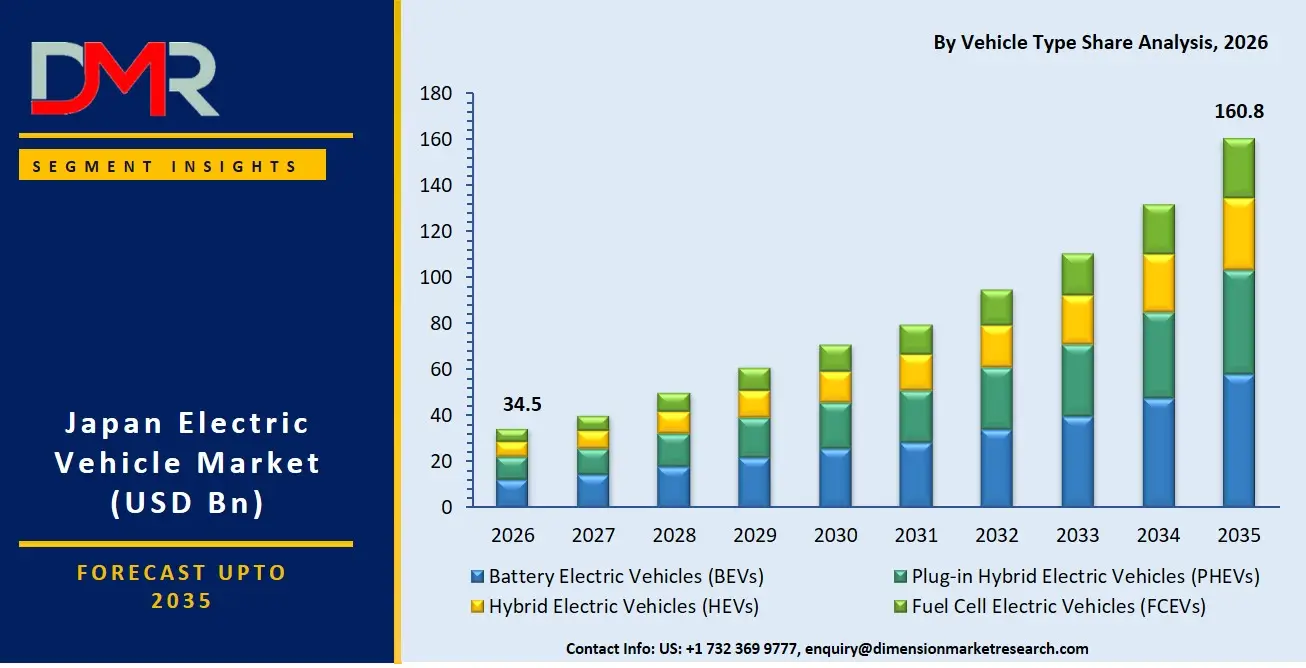
- By Vehicle Type Analysis: The segment projecetd to dominate by Battery Electric Vehicles since businesses and individuals seek emission-free mobility systems. Fleet operators opt for BEV for their electrification planning and energy costs considerations, with 800V architectures being the impetus for specialized battery and motor systems.
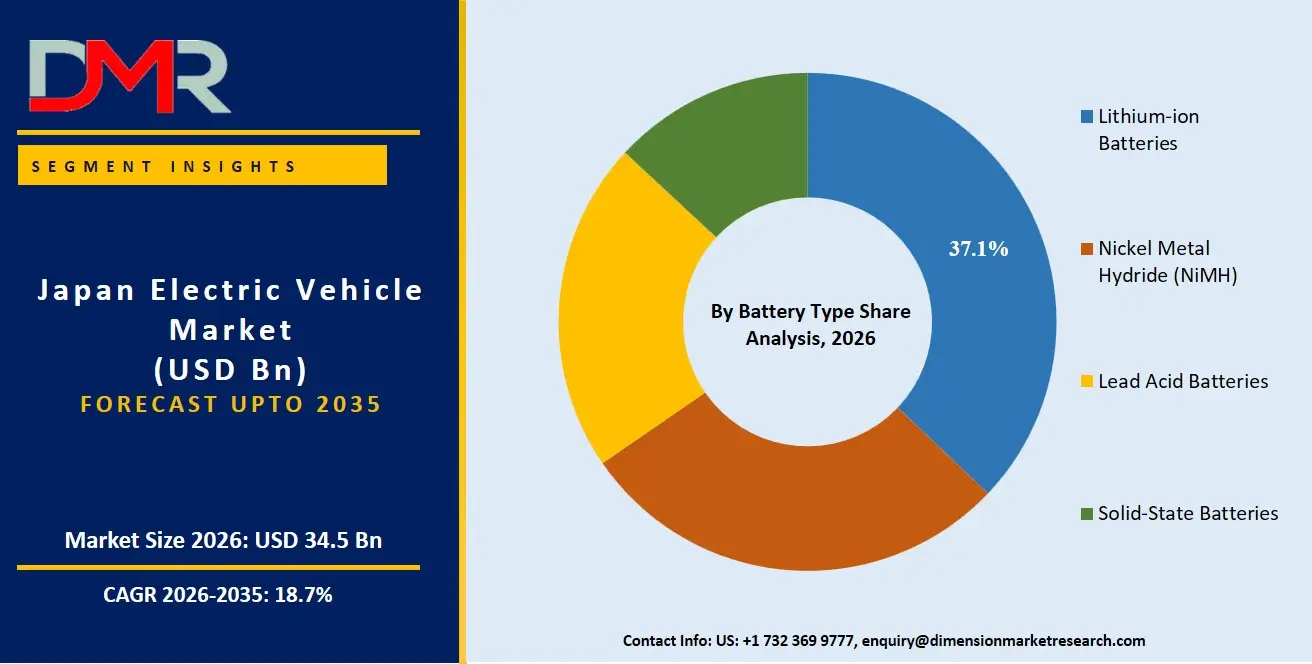
- By Battery Type Analysis: Lithium-ion Batteries is poised to continue to dominate because of established energy densities and mass manufacturing capabilities. Original Equipment Manufacturers rely more on the reliability of price points during their lifetime than on untested new chemistry developments.
What is the Electric Vehicle?
Japan Electric Vehicle Market refers to the unique creation, production, marketing, and provision of electricity that facilitates the shift from vehicles powered by fossil fuels to electrified vehicles. Unlike traditional cars that rely on internal combustion engines, EVs differ in their power train and energy sources, including Batteries Electric Vehicles that use electricity to move around, Plug-in Hybrid Electric Vehicles that utilize both the electric motors and combustion engines together with charging facilities, and Hybrid Electric Vehicles where the electric motor is charged through regenerative braking. In view of Japan's target of selling all-electric vehicles in 2035, several Battery, Vehicle, and Charging Types must be developed to ensure energy security, lower emissions, and maintain a competitive edge in technologies.
Use Cases
- Last-Mile Delivery Electrification in Logistics: Logistics firms make use of Light Duty Commercial Battery Electric Vehicles in place of diesel vans and use Home/Workplace AC Charging in their depots overnight to provide low cost of operations and ensure compliance with zero-emission zones in metropolitan cities like Tokyo.
- Solid-State Battery Pilot in Premium Sedans: Vehicle manufacturers introduce their fuel cell and battery electric passenger cars powered by Lithium-ion batteries as well as next generation Solid-State Batteries, targeting a distance of up to 1,000 kilometers and super fast charging time to address range anxiety.
- Municipal Bus Fleet Decarbonization: Metropolitan cities invest in heavy duty fuel cell and battery electric buses for public transportation with the help of public dc fast charging and hydrogen refueling to ensure continuous operations on a daily basis and zero emissions from the buses.
- Integrated Home Energy Ecosystems: Home owners employ plug-in hybrid and battery electric vehicles with the ability of home/workplace ac charging, which can be used to provide electricity to homes in case of grid failure along with solar panels.
How AI is Transforming the Electric Vehicle Market?
The use of AI is impacting the development of electric vehicles through rapid prototyping of batteries and increasing efficiency in operations. In Battery Technology, simulations using artificial intelligence could be utilized in screening millions of possible combinations for Solid State and Lithium-Ion chemistry, which would significantly reduce both physical laboratory testing and development time. Additionally, AI technology incorporated into Battery Management System enables better monitoring of battery conditions, including detection of any possible malfunctions, thermal runaways, and recommended charging regimes to increase battery lifespan.
Finally, in engineering and autonomous cars, AI is becoming a key component of many developments within the field. Intelligent charging technology uses AI agents to optimize Ultra-fast/Wireless charging to maintain the balance in the power grid infrastructure. In addition, the role of generative AI in enhancing in-car experience includes simulating a driver's behavior, providing predictive maintenance, and helping to assess the state of the vehicle.
Market Dynamics
Key Drivers in the Japan Electric Vehicle Market
The Japan Battery Supply Chain Imperative
The automobile industry in Japan is having trouble getting hold of a consistent source of qualified battery technicians and mineral resources that have the know-how about solid-state chemistry, packing of cell modules and managing the battery life cycle. The demand for these materials and skills is growing at a rate faster than the number of resources available, resulting in a shortage situation within the market place. This situation is resulting in a trend where manufacturers are collaborating with specialist battery manufacturers and chemical companies, as opposed to vertical integration into their systems. Such collaborations play an important role in processes like commercializing solid-state batteries, sourcing cathode material and assembling packs, which are constantly supplied. Such sources will help companies make the transition to EV platforms and avoid production delays.
Complexity of Multi-Vehicle Electrification Platforms
Even large automotive conglomerates will have many powertrain technologies such as BEVs, HEVs, PHEVs, and FCEVs so as to ensure that they are not dependent on a single powertrain but rather give themselves an advantage of having choices. But managing different powertrains manufacturing processes is quite complex. Companies need to coordinate designing the vehicles, thermal management, compliance with safety regulations, and minimizing costs on all platforms that use different kinds of materials. Such complexity might lead to inefficiencies, gaps in production, and wastage of resources without the advice of platform experts. There is therefore an increasing demand for flexible vehicle and manufacturing solutions in such a varied environment.
Restraints in the Japan Electric Vehicle Market
Inertia of Internal Combustion Engine Manufacturing Debt
The majority of car manufacturers and parts providers still rely on manufacturing technologies that evolved throughout a lengthy period of time, becoming deeply rooted in the efficient creation of engines and transmissions. This old-fashioned manufacturing infrastructure acts as a major impediment to any changes, as much as they could help by providing greater energy efficiency and simplifying the process. Switching such massive foundries and complicated chains to produce motors and batteries may prove both difficult and expensive. Extensive reconfigurations, spanning huge factories with millions of square feet, require many planning procedures and safety certifications. The firms are wary of potential disruptions in production and labor force along with the unexpected costs of switching. Thus, manufacturing debt hinders the growth of BEVs.
Economic Uncertainty and Consumer Budget Scrutiny
Economic instability and uncertain business environment make consumers and fleet operators become less willing to invest their money into expensive durable assets such as EVs. While the trend towards electrification still persists, households and companies are being forced to justify all their expenditures on automobiles and show total cost of ownership benefits. Premiums for purchasing BEVs and FCEVs will likely face growing criticism from businesses. Consumers and corporations have moved to choosing shorter-term solutions in the form of HEVs that bring immediate benefits in terms of savings while not requiring any charging facilities at all. BEV fleet adoption will probably take some time as firms need to see some benefits in the short-term due to the use of government incentives and cheaper electricity costs.
Growth Opportunities in the Japan Electric Vehicle Market
Solid-State Battery Commercialization
One of the key areas of growth within the EV market is helping auto makers design safe, high performance Solid-State Battery technologies. There are many companies out there who have developed lab-scale cells, but what they really want now is to develop their own batteries to meet their specific needs for energy density, regulation, and cost. Building these highly complex battery systems requires expertise in areas such as handling of the lithium metal anodes, stabilizing the sulfide electrolyte, and the ability to scale production up to the gigawatt-hour level. Battery producers are capable of helping OEMs design scalable personal EV systems that provide ultra long-range and 15-minute charging.
Commercial Vehicle Electrification as a Service
The requirement for bundling both technical capability and knowledge of fleet-specific operations is behind the emergence of a comprehensive ecosystem as OEMs develop customized solutions for logistics and construction. These include Dedicated Light Duty trucks, Dedicated Medium & Heavy Duty electric trucks, and Dedicated electric buses. Companies operating in transportation and municipality are obliged to comply with strict requirements on operational availability and duty cycles unique to their business environment. Hence, it becomes essential for charging station operators who have knowledge about the vehicle technology as well as the duty cycle framework of the industry. The energy companies could add value by including commercial fleets into depot charging and route optimization processes.
Trends in the Japan Electric Vehicle Market
The Rise of Software-Defined Vehicle Platforms
Vehicle platform engineering is gaining more traction as an alternative to the conventional architecture of electronic control units. Car makers have designed vehicle computing platforms that can make over-the-air updates available to drivers, as opposed to individual platforms that control different aspects such as brakes, entertainment systems, and battery management. The centralized computing platforms allow for the convenience in deploying features, performance tweaking, and automating predictive maintenance. In response, electric car manufacturers and their suppliers offer experience in domain controllers, cybersecurity, and vehicle to everything technology.
Sustainability Consulting across the Battery Lifecycle
The sustainability element in the battery's lifecycle is increasingly becoming a major factor in procuring electric vehicles due to the need to meet scope 3 emission targets and avoid the negative consequences that come with extracting raw materials. Companies today are seeking ways in which they can improve vehicle platforms that would not only increase efficiency but would also reduce costs as well as minimize the impact on the environment. This has led to the need for companies to seek services related to battery passports and lifecycle assessments.
Research Scope and Analysis
The Japan Electric Vehicle Market Report analyzes the market by vehicle type including BEVs, PHEVs, HEVs, and FCEVs, alongside battery technologies, vehicle categories, charging methods, and end-use applications. The study covers passenger vehicles, commercial transportation, and public transport adoption trends across Japan's evolving electric mobility ecosystem.
ℹ
To learn more about this report –
Download Your Free Sample Report Here
By Vehicle Type Analysis
Batteries Electric Vehicle are projected to dominate the category of vehicle type in the Japan electric vehicle market because it is essential that companies and customers obtain zero emissions before spending too much money on installing charging infrastructures. In most instances, it is difficult for fleet managers to get the required information about the route and operating cycle that is suitable for a BEV. Adoption of BEV can help organizations create an electrification strategy, calculate costs of electricity, and find ways to overcome range and payload restrictions. Light Duty and Passenger BEVs will be highly demanded. With the increase in adoption of 800-volt systems in production by manufacturers, there will be more demand for special battery packs and motors. The benefits of such vehicles include reduced risks of fuel spills, improvement of air quality decisions, fast deliveries, and better ROI from electrification investments.
By Battery Type Analysis
Lithium-ion Batteries is anticipated to retain the title of the market-leading battery technology because of its intrinsic energy density and production economies of scale. Companies choose Lithium-ion technology because of its well-known performance characteristics and reliable degradation-prone life cycle pricing that helps to overcome the risk of uncertain future chemistry. It allows a quick time-to-market strategy, making it possible for OEMs to bring passenger vehicles and commercial vehicle platforms online in regular time frames. This makes the electric vehicle environment revolve around Lithium-ion batteries, which concentrate on such important aspects as thermal runaway management, integration from cell to pack level, and Battery Management System programming.
By Vehicle Analysis
Light Duty Vehicles is projected to lead the EV industry when considering type of vehicles since the number and scope of passengers' cars and small vans in the market are too huge for any competitor. This category operates with massive consumer budgets and also possesses massive legacies with ICE platforms that are usually out-of-date. They have to apply very careful electrification strategies unlike the Medium & Heavy Duty segments that encounter extremely hard payload and range restrictions. The process will involve very elaborate platform strategies such as use of skateboards that can support many body types, sophisticated interior user experience for battery visualization, as well as regenerative braking systems.
By Charging Type Analysis
Home/Workplace AC Charging will poised to emerge as the dominant segment in terms of type because it effectively changes the entire fueling concept, offering unmatched convenience, low-cost infrastructure, and low-cost ownership compared to creating an entire public network of stations. Availability for home charging is leveraged by firms in controlling predictable depot arrival time of their fleets without any downtime during their journeys. However, AC charging has a dynamic and grid-dependent character, resulting in a similar kind of pressure on energy management solutions. Firms require proper guidance for optimizing smart-charging algorithms in dealing with rising peak demand costs, managing energy security posture for not falling into blackouts through load balancing, and optimizing bi-directional power flow to ensure efficient use of vehicle-to-grid services instead of being a burden to grids.
By End-Use Analysis
Passenger Vehicles will anticipated to lead in terms of having the largest market share because it is undergoing a dramatic technological shift due to consumer pressures and regulatory influences. Auto manufacturers are rushing to launch their electric vehicles (EV) to provide state-of-the-art digital cockpits, cutting-edge range prediction algorithms based on AI and which can analyze terrain in real time, and more robust safety features that can safeguard against thermal events. Moreover, the passenger car industry is regulated by a very volatile regulatory compliance system globally. Passenger vehicle original equipment manufacturers (OEMs) need EV battery durability and warranty management systems in order to create products that meet innovation and compliance standards.
The Japan Electric Vehicle Market Report is segmented on the basis of the following:
By Vehicle Type
- Battery Electric Vehicles (BEVs)
- Plug-in Hybrid Electric Vehicles (PHEVs)
- Hybrid Electric Vehicles (HEVs)
- Fuel Cell Electric Vehicles (FCEVs)
By Battery Type
- Lithium-ion Batteries
- Nickel Metal Hydride (NiMH)
- Lead Acid Batteries
- Solid-State Batteries
By Vehicle
- Light Duty Vehicles (LDV)
- Medium & Heavy Duty Vehicles (MHDV)
By Charging Type
- Home/Workplace AC Charging
- Public DC Fast Charging
- Ultra-Fast/ Wireless Charging
By End-Use
- Passenger Vehicles
- Commercial Vehicles
- Public Transport
Competitive Landscape
The competitive landscape of the Japanese electric vehicle market has transformed into a very dynamic one with a diverse range of global legacy automotive companies, dedicated EV segments from keiretsu groupings, and specialized electric vehicle start-ups. The decisive factor that will make the difference is the strategic partnerships formed with battery producers such as Panasonic and CATL since they will create the right possibilities for cooperation and the acquisition of new technology in the form of solid-state batteries and high-nickel cathodes. Market consolidation is advancing fast with traditional Tier 1 automotive parts suppliers buying out small specialized EV powertrain and power electronics boutiques simply to survive. Intellectual property rights related to automated battery assembly and e-axle integration technology have become much more crucial than ICEs and styling alone.
Some of the prominent players in the Japan Electric Vehicle Market are:
- Toyota Motor Corporation
- Nissan Motor Co., Ltd.
- Honda Motor Co., Ltd.
- Tesla, Inc.
- BYD Co., Ltd.
- Suzuki Motor Corporation
- Mitsubishi Motors Corporation
- Lexus
- Mazda Motor Corporation
- Subaru Corporation
- Daimler AG (Mercedes-Benz)
- BMW AG
- Volkswagen AG
- Hyundai Motor Company
- Kia Corporation
- Ford Motor Company
- General Motors
- Rivian Automotive
- Lucid Group
- XPeng Inc.
- Other Key Players
Recent Developments
- May 2026: Honda released the "Super-ONE" mini-electric vehicle with a 274km capacity in the country. Pre-orders totaled 7,000 units due to the high demand for mini-electric vehicles despite the reduced production of overseas electric vehicles.
- May 2026: EMT Co. is set to produce the first ever EMTA branded electric minivehicles in 2027 in collaboration with Autobacs Seven and Chery Automobile. The goal is to produce four vehicles by 2029 to increase competitiveness among Japanese minivehicles.
- April 2026: Toyota's subsidiary company, Daihatsu, presented the e-Atrai BEV van and e-SMART HYBRID model at the Automotive Engineering Exposition. There was also presentation of the DC microgrid system for the integration of electrified vehicles with stationary energy systems.
Report Details
| Report Characteristics |
| Market Size (2026) |
USD 34.5 Bn |
| Forecast Value (2035) |
USD 160.8 Bn |
| CAGR (2026–2035) |
18.7% |
| Historical Data |
2021 – 2025 |
| Forecast Data |
2027 – 2035 |
| Base Year |
2025 |
| Estimate Year |
2026 |
| Segments Covered |
By Vehicle Type, By Battery Type, By Vehicle, By Charging Type, and By End-Use |
| Country Coverage |
Japan |
Frequently Asked Questions
How big is the Japan Electric Vehicle Market?
▾ The Japan Electric Vehicle market is poised to be valued at USD 34.5 billion in 2026 and is projected to reach USD 160.8 billion by 2035, driven by the universal need for battery innovation, charging infrastructure deployment, and carbon-neutral mobility solutions.
What is the CAGR of the Japan Electric Vehicle Market from 2026 to 2035?
▾ The market is expected to grow at a CAGR of 18.7% from 2026 to 2035, reflecting the accelerating adoption of electric powertrains and the persistent phase-out of traditional fossil fuel vehicle sales.
What factors are driving the growth of the Japan Electric Vehicle Market?
▾ Key drivers include the automotive manufacturing skills gap for software-defined EVs, the imperative to modernize aging vehicle platforms, the management complexity of multi-powertrain strategies, and the surge in demand for ultra-fast and wireless charging amid consumer convenience concerns.
What are the major trends in the Japan Electric Vehicle Market?
▾ Major trends include the integration of Generative AI into battery chemistry discovery, the rise of vehicle-to-grid and battery lifecycle consulting, the demand for software-defined vehicle platforms, and the focus on Solid-State Battery commercialization within premium vehicle segments.
Who are the key players in the Japan Electric Vehicle Market?
▾ Key players include legacy Japanese automakers like Toyota, Nissan, and Honda, battery manufacturing giants such as Panasonic, as well as emerging pure-play EV manufacturers and the energy infrastructure divisions of industrial conglomerates like Hitachi and Mitsubishi.
How is the Japan Electric Vehicle Market segmented?
▾ The market is segmented by Vehicle Type, Battery Type, Vehicle, Charging Type, and End-Use.