What is the Electricity Market Size?
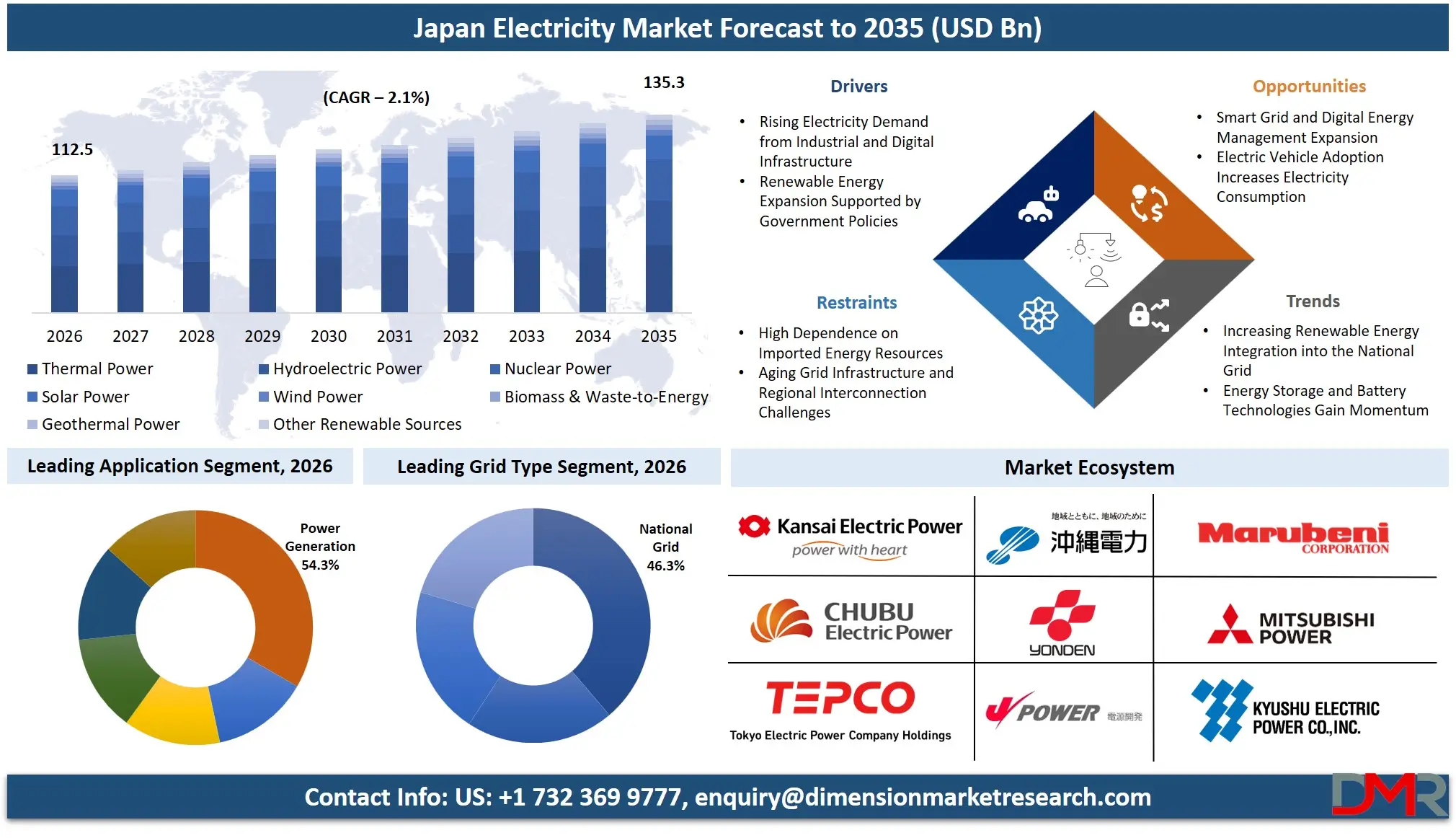
The Japan Electricity Market is expected to reach a value of USD 112.5 billion in 2026, and it is further anticipated to grow to USD 135.3 billion by 2035, at a steady CAGR of 2.1% during the forecast period.
ℹ
To learn more about this report –
Download Your Free Sample Report Here
The electricity market in Japan is undergoing a fundamental transformation, shifting from a highly regulated, monopoly-driven structure to a more competitive and diversified landscape. This evolution is fueled by the nationwide imperative to achieve carbon neutrality by 2050, which necessitates a rapid expansion of renewable energy sources, a cautious but strategic restart of nuclear power plants, and the gradual decommissioning of inefficient coal-fired facilities. The market is further shaped by the need to modernize an aging transmission and distribution network, integrate a growing fleet of electric vehicles, and fortify the national grid against frequent natural disasters. Consequently, Japanese power utilities, trading companies, and independent power producers are actively rebalancing their generation portfolios to enhance energy security, ensure grid stability, and meet sustainability targets.
Key Takeaways
- Market Size & Forecast: The Japan electricity market, valued at USD 112.5 billion in 2026, is projected to reach USD 135.3 billion by 2035. This growth is underpinned by substantial capital investments in renewable energy capacity and grid modernization, despite a gradually declining trend in per-capita energy consumption due to population decrease and enhanced efficiency.
- Growth Rate & Outlook: The market is forecasted to register a CAGR of 2.1%, a rate that reflects a dual dynamic: a premium on the value of low-carbon electricity and reliability services counterbalances a stable to declining total power output. Growth is concentrated in the generation and storage segments, rather than in pure consumption volume.
- Primary Growth Drivers: Key drivers include the aggressive national push for decarbonization, the full-scale liberalization of the retail power market, and a national security focus on energy self-sufficiency. This is supported by accelerating corporate demand for renewable energy Power Purchase Agreements (PPAs) and large-scale governmental subsidies for solar, offshore wind, and battery energy storage systems.
- Key Market Trends: The market is defined by the rapid expansion of offshore wind power, the emergence of battery storage as a distinct and profitable grid asset, the digitalization of the grid through smart meters and AI-driven demand response, and a surge in corporate renewable energy procurement through virtual and physical PPAs.
- By Generation Source Analysis: The generation mix is in a state of flux, with thermal power's share decreasing and renewable sources surging. Solar power, both utility-scale and rooftop, leads new capacity additions, while the careful restart of nuclear power units is critical for providing stable, dispatchable zero-emission baseload power.
- By Trading Type Analysis: The deregulated or liberalized market segment is the primary engine of competition and innovation, empowering millions of consumers to choose their electricity provider and unlocking new business models for retailers and aggregators.
What is the Japan Electricity Market?
The Japan Electricity Market encompasses the entire value chain of electric power, from generation using a diverse mix of sources to high-voltage transmission, low-voltage distribution, and final retail supply to end users. Unlike interconnected continental grids, Japan's network is uniquely split into two main frequency zones (50 Hz in the east and 60 Hz in the west), linked by limited-capacity frequency converter stations. The market was historically dominated by ten vertically integrated, regional monopoly utilities. Following comprehensive reforms, the retail sector was fully liberalized in 2016, and the legal unbundling of transmission and distribution sectors from generation and retail was completed in 2020. The market now features a wholesale power exchange (JEPX), active forward markets, and a regulatory framework designed to foster competition while ensuring a stable, resilient, and increasingly green power supply.
Use Cases
- Corporate Renewable Energy Procurement: Commercial and industrial end users, such as technology firms and manufacturers, sign long-term PPAs to directly source electricity from solar and wind farms, securing stable prices and achieving their Environmental, Social, and Governance (ESG) goals.
- Residential Solar Self-Consumption: Homeowners utilize rooftop solar PV systems paired with battery storage to maximize self-consumption, reduce dependence on the grid, and sell surplus power back to the market under revised feed-in-premium (FIP) schemes.
- Grid-Scale Energy Storage Arbitrage: Utility companies and aggregators deploy large-scale battery energy storage systems (BESS) to charge during periods of surplus solar generation and low wholesale prices, and discharge during peak demand, providing crucial grid balancing and earning revenue through energy arbitrage and ancillary services.
- Electric Vehicle Smart Charging: Aggregators use AI-driven platforms to manage the charging of thousands of electric vehicles, creating a virtual power plant (VPP) that can provide demand-response services to the transmission system operator to stabilize the grid during frequency fluctuations.
How AI is Transforming the Electricity Market?
Artificial intelligence is becoming a cornerstone of grid management and energy trading in Japan's complex electricity market. AI-driven forecasting tools analyze vast datasets on weather patterns, solar irradiance, and consumer behavior to predict renewable energy output and demand with remarkable accuracy, enabling better grid dispatch and reducing curtailment of solar and wind power. In the liberalized retail market, AI algorithms optimize bidding strategies on the JEPX for power retailers, managing risk in real time against volatile spot prices.
Furthermore, AI is central to the creation of VPPs, where machine learning platforms seamlessly aggregate and control thousands of distributed energy resources, like residential batteries and EV chargers, to provide synthetic baseload power and frequency regulation services to the grid. Predictive maintenance models also use sensor data from transformers and power lines to anticipate equipment failures in the aging T&D network, reducing downtime and enhancing the reliability that Japan's industrial sector demands.
Market Dynamics
Key Drivers in the Japan Electricity Market
Rising Electricity Demand from Industrial and Digital Infrastructure
Japan's expanding industrial production, semiconductor manufacturing, data centers, and digital infrastructure are significantly increasing electricity demand. Energy-intensive industries require a stable and uninterrupted power supply to maintain operational efficiency and productivity. Rapid digitalization, cloud computing, artificial intelligence, and electric mobility further contribute to rising electricity consumption across commercial and industrial sectors. Utilities are investing in generation capacity, transmission upgrades, and grid modernization to accommodate growing demand. Government initiatives supporting advanced manufacturing and digital transformation continue reinforcing electricity consumption, making industrial expansion and digital infrastructure development one of the strongest long-term drivers of Japan's electricity market growth.
Renewable Energy Expansion Supported by Government Policies
Government policies promoting decarbonization and energy security are accelerating renewable electricity generation across Japan. Supportive measures, including feed-in tariffs, feed-in premiums, renewable energy auctions, and carbon neutrality targets, encourage investments in solar, wind, biomass, and geothermal power projects. Utilities and independent power producers are expanding renewable capacity while upgrading transmission infrastructure for grid integration. Corporate demand for clean electricity through sustainability commitments also supports renewable deployment. Continuous policy support, technological improvements, and investment incentives are increasing renewable electricity generation while reducing dependence on imported fossil fuels, strengthening long-term development of Japan's electricity market.
Restraints in the Japan Electricity Market
High Dependence on Imported Energy Resources
Japan relies heavily on imported liquefied natural gas, coal, and oil for electricity generation due to limited domestic fossil fuel resources. Global fuel price volatility, geopolitical tensions, and supply chain disruptions significantly influence electricity generation costs and wholesale power prices. Import dependence also exposes utilities to currency fluctuations and energy security concerns. Rising fuel procurement costs often increase operational expenses for electricity providers and affect end-user electricity tariffs. Although renewable energy capacity continues expanding, imported fuels remain essential for maintaining reliable electricity supply, making external energy dependence a major constraint for Japan's electricity market.
Aging Grid Infrastructure and Regional Interconnection Challenges
Japan's electricity network includes aging transmission and distribution infrastructure that requires continuous modernization to accommodate growing renewable energy capacity and changing demand patterns. Limited interconnection capacity between regional grids, including differences in grid frequency, can restrict efficient electricity transfers during peak demand or emergencies. Significant investment is required to upgrade substations, transmission lines, digital monitoring systems, and smart grid technologies. Infrastructure modernization projects involve substantial capital expenditure and extended implementation timelines. These technical and financial challenges may slow renewable integration, reduce operational flexibility, and limit overall efficiency within Japan's evolving electricity market.
Growth Opportunities in the Japan Electricity Market
Smart Grid and Digital Energy Management Expansion
The modernization of Japan's electricity infrastructure creates significant opportunities for smart grid technologies, digital substations, advanced metering infrastructure, and energy management systems. Utilities are increasingly deploying smart meters, artificial intelligence, predictive maintenance, and real-time monitoring solutions to improve grid reliability and operational efficiency. Digital technologies enable better integration of renewable energy, demand response programs, and distributed energy resources. Increasing investments in grid automation and intelligent electricity management also support energy conservation initiatives. As electricity networks become more digitalized, technology providers and utilities gain substantial opportunities to improve efficiency while delivering more resilient and customer-focused electricity services.
Electric Vehicle Adoption Increases Electricity Consumption
Japan's growing electric vehicle market creates new opportunities for electricity suppliers and grid operators. Rising deployment of battery electric vehicles and charging infrastructure increases electricity demand across residential, commercial, and public charging networks. Utilities are investing in smart charging systems, vehicle-to-grid technologies, and renewable-powered charging stations to support sustainable transportation. Government incentives promoting zero-emission vehicles further accelerate electricity consumption from the transportation sector. Integration of electric vehicles with digital energy management systems also enhances grid flexibility and renewable energy utilization. This transition toward electrified mobility presents a long-term growth opportunity for Japan's electricity market.
Trends in the Japan Electricity Market
Increasing Renewable Energy Integration into the National Grid
Japan continues increasing the integration of renewable energy sources into its national electricity grid as part of its carbon neutrality strategy. Utilities are expanding solar, offshore wind, biomass, and geothermal generation while investing in advanced grid management technologies to balance intermittent renewable output. Energy storage systems, flexible thermal generation, and improved forecasting tools help maintain grid stability during renewable integration. Transmission upgrades and regional interconnections further enhance electricity distribution efficiency. Growing renewable deployment is reshaping Japan's electricity generation mix while supporting environmental sustainability, energy diversification, and reduced dependence on imported fossil fuels.
Energy Storage and Battery Technologies Gain Momentum
Energy storage systems are becoming an increasingly important component of Japan's electricity market. Utilities and private developers are deploying grid-scale battery storage to improve renewable energy integration, stabilize electricity supply, and enhance grid resilience. Advances in lithium-ion batteries, long-duration storage technologies, and hybrid renewable energy systems enable more efficient management of electricity demand and generation fluctuations. Government support for battery deployment and energy resilience further accelerates market adoption. As renewable electricity generation expands, energy storage technologies are expected to play a critical role in improving grid flexibility, reliability, and overall electricity system efficiency across Japan.
Research Scope and Analysis
The Japan electricity market is segmented by generation source (thermal, hydro, nuclear, solar, wind, biomass, geothermal, and other renewables), voltage level, grid type, transmission & distribution, trading type, connection type, application, and end user, including industrial, residential, commercial, utilities, and transportation sectors, reflecting Japan's diversified and evolving power ecosystem.
ℹ
To learn more about this report –
Download Your Free Sample Report Here
By Generation Source Analysis
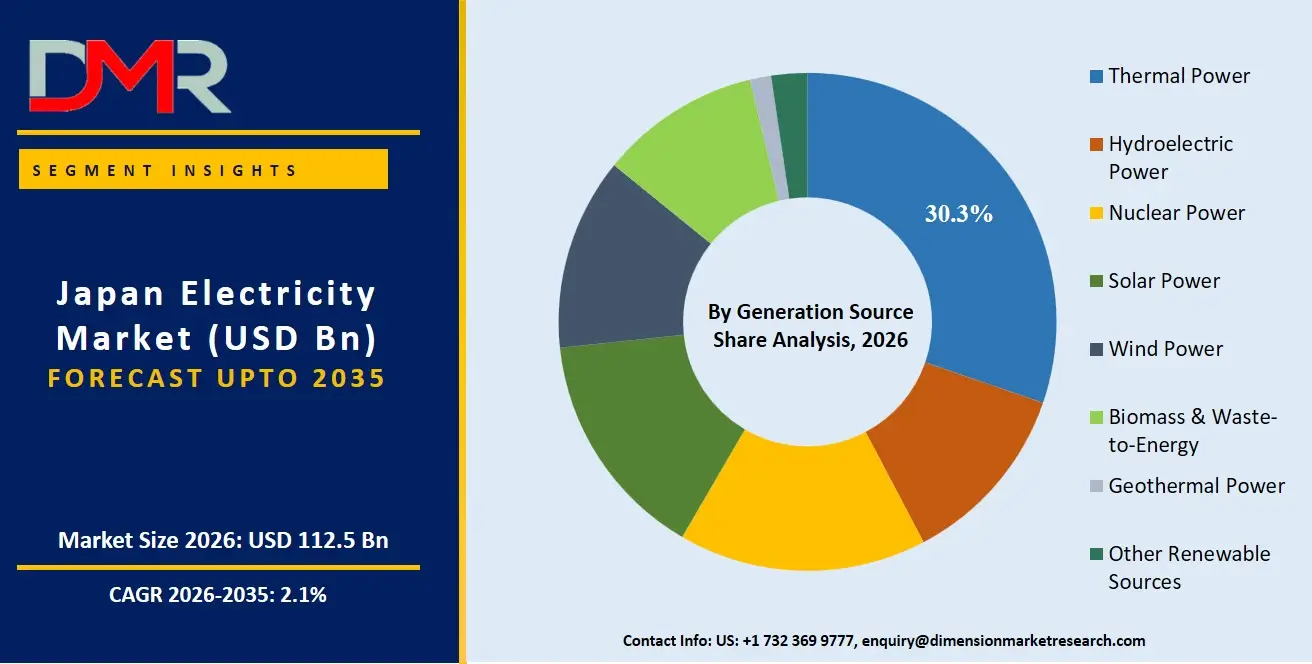
Thermal power is poised to dominate the Japan electricity market because it remains the country's primary source of electricity generation following the reduction in nuclear power output after the Fukushima accident. Liquefied natural gas (LNG)-fired plants account for the largest share within thermal generation due to their relatively lower emissions, operational flexibility, and ability to balance intermittent renewable energy. Coal-fired power stations also continue contributing significantly to baseload electricity supply despite decarbonization initiatives. Japan's limited domestic energy resources, established thermal infrastructure, reliable fuel import networks, and consistent electricity demand ensure thermal power remains the dominant generation source while renewable energy capacity continues expanding across the country.
By Voltage Level Analysis
High voltage is expected to dominate the Japan electricity market because it is the primary level used for bulk electricity transmission from power generation facilities to substations and major industrial consumers. High-voltage networks enable efficient long-distance electricity transport while minimizing transmission losses and supporting grid stability. Japan's densely interconnected transmission infrastructure relies extensively on high-voltage systems to ensure reliable power delivery across regions with varying electricity demand. Industrial facilities, commercial complexes, and utility substations are major users of high-voltage electricity. Continuous investment in transmission modernization, renewable energy integration, and smart grid technologies further reinforces the dominance of high-voltage infrastructure within Japan's electricity market.
By Grid Type Analysis
The national grid is projected to dominate Japan's electricity market by providing the backbone for electricity transmission and distribution across the country. It connects major generation facilities, regional utilities, industrial centers, and urban areas, ensuring secure and reliable electricity supply. The national grid supports efficient balancing of electricity demand and generation while facilitating renewable energy integration and emergency power transfers. Continuous investments in grid resilience, digital monitoring systems, and transmission upgrades enhance operational efficiency and energy security. Although microgrids are expanding in remote communities and disaster-resilient projects, the national grid remains the dominant infrastructure supporting Japan's overall electricity supply network and economic activities.
By Transmission & Distribution Analysis
Distribution is anticipated to dominate the transmission and distribution segment because every unit of generated electricity ultimately passes through distribution networks before reaching residential, commercial, and industrial consumers. Japan maintains an extensive distribution infrastructure comprising substations, transformers, and local distribution lines that ensure reliable last-mile electricity delivery. Increasing urbanization, widespread electrification, distributed renewable energy installations, and rising electricity consumption continue strengthening investment in distribution systems. Utilities are also deploying smart meters, automated distribution management systems, and digital monitoring technologies to improve operational efficiency and service reliability. These factors collectively make electricity distribution the dominant segment within Japan's power network.
By Trading Type Analysis
The regulated market is poised to continue to dominate Japan's electricity sector because regulated utility operations still account for a substantial share of electricity supply, particularly in transmission, distribution, and essential public services. While electricity market liberalization has expanded retail competition, established regional utilities maintain extensive infrastructure, long-standing customer relationships, and responsibility for grid reliability. Government oversight ensures stable electricity pricing, energy security, and consistent service quality for consumers. Large-scale infrastructure investments and regulatory frameworks continue supporting incumbent utilities. Consequently, the regulated market remains the dominant structure despite the gradual expansion of competitive electricity retail and wholesale trading activities.
By Connection Type Analysis
Grid-connected systems is projected to dominate the Japan electricity market because the vast majority of residential, commercial, industrial, and public infrastructure is connected to the national electricity network. Grid connectivity provides reliable electricity supply, enables efficient balancing between generation and demand, and supports the integration of renewable energy sources such as solar and wind. Government initiatives promoting distributed solar generation primarily encourage grid-connected installations rather than standalone systems. Urbanization, extensive transmission and distribution infrastructure, and advanced grid management technologies further strengthen this segment. Off-grid systems remain limited to remote islands, emergency applications, and specialized industrial operations across Japan.
By Application Analysis
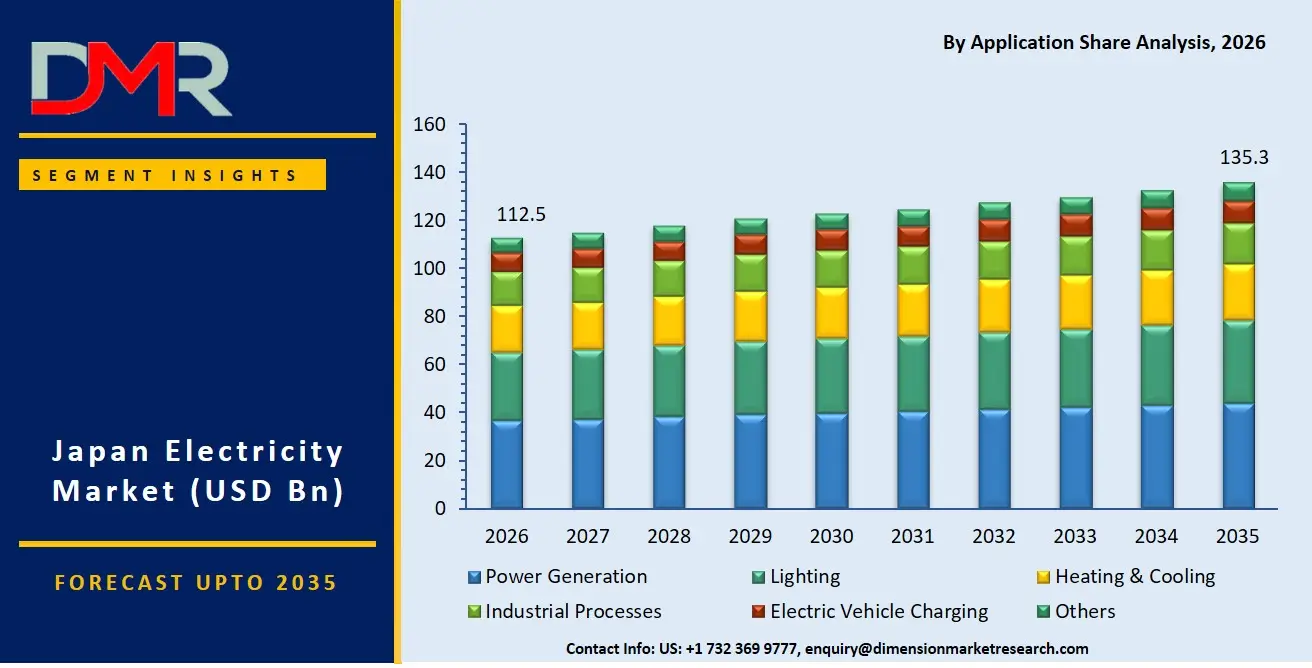
Power generation is expected to dominate the application segment because electricity production forms the foundation of the entire electricity value chain. Significant investments are directed toward maintaining and expanding thermal, renewable, hydroelectric, and nuclear generation capacity to ensure stable electricity supply across Japan.
ℹ
To learn more about this report –
Download Your Free Sample Report Here
Growing electricity demand from industries, commercial facilities, households, and transportation continues driving generation requirements. Utilities are also modernizing generation assets to improve efficiency, reduce emissions, and integrate renewable energy sources into the grid. As every downstream electricity application depends on consistent generation capacity, power generation remains the dominant application segment in Japan's electricity market.
By End User Analysis
The industrial sector is poised to dominate electricity consumption in Japan due to its large manufacturing base, including automotive, electronics, chemicals, steel, machinery, and semiconductor industries. These energy-intensive sectors require continuous, high-volume electricity to operate production facilities, automated equipment, and advanced manufacturing processes. Japan's export-oriented economy relies heavily on industrial productivity, making reliable electricity supply essential for economic growth. Industrial consumers increasingly adopt energy management systems and efficiency technologies while maintaining substantial electricity demand. Despite growing residential and commercial consumption, the industrial sector remains the largest end-user, accounting for the highest share of electricity consumption in Japan's overall power market.
The Japan Electricity Market Report is segmented on the basis of the following:
By Generation Source
- Thermal Power
- Hydroelectric Power
- Nuclear Power
- Solar Power
- Utility-Scale Solar
- Rooftop Solar
- Wind Power
- Onshore Wind
- Offshore Wind
- Biomass & Waste-to-Energy
- Geothermal Power
- Other Renewable Sources
By Voltage Level
- High Voltage
- Low Voltage
- Medium Voltage
- Extra High Voltage
By Grid Type
- National Grid
- Regional Grid
- Microgrid
- Off-Grid Systems
By Transmission & Distribution
- Distribution
- Transmission
By Trading Type
- Regulated Market
- Deregulated/Liberalized Market
By Connection Type
By Application
- Power Generation
- Lighting
- Heating & Cooling
- Industrial Processes
- Electric Vehicle Charging
- Others
By End User
- Industrial
- Residential
- Commercial
- Utilities
- Transportation
Competitive Landscape
The competitive landscape of the Japan electricity market is a dynamic and intensely contested arena, a stark departure from the former era of stable regional monopolies. The legacy Electric Power Companies (EPCOs) like TEPCO and Kansai Electric are being challenged by aggressive "new power" entrants trading houses, gas utilities, and telecom giants that are leveraging customer data, brand recognition, and innovative service bundles to capture market share. The core of competition is shifting from pure unit price of electricity to value-added services that integrate generation, storage, and smart management. Strategic partnerships are critical, with major utilities forming deep alliances with global offshore wind developers and technology firms to gain expertise. The key competitive differentiator is becoming a company's ability to create and monetize a balanced, green, and resilient portfolio, combining dispatchable low-carbon assets (nuclear, biomass, LNG) with variable renewable PPAs and AI-managed storage to offer stable, clean power products.
Some of the prominent players in the Japan Electricity Market are:
- Tokyo Electric Power Company Holdings, Inc. (TEPCO)
- Kansai Electric Power Company, Incorporated
- Chubu Electric Power Co., Inc.
- Tohoku Electric Power Co., Inc.
- Kyushu Electric Power Co., Inc.
- Hokkaido Electric Power Co., Inc.
- Hokuriku Electric Power Company
- Shikoku Electric Power Company, Incorporated
- Chugoku Electric Power Co., Inc.
- Okinawa Electric Power Company, Incorporated
- JERA Co., Inc.
- Electric Power Development Co., Ltd. (J-POWER)
- ENEOS Power Corporation
- Osaka Gas Co., Ltd.
- Tokyo Gas Co., Ltd.
- SB Power Corp.
- Mitsubishi Corporation Energy Solutions Ltd.
- Marubeni Corporation
- Mitsui & Co., Ltd.
- Idemitsu Kosan Co., Ltd.
- Other Key Players
Recent Developments
- January 2026: Toda Corporation, together with ENEOS Renewable Energy, Osaka Gas, INPEX, Kansai Electric Power, and Chubu Electric Power, commenced commercial operations of Japan's first floating offshore wind farm at the Goto Offshore Wind Project, advancing renewable electricity generation.
- February 2026: JERA commenced construction of the 315 MW Oga–Katagami–Akita Offshore Wind Project, strengthening Japan's offshore renewable energy capacity and supporting the country's long-term decarbonization goals through expanded clean electricity generation.
- June 2026: TEPCO entered a strategic partnership to jointly develop 1 GW-scale grid-connected battery energy storage systems, improving renewable energy integration, enhancing grid flexibility, and strengthening electricity supply reliability across Japan.
Report Details
| Report Characteristics |
| Market Size (2026) |
USD 112.5 Bn |
| Forecast Value (2035) |
USD 135.3 Bn |
| CAGR (2026–2035) |
2.1% |
| Historical Data |
2021 – 2025 |
| Forecast Data |
2027 – 2035 |
| Base Year |
2025 |
| Estimate Year |
2026 |
| Segments Covered |
By Generation Source, By Voltage Level, By Grid Type, By Transmission & Distribution, By Trading Type, By Connection Type, By Application, and By End User |
| Country Coverage |
Japan |
Frequently Asked Questions
How big is the Japan Electricity Market?
▾ The Japan Electricity market is poised to be valued at USD 112.5 billion in 2026 and is projected to reach USD 135.3 billion by 2035, driven by the capital-intensive transition towards a decarbonized, digitized, and resilient power system for a super-aging society.
What is the CAGR of the Japan Electricity Market from 2026 to 2035?
▾ The market is expected to grow at a CAGR of 2.1% from 2026 to 2035, a rate that reflects stable demand offset by the high value of new low-carbon generation, storage assets, and grid modernization services.
What factors are driving the growth of the Japan Electricity Market?
▾ Key drivers include the national carbon neutrality mandate requiring massive renewable energy deployment, the full liberalization of the retail electricity sector creating new competitive business models, and a strategic push for energy self-sufficiency.
What are the major trends in the Japan Electricity Market?
▾ Major trends include the mainstreaming of corporate virtual and physical PPAs, the rise of battery storage as a tradable grid asset, the creation of AI-driven virtual power plants, and the build-out of a new offshore wind energy industry.
Who are the key players in the Japan Electricity Market?
▾ Key players include legacy utilities like TEPCO and KEPCO, the dominant thermal and fuel player JERA, and new entrant retailers and developers like Marubeni, Eneos, Renova, and global leaders like Orsted, all competing in a fully liberalized environment.
How is the Japan Electricity Market segmented?
▾ The market is segmented by Generation Source, Voltage Level, Grid Type, Transmission & Distribution, Trading Type, Connection Type, Application, and End User.