Market Overview
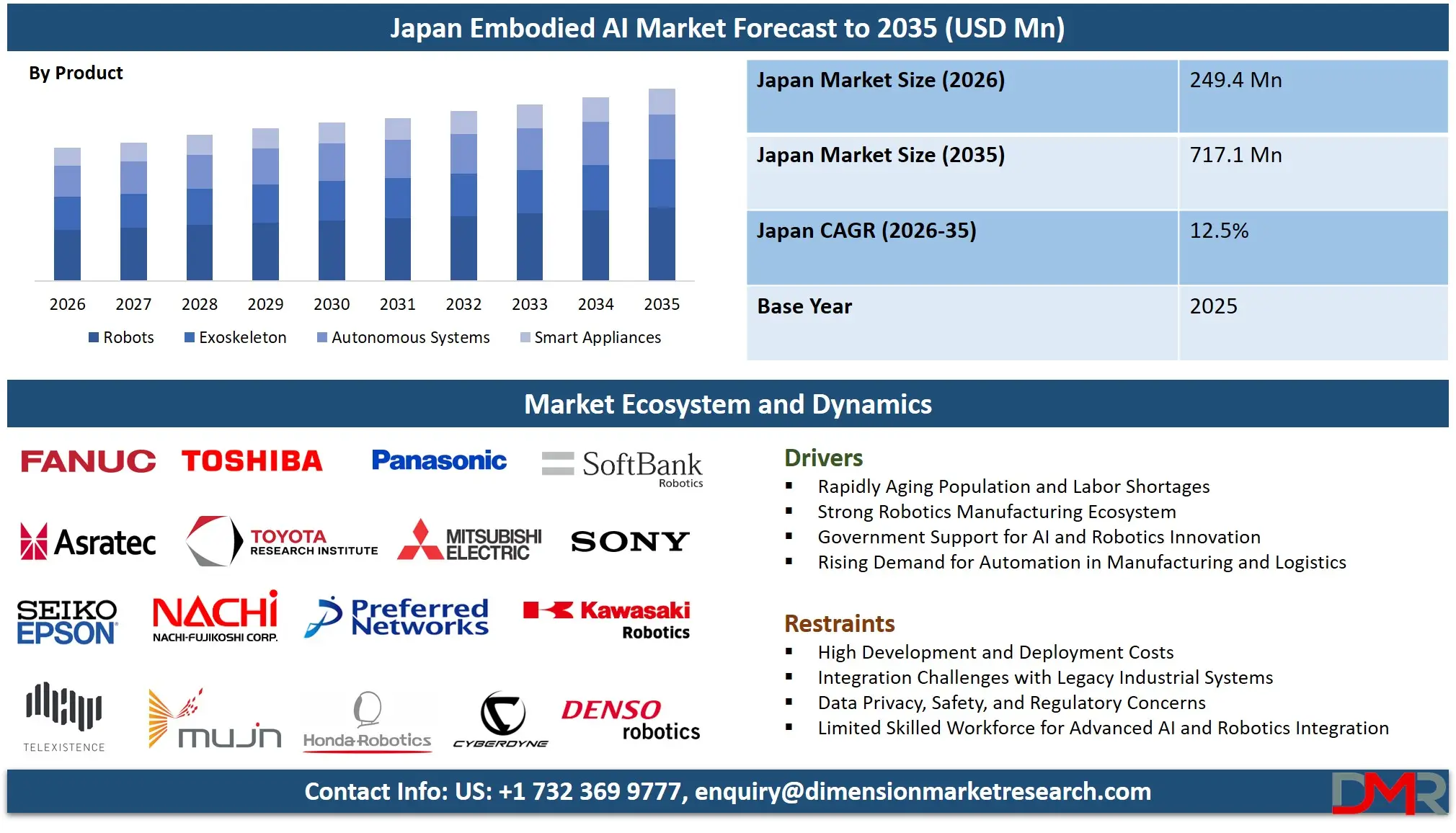
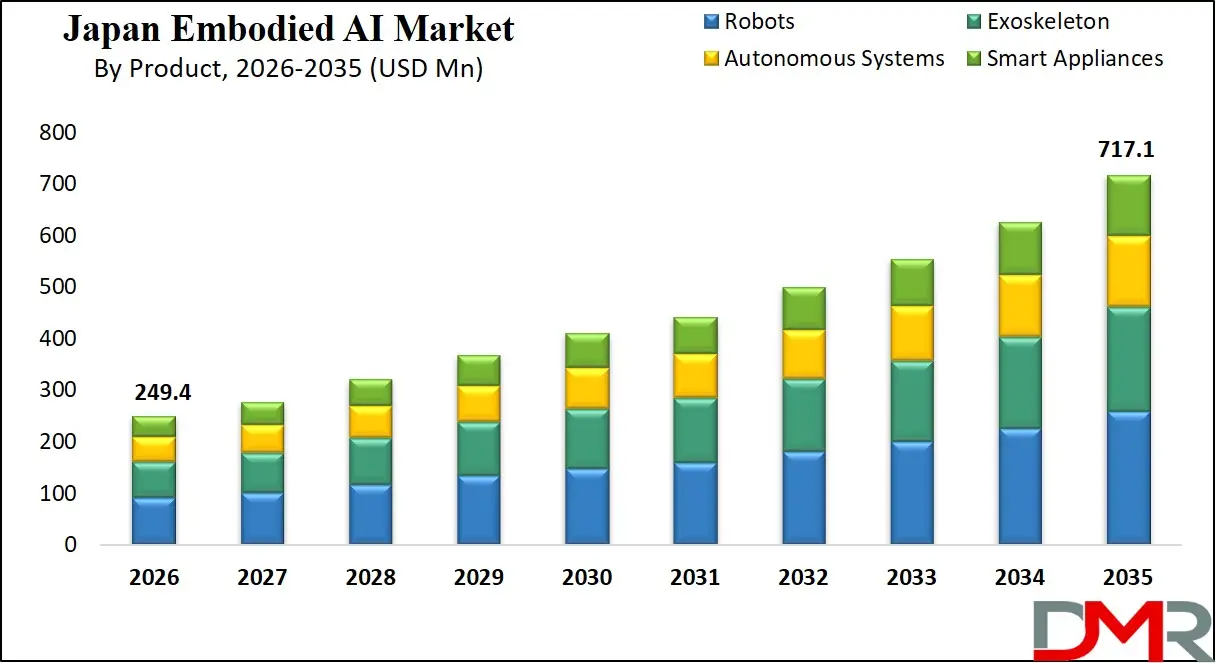
The Japan Embodied AI Market is projected to attain a valuation of USD 249.4 million in 2026 and is expected to expand significantly, reaching USD 717.1 million by 2035, advancing at a robust compound annual growth rate (CAGR) of 12.5% during the forecast period.
ℹ
To learn more about this report –
Download Your Free Sample Report Here
This growth reflects Japan's long-standing leadership in robotics innovation, artificial intelligence integration, and advanced automation technologies. The demand for intelligent robots, humanoid systems, machine vision, and autonomous robotics platforms is accelerating across industries including manufacturing, healthcare, logistics, automotive, and consumer electronics.
Japan has historically been a global pioneer in robotics and automation. The integration of embodied artificial intelligence AI systems that interact physically with the environment through robotic platforms is becoming central to the country's next-generation industrial transformation. Japan's aging population, shrinking workforce, and strong technological ecosystem are pushing industries to adopt intelligent robotics and AI-driven automation at an unprecedented pace.
Government initiatives such as the Society 5.0 strategy, the Moonshot R&D Program, and the AI Strategy 2022 aim to position Japan as a leader in AI-enabled robotics and human-machine collaboration. These programs promote research in humanoid robotics, service robots, autonomous mobility systems, and AI-driven industrial automation, creating a favorable ecosystem for embodied AI innovation.
Japan's demographic trends also strongly support adoption. According to national demographic projections, nearly 30% of Japan's population is over the age of 65, creating strong demand for assistive robots, rehabilitation exoskeletons, and AI-powered caregiving systems. Robotics companies are developing embodied AI solutions capable of monitoring patients, assisting mobility, and supporting healthcare workers.
The manufacturing sector remains another major growth pillar. Japan is home to some of the world's largest robotics manufacturers and maintains one of the highest robot densities in industrial production globally. Automotive, electronics, and precision manufacturing industries increasingly integrate embodied AI systems to enable adaptive production lines, predictive maintenance, and real-time operational optimization.
ℹ
To learn more about this report –
Download Your Free Sample Report Here
In logistics and retail sectors, embodied AI is transforming warehouse operations and service environments through autonomous mobile robots, inventory robots, and AI-enabled service assistants. Meanwhile, universities and technology research institutes are actively developing humanoid robots and AI-driven systems for education, disaster response, and public services.
Japan's unique combination of technological leadership, demographic necessity, industrial strength, and government-backed innovation programs positions the country as one of the most influential markets for embodied AI globally.
Japan Embodied AI Market: Key Takeaways
- Market Size Insights: The Japan Embodied AI Market is estimated at USD 249.4 million in 2026 and is expected to reach USD 717.1 million by 2035.
- Market Growth Rate: The market is projected to grow at a CAGR of 12.5% from 2026 to 2035.
- Key Players: Major players in the Japan Embodied AI Market include Fanuc Corporation, Yaskawa Electric Corporation, SoftBank Robotics, Kawasaki Heavy Industries Robotics, Honda Robotics, Cyberdyne Inc., Toyota Research Institute, Sony Robotics, Panasonic Robotics, and Mitsubishi Electric.
- Robots as the Core Growth Driver: Robots are expected to dominate the Japanese embodied AI market due to the country's strong robotics manufacturing base and high demand for service and industrial robots.
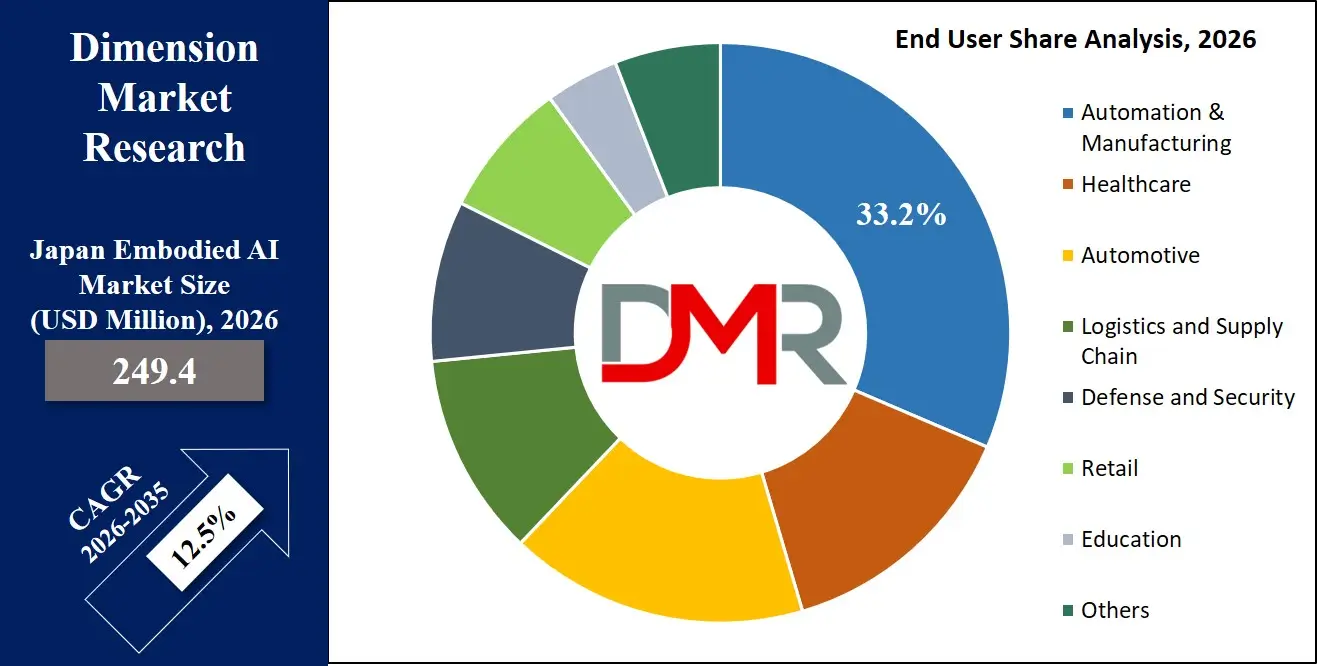
- Manufacturing Automation as the Leading End User: Japan's advanced automotive and electronics industries rely heavily on AI-driven robotics to address labor shortages and maintain global competitiveness.
- Government Policy as a Catalyst: Programs such as Society 5.0 and the Moonshot R&D Program promote robotics innovation and accelerate the adoption of embodied AI technologies.
Impact of the Iran Conflict on the Japan Embodied AI Market
- Supply Chain Disruptions in Semiconductors and Robotics Components: The embodied AI ecosystem relies heavily on semiconductors, sensors, and advanced electronics used in robots and autonomous systems. The Iran conflict has raised concerns about disruptions in the supply of critical materials such as helium and petrochemicals used in semiconductor manufacturing. Shortages or delays in chip production can slow the development of AI hardware and robotics platforms used in embodied AI systems.
- Rising Energy Costs Affecting Manufacturing: The conflict has triggered volatility in global oil and gas markets, with energy prices increasing due to disruptions in Middle Eastern supply routes and the Strait of Hormuz. Higher energy costs increase operational expenses for electronics, robotics, and semiconductor manufacturing facilities in Japan, potentially raising the cost of embodied AI technologies.
- Logistics and Trade Route Risks: Shipping routes in the Persian Gulf are critical for global trade between Asia, Europe, and the Middle East. Instability around the Strait of Hormuz through which a significant portion of global energy supplies passes creates risks for global logistics networks. Disruptions can delay the delivery of robotic components, AI hardware, and industrial materials needed for embodied AI production.
- Increased Investment in Defense and Security Robotics: Geopolitical tensions often accelerate investment in defense technologies such as autonomous drones, surveillance robots, and AI-enabled monitoring systems. This could increase demand for embodied AI technologies in defense, border security, and disaster response applications, indirectly benefiting robotics and AI companies in Japan.
Japan Embodied AI Market: Use Cases
- Healthcare Robotics Supporting Japan's Aging Society: Japan's rapidly aging population is significantly accelerating the deployment of embodied AI in healthcare environments. Embodied AI platforms can also analyze behavioral patterns and health indicators, allowing caregivers to detect early signs of medical complications.
- Logistics and Warehouse Automation: Japan's expanding e-commerce sector is driving significant demand for embodied AI technologies in logistics and supply chain operations. Autonomous mobile robots equipped with advanced perception systems are being deployed in warehouses to manage inventory movement, product sorting, and goods transportation.
- Manufacturing and Smart Factory Integration: Japan's globally recognized manufacturing sector is rapidly integrating embodied AI into next-generation smart factory environments. Embodied AI enables adaptive robotic assembly lines, machine-vision-based quality control systems, and predictive maintenance capabilities within production facilities.
- Disaster Response and Public Safety Robotics: Japan's exposure to natural disasters such as earthquakes, typhoons, and volcanic activity has encouraged the development of embodied AI systems for emergency response and public safety operations. Robotics platforms equipped with AI perception systems are capable of navigating hazardous environments, conducting infrastructure inspections, and supporting search-and-rescue missions.
- Educational and Service Robotics Application: Embodied AI robots are increasingly used within Japan's educational institutions and public service environments to support learning, research, and customer engagement. Universities and technical institutes deploy humanoid robots and interactive robotic platforms to facilitate STEM education, programming training, and robotics experimentation.
Japan Embodied AI Market: Stats & Facts
Ministry of Economy, Trade and Industry (METI)
- Japan's Society 5.0 initiative aims to create a trillion-dollar AI and robotics economy through digital transformation.
- Robotics and artificial intelligence are key components of Japan's industrial modernization strategy and national competitiveness agenda.
- METI supports several robotics innovation clusters and technology research hubs across the country.
International Federation of Robotics (IFR)
- Japan remains the largest manufacturer of industrial robots globally, accounting for approximately 45% of worldwide robot production.
- In 2022, Japan installed more than 50,000 new industrial robots across manufacturing facilities.
- The country maintains a robot density of over 399 robots per 10,000 manufacturing workers, among the highest globally.
World Bank
- Japan's working-age population is projected to decline substantially by 2040, increasing the need for automation and robotics technologies.
- Automation and robotics adoption are helping maintain stable industrial productivity despite workforce reductions.
World Health Organization
- Japan has one of the highest life expectancies globally, averaging approximately 84 years.
- Healthcare robotics adoption is increasing as healthcare providers address the challenges of an aging population.
OECD
- Automation technologies are expected to significantly impact more than 30% of jobs in Japan, particularly in manufacturing and logistics industries.
Japan Robot Association
- Japan hosts over 200 robotics research institutes and industrial laboratories dedicated to robotics innovation.
- Robotics exports represent a major component of Japan's high-technology manufacturing sector.
Japan Embodied AI Market: Market Dynamics
Driving Factors in the Japan Embodied AI Market
Aging Population and Workforce Shortage
Japan's demographic transition toward an aging population is one of the strongest drivers for embodied AI adoption. As the working-age population declines, industries are increasingly turning to intelligent robotic systems to maintain productivity and operational stability. Embodied AI robots are capable of performing physically demanding or repetitive tasks in manufacturing, logistics, and healthcare environments. In elderly care facilities, robotic assistants help patients with mobility, monitoring, and rehabilitation activities. By supporting both industrial operations and social care systems, embodied AI technologies are becoming essential tools for addressing Japan's workforce shortages and maintaining economic growth.
Leadership in Robotics Manufacturing
Japan has a long history of global leadership in robotics development and manufacturing. Major robotics companies such as Fanuc, Yaskawa Electric, and Kawasaki Heavy Industries have pioneered innovations in industrial automation and robotic systems. These organizations are now integrating advanced artificial intelligence capabilities into robotics platforms to create embodied AI systems capable of learning, adapting, and interacting with their environments. Japan's strong robotics supply chain, extensive research ecosystem, and highly skilled engineering workforce provide a solid foundation for the continued expansion of embodied AI technologies across multiple industries.
Restraints in the Japan Embodied AI Market
High Development and Deployment Costs
The development and implementation of embodied AI systems require advanced robotics hardware, sensor technologies, and sophisticated AI algorithms. These technologies involve substantial research, engineering, and infrastructure investments. As a result, initial deployment costs remain relatively high, particularly for small and medium-sized enterprises. Organizations must also invest in workforce training, system integration, and maintenance capabilities, which can further increase operational expenses.
Integration Challenges with Legacy Infrastructure
Many industrial facilities in Japan operate using established manufacturing systems that were not originally designed for AI-driven automation. Integrating embodied AI technologies into these environments often requires infrastructure upgrades, system compatibility adjustments, and operational redesign. These challenges can slow adoption timelines and increase implementation complexity for businesses transitioning toward AI-enabled operations.
Opportunities in the Japan Embodied AI Market
Expansion of Healthcare and Elderly Care Robotics
Japan's rapidly aging population creates a substantial opportunity for embodied AI technologies in healthcare and elderly care services. As the demand for long-term care facilities, rehabilitation services, and assisted living environments continues to rise, robotics solutions are increasingly being adopted to support healthcare professionals and improve patient outcomes. Rehabilitation exoskeletons help patients regain mobility following injuries or surgeries, while robotic mobility aids assist elderly individuals with daily movement and independence. AI-powered caregiving robots can monitor health conditions, detect emergencies, and provide reminders for medication or appointments. These technologies help reduce the physical workload on caregivers and medical staff while maintaining consistent patient care. As healthcare providers invest in technology-enabled care systems, embodied AI solutions are expected to become essential tools in addressing Japan's long-term healthcare and demographic challenges.
Autonomous Mobility and Smart Infrastructure
Embodied AI technologies are expected to play an important role in advancing autonomous mobility and smart infrastructure development across Japan. The integration of AI-powered robotics into transportation systems, public infrastructure monitoring, and urban services aligns closely with Japan's vision of creating digitally connected societies through the Society 5.0 initiative. Autonomous delivery robots, AI-driven inspection drones, and intelligent infrastructure monitoring systems can enhance operational efficiency and safety across cities and industrial zones. These systems are capable of analyzing real-time environmental data, detecting structural issues in bridges or tunnels, and supporting traffic management operations. As urban populations remain concentrated in major metropolitan areas, smart infrastructure solutions supported by embodied AI will help improve mobility services, optimize city operations, and support sustainable urban development.
Trends in the Japan Embodied AI Market
Expansion of Human-Robot Collaboration
Japan continues to lead global innovation in human-robot collaboration, particularly in industrial and service-oriented environments. Collaborative robots, often referred to as cobots, are designed to work safely alongside human operators, enabling efficient teamwork between humans and intelligent machines. These robots are equipped with advanced sensors, machine vision, and AI-driven control systems that allow them to recognize human movements and adapt their actions accordingly. In manufacturing facilities, cobots assist workers in performing repetitive or physically demanding tasks while maintaining high levels of precision and productivity. Beyond manufacturing, human-robot collaboration is also expanding into logistics, healthcare, and retail operations. By combining robotic automation with human expertise, organizations can achieve greater operational flexibility while ensuring workplace safety, making collaborative robotics a key trend in Japan's evolving embodied AI ecosystem.
Growth of AI-Enabled Service Robotics
Service robots powered by embodied AI are increasingly being adopted across Japan's retail, hospitality, and transportation sectors. These robots are designed to interact directly with customers and visitors, providing services such as navigation assistance, product information, and automated customer support. In retail environments, service robots help manage inventory, guide shoppers through stores, and enhance personalized shopping experiences. Hotels and airports are also deploying AI-driven robots to assist guests with check-in processes, luggage guidance, and multilingual information services. The combination of conversational AI, machine vision, and mobility capabilities allows these robots to operate effectively in crowded public spaces. As businesses seek innovative ways to improve operational efficiency and customer engagement, AI-enabled service robotics is becoming a rapidly growing trend within Japan's embodied AI market.
Japan Embodied AI Market: Research Scope and Analysis
By Product Analysis
Robots are projected to dominate the Japan Embodied AI Market due to their crucial role in integrating advanced artificial intelligence with real-world industrial, healthcare, and service applications. Japan has long been recognized as a global leader in robotics innovation, with major robotics manufacturers and technology developers driving continuous advancements in intelligent robotic systems. Companies such as Fanuc, Yaskawa Electric, and Kawasaki Heavy Industries have established strong industrial robotics ecosystems, supporting the integration of AI capabilities into robotic platforms used across manufacturing, logistics, and service industries. According to the International Federation of Robotics (IFR), Japan remains one of the largest producers and adopters of industrial robots globally, with some of the highest robot density levels in manufacturing facilities.
The demand for robots in Japan is strongly influenced by the country's demographic trends. Japan has one of the world's oldest populations, with nearly 30% of its citizens aged 65 and above. This demographic shift has significantly increased the need for service robots, rehabilitation robots, and healthcare support systems capable of assisting elderly individuals with daily activities, mobility support, and medical monitoring. Robots integrated with embodied AI technologies enhance environmental perception, adaptability, and human machine interaction, enabling deployment in complex and dynamic environments such as hospitals, logistics warehouses, agricultural operations, and public service facilities.
Government policies and innovation initiatives also play a vital role in strengthening this segment. Japan's Society 5.0 strategy, along with national AI development programs led by the Ministry of Economy, Trade and Industry (METI), supports research and development in robotics, artificial intelligence, and automation technologies. These programs aim to accelerate digital transformation across industries while promoting the development of next-generation intelligent robotics systems.
Furthermore, Japan's globally competitive manufacturing and automotive industries rely heavily on robotic integration to maintain efficiency, precision, and productivity. Industrial robots equipped with AI capabilities enable predictive maintenance, adaptive production systems, and advanced quality control processes. The combination of Japan's robotics heritage, strong policy support, and growing demand across multiple industries ensures that robots remain the most dominant product segment in the country's embodied AI ecosystem.
By End User Analysis
Factory automation is expected to represent the leading end-user segment in the Japan Embodied AI Market, driven by the country's highly advanced manufacturing sector and strong commitment to industrial modernization. Japan is home to globally recognized automotive, electronics, semiconductor, and precision machinery industries that depend heavily on automation technologies to maintain international competitiveness. Manufacturing plays a central role in Japan's economy, contributing significantly to national industrial output and employment.
ℹ
To learn more about this report –
Download Your Free Sample Report Here
Embodied AI technologies are increasingly being integrated into factory automation systems through intelligent robotic arms, machine vision platforms, and adaptive production lines. Unlike traditional automation systems that rely on pre-programmed instructions, embodied AI enables machines to interpret real-time data, learn from operational environments, and collaborate directly with human workers. This capability improves production flexibility, enhances quality control processes, and allows manufacturers to respond more efficiently to changes in demand and product customization requirements.
Japan's manufacturing sector also faces increasing labor shortages due to the country's aging workforce and declining population. As a result, companies are turning to embodied AI systems to address workforce gaps while maintaining operational efficiency. Autonomous mobile robots, robotic manipulators, and wearable exoskeleton systems are being deployed across factories to support workers, automate repetitive tasks, and reduce workplace injuries.
Sustainability goals are another important factor driving adoption of embodied AI within factory environments. Japan has committed to reducing industrial emissions and improving energy efficiency as part of its national environmental strategy. AI-enabled automation systems help manufacturers optimize energy consumption, reduce material waste, and improve overall operational efficiency. The integration of embodied AI into factory automation allows Japanese industries to enhance productivity while supporting sustainability initiatives and maintaining their leadership position in global manufacturing.
The Japan Embodied AI Market Report is segmented on the basis of the following:
By Product
- Robots
- Humanoid Robots
- Mobile Robots
- Industrial Robots
- Service Robots
- Cobots (Collaborative Robots)
- Exoskeleton
- Autonomous Systems
- Smart Appliances
By End User
- Automation & Manufacturing
- Factory Automation
- Quality Control and Inspection
- Healthcare
- Robotic Surgery and Assistance
- Patient Care and Rehabilitation
- Medical Imaging and Diagnostics
- Automotive
- Autonomous Vehicles
- Driver Assistance Systems (ADAS)
- Logistics and Supply Chain
- Autonomous Delivery Systems
- Warehouse Automation
- Defense and Security
- Autonomous surveillance drones
- Search and Rescue Operations
- Autonomous Combat Systems
- Retail
- Customer Service Robots
- In-Store Robotics for Inventory Management
- Personalized Shopping Assistants
- Education
- Teaching Robots
- Interactive Learning Systems
- AI Tutors
- Others
Japan Embodied AI Market: Competitive Landscape
The competitive landscape of the Japan Embodied AI Market is characterized by the presence of globally recognized robotics manufacturers, advanced electronics companies, and artificial intelligence innovators that are continuously advancing intelligent robotic systems. Japan has one of the most mature robotics ecosystems in the world, supported by strong industrial capabilities, extensive research infrastructure, and government-backed innovation programs. Leading companies such as Fanuc Corporation, Yaskawa Electric Corporation, Kawasaki Heavy Industries, and Mitsubishi Electric dominate the industrial robotics segment by integrating AI-driven perception, machine learning, and advanced control technologies into manufacturing automation solutions.
ℹ
To learn more about this report –
Download Your Free Sample Report Here
In addition to industrial automation leaders, technology companies such as SoftBank Robotics, Sony Group Corporation, and Panasonic Corporation are actively developing service robots and consumer-facing embodied AI solutions. These organizations focus on humanoid robotics, interactive service robots, and AI-powered assistance systems designed for retail, hospitality, healthcare, and public service environments. Their innovations emphasize human robot interaction, mobility, and real-time decision-making capabilities that allow robots to operate effectively in dynamic environments.
Japan's robotics innovation is further strengthened by collaboration between corporations, research institutions, and government agencies. Universities and national research laboratories frequently partner with private companies to accelerate advancements in machine learning, robotics engineering, and sensor technologies. Programs under the Society 5.0 initiative and national AI development strategies encourage the commercialization of next-generation robotics and embodied AI platforms.
Overall, Japan's competitive landscape combines established industrial leaders with emerging AI-focused robotics developers, creating a highly dynamic ecosystem that supports innovation, commercialization, and large-scale deployment of embodied AI technologies across multiple sectors.
Some of the prominent players in the Japan Embodied AI Market are:
- Fanuc Corporation
- Yaskawa Electric Corporation
- Kawasaki Heavy Industries Robotics
- SoftBank Robotics
- Mitsubishi Electric Corporation
- Sony Group Corporation
- Panasonic Corporation
- Omron Robotics and Safety Technologies
- Denso Robotics
- Cyberdyne Inc.
- Toyota Research Institute
- Honda Robotics
- Preferred Networks
- Toshiba Robotics
- Nachi-Fujikoshi Robotics
- Seiko Epson Robotics
- Asratec Corporation
- ZMP Inc.
- Mujin Inc.
- Telexistence Inc.
- Other Key Players
Recent Developments in the Japan Embodied AI Market
- March 2026: The Japanese government announced a national initiative to strengthen domestic AI and semiconductor capabilities to support next-generation robotics and embodied AI systems. The program aims to expand Japan's AI infrastructure and accelerate the development of advanced automation technologies.
- December 2025: Yaskawa Electric Corporation and SoftBank Group announced a collaboration on "Physical AI," focusing on integrating advanced artificial intelligence with robotics to create intelligent systems capable of interacting with real-world environments and improving industrial automation.
- December 2025: The International Conference on Knowledge, Information and Creativity Support Systems (KICSS 2025) was held in Nagaoka, Japan, bringing together global researchers and industry experts to discuss advancements in artificial intelligence, robotics, and human machine interaction technologies.
- October 2025: SoftBank Group announced the acquisition of ABB's robotics division, marking a major merger aimed at accelerating the development of AI-driven robotics and embodied AI technologies.
- October 2025: NVIDIA and Fujitsu Limited announced a strategic collaboration to develop advanced AI infrastructure that supports smart robots, healthcare automation, and intelligent manufacturing systems in Japan.
- September 2025: Japan launched the AI Boost Program, partnering with technology companies to support robotics and AI startups by providing advanced computing resources, innovation support, and research funding for embodied AI development.
- January 2026: Japan expanded national research initiatives focused on integrating artificial intelligence with robotics, encouraging the development of embodied AI systems capable of performing complex real-world tasks across industries.
- July 2024: SoftBank Robotics expanded the deployment of humanoid service robots across hospitals and elderly care facilities in Japan to support healthcare workers and improve patient care services.
- April 2024: The International Robot Exhibition (iREX) held in Tokyo showcased advanced robotics technologies, including embodied AI solutions for manufacturing, healthcare, and service robotics applications.
Report Details
| Report Characteristics |
| Market Size (2026) |
USD 249.4 Mn |
| Forecast Value (2035) |
USD 717.1 Mn |
| CAGR (2026–2035) |
12.5% |
| Historical Data |
2021 – 2025 |
| Forecast Data |
2027 – 2035 |
| Base Year |
2025 |
| Estimate Year |
2026 |
| Report Coverage |
Market Revenue Estimation, Market Dynamics, Competitive Landscape, Growth Factors and etc. |
| Segments Covered |
By Product (Robots, Exoskeleton, Autonomous Systems, and Smart Appliances), By End User (Automation & Manufacturing, Healthcare, Automotive, Logistics and Supply Chain, Defense and Security, Retail, Education, and Others) |
| Country Coverage |
Japan |
| Prominent Players |
Fanuc Corporation, Yaskawa Electric Corporation, Kawasaki Heavy Industries Robotics, SoftBank Robotics, Mitsubishi Electric Corporation, Sony Group Corporation, Panasonic Corporation, Omron Robotics and Safety Technologies, Denso Robotics, Cyberdyne Inc., Toyota Research Institute, Honda Robotics, Preferred Networks, Toshiba Robotics, Nachi-Fujikoshi Robotics, Seiko Epson Robotics, Asratec Corporation, ZMP Inc., Mujin Inc., and Telexistence Inc., and Other Key Players |
| Purchase Options |
We have three licenses to opt for: Single User License (Limited to 1 user), Multi-User License (Up to 5 Users), and Corporate Use License (Unlimited User) along with free report customization equivalent to 0 analyst working days, 3 analysts working days and 5 analysts working days respectively. |
Frequently Asked Questions
How big is the Japan Embodied AI Market?
▾ The Japan Embodied AI Market size is estimated to have a value of USD 721.0 million in 2026 and is expected to reach USD 8,756.5 million by the end of 2035.
What is the growth rate in the Japan Embodied AI Market in 2026?
▾ The market is growing at a CAGR of 13.5 percent over the forecasted period of 2026.
Who are the key players in the Japan Embodied AI Market?
▾ Some of the major key players in the Japan Embodied AI Market are ABB Robotics, KUKA AG, Bosch Robotics, PAL Robotics, SoftBank Robotics Japan, Festo AG, Universal Robots, Robotnik Automation, Comau Robotics, Aldebaran Robotics, and many others.