Market Overview
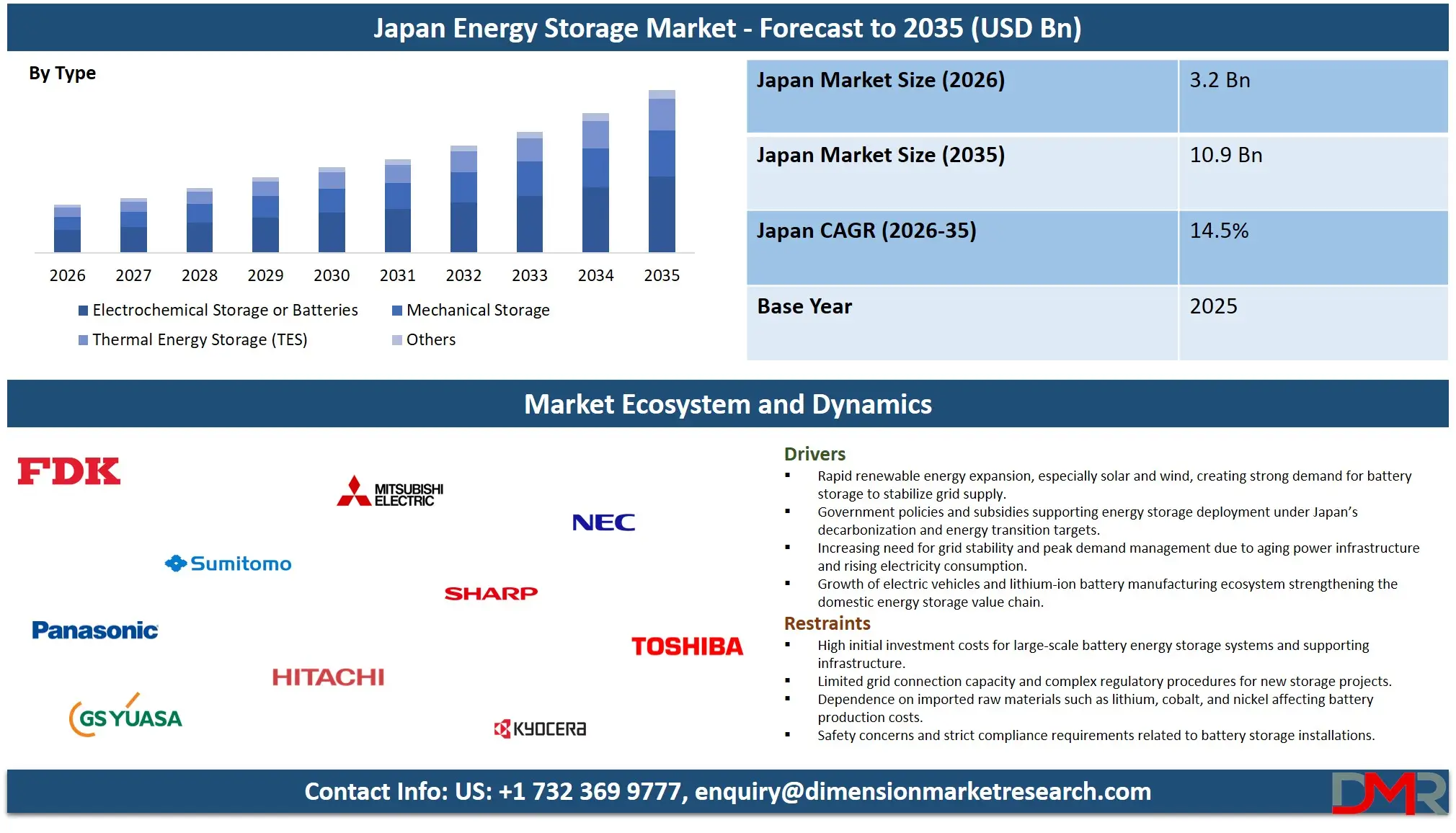
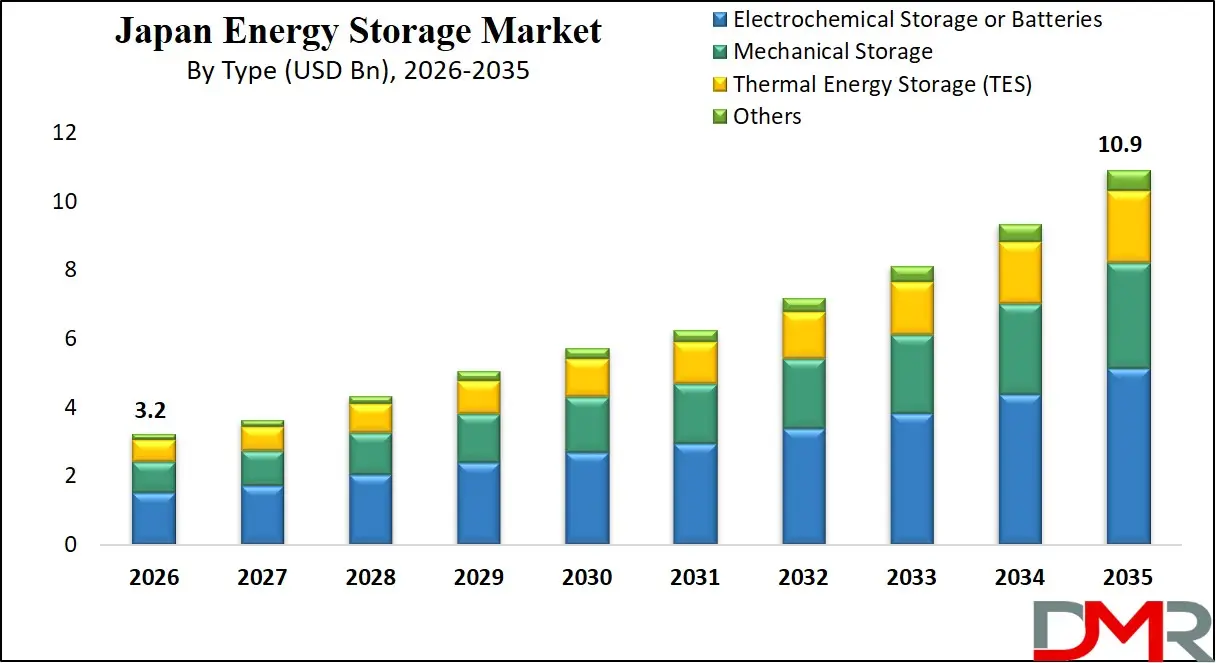
The Japan Energy Storage Market size is projected to reach USD 3.2 billion in 2026 and grow at a compound annual growth rate of 14.5% to reach a value of USD 10.9 billion in 2035.
ℹ
To learn more about this report –
Download Your Free Sample Report Here
Energy storage refers to technologies and systems used to capture, store, and release energy for later use across power, transportation, and industrial applications. These systems include electrochemical batteries, mechanical storage technologies such as pumped hydro and flywheels, and thermal energy storage solutions. They are designed to balance electricity supply and demand, stabilize power grids, and improve the efficiency of renewable energy utilization. In Japan’s highly electrified and technologically advanced economy, energy storage plays a crucial role in maintaining grid reliability and enabling flexible energy management.
Japan’s growing dependency on renewable energy sources such as solar and wind has accelerated the deployment of energy storage technologies. As renewable generation is intermittent, storage solutions help smooth fluctuations in electricity production and ensure a stable power supply. Technological progress in lithium-ion batteries, advanced control systems, and smart grid infrastructure is supporting the integration of distributed energy resources. Japan’s commitment to carbon neutrality by 2050 and its focus on energy security are further strengthening the role of energy storage across residential, commercial, and utility sectors.
ℹ
To learn more about this report –
Download Your Free Sample Report Here
Significant industry progress has been observed through investments in battery manufacturing, grid-scale storage projects, and research initiatives. Government policies encouraging renewable integration and grid modernization are influencing infrastructure development. Collaborations between energy utilities, technology developers, and automotive manufacturers are accelerating innovation in storage technologies. Japan is also witnessing expansion in stationary battery deployments and next-generation storage solutions, including hydrogen-based systems and solid-state batteries, which are expected to enhance system efficiency and long-term energy resilience.
Japan Energy Storage Market: Key Takeaways
- Market Growth: The Japan Energy Storage Market size is expected to grow by USD 7.3 billion, at a CAGR of 14.5%, during the forecasted period of 2027 to 2035.
- By Type: The electrochemical storage or battery segment is anticipated to get the majority share of the Japan Energy Storage market in 2026.
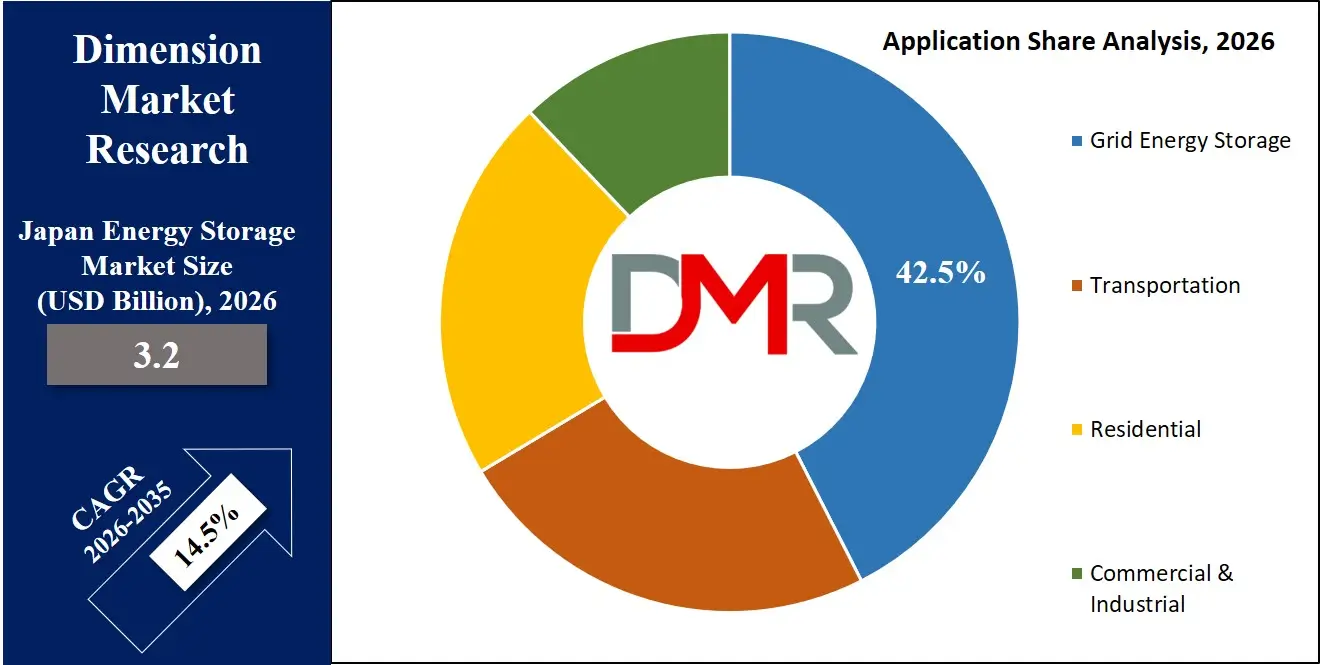
- By Application: The grid energy storage segment is expected to get the largest revenue share in 2026 in the Japan Energy Storage market.
- Use Cases: Some of the use cases of energy storage include grid stabilization, industrial peak shaving, and more.
Japan Energy Storage Market: Use Cases
- Grid stabilization: Energy storage systems support grid stability by balancing fluctuations between electricity generation and demand. They store excess renewable electricity and release it during peak consumption periods, improving overall grid reliability and reducing curtailment.
- Renewable energy integration: Solar and wind installations across Japan increasingly rely on energy storage to address intermittency. Batteries and other storage technologies enable smoother renewable integration by storing surplus generation and dispatching power when renewable output declines.
- Electric vehicle ecosystem support: Energy storage solutions are used in charging infrastructure and vehicle-to-grid systems. These technologies help manage charging loads, optimize electricity consumption, and support grid services during peak demand periods.
- Residential energy management: Home battery systems paired with rooftop solar allow households to store daytime energy production for nighttime use. This improves energy independence, reduces electricity costs, and enhances resilience during power outages.
- Industrial peak shaving: Manufacturing and commercial facilities deploy energy storage systems to reduce peak electricity demand charges. Stored energy is used during high-tariff periods, improving operational efficiency and lowering electricity expenses.
- Disaster resilience and backup power: Japan’s vulnerability to earthquakes and extreme weather as increased the adoption of backup storage systems. Batteries and microgrids provide emergency power for hospitals, shelters, and essential infrastructure.
- Microgrid and island energy systems: Remote islands and community microgrids use storage systems to maintain stable electricity supply. These solutions reduce reliance on diesel generation while enabling greater penetration of renewable energy.
Stats & Facts
- Ministry of Economy, Trade and Industry (Japan) reported that renewable energy accounted for approximately 24% of Japan’s electricity generation in 2024.
- International Energy Agency stated that Japan’s installed solar photovoltaic capacity exceeded 90 GW in 2024, making it one of the world’s largest solar markets.
- Agency for Natural Resources and Energy (Japan) noted that Japan targets 36–38% renewable electricity share by 2030 under its national energy strategy.
- International Renewable Energy Agency estimated that Japan had over 9 GW of pumped hydro storage capacity operational in 2024.
- Japan Electric Power Information Center recorded that electricity demand in Japan was approximately 870 TWh in 2024.
- Ministry of the Environment (Japan) confirmed the country’s target to achieve net-zero greenhouse gas emissions by 2050.
- International Energy Agency reported that global battery storage deployment surpassed 85 GW in 2024, with Asia-Pacific contributing a large share including Japan.
- World Bank indicated that Japan’s electricity access rate remained 100% in 2024, requiring advanced grid stability technologies such as storage.
- Japan Automobile Manufacturers Association reported that electric vehicle sales in Japan exceeded 90,000 units in 2024, increasing demand for battery technologies.
- Ministry of Internal Affairs and Communications (Japan) noted that more than 60% of households had smart meter installations by 2025, enabling advanced energy management systems.
- International Energy Agency reported that global stationary battery deployment grew by more than 40% in 2024 due to renewable integration needs.
- Japan Wind Power Association stated that Japan’s installed wind capacity exceeded 5 GW in 2024, requiring flexible grid management solutions including storage.
Market Dynamic
Driving Factors in the Japan Energy Storage Market
Expansion of Renewable Energy Integration
Japan’s increasing investment in renewable energy generation is one of the primary factors driving the demand for energy storage systems. Solar and wind power are expanding rapidly, but their intermittent nature requires efficient storage solutions to maintain grid stability. Energy storage enables excess electricity generated during high production periods to be stored and dispatched during peak demand. This capability improves renewable energy utilization and reduces reliance on fossil fuel-based backup generation. Government initiatives supporting renewable deployment, combined with technological advancements in battery systems, are accelerating the adoption of large-scale and distributed storage solutions across the country’s electricity infrastructure.
Government Policies Supporting Decarbonization
Japan’s national commitment to achieving carbon neutrality by 2050 has encouraged significant investments in clean energy infrastructure, including energy storage systems. Government programs promote research, subsidies, and incentives aimed at expanding storage deployment across residential, commercial, and grid-scale applications. Policies supporting smart grids, microgrids, and renewable integration are creating a favorable environment for energy storage adoption. Additionally, the government is supporting innovation in advanced battery technologies such as solid-state batteries and hydrogen storage solutions. These initiatives are improving system reliability, enabling energy independence, and encouraging private sector investment in energy storage projects.
Restraints in the Japan Energy Storage Market
High Capital Costs and Infrastructure Requirements
The deployment of energy storage systems often involves high upfront costs associated with battery materials, installation, and grid integration. Although technology costs have gradually declined, large-scale storage projects still require significant investment, which can limit adoption among utilities and industrial users. Additionally, integrating storage systems with existing grid infrastructure may require upgrades and specialized management systems. These financial and technical barriers can slow market expansion, particularly for smaller energy providers or communities that lack sufficient investment capacity. Cost considerations remain a critical factor influencing the pace of energy storage deployment in Japan.
Supply Chain Constraints for Battery Materials
Energy storage technologies, particularly lithium-ion batteries, rely heavily on critical raw materials such as lithium, cobalt, and nickel. Global supply chain volatility and geopolitical challenges can create uncertainties in material availability and pricing. Japan, which imports many of these resources, may face challenges in maintaining stable supply chains for battery production. Fluctuating raw material costs can affect manufacturing expenses and project economics. These challenges encourage industry players to explore alternative battery chemistries, recycling initiatives, and domestic supply chain strategies to reduce dependency on imported materials.
Opportunities in the Japan Energy Storage Market
Development of Advanced Battery Technologies
Japan is a global leader in battery innovation, particularly in the development of next-generation technologies such as solid-state batteries. These advanced systems promise higher energy density, improved safety, and longer lifecycle performance compared with conventional lithium-ion batteries. Research institutions and technology companies are investing heavily in these innovations, which could significantly expand energy storage applications. As new battery technologies mature, they may enable more efficient large-scale energy storage projects, improve electric vehicle performance, and support decentralized energy systems across residential and commercial sectors.
Growth of Distributed Energy Systems and Microgrids
The increasing adoption of distributed energy systems presents a significant opportunity for energy storage deployment. Microgrids, rooftop solar systems, and localized energy networks require efficient storage solutions to ensure reliable electricity supply. In Japan, energy resilience is particularly important due to the risk of natural disasters such as earthquakes and typhoons. Energy storage systems can provide backup power and maintain electricity supply during grid disruptions. As communities and businesses invest in decentralized energy infrastructure, the demand for flexible and scalable storage solutions is expected to increase.
Trends in the Japan Energy Storage Market
Development of Advanced Battery Technologies
Japan is a global leader in battery innovation, particularly in the development of next-generation technologies such as solid-state batteries. These advanced systems promise higher energy density, improved safety, and longer lifecycle performance compared with conventional lithium-ion batteries. Research institutions and technology companies are investing heavily in these innovations, which could significantly expand energy storage applications. As new battery technologies mature, they may enable more efficient large-scale energy storage projects, improve electric vehicle performance, and support decentralized energy systems across residential and commercial sectors.
Growth of Distributed Energy Systems and Microgrids
The increasing adoption of distributed energy systems presents a significant opportunity for energy storage deployment. Microgrids, rooftop solar systems, and localized energy networks require efficient storage solutions to ensure reliable electricity supply. In Japan, energy resilience is particularly important due to the risk of natural disasters such as earthquakes and typhoons. Energy storage systems can provide backup power and maintain electricity supply during grid disruptions. As communities and businesses invest in decentralized energy infrastructure, the demand for flexible and scalable storage solutions is expected to increase.
Impact of Artificial Intelligence in Japan Energy Storage Market
- Predictive energy management: AI algorithms analyze energy demand patterns and optimize charging and discharging cycles of storage systems, improving operational efficiency and reducing energy wastage.
- Grid stability optimization: AI-powered analytics help utilities predict fluctuations in renewable energy generation and adjust storage deployment to maintain stable grid performance.
- Battery lifecycle management: AI systems monitor battery health, predict degradation patterns, and optimize maintenance schedules, extending battery lifespan and improving reliability.
- Renewable generation forecasting: Machine learning models predict solar and wind generation patterns, allowing storage systems to prepare for expected supply fluctuations.
- Energy trading optimization: AI platforms support automated energy trading by analyzing electricity prices and grid demand, enabling storage operators to maximize economic returns.
- Smart microgrid management: AI enhances microgrid operations by coordinating distributed generation, storage, and demand response to ensure efficient energy distribution.
- Electric vehicle charging optimization: AI helps manage EV charging infrastructure by balancing electricity demand with available grid capacity and stored energy.
- Operational efficiency improvement: AI-driven automation improves monitoring, fault detection, and energy dispatch decisions across storage networks.
Research Scope and Analysis
By Type Analysis
Electrochemical storage systems, particularly lithium-ion batteries, represent the dominant segment in Japan’s energy storage market due to their high efficiency, rapid response capability, and wide applicability across residential, commercial, and grid-scale installations. These batteries are commonly integrated with renewable energy systems such as solar power plants and distributed rooftop installations. Japan’s strong battery manufacturing ecosystem and technological expertise further support this segment’s growth. In 2026, electrochemical storage systems are projected to account for approximately 46.8% of the Japan energy storage market share, driven by rising electric vehicle adoption, increased renewable integration, and supportive government policies. Advancements in battery chemistry, including solid-state technologies, are expected to further strengthen the segment’s position by offering improved safety, higher energy density, and longer lifecycle performance.
Mechanical storage systems such as pumped hydro storage, compressed air energy storage, and flywheel technologies represent an important component of Japan’s energy storage landscape. These systems are particularly suitable for large-scale grid applications where long-duration energy storage is required. Pumped hydro remains one of the most established technologies due to its high capacity and long operational lifespan. Mechanical storage systems also support grid stabilization during peak demand and renewable energy fluctuations. Growing investments in infrastructure modernization and grid reliability are expected to drive increased adoption of these technologies, particularly for utility-scale energy storage projects across Japan.
By Application Analysis
Grid energy storage represents the largest application segment in Japan’s energy storage market due to the country’s growing need for reliable electricity supply and renewable energy integration. Utility-scale storage systems are widely deployed to stabilize power networks, manage peak demand, and store excess electricity generated from renewable sources. These systems help utilities maintain grid reliability while reducing dependence on fossil fuel-based backup generation. By 2026, grid energy storage is expected to account for around 42.5% of the total market share, supported by government initiatives promoting grid modernization and renewable expansion. Large-scale battery installations, pumped hydro projects, and hybrid renewable-storage systems are contributing to the rapid development of this segment.
ℹ
To learn more about this report –
Download Your Free Sample Report Here
The transportation sector is emerging as the fastest-growing application segment in the Japan energy storage market. The rising adoption of electric vehicles and hybrid transportation systems is significantly increasing demand for advanced battery technologies. Energy storage solutions are also being integrated into charging infrastructure and vehicle-to-grid systems to improve energy efficiency and grid stability. Government incentives supporting electric mobility, along with investments in EV infrastructure development, are accelerating this segment’s growth. As automotive manufacturers continue to develop next-generation batteries and energy management technologies, transportation is expected to play a major role in expanding the overall energy storage ecosystem in Japan.
The Japan Energy Storage Market Report is segmented on the basis of the following:
By Type
- Electrochemical Storage or Batteries
- Mechanical Storage
- Thermal Energy Storage (TES)
- Other Types
By Application
- Grid Energy Storage
- Transportation
- Residential
- Commercial & Industrial
Competitive Landscape
The Japan energy storage market is characterized by strong technological innovation, significant research investments, and collaboration between energy companies, technology developers, and automotive manufacturers. Market participants focus heavily on research and development to enhance battery performance, improve energy density, and reduce production costs.
ℹ
To learn more about this report –
Download Your Free Sample Report Here
Strategic partnerships between utilities and technology providers are common, enabling large-scale energy storage deployment and grid integration projects. Companies also pursue vertical integration strategies to strengthen supply chains for battery materials and components. Additionally, firms are expanding manufacturing capacity and investing in advanced battery technologies such as solid-state systems. High capital requirements, technological expertise, and regulatory compliance create entry barriers, shaping a competitive environment driven by innovation and long-term infrastructure development.
Some of the prominent players in the Japan Energy Storage are:
- Panasonic Holdings Corporation
- Toshiba Corporation
- Hitachi Ltd.
- Mitsubishi Electric Corporation
- Sumitomo Electric Industries
- Kyocera Corporation
- Sharp Corporation
- NEC Corporation
- GS Yuasa Corporation
- NGK Insulators Ltd.
- Asahi Kasei Corporation
- Murata Manufacturing Co., Ltd.
- Maxell Holdings Ltd.
- Furukawa Battery Co., Ltd.
- FDK Corporation
- ELIIY Power Co., Ltd.
- Automotive Energy Supply Corporation
- Blue Energy Co., Ltd.
- Lithium Energy Japan
- Resonac Holdings Corporation
- Other Key Players
Recent Developments
- In April 2025, Toyota revealed a major research and development initiative focused on commercializing solid-state battery technology for both electric vehicles and stationary energy storage applications. The company invested heavily in advanced battery materials and production techniques to enhance energy density and charging efficiency. Toyota’s project aims to accelerate the commercialization timeline for solid-state batteries while supporting Japan’s transition toward clean energy systems.
- In January 2025, Panasonic Energy announced the expansion of its battery manufacturing capabilities to support the growing demand for energy storage and electric vehicle applications. The company introduced upgraded lithium-ion battery production lines incorporating advanced manufacturing technologies designed to improve energy density and reduce production costs. The initiative aims to strengthen Japan’s domestic battery supply chain while supporting renewable energy integration and EV growth.
Report Details
| Report Characteristics |
| Market Size (2026) |
USD 3.2 Bn |
| Forecast Value (2035) |
USD 10.9 Bn |
| CAGR (2026–2035) |
14.5% |
| Historical Data |
2021 – 2025 |
| Forecast Data |
2027 – 2035 |
| Base Year |
2025 |
| Estimate Year |
2026 |
| Report Coverage |
Market Revenue Estimation, Market Dynamics, Competitive Landscape, Growth Factors and etc. |
| Segments Covered |
By Type (Electrochemical Storage or Batteries, Mechanical Storage, Thermal Energy Storage (TES), Other Types), By Application (Grid Energy Storage, Transportation, Residential, Commercial & Industrial) |
| Country Coverage |
Japan |
| Prominent Players |
Panasonic Holdings Corporation, Toshiba Corporation, Hitachi Ltd., Mitsubishi Electric Corporation, Sumitomo Electric Industries, Kyocera Corporation, Sharp Corporation, NEC Corporation, GS Yuasa Corporation, NGK Insulators Ltd., Asahi Kasei Corporation, Murata Manufacturing Co., Ltd., Maxell Holdings Ltd., Furukawa Battery Co., Ltd., FDK Corporation, ELIIY Power Co., Ltd., Automotive Energy Supply Corporation, Blue Energy Co., Ltd., Lithium Energy Japan, Resonac Holdings Corporation, and Other Key Players |
| Purchase Options |
We have three licenses to opt for: Single User License (Limited to 1 user), Multi-User License (Up to 5 Users) and Corporate Use License (Unlimited User) along with free report customization equivalent to 0 analyst working days, 3 analysts working days and 5 analysts working days respectively. |
Frequently Asked Questions
How big is the Japan Energy Storage Market?
▾ The Japan Energy Storage Market size is expected to reach USD 3.2 billion by 2026 and is projected to reach USD 10.9 billion by the end of 2035.
Who are the key players in the Japan Energy Storage Market?
▾ Some of the major key players in the Japan Energy Storage Market include Hitachi, Toshiba, Panasonic, and others
What is the growth rate in the Japan Energy Storage Market?
▾ The market is growing at a CAGR of 14.5 percent over the forecasted period.