Market Overview
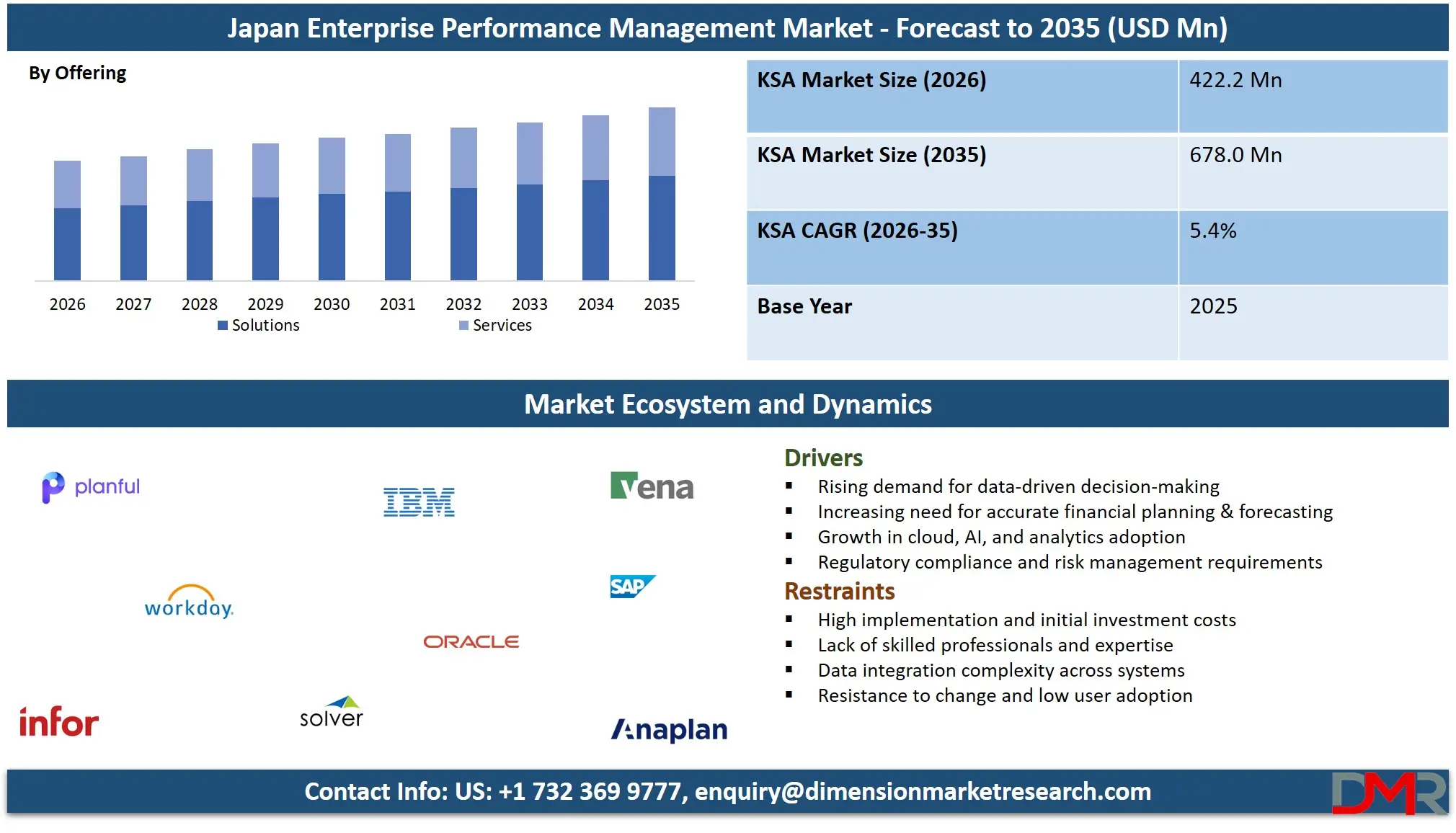
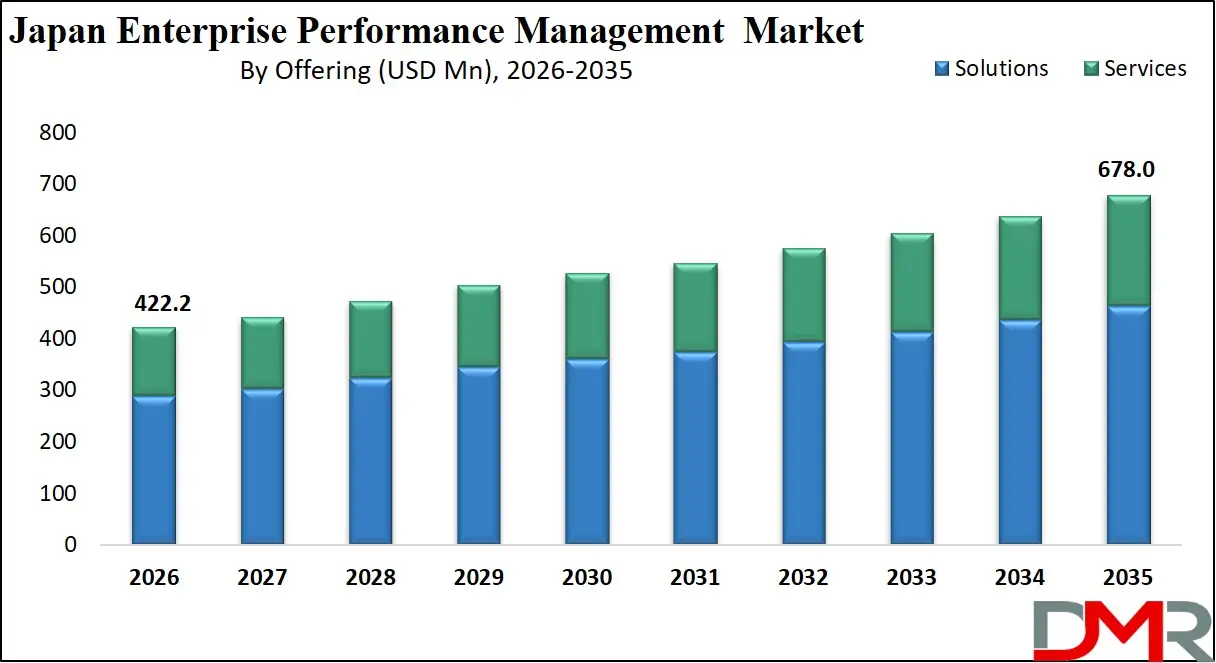
The Japan Enterprise Performance Management Market size is projected to reach USD 422.2 million in 2026 and grow at a compound annual growth rate of 5.4% to reach a value of USD 678.0 million in 2035.
ℹ
To learn more about this report –
Download Your Free Sample Report Here
Japan Enterprise Performance Management refers to the ecosystem of software solutions, analytical tools, and advisory services designed to help organizations in Japan monitor, manage, and optimize business performance across financial and operational domains. It includes budgeting, forecasting, consolidation, reporting, and strategic planning tools integrated with enterprise systems.
The market is significant due to Japan's strong corporate governance reforms and digital transformation initiatives. Emerging trends such as AI-powered analytics, cloud adoption, and real-time data integration are reshaping how enterprises enhance agility, improve compliance, and drive efficiency in decision-making processes.
ℹ
To learn more about this report –
Download Your Free Sample Report Here
Japan Enterprise Performance Management Market: Key Takeaways & Influencing Factors
- Market Growth: The Japan Enterprise Performance Management Market size is expected to grow by USD 235.3 million, at a CAGR of 5.4%, during the forecasted period of 2027 to 2035.
- By Offering: The solutions segment is anticipated to get the majority share of the Japan Enterprise Performance Management market in 2026.
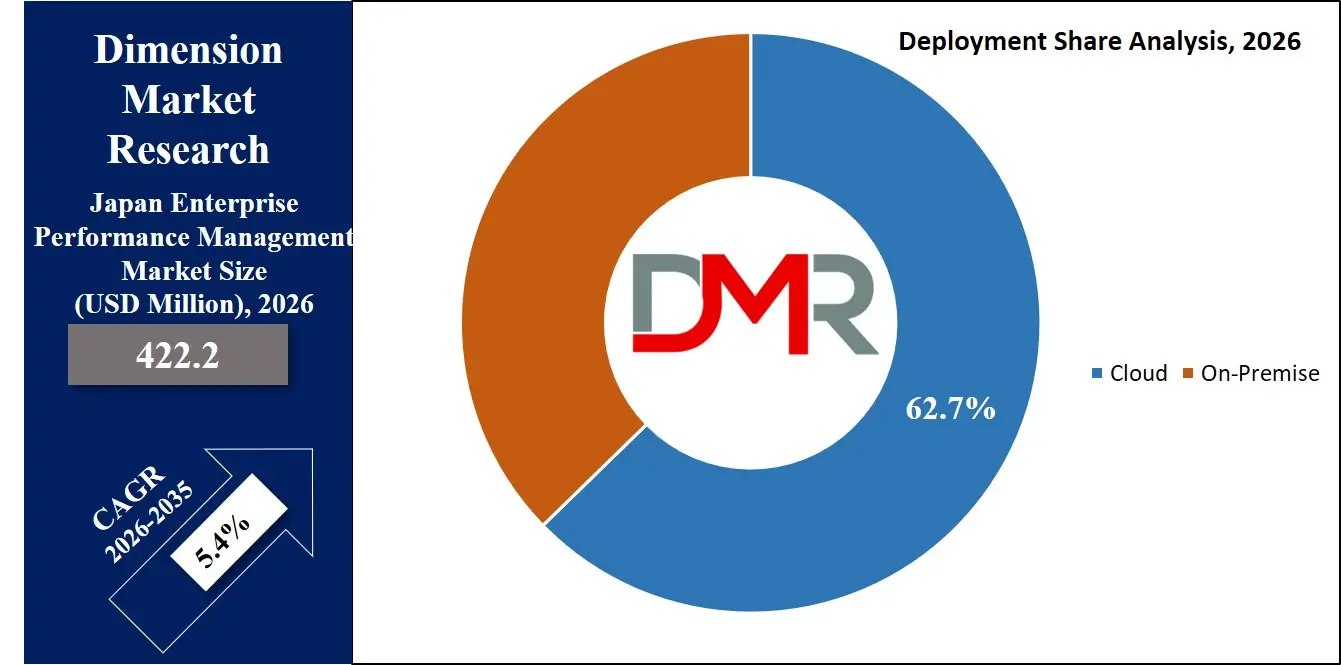
- By Deployment: The cloud segment is expected to get the largest revenue share in 2026 in the Japan Enterprise Performance Management market.
- Use Cases: Some of the use cases of Enterprise Performance Management include strategic decision support, financial planning & analysis and more.
- Ministry of Economy, Trade and Industry (METI): The organization reported in 2025 that over 72% of Japanese enterprises accelerated digital transformation initiatives, driving demand for advanced performance management solutions.
- Japan Cabinet Office: It stated in 2024 that corporate governance reforms increased transparency requirements, with over 65% of listed firms enhancing financial reporting systems.
- International Monetary Fund (IMF): The fund noted in 2025 that Japan's corporate sector productivity improved by 2.1%, supported by increased adoption of data analytics tools.
- World Bank: The bank reported in 2024 that Japan's ICT spending grew by 5.8% annually, reflecting strong investment in enterprise software systems.
- OECD (Organization for Economic Co-operation and Development): The organization highlighted in 2026 that nearly 60% of Japanese firms are integrating AI-driven analytics into financial planning processes.
Japan Enterprise Performance Management Market: Use Cases
- Financial Planning & Analysis: Enables organizations to automate budgeting, forecasting, and variance analysis, improving financial visibility. Companies leverage advanced analytics to enhance accuracy and reduce manual errors, leading to faster strategic decisions and optimized resource allocation.
- Regulatory Compliance & Reporting: Helps enterprises comply with stringent financial regulations and reporting standards in Japan. Automated reporting tools ensure transparency, accuracy, and timely submission of financial data, reducing compliance risks and operational inefficiencies.
- Operational Performance Monitoring: Provides real-time insights into key performance indicators across departments. Businesses use dashboards and analytics tools to track operational efficiency, identify bottlenecks, and improve productivity through data-driven interventions.
- Strategic Decision Support: Facilitates scenario planning and predictive analytics for long-term strategy formulation. Organizations can evaluate market conditions, assess risks, and simulate outcomes, enabling informed and proactive decision-making.
Market Dynamic
Driving Factors in the Japan Enterprise Performance Management Market
Rising Digital Transformation across Enterprises
The rapid adoption of digital technologies across Japanese enterprises is a primary driver for the market. Organizations are investing heavily in cloud computing, AI, and data analytics to modernize legacy systems. Enterprise performance management solutions play a critical role in integrating these technologies, enabling real-time insights and improved forecasting accuracy, thereby supporting strategic agility and operational efficiency.
Increasing Need for Data-Driven Decision-Making
Businesses in Japan are prioritizing data-driven strategies to remain competitive in a mature economy. Enterprise performance management tools provide advanced analytics and reporting capabilities, helping organizations extract actionable insights from large datasets. This demand for accurate, real-time information is driving the adoption of integrated performance management systems across industries.
Restraints in the Japan Enterprise Performance Management Market
High Implementation and Integration Costs
The deployment of enterprise performance management solutions often requires significant upfront investment, including software licensing, customization, and integration with existing systems. Small and medium-sized enterprises in Japan may face financial constraints, limiting adoption. Additionally, complex implementation processes can disrupt operations, posing challenges for market expansion.
Data Security and Privacy Concerns
With increasing reliance on cloud-based solutions, concerns around data security and privacy are growing. Japanese enterprises are highly sensitive to data breaches and regulatory compliance requirements. These concerns can delay adoption, particularly among organizations handling sensitive financial and customer data, thereby restraining market growth.
Opportunities in the Japan Enterprise Performance Management Market
High Implementation and Integration Costs
The deployment of enterprise performance management solutions often requires significant upfront investment, including software licensing, customization, and integration with existing systems. Small and medium-sized enterprises in Japan may face financial constraints, limiting adoption. Additionally, complex implementation processes can disrupt operations, posing challenges for market expansion.
Data Security and Privacy Concerns
With increasing reliance on cloud-based solutions, concerns around data security and privacy are growing. Japanese enterprises are highly sensitive to data breaches and regulatory compliance requirements. These concerns can delay adoption, particularly among organizations handling sensitive financial and customer data, thereby restraining market growth.
Trends in the Japan Enterprise Performance Management Market
Adoption of AI and Automation
Artificial intelligence and automation are transforming enterprise performance management processes. Organizations are leveraging AI to automate routine tasks such as data consolidation and reporting, reducing manual effort and errors. This trend is enhancing efficiency and enabling finance teams to focus on strategic activities.
Shift toward Integrated Business Planning
There is a growing trend toward integrated business planning, where financial and operational data are combined into a unified platform. This approach enables organizations to align strategies across departments, improve collaboration, and respond quickly to market changes, thereby driving demand for comprehensive performance management solutions.
Impact of Artificial Intelligence in Japan Enterprise Performance Management Market
Artificial intelligence is greatly impacting enterprise performance management, especially in predictive analytics, forecasting, and real-time data processing. Accuracy in financial planning is being achieved through AI technology, and manual intervention in reporting is minimized. Decision-making is another area where AI technology is impacting performance management, providing insights for better decision-making. Moreover, risk management, performance optimization, and anomaly detection are being achieved through AI technology, thus making enterprise systems intelligent and efficient, enabling them to respond to market changes.
Impact of Iran War on Japan Enterprise Performance Management Market
The Iran war has had an indirect impact on the market due to economic uncertainties. Japanese businesses are becoming more cautious about managing risk and planning scenarios, thus increasing the need for performance management solutions. The rise and fall of energy prices have also led to an increase in the need for better forecasting and financial planning solutions.
Research Scope and Analysis
By Offering Analysis
Solutions account for a large share in the market, and this segment is likely to continue growing, with a projected share of 68.4% by 2026, due to a high demand for integrated software platforms, budgeting, forecasting, and analytics. This software helps organizations automate processes and integrate them with ERP systems, providing a more efficient system overall. The services segment has the highest growth rate due to growing complexity in implementation and customization. The demand for managed services is also growing, and many organizations are seeking such services from outside providers to improve system performance and upgrade them continuously to meet changing needs.
By Deployment Analysis
The cloud deployment is expected to take the lead, with a share of 62.7% in 2026, because of its flexibility, scalability, and cost-effectiveness. The organizations in Japan are shifting to cloud platforms because these are flexible and easy to use, especially when the employees are distributed geographically. The cloud solutions also offer the additional advantage of faster update and integration with other technologies, such as AI and ML.
ℹ
To learn more about this report –
Download Your Free Sample Report Here
The on-premises solutions are also relevant to the market, especially for large organizations, because these organizations have high security requirements for their data. The cloud deployment is growing the fastest, especially because of the advancements and requirements for security, compliance, and ensuring accessibility and business continuity in this modern digital world.
By Enterprise Size Analysis
Large enterprises are also expected to take the top spot with a 64.1% share in 2026, considering their huge financial resources and complex operational structures, for which they need sophisticated performance management systems. Large enterprises use integrated platforms to effectively handle huge volumes of financial and operational data from different business units. SMEs are also growing rapidly, and cloud-based performance management solutions are providing opportunities for SMEs to use such tools, even if they were previously unable to do so due to cost and other limitations. The awareness of digital tools, along with government initiatives, is also contributing to growth in this segment, and SMEs are also realizing the importance of data-driven decisions to remain competitive in changing market conditions.
By Function Analysis
Finance segment is expected to have the largest share, 58.9%, in 2026, as performance management solution adoption in enterprises has been mainly concentrated in finance planning, reporting, and compliance. The increasing need for better forecasting and transparent reporting has been driving performance management solution adoption in this segment. Enterprises are adopting performance management solutions in finance planning and reporting to eliminate errors and increase efficiency. The supply chain segment has been witnessing the highest growth rate, driven by increasing demand for real-time visibility and optimization in logistics and operations. Enterprises are consolidating financial and operational data to become more responsive, better forecast demand, and manage disruptions.
By Industry Vertical Analysis
The BFSI sector is likely to be at the forefront with a market share of 27.6% in 2026, driven by the need to adhere to stringent regulatory norms and the need to have an efficient financial management system. The financial industries are always in need of solutions related to risk management, compliance, and performance monitoring. The IT and telecom sector is expected to be the fastest-growing sector, driven by the high rate of digital transformation and the adoption of sophisticated analytics solutions. The industries are looking to have highly dynamic solutions to cater to the changing needs of the business. The manufacturing sector is another sector with high growth potential.
The Japan Enterprise Performance Management Market Report is segmented on the basis of the following:
By Offering
By Deployment
By Enterprise Size
By Function
- Finance
- Human Resources
- Supply Chain
- Sales and Marketing
- Others
By Industry Vertical
- BFSI
- Retail & Consumer
- Government
- Healthcare
- Manufacturing
- IT and Telecom
- Other
Competitive Landscape
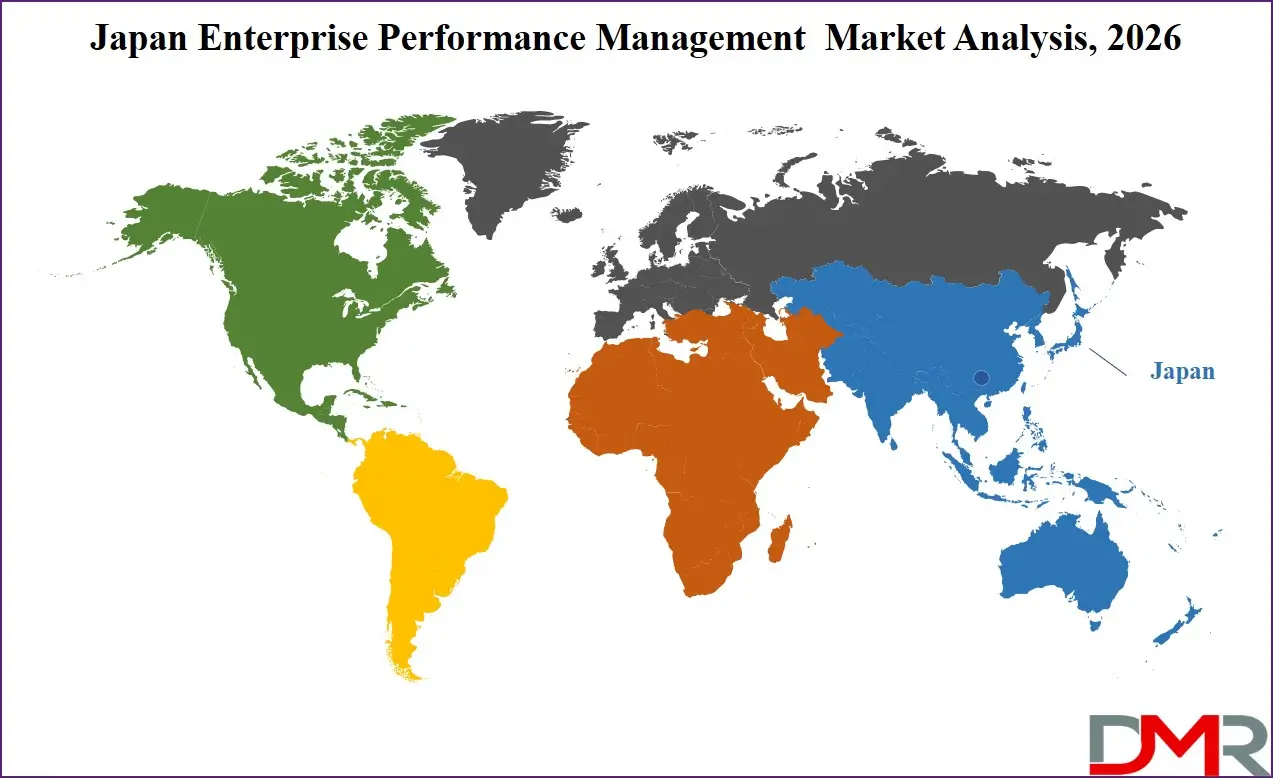
The Japan Enterprise Performance Management Market has a competitive environment, and innovation, technological changes, and differentiation in terms of services are the main drivers for the Japan Enterprise Performance Management Market. The main strategies adopted by the Japan Enterprise Performance Management Market are investments in AI and cloud technologies, strategic partnerships, and expansion of service portfolios.
ℹ
To learn more about this report –
Download Your Free Sample Report Here
The Japan Enterprise Performance Management Market has a high barrier to entry, and this has been achieved through technological intricacies and domain expertise. The main focus areas for organizations are to improve user experience, security, and scalability, hence maintaining a competitive edge and expanding market share.
Some of the prominent players in the Japan Enterprise Performance Management are:
- Oracle Corporation
- SAP SE
- IBM Corporation
- Workday, Inc.
- Anaplan, Inc.
- OneStream Software LLC
- Infor, Inc.
- Wolters Kluwer (CCH Tagetik)
- Board International
- Prophix Software
- Vena Solutions
- Jedox
- Solver
- Planful
- SAS Institute
- Insightsoftware
- BlackLine, Inc.
- Centage Corporation
- Talentia Software Group
- Corporater
- Other Key Players
Recent Developments
- In April 2026, Panasonic Corporation has transitioned into a new corporate structure focused on lifestyle solutions, following a broader group reorganization. Key businesses were transferred to Panasonic Entertainment & Communication Co., Ltd., now renamed Panasonic Corporation, covering major and small appliances, AVC products, related devices, business solutions, and bicycles under a new management framework.
- In February 2026, Fujitsu Japan Limited and JMDC Inc. have launched a collaboration starting January 5 to enhance medical care and build a sustainable healthcare system in Japan. By combining JMDC's anonymized data expertise with Fujitsu Japan's strong EHR market presence, the partnership aims to promote medical data utilization and enable informed, data-driven decision-making across healthcare institutions.
- In November 2025, Minitab, LLC has expanded its presence in Japan by opening a new office and training facility in Marunouchi, Tokyo, and strengthening support for local businesses. Since establishing its Japan entity, the company has grown its team and introduced industry-focused training programs, offering hands-on learning in data analytics, SQC, and Six Sigma to enhance operational excellence.
Report Details
| Report Characteristics |
| Market Size (2026) |
USD 422.2 Mn |
| Forecast Value (2035) |
USD 678.0 Mn |
| CAGR (2026–2035) |
5.4% |
| Historical Data |
2021 – 2025 |
| Forecast Data |
2027 – 2035 |
| Base Year |
2025 |
| Estimate Year |
2026 |
| Report Coverage |
Market Revenue Estimation, Market Dynamics, Competitive Landscape, Growth Factors and etc. |
| Segments Covered |
By Offering (Solutions, Services), By Deployment (On-Premises, Cloud), By Enterprise Size (SMEs, Large Enterprises), By Function (Finance, Human Resources, Supply Chain, Sales and Marketing, Others), By Industry Vertical (BFSI, Retail & Consumer, Government, Healthcare, Manufacturing, IT and Telecom, Other) |
| Country Coverage |
Japan |
| Prominent Players |
Oracle Corporation, SAP SE, IBM Corporation, Workday, Inc., Anaplan, Inc., OneStream Software LLC, Infor, Inc., Wolters Kluwer (CCH Tagetik), Board International, Prophix Software, Vena Solutions, Jedox, Solver, Planful, SAS Institute, Insightsoftware, BlackLine, Inc., Centage Corporation, Talentia Software Group, Corporater, and Other Key Players |
| Purchase Options |
We have three licenses to opt for: Single User License (Limited to 1 user), Multi-User License (Up to 5 Users) and Corporate Use License (Unlimited User) along with free report customization equivalent to 0 analyst working days, 3 analysts working days and 5 analysts working days respectively. |
Frequently Asked Questions
How big is the Japan Enterprise Performance Management Market?
▾ The Japan Enterprise Performance Management Market size is expected to reach USD 422.2 million by 2026 and is projected to reach USD 678.0 million by the end of 2035.
Who are the key players in the Japan Enterprise Performance Management Market?
▾ Some of the major key players in the Japan Enterprise Performance Management Market include IBM, SAP, Oracle, and others.
What is the growth rate in the Japan Enterprise Performance Management Market?
▾ The market is growing at a CAGR of 5.4 percent over the forecasted period.