Market Snapshot
- Market Size (2026): USD 14.8 Bn
- Forecast Value (2035): USD 40.4 Bn
- CAGR (2026-2035): 11.8%
- Leading Offering (2026): Solutions, approximately 68%
- Leading Deployment (2026): Cloud, around 49%
- Key Players: Fujitsu, NEC, Microsoft and others
What is the Japan Enterprise Software Market and its Market Size?
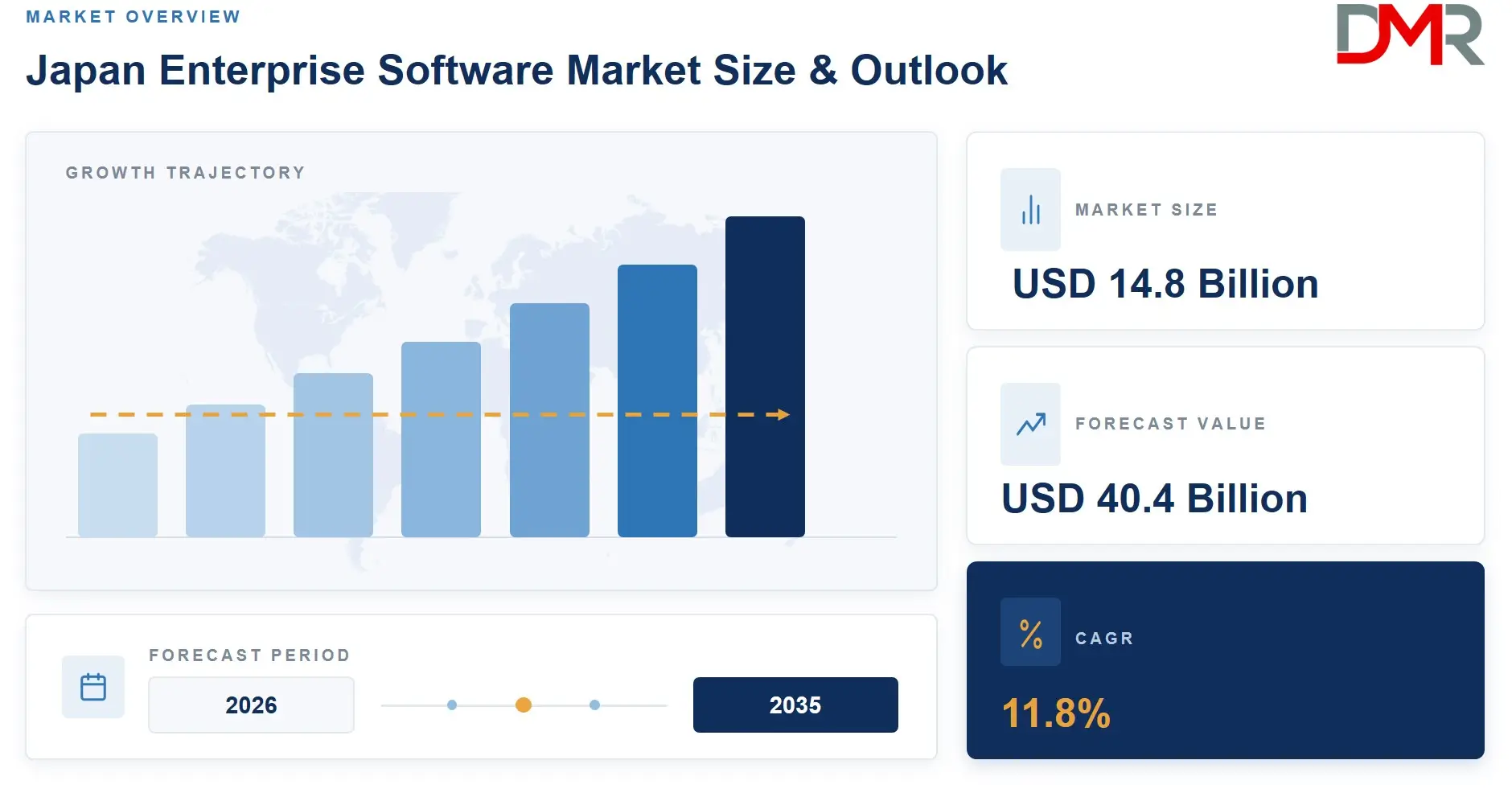
The Japan Enterprise Software Market size is estimated to reach USD 14.8 Bn in 2026 and is further anticipated to reach USD 40.4 Bn by 2035, at a CAGR of 11.8%.
ℹ
To learn more about this report –
Download Your Free Sample Report Here
This assessment covers licensed and subscription software used by Japanese organizations to manage finance, people, customers, operations, supply chains, content and decision workflows. It includes application revenue, related implementation and support where these are directly attached to enterprise software deployments, while excluding consumer applications, hardware-only sales and general telecommunications revenue.
Enterprise buyers use ERP, CRM, SCM, business intelligence, cybersecurity, collaboration and industry platforms to standardize fragmented processes. Demand comes from large corporations, mid-sized firms, public agencies and regulated operators that need auditability, labor productivity and more consistent data exchange across plants, branches and suppliers.
Cloud migration is changing the commercial model. Subscription contracts reduce initial infrastructure commitments, while hybrid architecture remains relevant where sensitive workloads, legacy systems or operational technology cannot move immediately. Japanese-language interfaces, local support, integration with domestic accounting practices and data governance remain important purchase criteria.
Use Cases
- Factory Operations: Manufacturers deploy production planning and maintenance applications across plants to coordinate materials, labor and equipment availability. The result is better schedule visibility and fewer manual reconciliations between headquarters and factory teams.
- Banking Compliance: Financial institutions use workflow and records platforms to manage approvals, controls and reporting obligations. Centralized evidence reduces duplicated review work and gives risk teams a clearer trail across products and branches.
- Retail Merchandising: Retail groups connect purchasing, inventory and supplier processes through enterprise applications. Category managers can respond to store-level demand changes without relying on disconnected spreadsheets or delayed regional updates.
- Public Administration: Government departments deploy case-management and document systems to consolidate citizen records and internal requests. Standardized workflows improve handoffs between offices and support more consistent service delivery.
Key Takeaways
- Market Size & Share: Japan Enterprise Software Market revenue is estimated at USD 14.8 Bn in 2026, with solutions holding approximately 68% of offering revenue.
- Offering Analysis: Solutions are projected to lead with close to 68% in 2026, while AI-enabled software is expanding at a CAGR of 20.6%.
- Demand Concentration: Kanto is expected to account for around 52% of domestic demand in 2026 because headquarters, financial institutions and technology suppliers are concentrated there.
- Cloud Transition: Cloud deployment is set to represent nearly 49% in 2026 as buyers shift recurring infrastructure and upgrade costs into subscription budgets.
- Buyer Priorities: Manufacturing and logistics buyers are increasing spending on integration, analytics and automation to address labor scarcity and fragmented operating data.
- Competitive Basis: Vendors compete through local implementation capacity, vertical functionality, security controls and migration support rather than software features alone.
How AI/Gen AI is Transforming the Japan Enterprise Software Market?
AI is moving enterprise software beyond record keeping toward recommendation, exception handling and assisted execution. Japanese organizations are applying machine learning to demand sensing, fraud monitoring, workforce planning and equipment maintenance, while governance teams assess explainability, access control and data residency.
Generative AI is entering through bounded workflows rather than unrestricted automation. Large language models summarize internal documents, retrieve policy material and draft service responses, but production deployments generally require approval gates, Japanese-language evaluation and protection against confidential-data leakage.
- LLM Document Processing: Extracts fields from invoices, contracts and forms, then routes exceptions to staff.
- Computer Vision: Detects defects and safety conditions in manufacturing and logistics environments.
- Digital Twins: Tests production, energy and facility decisions before operational changes are made.
- Reinforcement Learning Scheduling: Improves allocation of machines, transport slots and workforce capacity under changing constraints.
Key Drivers in the Japan Enterprise Software Market
Demand is being shaped by productivity pressure and the need to modernize fragmented systems.
- Labor Scarcity and Process Automation: An aging workforce increases the value of software that removes repetitive reconciliation, scheduling and reporting tasks. Manufacturing, distribution and care-related organizations are prioritizing workflow automation because productivity gains can be deployed across existing sites without proportional headcount growth. The fastest-moving AI-enabled function is projected to expand at a CAGR of 20.6% from 2026 to 2035, above the market rate, as buyers move from dashboards toward recommendations and automated exception queues.
- Legacy Renewal and Cloud Economics: Long-lived customized systems create integration costs and limit timely data access. Cloud subscriptions, API-based platforms and managed upgrades let buyers replace individual modules rather than fund a single disruptive overhaul. Cloud deployment is expected to represent approximately 49% of domestic revenue in 2026, with migration strongest where standard processes, remote access and faster release cycles outweigh concerns about control over infrastructure.
Restraints in the Japan Enterprise Software Market
Expansion is constrained by implementation complexity and uneven organizational readiness.
- Migration Risk Across Customized Estates: Japanese enterprises often carry business rules embedded in legacy code, spreadsheets and informal operating practices. Mapping those dependencies can extend projects and raise the cost of data cleansing, testing and employee retraining. Buyers may therefore run parallel systems longer than planned, delaying subscription expansion and reducing the near-term conversion rate from on-premises licenses to cloud contracts.
- Security, Skills and Vendor Concentration: Cloud adoption requires architecture, identity and incident-response skills that many mid-sized organizations must purchase from external integrators. Concerns about sensitive data, supplier lock-in and service continuity also slow decisions in finance, healthcare and public administration. The result is a preference for hybrid deployments, phased contracts and vendors able to provide local support rather than purely low-price software.
Growth Opportunities in the Japan Enterprise Software Market
White space is emerging where software connects operational data with measurable productivity outcomes.
- Mid-Market Vertical SaaS: Regional manufacturers, wholesalers and service companies need Japanese-language applications that combine accounting, inventory, workforce and customer workflows without the cost of a large transformation program. Vendors can grow through modular pricing, local reseller networks and packaged migration services. The opportunity is strongest outside major headquarters markets, where implementation capacity remains limited but process standardization needs are rising.
- Industrial Data Platforms: Suppliers that connect ERP with manufacturing execution, robotics and quality systems can sell a higher-value layer around existing applications. A common data model supports predictive maintenance, traceability and energy management. Partnerships with automation integrators and equipment makers can shorten sales cycles because the software is attached to a plant modernization decision rather than treated as a separate IT purchase.
Trends in the Japan Enterprise Software Market
Buyer behavior is shifting toward composable platforms, managed services and measurable adoption.
- Hybrid by Design: Organizations are selecting cloud for collaboration, analytics and standardized finance while retaining sensitive or highly customized workloads locally. This creates demand for integration, identity federation and observability instead of a simple cloud-versus-on-premises replacement.
- Japanese-Language AI Governance: Buyers are testing model accuracy on domestic documents, business terminology and mixed Japanese-English datasets. Procurement teams increasingly require logging, role-based access, human review and clear separation between training data and production prompts.
Research Scope and Analysis
Segment performance is assessed across offering, deployment, function, end use industry and distribution channel. Each axis identifies where 2026 revenue is concentrated and where adoption is moving fastest through 2035, giving buyers a practical view of present demand and future commercial emphasis.
ℹ
To learn more about this report –
Download Your Free Sample Report Here
By Offering
Solutions are projected to hold the largest share by offering in 2026, accounting for approximately 68% of revenue because core applications carry the recurring value of enterprise workflows. Growth, however, is concentrated in managed services, expanding at a CAGR of 15.9% between 2026 and 2035 as buyers outsource upgrades, security operations and integration. Support remains important in customized estates, while professional services capture project-linked revenue during migration. Other offerings remain limited because buyers increasingly prefer bundled contracts that combine software, implementation and lifecycle assistance. The balance favors vendors that can translate product capability into operating outcomes for local teams.
By Deployment
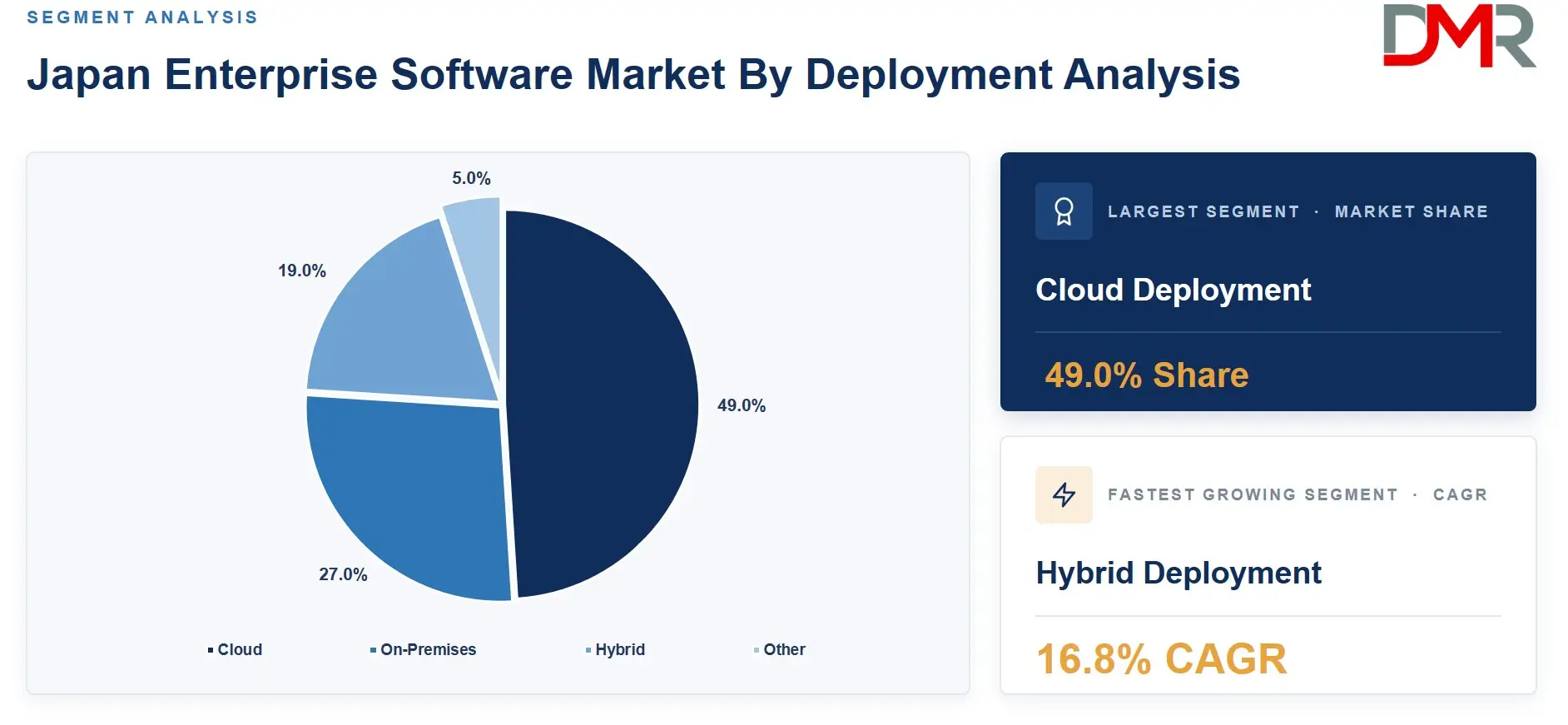
Cloud deployment is expected to lead in 2026 with around 49% of revenue, supported by subscription procurement, remote access and standardized updates. The steeper trajectory sits with hybrid deployment, growing at a CAGR of 16.8% as regulated organizations combine hosted applications with retained legacy and operational systems. On-premises software continues to serve sensitive workloads and highly customized processes. Buyers are not abandoning control; they are separating workloads by risk, latency and integration need. That pattern makes migration tools, API management and identity services central to the deployment decision.
By Function
Enterprise resource planning is set to represent close to 31% of function revenue in 2026 because finance, procurement and operations remain the backbone of modernization programs. Growth, however, is concentrated in analytics and AI applications, expanding at a CAGR of 20.6% as organizations seek timely recommendations from operational data. CRM, SCM and collaboration platforms extend the workflow footprint, but their expansion depends on integration with core records. Vendors with prebuilt connectors and Japanese business terminology can reduce adoption friction and improve the value of new analytical layers.
By End Use Industry
Manufacturing is expected to command approximately 29% of 2026 revenue, reflecting Japan's dense base of plants, suppliers and export-oriented producers. Growth is faster in healthcare, where software is projected to expand at a CAGR of 15.2% as providers digitize records, scheduling and administrative coordination. Banking and retail remain substantial buyers with stringent security requirements. Manufacturing demand increasingly links enterprise planning to factory data, while healthcare growth depends on interoperability, workflow redesign and support for smaller institutions.
By Distribution Channel
Direct sales are projected to hold nearly 55% of 2026 revenue because large accounts expect vendor accountability, architecture guidance and negotiated support. Partner-led distribution is growing faster at a CAGR of 14.7% as regional integrators and resellers extend reach into mid-sized firms. Marketplaces help buyers discover standardized applications but remain less influential for complex transformations. Channel economics favor vendors that certify local implementation capacity, publish integration patterns and share responsibility for adoption after the initial contract.
The Japan Enterprise Software Market Report is Segmented Based on the Following
By Offering
- Solutions
- Services
- Support
- Other
By Deployment
- Cloud
- On-Premises
- Hybrid
- Other
By Function
- ERP
- CRM
- SCM
- Analytics and AI
- Collaboration
- Other
By End Use Industry
- Manufacturing
- BFSI
- Retail
- Healthcare
- Government
- Other
By Distribution Channel
- Direct
- System Integrators and Resellers
- Cloud Marketplaces
- Other
Competitive Landscape
Competition combines product breadth with local delivery capability. Global vendors bring platform scale, while Japanese incumbents compete through trusted relationships, industry knowledge and integration services. Specialists differentiate in CRM, analytics, cybersecurity, workflow and vertical applications. Buyers often evaluate implementation risk, Japanese-language support, data controls and migration depth alongside feature coverage. Partnerships with system integrators and cloud providers remain a major route to market, particularly for mid-sized organizations. Consolidation is less about eliminating all alternatives than about reducing the number of platforms that IT teams must govern.
Some of the Prominent Players in the Japan Enterprise Software Market Are,
- Microsoft Corporation
- Oracle Corporation
- SAP SE
- IBM Corporation
- Salesforce, Inc.
- ServiceNow, Inc.
- Adobe Inc.
- Amazon Web Services, Inc.
- Google LLC
- Workday, Inc.
- Fujitsu Limited
- NEC Corporation
- Hitachi, Ltd.
- NTT DATA Group Corporation
- Ricoh Company, Ltd.
- Hitachi Solutions, Ltd.
- TIS Inc.
- SCSK Corporation
- Otsuka Corporation
- Works Applications Co., Ltd.
- Sansan, Inc.
- freee K.K.
- Money Forward, Inc.
- Cybozu, Inc.
- HENNGE K.K.
- Chatwork Co., Ltd.
- SmartHR, Inc.
- OBIC Co., Ltd.
- TKC Corporation
- ラクス株式会社
- Sansan Corporation
- Trend Micro Incorporated
- Geniee, Inc.
- Uzabase, Inc.
- WingArc1st Inc.
- QlikTech International AB
- Dassault Systèmes SE
- PTC Inc.
- Infor, Inc.
- Atlassian Corporation
- Other Key Players
Recent Developments
- In March 2026, Japan's public and enterprise technology buyers continued shifting new application budgets toward cloud, data platforms and AI-enabled workflows, increasing demand for integration and governance services.
- In January 2026, domestic software providers expanded packaged automation offerings for mid-sized companies, addressing the gap between large transformation programs and smaller firms with limited internal IT capacity.
- In August 2025, Japanese enterprises increased evaluation of generative AI controls for internal documents and customer workflows, making audit logs, permissions and human approval more important in software selection.
- In April 2025, manufacturers and logistics operators broadened investment in connected planning and operational analytics, linking enterprise applications with factory and warehouse data to improve labor productivity.
Report Details
| Report Characteristics |
| Market Size (2026) |
USD 14.8 Bn |
| Forecast Value (2035) |
USD 40.4 Bn |
| CAGR (2026-2035) |
11.8% |
| Historical Data |
2021 - 2025 |
| Forecast Data |
2026 - 2035 |
| Base Year |
2025 |
| Segments Covered |
By Offering, By Deployment, By Function, By End Use Industry, By Distribution Channel |
| Regional Coverage |
Japan |
Frequently Asked Questions
How big is the Japan Enterprise Software Market?
▾ The Japan Enterprise Software Market is estimated at USD 14.8 Bn in 2026 and is projected to reach USD 40.4 Bn by 2035.
What is the growth rate of the Japan Enterprise Software Market?
▾ The market is anticipated to expand at a CAGR of 11.8% from 2026 to 2035, supported by cloud migration, automation and data-intensive applications.
Which region holds the largest share in the Japan Enterprise Software Market?
▾ Kanto holds the largest domestic concentration, accounting for around 52% of demand in 2026 because corporate headquarters, financial institutions and technology suppliers are clustered around Tokyo.
Who are the key players in the Japan Enterprise Software Market?
▾ Leading participants include Microsoft, Oracle, SAP, Fujitsu, NEC, NTT DATA and Salesforce. Competition also includes Japanese specialists in accounting, workflow, HR, cybersecurity and collaboration.
Which offering leads the Japan Enterprise Software Market?
▾ Solutions are expected to lead in 2026 with approximately 68% of revenue. Their position reflects the central role of ERP, CRM, SCM and analytics applications in enterprise modernization programs.
What is the fastest-growing deployment in the Japan Enterprise Software Market?
▾ Hybrid deployment is forecast to grow at a CAGR of 16.8% between 2026 and 2035 as organizations retain sensitive or customized workloads while adopting cloud applications for standardized processes.
What industries generate demand for the Japan Enterprise Software Market?
▾ Manufacturing is the largest end-use industry at approximately 29% of 2026 revenue, while healthcare is expanding faster as providers digitize records, scheduling, administration and coordination.