Market Overview
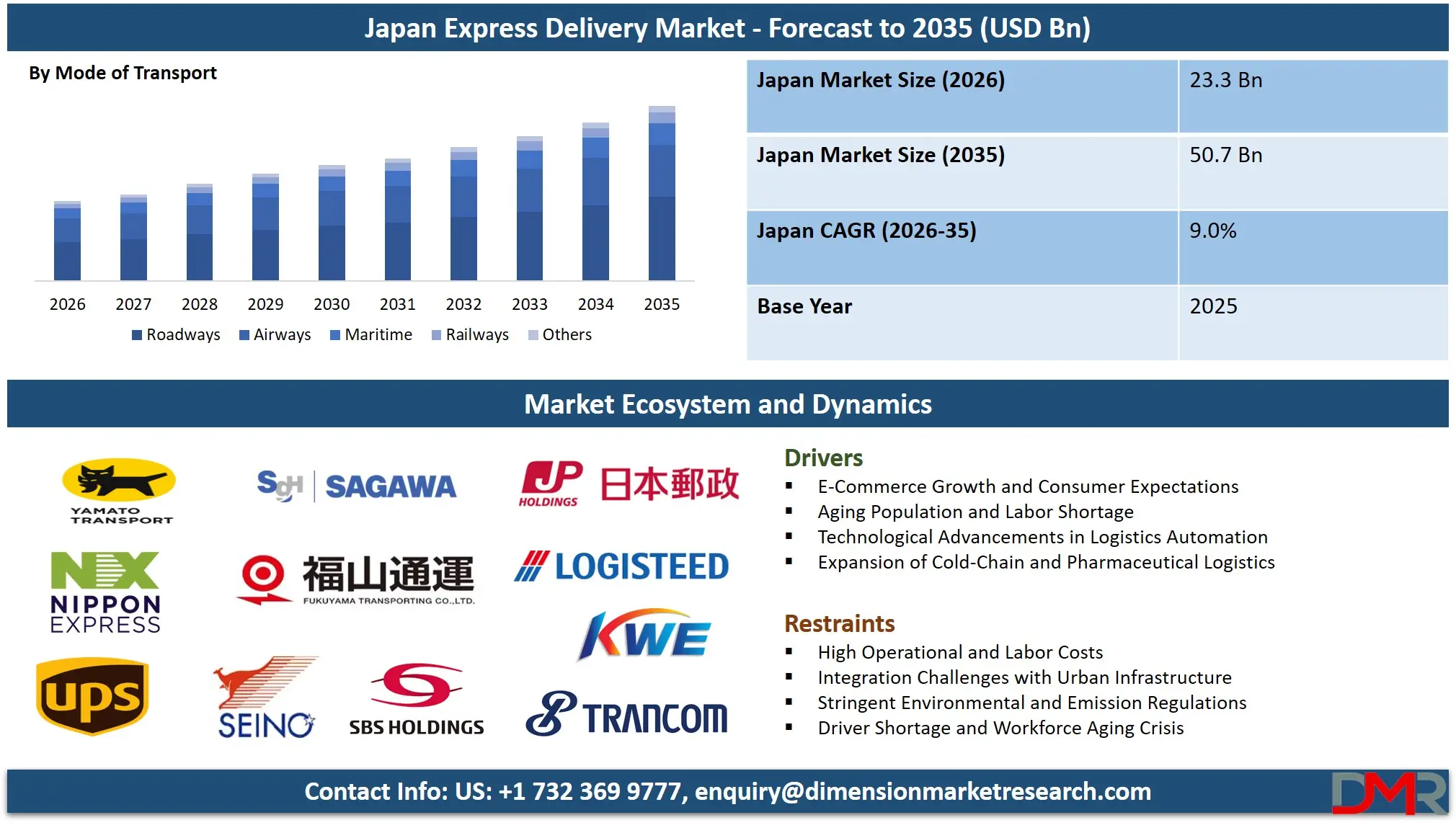
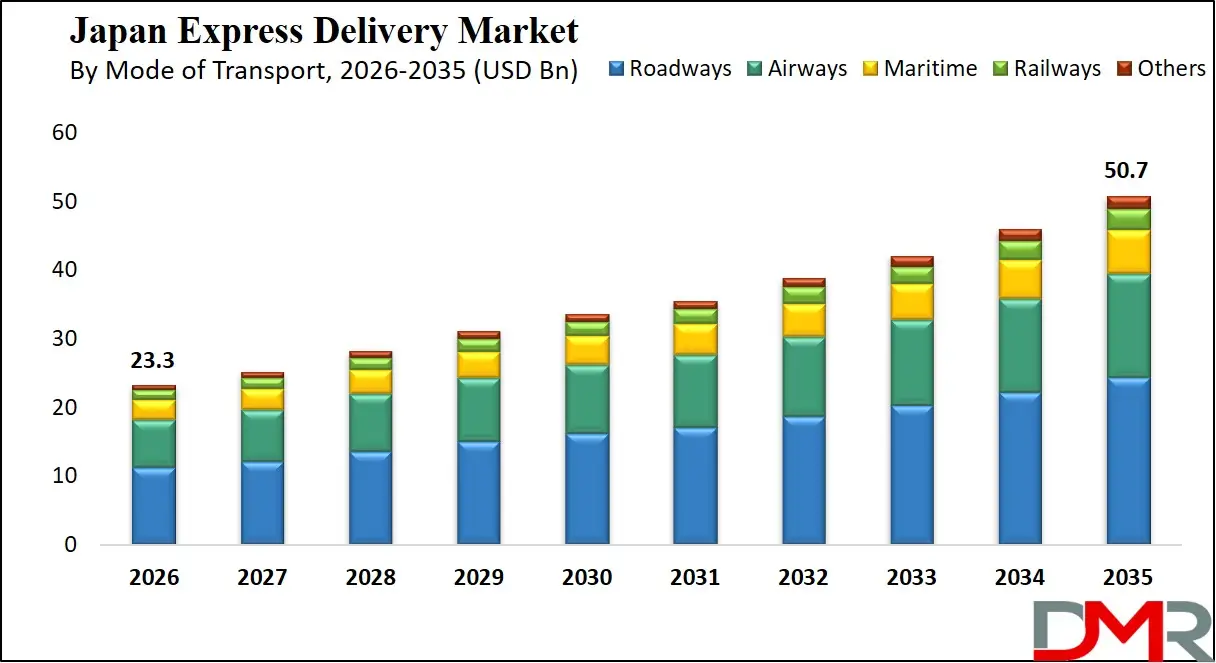
The Japan Express Delivery Market is projected to attain a valuation of USD 23.3 billion in 2026 and is expected to expand significantly, reaching USD 50.7 billion by 2035, advancing at a robust compound annual growth rate (CAGR) of 9.0% during the forecast period.
ℹ
To learn more about this report –
Download Your Free Sample Report Here
This growth reflects Japan's position as a technologically advanced nation with a highly sophisticated logistics infrastructure and a strong e-commerce culture. The demand for time-definite delivery, same-day shipping, and cold-chain logistics is accelerating across industries including e-commerce, healthcare, manufacturing, and automotive.
Japan has historically been a global leader in logistics efficiency and supply chain management. The integration of advanced technologies such as IoT, AI route optimization, and automated sorting systems is becoming central to the country's next-generation logistics transformation. Japan's densely populated urban centers, high consumer expectations, and strong industrial base are pushing logistics providers to adopt faster and more reliable delivery services at an unprecedented pace.
Government initiatives such as the Digital Garden City Nation vision and logistics digitization policies aim to modernize Japan's freight network and address critical labor shortages. These programs promote investment in automated warehouses, drone delivery systems, and green logistics, creating a favorable ecosystem for express delivery innovation.
Japan's demographic trends also strongly support adoption. According to national projections, nearly 30% of Japan's population is over the age of 65, creating strong demand for medical deliveries, pharmaceutical logistics, and assisted living supply chains. Logistics companies are developing specialized express services capable of handling temperature-sensitive medications, delivering to remote areas, and supporting healthcare providers.
The e-commerce sector remains another major growth pillar. Japan boasts one of the largest online retail markets globally, with consumers demanding increasingly shorter delivery windows. Retail giants and marketplace platforms are integrating express delivery solutions to enable same-day shipping, convenient returns, and real-time shipment tracking.
ℹ
To learn more about this report –
Download Your Free Sample Report Here
In the business-to-business (B2B) sector, express delivery is transforming supply chain operations through just-in-time inventory management, spare parts logistics, and urgent document delivery. Meanwhile, logistics technology startups are actively developing autonomous delivery vehicles, smart locker systems, and AI-driven dispatch platforms for last-mile efficiency.
Japan's unique combination of technological leadership, demographic necessity, industrial strength, and government-backed modernization programs positions the country as one of the most influential markets for express delivery globally.
Japan Express Delivery Market: Key Takeaways
- Market Size Insights: The Japan Express Delivery Market is estimated at USD 23.3 billion in 2026 and is expected to reach USD 50.7 billion by 2035.
- Market Growth Rate: The market is projected to grow at a CAGR of 9.0% from 2026 to 2035.
- Key Players: Major players in the Japan Express Delivery Market include Yamato Holdings Co., Sagawa Express Co., Japan Post Co., DHL Japan, FedEx Japan, UPS Japan, Seino Holdings Co., Nippon Express Holdings, and others.
- Domestic Delivery as the Core Growth Driver: Domestic express delivery is expected to dominate the Japanese market due to the country's high population density and intense e-commerce activity concentrated in major metropolitan areas.
- E-commerce as the Leading End-User Industry: Japan's massive online retail sector relies heavily on express delivery networks to meet consumer expectations for rapid shipping and convenient returns.
- Government Policy as a Catalyst: Programs such as the Digital Garden City Nation vision promote logistics modernization and accelerate the adoption of automated delivery technologies.
Impact of the Iran Conflict on the Japan Express Delivery Market
- Supply Chain Disruptions in Logistics Technology Components: The express delivery ecosystem relies heavily on vehicle telematics, sorting automation, and tracking hardware. The Iran conflict has raised concerns about disruptions in the supply of critical materials and semiconductors used in these technologies. Shortages or delays in component production can slow the deployment of advanced logistics platforms used in express delivery networks.
- Rising Fuel Costs Affecting Operations: The conflict has triggered volatility in global oil markets, with energy prices increasing due to disruptions in Middle Eastern supply routes. Higher fuel costs increase operational expenses for delivery fleets, potentially raising shipping rates and compressing margins for logistics providers in Japan.
- Logistics and Trade Route Risks: Shipping routes in the Persian Gulf are critical for global trade between Asia and the Middle East. Instability in the region creates risks for international express shipments, potentially delaying the delivery of cross-border parcels and industrial materials needed for just-in-time supply chains.
- Increased Focus on Supply Chain Resilience: Geopolitical tensions often accelerate investment in diversified logistics networks and domestic supply chain resilience. This could increase demand for robust, technology-enabled express delivery services within Japan, as businesses seek to secure critical supply lines against global disruptions.
Japan Express Delivery Market: Use Cases
- E-commerce Fulfillment and Last-Mile Delivery: Japan's thriving e-commerce sector is significantly accelerating the deployment of express delivery in last-mile logistics. Delivery platforms enable consumers to receive online orders within hours of purchase, supporting the growth of digital retail and direct-to-consumer business models.
- Healthcare and Pharmaceutical Logistics: Japan's rapidly aging population is driving significant demand for express delivery technologies in healthcare supply chains. Temperature-controlled vehicles and real-time monitoring systems are being deployed to transport medications, medical devices, and lab specimens with guaranteed delivery windows.
- Manufacturing and Industrial Parts Supply: Japan's globally recognized manufacturing sector relies heavily on express delivery for just-in-time inventory management. Express delivery enables rapid replenishment of production lines, urgent delivery of spare parts, and time-critical shipments between industrial facilities.
- Disaster Response and Emergency Logistics: Japan's exposure to natural disasters has encouraged the development of express delivery systems for emergency response operations. Logistics networks are capable of rapidly deploying supplies, medicines, and equipment to affected areas, supporting relief efforts and maintaining supply continuity.
- Retail and Omnichannel Integration: Express delivery services are increasingly used within Japan's retail sector to support omnichannel operations. Retailers deploy express networks for ship-from-store programs, buy-online-pick-up-in-store (BOPIS) fulfillment, and rapid home delivery of large or bulky items.
Japan Express Delivery Market: Stats & Facts
Ministry of Land, Infrastructure, Transport and Tourism (MLIT)
- Japan's logistics sector handles over 40 billion tons of freight annually, with express delivery representing a growing share.
- The government's logistics digitization strategy aims to improve supply chain efficiency and reduce carbon emissions through smart logistics technologies.
- MLIT supports several logistics innovation hubs and smart city pilot programs across the country.
Japan Trucking Association
- The domestic trucking fleet consists of over 600,000 commercial vehicles, with a significant portion dedicated to express delivery services.
- Japan maintains one of the highest densities of delivery vehicles per capita among developed nations.
Ministry of Internal Affairs and Communications
- Japan's e-commerce market exceeds USD 150 billion annually, driving substantial demand for parcel delivery services.
- Over 80% of Japanese consumers use online shopping platforms, with expectations for fast and reliable shipping continuing to rise.
World Bank
- Japan's working-age population is projected to decline substantially by 2040, increasing the need for automated logistics and delivery technologies.
- Logistics automation adoption is helping maintain stable delivery productivity despite workforce reductions.
Ministry of Health, Labour and Welfare
- Japan has one of the highest life expectancies globally, averaging approximately 84 years.
- Cold-chain express delivery adoption is increasing as healthcare providers address the challenges of distributing temperature-sensitive medications to an aging population.
Japan Direct Marketing Association
- The recurring delivery and subscription e-commerce market has grown significantly, with consumers relying on scheduled express deliveries for daily essentials.
Japan Express Delivery Market: Market Dynamics
Driving Factors in the Japan Express Delivery Market
E-Commerce Growth and Consumer Expectations
Japan's rapidly expanding e-commerce sector is one of the strongest drivers for express delivery adoption. As online retail penetration deepens, consumers increasingly expect faster, more flexible delivery options. Express delivery services capable of offering same-day or next-day shipping have become essential competitive differentiators for retailers. In urban areas, delivery density and route optimization allow providers to offer increasingly narrow delivery windows. By supporting both business-to-consumer (B2C) and consumer-to-consumer (C2C) platforms, express delivery technologies are becoming essential tools for addressing consumer demands and maintaining e-commerce growth.
Aging Population and Labor Shortage
Japan's demographic transition toward an aging population is reshaping the express delivery industry. As the working-age population declines, logistics providers are increasingly turning to automation and network optimization to maintain service levels and operational stability. Delivery companies are implementing route optimization algorithms, automated sorting facilities, and self-driving delivery vehicles to reduce reliance on manual labor. By supporting both operational efficiency and service reliability, express delivery innovations are becoming essential tools for addressing Japan's workforce shortages and maintaining supply chain continuity.
Restraints in the Japan Express Delivery Market
High Operational and Labor Costs
The operation of express delivery networks requires substantial investment in vehicles, sorting facilities, technology platforms, and labor resources. These expenses involve significant capital and ongoing operational investments. As a result, maintaining profitability remains challenging, particularly for small and medium-sized logistics providers. Organizations must also invest in workforce training, safety compliance, and fleet maintenance, which can further increase operational expenses.
Integration Challenges with Urban Infrastructure
Many urban areas in Japan operate with established infrastructure that was not originally designed for high-density delivery traffic. Integrating express delivery operations into these environments often requires route restrictions, parking solutions, and coordination with local municipalities. These challenges can slow delivery times and increase operational complexity for providers navigating congested metropolitan areas.
Opportunities in the Japan Express Delivery Market
Expansion of Cold-Chain and Pharmaceutical Logistics
Japan's rapidly aging population creates a substantial opportunity for express delivery technologies in pharmaceutical and healthcare logistics. As the demand for temperature-sensitive medications, biologics, and medical supplies continues to rise, specialized delivery solutions are increasingly being adopted to support healthcare providers and improve patient outcomes. Temperature-controlled vehicles and containers help maintain product integrity during transit, while real-time monitoring systems ensure compliance with strict regulatory requirements. Express delivery networks can prioritize urgent medical shipments, delivering critical supplies to hospitals, clinics, and home care patients within guaranteed time windows. These technologies help healthcare providers maintain consistent patient care while managing complex supply chain requirements. As investment in healthcare infrastructure continues, specialized express delivery solutions are expected to become essential tools in addressing Japan's long-term healthcare and demographic challenges.
Autonomous Delivery and Smart Logistics
Express delivery technologies are expected to play an important role in advancing autonomous delivery and smart infrastructure development across Japan. The integration of AI-powered robotics into last-mile logistics aligns closely with Japan's vision of creating digitally connected societies through national modernization initiatives. Autonomous delivery vehicles, drone delivery systems, and smart locker networks can enhance operational efficiency and service coverage across cities and rural areas. These systems are capable of navigating urban environments, optimizing delivery routes in real-time, and providing contactless delivery options. As urban populations remain concentrated in major metropolitan areas, smart logistics solutions supported by express delivery technology will help improve service levels, optimize city operations, and reduce environmental impact.
Trends in the Japan Express Delivery Market
Expansion of Automated Sorting and Fulfillment
Japan continues to lead global innovation in logistics automation, particularly in parcel sorting and fulfillment operations. Automated sorting systems, equipped with advanced sensors, machine vision, and AI-driven control systems, enable efficient processing of high parcel volumes with minimal manual intervention. In major sorting facilities, automated systems handle thousands of parcels per hour, directing shipments to appropriate delivery routes with high precision. Beyond sorting, automation is also expanding into warehouse fulfillment and last-mile preparation. By combining automated systems with human oversight, organizations can achieve greater operational efficiency while managing labor constraints, making logistics automation a key trend in Japan's evolving express delivery ecosystem.
Growth of On-Demand and Instant Delivery
On-demand delivery services powered by digital platforms are increasingly being adopted across Japan's urban centers. These services are designed to connect consumers directly with couriers, providing delivery within minutes or hours of order placement. In food delivery, grocery, and convenience retail segments, on-demand platforms enable rapid fulfillment of immediate consumer needs. The combination of mobile applications, real-time tracking, and dynamic routing allows these services to operate efficiently in densely populated areas. As consumers seek greater convenience and immediacy in their daily lives, on-demand and instant delivery is becoming a rapidly growing trend within Japan's express delivery market.
Japan Express Delivery Market: Research Scope and Analysis
By Destination Analysis
Domestic Delivery is projected to dominate the Destination segment of the Japan Express Delivery Market. This dominance is driven by the sheer volume of intra-country e-commerce parcels, the ability to offer compressed delivery windows (next-day, same-day) within Japan's dense and highly efficient transport networks, and the operational control major carriers such as Yamato Holdings, Sagawa Express, and Japan Post maintain over domestic line-haul and last-mile assets. Domestic express provides the highest density economics, particularly in major metropolitan corridors like Tokyo, Osaka, and Nagoya, and enables premium service tiers with reliable time-definite commitments such as morning delivery slots and scheduled delivery windows. While International Delivery addresses the critical need for cross-border trade and global supply chain connectivity for Japan's export-driven industries, its adoption is constrained by customs clearance variability, longer transit times, and higher unit costs. Therefore, the imperative for rapid, cost-efficient fulfillment of domestic e-commerce orders, coupled with continuous investment in automated sortation and urban delivery infrastructure to address persistent labor shortages, secures Domestic Delivery's leading market position throughout the forecast period.
International Delivery represents a strategically vital and growing segment of the Japan Express Delivery Market, serving the needs of the world's third-largest economy and its extensive global trade networks. Its importance is underscored by Japan's position as a major exporter of automotive, electronics, and precision machinery, all of which require time-definite shipping of parts, prototypes, and finished goods to global markets. This segment relies on complex multimodal networks, with air freight as the primary enabler of speed, supported by sophisticated customs brokerage capabilities and strategic partnerships with global integrators such as DHL, FedEx, and UPS operating through major gateways at Narita and Kansai airports. The growth of International Delivery is fueled by the expansion of cross-border e-commerce, where Japanese consumers purchase from overseas platforms and domestic brands reach international customers directly. As trade digitization advances through Japan's Nippon Automated Cargo Clearance System, International Delivery is positioned for robust growth, becoming an increasingly accessible and essential component of Japan's logistics infrastructure.
By Business Model Analysis
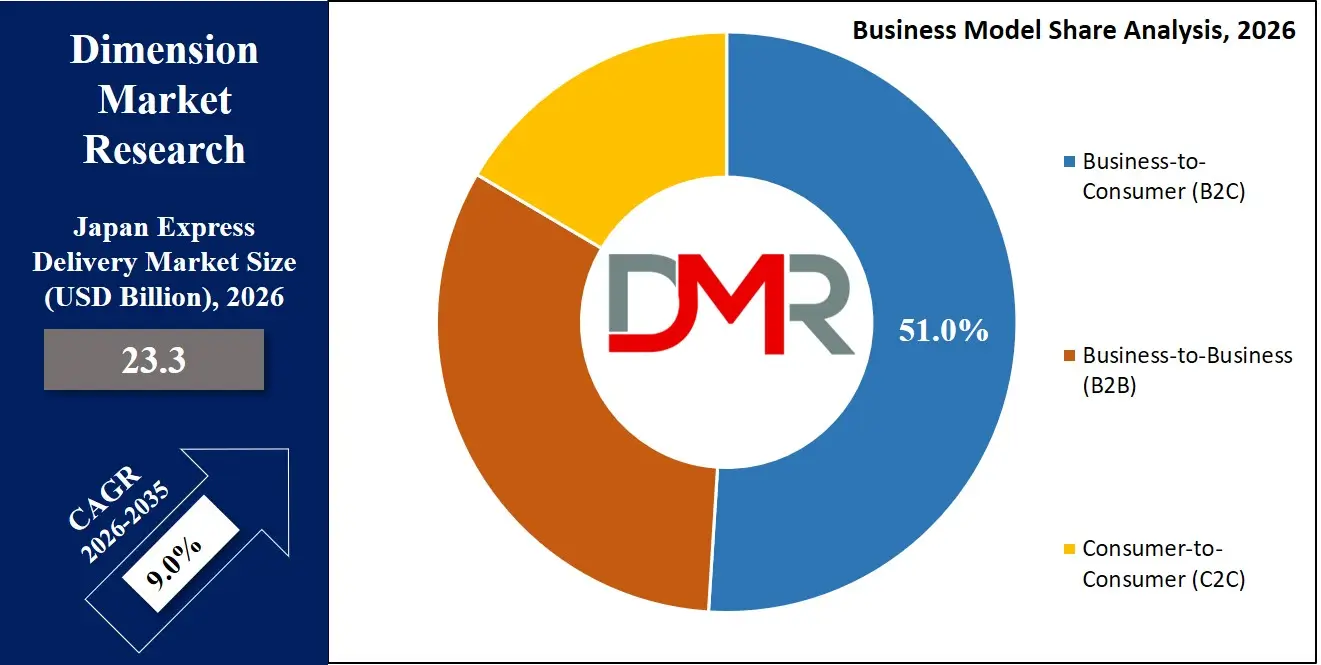
Business-to-Consumer (B2C) Delivery is projected to dominate the Japan Express Delivery Market, as it represents the fastest-growing and most volume-intensive segment of domestic logistics. Its dominance stems from the structural shift of retail to online channels, with Japan's e-commerce market exceeding USD 150 billion annually and penetration rates continuing to rise across all demographic groups. Consumer expectations for transparent, flexible delivery experiences, including real-time tracking, one-hour delivery windows, and convenient redelivery options through convenience store pickup or smart lockers, have elevated delivery performance to a strategic priority for e-commerce conversion and customer retention. The driving forces are the maturation of omnichannel retail strategies among Japanese merchants, the proliferation of direct-to-consumer brands, and the increasing willingness of consumers to pay for delivery speed and convenience. As e-commerce penetration deepens, the economic and operational case for B2C shipment scale becomes compelling, making it the primary engine of growth and innovation in Japan's express delivery ecosystem.
ℹ
To learn more about this report –
Download Your Free Sample Report Here
Business-to-Business (B2B) Delivery remains a crucial and high-revenue segment, serving the time-definite transport of documents, spare parts, and finished goods across Japan's industrial and commercial supply chains. By providing reliable, auditable, and often contractually-guaranteed service, it enables just-in-time inventory strategies and operational continuity for sectors like automotive manufacturing, where production lines depend on precisely timed parts deliveries, and electronics production requiring rapid component replenishment. This balance of revenue stability, long-term client relationships, and high-value shipment composition makes it a foundational and enduring segment. The Consumer-to-Consumer (C2C) model, facilitated by the massive popularity of peer-to-peer marketplaces like Mercari and Rakuten Rakuma, contributes significant and growing volume, relying on simplified, affordable shipping solutions such as prepaid QR code labels available at convenience stores nationwide, integrating express delivery directly into the C2C transaction experience and addressing the reality that individual sellers require enterprise-grade logistics simplicity.
By Mode of Transport Analysis
Roadways forms a fundamental and dominant transport mode segment, as trucks and light commercial vehicles provide the essential connectivity between air hubs, sortation centers, and final delivery destinations across Japan's four main islands. Surface transportation is indispensable for first-mile collection from thousands of retail and business locations, line-haul between major metropolitan markets via the extensive expressway network connecting the Pacific Belt zone, and the vast majority of last-mile customer contacts in dense urban environments. The roadways segment is undergoing transformation through AI-powered route optimization, investment in electric delivery vehicles to meet sustainability commitments, and pilot programs for autonomous delivery vehicles addressing the critical shortage of delivery drivers. With over 600,000 commercial vehicles operating in logistics fleets and continuous pressure to improve efficiency while reducing environmental impact, roadways maintains its position as the indispensable backbone of Japan's express delivery network.
Airways is another critical and high-value segment, directly correlated to time-definite commitments over long distances and international corridors. Freighters and commercial belly-cargo capacity operating through Japan's major international airports enable next-morning delivery commitments across domestic long-haul routes connecting Hokkaido to Kyushu and maintain the integrity of integrated express networks for international shipments. The segment is essential for intercontinental express delivery and for connecting remote islands and northern regions where ground transport alone cannot meet next-day service guarantees. While representing a higher cost structure, the speed and reliability of air transport are non-negotiable for industries like healthcare requiring urgent medical device delivery and international e-commerce, ensuring its continued strategic importance. Railways serves specific corridor applications, particularly for high-density freight movement between Tokyo and Osaka, offering a reliable alternative to road transport. Maritime serves specialized applications for express delivery to Japan's remote islands where surface transport provides the only practical connection.
By Shipment Weight Analysis
Lightweight shipments dominate Japan's express delivery volume, driven by e-commerce parcels, documents, and small electronics that constitute the vast majority of B2C and C2C shipments. Its dominance stems from the exponential growth of online retail, where the majority of consumer purchases from fashion items to books and household goods fall within lightweight categories under 5 kilograms that can be efficiently processed through automated sorting systems. The driving forces are rising B2C parcel volumes, consumer expectations for affordable shipping rates, and continuous compression of carrier cost-to-serve through route optimization and automated sorting technologies designed specifically for small package handling at facilities capable of processing tens of thousands of parcels per hour. As e-commerce penetration deepens and delivery frequency increases through subscription models, the economic and operational case for lightweight shipment scale becomes compelling, making it the primary driver of overall market volume and the focus of intense logistical innovation in last-mile efficiency.
Heavyweight shipments form the premium revenue tier for B2B freight express, industrial equipment, automotive parts, and bulk healthcare logistics requiring specialized handling. This segment serves assets where shipment value justifies expedited, white-glove treatment and where production stoppage costs in just-in-time manufacturing environments far exceed transport premiums for guaranteed delivery windows. By providing time-definite, heavy-lift capability with specialized equipment including lift-gate trucks, it enables just-in-time manufacturing replenishment for automotive plants operating with minimal inventory buffers and urgent shipment of industrial components for emergency repairs. This balance of premium pricing and mission-critical application makes it a resilient and high-margin practice within Japan's express delivery market, addressing the reality that not every heavyweight move requires express speed, but for those that do, whether for production continuity or emergency response, the cost is readily justified by the value of operational reliability.
By Service Type Analysis
Time-Definite Delivery (Express) is the foundational premium tier in the Japanese market guaranteeing delivery by a specified time, typically morning delivery by 10:00 AM or 12:00 PM, with full tracking, proof of delivery, and service guarantees that include compensation for missed commitments. Its dominance in premium segments stems from the non-negotiable nature of legal document exchanges, financial institution settlements, and healthcare shipments where lateness carries contractual penalties, regulatory compliance risks, or clinical consequences for patient care. The driving forces are Japan's concentrated business districts where time-critical document exchange remains essential, just-in-time business processes, and regulatory requirements for auditable chain-of-custody in pharmaceutical distribution. As enterprises continue to prioritize operational certainty, the economic case for time-definite commitments remains resilient, with corporate clients willing to pay substantial premiums for guaranteed delivery windows that enable lean inventory strategies across distributed business networks.
Next-Day Delivery has become the universal e-commerce baseline across Japan's mature retail market, frequently included in standard shipping thresholds or loyalty program benefits offered by major online platforms and retailers. This segment serves the deeply embedded expectation that online orders placed by cutoff times arrive the following day, a standard now firmly established in Japanese consumer purchasing behavior that drives platform selection and repeat purchase decisions. Its strength lies in massive addressable volume from both B2C and B2B shipments and the operational discipline of evening cutoff coordination, overnight line-haul between regional sortation centers, and dawn sortation cycles enabling morning dispatch for afternoon delivery completion. This equilibrium of consumer expectation and carrier economics makes it the volume anchor of Japan's integrated express industry, addressing the reality that next-day is no longer a premium upcharge but a competitive necessity across both consumer and business segments. Same-Day Delivery represents the fastest-growing premium tier in major metropolitan areas, serving urgent e-commerce and business needs. Instant Delivery (On-Demand) pushes this further with delivery within minutes or hours for food and convenience items. Deferred Delivery (Standard) serves cost-sensitive customers prioritizing affordability over speed. Freight Express addresses heavyweight and palletized shipments requiring expedited handling with specialized freight equipment.
By End-User Industry Analysis
Retail & E-commerce is poised to be the largest and most dominant vertical in the Japan Express Delivery Market, encompassing omnichannel merchants, marketplace sellers, direct-to-consumer brands, and traditional retailers transitioning to digital fulfillment models. The high velocity of parcel generation from Japan's massive online retail sector, intense delivery speed competition among major platforms like Rakuten, Amazon Japan, and ZOZOTOWN, and strategic importance of returns logistics for fashion and general merchandise create a perfect use case for time-definite, next-day, and same-day express services to secure customer loyalty and repeat purchase behavior. This vertical drives continuous innovation in last-mile delivery, including convenience store pickup networks, smart locker installations, and precise delivery slot scheduling that accommodates Japanese consumer preferences for reliability and convenience, cementing its position as the primary demand generator for the entire market.
Healthcare & Pharmaceuticals ranks as the second-fastest-growing vertical, fueled by the expansion of direct-to-patient pharmacy services, specialty drug distribution requiring cold-chain integrity, and clinical trial logistics supporting Japan's pharmaceutical research sector. The criticality of temperature-controlled transport for biologics and vaccines, chain-of-custody documentation required for regulatory compliance, and time-definite delivery for surgical supplies positions express delivery as essential infrastructure for modern healthcare supply chains serving Japan's aging population. The demographic imperative of supporting a society where nearly 30% of citizens are over 65 creates sustained demand for reliable delivery of medications and medical equipment directly to patients, reducing burden on caregivers while maintaining treatment continuity and quality of life. Technology & Electronics is a major adopter driven by product launch cycles, high-value compact shipments, and urgent field replacement requirements. Automotive & Industrial relies on express delivery for just-in-time parts replenishment and prototype shipping. Manufacturing depends on express networks for production line continuity. Banking, Financial Services & Insurance (BFSI) requires express delivery for time-sensitive document exchange. Construction utilizes express services for urgent equipment parts and material samples, completing the diverse end-user landscape that collectively drives Japan's express delivery market toward its projected growth trajectory.
The Japan Express Delivery Market Report is segmented on the basis of the following:
By Destination
By Business Model
- Business-to-Business (B2B)
- Business-to-Consumer (B2C)
- Consumer-to-Consumer (C2C)
By Mode of Transport
- Roadways
- Airways
- Railways
- Maritime
- Others
By Shipment Weight
- Lightweight
- Medium Weight
- Heavyweight
By Service Type
- Time-Definite Delivery (Express)
- Deferred Delivery (Standard)
- Same-Day Delivery
- Next-Day Delivery
- Instant Delivery (On-Demand)
- Freight Express
By End-User Industry
- Retail & E-commerce
- Healthcare & Pharmaceuticals
- Automotive & Industrial
- Banking, Financial Services & Insurance (BFSI)
- Technology & Electronics
- Manufacturing
- Construction
- Others
Japan Express Delivery Market: Competitive Landscape
The competitive landscape of the Japan Express Delivery Market is characterized by the presence of globally recognized logistics providers, advanced transportation companies, and technology innovators that are continuously advancing delivery networks and service offerings. Japan has one of the most mature logistics ecosystems in the world, supported by strong infrastructure, extensive transport networks, and government-backed modernization programs. Leading companies such as Yamato Holdings, Sagawa Express, and Japan Post dominate the domestic express delivery segment by integrating AI-driven route optimization, real-time tracking, and automated sorting technologies into their operations.
ℹ
To learn more about this report –
Download Your Free Sample Report Here
In addition to domestic logistics leaders, international express providers such as DHL Japan, FedEx Japan, and UPS Japan are actively developing cross-border delivery solutions and specialized services. These organizations focus on international express shipping, customs clearance, and time-critical logistics designed for business-to-business (B2B) and business-to-consumer (B2C) environments. Their innovations emphasize reliability, speed, and real-time visibility that allow shippers to manage global supply chains effectively.
Japan's logistics innovation is further strengthened by collaboration between corporations, technology companies, and government agencies. Universities and research institutions frequently partner with private companies to accelerate advancements in autonomous delivery, drone logistics, and smart infrastructure. Programs under national logistics modernization initiatives encourage the commercialization of next-generation delivery technologies and sustainable logistics platforms.
Overall, Japan's competitive landscape combines established logistics leaders with emerging technology-focused delivery startups, creating a highly dynamic ecosystem that supports innovation, service expansion, and large-scale deployment of express delivery solutions across multiple sectors.
Some of the prominent players in the Japan Express Delivery Market are:
- Yamato Transport
- Sagawa Express
- Japan Post Holdings
- Nippon Express
- Seino Holdings
- Fukuyama Transporting
- Logisteed
- Kintetsu World Express
- SBS Holdings
- Trancom
- Senko Group Holdings
- Nittsu NEC Logistics
- ASKUL Logistics
- Maruzen Showa Unyu
- Konoike Transport
- DHL Express (Japan)
- FedEx (Japan)
- United Parcel Service (Japan)
- Amazon Logistics (Japan)
- Rakuten Super Logistics
- Other Key Players
Recent Developments in the Japan Express Delivery Market
- November 2025: Yamato Transport launched same-day TA-Q-BIN delivery services along with revised intra-prefecture pricing, aimed at enhancing delivery speed, improving service flexibility, and strengthening its competitive position in Japan’s rapidly evolving express delivery market.
- August 2025: Japan Post Holdings announced a large-scale investment of approximately USD 2.3 billion aimed at transforming its logistics infrastructure, focusing on parcel delivery expansion, automation, and network optimization to address declining mail volumes and growing e-commerce demand.
- August 2025: Japan Local Network System, supported by logistics operators including Yamato Transport, signed a collaboration agreement to expand joint transportation and delivery networks, aiming to improve nationwide logistics efficiency, reduce operational bottlenecks, and strengthen regional delivery connectivity.
- April 2025: Nippon Express collaborated with Kansai Airports and ANA Cargo to support the Pharma Logistics Masterclass initiative in Japan, focusing on enhancing temperature-controlled logistics and strengthening pharmaceutical supply chain capabilities.
- March 2025: Nippon Express collaborated with Kansai Airports and ANA Cargo to support advanced pharmaceutical logistics initiatives in Japan, focusing on improving temperature-controlled delivery, enhancing supply chain reliability, and strengthening healthcare logistics capabilities.
Report Details
| Report Characteristics |
| Market Size (2026) |
USD 23.3 Bn |
| Forecast Value (2035) |
USD 50.7 Bn |
| CAGR (2026–2035) |
9.0% |
| Historical Data |
2021 – 2025 |
| Forecast Data |
2027 – 2035 |
| Base Year |
2025 |
| Estimate Year |
2026 |
| Report Coverage |
Market Revenue Estimation, Market Dynamics, Competitive Landscape, Growth Factors and etc. |
| Segments Covered |
By Destination (Domestic and International), By Business Model (Business-to-Business (B2B), Business-to-Consumer (B2C) and Consumer-to-Consumer (C2C)), By Mode of Transport (Roadways, Airways, Railways, Maritime and Others), By Shipment Weight (Lightweight, Medium Weight and Heavyweight), By Service Type (Time-Definite Delivery (Express), Deferred Delivery (Standard), Same-Day Delivery, Next-Day Delivery, Instant Delivery (On-Demand) and Freight Express), By End-User Industry (Retail & E-commerce, Healthcare & Pharmaceuticals, Automotive & Industrial, Banking, Financial Services & Insurance (BFSI), Technology & Electronics, Manufacturing, Construction and Others) |
| Country Coverage |
Japan |
| Prominent Players |
Yamato Transport, Sagawa Express, Japan Post Holdings, Nippon Express, Seino Holdings, Fukuyama Transporting, Logisteed, Kintetsu World Express, SBS Holdings, Trancom, Senko Group Holdings, Nittsu NEC Logistics, ASKUL Logistics, Maruzen Showa Unyu, Konoike Transport, DHL Express (Japan), FedEx (Japan), United Parcel Service (Japan), Amazon Logistics (Japan), Rakuten Super Logistics, and Other Key Players |
| Purchase Options |
We have three licenses to opt for: Single User License (Limited to 1 user), Multi-User License (Up to 5 Users), and Corporate Use License (Unlimited User) along with free report customization equivalent to 0 analyst working days, 3 analysts working days and 5 analysts working days respectively. |
Frequently Asked Questions
How big is the Japan Express Delivery Market?
▾ The Japan Express Delivery Market size is estimated to have a value of USD 23.3 billion in 2026 and is expected to reach USD 50.7 billion by the end of 2035.
What is the growth rate in the Japan Express Delivery Market in 2026?
▾ The market is growing at a CAGR of 9.0% over the forecasted period of 2026.
Who are the key players in the Japan Express Delivery Market?
▾ Some of the major key players in the Japan Express Delivery Market are Yamato Transport, Sagawa Express, Japan Post Holdings, Nippon Express, Seino Holdings, Fukuyama Transporting, and many others.