What is the Japan Facial Recognition Market Size?
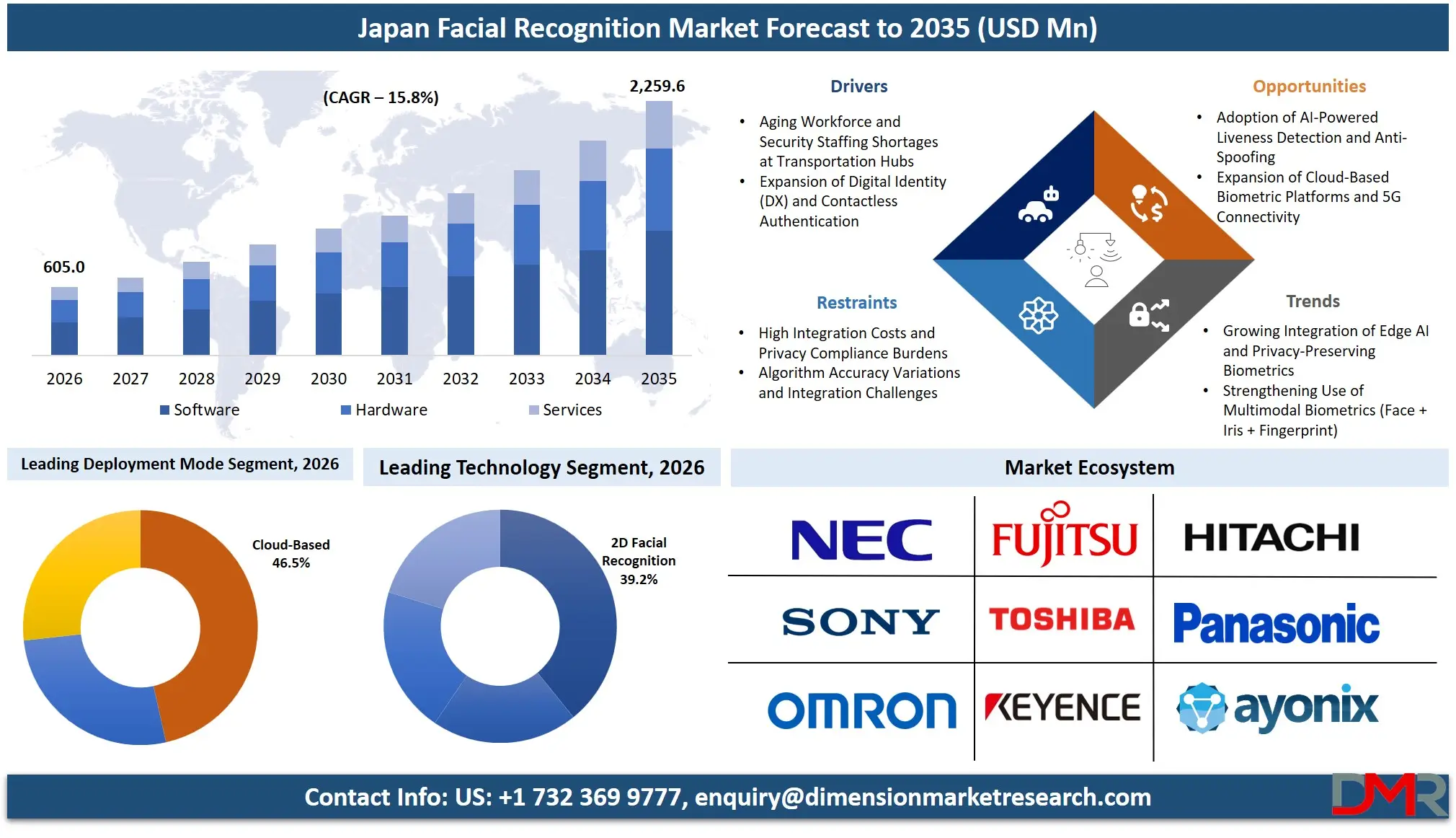
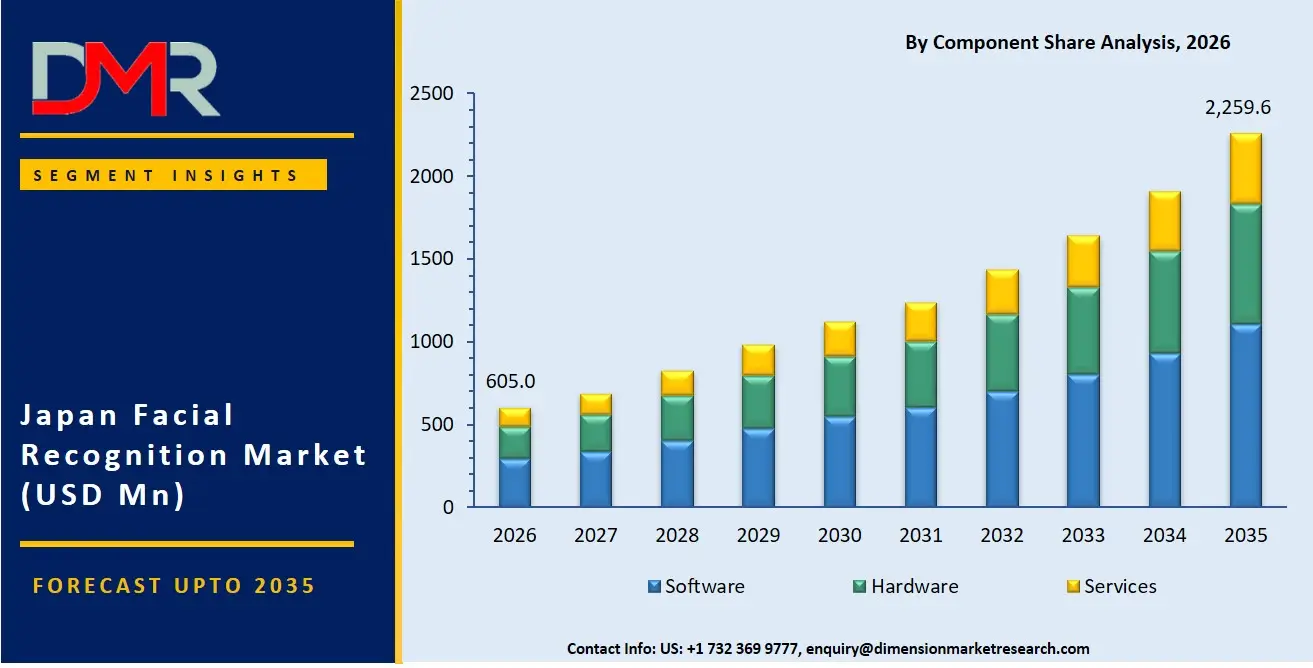
The Japan Facial Recognition Market size is expected to reach USD 605.0 million in 2026 and is likely to grow to USD 2,259.6 million by 2035, progressing at a CAGR of 15.8% during the forecast period.
ℹ
To learn more about this report –
Download Your Free Sample Report Here
The facial recognition market has been showing consistent growth due to Japan's rising dependence on advanced biometric authentication solutions that seamlessly integrate AI-powered facial matching for real-time identity verification and liveness detection. This includes several hardware components, software algorithms, and professional services that help consumers and enterprises deploy facial recognition for residential, commercial, and government purposes.
There has been an increasing demand for the development of customized facial analytics because of the demands posed by the implementation of sophisticated neural networks, continuity of operations for identity management, and efficient face-matching capabilities to be provided to clients. The software platform is now seen as the leading segment within the facial recognition market, with cloud computing being the preferred mode of delivery for its scalability and cost-effectiveness. The 3D facial recognition and on-premises facial recognition systems are witnessing rapid adoption for highly secure government applications.
ℹ
To learn more about this report –
Download Your Free Sample Report Here
Key Takeaways
- Market Size & Forecast: The Japan Facial Recognition market is forecasted to be valued at USD 605.0 million in 2026, growing incrementally to USD 2,259.6 million by 2035, due to the joint efforts of digital transformation deployment on the part of enterprises as well as the mandatory adoption of biometric authentication and AI-powered facial analytics technologies.
- Growth Rate & Outlook: Japan market is expected to grow at 15.8% CAGR, propelled by the urgent need to mitigate emerging security vulnerabilities at transportation hubs, alongside increasing challenges in managing identity fraud and contactless access control across airports, financial institutions, and government facilities.
- Primary Growth Drivers: Major driving factors comprise the transition from traditional PINs and ID cards toward modern biometric facial interfaces, the necessity to deploy touchless identity verification for public health and hygiene, as well as the adoption of AI-powered liveness detection for banking e-KYC and fraud prevention applications.
- Key Market Trends: Major trends include the emergence of real-time alerts through 5G-enabled networks, the adoption of facial matching technology in commercial applications to prevent fraud and authenticate customers, and increasing emphasis on the development of privacy-compliant and highly accurate facial recognition algorithms in light of ethical concerns and APPI regulations.
- By Component Analysis: The software component is expected to lead the Japanese facial recognition market owing to high adoption of AI-powered facial recognition engines, dashboards, and middleware among enterprises and governments for performing functions such as facial recognition, liveness detection, remote identity verification, and other real-time operations within digital identity management.
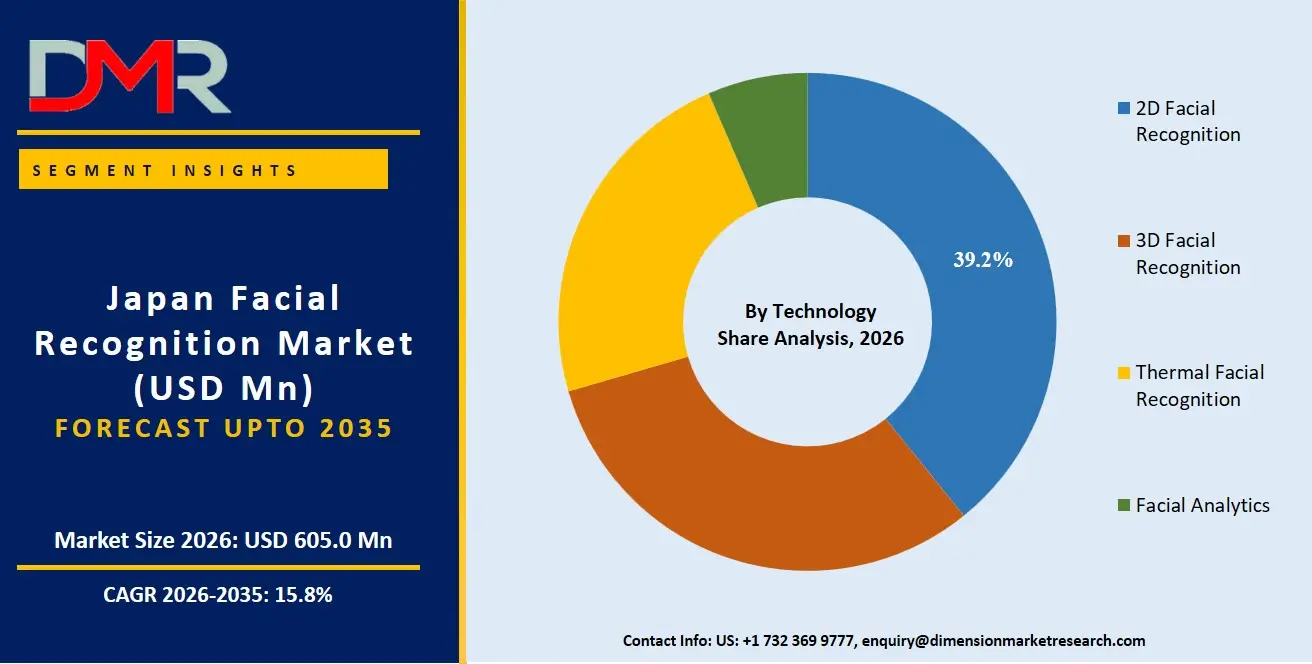
- By Technology Analysis: The 2D Facial Recognition is estimated to dominate the Japan Facial Recognition Market in 2026 due to the extensive installation base in legacy surveillance systems, access control devices, and mobile phone applications that provide highly accurate face matching functionality in a cost-effective manner.
- By Application Analysis: The Identity Verification & Authentication is estimated to hold the largest share in Japan Facial Recognition Market since Japanese banks and government agencies will be using scalable, flexible, and highly effective systems for remote user onboarding, transaction verification, and other authentication procedures for managing their challenges.
What are Facial Recognitions?
Facial recognition refers to the technology that recognizes and verifies a person by comparing his or her facial characteristics, such as the distance between the eyes, the shape of the nose, and the outline of the jaw, through a digital picture or video frame with those stored in a face database in real time for constant authentication and monitoring of behavior. Contrary to the use of passwords and fingerprints, the technology makes the process more convenient because it allows contactless verification of one's identity through the use of passive biometric identification, while fingerprints involve touching specific machines or tools. The technologies incorporate computer vision, deep learning, depth sensing, and sensor fusion capabilities that align facial templates to match them. Some of the key components include devices for facial recognition, facial recognition platforms, and services.
Use Cases
- E-Gates at Airport and Border Checks: E-gates are used by airports to process immigration using real-time facial recognition that matches faces with information embedded in the passport chip, thus reducing wait time and costs associated with border patrol employees at all major airports in Japan like Narita and Haneda.
- KYC in Banking and Remote Account Opening: Facial recognition technology is being used by banks to onboard new clients and carry out high-risk transactions by verifying identity through mobile banking apps and ATMs, thereby reducing fraudulent transactions within FSA guidelines in Japan.
- Age Verifications at Retail Stores: Cloud-based facial recognition technology is used at retail stores by capturing faces through in-store security cameras and at the point of sale terminals to verify ages and recognize repeat customers and reward them accordingly, thus increasing sales conversions.
- Workforce Attendance and Access Control: Facial recognition is widely used by organizations to record attendance of employees and provide restricted area access rights to authorized persons.
How AI is Transforming the Facial Recognition Market?
AI is revolutionizing the facial recognition industry through improved feature extraction, liveness detection, and predictive matching capabilities. The facial recognition software suite includes AI-based systems that detect spoofing attempts (printed photos, video replay, 3D masks), track user head poses, and recognize occluded faces (masks, glasses, sunglasses) in order to overlay identity confidence scores instantaneously, thereby preventing any authentication errors and security breaches. In addition, the AI-driven functions of facial recognition platforms help organizations analyze demographic data, determine optimal matching thresholds, and customize their access policies. AI forms an essential part of governance and user experience initiatives. Professional services involve intelligent systems that analyze matching patterns, improve recognition accuracy in low-light conditions, and optimize real-time alerting workflows while ensuring that all facial data processing complies with privacy regulations and the stringent data protection standards under Japan's APPI (Act on the Protection of Personal Information).
Market Dynamics
Key Drivers in the Japan Facial Recognition Market
Aging Workforce and Security Staffing Shortages at Transportation Hubs
Transportation and public security sectors in Japan are witnessing a severe shortage of trained personnel owing to the demographic problem and retiring security staff. The issue is tackled using facial recognition technology as it offers the ability to automate identity checks and provide touchless, 24/7 monitoring for access control at train stations, airports, and event venues. IP cameras and smart terminals facilitate real-time alerts from central command centers to on-the-ground security personnel involved in crowd management and suspicious person detection. East Japan Railway Company (JR East), NTT, and the Tokyo Metropolitan Government use facial recognition technology to save manpower and cut down the time required for identity verification by 40%. It has been seen that AI-assisted matching minimizes errors in high-traffic situations. Since Japanese organizations are known for maintaining strict safety and security standards, such technology is being quickly embraced by many transportations, retail, and hospitality industries.
Expansion of Digital Identity (DX) and Contactless Authentication
Facial recognition and the creation of contactless authentication through digital identity DX represent one of the major drivers of market growth in the facial recognition space in Japan. In today's world, facial recognition becomes an integral part of smart building and e-government systems that allow facial cameras, mobile scanners, and edge workstations to interact with IoT sensors, identity databases, and HR systems to provide identity verification and time tracking. The use of facial recognition technology can prove to be advantageous, particularly in the context of the need for hygienic, contactless processes and real-time fraud prevention in the banks and offices of Japan. In addition, due to government support through METI and the Digital Agency in the form of subsidies for DX projects, companies tend to choose facial recognition solutions as compared to physical ID card management systems or manual document checks.
Restraints in the Japan Facial Recognition Market
High Integration Costs and Privacy Compliance Burdens
Among the developed markets in the face recognition technology is Japan. However, the high cost associated with the deployment of software solutions, customizations for matching algorithms, and the strict privacy laws pose some constraints in terms of penetration among SMEs. This is because SMEs do not easily see the economic value of deploying facial recognition technologies given the additional cost burden of complying with privacy requirements stipulated by the APPI (Act on the Protection of Personal Information). It is difficult to penetrate the vast SME market due to compliance issues with the privacy law in Japan, which accounts for over 99% of the total enterprises in the country. Other deployments experience issues of public concern regarding continuous surveillance and potential bias, making them unsuitable for deployment without clear signage and opt-out mechanisms.
Algorithm Accuracy Variations and Integration Challenges
Creation of customized facial recognition algorithms tailored to a specific demographic or environment, be it in retail, banking, or for access control, involves specific expertise in deep learning, bias mitigation, and biometric database management. Many firms in Japan do not have in-house capabilities for developing facial recognition solutions, thus making them dependent on expensive outsourced help. The integration of facial recognition solutions into existing HR systems or older legacy access databases will entail technical complexities and delays. Moreover, there being no standard facial recognition ecosystem, algorithms trained for one device platform, such as NEC's NeoFace platform, may not achieve the same accuracy on other devices like the smart cameras made by Sony or Panasonic without significant recalibration.
Growth Opportunities in the Japan Facial Recognition Market
Adoption of AI-Powered Liveness Detection and Anti-Spoofing
The verification and anti-spoofing process enabled via the application of AI-based technologies can be considered as another promising growth driver for the Japanese facial recognition market. The emergence of enterprise-level implementations of intelligent systems enabling the remote verification of users by matching live faces against ID document photos while detecting presentation attacks with the help of smartphone cameras or dedicated terminals shows the trend towards efficient and cost-effective fraud prevention. As for Japan, its specific aging population and distribution of retail stores make it even more interesting to implement facial recognition for personalized service and secure remote banking. Besides, innovations in the field of artificial intelligence and micro-expression recognition allow achieving fraud detection and, as an emerging niche, basic sentiment analysis for customer experience applications.
Expansion of Cloud-Based Biometric Platforms and 5G Connectivity
Facial recognition ecosystems based on cloud technology present one of the future areas of opportunity within the facial recognition industry in Japan. The modern gadgets, such as smart cameras, access terminals, and mobile devices, have been connected to cloud-based systems capable of delivering real-time matching of facial templates, persistent watchlists, and constant software updates. This approach helps to decrease the demand for processing performed by the device, increase its battery life, and enable shared facial databases among multiple locations. Connection to edge computing devices via Japan's 5G network can provide sub-10 milliseconds of latency for critical security operations requiring identification through facial recognition. The ability to integrate smoothly with the current cloud ecosystem is highly valued by Japanese enterprises, making the cloud-based facial recognition ecosystem especially popular for commercial deployments.
Trends in the Japan Facial Recognition Market
Growing Integration of Edge AI and Privacy-Preserving Biometrics
The introduction of technologies such as edge AI and privacy-preserving biometrics is essential and is one of the key elements behind the growth of the facial recognition market in Japan. Companies have been utilizing facial recognition systems in order to synchronize their access control databases with real-time camera feeds, where through the edge devices, the security personnel are able to view match scores, demographic attributes, and visitor frequency without sending biometric data to the cloud. Through the AI-powered edge processing, there have been real-time facial alerts that trigger instantly upon watchlist detection, and this has helped increase efficiency when dealing with large crowd venues. In Japan, due to the fact that they have advanced semiconductor capabilities and technology utilization by engineers, there has been faster adoption of edge AI in the enterprise facial recognition market while maintaining compliance with APPI data localization requirements.
Strengthening Use of Multimodal Biometrics (Face + Iris + Fingerprint)
A significant trend within the facial recognition market in Japan is the growing demand for multimodal biometric solutions. Nowadays, enterprises and government agencies prefer a solution where facial recognition is combined with iris scanning or fingerprint verification, allowing users to achieve near-zero false acceptance rates even in challenging environments. With multimodal fusion technology, users are allowed to be verified using multiple biometric traits simultaneously, a function vital when conducting high-security access, hospital patient matching, and critical infrastructure entry. Major players in facial recognition platforms are taking advantage of multimodal biometrics in order to help their enterprise clients implement facial recognition without compromising on security or user convenience. The trend is highly dominant within the Japanese facial recognition market due to the preference for high-precision, low-error biometrics amongst Japanese government agencies and financial institutions.
Research Scope and Analysis
The Japan facial recognition market is segmented by component, technology, deployment mode, application, and end-use. The market supports security & surveillance, access control, identity verification, emotion recognition, and other applications across government, BFSI, retail, healthcare, automotive, telecom, and other sectors through on-premises, cloud-based, and hybrid facial recognition deployment models.
ℹ
To learn more about this report –
Download Your Free Sample Report Here
By Component Analysis
Software is expected to lead the Japan Facial Recognition Market in 2026 with a projected market share of 48.9% as a result of enterprises' and government agencies' growing preference for AI-based matching engines, facial analytics dashboards, and biometric middleware. Japanese organizations have developed a preference for software platforms that offer liveness detection, watchlist management, and real-time alerting capabilities. Enterprise and government software deployments, including platforms such as NEC NeoFace, IDEMIA's Morpho, and Fujitsu's PalmSecure (facial module), drive the majority of near-term revenue. Unlike hardware, which has become increasingly commoditized, software captures recurring revenue through subscription licenses, SDK royalties, and analytics updates. Software represents the core value layer of any facial recognition implementation, as without advanced matching algorithms, demographic analysis, and anti-spoofing logic, the captured images cannot be reliably verified. Japanese firms prioritize accuracy, low false acceptance rates, and integration flexibility, which further justifies software investment. As more enterprises and agencies move from pilot programs to full-scale deployment, software license volumes and subscription renewals are expected to increase substantially across the government, BFSI, and retail sectors in Japan.
By Technology Analysis
2D Facial Recognition is projected to dominate the Japan Facial Recognition Market in 2026, with an estimated share of 39.2%, owing to its large installed base in legacy surveillance cameras, access control terminals, and smartphone face unlock systems. Most enterprise and government facial recognition deployments today remain 2D-based due to lower hardware costs and broad compatibility with existing infrastructure. However, 3D facial recognition is the fastest-growing segment, driven by demand for higher accuracy and spoofing resistance in banking e-KYC and border control applications. Japanese government agencies and financial institutions are increasingly adopting 3D solutions for high-security use cases. With continuous improvements in 2D algorithms under challenging lighting conditions and the declining cost of 3D sensors, 2D is expected to maintain its installed base leadership, while 3D gains share at a faster CAGR throughout the forecast period.
By Deployment Mode Analysis
Cloud-Based is expected to lead with 46.5% share in 2026, driven by strong demand from commercial enterprises for lower upfront costs, automatic software updates, and scalability across multiple locations. Japanese retail chains, banks, and hospitality providers prefer cloud-based facial recognition for customer authentication, loyalty programs, and age verification. Unlike on-premises systems that require dedicated servers and IT maintenance, cloud-based platforms offer pay-as-you-go pricing and rapid deployment. However, on-premises deployment remains strong in government and critical infrastructure sectors where data sovereignty is mandated under APPI. Japanese privacy regulators have shown a preference for on-premises solutions in high-risk government environments. Hybrid deployment is growing as an intermediate option, allowing sensitive biometric templates to be stored on-premises while leveraging cloud analytics. As cloud security certifications mature and 5G reduces latency concerns, cloud-based deployment is expected to further solidify its leadership across Japanese commercial facial recognition deployments, while on-premises remains dominant in government.
By Application Analysis
Identity Verification & Authentication is set to dominate the Japan Facial Recognition Market in 2026 with a projected share of 38.5%, thanks to its high deployment penetration, government-backed e-government subsidy programs, and the urgent need to address digital identity fraud. Facial recognition enables real-time remote onboarding, transaction authorization, and biometric binding. Japanese financial institutions and government agencies have been early adopters, using facial recognition to prevent identity theft and deliver it interactively to end users. Large enterprises such as MUFG Bank, Sumitomo Mitsui Banking Corporation, and Japan Post Bank have reported significant reductions in fraud losses and customer onboarding time after deploying facial recognition solutions. The FSA and Digital Agency subsidy programs specifically encourage DX investments that include biometric authentication technologies, making facial recognition financially accessible for more financial institutions. Unlike consumer-focused applications, identity verification delivers clear ROI through reduced fraud, improved customer experience, and faster compliance. As Japan's digital transformation intensifies, identity verification & authentication will remain the largest and most strategically important application segment.
By End-Use Analysis
Government is anticipated to be the largest end-use segment in the Japan Facial Recognition Market in 2026 with an estimated share of 35.5%, owing to significant investment in border control e-gates, national ID systems (My Number Card with biometrics), and law enforcement facial databases. However, the BFSI, retail, healthcare, and transportation sectors collectively represent a substantial and growing portion of the market, driven by commercial use cases such as e-KYC, age verification, patient identification, and workforce attendance. Unlike previous years when the government dominated overwhelmingly, commercial adoption has accelerated due to falling software costs and increased awareness of fraud prevention benefits. Japanese government agencies across the Ministry of Justice, National Police Agency, and Digital Agency continue to allocate dedicated budgets for biometric identity initiatives. However, banks, retailers, hospitals, and railway operators are deploying facial recognition at scale, diversifying the end-use landscape. With large government agencies leading but commercial sectors growing rapidly, the government segment's share is expected to remain stable around 30-35%, while BFSI and retail will capture an increasing share throughout the forecast period.
The Japan Facial Recognition Market Report is segmented based on the following:
By Component
- Hardware
- Software
- Services
By Technology
- 2D Facial Recognition
- 3D Facial Recognition
- Thermal Facial Recognition
- Facial Analytics
By Deployment Mode
- On-Premises
- Cloud-Based
- Hybrid
By Application
- Security & Surveillance
- Access Control & Attendance Management
- Identity Verification & Authentication
- Emotion Recognition & Facial Analytics
- Others
By End Use
- Government
- BFSI
- Retail & E-commerce
- Healthcare
- Automotive & Transportation
- Telecom & IT
- Others
Competitive Landscape
The Japan Facial Recognition market is highly competitive, driven by global biometric leaders and strong domestic electronics and systems integration companies. International players such as NEC Corporation, IDEMIA Group SAS, Thales Group, Daon Inc., Aware, Inc., Cognitec Systems GmbH, AnyVision Interactive Technologies Ltd., Hikvision Digital Technology Co., Ltd., and SenseTime Group Inc. are strengthening their presence through enterprise facial recognition engines, biometric platforms, and ecosystem partnerships in Japan. Domestic leaders such as Sony Group Corporation, Panasonic Holdings Corporation, Canon Inc., Toshiba Corporation, Fujitsu Limited, Hitachi, Ltd., Sharp Corporation, and Ayonix Corporation play a crucial role in hardware innovation, especially in sensors and camera optics, while also offering integrated software solutions for government and BFSI applications.
In addition, Japanese software and algorithm specialists such as NEC Corporation (NeoFace), Morpho, Inc. (now part of IDEMIA), Fronteo, Inc., and Ayonix Corporation focus on deep learning-based matching, liveness detection, and emotion analytics platforms, enabling localization of global facial recognition hardware for enterprise use cases. Competitive differentiation in the market is increasingly driven by AI-powered biometric matching, privacy-preserving edge processing, cross-platform interoperability, and integration with enterprise digital transformation initiatives. Strategic partnerships between global biometric providers and Japanese system integrators are becoming central to market expansion, particularly in government, BFSI, and transportation application.
Some of the prominent players in the Japan Facial Recognition Market are:
- NEC Corporation
- Fujitsu Limited
- Hitachi, Ltd.
- Panasonic Holdings Corporation
- Sony Group Corporation
- Toshiba Corporation
- Omron Corporation
- Canon Inc.
- Keyence Corporation
- DENSO Corporation
- Ayonix Corporation
- i-PRO Co., Ltd.
- GLORY LTD.
- NTT DATA Group Corporation
- Mitsubishi Electric Corporation
- Thales S.A.
- IDEMIA Identity & Security France SAS
- Cognitec Systems GmbH
- Aware, Inc.
- HID Global Corporation
- Other Key Players
Recent Developments
- January 2026: Panasonic Connect Co., Ltd. announced that its Walk-Through Facial Recognition Ticket Gate, deployed across 130 Osaka Metro stations, received the Grand Prize at the 2025 Nikkei Superior Products and Services Awards. The system enables passengers to pass through ticket gates using facial recognition without physical tickets or IC cards, supporting next-generation smart mobility infrastructure in Japan.
- December 2025: IDEMIA Public Security signed a strategic partnership agreement with MATARAT Holding to advance digital transformation across Saudi Arabia's airport network through biometric-based passenger processing technologies, reinforcing IDEMIA's global leadership in facial recognition and airport identity management solutions.
- December 2025: NEC Corporation announced the development of a next-generation walk-through face and iris multimodal biometric authentication technology, enabling high-accuracy identity verification of moving individuals using a single compact camera. The system is designed for deployment in high-security environments such as airports, public infrastructure, and payment systems, with pilot trials planned for FY2026 and commercialization targeted for FY2027.
- October 2025: Fujitsu Limited and ARYA Inc. announced a strategic partnership to develop and deploy an AI-powered security solution combining Fujitsu's video analytics AI with geospatial intelligence technologies for real-time detection of suspicious behavior in public facilities, airports, and large venues, strengthening advanced biometric and surveillance capabilities.
Report Details
| Report Characteristics |
| Market Size (2026) |
USD 605.0 Mn |
| Forecast Value (2035) |
USD 2,259.6 Mn |
| CAGR (2026–2035) |
15.8% |
| Historical Data |
2021 – 2025 |
| Forecast Data |
2027 – 2035 |
| Base Year |
2025 |
| Estimate Year |
2026 |
| Segments Covered |
By Component, By Technology, By Deployment Mode, By Application, By End-Use |
| Country Coverage |
Japan |
Frequently Asked Questions
How big is the Japan Facial Recognition Market?
▾ The Japan Facial Recognition Market is poised to be valued at USD 605.0 million in 2026 and is projected to reach USD 2,259.6 million by 2035.
What is the CAGR of the Japan Facial Recognition Market from 2026 to 2035?
▾ The market is expected to grow at a CAGR of 15.8% from 2026 to 2035, supported by government digital identity initiatives, 5G-enabled real-time matching, and consistent enterprise replacement cycles.
What factors are driving the growth of the Japan Facial Recognition Market?
▾ Growth is driven by the aging workforce and security staffing shortages at transportation hubs, rising demand for contactless identity verification, expansion of e-KYC and digital onboarding, and government DX subsidies for biometric adoption. Japan's strong technology base and preference for high-precision biometrics also support market expansion across both government and commercial sectors.
What are the major trends in the Japan Facial Recognition Market?
▾ Key trends include edge AI with privacy-preserving biometrics, multimodal biometrics (face + iris + fingerprint), AI-powered liveness detection and anti-spoofing, and expansion of 5G-connected cloud-based biometric platforms. Enterprises prefer seamless integration across cameras, terminals, and mobile devices for identity management.
Who are the key players in the Japan Facial Recognition Market?
▾ Key players include NEC Corporation, IDEMIA Group SAS, Sony Group Corporation, Panasonic Holdings Corporation, Fujitsu Limited, Hitachi, Ltd., Ayonix Corporation, and many more.
How is the Japan Facial Recognition Market segmented?
▾ The market is segmented by component, technology, deployment mode, application, and end-use.