Japan Food Safety Testing Market Snapshot
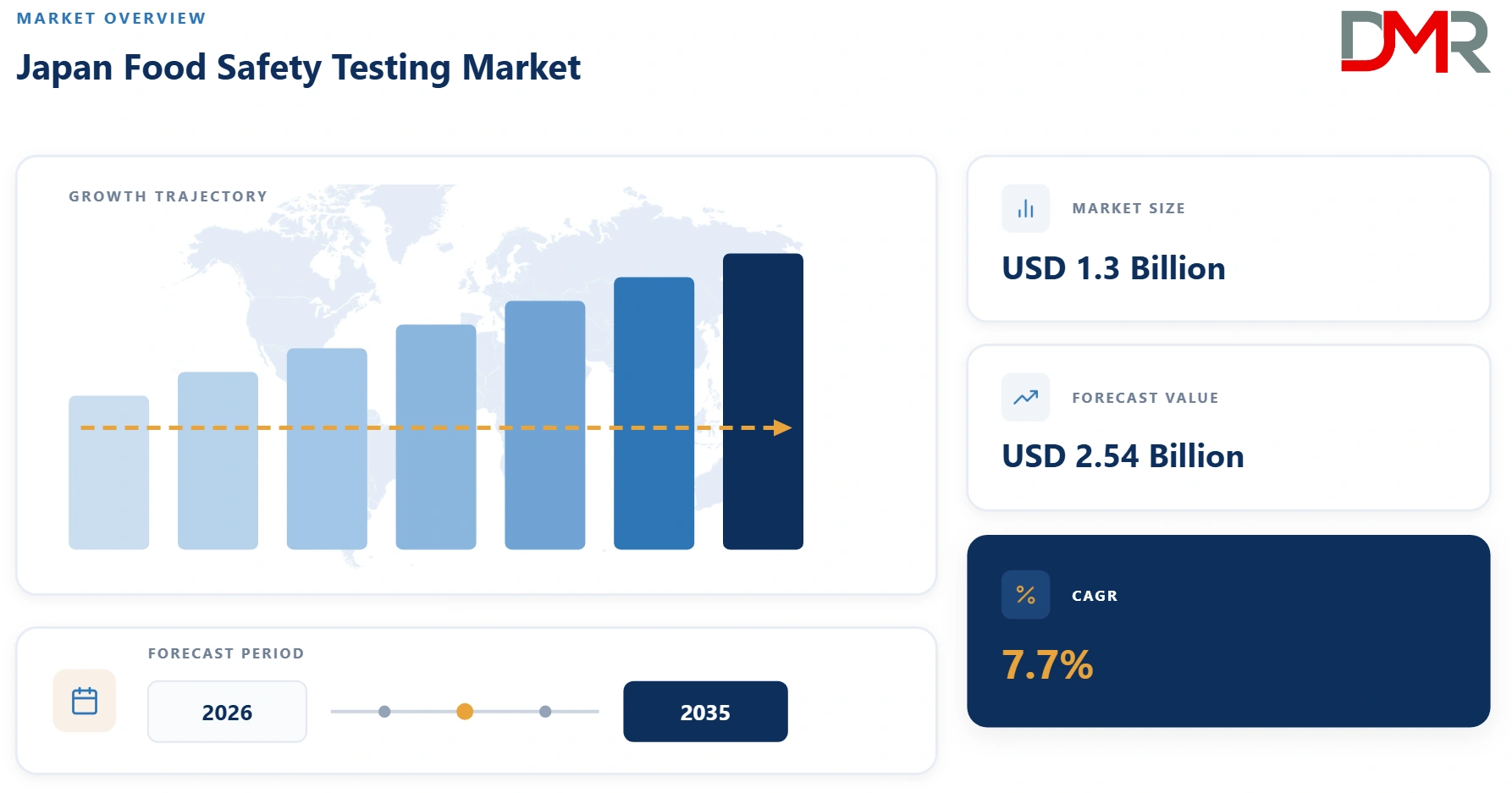
- Market Size, 2026: USD 1.30 Billion
- Market Size, 2035: USD 2.54 Billion
- CAGR, 2026-2035: 7.7%
- Leading Type Segment, 2026: Pathogen, 39.0% share
- Leading Food Tested Segment, 2026: Meat & Meat Products , 27.0% share
- Leading Technology Segment, 2026: PCR-based Assay, 34.0% share
- Fastest-Growing Segment: PCR-based Assay, 9.4% CAGR
What is the Japan Food Safety Testing and its Market Size?
Japan food safety testing comprises laboratory, onsite and rapid analytical services used to detect, identify, quantify and monitor biological, chemical, genetic and physical hazards in food and food-related materials. The market covers pathogen detection, GMO analysis, pesticide and veterinary-drug residues, mycotoxins, heavy metals, allergens, authenticity and other contaminant testing.
ℹ
To learn more about this report –
Download Your Free Sample Report Here
Testing is performed by food manufacturers, importers, retailers, laboratories and government bodies to verify compliance, support HACCP systems, protect consumers and reduce recalls. Japan's regulatory framework combines national food-safety management with registered private laboratories and quarantine-station inspections.
The Japan food safety testing market is estimated at USD 1.30 billion in 2026 and is projected to reach approximately USD 2.54 billion by 2035, representing a 7.7% CAGR. Growth is supported by mandatory HACCP-based hygiene controls, stringent contaminant limits, increasing imported-food scrutiny, sophisticated food manufacturing, consumer expectations for traceability and rising adoption of molecular and rapid analytical technologies.
Use Cases
- Pathogen Screening: Detect Salmonella, E. coli, Listeria, Campylobacter and other microorganisms before products reach consumers.
- Chemical Contaminant Testing: Measure pesticides, veterinary drugs, mycotoxins, heavy metals and emerging contaminants.
- Import Compliance Testing: Verify imported food against Japanese Food Sanitation Act requirements before commercial distribution.
- Authenticity and GMO Testing: Confirm ingredient identity, genetic composition and protection against economically motivated adulteration.
- HACCP Verification: Generate laboratory evidence supporting hazard analysis, critical-control-point monitoring and corrective actions.
- Shelf-Life Validation: Evaluate microbial stability and product quality to optimize expiration periods and reduce waste.
Key Takeaways
- Market Size: Japan's food safety testing market is estimated at USD 1.30 billion in 2026, reaching USD 2.54 billion by 2035.
- Growth: The market is projected to expand at a 7.7% CAGR, supported by regulation, imports, food manufacturing complexity and technology adoption.
- Segment Dominance: Pathogen testing, meat and meat products, and PCR-based assays are estimated to hold the leading positions in 2026.
- Fastest Growth: PCR-based testing is expected to expand at approximately 9.4% CAGR, driven by faster turnaround, sensitivity and multiplexing capabilities.
How AI/Gen AI is Transforming the Japan Food Safety Testing Market?
AI is increasingly being combined with PCR, sequencing, chromatography and laboratory-information-management systems to automate interpretation, flag abnormal results and prioritize samples according to risk. Molecular testing already supports detection of difficult-to-identify microorganisms, while advanced laboratories are expanding DNA-based testing across the food value chain.
Automation reduces manual review, improves laboratory throughput and enables faster release decisions. AI-assisted pattern recognition can correlate historical results, supplier information and contamination patterns to create risk-based testing programs, while multiplex PCR can identify several hazards from one sample.
Key Drivers in the Japan Food Safety Testing Market
Stringent Regulatory and HACCP Requirements
Japan's food safety framework is a fundamental structural driver of testing demand. The Food Sanitation Act establishes controls covering food safety, contaminants, additives and imported foods, while HACCP-based hygiene management has become embedded in Japan's food-control framework. The regulatory emphasis shifts testing from occasional quality assurance toward systematic, risk-based verification throughout production and distribution. Importers must also submit notifications for food brought into Japan for commercial purposes, with quarantine stations conducting document examination and inspection.
Complex Food Supply Chains and Consumer Expectations
Japan's food system combines domestic manufacturing with significant dependence on imported agricultural commodities, seafood, ingredients and processed foods. Longer and more internationally dispersed supply chains increase exposure to microbial contamination, residues, allergens, adulteration and authenticity risks. Japanese consumers and retailers also place substantial emphasis on quality, origin and safety, encouraging manufacturers to use testing as a brand-protection mechanism rather than merely as a compliance expense. Food testing providers consequently benefit from recurring programs covering raw materials, finished products, environmental samples and suppliers.
Restraints in the Japan Food Safety Testing Market
High Cost and Technical Complexity
Advanced food safety testing requires expensive analytical instruments, accredited facilities, skilled microbiologists and chemists, validated methodologies and continuous proficiency testing. LC-MS/MS, GC-MS/MS, ICP-MS, high-resolution mass spectrometry and molecular platforms can generate substantial capital and operating costs. Smaller food processors may therefore reduce testing frequency or rely on standardized third-party packages rather than building comprehensive internal laboratories. Complex matrices can further increase sample preparation requirements and turnaround times, limiting the attractiveness of high-end testing for low-margin products.
Fragmented Standards and Methodological Requirements
Food companies operating internationally face different maximum residue limits, labeling requirements, sampling protocols and analytical standards across Japan and export markets. Even within a single compliance program, pathogen, chemical, GMO and authenticity testing may require different technologies and validation approaches. Regulatory revisions can also require laboratories to update methods and customers to modify testing protocols.
Growth Opportunities in the Japan Food Safety Testing Market
Rapid and Molecular Testing
Rapid PCR, immunoassay, sequencing and other molecular methods represent one of the strongest expansion opportunities. Japan's mature food industry increasingly values shorter turnaround times because delayed laboratory results can hold inventory, disrupt production schedules and increase working-capital requirements.
Digitalized Risk-Based Testing
Digital laboratory platforms can connect test results with suppliers, production batches, HACCP plans, historical deviations and regulatory requirements. This creates opportunities for testing providers to sell subscription-based compliance intelligence rather than individual laboratory analyses. Large TIC companies already market customized and managed testing programs combining laboratories, technical expertise and digital risk-management tools.
Trends in the Japan Food Safety Testing Market
Shift Toward Faster, Risk-Based Testing
Japanese food manufacturers are moving from purely periodic testing toward testing programs aligned with HACCP, supplier risk and production-critical control points. Rapid microbiology and molecular technologies are particularly suited to this transition because they can shorten decision cycles and support earlier intervention.
Expansion of Authenticity and Traceability Testing
Food fraud, complex global sourcing and premiumization are expanding demand for DNA-based authenticity, GMO analysis, isotope or chemical fingerprinting and supply-chain verification. Testing is increasingly being used to substantiate origin, species, ingredient claims and product integrity rather than only detect hazards.
Research Scope and Analysis
The Japan food safety testing market is segmented by Type, Food Tested, Technology and End Use. These dimensions capture the hazard being investigated, the food matrix being analyzed, the analytical platform deployed and the customer group purchasing or performing testing services.
ℹ
To learn more about this report –
Download Your Free Sample Report Here
By Type Analysis
Pathogen testing is estimated to dominate the Type segment in 2026 with approximately 39.0% share, reflecting recurring microbiological testing requirements across meat, seafood, dairy, prepared foods and ready-to-eat products. Salmonella, E. coli, Listeria, Campylobacter and other microorganisms remain central food-safety concerns, making pathogen analysis a high-frequency testing category. SGS Japan, for example, provides routine microbiology covering pathogenic and spoilage organisms and applies PCR and DNA sequencing to molecular microbiology. Chemical and toxin testing is estimated to rank second at 31.0%, supported by pesticide, veterinary-drug, mycotoxin, heavy-metal and other contaminant monitoring. GMO testing, at approximately 17.0%, maintains a meaningful position because of ingredient verification and labeling requirements. Others, including allergens, authenticity and selected physical hazards, account for roughly 13.0%. Chemical and toxin testing is expected to be the fastest-growing Type sub-segment at about 8.2% CAGR, reflecting expanded screening for emerging contaminants and increasingly sensitive analytical methods.
By Food Tested Analysis
Meat and meat products are estimated to lead the Food Tested segment with approximately 27.0% share in 2026, reflecting high microbiological risk, complex processing environments and frequent testing for pathogens, residues and authenticity. Seafood is included in the broader "Others" category in this report and remains strategically important given Japan's seafood consumption and import exposure. Processed food is estimated at 24.0%, supported by extensive production of ready-to-eat meals, sauces, snacks, and convenience foods that require microbiological, chemical, and allergen verification. Dairy and dairy products account for approximately 19.0%, while cereals, grains and pulses represent 15.0%, with the balance in other food matrices. Processed food is expected to be the fastest-growing category at approximately 8.6% CAGR, reflecting convenience-food consumption, increasingly complex formulations and longer supply chains.
By Technology Analysis
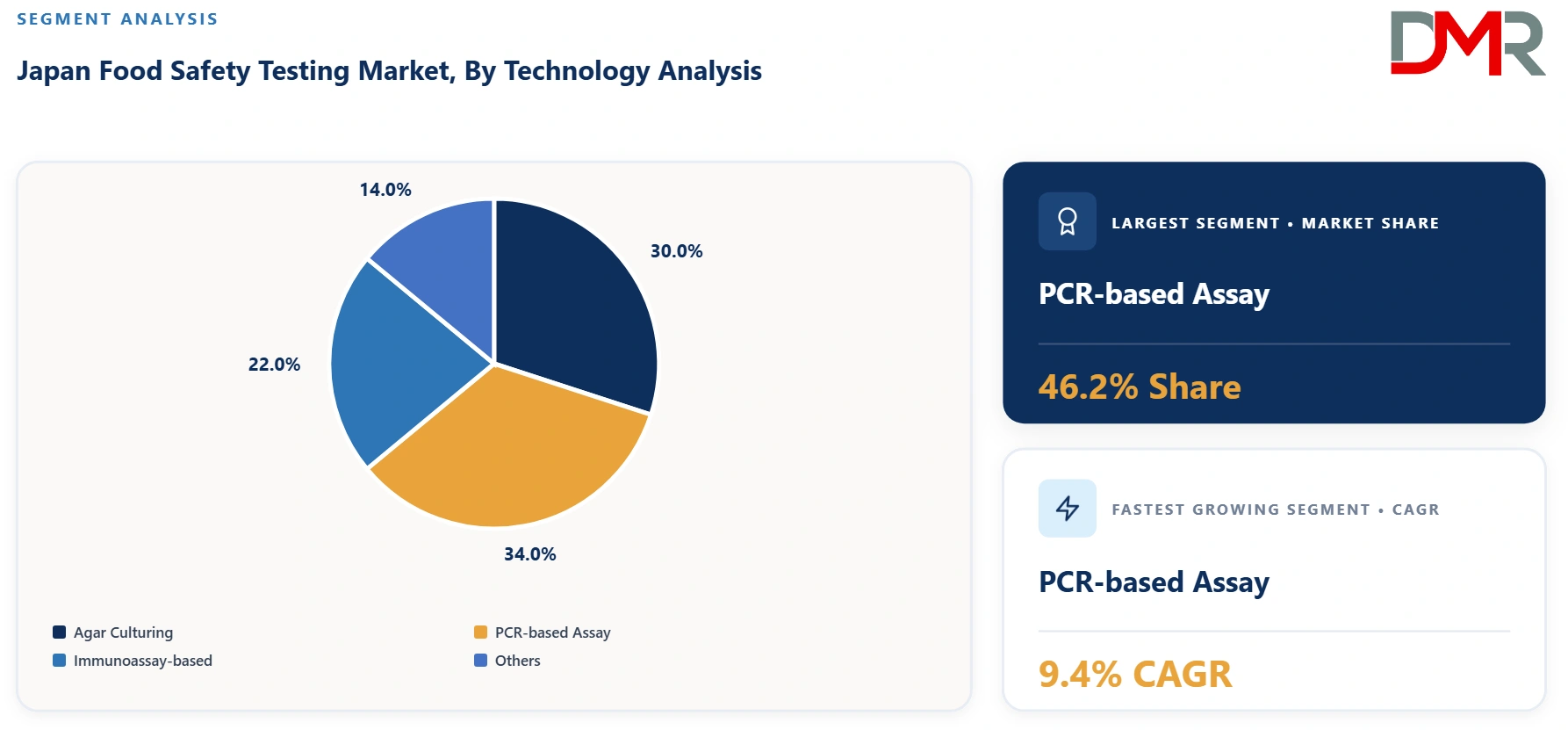
PCR-based assays are estimated to hold the leading Technology position with approximately 34.0% share in 2026, supported by rapid pathogen identification, high sensitivity, specificity and suitability for multiplex testing. Molecular approaches are particularly valuable when manufacturers need quicker release decisions than conventional culture methods permit. Agar culturing remains the second-largest technology at approximately 30.0%, benefiting from established methodologies, regulatory familiarity and relatively low testing costs. Immunoassay-based testing accounts for approximately 22.0%, with particular utility in allergen, toxin and selected pathogen applications, while Others represent approximately 14.0% and include chromatography, mass spectrometry and emerging molecular approaches. PCR-based assays are estimated to be the fastest-growing sub-segment at 9.4% CAGR, driven by rapid turnaround, multiplexing, automation and increasing laboratory acceptance. SGS Japan's food microbiology portfolio demonstrates the continuing expansion of PCR and sequencing alongside conventional microbiological approaches.
The Japan Food Safety Testing Market Report is segmented on the basis of the following:
By Type
- Pathogen
- Genetically Modified Organism
- Chemical and Toxin
- Others
By Food Tested
- Meat and Meat Products
- Dairy and Dairy Products
- Cereals, Grains and Pulses
- Processed Food
- Others
By Technology
- Agar Culturing
- PCR-based Assay
- Immunoassay-based
- Others
Regulatory Landscape
Japan has one of Asia's more structured food-safety regulatory environments, with responsibilities distributed among the Food Safety Commission, Ministry of Health, Labour and Welfare, Ministry of Agriculture, Forestry and Fisheries, Consumer Affairs Agency and local authorities. The Food Sanitation Act establishes requirements covering contaminants, additives, food-contact materials and imported foods, while HACCP-based hygiene management supports preventive control. Private laboratories may operate as registered inspection laboratories under the regulatory framework. Recent revisions to food-contact-material standards effective June 2026 demonstrate continuing regulatory evolution. The resulting environment favors accredited laboratories with strong method-validation, regulatory intelligence and documentation capabilities.
Investment and White Space Analysis
The most attractive investment opportunities are concentrated in rapid molecular testing, multi-residue chemical analysis, digital laboratory platforms, authenticity testing and integrated supplier-risk management. White space remains in combining laboratory results with automated regulatory interpretation and predictive risk scoring for small and mid-sized food producers. Another opportunity exists in managed import-compliance packages covering pesticides, veterinary drugs, pathogens and additives under a single service contract. Eurofins' Japanese import-monitoring packages illustrate demand for broad, regulation-aligned analytical panels. Consolidation also remains relevant, as demonstrated by Mérieux NutriSciences' acquisition of Bureau Veritas' food-testing activities in Japan and other markets.
Competitive Landscape
The Japan food safety testing market is moderately consolidated at the upper end but fragmented across specialist laboratories, with global TIC companies competing alongside Japanese analytical laboratories, food manufacturers' internal laboratories and specialist molecular-testing providers. Major competitors differentiate through accreditation, geographic coverage, turnaround time, analytical breadth, regulatory expertise and integrated inspection/certification services. Leading strategies include acquisitions, laboratory-network expansion, technology investment, regulatory consulting, digitalization and bundled testing programs. The market is moving toward a "one-stop" model in which testing is combined with auditing, certification, supply-chain inspection and regulatory intelligence. M&A is likely to remain an important strategy as global providers seek scale and specialized capabilities.
Some of the prominent players in the Japan Food Safety Testing Market are:
- Eurofins Scientific
- SGS
- Intertek Group
- Bureau Veritas
- Mérieux NutriSciences
- ALS Limited
- TÜV SÜD
- NSF International
- Thermo Fisher Scientific
- Shimadzu Corporation
- Bio-Rad Laboratories
- Agilent Technologies
- QIAGEN
- Neogen Corporation
- IDEXX Laboratories
- AsureQuality
- Romer Labs
- 3M
- Charm Sciences
- Hygiena
- R-Biopharm
- Microbac Laboratories
- Food & Drug Safety Center
- Japan Food Inspection Corporation
- Japan Inspection Co.
- Japan Food Research Laboratories
- Japan Quality Assurance Organization
- Nippon Kaiji Kentei Kyokai
- Japan Frozen Foods Inspection Corporation
- Japan Food Analysis Center
- Japan Inspection & Testing Co.
- Japan Chemical Analysis Center
- BML Food Science Solutions
- Kewpie Egg Research Institute
- Nippon Gene
- Takara Bio
- Kikkoman Biochemifa
- Nissui Pharmaceutical
- Eiken Chemical
- Denka
- Other Key Players
Recent Developments
- In May 2026, Bureau Veritas published an implementation update on Japan's revised Food Sanitation Law requirements, emphasizing changes to overall migration testing for food-contact materials and the associated compliance transition period.
- In August 2025, SGS published guidance on Japan's revised food-contact-material requirements, highlighting new specifications and analytical methods that became effective June 1, 2026, increasing demand for compliance testing.
- In May 2025, Eurofins QKEN released import-monitoring testing packages aligned with Japan's FY2025 monitoring plan, covering pesticides, veterinary drugs and other regulated targets for companies handling imported foods.
- In February 2025, Mérieux NutriSciences completed its acquisition of Bureau Veritas' food-testing activities in Japan, adding Japanese laboratories and personnel to its global food-testing network and strengthening its competitive position in the Japan Food Safety Testing Market.
Report Details
| Report Characteristics |
| Market Size (2026) |
USD 1.3 Bn |
| Forecast Value (2035) |
USD 2.54 Bn |
| CAGR (2026–2035) |
7.7% |
| Historical Data |
2021 – 2025 |
| Forecast Data |
2026 – 2035 |
| Base Year |
2025 |
| Segments Covered |
By Type, By Food Tested, By Technology |
| Country Coverage |
Japan |
Frequently Asked Questions
What is the Japan Food Safety Testing Market size in 2026?
▾ The Japan Food Safety Testing Market is estimated at USD 1.30 billion in 2026, supported by regulatory compliance, HACCP implementation and imported-food monitoring.
What will the Japan Food Safety Testing Market reach by 2035?
▾ The Japan Food Safety Testing Market is projected to reach approximately USD 2.54 billion by 2035, reflecting continued investment in testing infrastructure and advanced analytical technologies.
What is the CAGR of the Japan Food Safety Testing Market?
▾ The Japan Food Safety Testing Market is expected to grow at approximately 7.7% CAGR from 2026 to 2035, driven by regulatory and technological developments.
What are the key drivers of the Japan Food Safety Testing Market?
▾ Stringent food-safety regulations, HACCP requirements, imported-food inspections, consumer safety expectations and increasingly complex food supply chains are major drivers.
Which technology is growing fastest in the Japan Food Safety Testing Market?
▾ PCR-based assays are expected to be the fastest-growing technology, with an estimated 9.4% CAGR, supported by speed, sensitivity and multiplexing capabilities.
Which food category dominates the Japan Food Safety Testing Market?
▾ Meat and meat products are estimated to lead the Japan Food Safety Testing Market with approximately 27.0% share in 2026, owing to high pathogen and contamination risks.