Japan Functional Food Ingredients Market Snapshot
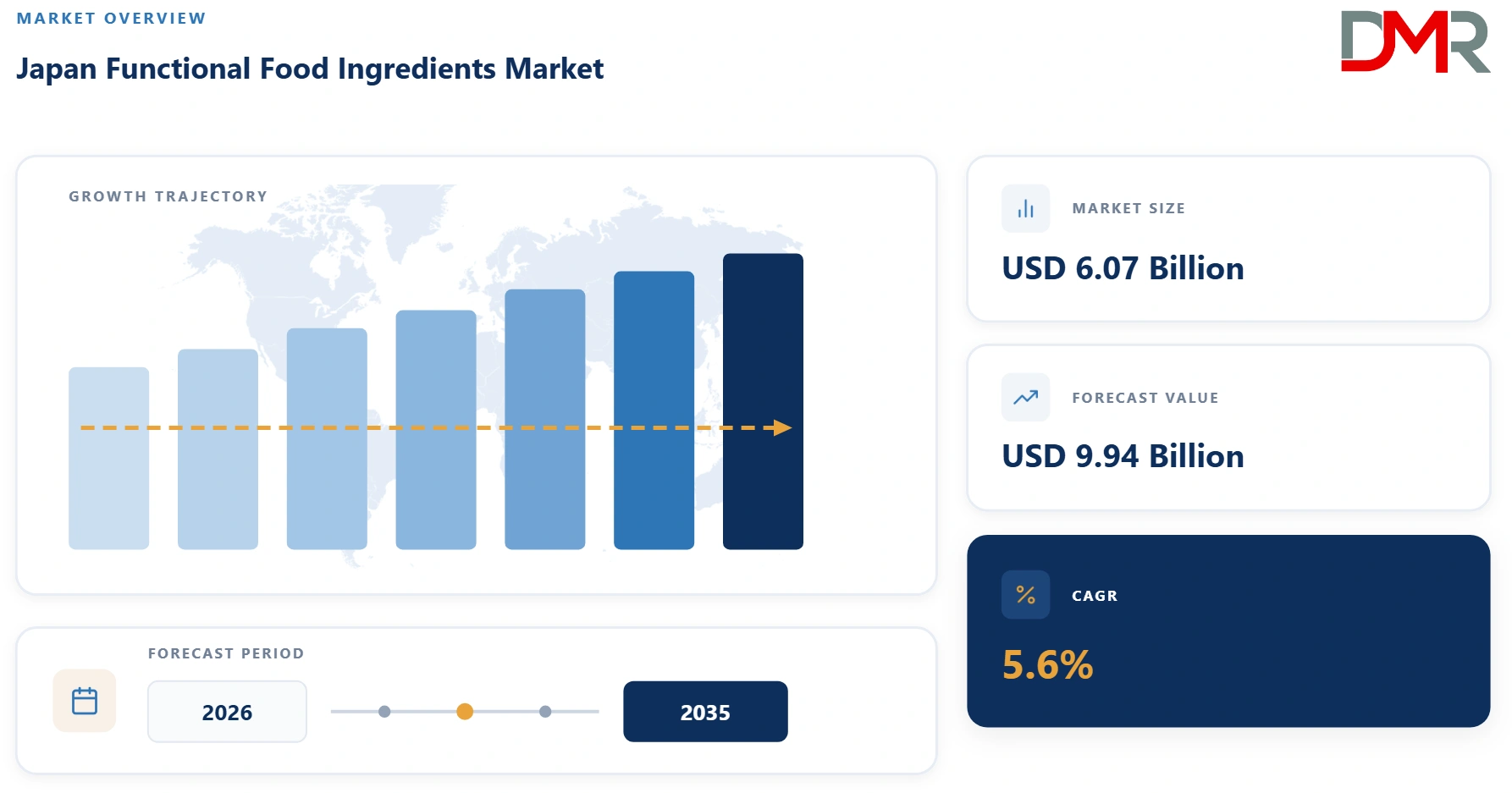
- Market Size in 2026: USD 6.07 billion
- Market Size in 2035: USD 9.94 billion
- Japan CAGR, 2026-2035: 5.6%
- Leading Ingredient Type : Probiotics, 28% share
- Leading Source: Plant-Based, 42% share
- Leading Application: Functional Food & Beverages, 44% share
- Leading End-Use Industry: Food & Beverage Industry, 43% share
- Leading Form: Powder, 51% share
- Fastest-Growing Segment: Microbial Source Ingredients, 7.4% CAGR
What is the Japan Functional Food Ingredients and its Market Size?
Japan's functional food ingredients market comprises specialty ingredients incorporated into foods, beverages, dietary supplements, and nutrition products to provide physiological, nutritional, metabolic, digestive, immune, cognitive, or other health-related benefits beyond basic nutrition. It includes probiotics, prebiotics, vitamins and minerals, proteins and amino acids, omega-3 fatty acids, functional fibers, antioxidants, plant extracts, phytochemicals, and related bioactive compounds.
ℹ
To learn more about this report –
Download Your Free Sample Report Here
Ingredient suppliers generally sell through B2B channels to food manufacturers, beverage companies, nutraceutical producers, supplement brands, and pharmaceutical-healthcare businesses. Japan is particularly important because its established functional-food ecosystem and regulatory architecture support products positioned around scientifically substantiated health functions.
The Japan functional food ingredients market is estimated at USD 6.07 billion in 2026 and is projected to reach approximately USD 9.94 billion by 2035, representing a modeled 5.6% CAGR.
Growth is supported by Japan's aging population, preventive-health orientation, demand for digestive and immune-health products, premiumization, functional beverages, sports and healthy-aging nutrition, and increasing use of ingredients with substantiated claims. Japan's Foods with Health Claims framework covering Foods for Specified Health Uses, Foods with Nutrient Function Claims, and Foods with Function Claims, also creates a mature commercialization environment.
Use Cases
- Gut health: Probiotics, prebiotics, and functional fibers support digestive-health positioning in yogurts, beverages, and supplements.
- Immune support: Probiotics, vitamins, minerals, and specialty bioactives enable immunity-focused food and beverage formulations.
- Healthy aging: Proteins, amino acids, vitamins, minerals, omega-3s, and specialty ingredients target aging-related nutritional requirements.
- Cognitive wellness: Functional ingredients support memory, concentration, mental performance, and brain-health product positioning.
- Sports nutrition: Protein, amino acids, electrolytes, omega-3s, and recovery ingredients are incorporated into performance formulations.
- Beauty-from-within: Collagen-related ingredients, antioxidants, proteins, and botanical compounds support skin and appearance-oriented products.
Key Takeaways
- Market Size: Japan's functional food ingredients market is estimated at USD 6.07 billion in 2026, reaching about USD 9.94 billion in 2035.
- Growth Rate: The market is expected to expand at approximately 5.6% CAGR from 2026-2035.
- Primary Driver: Population aging and preventive-health consumption are creating sustained demand for convenient functional nutrition.
- Segment Dominance: Probiotics lead ingredient demand, while plant-based ingredients dominate the source category and functional food and beverages lead applications.
- Fastest Growth: Microbial-source ingredients are projected to grow at approximately 7.4% CAGR, reflecting interest in probiotics, postbiotics, fermentation-derived compounds, and microbiome science.
- Regulation: Japan's health-claims system provides a structured commercialization pathway but places increasing emphasis on safety, scientific substantiation, quality control, and post-market monitoring.
How AI/Gen AI is Transforming the Japan Functional Food Ingredients Market?
AI is increasingly being applied across ingredient discovery, formulation optimization, consumer analytics, fermentation process control, and evidence generation. Ingredient companies can use machine-learning models to screen botanical compounds, predict ingredient interactions, optimize taste and stability, and identify combinations suitable for specific health-positioning strategies. AI-enabled analysis of clinical and consumer datasets also helps manufacturers identify emerging demand for immunity, gut health, sleep, cognition, healthy aging, and metabolic wellness.
The principal benefits are faster formulation cycles, reduced experimental costs, improved quality consistency, and more targeted product development. AI can also help manufacturers optimize dosage, sensory characteristics, shelf life, and production parameters.
Key Drivers in the Japan Functional Food Ingredients Market
Aging Population and Preventive Health Consumption
Japan's demographic structure is one of the strongest long-term demand drivers for functional food ingredients. A large and growing older population increases demand for products supporting digestive health, immunity, cognition, bone health, muscle maintenance, cardiovascular wellness, and nutritional adequacy.
Established Functional-Claim Culture and Product Innovation
Japan has one of the world's most developed functional-food ecosystems. The Foods with Health Claims framework includes Foods for Specified Health Uses, Foods with Nutrient Function Claims, and Foods with Function Claims. Under the Foods with Function Claims system, businesses may make qualifying functional claims after submitting required safety and scientific-evidence information to the Consumer Affairs Agency, while responsibility for appropriate claims remains with the business operator.
Restraints in the Japan Functional Food Ingredients Market
Regulatory and Evidence Requirements
Japan's functional-claim environment creates commercial opportunities but also raises compliance costs. Functional claims require appropriate scientific evidence, safety information, labeling controls, quality-management procedures, and documentation. The Consumer Affairs Agency has continued updating guidance and procedures for Foods with Function Claims, including revised operating requirements and reporting processes.
High Production Costs and Supply-Chain Exposure
Japan's ingredient market includes premium products with high formulation and quality requirements, while many raw materials remain exposed to global agricultural, marine, fermentation, energy, and logistics costs. Imported omega-3s, specialty botanicals, vitamins, proteins, and other functional materials can experience foreign-exchange and freight volatility.
Growth Opportunities in the Japan Functional Food Ingredients Market
Microbiome, Probiotics and Postbiotics
The microbiome remains one of Japan's most commercially developed functional-ingredient opportunities. Probiotics already represent the largest ingredient category in the modeled market, while new research around postbiotics, strain-specific mechanisms, gut-brain interactions, and immune modulation is expanding the addressable opportunity.
Multifunctional and Convenience-Based Nutrition
Japanese consumers increasingly favor products that integrate health benefits into everyday consumption. This creates opportunities for ingredients that combine several benefits without substantially compromising taste, texture, convenience, or cost.
Trends in the Japan Functional Food Ingredients Market
From Single-Benefit Ingredients to Multi-Health Platforms
Japanese functional products are increasingly combining ingredients and claims around multiple consumer needs. Immunity, sleep, fatigue, cognition, digestion, and healthy aging are increasingly treated as interconnected rather than isolated categories.
Greater Emphasis on Scientific Validation
Scientific substantiation is becoming an increasingly important competitive differentiator. Suppliers and manufacturers are investing in clinical research, strain-specific evidence, biomarker studies, and Japanese consumer trials rather than relying solely on generic ingredient functionality.
Research Scope and Analysis
The market is segmented by Ingredient Type, Source, Form, Application, and End-Use Industry. These dimensions capture differences in ingredient technology, raw-material origin, formulation characteristics, downstream product use, and purchasing behavior across Japan's functional-food ecosystem.
ℹ
To learn more about this report –
Download Your Free Sample Report Here
By Ingredient Type Analysis
Probiotics are estimated to dominate the ingredient-type segment with approximately 28% share in 2026, supported by Japan's longstanding probiotic culture, strong fermented-food ecosystem, consumer familiarity, and extensive use in yogurt, fermented beverages, supplements, and functional foods. Vitamins & Minerals represent the second-largest category at approximately 18%, benefiting from broad fortification applications and demand for immunity, bone, energy, and healthy-aging products. Prebiotics account for approximately 17%, supported by growing interest in microbiome health and digestive wellness. The fastest-growing sub-segment is estimated to be Other Functional Ingredients, including postbiotics and emerging bioactives, at approximately 8.0% CAGR, as suppliers develop products beyond conventional live-culture probiotics. Proteins & amino acids, omega-3 fatty acids, functional fibers, antioxidants, and plant extracts remain important secondary categories. The segment's competitive direction is shifting toward proprietary, clinically substantiated ingredients rather than generic nutrients.
By Source Analysis
Plant-Based ingredients lead the source segment with an estimated 42% share in 2026, reflecting strong Japanese demand for botanicals, plant proteins, dietary fibers, phytochemicals, polyphenols, and natural antioxidant systems. Plant-derived materials also benefit from clean-label positioning and demand for recognizable natural ingredients. Microbial sources are the second-largest category at approximately 27%, driven by probiotics, fermentation-derived ingredients, enzymes, and emerging postbiotics. Microbial-source ingredients are projected to be the fastest-growing source at approximately 7.4% CAGR, as strain-specific science and fermentation technology expand. Animal-based ingredients account for roughly 19%, supported by collagen, dairy proteins, fish-derived omega-3s, and other specialized materials, while synthetic ingredients represent approximately 12%. The strategic opportunity is strongest where suppliers can combine natural sourcing with standardized potency, traceability, and clinical evidence.
By Form Analysis
Powder represents the leading form with approximately 51% share in 2026, because powders provide high concentration, transportation efficiency, formulation flexibility, and compatibility with supplements, dry premixes, sports nutrition, fortified foods, and industrial beverage production. Liquid ingredients represent approximately 28%, benefiting from functional beverages and ready-to-drink formats, while granules account for approximately 13%. Other forms—including emulsions, capsules, gels, and specialty delivery formats—represent approximately 8%. Granules are expected to grow fastest at around 6.5% CAGR, supported by improved dispersibility, controlled release, reduced dusting, and suitability for convenient consumer formats. Suppliers increasingly compete on solubility, stability, flavor masking, heat resistance, and compatibility with low-sugar and low-calorie formulations.
By Application Analysis
Functional Food & Beverages are estimated to represent approximately 44% of 2026 ingredient demand, making this the dominant application segment. The category benefits from Japan's mature functional beverage, fermented dairy, yogurt, tea, snack, and fortified-food sectors. Dietary Supplements constitute the second-largest application at approximately 28%, supported by concentrated-dose formulations and consumers seeking targeted health benefits. Sports Nutrition accounts for roughly 11%, while Infant Nutrition and Clinical Nutrition represent approximately 7% and 6%, respectively, with other applications comprising the balance. Clinical Nutrition is projected to grow fastest at approximately 7.2% CAGR, supported by aging, hospital nutrition, recovery, and specialized dietary requirements. The broader opportunity remains the integration of functional ingredients into everyday foods rather than limiting them to supplement products.
By End Use Industry Analysis
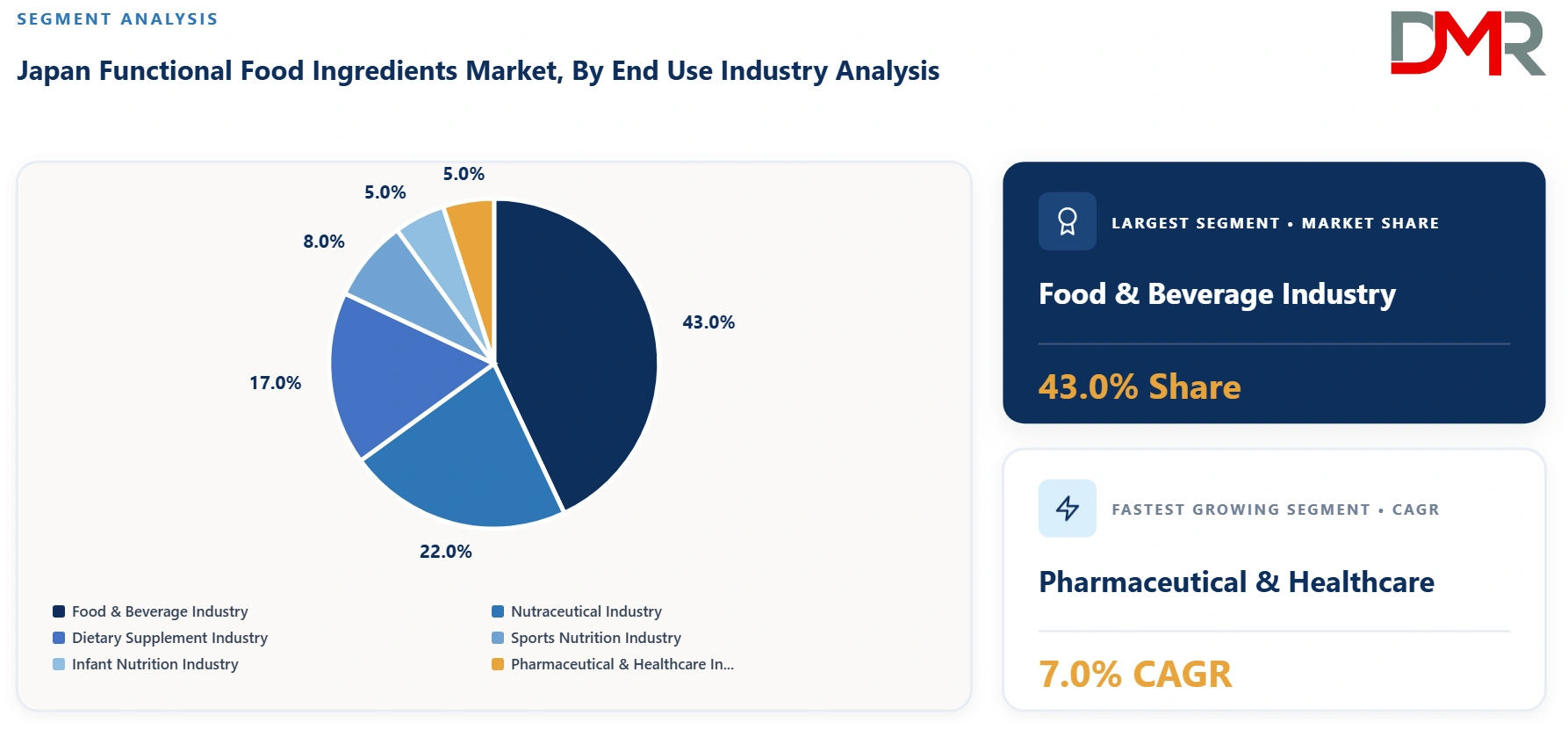
The Food & Beverage Industry is estimated to lead with approximately 43% share in 2026, reflecting the enormous variety of products in which functional ingredients can be incorporated, including dairy, beverages, bakery products, cereals, snacks, confectionery, and convenience foods. The Nutraceutical Industry follows at approximately 22%, while the Dietary Supplement Industry accounts for approximately 17%. Sports Nutrition, Infant Nutrition, and Pharmaceutical & Healthcare account for approximately 8%, 5%, and 5%, respectively. Pharmaceutical & Healthcare is projected to be the fastest-growing end-use category at approximately 7.0% CAGR, supported by medical nutrition, healthy-aging strategies, hospital nutrition, and increased convergence between nutrition and preventive healthcare. Suppliers with strong quality systems and clinical evidence are particularly well positioned in healthcare-oriented applications.
The Japan Functional Food Ingredients Market Report is segmented on the basis of the following:
By Ingredient Type
- Probiotics
- Prebiotics
- Vitamins & Minerals
- Proteins & Amino Acids
- Omega-3 Fatty Acids
- Functional Fibers
- Antioxidants
- Plant Extracts & Phytochemicals
- Other Functional Ingredients
By Source
- Plant-Based
- Animal-Based
- Microbial
- Synthetic
By Form
- Powder
- Liquid
- Granules
- Other Forms
By Application
- Functional Food & Beverages
- Dietary Supplements
- Sports Nutrition
- Infant Nutrition
- Clinical Nutrition
By End-Use Industry
- Food & Beverage Industry
- Nutraceutical Industry
- Dietary Supplement Industry
- Sports Nutrition Industry
- Infant Nutrition Industry
- Pharmaceutical & Healthcare Industry
Regulatory Landscape
Japan's regulatory landscape is simultaneously a growth enabler and a market-entry barrier. The Foods with Health Claims framework comprises Foods for Specified Health Uses, Foods with Nutrient Function Claims, and Foods with Function Claims. Foods with Function Claims allow businesses to communicate qualifying health functions based on submitted safety and scientific evidence, while the business remains responsible for the accuracy and appropriateness of the claim.
Recent reforms have strengthened safety, quality-control, adverse-event reporting, self-inspection, and documentation expectations following the red-yeast-rice issue. The resulting market favors suppliers with clinical capabilities, Japanese regulatory expertise, traceability, and robust quality systems. The principal risk is higher compliance expenditure and longer commercialization cycles for novel ingredients, but the regulatory framework also creates defensibility for scientifically differentiated ingredients.
Investment and White Space Analysis
Investment opportunities are concentrated in microbiome science, postbiotics, healthy aging, cognitive health, immune support, metabolic wellness, precision fermentation, and multifunctional delivery systems. The most attractive whitespace is not necessarily another commodity vitamin or generic probiotic; it is a clinically differentiated ingredient capable of supporting a credible Japanese functional claim. Partnerships between global ingredient specialists and Japanese food manufacturers can reduce market-entry risk by combining international technology with local formulation and regulatory expertise. Recent activity by Probi and Nomura Dairy illustrates the value of Japan-specific probiotic validation, while Kirin's expansion of Plasma Lactobacillus applications demonstrates the commercial potential of proprietary strains.
Competitive Landscape
The Japan functional food ingredients market is moderately fragmented but increasingly concentrated around scientifically differentiated suppliers and vertically integrated Japanese food-health companies. Competition occurs across ingredient efficacy, clinical evidence, formulation expertise, purity, supply reliability, regulatory support, price, and brand recognition. Major participants include domestic specialists such as Yakult Honsha, Kirin Holdings, Morinaga Milk Industry and Meiji Holdings, alongside global suppliers such as dsm-firmenich, IFF and ADM. Competitive strategies increasingly include proprietary strains, clinical research, partnerships, customized premixes, M&A, geographic expansion, and multifunctional formulations.
Some of the prominent players in the Japan Functional Food Ingredients Market are:
- Ajinomoto Co., Inc.
- Kirin Holdings Company, Limited
- Otsuka Pharmaceutical Co., Ltd.
- Meiji Holdings Co., Ltd.
- dsm-firmenich
- Yakult Honsha Co., Ltd.
- Fuji Oil Holdings Inc.
- Nisshin Seifun Group Inc.
- Mitsubishi Corporation Life Sciences Limited
- Kao Corporation
- Suntory Holdings Limited
- Nippon Suisan Kaisha, Ltd. (Nissui)
- Maruha Nichiro Corporation
- Kyowa Hakko Bio Co., Ltd.
- Asahi Group Holdings, Ltd.
- Morinaga & Co., Ltd.
- House Foods Group Inc.
- Kikkoman Corporation
- Miyarisan Pharmaceutical Co., Ltd.
- Nippon Shinyaku Co., Ltd.
- San-Ei Gen F.F.I., Inc.
- T. Hasegawa Co., Ltd.
- Nagase & Co., Ltd.
- Mitsui & Co., Ltd.
- Itochu Corporation
- Nisshin OilliO Group, Ltd.
- Kewpie Corporation
- Meiji Food Materia Co., Ltd.
- Iwase Cosfa Co., Ltd.
- Nippon Pure Food Co., Ltd.
- SCETI K.K.
- Ogawa & Co., Ltd.
- Mitsui Sugar Co., Ltd.
- Takasago International Corporation
- Taiyo Kagaku Co., Ltd.
- Hayashibara Co., Ltd.
- Amano Enzyme Inc.
- Yakult Pharmaceutical Industry Co., Ltd.
- Kobayashi Pharmaceutical Co., Ltd.
- FANCL Corporation
- DHC Corporation
- Other Key Players
Recent Developments
- May 2026: Probi and Nomura Dairy Products announced the first clinical validation of LP299V in Japanese adults, providing Japan-specific evidence for the probiotic strain and strengthening its commercialization potential in Asia.
- April 2026: Yakult Honsha launched Yakult 400 Immunity & Gut Health and Yakult 400 LT Immunity & Gut Health as Foods with Function Claims, expanding the health positioning of its probiotic portfolio.
- February 2026: Kirin Holdings launched iMUSE Immunity Care & Fatigue Down, combining Plasma Lactobacillus with reduced CoQ10; the company reported that its iMUSE supplement sales grew approximately 30% year-on-year in 2025.
- October 2025: Kirin Holdings expanded its immune-care beverage portfolio with a product combining Plasma Lactobacillus and vitamins C and B6, demonstrating continued movement toward multifunctional formulations.
- October 2025: dsm-firmenich showcased customized premixes and science-backed solutions at Hi Japan 2025, emphasizing healthy longevity, gut health, performance blends, and market-ready nutrition systems.
- April 2025: Morinaga Milk Industry launched a functional yogurt drink positioned around maintaining aspects of cognitive function, using its Bifidobacterium MCC1274 research platform and targeting the emerging gut-brain-health opportun
Report Details
| Report Characteristics |
| Market Size (2026) |
USD 6.07 Bn |
| Forecast Value (2035) |
USD 9.94 Bn |
| CAGR (2026–2035) |
5.6% |
| Historical Data |
2021 – 2025 |
| Forecast Data |
2026 – 2035 |
| Base Year |
2025 |
| Segments Covered |
By Ingredient Type, By Source, By Form, By Application, By End-Use Industry |
| Country Coverage |
Japan |
Frequently Asked Questions
What is the current size of the Japan Functional Food Ingredients Market?
▾ The Japan Functional Food Ingredients Market is estimated at approximately USD 6.07 billion in 2026.
What will the Japan Functional Food Ingredients Market reach by 2035?
▾ The Japan Functional Food Ingredients Market is projected to reach approximately USD 9.94 billion by 2035.
What is the CAGR of the Japan Functional Food Ingredients Market?
▾ The Japan Functional Food Ingredients Market is expected to grow at approximately 5.6% CAGR from 2026 to 2035.
What are the key growth drivers of the Japan Functional Food Ingredients Market?
▾ The Japan Functional Food Ingredients Market is driven by population aging, preventive healthcare, functional beverages, gut health, immunity, cognition, and healthy-aging demand.
Which ingredient type dominates the Japan Functional Food Ingredients Market?
▾ Probiotics dominate the Japan Functional Food Ingredients Market, accounting for an estimated 28% share in 2026.
What are the major trends in the Japan Functional Food Ingredients Market?
▾ Major Japan Functional Food Ingredients Market trends include microbiome science, postbiotics, multifunctional formulations, personalized nutrition, healthy aging, and clinically validated ingredients.
Who are the key players in the Japan Functional Food Ingredients Market?
▾ Key players in the Japan Functional Food Ingredients Market include Yakult, Kirin, Morinaga Milk, Meiji, dsm-firmenich, IFF, ADM, Probi, and other specialty ingredient suppliers.
How is the Japan Functional Food Ingredients Market segmented?
▾ The Japan Functional Food Ingredients Market is segmented by Ingredient Type, Source, Form, Application, and End-Use Industry.