Market Overview
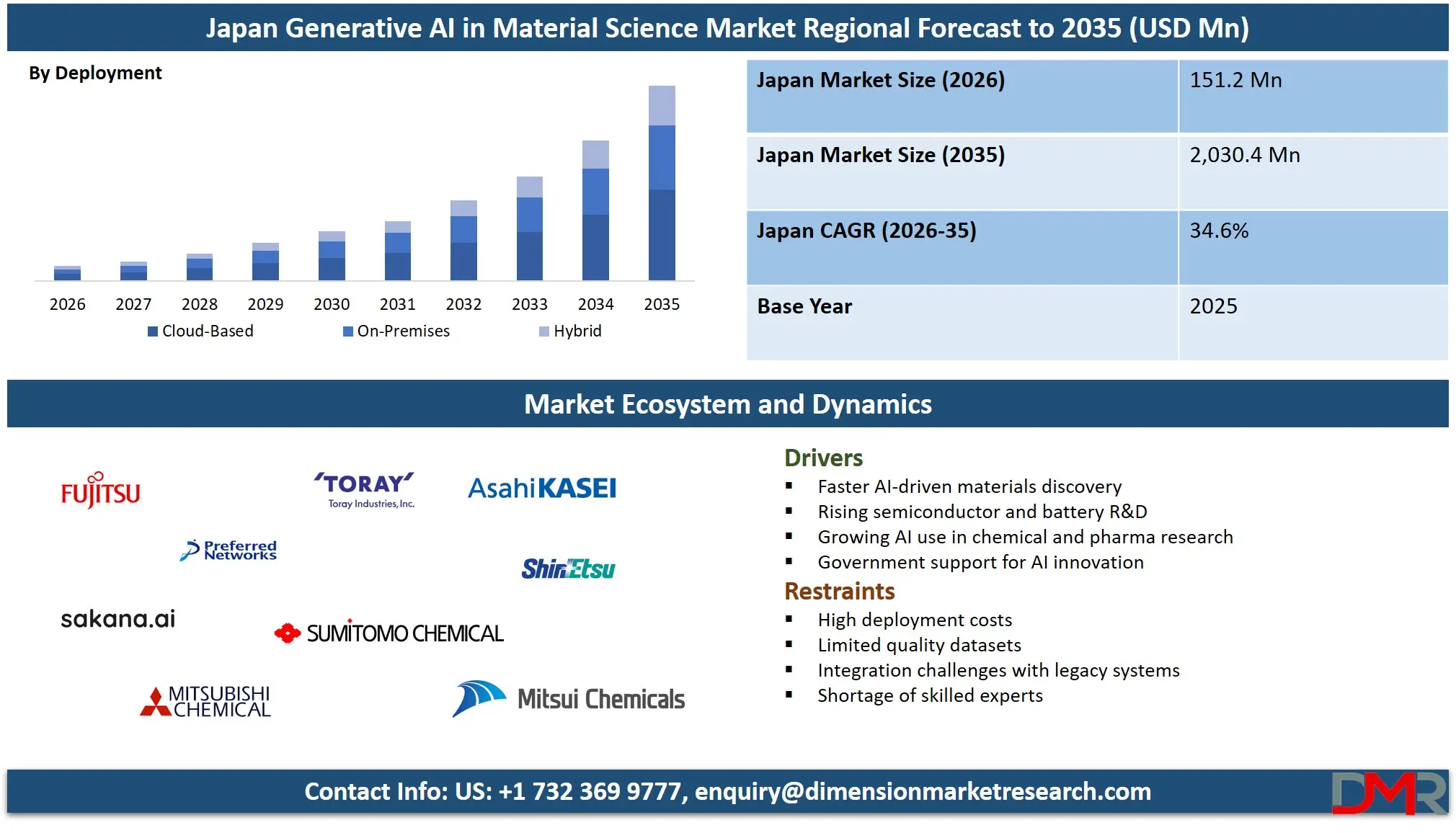
The Japan generative AI in material science market is expected to reach USD 151.2 million in 2026 and expand at a CAGR of 34.6%, reaching approximately USD 2,030.4 million by 2035, driven by increasing adoption of AI driven materials discovery, predictive modeling, materials informatics, and advanced computational research across semiconductor, chemical, and energy storage industries.
ℹ
To learn more about this report –
Download Your Free Sample Report Here
Generative AI in material science refers to the application of advanced artificial intelligence models to design, discover, and optimize new materials with specific physical, chemical, and mechanical properties. These AI systems analyze large datasets related to molecular structures, crystal compositions, and experimental results to generate novel material candidates that may not be easily identified through traditional research methods. By combining machine learning, deep learning, and materials informatics, generative AI accelerates simulations, predictive modeling, and laboratory experimentation. This approach significantly reduces the time and cost required for material discovery while enabling scientists to explore innovative solutions for industries such as electronics, pharmaceuticals, energy storage, and advanced manufacturing.
The Japan generative AI in material science market is evolving as research institutions, chemical companies, and technology firms increasingly integrate artificial intelligence into materials research and development processes. Japan has long been recognized for its strong foundation in advanced materials, semiconductor technologies, and chemical engineering, which provides a supportive ecosystem for the adoption of AI driven materials discovery platforms. Companies and research organizations are leveraging generative models to analyze molecular databases, improve computational simulations, and accelerate the development of high performance materials used in electronics, batteries, and specialty chemicals.
ℹ
To learn more about this report –
Download Your Free Sample Report Here
In addition, growing investment in digital transformation and artificial intelligence innovation is strengthening the adoption of AI powered material design tools across various industries in Japan. Universities, technology companies, and manufacturing firms are collaborating to apply machine learning algorithms and predictive analytics for material optimization, sustainable material development, and next generation product engineering. This trend is supporting the expansion of the Japan generative AI in material science market while enabling faster innovation cycles, improved research efficiency, and enhanced competitiveness in global advanced materials and technology markets.
Japan Generative AI in Material Science Market: Key Takeaways
- Rapid Market Expansion: Market expected to grow from USD 151.2 million in 2026 to USD 2,030.4 million by 2035, reflecting strong adoption of AI in materials research.
- Strong Growth Rate: The market is projected to expand at a 34.6% CAGR, driven by increasing use of generative AI in semiconductor and chemical innovation.
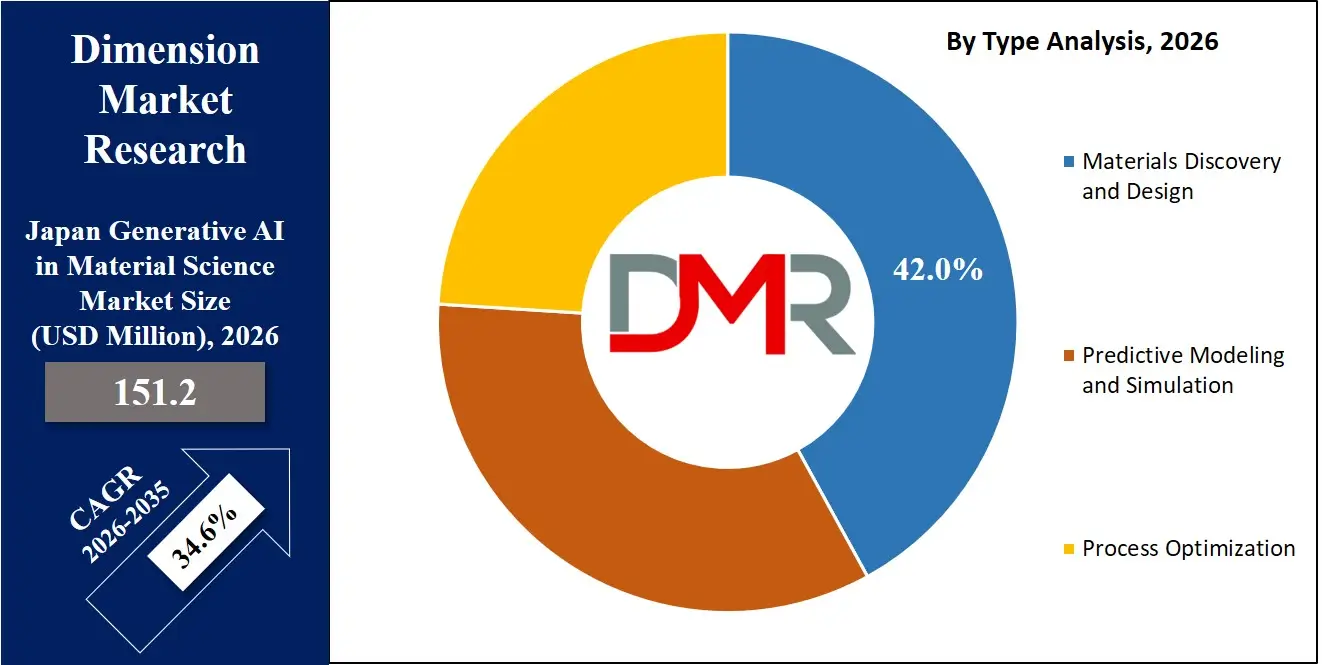
- Materials Discovery Leading Segment: Materials discovery and design holds about 42.0% market share in 2026, supported by AI driven molecular and materials modeling.
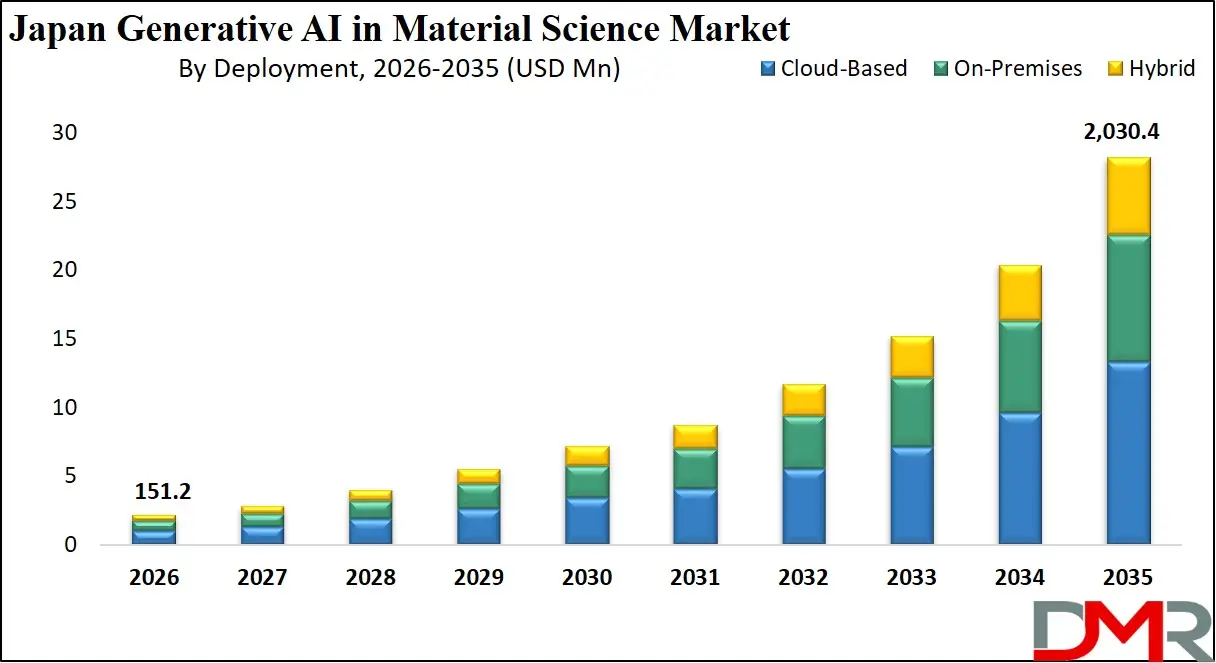
- Cloud Deployment Dominance: Cloud based platforms account for 47.0% of the market in 2026, enabling scalable computing for AI simulations.
- Pharmaceuticals and Chemicals Leading Application: Pharmaceuticals and chemicals capture 26.0% market share in 2026, driven by AI based compound and material design.
Japan Generative AI in Material Science Market: Use Cases
- Semiconductor Material Discovery: Generative AI is used to accelerate semiconductor material discovery by analyzing crystal structures, molecular data, and performance properties. AI driven simulations help researchers design high performance materials for advanced electronics and microchip manufacturing while reducing experimental time and R&D costs.
- Battery and Energy Storage Materials: AI powered materials informatics enables faster discovery of battery materials with improved energy density, durability, and charging efficiency. Generative models support research on lithium ion batteries and next generation energy storage materials used in electric vehicles and renewable energy systems.
- Chemical and Pharmaceutical Material Design: Generative AI helps chemical and pharmaceutical companies design new compounds and functional materials by analyzing large chemical datasets. Predictive modeling improves formulation development, material stability, and research efficiency in chemical manufacturing and drug related materials.
- Advanced Manufacturing Materials Optimization: AI driven modeling and simulation support the development of lightweight and high strength materials used in automotive, aerospace, and industrial manufacturing. Generative AI enables faster material testing and optimization for improved durability, performance, and production efficiency.
Japan Generative AI in Material Science Market: Stats & Facts
- Statistics Bureau of Japan (SBJ)
- Japan’s total research and development expenditure reached 22.05 trillion yen in FY2023, representing the highest recorded national R&D spending.
- National R&D spending accounted for 3.70% of Japan’s GDP in FY2023.
- Japan had approximately 907,400 researchers as of March 2024 across universities, public institutions, and private companies.
- Average R&D expenditure per researcher reached 24.3 million yen in FY2023.
- The number of female researchers increased to 182,800 in 2024, representing 18.5% of the total research workforce.
- Ministry of Economy, Trade and Industry (METI)
- Japan created a 500 billion yen strategic reserve of semiconductor materials to strengthen supply chain resilience.
- Domestic production of semiconductor materials reached 45% localization in 2023, increasing from 35% in 2020.
- Japan imports approximately 90% of rare earth materials used in semiconductor production.
- Around 70% of Japan’s rare earth imports originate from China.
- Automotive semiconductors represented 22% of total semiconductor sales in Japan in 2023.
- Japan has set a target to increase domestic semiconductor production value to 40 trillion yen by 2040.
Japan Generative AI in Material Science Market: Market Dynamics
Driving Factors in the Japan Generative AI in Material Science Market
Increasing Demand for AI Driven Materials Discovery
The growing need for faster innovation in advanced materials is driving the adoption of generative AI in material science across Japan. AI powered materials discovery platforms use machine learning algorithms, molecular modeling, and predictive analytics to analyze large materials databases and identify new compounds with specific properties. This approach significantly reduces experimental time and research costs compared to traditional laboratory testing. Industries such as semiconductors, specialty chemicals, and battery manufacturing are increasingly using materials informatics and computational materials science to accelerate product development and improve material performance.
Strong R&D Ecosystem in Advanced Materials and Electronics
Japan has a well-established research ecosystem supported by universities, technology firms, and chemical manufacturers that are investing in artificial intelligence and advanced materials research. Companies are integrating generative models and data driven simulations into their research workflows to develop high performance polymers, semiconductor materials, and energy storage components. Government initiatives that promote digital transformation, AI innovation, and smart manufacturing are further supporting the adoption of generative AI technologies in materials engineering and industrial research applications.
Restraints in the Japan Generative AI in Material Science Market
Limited Availability of Structured Materials Data
Generative AI models require large volumes of high quality and structured datasets to generate reliable material predictions. However, in material science research, experimental data is often fragmented, proprietary, or stored in unstructured formats. This limitation can reduce the accuracy of AI driven simulations and slow the adoption of generative AI platforms in materials informatics. Without well-organized molecular databases and standardized research data, training advanced AI models for materials discovery remains challenging for many research institutions and companies.
High Computational Infrastructure and Implementation Costs
The deployment of generative AI solutions in material science requires high performance computing infrastructure, specialized software tools, and skilled AI researchers. Running complex simulations and deep learning models for molecular design or materials optimization demands significant computing power and cloud resources. For many small and mid-sized research organizations, the cost of implementing AI driven material discovery platforms and maintaining computational infrastructure can limit widespread adoption in the market.
Opportunities in the Japan Generative AI in Material Science Market
Development of Sustainable and Green Materials
Generative AI is creating new opportunities for the development of sustainable and environmentally friendly materials. AI powered simulations enable researchers to design biodegradable polymers, recyclable materials, and energy efficient compounds with reduced environmental impact. In Japan, industries are focusing on sustainable material innovation for applications in packaging, automotive components, and consumer products. Generative AI based materials modeling helps accelerate the discovery of eco-friendly materials while supporting global sustainability and circular economy initiatives.
Advancement in Battery and Energy Storage Research
Japan’s strong focus on battery innovation and renewable energy technologies presents a major opportunity for generative AI in material science. AI driven predictive modeling can analyze electrochemical properties and generate new material compositions for high capacity batteries, solid state batteries, and advanced energy storage systems. This technology supports research in lithium based materials, electrode materials, and energy conversion components, enabling faster breakthroughs in electric vehicle batteries and renewable energy storage technologies.
Trends in the Japan Generative AI in Material Science Market
Integration of Materials Informatics with AI Platforms
A key trend in the market is the increasing integration of materials informatics with artificial intelligence and data science platforms. Researchers are combining machine learning, big data analytics, and computational chemistry tools to create intelligent research environments that accelerate material discovery. AI driven platforms can analyze millions of molecular combinations and predict physical properties such as conductivity, durability, and thermal stability, improving research productivity and innovation efficiency.
Growing Collaboration between Technology Firms and Chemical Companies
Another notable trend is the rising collaboration between technology companies, semiconductor manufacturers, and chemical producers in Japan. These partnerships aim to combine expertise in AI development with deep knowledge of materials engineering and chemical science. Collaborative research initiatives are focusing on generative modeling, digital materials design, and AI based simulation platforms to develop next generation materials for electronics, energy storage, and industrial manufacturing applications.
Japan Generative AI in Material Science Market: Research Scope and Analysis
By Type Analysis
Materials discovery and design are expected to dominate the type segment of the Japan generative AI in material science market, accounting for around 42.0% of the market share in 2026. The growing complexity of modern materials used in semiconductors, batteries, and specialty chemicals is increasing the need for advanced computational tools that can accelerate material innovation. Generative AI models enable researchers to analyze vast molecular datasets, crystal structures, and chemical compositions to generate new material candidates with desired physical and chemical properties. By leveraging machine learning algorithms and materials informatics, companies can significantly reduce the time required for laboratory experimentation and prototype development. In Japan, where industries such as electronics manufacturing, advanced chemicals, and automotive materials play a major role in economic growth, generative AI driven materials discovery platforms are helping research teams identify high performance materials that improve product durability, efficiency, and sustainability.
ℹ
To learn more about this report –
Download Your Free Sample Report Here
The predictive modeling and simulation segment is also gaining strong momentum as organizations increasingly adopt artificial intelligence for advanced materials analysis and performance forecasting. Predictive modeling uses deep learning techniques and data driven simulations to estimate how different materials behave under various environmental and operational conditions. This capability allows scientists and engineers to evaluate material strength, conductivity, thermal resistance, and chemical stability before conducting physical experiments. In Japan’s research ecosystem, predictive simulation tools are widely used in industries such as semiconductor fabrication, battery technology, and aerospace engineering to optimize material selection and manufacturing processes. By integrating generative AI with computational materials science, companies can test thousands of material variations virtually, reducing research costs while improving the accuracy of material performance predictions.
By Deployment Analysis
Cloud based deployment is expected to lead the deployment segment of the Japan generative AI in material science market, accounting for around 47.0% of the market share in 2026. The growing use of artificial intelligence in materials research requires large computational resources and scalable data processing capabilities, which cloud platforms can provide efficiently. Cloud infrastructure enables research institutions, technology firms, and chemical manufacturers to access advanced AI tools, materials databases, and high performance computing systems without investing heavily in physical hardware. This flexibility allows researchers to run complex molecular simulations, predictive analytics, and materials discovery models in real time. In Japan, many organizations are adopting cloud based generative AI platforms to support collaborative research, accelerate product innovation, and manage large volumes of experimental and simulation data generated during materials engineering processes.
On premises deployment continues to play an important role in the market, particularly among companies that require strict control over sensitive research data and intellectual property. Large semiconductor manufacturers, chemical companies, and industrial research laboratories often prefer on premises infrastructure to ensure data security and regulatory compliance. By hosting generative AI models and materials informatics platforms within internal data centers, organizations can maintain full control over proprietary datasets, experimental results, and advanced research algorithms. On premises systems also allow companies to integrate AI tools directly with existing laboratory equipment, simulation software, and enterprise research systems, supporting customized workflows and specialized materials development processes. This deployment approach remains relevant in industries where confidentiality, performance control, and secure data management are critical for competitive innovation.
By Application Analysis
Pharmaceuticals and chemicals are expected to lead the application segment of the Japan generative AI in material science market, accounting for approximately 26.0% of the market share in 2026. The pharmaceutical and chemical industries increasingly rely on advanced computational tools to accelerate compound discovery, chemical formulation, and material design. Generative AI models analyze molecular structures, chemical interactions, and large experimental datasets to generate new compounds with improved functional properties. This technology helps researchers identify potential materials for drug delivery systems, specialty chemicals, and high performance polymers while reducing the time required for laboratory experimentation. In Japan, strong research capabilities in chemical engineering and pharmaceutical development are supporting the adoption of AI driven materials informatics and predictive modeling platforms, enabling faster innovation and improved efficiency in chemical and pharmaceutical research processes.
The electronics and semiconductors segment is also witnessing significant adoption of generative AI as the demand for advanced electronic materials continues to grow. Semiconductor manufacturing requires highly specialized materials with precise electrical, thermal, and structural properties. Generative AI supports the design and optimization of semiconductor materials by simulating crystal structures, predicting material behavior, and evaluating performance under different manufacturing conditions. Japanese electronics and semiconductor companies are increasingly integrating artificial intelligence into materials engineering workflows to develop high purity materials, improve chip fabrication processes, and enhance device performance. By combining machine learning algorithms with computational materials science, researchers can rapidly explore multiple material combinations and optimize properties required for next generation electronic devices, microchips, and high efficiency semiconductor components.
The Japan Generative AI in Material Science Market Report is segmented on the basis of the following:
By Type
- Materials Discovery and Design
- Predictive Modeling and Simulation
- Process Optimization
By Deployment
- Cloud-Based
- On-Premises
- Hybrid
By Application
- Pharmaceuticals and Chemicals
- Electronics and Semiconductors
- Energy Storage and Conversion
- Automotive and Aerospace
- Construction and Infrastructure
- Consumer Goods
- Others
Japan Generative AI in Material Science Market: Competitive Landscape
The competitive landscape of the Japan generative AI in material science market is characterized by a mix of technology providers, materials research organizations, and industrial manufacturers that compete through innovation in AI driven materials discovery, computational modeling, and materials informatics platforms. Companies are focusing on integrating machine learning algorithms, predictive simulation tools, and high performance computing capabilities to accelerate the development of advanced materials for applications such as semiconductors, chemicals, energy storage, and electronics.
ℹ
To learn more about this report –
Download Your Free Sample Report Here
Competition in the market is largely driven by the ability to leverage proprietary materials datasets, domain expertise in materials engineering, and advanced AI infrastructure. Strategic collaborations between research institutions, cloud platform providers, and industrial manufacturers are becoming increasingly common to combine AI expertise with deep materials science knowledge and accelerate research efficiency. The market remains moderately fragmented, with players differentiating themselves through specialized generative design tools, AI based simulation platforms, and integrated hardware software ecosystems for next generation materials research.
Some of the prominent players in the Japan Generative AI in Material Science Market are:
- Fujitsu
- Preferred Networks
- Sakana AI
- Mitsubishi Chemical Group
- Sumitomo Chemical
- Mitsui Chemicals
- Toray Industries
- Asahi Kasei
- Shin-Etsu Chemical
- Nitto Denko
- Resonac Holdings
- DIC Corporation
- Denka Company
- Toagosei
- JSR Corporation
- AGC Inc.
- Tokyo Ohka Kogyo
- Hitachi
- NEC Corporation
- SoftBank Group
- Other Key Players
Recent Developments in the Japan Generative AI in Material Science Market
- December 2025: Novyte Materials, an AI driven materials discovery startup, secured a pre seed funding round led by Theia Ventures to accelerate development of AI based platforms for advanced materials design and research.
- November 2025: Preferred Networks and ENEOS launched the Matlantis AI powered atomistic simulation platform to support large scale materials discovery and accelerate research through deep learning based molecular simulations
- October 2025: Gen Phoenix secured a USD 15 million investment round led by Material Impact with participation from Tapestry to expand research and development of next generation sustainable materials technologies.
Report Details
| Report Characteristics |
| Market Size (2026) |
USD 151.2 Mn |
| Forecast Value (2035) |
USD 2,030.4 Mn |
| CAGR (2026–2035) |
34.6% |
| Historical Data |
2021 – 2025 |
| Forecast Data |
2027 – 2035 |
| Base Year |
2025 |
| Estimate Year |
2026 |
| Report Coverage |
Market Revenue Estimation, Market Dynamics, Competitive Landscape, Growth Factors and etc. |
| Segments Covered |
By Type (Materials Discovery and Design, Predictive Modeling and Simulation, and Process Optimization), By Deployment (On-Premises, Cloud-Based, and Hybrid), and By Application (Pharmaceuticals and Chemicals, Electronics and Semiconductors, Energy Storage and Conversion, Automotive and Aerospace, Construction and Infrastructure, Consumer Goods, and Others) |
| Country Coverage |
Japan |
| Prominent Players |
Fujitsu, Preferred Networks, Sakana AI, Mitsubishi Chemical Group, Sumitomo Chemical, Mitsui Chemicals, Toray Industries, Asahi Kasei, Shin-Etsu Chemical, Nitto Denko, Resonac Holdings, DIC Corporation, Denka Company, Toagosei, JSR Corporation, AGC Inc., Tokyo Ohka Kogyo, Hitachi, NEC Corporation, SoftBank Group, and Other Key Players |
| Purchase Options |
We have three licenses to opt for: Single User License (Limited to 1 user), Multi-User License (Up to 5 Users) and Corporate Use License (Unlimited User) along with free report customization equivalent to 0 analyst working days, 3 analysts working days and 5 analysts working days respectively. |
Frequently Asked Questions
How big is the Japan Generative AI in Material Science Market?
▾ The Japan Generative AI in Material Science Market size is estimated to have a value of USD 151.2 million in 2026 and is expected to reach USD 2,030.4 million by the end of 2035.
What is the growth rate in the Japan Generative AI in Material Science Market in 2026?
▾ The market is growing at a CAGR of 34.6% over the forecasted period of 2026.
Who are the key players in the Japan Generative AI in Material Science Market?
▾ Some of the major key players in the Japan Generative AI in Material Science Market are Fujitsu, Preferred Networks, Sakana AI, Mitsubishi Chemical Group, Sumitomo Chemical, Mitsui Chemicals, Toray Industries, Asahi Kasei, Shin-Etsu Chemical, Nitto Denko, and many others.