Japan Generative AI Market Snapshot
- Japan Generative AI Market Size in 2026: USD 2,704.7 Million
- Japan Generative AI Market Size in 2035: USD 57,142.5 Million
- Japan CAGR from 2026 to 2035: 40.3%
- Software is the leading Component segment in 2026: 64.3%
- Generative Adversarial Networks is the leading Technology segment in 2026: 64.3%
- Large Language Models is the leading Model Outlook segment in 2026: 37.6%
- Natural Language Processing is the leading Application segment in 2026: 31.8%
- Banking, Financial Services, and Insurance is the leading End User segment in 2026: 27.4%
What is the Japan Generative AI and its Market Size?
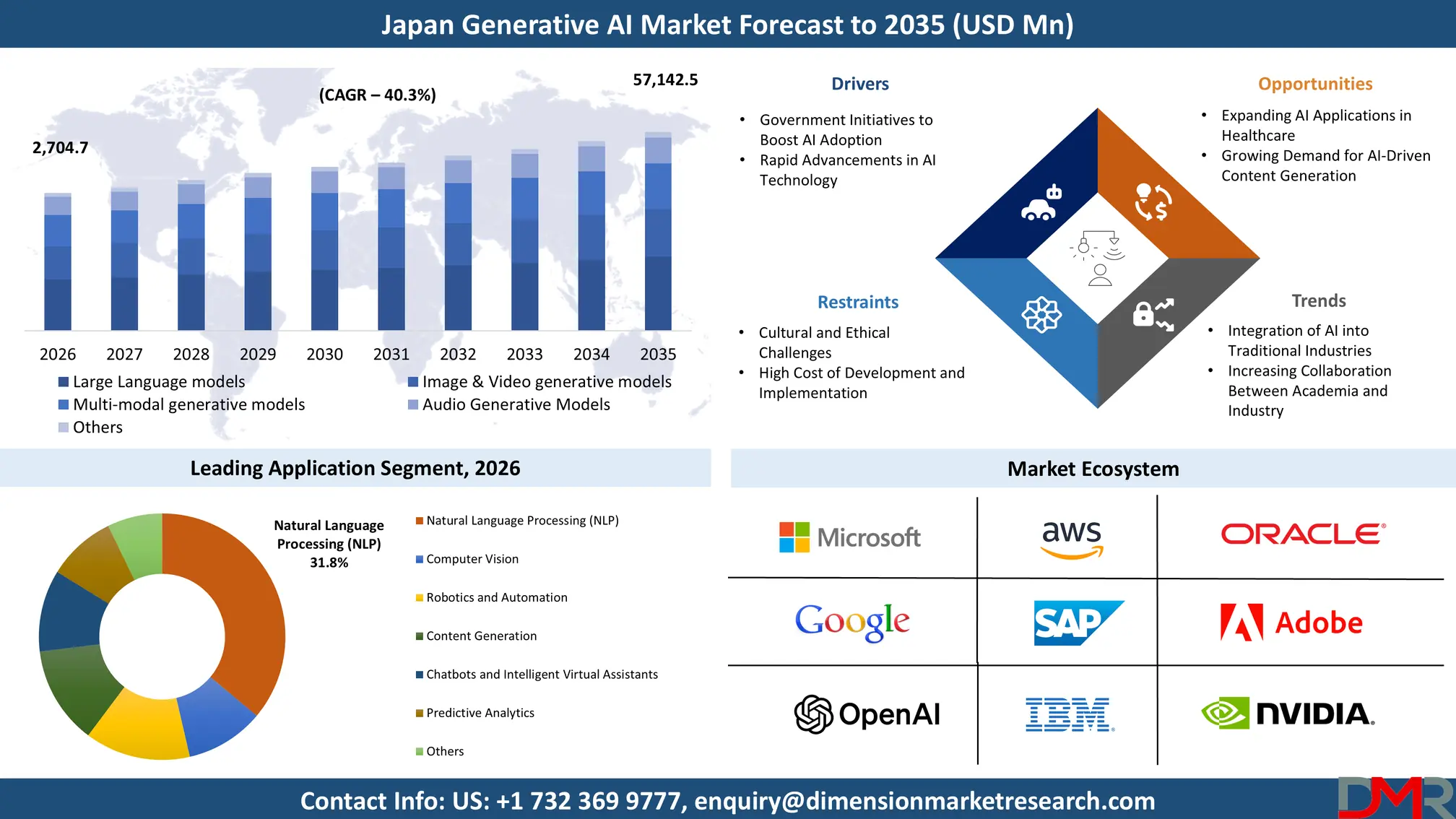
The Japan Generative AI Market size is expected to reach a value of USD 2,704.7 million in 2026, and it is further anticipated to reach a market value of USD 57,142.5 million by 2035 at a CAGR of 40.3%.
ℹ
To learn more about this report –
Download Your Free Sample Report Here
The growth of the Generative AI market in Japan is taking place at a phenomenal pace owing to the advancements in technology in the form of artificial intelligence as well as their widespread application in different industries. By 2026, it is evident that the Japanese Generative AI market will have gained characteristics such as government support, high research and development activities, and adoption of AI solutions in sectors such as healthcare, automotive manufacturing, and finance. The Society 5.0 initiatives in Japan have an instrumental role in promoting innovation in the domain of artificial intelligence, especially generative AI innovation that yields better socio-economic outcomes.
Use Cases
- Content Generation: Content generation through artificial intelligence provides companies in Japan with personalized marketing copy, product descriptions, social media posts, and campaign assets. It saves time during the process, helps with localization, ensures consistency, and enables scalable customer engagement.
- Healthcare Diagnostics: By studying medical imaging, clinical data, and diagnosis patterns, generative AI allows for disease detection and personalized treatment in Japan. With this tool, healthcare institutions can enhance their diagnostic abilities, prioritize cases, lighten workload, and provide efficient patient-centered care.
- Automotive Design: Generative AI allows Japan's automotive industry to design vehicles, run prototypes, and make styling, engineering, and manufacturing decisions more efficiently. With this technology, automotive companies can reduce the time of the development cycle and increase the precision and efficiency of the processes.
- Media Production: With AI-powered video editing and animation software, Japan's media and entertainment companies can generate realistic content. With this technology, media institutions can produce content, reduce workload and enhance storytelling as well as create localized campaigns.
Key Takeaways
- The Japan Market Value: The Japan Generative AI Market is expected to reach USD 2,704.7 million in 2026 and USD 57,142.5 million by 2035, expanding at a CAGR of 40.3% during the forecast period.
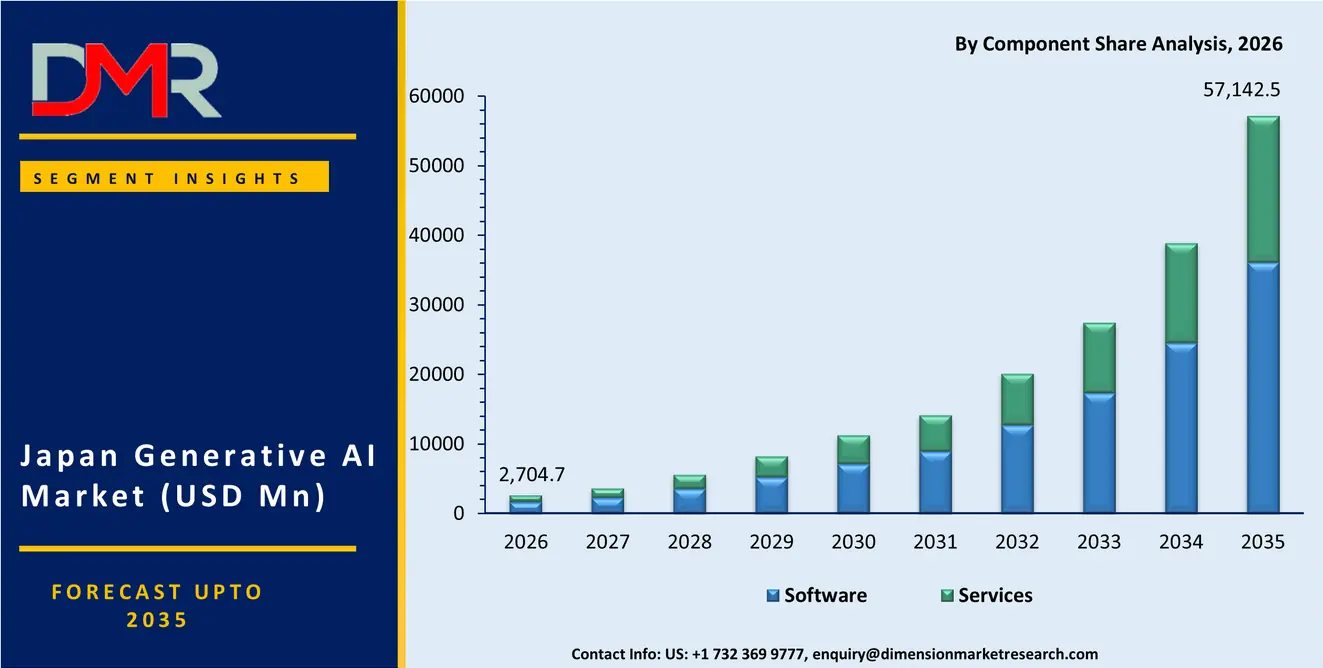
- By Component Segment Analysis: Software is poised to lead the component segment with a total revenue share of 64.3% in 2026. The dominance of software can be attributed to generative AI platforms, APIs, SDKs, and pretrained models that are being demanded in Japan.
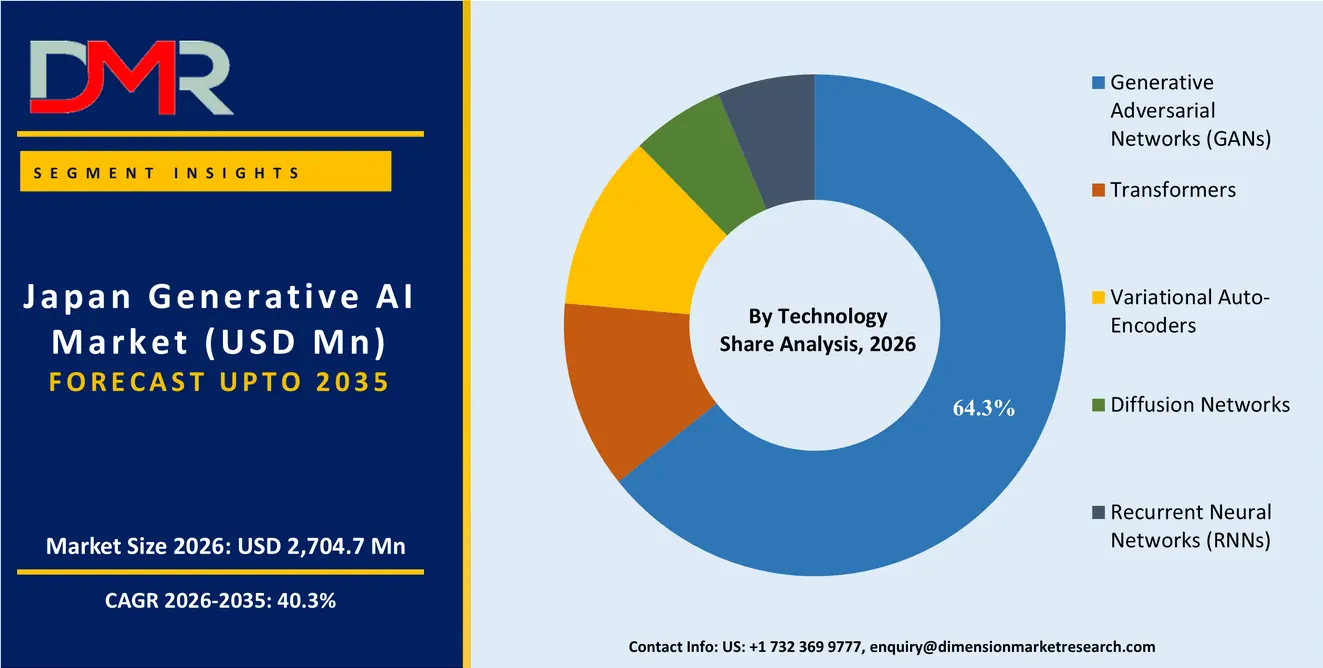
- By Technology Segment Analysis: Generative Adversarial Networks is expected to emerge as dominant in the technology outlook category and hold a market share of 64.3% in 2026. This can be attributed to their use in image, video, audio, avatar, and synthetic data generation applications.
- By Model Outlook Segment Analysis: Large Language Models are expected to dominate the model outlook segment and hold 37.6% of the total market share in 2026. Growth is due to Japanese language processing, enterprise search, document automation, coding, customer service, and knowledge management.
- By Application Segment Analysis: The largest application segment is poised to be NLP, which occupies 31.8% market share in 2026. There is increased use due to rising demand for machine translation, text summarization, sentiment analysis, language models, customer support, and automation.
- Growth Drivers: Increased government funding to support R&D and implementation of digital transformation with responsible usage in healthcare, manufacturing, mobility, and public services. Rising need for automation, AI solutions in Japanese language, personalized customer experience, and faster content generation.
- Market Trends: Increasing use of LLMs and multimodal AI in customer support, document automation, programming, and enterprise knowledge management. Increasing cooperation between Japanese technology companies, academic institutions, and foreign AI providers to develop local and industry-specific generative AI solutions.
- Growth Rate: The compound annual growth rate of the Japan Generative AI Market from 2026 to 2035 is expected to be 40.3%, driven by enterprise adoption, government initiatives, technological advancements, and industrial applications.
Key Drivers in the Japan Generative AI Market
Government Initiatives to Boost AI Adoption
The proactive stance of the Japanese government on the adoption of AI is among the key growth drivers of the generative AI market. It has brought out initiatives such as the Society 5.0 vision, through which it plans to integrate AI, along with other advanced technologies, into various walks of life. This has meant more investments in AI research and development, particularly in self-driving vehicles, smart cities, and health. Companies such as Hitachi and Panasonic have already moved to the forefront in developing AI-driven solutions fully aligned with this vision.
Rapid Advancements in AI Technology
The rapid pace of technological development for artificial intelligence, precisely in generative adversarial networks and transformers, propels the pace of growth in the generative AI market of Japan. Tech giants such as Sony and SoftBank are some big Japanese investors in AI research to develop pioneering solutions to the specific needs of the Japanese market. Be it media and entertainment, gaming, or advertising, this area is seeing increasingly realistic AI-generated content that can enhance user experience.
Restraints in the Japan Generative AI Market
Cultural and Ethical Challenges
The uniqueness of the Japanese cultural context provides many challenges to wide adoption in the area of generative AI. The main aspects restraining AI growth concern ethical issues, mostly in areas such as deepfakes and privacy. Japanese companies will have to be very considerate of cultural sensitivities, balancing innovation with ethics. Above all, public confidence in AI technologies is the most important aspect. Companies like Rakuten and LY Corporation are indeed working toward ensuring that AI use in products and services offered is being transparently deployed and used in ways that can be considered ethical.
High Cost of Development and Implementation
This forms the main restraint toward which the generative AI market is leaning in Japan because generative AI solutions require high development and implementation costs. While the adoption of AI requires much investment and therefore is not affordable for many Japanese SMEs, maintenance and replacement costs are expensive, especially for industries with a lower margin on their products. To negotiate this specific challenge, companies such as NTT Data and Toshiba have been looking into more cost-effective solutions and offering support to SMEs to facilitate wide considerations toward the use of AI technology.
Growth Opportunities in the Japan Generative AI Market
Expanding AI Applications in Healthcare
The growth possibilities for generative AI solutions are promising in Japan's healthcare sector. AI is gaining momentum in clinical diagnosis related to imagery, drug discovery, and preparation of personalized treatment plans so crucial for Japan's aging population. Companies such as Olympus Corporation and Canon Medical Systems create AI-driven tools for early diagnosis and treatment options that could have great impacts on the industry. The integration of generative AI in healthcare should be such that it ensures better outcomes for patients and makes operations more efficient, hence driving the growth of the market.
Growing demand for AI-driven content generation
The industry demands are increasing towards AI-driven content generation in the media and entertainment sectors of Japan. With innovation and creativity inherent in the culture, Japanese companies are leading from the front in leveraging generative AI to create full automation of creative processes, including the creation of music, graphics, and video editing. That will no doubt dramatically alter how content is created and consumed, with great growth opportunities ahead
Trends in the Japan Generative AI Market
Integration of AI into Traditional Industries
Traditional industries like manufacturing, retail, and transport are increasingly integrating generative AI solutions aimed at enhancing operational efficiency and innovation. Companies such as Toyota and Mitsubishi Electric are developing AI-enabled solutions to enhance their production processes, optimize their supply chains, and improve the quality of their products. This trend is propelled by strong manufacturing in Japan and the need to bring out more competitiveness in the international market.
Increasing Collaboration between Academia and Industry
Notable trends that are going to make a difference in the generative AI Japan market would include increasing academic and industry collaboration. For instance, universities such as the University of Tokyo and Kyoto University have partnership relations with companies like NEC Corporation and Fujitsu, among others, for advancement in research and development concerning AI. These are focused on developing top-of-the-line AI technologies, especially in NLP and computer vision, with key applications in the healthcare, automotive, and finance sectors.
Research Scope and Analysis
Japan Generative AI market report is segmented based on component, technology, model type, application, and end-user. It comprises software & services, GANs, transformers, VAEs, diffusion networks, RNNs, various types of generative models, AI applications, and BFSI, media, IT, healthcare, automotive, gaming, and other industry sectors in Japan.
ℹ
To learn more about this report –
Download Your Free Sample Report Here
By Component Analysis
Software is estimated to account for the largest share of 64.3% of the Japan generative AI market revenue in the component segment in 2026. The large share is attributed to enterprise demand for generative AI platforms, APIs & SDKs, and pre-trained models that enable faster application development and deployment.
ℹ
To learn more about this report –
Download Your Free Sample Report Here
Software will continue to be fueled by innovations in secure, scalable, and advanced enterprise Japanese language models and cloud infrastructures. Services are forecasted to experience the highest CAGR of 40.6% till 2035 owing to increasing demand for consulting, implementation, integration, training, and technical services.
By Technology Analysis
Generative Adversarial Networks are expected to lead the technology segment in terms of revenue share, with 64.3% of the revenue share in 2026. The high dominance is attributed to their application in realistic image, video, audio, avatar, and synthetic data generation in various domains such as media, entertainment, gaming, healthcare, and industrial sectors. The well-established development ecosystem and commercial adoption of GANs boost their adoption. Diffusion Networks are forecasted to grow at the highest CAGR of 43.2% during the forecast period due to the visual quality, controllability, creativity, and growing enterprise-grade image and video solutions.
By Model Outlook Analysis
The Large Language Models are projected to occupy a dominant position in the model outlook of the Japan Generative AI market with a revenue share of 37.6% in 2026. The dominance of Large Language Models will be because of the growing adoption of text-based and code generation models for Japanese language processing, enterprise search, document automation, software development, customer service, and knowledge management. Large enterprises will integrate Large Language Models into their business processes. The multimodal generative models will grow at the highest CAGR of 44.1% during the forecast period, due to the growing use of text, image, speech, and data generation capability in organizations.
By Application Analysis
Natural Language Processing is expected to lead the application segment with the highest market share of 31.8% in 2026. The dominance of NLP is due to the high requirements of language modeling, machine translation, text summarization, sentiment analysis, and automated document processing in Japan, along with growing domestic enterprise language models. Content Generation is set to grow at the highest CAGR of 42.9% during the forecast period of 2026 to 2035 owing to growing requirements for automated copywriting, creative content, graphic design, localization, and personalized marketing.
By End User Analysis
Banking, Financial Services, and Insurance is estimated to take the lead position in the end-user category of the Japan generative AI market, holding 27.4% revenue share in 2026. The reason behind its leadership includes expenditure on fraud detection, risk assessment, regulatory compliance, document management, customer onboarding, tailored financial solutions, and conversational banking. Data volumes in this category will encourage the use of models. Healthcare will have the highest CAGR of 43.6% during the forecast period due to use cases including medical imaging, drug discovery, clinical documentation, diagnostics, and personalized medicine.
The Japan Generative AI Market Report is segmented based on the following:
By Component
- Software
- Generative AI Platforms
- API & SDKs
- Pre-trained Models
- Services
- Consulting & Advisory Services
- Implementation & Integration Services
- Training & Support
By Technology
- Generative Adversarial Networks (GANs)
- Transformers
- Variational Auto-Encoders
- Diffusion Networks
- Recurrent Neural Networks (RNNs)
By Model Outlook
- Large Language models
- Text-based Models
- Code Generation Models
- Image & Video generative models
- Style Transfer Models
- Deepfake Models
- Animation & Video Editing Models
- Multi-modal generative models
- Text-to-Image Models
- Text-to-Speech Models
- Image-to-Text Models
- Audio Generative Models
- Speech Synthesis
- Music Generation
- Others
By Application
- Natural Language Processing (NLP)
- Machine Translation
- Text Summarization
- Sentiment Analysis
- Language Modeling
- Computer Vision
- Image Recognition & Enhancement
- Object Detection & Classification
- Facial Recognition
- Robotics and Automation
- Autonomous Navigation
- Human-Robot Interaction
- Process Automation
- Content Generation
- Text & Copywriting
- Creative Writing
- Graphic Design
- Chatbots and Intelligent Virtual Assistants
- Customer Support Automation
- Personalized Recommendations
- Conversational AI
- Predictive Analytics
- Demand Forecasting
- Risk Assessment
- Anomaly Detection
- Others
By End User
- Media & Entertainment
- Banking, Financial Services, and Insurance (BFSI)
- IT & Telecommunication
- Healthcare
- Automotive & Transportation
- Gaming
- Others
Regulatory Landscape
The regulatory environment is becoming increasingly crucial as governments put regulations on areas such as transparency, copyright, privacy, safety, responsibility, and artificial content. METI/MIC AI guidelines outlines four risk categories and bans nine activities; its general purpose AI obligations came into effect in August 2025, while further requirements for transparency and enforcement took effect in August 2026. Such requirements present opportunities in governance tools, model validation, watermarking, bias mitigation, and privacy-preserving techniques. Nevertheless, inconsistencies in regulations, intellectual property conflicts, costs associated with compliance, and delays in product releases are still significant risks.
Investment and White Space Analysis
The Investment and White Space Analysis shows high capital availability and untapped potential in the Generative AI industry. Data from the OECD indicates that the investment in generative AI ventures was at USD 35.3 billion in 2025 and constituted more than 14% of the AI venture capital investment, compared to USD 2.8 billion in 2022. The capital is directed towards foundation models, multimodal systems, AI agents, computing hardware, cybersecurity, and enterprise application. The white spaces in the industry involve local language models, cost-effective tools for small businesses, privacy-oriented implementation, edge AI, and tailored healthcare, educational, manufacturing, and finance services.
Competitive Landscape
Japan's generative AI market is marked by fierce competition between key players, each striving to develop and deploy advanced solutions across various industries. Major companies like OpenAI, NVIDIA, and Google lead this effort with cutting-edge AI platforms and tools tailored specifically for Japanese enterprises' diverse needs. Furthermore, each player invests heavily in research and development to bolster the capabilities of generative AI models like natural language processing (NLP), computer vision (CV), content generation, etc. Not to be outdone by global giants, Japan also features several domestic companies making significant strides in the generative AI market.
Some of the prominent players in the Japan Generative AI Market are:
- Preferred Networks, Inc.
- ABEJA, Inc.
- Cinnamon AI
- Ubie, Inc.
- Ascent Robotics, Inc.
- LeapMind, Inc.
- Stockmark, Inc.
- Studio Ousia
- HEROZ, Inc.
- Autify, Inc.
- Fujitsu Limited
- NEC Corporation
- NTT DATA Corporation
- Hitachi, Ltd.
- Sony Group Corporation
- SoftBank Group Corp.
- CyberAgent, Inc.
- Cogent Labs Inc.
- Rakuten Group, Inc.
- LY Corporation
- Sakana AI
- ELYZA, Inc.
- PKSHA Technology Inc.
- ExaWizards Inc.
- AI inside Inc.
- Ridge-i Inc.
- Laboro.AI Inc.
- FRONTEO, Inc.
- rinna Co., Ltd.
- LegalOn Technologies, Inc.
- Google LLC
- Microsoft Corporation
- Amazon Web Services, Inc.
- IBM Corporation
- NVIDIA Corporation
- OpenAI
- Anthropic PBC
- Adobe Inc.
- Salesforce, Inc.
- Oracle Corporation
- Other Key Players
Recent Developments
- July 2026: Sakana AI partnered with NVIDIA to integrate the Nemotron open-model stack and accelerated computing into Sakana Fugu, supporting dynamic coordination of specialized models and advancing multi-agent innovation from Japan.
- June 2026: SoftBank Group announced "Patching as a Service," an OpenAI-powered cybersecurity solution designed to identify vulnerabilities, support automated remediation, and strengthen the protection of critical infrastructure across Japan.
- April 2026: NTT developed lossless vocabulary-reduction technology that enables heterogeneous large language models to coordinate and transfer knowledge through shared token vocabularies without reducing inference accuracy.
- November 2025: Sakana AI raised JPY 32.0 billion, equivalent to approximately USD 200.0 million, through its Series B funding round to accelerate sustainable AI development and commercial implementation across Japan.
Report Details
| Report Characteristics |
| Market Size (2026) |
USD 2,704.7 Mn |
| Forecast Value (2035) |
USD 57,142.5 Mn |
| CAGR (2026–2035) |
40.3% |
| Historical Data |
2021 – 2025 |
| Forecast Data |
2026 – 2035 |
| Base Year |
2025 |
| Estimate Year |
2026 |
| Segments Covered |
By Component, By Technology, By Model Outlook, By Application, By End User |
| Country Coverage |
Japan |
Frequently Asked Questions
How big is the Japan Generative AI Market?
▾ The Japan Generative AI Market is valued at USD 2,704.7 million in 2026 and is projected to reach USD 57,142.5 million by 2035, reflecting sustained adoption across major Japanese industries.
What is the CAGR of the Japan Generative AI Market from 2026 to 2035?
▾ The Japan Generative AI Market is projected to expand at a compound annual growth rate of 40.3% from 2026 to 2035, supported by enterprise adoption and continuing technological innovation nationwide.
What factors are driving the growth of the Japan Generative AI Market?
▾ Growth is driven by government support, enterprise digital transformation, workforce shortages, Japanese language model development, cloud infrastructure, automation demand, and adoption across finance, healthcare, automotive, manufacturing, media, gaming, and telecommunications.
What are the major trends in the Japan Generative AI Market?
▾ Major trends include localized language models, multimodal AI, autonomous agents, retrieval augmented generation, enterprise copilots, synthetic data, private AI deployment, smaller domain specific models, secure infrastructure, and responsible AI governance.
Who are the key players in the Japan Generative AI Market?
▾ Key players include Preferred Networks, ABEJA, Cinnamon AI, Ubie, Ascent Robotics, LeapMind, Stockmark, Studio Ousia, HEROZ, Autify, Fujitsu, NEC, NTT DATA, Hitachi, Sony, SoftBank, Sakana AI, and ELYZA, among others.
How is the Japan Generative AI Market segmented?
▾ The market is segmented by component, technology, model outlook, application, and end user, covering software, services, GANs, transformers, language models, multimodal models, NLP, automation, BFSI, healthcare, automotive, gaming, and others.