Market Overview
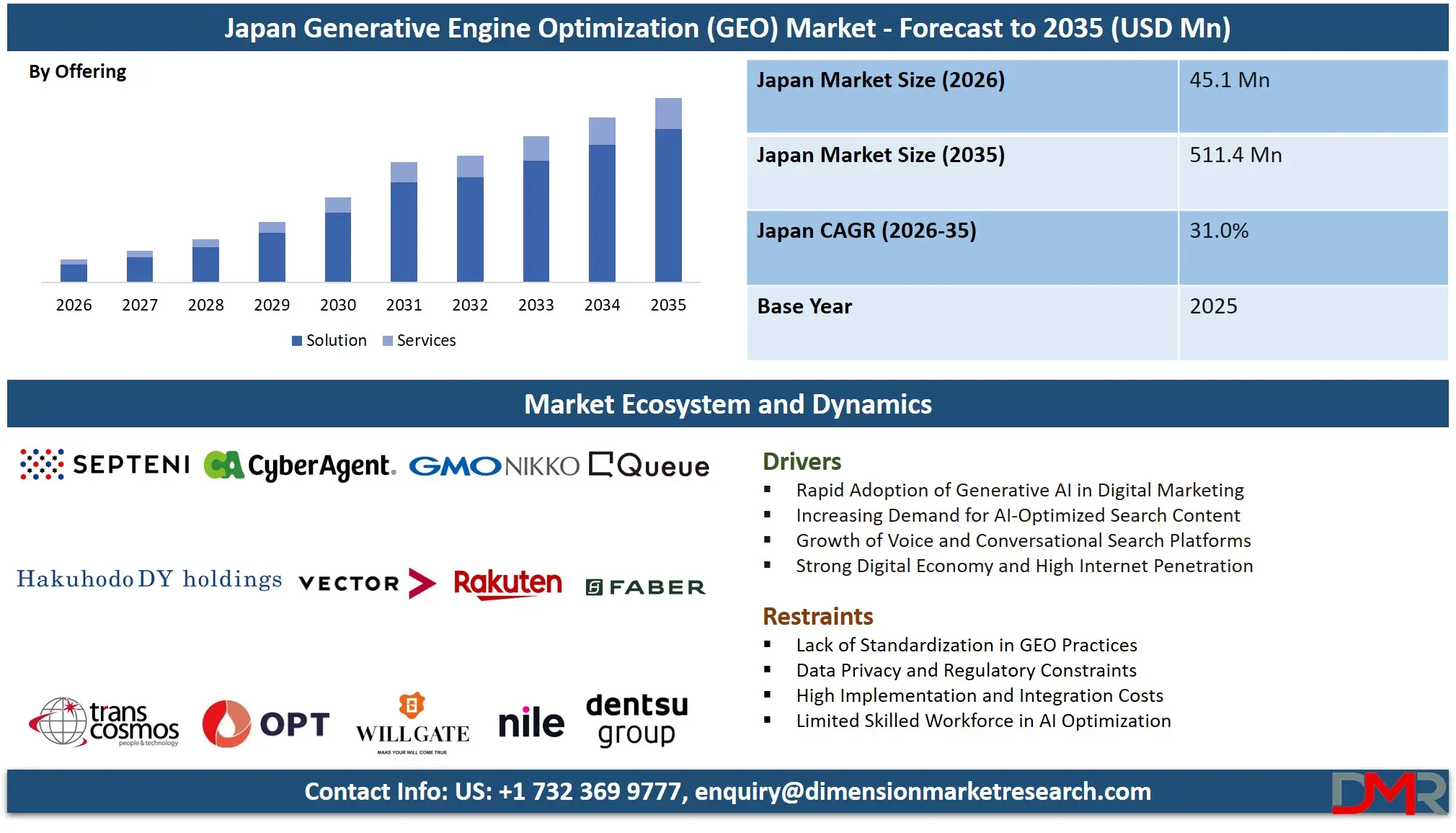
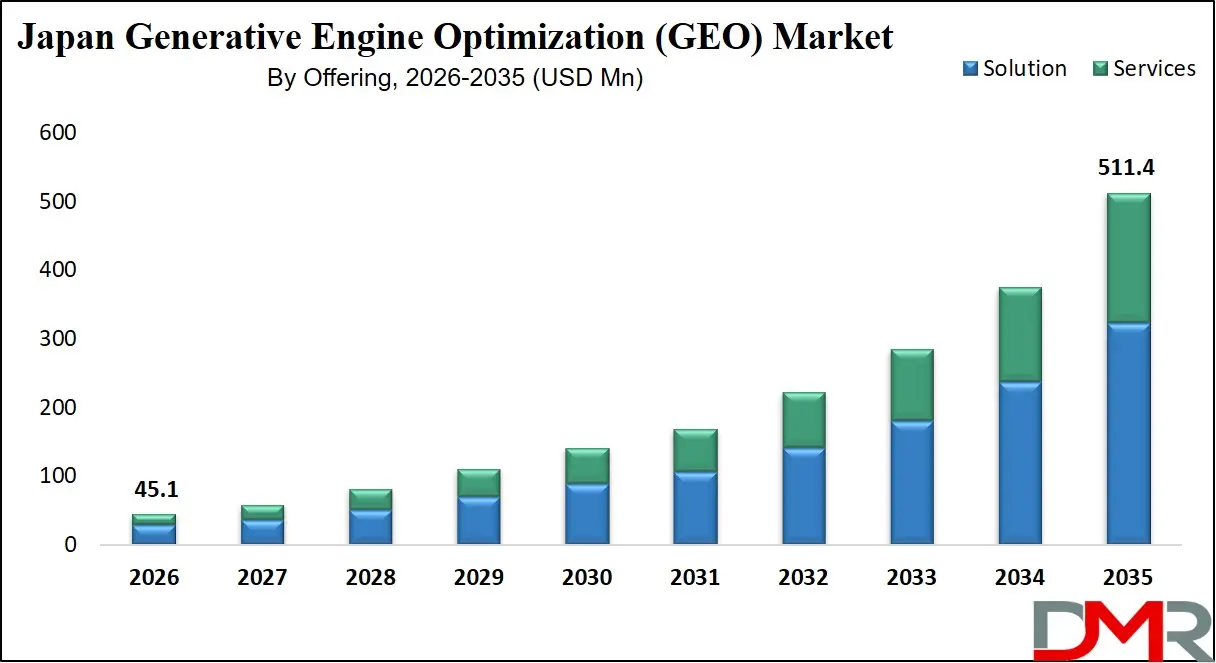
The Japan Generative Engine Optimization (GEO) Market is projected to reach USD 45.1 million in 2026, which is further anticipated to grow to USD 511.4 million by 2035, expanding at a compound annual growth rate of 31.0% during the forecast period. This growth reflects Japan’s accelerating transition toward AI-driven digital ecosystems, supported by strong government initiatives, advanced technological infrastructure, and increasing enterprise adoption of generative AI platforms.
ℹ
To learn more about this report –
Download Your Free Sample Report Here
GEO is rapidly evolving as a specialized domain within digital marketing in Japan, incorporating advanced practices such as AI-driven content optimization, prompt engineering, semantic structuring, and knowledge graph integration. As generative search engines and conversational AI applications gain traction across industries, Japanese enterprises are prioritizing AI-first content strategies to ensure visibility across evolving digital interfaces. Japan’s strong presence in robotics, automation, and enterprise software further strengthens its position in adopting GEO solutions across sectors such as retail, automotive, finance, and media.
The market is witnessing increasing adoption of advanced techniques including retrieval-augmented generation, multilingual optimization (especially Japanese-English content alignment), and real-time content performance tracking. These capabilities enable organizations to improve contextual accuracy, enhance discoverability, and maintain brand credibility in AI-generated outputs.
ℹ
To learn more about this report –
Download Your Free Sample Report Here
Key trends include the shift from traditional SEO practices to AI-native optimization, rising adoption of machine learning-driven analytics, and growing emphasis on ethical AI usage, including transparency and data reliability. However, challenges such as regulatory complexities, language-specific AI limitations, and shortage of skilled AI professionals remain significant barriers.
Overall, the Japan GEO market is positioned for strong long-term growth, driven by innovation, digital transformation, and increasing reliance on AI-powered content ecosystems.
Japan Generative Engine Optimization (GEO) Market: Key Takeaways
- Market Value: The Japan Generative Engine Optimization market is valued at USD 45.1 million in 2026 and is projected to reach USD 511.4 million by 2035, reflecting rapid expansion driven by AI adoption.
- By Offering Segment Analysis: Solutions dominate the market, accounting for 65.8% share in 2026, supported by rising demand for AI-driven tools that enhance content optimization, automation, and digital visibility across industries.
- By Deployment Segment Analysis: Cloud-based deployment leads the market due to Japan’s strong cloud infrastructure, scalability benefits, and increasing enterprise preference for flexible, cost-efficient, and easily deployable AI-powered GEO solutions.
- By Application Segment Analysis: Content and discoverability optimization dominates as businesses increasingly prioritize visibility across AI-driven search platforms, leveraging GEO tools to enhance rankings, engagement, and personalized user experiences effectively.
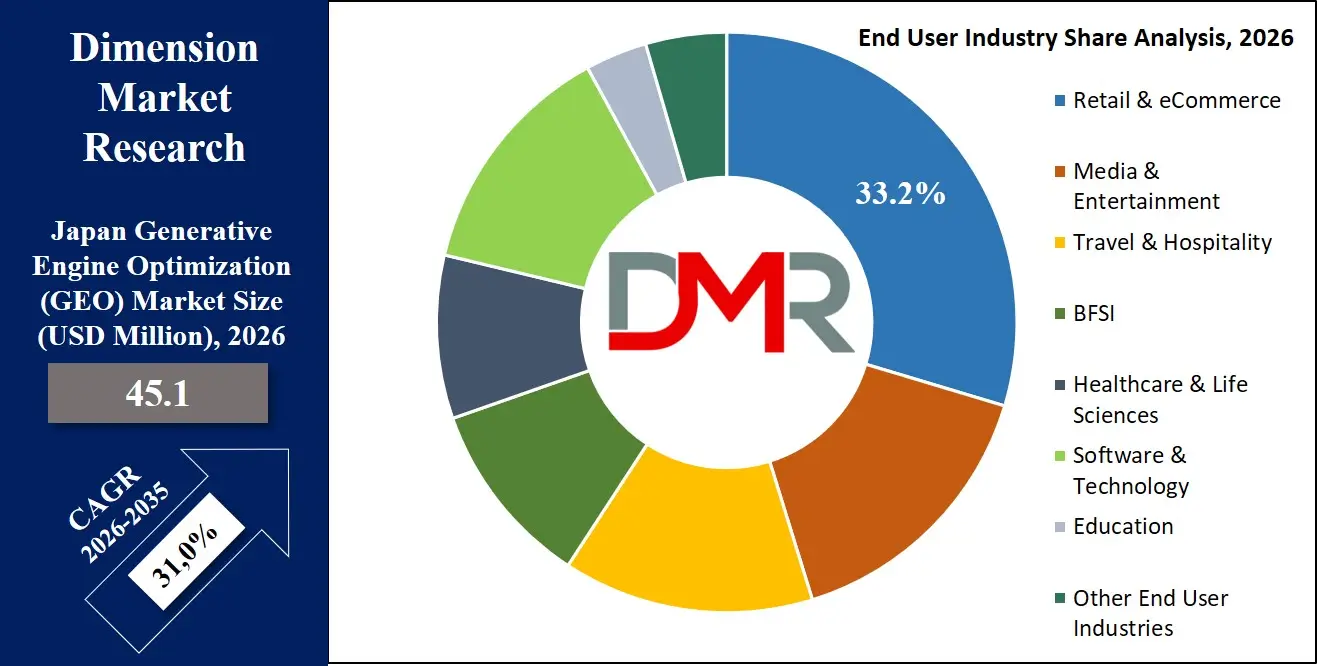
- By End User Industry Segment Analysis: Retail and e-commerce sectors dominate due to intense competition for online visibility, increasing digital transactions, and growing reliance on AI-driven optimization strategies to attract and retain customers.
- Key Players: Major companies include Google LLC, Microsoft Corporation, OpenAI, Rakuten Group Inc., NTT Data, and Fujitsu, driving innovation and competition.
- Market Growth Rate: The Japan GEO market is expanding at a strong CAGR of 31.0% during the forecast period, driven by rapid AI adoption, increasing enterprise investments, and growing demand for advanced digital optimization solutions.
Japan Generative Engine Optimization (GEO) Market: Use Cases
- Retail and E-commerce Product Discovery: Optimization of product catalogs, attributes, and structured data for AI-powered shopping assistants and generative search platforms, enabling personalized and context-aware product recommendations across multilingual digital marketplaces.
- Media Content Distribution and Visibility Enhancement: Optimization of digital content, including articles, videos, and multimedia assets, for improved inclusion in AI-generated summaries and search outputs, enhancing audience reach and engagement across content platforms.
- Healthcare Information Accessibility and Optimization: Enhancing the accessibility and accuracy of healthcare information through structured content optimization and AI-driven knowledge systems, ensuring compliance with Japan’s regulatory frameworks and addressing the needs of an aging population.
- Financial Services Customer Interaction Optimization: Implementation of GEO strategies to optimize conversational AI systems in banking and financial services, improving customer engagement, regulatory compliance, and personalized service delivery.
Japan Generative Engine Optimization (GEO) Market: Stats & Facts
Ministry of Internal Affairs and Communications (Japan)
- Over 80% of enterprises in Japan are actively investing in digital transformation initiatives.
- AI adoption in enterprises has surpassed 35%, reflecting growing reliance on automation and analytics.
- Cloud computing adoption continues to expand rapidly across industries.
Ministry of Economy, Trade and Industry (METI)
- More than 50% of large enterprises have integrated AI into operational workflows.
- Digital economy initiatives are driving innovation across multiple sectors.
- AI investment is increasing across manufacturing, retail, and service industries.
Japan IT Services Industry Association (JISA)
- IT services sector growth is strongly driven by AI and cloud-based solutions.
- Increasing demand for AI-driven analytics platforms is observed across enterprises.
Cabinet Office Japan (Society 5.0 Initiative)
- AI and digital transformation are central to Japan’s economic strategy.
- Smart society initiatives are accelerating adoption of AI technologies across industries.
Japan Generative Engine Optimization (GEO) Market: Market Dynamic
Driving Factors in Japan Generative Engine Optimization (GEO) Market
National AI Strategy and Digital Transformation Initiatives
Japan’s long-term digital vision under Society 5.0, supported by policy frameworks from the Ministry of Economy, Trade and Industry and the Cabinet Office of Japan, is significantly accelerating the adoption of artificial intelligence across industries. These initiatives emphasize smart infrastructure, data-driven governance, and AI integration into business processes, creating a strong foundation for GEO adoption. As enterprises increasingly prioritize digital transformation, GEO solutions are becoming essential for managing AI-driven discoverability, optimizing structured data, and aligning content with generative search systems. The government’s focus on innovation hubs, AI funding programs, and cross-industry collaboration further strengthens the ecosystem, positioning GEO as a critical enabler of Japan’s digital economy.
Growing Enterprise Demand for AI-Based Optimization
The rapid proliferation of generative AI tools across sectors such as retail, finance, and media is driving significant demand for GEO solutions in Japan. Enterprises are increasingly leveraging AI for customer engagement, content automation, and decision-making, which requires advanced optimization frameworks to ensure visibility and accuracy in AI-generated outputs. The expansion of conversational interfaces, virtual assistants, and AI-powered recommendation engines is further amplifying the need for GEO strategies. Businesses are also investing in predictive analytics, real-time content monitoring, and semantic optimization to improve user experience and maintain competitive differentiation in a highly digitalized market environment.
Restraints in Japan Generative Engine Optimization (GEO) Market
High Implementation and Infrastructure Costs
The adoption of advanced GEO technologies involves substantial investment in AI infrastructure, cloud platforms, and data management systems. Technologies such as knowledge graphs, large language models, and real-time analytics platforms require significant financial and technical resources, making it challenging for small and medium-sized enterprises to adopt GEO solutions. Additionally, the cost of integrating these systems with existing enterprise architectures and maintaining continuous optimization processes further increases the financial burden, potentially slowing market penetration.
Shortage of Skilled Workforce
Japan faces a growing shortage of professionals with expertise in AI, machine learning, prompt engineering, and generative optimization techniques. The complexity of GEO requires multidisciplinary skills, including data science, linguistics, and digital marketing, which are currently in limited supply. This talent gap creates challenges for organizations seeking to implement advanced GEO strategies at scale. Companies often need to invest heavily in training programs or rely on external consultants, which increases operational costs and delays implementation timelines.
Opportunities in Japan Generative Engine Optimization (GEO) Market
Multilingual Content Optimization and Localization
Japan’s unique linguistic landscape presents significant opportunities for GEO providers specializing in multilingual optimization. The need to align Japanese content with global platforms, particularly English-language generative AI systems, is driving demand for advanced localization solutions. Businesses are increasingly investing in language-specific AI models, translation technologies, and culturally relevant content strategies to enhance global reach and ensure accurate representation in AI-generated outputs.
Expansion of Digital Commerce and AI Integration
The rapid growth of e-commerce and digital platforms in Japan is creating new opportunities for GEO adoption. Companies such as Rakuten are leveraging AI-driven product discovery and recommendation systems, which require optimized content and structured data. The integration of GEO with digital commerce platforms enables real-time personalization, improved customer engagement, and higher conversion rates, making it a key growth area for the market.
Trends in Japan Generative Engine Optimization (GEO) Market
Transition to AI-Native Optimization Models
Organizations in Japan are rapidly shifting from traditional SEO practices to AI-native GEO strategies that focus on optimizing content for generative search engines and conversational AI platforms. This transition involves the adoption of advanced techniques such as entity-based optimization, semantic search alignment, and prompt engineering. Businesses are increasingly prioritizing intent-driven content strategies to ensure relevance and accuracy in AI-generated responses.
Adoption of Advanced AI Technologies
The integration of cutting-edge technologies such as natural language processing, knowledge graphs, and predictive analytics is transforming the GEO landscape. Companies are leveraging these tools to analyze user behavior, forecast content performance, and optimize digital assets in real time. The adoption of retrieval-augmented generation and automated content optimization systems further enhances efficiency and scalability, enabling organizations to stay competitive in an AI-driven ecosystem.
Japan Generative Engine Optimization (GEO) Market: Research Scope and Analysis
By Offering Analysis
The solutions segment is projected to hold a dominant position in the Japan Generative Engine Optimization (GEO) market, primarily driven by the increasing need for advanced, AI-powered optimization frameworks that support end-to-end digital content lifecycle management. Organizations across Japan are rapidly adopting sophisticated GEO solutions that encompass content intelligence platforms, prompt engineering systems, AI visibility optimization engines, and knowledge graph integration tools. These technologies enable enterprises to structure, analyze, and optimize content in alignment with generative AI algorithms, ensuring higher accuracy, contextual relevance, and improved ranking within AI-generated responses.
Additionally, the integration of real-time analytics and performance monitoring dashboards allows businesses to continuously evaluate content effectiveness and refine strategies dynamically. Solutions also facilitate automation in content structuring, metadata tagging, and semantic enrichment, reducing manual effort while enhancing operational efficiency. The growing emphasis on AI-driven marketing, conversational interfaces, and digital branding further reinforces the importance of comprehensive GEO platforms.
Moreover, enterprises are increasingly seeking unified solutions that combine analytics, automation, and optimization capabilities within a single ecosystem, enabling seamless coordination between technical and creative teams. Government-led digital transformation initiatives and increasing enterprise AI adoption are further accelerating demand for these advanced solutions. As organizations prioritize scalable and intelligent content optimization strategies, the solutions segment is expected to maintain its leadership position, forming the technological backbone of Japan’s evolving GEO ecosystem.
By Deployment Mode Analysis
Cloud-based deployment is expected to dominate the Japan GEO market due to its inherent advantages in scalability, flexibility, and cost efficiency, making it the preferred choice for enterprises implementing AI-driven optimization strategies. Japan’s highly developed cloud infrastructure, supported by leading providers such as Amazon Web Services and Microsoft Azure, enables seamless integration of GEO technologies across diverse business environments. These platforms provide the computational power and storage capacity required to handle large-scale data processing and real-time optimization tasks associated with generative AI systems.
Cloud-based GEO solutions allow organizations to deploy applications rapidly, scale operations dynamically, and implement continuous updates without significant infrastructure investments. This is particularly important in a fast-evolving AI landscape where algorithms and content requirements change frequently. Additionally, cloud environments support advanced technologies such as containerization, serverless computing, and microservices architecture, which enhance system performance, reduce latency, and improve operational efficiency.
Another key advantage of cloud deployment is its ability to facilitate collaboration across geographically distributed teams, enabling centralized data management and streamlined workflows. Security and compliance features integrated within cloud platforms further ensure data protection and regulatory adherence. As enterprises increasingly adopt hybrid and multi-cloud strategies, the demand for cloud-based GEO solutions is expected to grow, reinforcing their dominance in Japan’s digital optimization ecosystem.
By Application Analysis
Content and discoverability optimization is poised to remain the leading application segment in the Japan GEO market, driven by its critical role in enhancing digital visibility, user engagement, and brand authority within AI-driven ecosystems. As generative AI platforms increasingly influence how users access and interact with information, businesses are prioritizing advanced optimization strategies to ensure their content is accurately represented in AI-generated outputs. GEO systems leverage technologies such as natural language processing, semantic analysis, and knowledge graph integration to structure content in a way that aligns with AI model behavior and improves contextual relevance.
These solutions enable real-time monitoring of content performance, allowing organizations to identify gaps, optimize messaging, and adapt to changing user intent patterns. Additionally, predictive analytics capabilities help forecast content performance, enabling proactive strategy adjustments that enhance engagement and conversion rates. The integration of GEO with content management systems and distribution platforms further streamlines workflows, reducing response times and improving operational efficiency.
The increasing adoption of conversational AI, voice search, and AI-powered recommendation engines is further amplifying the importance of this segment. Businesses across industries, including retail, media, and finance, rely on content and discoverability optimization to maintain a competitive edge in digital markets. As AI continues to reshape content consumption patterns, this application segment is expected to remain a cornerstone of the Japan GEO market.
By End User Industry Analysis
The retail and e-commerce sector is expected to dominate the Japan GEO market due to its strong dependence on digital platforms and AI-driven customer engagement strategies. Companies such as Rakuten and Amazon are at the forefront of leveraging GEO solutions to enhance product visibility, optimize search rankings, and deliver personalized shopping experiences. The rapid growth of online retail in Japan, coupled with increasing consumer reliance on digital channels, has significantly increased the demand for advanced content optimization and discoverability solutions.
ℹ
To learn more about this report –
Download Your Free Sample Report Here
GEO technologies enable retailers to structure product information, optimize metadata, and align content with generative AI algorithms, ensuring accurate representation in AI-powered search and recommendation systems. This enhances customer experience by providing relevant, context-aware product suggestions and improving conversion rates. Additionally, the integration of GEO with omnichannel retail strategies allows businesses to deliver consistent experiences across online and offline touchpoints, strengthening brand loyalty and customer engagement.
The use of predictive analytics and real-time monitoring further enables retailers to adapt to changing consumer preferences and market trends. As competition intensifies in the e-commerce landscape, companies are increasingly investing in GEO solutions to differentiate themselves and maintain a competitive advantage. This strong reliance on digital innovation and AI-driven optimization ensures the continued dominance of the retail and e-commerce sector in the Japan GEO market.
Japan Generative Engine Optimization (GEO) Market Report is segmented on the basis of the following:
By Offering
- Solution
- Content Optimization & Prompt Engineering Tools
- GEO Analytics & Monitoring Tools
- AI Search Visibility Optimization Platforms
- Knowledge Graph & Structured Data Optimization Solutions
- Services
- Consulting & Strategy Design
- Implementation & Integration
- Managed GEO Services
- Training & Enablement
By Deployment Mode
- Cloud-based GEO Solutions
- On-premises GEO Solutions
By Application
- Content & Discoverability Optimization
- Brand & Reputation Visibility
- Commerce & Conversion Enablement
- Data & Model Interaction Optimization
By End User Industry
- Retail & eCommerce
- Media & Entertainment
- Travel & Hospitality
- BFSI
- Healthcare & Life Sciences
- Software & Technology
- Education
- Other End User Industries
Impact of Artificial Intelligence in Japan Generative Engine Optimization (GEO) Market
- AI-Driven Content Optimization: Artificial Intelligence, led by platforms like OpenAI, Google LLC, and Microsoft Corporation, enables automated content creation, semantic analysis, and optimization for generative search, improving efficiency and accuracy in digital strategies.
- Hyper-Personalization and User Intent Analysis: AI enhances GEO by analyzing user behavior, search intent, and preferences, allowing businesses in Japan to deliver highly personalized and context-aware content, improving engagement, relevance, and overall digital visibility.
- Multilingual and Localized Content Generation: AI supports large-scale generation of culturally relevant Japanese-language content, helping companies optimize for local audiences while maintaining consistency, accuracy, and improved discoverability across AI-driven platforms.
- Predictive Analytics and Performance Insights: AI-powered tools provide real-time analytics, trend forecasting, and performance tracking, enabling businesses to anticipate search behavior changes and refine GEO strategies for better ROI and competitive advantage.
Japan Generative Engine Optimization (GEO) Market: Competitive Landscape
The competitive landscape of the Japan GEO market is highly dynamic and characterized by the presence of both global technology leaders and strong domestic players, each contributing to the rapid evolution of AI-driven optimization solutions. Major global companies such as Google, Microsoft, and OpenAI are leading innovation in generative AI platforms, natural language processing, and advanced analytics, enabling enterprises to optimize digital content for AI-driven search environments.
ℹ
To learn more about this report –
Download Your Free Sample Report Here
At the same time, domestic firms like Fujitsu and NTT Data are focusing on localized solutions, enterprise integration, and compliance with regional regulations, giving them a competitive edge in the Japanese market. These companies leverage their deep understanding of local language nuances and business practices to deliver tailored GEO solutions.
Strategic partnerships, mergers, and collaborations are key strategies adopted by market players to expand their capabilities and strengthen their market presence. Companies are increasingly investing in automation, real-time analytics, multilingual optimization, and predictive modeling to differentiate their offerings. Additionally, the emergence of specialized GEO service providers and digital agencies is intensifying competition, fostering innovation, and accelerating market growth. As the demand for AI-driven optimization continues to rise, the competitive landscape is expected to remain highly dynamic and innovation-focused.
Some of the prominent players in Japan Generative Engine Optimization (GEO) Market are:
- GMO NIKKO Inc.
- Queue Inc.
- Nile Inc.
- Willgate Inc.
- Faber Company Inc.
- Dentsu Group Inc.
- CyberAgent Inc.
- Hakuhodo DY Holdings Inc.
- Septeni Holdings Co., Ltd.
- Vector Inc.
- Opt Inc.
- Transcosmos Inc.
- SATORI Inc.
- Kaizen Platform Inc.
- Preferred Networks Inc.
- LegalOn Technologies
- Raksul Inc.
- LINE Yahoo Corporation
- Rakuten Group Inc.
- Other Key Players
Recent Developments in Japan Generative Engine Optimization (GEO) Market
- March 2026: Rakuten Group Inc. launched its advanced large language model Rakuten AI 3.0, designed for Japanese-language processing, enhancing content generation accuracy and strengthening GEO capabilities in localized optimization.
- January 2026: Fujitsu introduced its next-generation AI strategy focused on sovereign AI platforms, multi-agent systems, and enterprise AI optimization, supporting advanced GEO implementations.
- December 2025: NTT Data released a global AI report and established a dedicated AI-focused entity to expand enterprise AI capabilities and strengthen optimization and analytics solutions.
- December 2025: GMO NIKKO Inc. launched a generative AI-powered reputation management and optimization service to improve brand visibility across AI-driven platforms.
- November 2025: Rakuten Group Inc. partnered with HP Japan to integrate AI technologies into computing devices, enabling broader use of AI-driven content optimization tools.
- October 2025: GMO Internet Group expanded its AI-enabled digital marketing services, enhancing enterprise adoption of AI-based optimization and GEO strategies.
- September 2025: NTT Data strengthened global capabilities through strategic partnerships and ecosystem expansion, supporting large-scale AI-driven digital transformation and GEO-related services.
- August 2025: Fujitsu advanced research in lightweight generative AI models and scalable AI systems, improving enterprise-level automation and optimization capabilities.
- July 2025: Rakuten Group Inc. participated in Japan’s GENIAC initiative to develop Japanese-language AI models, supporting innovation in generative AI and GEO applications.
- June 2025: NTT Data expanded AI-driven enterprise services and analytics solutions, reinforcing its position in digital transformation and optimization markets.
Report Details
| Report Characteristics |
| Market Size (2026) |
USD 45.1 Mn |
| Forecast Value (2035) |
USD 511.4 Mn |
| CAGR (2026–2035) |
31.0% |
| Historical Data |
2021 – 2025 |
| Forecast Data |
2027 – 2035 |
| Base Year |
2025 |
| Estimate Year |
2026 |
| Report Coverage |
Market Revenue Estimation, Market Dynamics, Competitive Landscape, Growth Factors and etc. |
| Segments Covered |
By Offering (Solutions and Services), By Deployment Mode (Cloud-based GEO Solutions and On-premises GEO Solutions), By Application (Content & Discoverability Optimization, Brand & Reputation Visibility, Commerce & Conversion Enablement and Data & Model Interaction Optimizations), By End User Industry (Retail & eCommerce, Media & Entertainment, Travel & Hospitality, BFSI, Healthcare & Life Sciences, Software & Technology, Education and Other End User Industries) |
| Country Coverage |
Japan |
| Prominent Players |
GMO NIKKO Inc., Queue Inc., Nile Inc., Willgate Inc., Faber Company Inc., Dentsu Group Inc., CyberAgent Inc., Hakuhodo DY Holdings Inc., Septeni Holdings Co., Ltd., Vector Inc., Opt Inc., Transcosmos Inc., SATORI Inc., Kaizen Platform Inc., Preferred Networks Inc., LegalOn Technologies, Raksul Inc., LINE Yahoo Corporation, Rakuten Group Inc., and Other Key Players |
| Purchase Options |
We have three licenses to opt for: Single User License (Limited to 1 user), Multi-User License (Up to 5 Users) and Corporate Use License (Unlimited User) along with free report customization equivalent to 0 analyst working days, 3 analysts working days and 5 analysts working days respectively. |
Frequently Asked Questions
How big is the Japan' Generative Engine Optimization Market?
▾ The Japan Generative Engine Optimization Market size is estimated to have a value of USD 45.1 million in 2026 and is expected to reach USD 511.4 million by the end of 2035.
Who are the key players in the Japan Generative Engine Optimization Market?
▾ Some of the major key players in the Japan Generative Engine Optimization Market are OpenAI, Google, IBM, Microsoft, Salesforce, Oracle and many others.
What is the growth rate in the Japan Generative Engine Optimization Market?
▾ The market is growing at a CAGR of 31.0 percent over the forecasted period.