What is the Japan Green Ammonia Market Size?
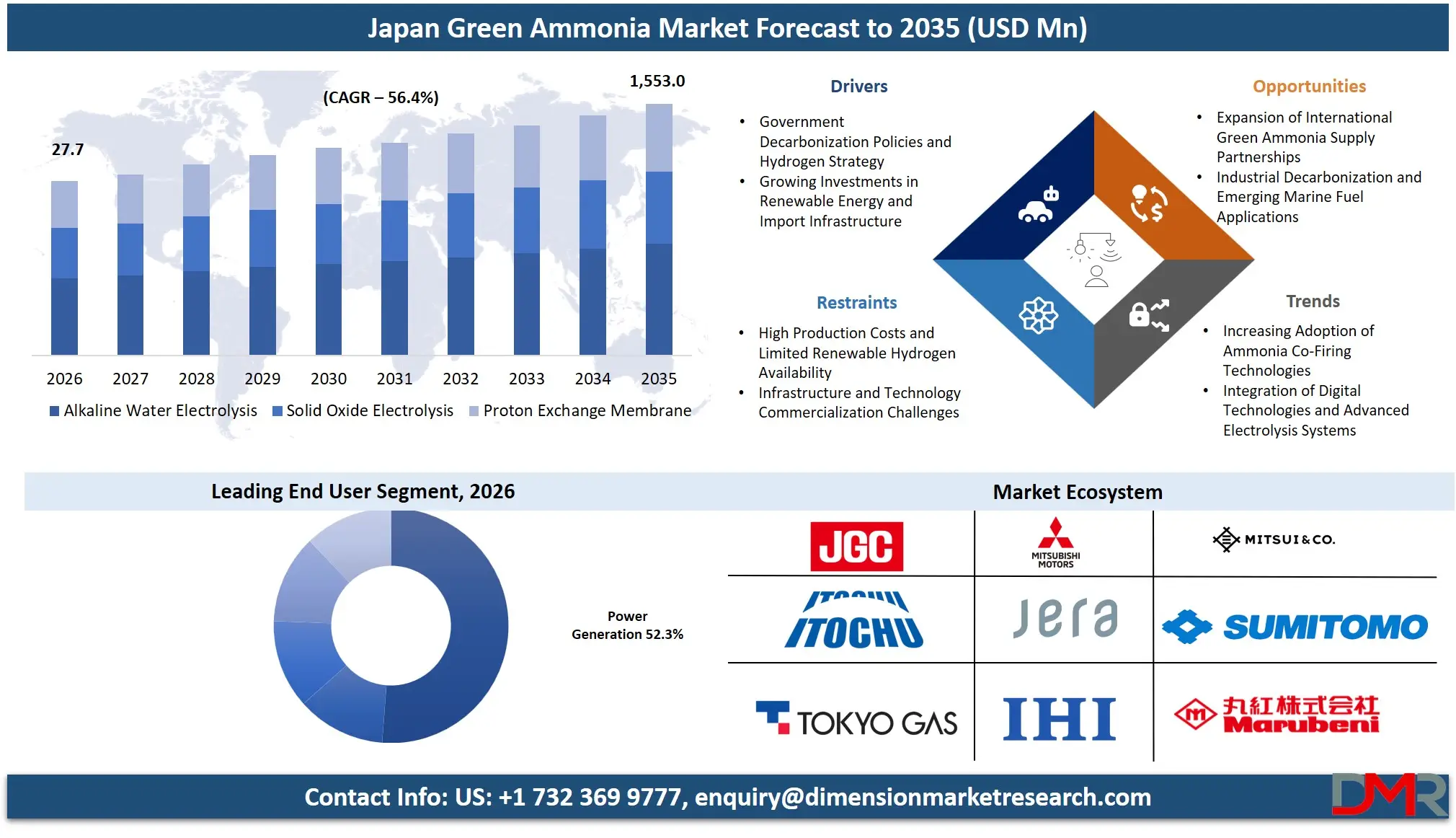
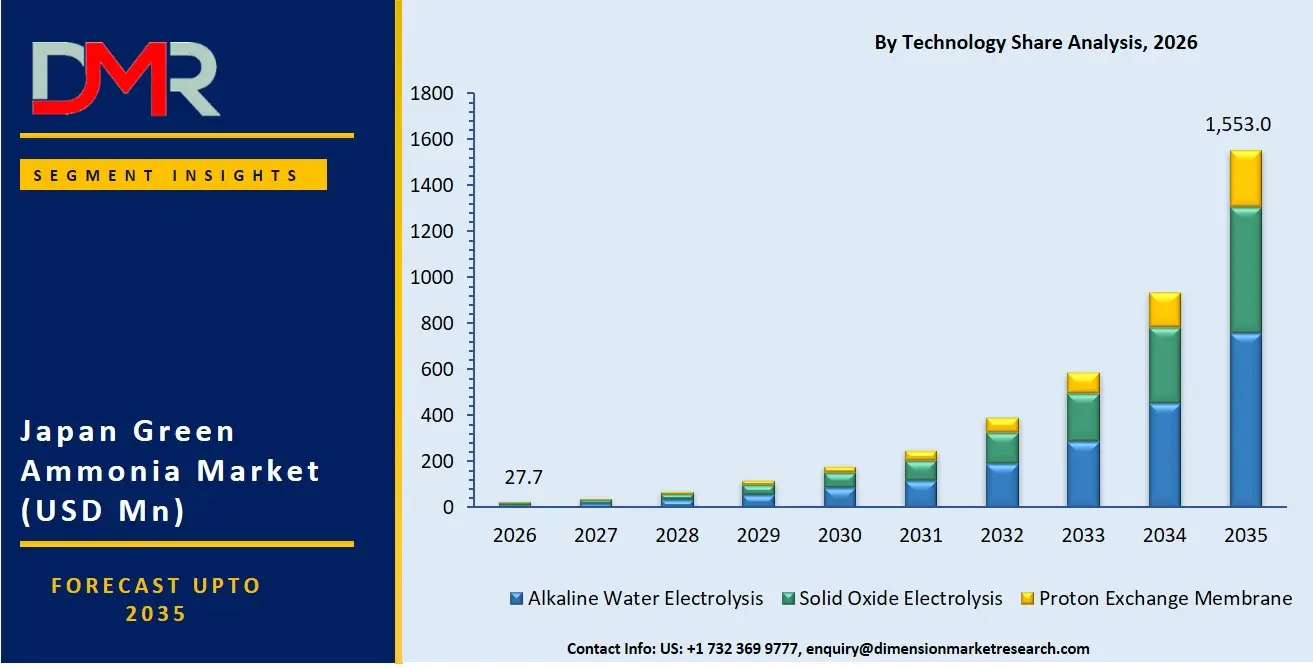
The Japan Green Ammonia Market size is expected to be USD 27.7 million in 2026 and increase at a compound annual growth rate of 56.4% to USD 1,553.0 million in 2035 owing to government decarbonization policies and hydrogen strategy.
ℹ
To learn more about this report –
Download Your Free Sample Report Here
The Japan Green Ammonia Market is witnessing steady growth as the country accelerates its transition toward carbon neutrality and strengthens energy security through the adoption of low-carbon fuels. Government initiatives promoting hydrogen and ammonia utilization, combined with increasing investments in renewable hydrogen production, ammonia import infrastructure, and co-firing technologies in thermal power plants, are driving market expansion. Rising collaborations between domestic utilities, trading companies, and international suppliers are enhancing supply chain development. Technological advancements in electrolyzers, declining renewable energy costs, and increasing demand for clean industrial feedstocks are further supporting commercialization, positioning Japan as one of the leading markets for green ammonia adoption in the Asia-Pacific region.
Key Takeaways
- Market Size & Forecast: The Japan Green Ammonia Market size is projected to reach USD 27.7 million in 2026 and is anticipated to have a value of USD 1,553.0 million in 2035.
- Growth Rate & Outlook: The Japan Green Ammonia Market size is set to grow at a compound annual growth rate of 56.4% during the forecast period of 2026 to 2035.
- Primary Growth Drivers: Some of the major growth drivers in the market are Government Decarbonization Policies and Hydrogen Strategy and more.
- Key Market Trends: Some of the major trends in the market are Integration of Digital Technologies and Advanced Electrolysis Systems and more.
- By Technology Type: Alkaline Water Electrolysis is expected to get the largest revenue share in 2026 in the Japan Green Ammonia Market.
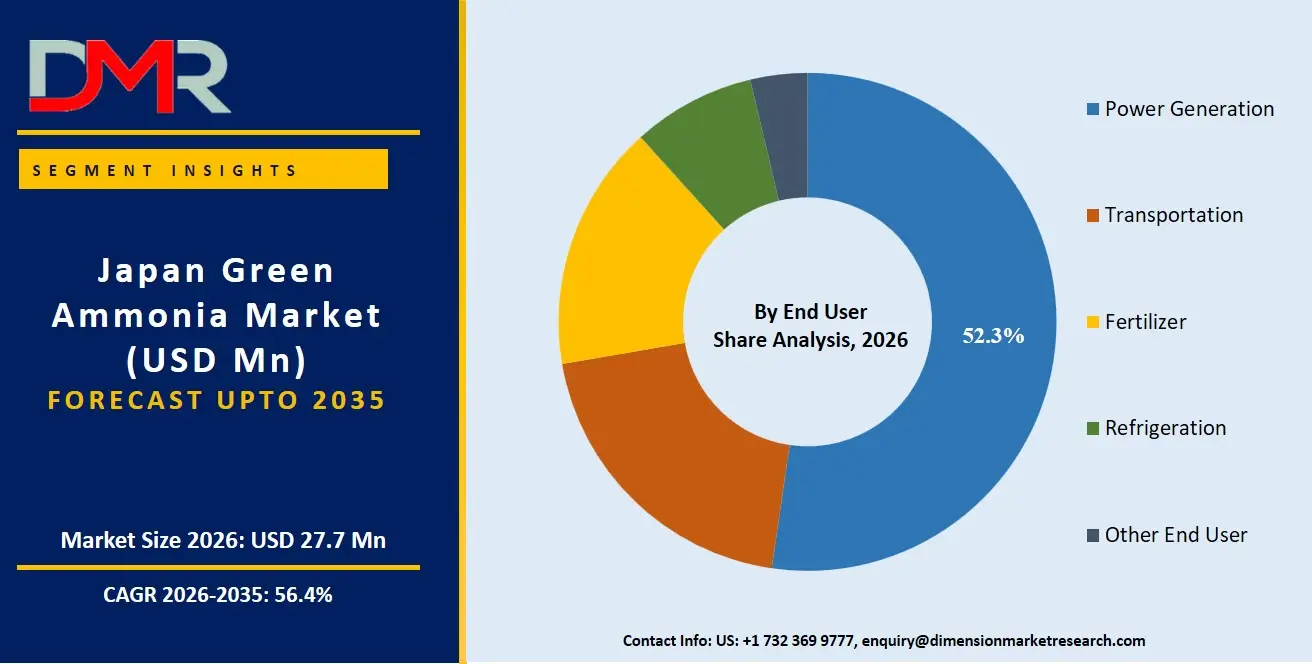
- By End User Type: Power Generation segment is expected to get the largest revenue share in 2026 in the Japan Green Ammonia Market.
What is the Green Ammonia?
Green ammonia is a sustainable form of ammonia produced by combining nitrogen extracted from the air with green hydrogen generated through water electrolysis powered entirely by renewable energy sources such as solar, wind, or hydropower. Unlike conventional ammonia, which relies on fossil fuels and emits significant carbon dioxide during production, green ammonia is manufactured with little to no greenhouse gas emissions. It serves as an environmentally friendly energy carrier, hydrogen storage medium, and industrial feedstock for applications including fertilizers, power generation, marine fuel, transportation, refrigeration, and chemical manufacturing, supporting global decarbonization and clean energy transition efforts.
Use Cases
- Power Generation: Green ammonia is increasingly used as a low-carbon fuel for co-firing and dedicated combustion in thermal power plants to reduce greenhouse gas emissions while utilizing existing power generation infrastructure. Japanese utilities are investing in ammonia-compatible turbines and combustion technologies to support the country's decarbonization roadmap and improve energy security through diversified fuel sources.
- Transportation: The transportation sector is adopting green ammonia as a clean marine fuel and hydrogen carrier for long-distance energy transport. Its high energy density and established storage infrastructure make it suitable for shipping, heavy-duty vehicles, and future hydrogen distribution networks, supporting Japan's efforts to develop sustainable mobility solutions.
- Fertilizer Production: Green ammonia serves as a sustainable alternative to conventionally produced ammonia in fertilizer manufacturing. Its adoption enables fertilizer producers to significantly reduce carbon emissions while maintaining production efficiency. Increasing demand for environmentally responsible agricultural inputs is encouraging investments in low-carbon ammonia production technologies.
- Refrigeration and Industrial Applications: Green ammonia is widely utilized as a natural refrigerant in industrial cooling systems and as a feedstock in chemical manufacturing. Industries are increasingly replacing conventionally produced ammonia with green alternatives to meet sustainability targets, comply with environmental regulations, and reduce lifecycle carbon emissions across manufacturing operations.
How AI Is Transforming the Japan Green Ammonia Market
Artificial intelligence is transforming the Japan Green Ammonia Market by improving production efficiency, reducing operational costs, and enhancing decision-making across the value chain. AI-powered predictive analytics optimize electrolyzer performance, renewable energy utilization, and ammonia synthesis processes by continuously monitoring operating conditions and minimizing energy losses. Machine learning algorithms also enable predictive maintenance of production facilities, reducing equipment downtime and improving plant reliability.
AI further supports supply chain optimization through demand forecasting, logistics planning, and inventory management, helping producers efficiently coordinate domestic production and imports. Advanced AI models assist in carbon emission monitoring, process automation, and quality control while improving safety in ammonia handling and storage. As Japan expands its green hydrogen and ammonia infrastructure, AI-driven digital solutions are expected to accelerate commercialization, maximize asset utilization, and strengthen the competitiveness of the green ammonia ecosystem.
Market Dynamic
Driving Factors in the Japan Green Ammonia Market
Government Decarbonization Policies and Hydrogen Strategy
Japan's ambitious carbon neutrality target for 2050 and its comprehensive hydrogen strategy are major drivers of the green ammonia market. Government support through funding programs, policy incentives, demonstration projects, and regulatory frameworks is encouraging investments in green hydrogen and ammonia production, import terminals, and utilization technologies. National initiatives promoting ammonia co-firing in thermal power plants and industrial decarbonization are accelerating commercialization while reducing dependence on fossil fuels, making green ammonia an integral component of Japan's long-term clean energy transition.
Restraints in the Japan Green Ammonia Market
High Production Costs and Limited Renewable Hydrogen Availability
Green ammonia production remains considerably more expensive than conventional ammonia due to the high costs associated with renewable electricity, water electrolysis systems, and hydrogen production technologies. Limited domestic renewable energy resources also constrain large-scale green hydrogen production, increasing dependence on imported renewable fuels. These economic challenges slow commercial adoption, particularly in cost-sensitive industries where conventional alternatives remain significantly more affordable.
Opportunities in the Japan Green Ammonia Market
Expansion of International Green Ammonia Supply Partnerships
Japan's increasing partnerships with renewable energy-rich countries present substantial growth opportunities for the green ammonia market. Long-term supply agreements, joint production projects, and overseas investments enable Japanese companies to secure competitively priced green ammonia while diversifying import sources. These international collaborations strengthen supply chain resilience and support the country's long-term decarbonization objectives across power generation, transportation, and industrial sectors.
Trends in the Japan Green Ammonia Market
Integration of Digital Technologies and Advanced Electrolysis Systems
The market is witnessing growing integration of digital monitoring platforms, predictive maintenance solutions, and advanced electrolyzer technologies to improve operational efficiency. Automation, real-time process optimization, and data-driven energy management are reducing production costs and improving plant reliability. Continuous innovation in high-efficiency electrolysis systems is further enhancing green ammonia competitiveness, supporting long-term commercial scalability across Japan's clean energy ecosystem.
Research Scope and Analysis
The report provides a comprehensive analysis of the Japan Green Ammonia Market across key technology and end-user segments, evaluating market trends, growth drivers, competitive dynamics, emerging opportunities, technological advancements, and future demand patterns. It also assesses segment performance, adoption trends, and strategic developments shaping the market through the forecast period.
ℹ
To learn more about this report –
Download Your Free Sample Report Here
By Technology Analysis
Among the technology segments, Alkaline Water Electrolysis is estimated to account for 48.6% of the Japan Green Ammonia Market in 2026, making it the leading segment due to its technological maturity, lower capital costs, proven operational reliability, and suitability for large-scale hydrogen production.
ℹ
To learn more about this report –
Download Your Free Sample Report Here
The technology has been extensively adopted in commercial green hydrogen projects because of its long operating life and compatibility with renewable electricity sources. Strong government support for hydrogen development and continuous investments in industrial-scale electrolysis facilities further reinforce its dominant position. Meanwhile, Proton Exchange Membrane (PEM) Electrolysis is expected to be the fastest-growing segment during the forecast period owing to its higher operational efficiency, rapid response to fluctuating renewable power generation, compact system design, and increasing deployment in advanced green hydrogen projects. Continuous technological advancements and declining system costs are expected to significantly accelerate PEM adoption across future green ammonia production facilities in Japan.
By End User Analysis
The Power Generation segment is projected to hold the largest share of the Japan Green Ammonia Market, accounting for an estimated 52.3% in 2026. This leadership is primarily driven by Japan's national strategy promoting ammonia co-firing in coal-fired thermal power plants to reduce carbon emissions while maintaining grid stability. Increasing investments by electric utilities in ammonia-compatible combustion technologies and long-term fuel procurement agreements continue to strengthen this segment's market position. Conversely, the Transportation segment is anticipated to register the fastest growth throughout the forecast period due to rising development of ammonia-powered marine vessels, increasing investments in alternative maritime fuels, and expanding use of green ammonia as a hydrogen carrier for heavy-duty mobility applications. Supportive international emission regulations and ongoing innovations in ammonia-fueled engines are expected to further accelerate adoption across the transportation sector.
The Japan Green Ammonia Market Report is segmented on the basis of the following:
By Technology
- Solid Oxide Electrolysis
- Proton Exchange Membrane
- Alkaline Water Electrolysis
By End User
- Power Generation
- Transportation
- Fertilizer
- Refrigeration
- Other End User
Competitive Landscape
The Japan Green Ammonia Market is characterized by strategic collaborations, long-term supply agreements, technological innovation, and substantial investments in renewable hydrogen and ammonia infrastructure. Market participants primarily compete by expanding production capacity, improving electrolysis efficiency, securing international sourcing partnerships, and investing in research and development to reduce production costs. High capital requirements, complex regulatory compliance, and the need for integrated supply chains create significant barriers to entry. Companies are increasingly focusing on demonstration projects, technology commercialization, infrastructure development, and cross-industry partnerships to strengthen their competitive position while supporting Japan's long-term decarbonization and clean energy objectives.
Some of the prominent players in the Japan Green Ammonia are:
- Mitsubishi Corporation
- Mitsui & Co.
- Itochu Corporation
- Marubeni Corporation
- Sumitomo Corporation
- Mitsubishi Heavy Industries
- IHI Corporation
- JERA
- ENEOS Holdings
- Tokyo Gas
- Osaka Gas
- Kawasaki Heavy Industries
- JGC Holdings
- Chiyoda Corporation
- Toyo Engineering Corporation
- Asahi Kasei
- Yara International
- CF Industries
- Nutrien
- Air Liquide
- Other Key Players
Recent Developments
- In July 2025, IHI Corporation and Royal Vopak signed a Joint Development Agreement to establish a joint venture for developing and operating a dedicated ammonia import terminal in Japan. The planned terminal, targeted to commence operations in Japan's fiscal year 2030, will provide safe storage, handling, and distribution infrastructure for imported low-carbon and green ammonia. The partnership combines IHI's expertise in ammonia storage technologies with Vopak's global terminal management capabilities, supporting Japan's efforts to establish a resilient ammonia supply chain for power generation and industrial decarbonization.
- In June 2025, GE Vernova and IHI Corporation inaugurated a Large-Scale Combustion Test (LCT) facility at IHI's Aioi Works in Hyogo Prefecture, Japan, to accelerate the commercialization of gas turbine combustion systems capable of operating on 100% ammonia. The facility supports full-scale prototype testing for retrofittable F-class gas turbines and is part of the companies' joint development program targeting commercial deployment by 2030. The project is expected to strengthen Japan's clean power generation strategy by enabling utilities to reduce carbon emissions while utilizing existing thermal power infrastructure.
- In April 2025, CF Industries, JERA, and Mitsui & Co. announced the formation of a joint venture to develop the Blue Point low-carbon ammonia production facility in Louisiana, representing an investment of approximately US$4 billion. The project will have an annual production capacity of around 1.4 million metric tons, making it one of the world's largest low-carbon ammonia facilities. JERA intends to import the ammonia for use in Japan's thermal power sector, supporting commercial ammonia co-firing initiatives and strengthening the country's long-term clean energy supply strategy.
Report Details
| Report Characteristics |
| Market Size (2026) |
USD 27.7 Mn |
| Forecast Value (2035) |
USD 1,553.0 Mn |
| CAGR (2026–2035) |
56.4% |
| Historical Period |
2021 – 2025 |
| Forecast Period |
2027 – 2035 |
| Base Year |
2025 |
| Estimate Year |
2026 |
| Segments Covered |
By Technology, By End User |
| Country Coverage |
Japan |
Frequently Asked Questions
How big is the Japan Green Ammonia Market?
▾ The Japan Green Ammonia Market size is expected to reach USD 27.7 million by 2026 and is projected to reach USD 1,553.0 million by the end of 2035.
What is the CAGR of the Japan Green Ammonia Market from 2026 to 2035?
▾ The market is growing at a CAGR of 56.4 percent over the forecasted period.
What factors are driving the growth of the Japan Green Ammonia Market?
▾ Government Decarbonization Policies and Hydrogen Strategy, and more are the factors driving the growth of the Japan Green Ammonia Market.
What are the major trends in the Japan Green Ammonia Market?
▾ Integration of Digital Technologies and Advanced Electrolysis Systems, and more are some of the major trends in the market.
Who are the key players in the Japan Green Ammonia Market?
▾ Some of the key players in the Japan Green Ammonia Market include IHI, JGC, Tokyo gas, and more
How is the Japan Green Ammonia Market segmented?
▾ The Japan Green Ammonia Market is segmented by technology, end user.