Market Snapshot
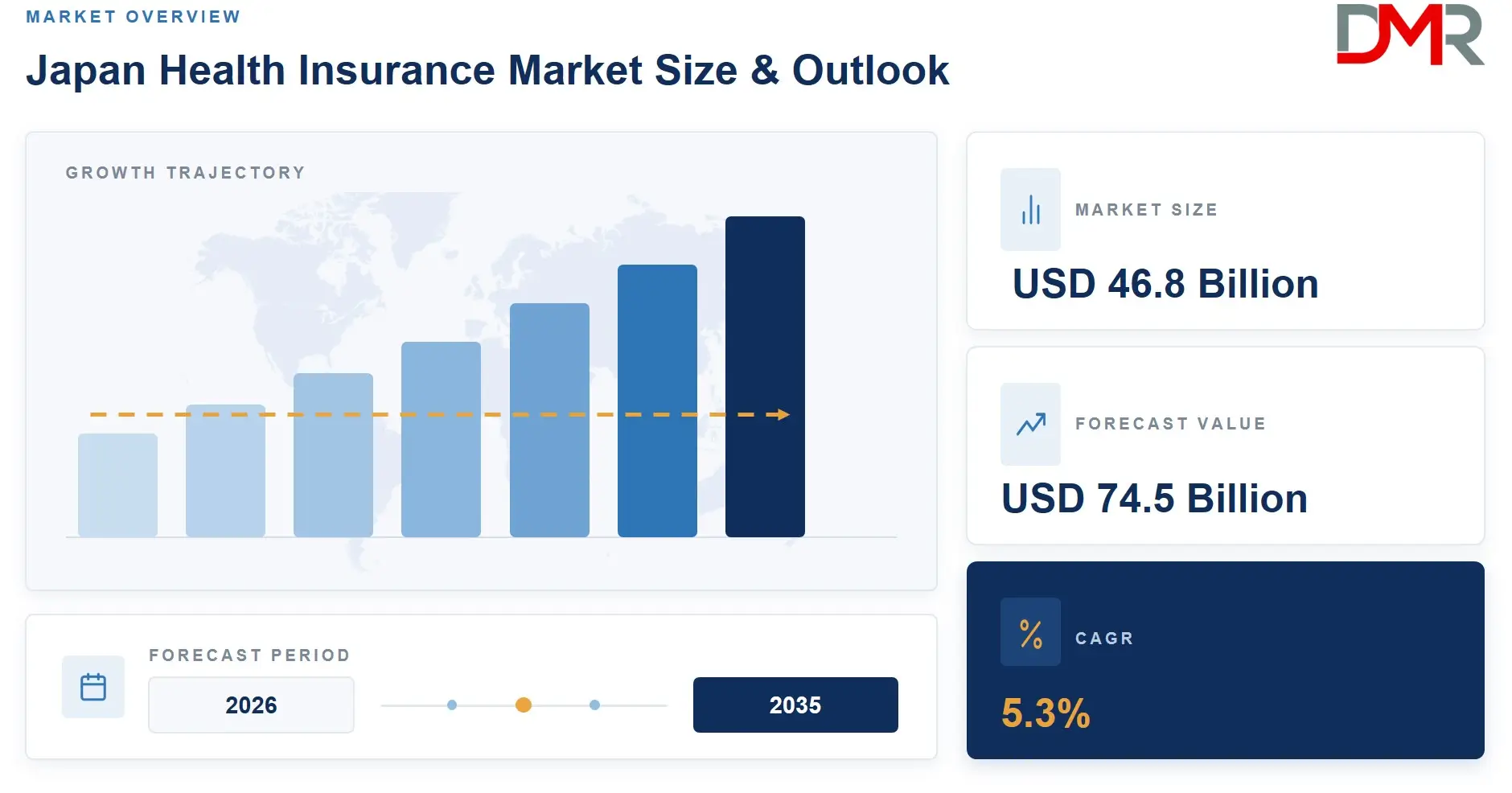
- Market Size (2026): USD 46.8 Bn
- Forecast Value (2035): USD 74.5 Bn
- CAGR (2026-2035): 5.3%
- Leading Insurance Type (2026): Medical and Hospitalisation, around 41%
- Leading Product Structure (2026): Riders Attached to Life Policies, close to 38%
- Key Players: Nippon Life Insurance Company, Aflac Incorporated, Dai-ichi Life Holdings and others
What is Japan Health Insurance Market and its Market Size?
The Japan Health Insurance Market size is estimated to reach USD 46.8 Bn in 2026 and is further anticipated to reach USD 74.5 Bn by 2035, at a CAGR of 5.3%.
ℹ
To learn more about this report –
Download Your Free Sample Report Here
Coverage here means commercially underwritten health protection sold inside Japan: hospitalisation and surgical benefits, cancer policies, nursing care contracts, income protection, and the medical riders attached to life products. Kyosai cooperative mutual aid is included, since it competes for the same household budget. The statutory schemes that enrol the whole population, employees' health insurance and National Health Insurance, sit outside the sizing; they are the reason the commercial layer exists rather than a part of it. The figures cover premium demand originating inside Japan, not the worldwide revenue of insurers headquartered there.
What buyers purchase is cash, not care. A household already has treatment paid for at a fixed co-payment ratio, so a private policy pays a stated daily amount per night in hospital, a lump sum on diagnosis of cancer, or a monthly benefit while the policyholder cannot work. The money covers what the public system does not: the differential room charge, transport and family accommodation, therapies still outside reimbursement, lost bonus income and custodial help at home. Purchase is overwhelmingly individual and voluntary, made in a buyer's thirties and held for decades. Employers contribute group schemes as a recruitment benefit rather than as the primary channel.
Three structural shifts are reshaping the layer. Treatment has moved out of the ward and into the outpatient clinic, which strips value from per-night hospitalisation benefits and rewards policies that pay on diagnosis. The over-75 cohort is expanding faster than any other, moving nursing care from an afterthought rider to a standalone category. Economic value-based capital rules now make long guarantees expensive to hold, pushing carriers toward shorter terms and protection-only design.
Use Cases
- Salaried Household Hospitalisation Top-Up: A company employee in their thirties buys a daily hospitalisation benefit with a surgical rider, covering the differential room charge and the income gap during recovery that the employees' health insurance scheme does not reimburse.
- Outpatient Cancer Treatment Financing: Patients on multi-cycle oral or infusion regimens draw a diagnosis lump sum and monthly treatment benefits that fund travel, reduced working hours and drugs awaiting reimbursement approval, replacing older policies that paid only while a bed was occupied.
- SME Employee Welfare Schemes: Manufacturers and service firms below 300 staff attach group medical and income protection to their benefits package to compete for scarce workers, administered through a platform that removes the enrolment burden small schemes once carried.
- Family-Funded Custodial Care Cover: Adult children in their fifties buy long-term care policies for themselves and their parents to fund home helpers, adapted housing and residential places beyond the statutory benefit, a segment growing at a CAGR of 9.6%.
Key Takeaways
- Market Size & Share: Premium demand is set to expand by roughly 1.6 times between 2026 and 2035, a rate consistent with a mature category carried by demographics rather than new adoption.
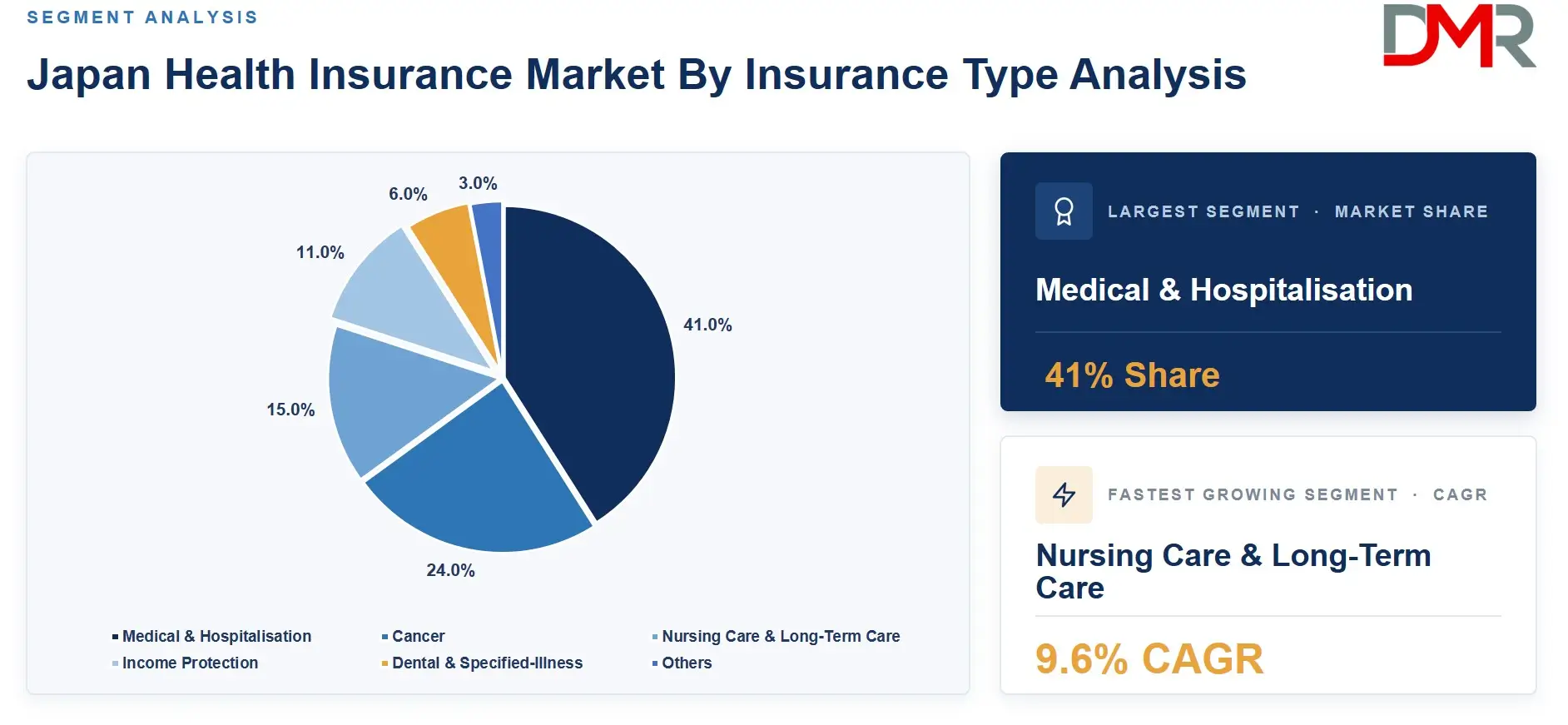
- Insurance Type Analysis: Cancer cover is projected to hold a share of roughly 24% of premium income in 2026, the second largest line in the market.
- Product Structure Analysis: Relaxed-underwriting policies, which waive full medical disclosure in exchange for higher rates, are forecast to grow at a CAGR of 10.8% to 2035.
- Demand Concentration: Individual retail buyers are expected to account for nearly 63% of premium income in 2026, since employers already fund the statutory layer.
- Channel Shift: Direct online and mail-order distribution is projected to compound at 11.2% through 2035, outpacing every face-to-face channel.
- Long-Term Care Pull: Nursing care cover is set to expand at a CAGR of 9.6% to 2035, the steepest trajectory among insurance types.
How AI/Gen AI is Transforming the Japan Health Insurance Market?
Japanese insurers have applied machine learning to claims and underwriting for longer than most markets, mainly because the third-sector book is enormous, highly standardised and generates millions of small hospitalisation claims a year. The payoff is operational rather than transformative. Claims arrive as scanned hospital certificates and handwritten forms; document understanding models read them, match diagnosis codes against policy conditions and settle straightforward payments without a human file review.
Underwriting is the second front. Relaxed-disclosure products depend on pricing applicants with treated chronic conditions, and models trained on decades of persistency and claims history let carriers quote that risk narrowly instead of declining it. Generative tooling contributes mostly in compliance, drafting the solicitation records that conduct rules require.
- Document Understanding: Optical character recognition with language models extracts diagnosis, procedure and admission dates from hospital certificates, enabling straight-through payment on standard claims.
- Risk Selection Models: Predictive underwriting scores substandard applicants against historical claims experience, widening the insurable population among older buyers with managed conditions.
- Fraud and Anomaly Detection: Network analysis flags coordinated claiming across multiple policies and clinics, a growing exposure as short-stay admissions rise.
- Conduct Documentation: Language models draft the intention-confirmation records that solicitation rules require, reducing administrative load on agency channels.
Key Drivers in the Japan Health Insurance Market
Two forces account for most of the incremental premium. Both originate in the public system rather than in insurer innovation.
- Demographic Load on the Statutory Long-Term Care Scheme: Japan's population above 75 continues to grow while the contributing workforce shrinks, and the statutory long-term care insurance scheme has responded by raising co-payment ratios for higher-income beneficiaries and tightening eligibility at the lower care grades. The gap falls on families, who fund home helpers, day services and residential places from savings. Commercial nursing care cover is the instrument that converts that exposure into a monthly benefit, and it is expanding at a CAGR of 9.6% to 2035. Adult children in their fifties typically make the purchase after a parent's first care assessment.
- Migration of Costs onto the Patient: Reimbursement policy has steadily shifted marginal cost to the point of use. Additional charges now apply to branded drugs where a generic exists, differential room charges are unregulated, and advanced therapies frequently sit outside the reimbursement schedule for years after approval. Cancer treatment concentrates all three effects at once, which is why cancer policies are projected to hold roughly 24% of premium income in 2026. The mechanism is not catastrophic cost, since the high-cost medical expense benefit caps monthly exposure, but the accumulation of uncapped ancillary spending across a long treatment course.
Restraints in the Japan Health Insurance Market
Growth is constrained less by demand than by arithmetic. Two brakes are structural.
- Saturated Household Penetration: Most Japanese adults already hold private medical or cancer cover, much of it bought decades ago and still in force. With individual retail buyers accounting for nearly 63% of premium income in 2026, incremental volume has to come from replacing existing policies rather than converting the uninsured. That turns much of the market into a churn business fought on price and benefit design, where a switch generates acquisition cost without net industry premium. Falling household formation compounds it, since the usual trigger for a first purchase, marriage or a first child, occurs less often each year.
- Capital Cost of Long Guarantees: Economic value-based solvency rules attach a capital charge to the interest rate and longevity risk embedded in whole-life medical contracts, which are written to age 100 and repriced never. Since riders attached to life policies are expected to represent close to 38% of the market in 2026, a substantial legacy block now carries a heavier capital load than the premium originally assumed. Carriers respond by shortening terms, adding repricing rights and steering new business toward protection-only design, all of which reduce the average premium per policy even as policy counts hold.
Growth Opportunities in the Japan Health Insurance Market
The open ground sits in buyer groups the career sales model was never built to reach.
- Group Schemes Among Smaller Employers: Firms below 300 employees, concentrated in regional manufacturing clusters around Aichi, Osaka and northern Kyushu, compete for labour against metropolitan employers offering richer benefits. Group medical and income protection is a cheap differentiator, and SME group plans are forecast to grow at a CAGR of 8.9% through 2035. The unlock is administrative rather than actuarial: benefits platforms and payroll integrations have cut the cost of enrolling and billing a 40-person scheme to a level that supports commission, whereas manual administration made anything under 100 lives unprofitable to write.
- Embedded Distribution Through Non-Insurance Platforms: Mobile carriers, e-commerce groups and banking apps hold verified identity, payment credentials and daily attention for tens of millions of Japanese consumers who have never met an agent. Placing a standardised hospitalisation product inside those accounts removes the two highest costs in the model, lead generation and application handling. Direct channels are projected to compound at 11.2% to 2035 largely on this basis. The constraint is product simplicity: only cover that can be explained in a single screen and underwritten on three questions travels well through this route.
Trends in the Japan Health Insurance Market
Product design and competitive structure are both moving, in ways that have little to do with each other.
- Underwriting Relaxation Becomes a Category: Products that accept applicants with treated hypertension, diabetes or a cancer history, once a marginal line sold apologetically at punitive rates, now form a distinct shelf with its own pricing tiers and waiting periods. The category is expanding at a CAGR of 10.8% to 2035. Two things changed: carriers accumulated enough claims experience on substandard lives to price them narrowly, and the buyer profile shifted, since a first-time purchaser at 65 is now common. Competitive differentiation has moved from headline premium to the breadth of conditions accepted.
- Non-Life Carriers Entering Third-Sector Lines: Motor and fire insurers are building out medical and cancer portfolios through their third-sector units, growing at a CAGR of 8.7% between 2026 and 2035. The logic is customer file economics. Annual motor renewals create a contact rhythm that life insurers must pay to manufacture, and claims infrastructure designed for high-frequency, low-severity lines handles outpatient medical benefits at marginal cost. Life insurers are responding by pushing further into health services, wellness-linked pricing and nursing care operations, so the two sides now meet on ground that belonged to neither.
Research Scope and Analysis
Segment performance is assessed across five axes: insurance type, product structure, underwriter type, distribution channel and customer type. Each axis identifies where premium income concentrates in 2026 and which sub-segment expands fastest through 2035, with the commercial reason behind both positions.
ℹ
To learn more about this report –
Download Your Free Sample Report Here
By Insurance Type
Medical cover for hospitalisation and surgery is projected to hold the largest share by insurance type in 2026, accounting for approximately 41% of premium income, since it is the default first purchase for salaried households and sits inside the standard bundle sold through agency and worksite channels. Renewal behaviour is unusually sticky. Policies written in a buyer's thirties stay in force for decades, so the block turns over slowly. The steeper trajectory sits with nursing care and long-term care cover, expanding at a CAGR of 9.6% between 2026 and 2035, pulled by growth in the over-75 cohort, rising co-payment ratios under the statutory scheme, and family purchases against custodial costs the public system was never designed to fund.
By Product Structure
Riders attached to life policies are expected to account for close to 38% of the market in 2026, the largest position by product structure, because decades of career sales distribution built medical and cancer benefits onto whole-life and endowment contracts rather than selling them separately. That legacy book is large and unwinds slowly. Growth, however, is concentrated in relaxed-underwriting products, advancing at a CAGR of 10.8% through 2035. The pull is demographic: buyers in their sixties and seventies with managed chronic conditions were routinely declined a decade ago, and carriers now hold enough claims data to price that risk and compete openly for it.
By Underwriter Type
Domestic life insurers are projected to hold roughly 52% of premium income in 2026, the leading position by underwriter type, on the strength of career sales forces that still call on workplaces and households and on brand trust accumulated over more than a century of mutual ownership. Scale also lets them cross-subsidise third-sector pricing. Faster expansion belongs to the third-sector units of non-life insurers, growing at a CAGR of 8.7% between 2026 and 2035. Their advantage is the motor and fire customer file, where annual renewal contact creates a cross-sell opening life insurers must buy.
By Distribution Channel
Tied agents and career sales representatives are set to represent around 36% of distribution in 2026, still the largest channel, since face-to-face explanation remains how most Japanese households resolve a product whose exclusions and waiting periods resist comparison on paper. Worksite access reinforces the position. Growth, however, is concentrated in direct online and mail-order sales, rising at a CAGR of 11.2% through 2035. Price transparency is the mechanism. Standardised hospitalisation benefits invite side-by-side comparison, platforms bundle cover into accounts consumers already hold, and buyers under 40 complete underwriting questionnaires in minutes without ever meeting an agent.
By Customer Type
Individual retail buyers are expected to hold nearly 63% of premium income in 2026, the dominant customer type, a consequence of universal statutory cover. Employers already fund the basic scheme, so supplementary protection is bought privately and priced per household rather than negotiated per group. The steeper trajectory sits with SME group plans, growing at a CAGR of 8.9% between 2026 and 2035. Labour scarcity is the driver. Smaller firms competing for staff against large employers use group medical and income protection as a hiring benefit, and platform administration has pushed break-even scheme size below the threshold that once made such plans uneconomic.
The Japan Health Insurance Market Report is Segmented Based on the Following
By Insurance Type
- Medical and Hospitalisation Insurance
- Cancer Insurance
- Nursing Care and Long-Term Care Insurance
- Income Protection and Disability Income Insurance
- Dental and Specified-Illness Cover
- Others
By Product Structure
- Riders Attached to Life Policies
- Standalone Whole-Life Medical
- Standalone Term Medical
- Relaxed-Underwriting Products
- Others
By Underwriter Type
- Domestic Life Insurers
- Foreign-Affiliated Insurers
- Non-Life Insurers Third-Sector Units
- Kyosai Cooperative Mutual Aid Providers
- Others
By Distribution Channel
- Tied Agents and Career Sales Representatives
- Independent Agencies and Walk-In Insurance Shops
- Bancassurance
- Direct Online and Mail Order
- Workplace and Group Enrolment Schemes
- Others
By Customer Type
- Individual Retail
- Corporate Group Plans
- SME Group Plans
- Others
Competitive Landscape
Concentration is high at the top and thinning below it. Four domestic life groups and one foreign-affiliated cancer specialist together write the majority of third-sector premium, a position built on distribution reach rather than product advantage, since benefit structures are broadly comparable across carriers. Competition therefore runs on three axes: the breadth of conditions a policy will accept, the speed and simplicity of claims settlement, and control of the shelf, whether that shelf is a career sales force, a walk-in comparison shop or a mobile app. Strategy has followed. Large insurers have bought benefits platforms and nursing care operators to reach buyers outside the agency channel, non-life groups are converting motor customers into medical policyholders, and smaller entrants compete on underwriting appetite rather than price.
Some of the Prominent Players in the Japan Health Insurance Market Are
- Nippon Life Insurance Company
- Dai-ichi Life Holdings, Inc.
- Meiji Yasuda Life Insurance Company
- Sumitomo Life Insurance Company
- Japan Post Insurance Co., Ltd.
- Aflac Incorporated
- MetLife, Inc.
- Prudential Financial, Inc.
- Manulife Financial Corporation
- AXA SA
- Allianz SE
- Zurich Insurance Group Ltd
- Chubb Limited
- The Cigna Group
- FWD Group Holdings Limited
- BNP Paribas Cardif
- Asahi Mutual Life Insurance Company
- Fukoku Mutual Life Insurance Company
- Taiyo Life Insurance Company
- Daido Life Insurance Company
- Sony Life Insurance Co., Ltd.
- ORIX Life Insurance Corporation
- Tokio Marine Holdings, Inc.
- MS&AD Insurance Group Holdings, Inc.
- Sompo Holdings, Inc.
- Lifenet Insurance Company
- Rakuten Group, Inc.
- SBI Insurance Group Co., Ltd.
- Zenkyoren
- Kokumin Kyosai co-op
- Hoken no Madoguchi Group Inc.
- Advance Create Co., Ltd.
- Aeon Financial Service Co., Ltd.
- justInCase, Inc.
- Finatext Holdings Ltd.
- Swiss Re Ltd
- Munich Re
- Reinsurance Group of America, Incorporated
- Marsh McLennan
- Aon plc
- Other Key Players
Recent Developments
- In April 2025, the economic value-based solvency regulation took effect for Japanese life insurers, changing how long-duration medical and nursing care liabilities are capitalised and prompting carriers to shorten guarantee periods and add repricing rights on new third-sector business.
- In March 2025, the government shelved its planned increase to the ceiling on the high-cost medical expense benefit after public opposition, leaving statutory out-of-pocket exposure unchanged and removing a near-term demand catalyst several insurers had been designing products around.
- In December 2024, paper health insurance certificates were withdrawn in favour of enrolment verification through the My Number card, giving insurers and providers a digital eligibility trail that shortens claims substantiation and supports faster settlement on supplementary policies.
- In October 2024, an additional patient charge was introduced on branded medicines where a generic equivalent is available, raising routine out-of-pocket spending for chronic-condition patients and strengthening the commercial case for supplementary medical cover.
- In 2024, Dai-ichi Life Holdings completed its acquisition of Benefit One, adding a corporate employee benefits platform with a large membership base and opening a route to sell group health and wellness cover to employers outside the traditional agency channel.
Frequently Asked Questions
How big is the Japan Health Insurance Market?
▾ Premium demand for commercially underwritten health protection in Japan is estimated to reach USD 46.8 Bn in 2026. The figure covers medical, cancer, nursing care and income protection cover sold inside the country, together with medical riders on life policies, and excludes the statutory employees' and national health insurance schemes.
What is the growth rate of the Japan Health Insurance Market?
▾ The market is forecast to compound at a CAGR of 5.3% between 2026 and 2035, reaching USD 74.5 Bn by the end of the period. Growth is demographic rather than adoption-led, since household penetration is already high and most incremental premium comes from older buyers and richer benefit design.
What is driving demand in the Japan Health Insurance Market?
▾ The main driver is the widening gap between statutory cover and actual household cost. Rising co-payment ratios in the long-term care scheme, unregulated differential room charges, additional charges on branded medicines and long reimbursement lags for advanced therapies all push spending onto patients, which commercial policies convert into predictable cash benefits.
Which insurance type holds the largest share in the Japan Health Insurance Market?
▾ Medical and hospitalisation cover is expected to lead in 2026 with approximately 41% of premium income. It functions as the default first purchase for salaried households, is bundled into most agency and worksite offers, and benefits from decades-long persistency that keeps the in-force block from eroding.
Who are the key players in the Japan Health Insurance Market?
▾ Leading participants include Nippon Life Insurance Company, Dai-ichi Life Holdings, Meiji Yasuda Life Insurance Company, Sumitomo Life Insurance Company, Aflac Incorporated, Japan Post Insurance and ORIX Life Insurance Corporation. Non-life groups, kyosai cooperatives and online-only underwriters compete alongside them, with distribution reach mattering more than product differentiation.
What is the outlook for the Japan Health Insurance Market through 2035?
▾ Growth in the Japan Health Insurance Market will be carried by nursing care cover, relaxed-underwriting products and SME group schemes rather than by traditional hospitalisation policies. Capital rules favour shorter, repriceable protection, and distribution keeps shifting from career sales forces toward comparison shops, benefits platforms and direct digital channels.