Market Overview
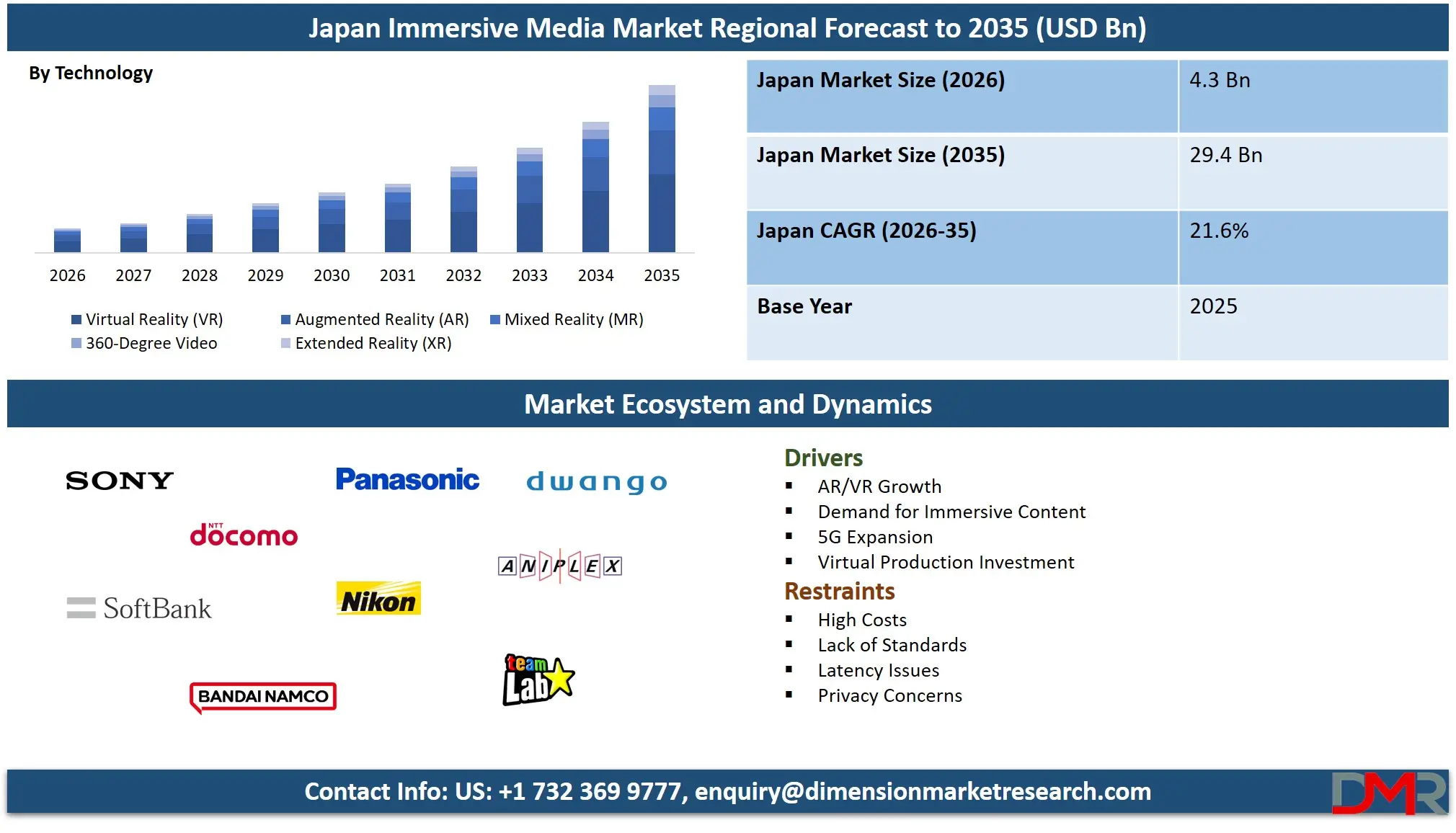
The Japan immersive media market is projected to reach USD 4.3 billion in 2026 and is expected to grow at a CAGR of 21.6%, reaching approximately USD 29.4 billion by 2035, driven by increasing adoption of virtual reality, augmented reality, extended reality technologies, and rising demand for interactive digital experiences across gaming, enterprise, and media applications.
ℹ
To learn more about this report –
Download Your Free Sample Report Here
Immersive media refers to a broad category of digital experiences that blend the physical and virtual worlds to create a sense of presence and interaction for users. It leverages advanced technologies such as virtual reality, augmented reality, mixed reality, and extended reality to enable users to engage with digital environments in a more natural and intuitive way. By integrating 3D modeling, spatial audio, real time rendering, and interactive interfaces, immersive media transforms passive content consumption into active participation. This form of media is widely used across gaming, entertainment, education, healthcare, and enterprise applications, enhancing visualization, storytelling, and experiential learning while enabling deeper emotional and sensory engagement.
The Japan immersive media market is characterized by its strong alignment with the country’s advanced digital ecosystem and globally recognized entertainment industry. Japan’s leadership in gaming, animation, and consumer electronics has created a fertile environment for immersive technologies to thrive, particularly in areas such as virtual reality gaming, interactive media platforms, and digital content creation. The presence of established technology firms and innovative startups is accelerating the development of AR and VR solutions, while the integration of 5G networks is enabling seamless delivery of high quality immersive experiences. This market is also witnessing growing adoption in sectors such as manufacturing, where simulation and visualization tools are used for product design and training.
ℹ
To learn more about this report –
Download Your Free Sample Report Here
In addition, the market in Japan is evolving with increasing applications beyond entertainment, including education, healthcare, and retail. Companies are utilizing immersive solutions for virtual training programs, remote collaboration, and enhanced customer engagement through augmented reality experiences. The rising popularity of virtual events, metaverse platforms, and social virtual environments is further contributing to market expansion. Moreover, the demand for interactive storytelling, real time simulation, and experiential marketing is driving innovation across software platforms and content ecosystems, positioning Japan as a key contributor to the global immersive media landscape.
Japan Immersive Media Market: Key Takeaways
- Strong Market Expansion Outlook: The market is projected to grow from USD 4.3 billion in 2026 to USD 29.4 billion by 2035, reflecting a high growth trajectory driven by immersive technology adoption.
- High Growth Rate Momentum: A robust CAGR of 21.6% (2026–2035) highlights rapid expansion supported by increasing demand for AR, VR, and extended reality applications.
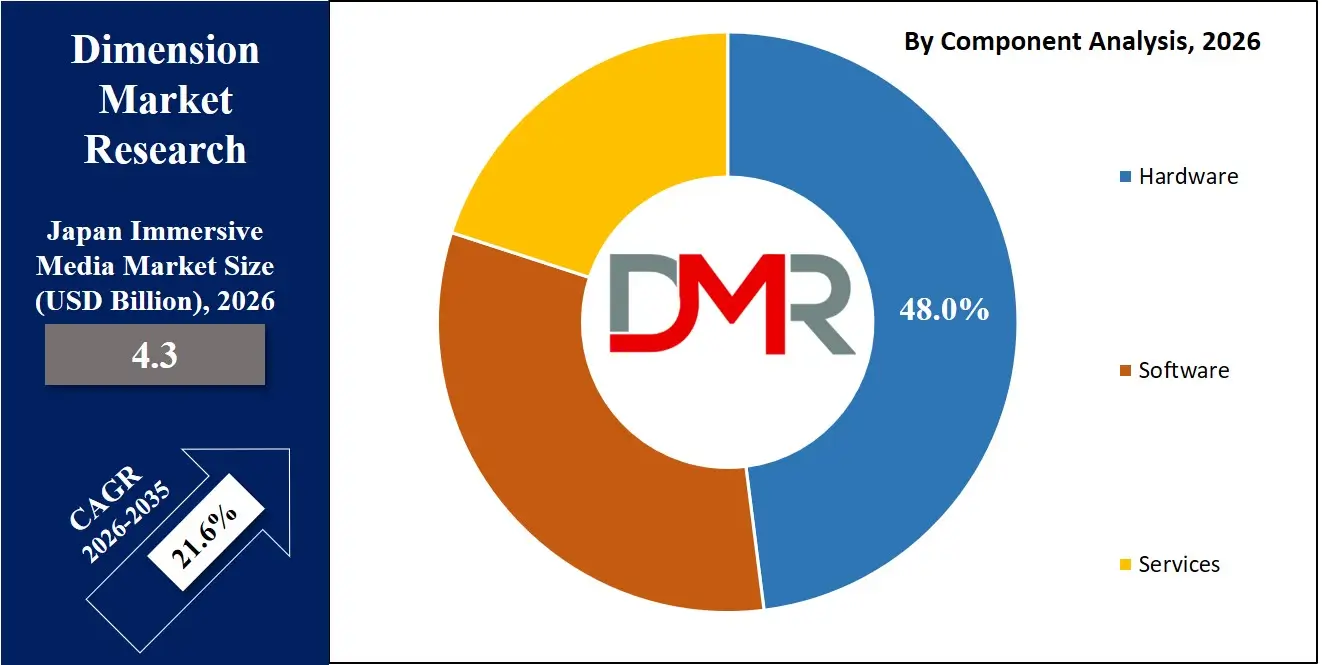
- Hardware Segment Leadership: Hardware dominates with 48.0% market share in 2026, driven by strong adoption of head mounted displays, AR glasses, and advanced sensors.
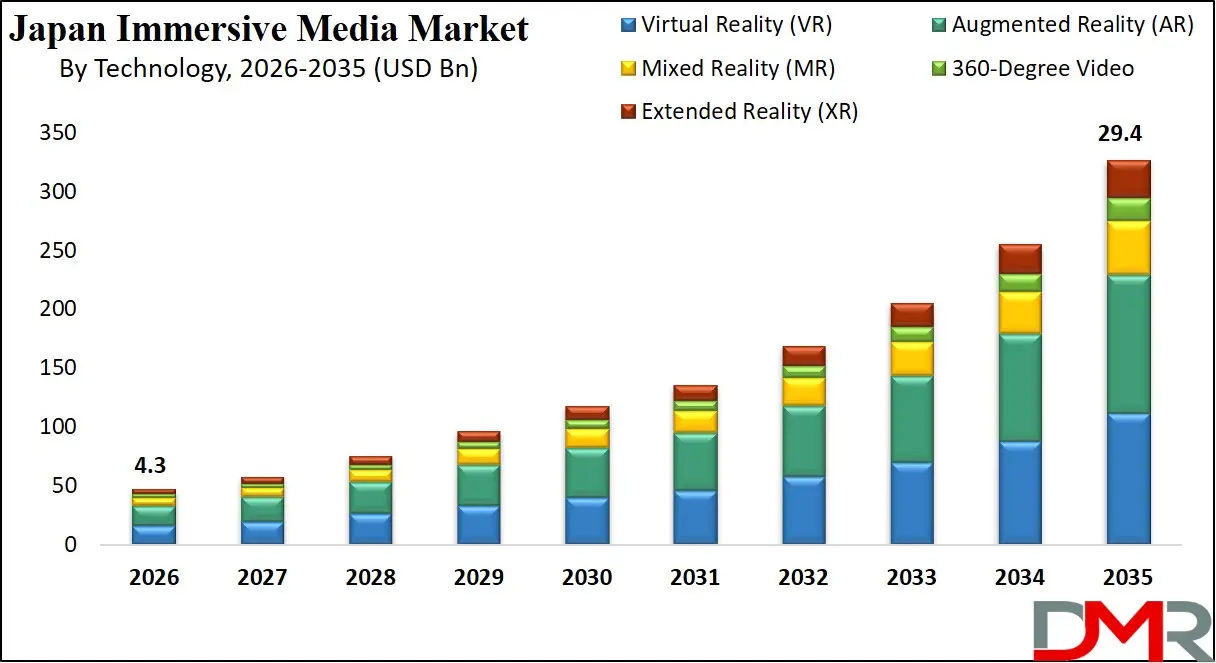
- AR Technology Leading Adoption: Augmented reality leads the technology segment with 36.0% share in 2026, supported by widespread enterprise and consumer use cases.
- Entertainment & Media Dominance: Entertainment and media account for 32.0% of total market share in 2026, reflecting Japan’s strong gaming and digital content ecosystem.
Japan Immersive Media Market: Use Cases
- Virtual Reality Gaming and Entertainment: Japan leverages virtual reality, real time rendering, and 3D environments to deliver immersive gaming and interactive media experiences, supported by strong demand for digital content and metaverse platforms.
- Industrial Training and Simulation: Enterprises use VR and AR solutions for workforce training, simulation, and visualization, improving efficiency and safety across manufacturing and robotics applications.
- Retail and Customer Experience: Augmented reality and spatial computing are used to enhance customer engagement through virtual try ons, interactive product visualization, and immersive shopping experiences.
- Education and Skill Development: Immersive learning using VR, AR, and interactive simulation tools is growing in Japan, enabling experiential education, remote training, and advanced skill development.
Japan Immersive Media Market: Stats & Facts
- Ministry of Internal Affairs and Communications (MIC), Japan
- 2024: Over 90% of Japanese enterprises use digital tools, supporting integration of advanced technologies like AR, VR, and XR in business operations
- 2023: Around 74% of companies adopted cloud services, enabling deployment of cloud based immersive platforms and real time collaboration tools
- 2024: 5G population coverage exceeded 95%, facilitating low latency immersive applications in industrial and enterprise environments
- 2025: Enterprises increasingly utilize AI and IoT integration, forming the backbone for immersive simulation and smart factory applications
- Ministry of Economy, Trade and Industry (METI), Japan
- 2024: More than 70% of large manufacturing firms adopted digital transformation initiatives, including simulation, digital twins, and immersive visualization tools
- 2023: Over 60% of Japanese companies reported labor shortages, driving adoption of VR based training and automation solutions
- 2024: Industrial companies reported productivity improvements through digital simulation and visualization technologies in manufacturing workflows
- 2025: Increasing adoption of smart factory initiatives, integrating immersive technologies for design, monitoring, and operational efficiency
Japan Immersive Media Market: Market Dynamic
Driving Factors in the Japan Immersive Media Market
Rapid Expansion of Gaming and Digital Content Ecosystem
Japan’s globally recognized gaming and entertainment industry is a major driver for immersive media adoption. The increasing demand for virtual reality gaming, interactive storytelling, and real time 3D content is encouraging companies to invest in advanced game engines, spatial computing, and immersive platforms. The popularity of anime based virtual environments and metaverse experiences is further accelerating user engagement and content monetization.
Strong Technological Infrastructure and 5G Deployment
The widespread rollout of 5G networks and advanced digital infrastructure in Japan is enabling seamless delivery of high quality immersive experiences. Low latency connectivity supports augmented reality applications, cloud rendering, and extended reality platforms, enhancing performance across enterprise and consumer use cases. This technological readiness is fostering innovation in areas such as remote collaboration and immersive communication.
Restraints in the Japan Immersive Media Market
High Cost of Immersive Hardware and Development
The cost associated with VR headsets, AR glasses, sensors, and content development remains a key barrier in the Japan immersive media market. Developing high quality 3D modeling, simulation environments, and interactive applications requires significant investment, limiting adoption among small and medium enterprises and restricting mass market penetration.
Limited Content Standardization and Fragmented Ecosystem
The lack of unified standards across immersive platforms and devices creates challenges for interoperability and scalability. Fragmentation in software frameworks, content management systems, and extended reality ecosystems can lead to inconsistent user experiences and higher integration complexity, slowing down widespread adoption.
Opportunities in the Japan Immersive Media Market
Growing Enterprise Adoption across Industries
There is rising demand for immersive solutions in sectors such as healthcare, education, retail, and manufacturing. Applications like virtual training, product visualization, and digital twin simulation are creating new revenue streams. Businesses are increasingly adopting augmented reality and mixed reality tools to enhance productivity, customer engagement, and operational efficiency.
Emergence of Metaverse and Virtual Platforms
The expansion of metaverse platforms and social virtual environments presents significant growth opportunities. Companies are investing in immersive media platforms, virtual events, and digital assets to create new forms of user interaction. This trend is driving demand for content creation tools, real time collaboration solutions, and immersive commerce experiences.
Trends in the Japan Immersive Media Market
Integration of AI with Immersive Technologies
Artificial intelligence is increasingly being integrated with immersive media to enhance personalization and automation. AI driven avatars, intelligent virtual assistants, and adaptive environments are improving user interaction within virtual reality and augmented reality experiences. This trend is enabling more realistic simulations and data driven immersive applications.
Shift Toward Cross Platform Extended Reality Ecosystems
The market is witnessing a shift toward unified extended reality ecosystems that combine VR, AR, and MR capabilities. Companies are focusing on developing cross platform solutions that support multiple devices and operating systems. This trend is enhancing accessibility, enabling seamless content delivery, and driving the adoption of immersive technologies across diverse applications.
Japan Immersive Media Market: Research Scope and Analysis
By Component Analysis
Hardware is anticipated to dominate the component segment of the Japan immersive media market, capturing around 48.0% of the total market share in 2026 due to strong consumer and enterprise demand for advanced devices such as virtual reality headsets, augmented reality glasses, sensors, and motion tracking systems. Japan’s well established consumer electronics industry and gaming culture significantly contribute to the adoption of high performance immersive hardware, enabling realistic 3D environments, spatial interaction, and real time rendering experiences. The increasing use of head mounted displays in gaming, simulation, and industrial training, along with the growing deployment of AR smart glasses in enterprise applications, continues to strengthen the hardware segment’s leadership position.
ℹ
To learn more about this report –
Download Your Free Sample Report Here
At the same time, the software segment plays a critical supporting and enabling role in the market, driven by rising demand for AR and VR content development, immersive media platforms, and interactive applications. Software components such as 3D modeling and simulation tools, game engines, and content management systems are essential for creating and delivering engaging virtual experiences. In Japan, the strong presence of game developers and digital content creators is accelerating innovation in real time graphics, virtual environments, and immersive storytelling. Additionally, increasing enterprise adoption of extended reality solutions for training, visualization, and remote collaboration is further fueling growth in the software segment, making it a key contributor to the overall immersive media ecosystem.
By Technology Analysis
Augmented reality is anticipated to dominate the technology segment of the Japan immersive media market, capturing around 36.0% of the total market share in 2026 due to its wide applicability across both consumer and enterprise environments. AR enables the overlay of digital content onto the real world, making it highly valuable for applications such as retail visualization, navigation, maintenance support, and interactive marketing. In Japan, the adoption of AR is being driven by advancements in spatial computing, mobile based AR platforms, and the integration of 5G connectivity, which allows seamless real time interaction and enhanced user experience. The technology is also gaining traction in industrial use cases where real time data visualization, remote assistance, and digital overlays improve operational efficiency and decision making.
At the same time, virtual reality continues to hold a significant share in the market, particularly in gaming, entertainment, and simulation based applications. VR provides fully immersive digital environments that enable users to engage in interactive experiences through head mounted displays and motion tracking systems. Japan’s strong gaming ecosystem and demand for immersive storytelling are key factors supporting VR adoption, along with its growing use in training, education, and virtual collaboration. The ability of VR to deliver high quality 3D environments, realistic simulations, and engaging content ensures its continued relevance, making it a crucial component of the overall immersive media landscape in Japan.
By Application Analysis
Entertainment and media are anticipated to dominate the application segment of the Japan immersive media market, capturing around 32.0% of the total market share in 2026, primarily driven by the country’s strong gaming, animation, and digital content ecosystem. The demand for virtual reality gaming, interactive storytelling, and immersive video experiences is accelerating the use of real time rendering, 3D environments, and spatial audio technologies. The growing popularity of virtual concerts, anime based virtual worlds, and metaverse platforms is further enhancing user engagement and content consumption. In addition, media companies are increasingly adopting immersive platforms and content creation tools to deliver more engaging and personalized experiences, reinforcing the segment’s leading position.
At the same time, the training and learning segment is gaining steady traction as organizations and educational institutions adopt immersive technologies for skill development and knowledge transfer. Virtual reality and augmented reality are being used to create simulation based training environments, enabling experiential learning and safe practice in fields such as healthcare, manufacturing, and technical education. These solutions leverage 3D modeling, interactive simulation, and virtual environments to improve retention and engagement compared to traditional methods. The increasing need for remote training, digital classrooms, and workforce upskilling is further driving the adoption of immersive learning platforms in Japan.
The Japan Immersive Media Market Report is segmented on the basis of the following:
By Component
- Hardware
- Head-Mounted Displays (HMDs)
- Gesture Tracking Devices
- Sensors and Cameras
- AR Glasses and Smart Glasses
- Software
- AR/VR Content Management Systems
- 3D Modeling & Simulation
- Game Engines
- Services
- Integration & Deployment
- Support & Maintenance
- Consulting & Training
- Solution
- Immersive Media Platforms
- Content Creation Tools
By Technology
- Virtual Reality (VR)
- Augmented Reality (AR)
- Mixed Reality (MR)
- 360-Degree Video
- Extended Reality (XR)
By Application
- Entertainment & Media
- Training & Learning
- Emergency Services
- Product Development
- Sales & Marketing
- Gaming
- Social Media
- Commercial
- Other Applications
Impact of Artificial Intelligence in the Japan Immersive Media Market
Artificial intelligence is significantly enhancing the capabilities of the Japan immersive media market by enabling more intelligent, adaptive, and personalized digital experiences. AI technologies are being integrated with virtual reality, augmented reality, and extended reality platforms to improve real time rendering, object recognition, and spatial interaction. In Japan, AI driven avatars, computer vision, and natural language processing are allowing users to interact more naturally within virtual environments, particularly in gaming, entertainment, and virtual social platforms. This integration is also optimizing content creation processes through automated 3D modeling, procedural generation, and intelligent animation, reducing development time while improving the quality of immersive experiences.
In addition, AI is playing a crucial role in expanding enterprise applications of immersive media across sectors such as healthcare, education, and manufacturing. Intelligent simulation systems and predictive analytics are enabling more effective training, digital twin development, and real time decision making. AI powered immersive platforms are also supporting personalized learning environments and adaptive training modules, enhancing user engagement and knowledge retention. Furthermore, the combination of AI with immersive analytics and data visualization is helping businesses in Japan gain deeper insights and improve operational efficiency, positioning artificial intelligence as a key enabler of innovation and long term growth in the immersive media ecosystem.
Japan Immersive Media Market: Competitive Landscape
The competitive landscape of the Japan immersive media market is highly dynamic and innovation driven, characterized by the presence of both established technology providers and emerging digital content developers competing on advanced capabilities and user experience. Companies are focusing on continuous innovation in virtual reality, augmented reality, and extended reality solutions, supported by strong investments in immersive content development and platform integration.
ℹ
To learn more about this report –
Download Your Free Sample Report Here
Strategic collaborations between telecom operators, software developers, and media companies are accelerating the deployment of immersive platforms, particularly with the expansion of 5G and cloud based rendering technologies. The market is also witnessing increasing competition around metaverse ecosystems, interactive storytelling, and real time 3D environments, where differentiation is largely based on content quality, scalability, and cross platform compatibility. Additionally, firms are emphasizing localization strategies and culturally relevant content to cater to domestic preferences, while also expanding globally through partnerships and digital distribution channels, making the market increasingly competitive and experience centric.
Some of the prominent players in the Japan Immersive Media Market are:
- Sony Group Corporation
- NTT DOCOMO
- SoftBank Corp.
- Bandai Namco Entertainment
- Panasonic Corporation
- Nikon Corporation
- FOVE Inc.
- Dwango Co., Ltd.
- Aniplex Inc.
- teamLab
- Styly Inc.
- GREE Inc.
- CyberAgent Inc.
- Square Enix Holdings
- Capcom Co., Ltd.
- Konami Group Corporation
- Gugenka Inc.
- HIKKY Co., Ltd.
- Psychic VR Lab
- Geek Pictures Inc.
- Other Key Players
Recent Developments in the Japan Immersive Media Market
- October 2025: teamLab launched a large scale immersive exhibition featuring interactive digital environments, real time rendering, and sensor driven installations to enhance experiential media engagement.
- July 2025: Sony Group Corporation acquired a volumetric video and spatial imaging startup to strengthen its immersive media and real time 3D content capabilities.
- June 2025: HIKKY Co., Ltd. secured funding to expand its virtual event platform and metaverse based immersive experiences.
- April 2025: CyberAgent Inc. acquired a virtual production studio to expand its immersive content creation and interactive media offerings.
Report Details
| Report Characteristics |
| Market Size (2026) |
USD 4.3 Bn |
| Forecast Value (2035) |
USD 29.4 Bn |
| CAGR (2026–2035) |
21.6% |
| Historical Data |
2021 – 2025 |
| Forecast Data |
2027 – 2035 |
| Base Year |
2025 |
| Estimate Year |
2026 |
| Report Coverage |
Market Revenue Estimation, Market Dynamics, Competitive Landscape, Growth Factors and etc. |
| Segments Covered |
By Component (Hardware, Software, Services, Solution), By Technology (Virtual Reality (VR), Augmented Reality (AR), Mixed Reality (MR), 360-Degree Video, Extended Reality), By Application (Entertainment & Media, Training & Learning, Emergency Services, Product Development, Sales & Marketing, Gaming, Social Media, Commercial, Other Applications) |
| Country Coverage |
Japan |
| Prominent Players |
Sony Group Corporation, NTT DOCOMO, SoftBank Corp., Bandai Namco Entertainment, Panasonic Corporation, Nikon Corporation, FOVE Inc., Dwango Co., Ltd., Aniplex Inc., teamLab, STYLY Inc., GREE Inc., CyberAgent Inc., Square Enix Holdings, Capcom Co., Ltd., Konami Group Corporation, Gugenka Inc., HIKKY Co., Ltd., Psychic VR Lab, Geek Pictures Inc., and Other Key Players |
| Purchase Options |
We have three licenses to opt for: Single User License (Limited to 1 user), Multi-User License (Up to 5 Users) and Corporate Use License (Unlimited User) along with free report customization equivalent to 0 analyst working days, 3 analysts working days and 5 analysts working days respectively. |
Frequently Asked Questions
How big is the Japan Immersive Media Market?
▾ The Japan Immersive Media Market size is estimated to have a value of USD 4.3 billion in 2026 and is expected to reach USD 29.4 billion by the end of 2035.
What is the growth rate in the Japan Immersive Media Market in 2026?
▾ The market is growing at a CAGR of 21.6% over the forecasted period of 2026.
Who are the key players in the Japan Immersive Media Market?
▾ Some of the major key players in the Japan Immersive Media Market are Sony Group Corporation, NTT DOCOMO, SoftBank Corp., Bandai Namco Entertainment, Panasonic Corporation, Nikon Corporation, FOVE Inc., Dwango Co., Ltd., Aniplex Inc., teamLab, STYLY Inc., GREE Inc., CyberAgent Inc., Square Enix Holdings, and many others.