What is the Japan Industrial Vision Market Size?
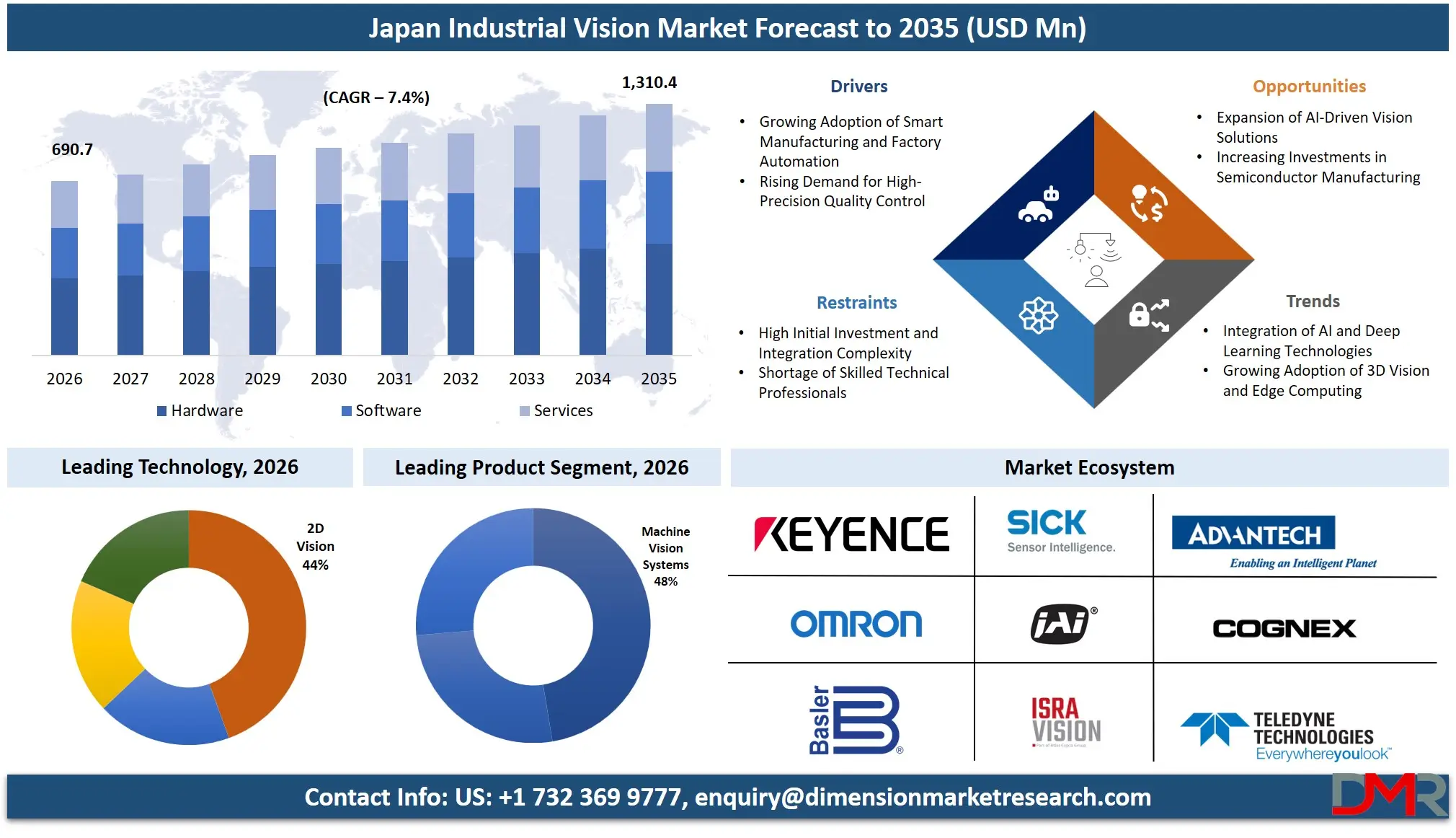
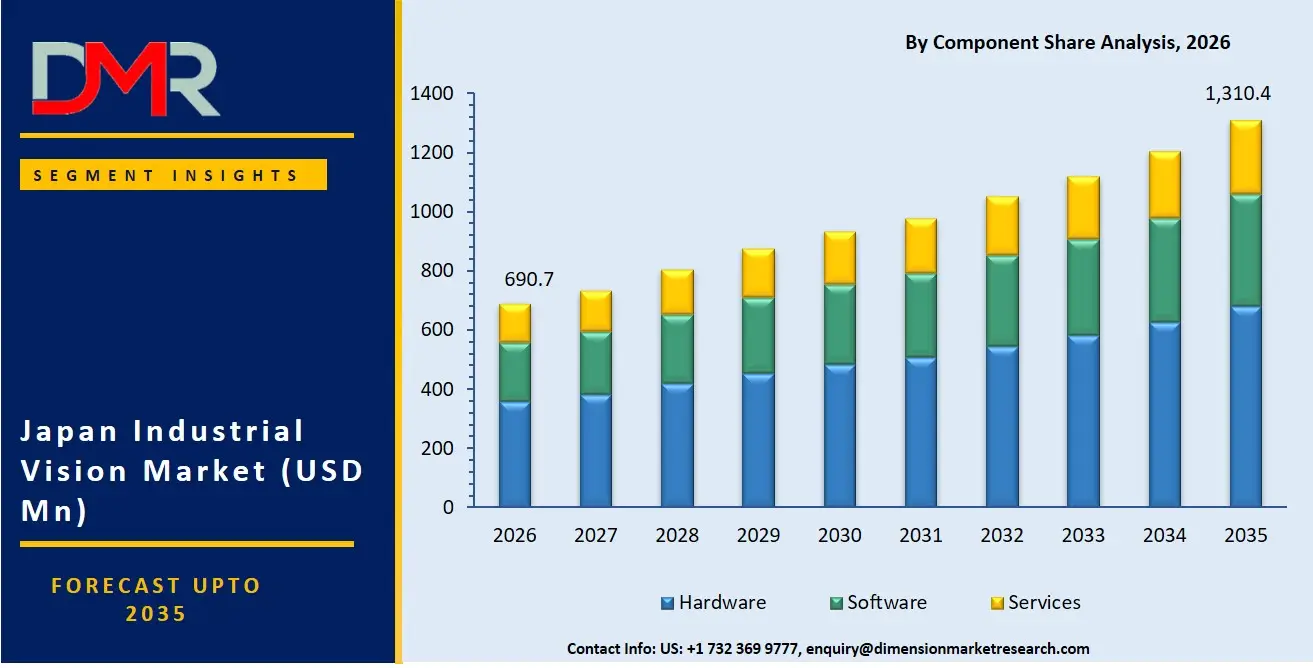
The Japan Industrial Vision Market size is expected to be USD 690.7 million in 2026 and increase at a compound annual growth rate of 7.4% to USD 1,310.4 million in 2035 owing to growing adoption of smart manufacturing and factory automation.
ℹ
To learn more about this report –
Download Your Free Sample Report Here
Industrial vision integrates advanced imaging systems, intelligent cameras, optics, lighting, sensors, software, and artificial intelligence to enable automated visual inspection, measurement, identification, and process control across manufacturing environments. These systems play a critical role in improving production accuracy, minimizing defects, and enhancing operational efficiency through real-time image analysis and decision-making. In Japan, the market is driven by the country's highly automated manufacturing sector, increasing adoption of smart factories, and demand for precision inspection in automotive, electronics, semiconductor, and pharmaceutical industries. Emerging trends such as AI-powered vision analytics, 3D imaging, hyperspectral inspection, and edge-based processing continue to expand industrial vision capabilities and accelerate digital transformation across production facilities.
Key Takeaways
- Market Size & Forecast: The Japan Industrial Vision Market size is projected to reach USD 690.7 million in 2026 and is anticipated to have a value of USD 1,310.4 million in 2035.
- Growth Rate & Outlook: The Japan Industrial Vision Market size is set to grow at a compound annual growth rate of 7.4% during the forecast period of 2026 to 2035.
- Primary Growth Drivers: Some of the major growth drivers in the market are Growing Adoption of Smart Manufacturing and Factory Automation, and more.
- Key Market Trends: Some of the major trends in the market are Growing Adoption of 3D Vision and Edge Computing and more.
- By Component Type: Hardware is expected to get the largest revenue share in 2026 in the Japan Industrial Vision Market.
- By Technology Type: 2D Vision is expected to get the largest revenue share in 2026 in the Japan Industrial Vision Market.
- By Product Type: Machine Vision Systems segment is expected to get the largest revenue share in 2026 in the Japan Industrial Vision Market.
What is the Industrial Vision?
Industrial vision refers to the application of machine-based imaging technologies that enable equipment and automated systems to capture, process, and interpret visual information for industrial operations. It combines cameras, optical components, illumination systems, image processing software, artificial intelligence, and sensing technologies to perform tasks such as quality inspection, dimensional measurement, object recognition, barcode reading, defect detection, and robotic guidance. Industrial vision enhances manufacturing precision by replacing or supporting manual inspection with fast, consistent, and highly accurate visual analysis.
Use Cases
- Automated Quality Inspection: Industrial vision systems perform high-speed inspection of manufactured components by detecting scratches, cracks, dimensional deviations, assembly errors, and surface defects. Manufacturers use these systems to improve product consistency, reduce manual inspection errors, minimize waste, and maintain strict quality standards throughout production processes.
- Robotic Guidance and Automation: Vision-enabled robots utilize real-time image processing to identify object positions, orientations, and movements for accurate pick-and-place, assembly, welding, and packaging operations. This improves production flexibility, reduces downtime, enhances precision, and supports fully automated manufacturing lines in modern factories.
- Traceability and Product Identification: Industrial vision solutions read barcodes, QR codes, serial numbers, and direct part markings to ensure complete product traceability across manufacturing and logistics operations. This capability helps manufacturers comply with regulatory requirements, improve inventory management, streamline recalls, and strengthen supply chain transparency.
- Semiconductor and Electronics Manufacturing: Industrial vision systems inspect printed circuit boards, semiconductor wafers, microchips, and miniature electronic components with extremely high precision. Advanced imaging technologies enable rapid defect detection, dimensional verification, and alignment control, ensuring high manufacturing yields while supporting increasingly complex electronic device production.
How AI Is Transforming the Japan Industrial Vision Market
Artificial intelligence is transforming industrial vision by enabling systems to detect complex defects, classify products more accurately, optimize inspection parameters, and continuously improve performance through machine learning. AI-powered image analysis significantly reduces false positives, increases inspection speed, and enables manufacturers to identify subtle quality variations that conventional vision algorithms may overlook. These capabilities improve production consistency while lowering operational costs.
AI also strengthens predictive maintenance, autonomous robotics, adaptive manufacturing, and real-time production optimization by integrating industrial vision with smart factory platforms. Deep learning models continuously analyze production data to enhance decision-making, automate visual inspection tasks, support flexible manufacturing operations, and improve overall equipment effectiveness. As AI technologies mature, industrial vision systems are becoming increasingly intelligent, scalable, and capable of supporting highly automated manufacturing environments across Japan.
Market Dynamic
Driving Factors in the Japan Industrial Vision Market
Growing Adoption of Smart Manufacturing and Factory Automation
Japan's strong focus on Industry 4.0 initiatives and intelligent manufacturing continues to accelerate industrial vision adoption across production facilities. Manufacturers increasingly integrate machine vision systems with robotics, industrial IoT platforms, and automated production lines to improve inspection accuracy, reduce labor dependency, and increase production efficiency. The growing need for real-time monitoring, predictive maintenance, and data-driven manufacturing decisions further strengthens investment in advanced industrial vision technologies across multiple industries.
Restraints in the Japan Industrial Vision Market
Shortage of Skilled Technical Professionals
Industrial vision systems require specialized expertise in optics, imaging technologies, artificial intelligence, software development, robotics, and automation engineering. Many manufacturers face difficulties in recruiting professionals capable of designing, integrating, calibrating, and maintaining these sophisticated systems. Limited availability of skilled personnel can delay project implementation, increase operational costs, and reduce the overall efficiency of industrial vision deployments across manufacturing environments.
Opportunities in the Japan Industrial Vision Market
Increasing Investments in Semiconductor Manufacturing
Growing domestic investment in semiconductor fabrication, electronic component manufacturing, and advanced packaging facilities presents strong growth opportunities for industrial vision vendors. Semiconductor production requires extremely precise visual inspection at every manufacturing stage, encouraging greater adoption of high-resolution cameras, 3D imaging systems, AI-enabled inspection software, and automated metrology solutions designed for ultra-precision manufacturing environments.
Trends in the Japan Industrial Vision Market
Growing Adoption of 3D Vision and Edge Computing
Manufacturers are increasingly deploying 3D vision technologies alongside edge computing platforms to perform real-time image processing directly on production equipment. This approach reduces processing latency, minimizes network dependency, enhances robotic guidance accuracy, and supports immediate quality control decisions. The combination of advanced imaging and localized computing significantly improves manufacturing responsiveness and operational productivity.
Research Scope and Analysis
The research scope of the Japan industrial vision market covers detailed segmentation across components, product types, technologies, applications, and end-use industries to evaluate adoption patterns and growth potential. It analyzes demand shifts, automation penetration, and AI integration across manufacturing sectors. The study highlights leading and fastest-growing segments, competitive intensity, and innovation trends shaping market evolution through 2026.
ℹ
To learn more about this report –
Download Your Free Sample Report Here
By Component Analysis
The hardware segment dominates the Japan industrial vision market in 2026, accounting for an estimated 52% share, driven by strong demand for high-resolution cameras, advanced optics & lenses, lighting systems, and frame grabbers used across automotive, semiconductor, and electronics manufacturing.
ℹ
To learn more about this report –
Download Your Free Sample Report Here
Hardware remains the foundation of vision systems because precision imaging and reliable data capture are essential for downstream analytics. The software segment is the fastest-growing, supported by rapid adoption of AI-based vision processing software and deep learning algorithms that enhance defect detection and predictive analytics capabilities. Services, including integration, installation, and maintenance, are also expanding as manufacturers increasingly outsource complex system deployment to specialized providers for efficiency and scalability.
By Product Type Analysis
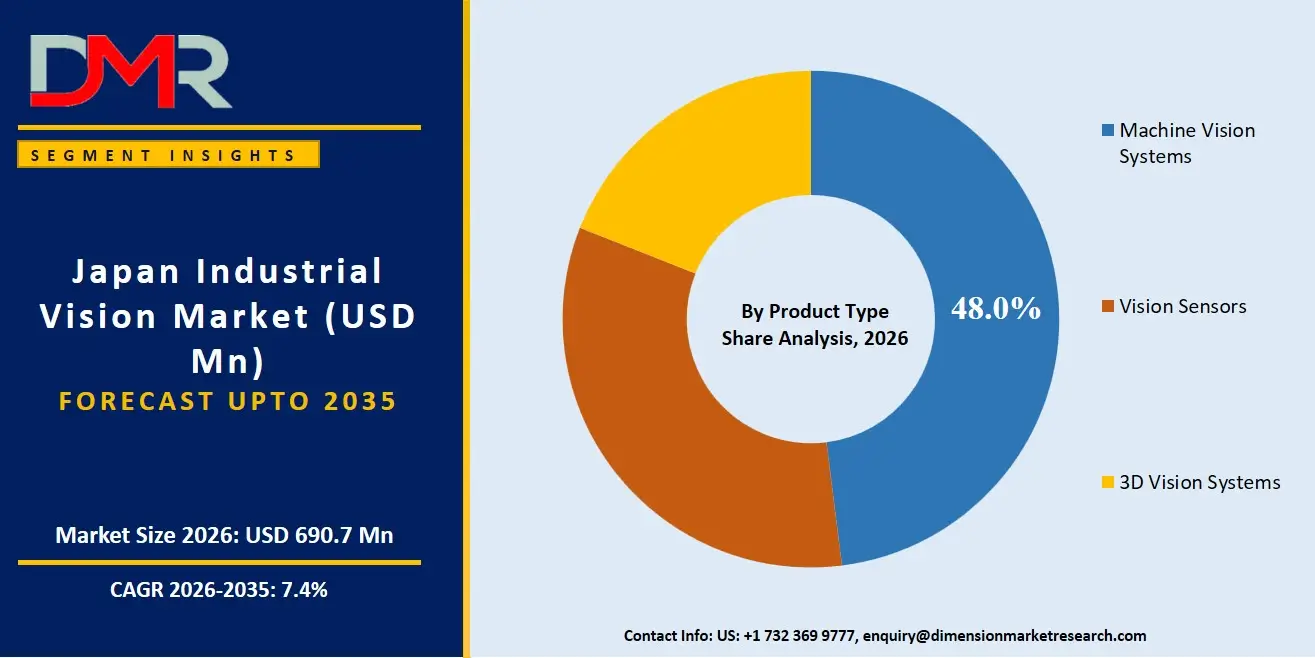
Machine vision systems hold the leading share of approximately 48% in 2026, supported by widespread use in automated inspection, robotics guidance, and quality control applications across high-precision industries such as electronics and automotive manufacturing. PC-based systems remain popular due to high processing power and flexibility. However, smart camera-based systems are gaining traction due to compact design and ease of deployment. The fastest-growing segment is 3D vision systems, fueled by rising demand for spatial measurement, robotic navigation, and defect detection in complex geometries. Vision sensors are also witnessing steady adoption in cost-sensitive applications requiring basic inspection and identification functions.
By Technology Analysis
2D vision technology leads the market with an estimated 44% share in 2026, primarily due to its cost-effectiveness, simplicity, and strong adoption in traditional inspection and barcode reading applications. It remains widely used in packaging, labeling, and basic quality inspection tasks. However, AI-based vision is the fastest-growing technology segment as manufacturers increasingly deploy intelligent systems capable of adaptive learning, real-time defect recognition, and predictive quality control. 3D vision is expanding rapidly in robotics and semiconductor inspection, while hyperspectral and thermal vision are gaining niche adoption in advanced material analysis, food safety inspection, and high-end industrial diagnostics.
By Application Analysis
Quality inspection dominates the application segment with an estimated 41% share in 2026, as manufacturers prioritize defect-free production and strict compliance standards across automotive, electronics, and pharmaceutical sectors. Identification and traceability also represent a strong base demand due to increasing supply chain transparency requirements. The fastest-growing application is robot guidance and positioning, driven by rapid expansion of industrial automation and collaborative robotics in smart factories. Measurement and gauging applications continue to grow steadily in precision engineering, while packaging and label inspection benefits from increasing e-commerce logistics and regulatory labeling requirements.
By End Use Industry Analysis
The electronics & semiconductor industry leads the market with an estimated 38% share in 2026, supported by Japan's strong semiconductor ecosystem and demand for ultra-precise defect detection in micro-scale manufacturing processes. Automotive manufacturing follows closely due to high automation levels and stringent safety standards. The fastest-growing segment is pharmaceuticals & medical devices, driven by increasing regulatory compliance, rising demand for high-precision inspection, and growth in advanced medical device production. Logistics & warehousing is also expanding rapidly due to automation of sorting, tracking, and fulfillment operations using vision-enabled robotics.
The Japan Industrial Vision Market Report is segmented on the basis of the following:
By Component
- Hardware
- Cameras
- Optics & Lenses
- Lighting Systems
- Frame Grabbers & Controllers
- Software
- Vision Processing Software
- AI & Deep Learning Software
- Services
- Integration & Installation
- Maintenance & Support
By Product Type
- Machine Vision Systems
- PC-Based Vision Systems
- Smart Camera-Based Vision Systems
- Vision Sensors
- 3D Vision Systems
By Technology
- 2D Vision
- 3D Vision
- AI-Based Vision
- Hyperspectral & Thermal Vision
By Application
- Quality Inspection
- Measurement & Gauging
- Identification & Traceability
- Robot Guidance & Positioning
- Packaging & Label Inspection
By End-Use Industry
- Automotive
- Electronics & Semiconductor
- Food & Beverage
- Pharmaceuticals & Medical Devices
- Metals & Heavy Machinery
- Logistics & Warehousing
- Aerospace & Defense
- Other Manufacturing Industries
Competitive Landscape
The Japan industrial vision market is highly competitive, characterized by strong emphasis on technological innovation, AI integration, and precision imaging capabilities. Companies compete through continuous investment in R&D to develop high-resolution cameras, advanced AI algorithms, and integrated vision platforms that improve inspection accuracy and processing speed. Strategic partnerships with robotics and automation providers are increasingly common to strengthen ecosystem integration. High entry barriers exist due to technical complexity, capital-intensive development, and requirement for domain-specific expertise in optics, imaging, and AI. Competitive advantage is primarily driven by product reliability, customization capability, and ability to deliver end-to-end solutions across smart manufacturing environments.
Some of the prominent players in the Japan Industrial Vision are:
- Keyence Corporation
- OMRON Corporation
- Cognex Corporation
- Teledyne Technologies
- Basler AG
- Sony Semiconductor Solutions Corporation
- Canon Inc.
- FANUC Corporation
- Yaskawa Electric Corporation
- Mitsubishi Electric Corporation
- Panasonic Connect
- SICK AG
- Baumer Group
- ISRA VISION
- Advantech
- Allied Vision Technologies
- JAI A/S
- IDS Imaging Development Systems
- TKH Vision
- LMI Technologies
- Other Key Players
Recent Developments
- In June 2025, Omron Corporation announced a strategic partnership with a leading robotics automation company to strengthen integrated smart factory solutions combining machine vision, robotics, and AI analytics. The collaboration focuses on developing adaptive inspection systems capable of real-time learning and autonomous decision-making in production environments. This initiative aims to enhance manufacturing efficiency, reduce defects, and support flexible production lines in automotive and electronics industries. The partnership highlights growing convergence between industrial vision and robotics in Japan's Industry 4.0 ecosystem.
- In March 2025, Cognex Corporation introduced an expanded range of smart industrial cameras designed for compact manufacturing environments and high-speed production lines. The new systems feature enhanced onboard AI processing, improved image resolution, and simplified deployment architecture. The upgrade targets automotive and packaging industries where rapid inspection and traceability are critical. The company emphasized improved integration with robotics systems and factory automation platforms, enabling manufacturers to streamline inspection workflows while reducing operational downtime and system complexity across large-scale industrial deployments.
- In January 2025, Keyence Corporation enhanced its industrial vision product portfolio by upgrading its AI-powered inspection systems with improved deep learning defect detection capabilities. The update focused on increasing accuracy in identifying micro-defects in semiconductor wafers and electronic components. The company integrated faster edge-processing modules, enabling real-time decision-making on production lines without cloud dependency. This development strengthens Keyence's position in high-precision manufacturing applications and supports growing demand for autonomous quality control solutions in Japan's electronics and automotive sectors.
Report Details
| Report Characteristics |
| Market Size (2026) |
USD 690.7 Mn |
| Forecast Value (2035) |
USD 1,310.4 Mn |
| CAGR (2026–2035) |
7.4% |
| Historical Period |
2021 – 2025 |
| Forecast Period |
2027 – 2035 |
| Base Year |
2025 |
| Estimate Year |
2026 |
| Segments Covered |
By Component, By Product Type, By Technology, By Application, By End-Use Industry |
| Country Coverage |
Japan |
Frequently Asked Questions
How big is the Japan Industrial Vision Market?
▾ The Japan Industrial Vision Market size is expected to reach USD 690.7 million by 2026 and is projected to reach USD 1,310.4 million by the end of 2035.
What is the CAGR of the Japan Industrial Vision Market from 2026 to 2035?
▾ The market is growing at a CAGR of 7.4 percent over the forecasted period.
What factors are driving the growth of the Japan Industrial Vision Market?
▾ Growing Adoption of Smart Manufacturing and Factory Automation, and more are the factors driving the growth of the Japan Industrial Vision Market.
What are the major trends in the Japan Industrial Vision Market?
▾ Growing Adoption of 3D Vision and Edge Computing, and more are some of the major trends in the market.
Who are the key players in the Japan Industrial Vision Market?
▾ Some of the key players in the Japan Industrial Vision Market include Omron, SICK JAI, and more.
How is the Japan Industrial Vision Market segmented?
▾ The Japan Industrial Vision Market is segmented by component, product type, technology, application, end-use industry.