What is the Japan Infrastructure Construction Market Size?
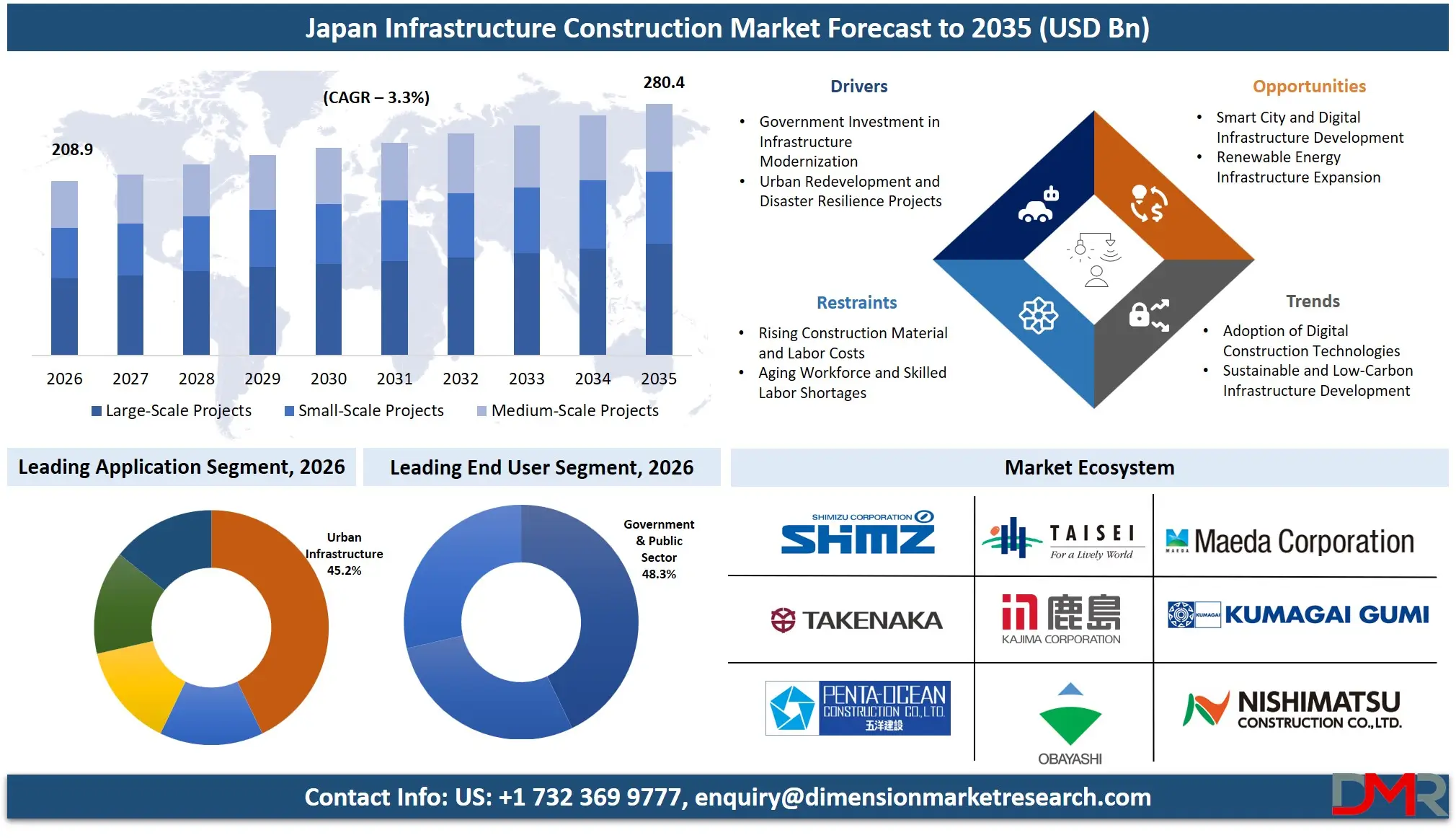
The Japan Infrastructure Construction Market is expected to reach a value of USD 208.9 billion in 2026, and it is further anticipated to reach USD 280.4 billion by 2035, growing at a CAGR of 3.3% during the forecast period.
ℹ
To learn more about this report –
Download Your Free Sample Report Here
The infrastructure construction market in Japan has witnessed steady growth, driven by the nation's commitment to maintaining its position as a global leader in seismic-resistant design and advanced civil engineering. The market encompasses a wide array of projects, from next-generation transportation networks and renewable energy facilities to resilient water systems and smart city developments. The escalating need to refurbish legacy infrastructure built during the post-war economic boom, coupled with the pressing demand for disaster-mitigation structures in a seismically active region, has necessitated sustained public and private investment. Major general contractors and engineering, procurement, and construction (EPC) firms are the primary drivers, focusing on integrating digital technologies and high-performance materials to extend asset lifecycles and enhance public safety.
Key Takeaways
- Market Size & Forecast: Based on forecasts, the market size for Japan's infrastructure construction will experience steady growth, attaining a value of USD 208.9 billion by 2026, expanding to USD 280.4 billion by 2035 due to the convergence of national resilience programs and the systematic renewal of aging assets.
- Growth Rate & Outlook: It is predicted that the market will register a CAGR of 3.3%, attributed to the presence of critical growth factors, such as consistent government fiscal stimulus for public works and a strategic push to develop smart, connected urban centers.
- Primary Growth Drivers: Important growth factors will include the mandatory seismic retrofitting of public buildings and transport arteries, an increase in government focus on decarbonization through green infrastructure and offshore wind projects, and a mature ecosystem of construction conglomerates pioneering automation to counter labor shortages.
- Key Market Trends: Market trends are mainly related to the adoption of modular and prefabricated construction methods to enhance productivity, the integration of 5G-enabled digital twins for real-time asset management, and increased investment in green building materials to meet stringent carbon-neutral targets.
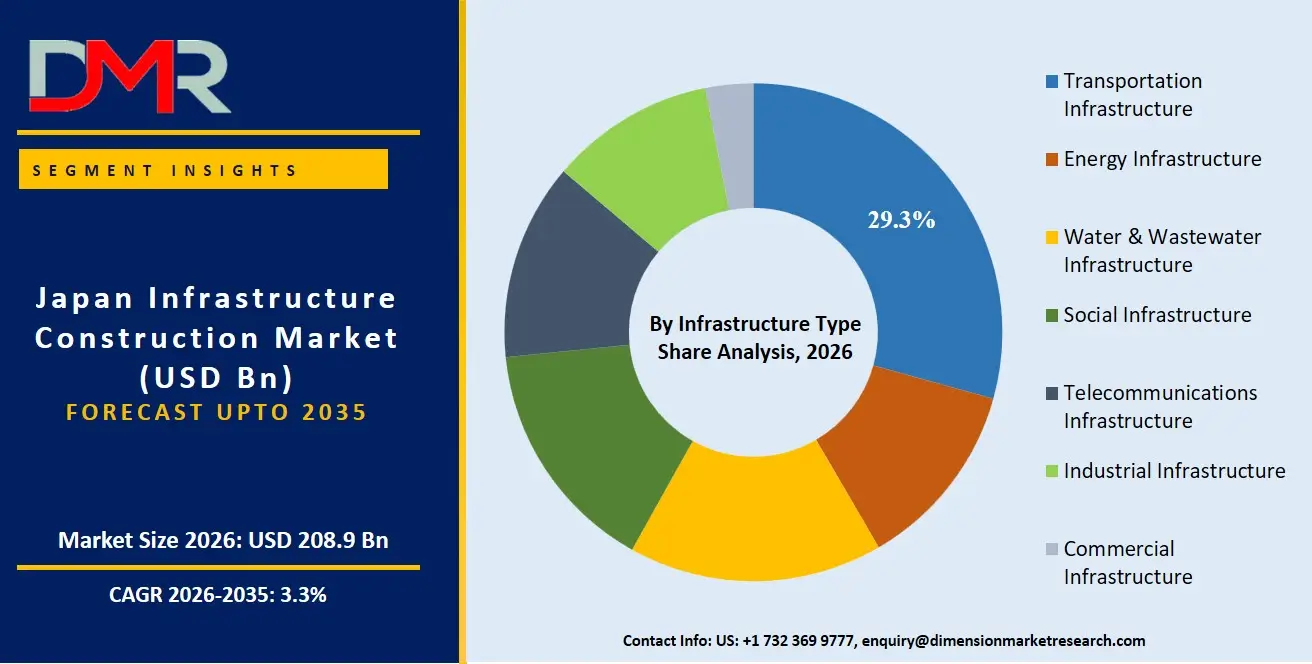
- By Infrastructure Type Analysis: The transportation infrastructure segment drives the Japanese market, as it requires continuous modernization. Projects related to the Shinkansen maglev extension, expressway renovations, and hub airport expansions command substantial capital, reflecting the nation's priority on efficient logistics and high-speed connectivity.
- By Application Analysis: The Japan infrastructure market is projected to be dominated by urban infrastructure, as it necessitates the integration of advanced seismic isolation bearings and flood control systems directly into public works to safeguard communities against earthquakes and tsunamis as this region is high prone.
What is the Infrastructure Construction?
Infrastructure construction can be described as the specific sector of civil engineering focused on the planning, design, and assembly of the fundamental physical systems required for societal and economic function. Unlike standard vertical building, infrastructure projects are typically capital-intensive public goods designed for decades-long operational lifespans. This is executed through diverse procurement approaches like the traditional Design-Bid-Build method, which separates design from construction, or the streamlined Design-Build and Public-Private Partnership (PPP) models, which consolidate responsibility to accelerate delivery. Considering Japan's susceptibility to natural hazards, infrastructure construction mandates the application of stringent seismic codes and the utilization of high-durability materials such as high-performance concrete and steel alloys.
Use Cases
- High-Speed Rail Expansion: A national railway operator employs the linear Chuo Shinkansen project, utilizing deep-underground tunneling and advanced composite materials to connect Tokyo and Nagoya at unprecedented speeds, drastically reducing travel time between the metropolitan hubs.
- Offshore Wind Energy Development: A consortium of EPC contractors engages in the design, procurement, and construction of fixed-bottom and floating offshore wind farms along the Sea of Japan coast to replace decommissioned nuclear and fossil fuel capacity.
- Urban Flood Control Systems: Metropolitan governments construct massive underground regulating reservoirs and storm surge barriers, integrating real-time sensor networks to mitigate pluvial and fluvial flooding risks intensified by climate change and typhoons.
- Resilient Utility Tunnels: Utility providers replace aging, fragile pipelines with seismically resilient common utility ducts constructed using ductile iron and smart monitoring sensors to prevent service disruptions during major seismic events.
How AI is Transforming the Infrastructure Construction Market?
The impact of AI on the Japanese infrastructure construction market centers on solving the acute shortage of skilled labor and optimizing the complexity of mega-projects. In the realm of design and engineering, AI-driven generative design tools analyze vast datasets on seismic activity and soil liquefaction to propose thousands of structural configurations that maximize seismic resistance while minimizing concrete and steel weight.
Furthermore, the role of AI in construction management is now foundational. Computer vision systems, mounted on heavy machinery and drones, automatically monitor earthworks and welding quality against BIM models, flagging deviations in real-time without human inspection. AI-powered scheduling algorithms simulate supply chain disruptions and weather events to dynamically re-sequence tasks, preventing costly delays on critical path items like bridge deck pours. Predictive maintenance AI processes edge-computed data from IoT sensors embedded in roadways and tunnels, forecasting spalling or rail corrugation months before failure.
Market Dynamics
Key Drivers in the Japan Infrastructure Construction Market
Government Investment in Infrastructure Modernization
Japan continues to prioritize infrastructure modernization through substantial public investment in transportation networks, water systems, energy infrastructure, and public facilities. National and local governments allocate significant budgets for replacing aging assets, strengthening seismic resilience, and improving operational efficiency. Long-term infrastructure renewal programs support the rehabilitation of bridges, tunnels, railways, airports, and ports while enhancing public safety. Strategic investments also focus on digital infrastructure and sustainable urban development. Continuous government funding creates a stable pipeline of construction projects, encouraging contractor participation, technological innovation, and long-term growth across Japan's infrastructure construction market.
Urban Redevelopment and Disaster Resilience Projects
Rapid urban redevelopment and the need for disaster-resilient infrastructure are major drivers of Japan's infrastructure construction market. Major cities continue upgrading transportation systems, utilities, and public facilities to accommodate evolving economic activities and population needs. Frequent earthquakes, typhoons, and flooding increase demand for resilient construction, seismic retrofitting, and flood-control infrastructure. Government policies encourage resilient urban planning and smart infrastructure deployment to minimize disaster risks. Growing investment in resilient transportation corridors, coastal protection, and emergency response infrastructure supports sustained construction activity while improving public safety and strengthening long-term infrastructure reliability throughout Japan.
Restraints in the Japan Infrastructure Construction Market
Rising Construction Material and Labor Costs
Increasing prices of steel, cement, concrete, fuel, and other construction materials continue raising overall project costs across Japan. Inflationary pressures, supply chain disruptions, and higher transportation expenses further affect procurement budgets and contractor profitability. Simultaneously, labor shortages increase wage costs, making infrastructure projects more expensive and difficult to complete within planned budgets. Small and medium-sized contractors face additional financial pressure from volatile material prices. These cost challenges can delay project implementation, reduce investment returns, and create financial constraints for both public authorities and private infrastructure developers.
Aging Workforce and Skilled Labor Shortages
Japan's construction industry faces persistent labor shortages due to an aging workforce and declining availability of skilled workers. Experienced engineers, equipment operators, and construction technicians are retiring faster than new workers enter the industry. Labor scarcity affects project scheduling, increases recruitment costs, and limits construction capacity for large-scale infrastructure developments. Contractors increasingly invest in automation, robotics, and digital construction technologies to improve productivity and compensate for workforce shortages. Despite these efforts, human resource constraints remain a significant challenge affecting project execution, operational efficiency, and long-term market expansion.
Growth Opportunities in the Japan Infrastructure Construction Market
Smart City and Digital Infrastructure Development
Japan's expanding smart city initiatives create substantial opportunities for infrastructure construction companies. Investments in intelligent transportation systems, digital utilities, smart grids, connected public facilities, and advanced communication networks require extensive civil engineering and construction activities. Government support for digital transformation encourages deployment of Internet of Things technologies, artificial intelligence, and integrated urban management platforms. Infrastructure developers increasingly participate in technologically advanced urban projects that improve sustainability, mobility, and public services. Growing demand for digitally enabled infrastructure offers long-term opportunities for contractors, engineering firms, and technology providers operating in Japan's construction sector.
Renewable Energy Infrastructure Expansion
Japan's transition toward carbon neutrality creates significant opportunities for renewable energy infrastructure development. Increasing investments in offshore wind farms, solar power facilities, battery energy storage systems, hydrogen infrastructure, and electricity transmission upgrades require extensive construction activities. Government incentives and private-sector investment continue supporting renewable energy deployment across the country. Infrastructure companies benefit from growing demand for specialized engineering, civil works, and grid expansion projects associated with clean energy development. Rising renewable energy investments diversify construction opportunities while contributing to Japan's long-term environmental sustainability and energy security objectives.
Trends in the Japan Infrastructure Construction Market
Adoption of Digital Construction Technologies
Digital transformation is reshaping Japan's infrastructure construction market through increasing adoption of Building Information Modeling (BIM), drones, artificial intelligence, robotics, and digital project management platforms. Contractors utilize these technologies to improve design accuracy, project coordination, construction productivity, and safety performance. Real-time monitoring and predictive maintenance solutions also enhance infrastructure lifecycle management. Government initiatives encouraging digital construction further accelerate technology adoption across public infrastructure projects. Growing reliance on automation and intelligent construction practices improves operational efficiency while addressing labor shortages and supporting higher-quality infrastructure delivery throughout Japan.
Sustainable and Low-Carbon Infrastructure Development
Sustainability has become a defining trend within Japan's infrastructure construction market. Developers increasingly incorporate low-carbon construction materials, energy-efficient designs, green buildings, renewable energy systems, and environmentally responsible construction practices into infrastructure projects. Government carbon neutrality targets encourage sustainable procurement, circular economy principles, and climate-resilient infrastructure development. Contractors also adopt environmentally friendly equipment and waste reduction strategies to minimize project emissions. Increasing focus on sustainable infrastructure enhances environmental performance while creating long-term economic value, positioning green construction as a central trend shaping Japan's future infrastructure development.
Research Scope and Analysis
The Japan infrastructure construction market is segmented by infrastructure type, construction type, project size, material type, procurement method, application, and end user. It covers transportation, energy, water, telecommunications, industrial, commercial, and social infrastructure projects, serving government, private sector, and public-private partnership initiatives supporting modernization, urban development, and resilient infrastructure.
ℹ
To learn more about this report –
Download Your Free Sample Report Here
By Infrastructure Type Analysis
Transportation infrastructure is poised to dominate the Japan infrastructure construction market due to continuous government investment in highways, railways, bridges, tunnels, airports, and ports. Japan's mature transport network requires ongoing modernization, seismic reinforcement, maintenance, and capacity expansion to support economic activity and urban mobility. Major investments in high-speed rail, expressways, metropolitan transit systems, and logistics corridors further strengthen this segment. The country's focus on disaster resilience and infrastructure renewal also drives significant spending on transportation assets. As mobility remains essential for trade, tourism, and regional connectivity, transportation infrastructure continues to account for the largest share of construction investment across Japan.
By Construction Type Analysis
Maintenance and repair is expected to dominate the construction type segment because Japan possesses one of the world's most extensive aging infrastructure networks. Roads, bridges, tunnels, railways, ports, dams, and public buildings require continuous inspection, rehabilitation, and seismic strengthening to ensure safety and operational efficiency. Government policies prioritize extending the service life of existing infrastructure rather than replacing it entirely. Increasing investments in preventive maintenance, digital asset monitoring, and resilient infrastructure management further support this segment. Given the country's aging public assets and strict safety standards, maintenance and repair remain the largest category within Japan's infrastructure construction market.
By Project Size Analysis
Large-scale projects is anticipated to dominate Japan's infrastructure construction market due to substantial public investment in transportation, energy, telecommunications, water management, and urban redevelopment. These projects involve significant capital expenditure, long implementation periods, and extensive engineering expertise. Major railway upgrades, highway expansions, airport modernization, renewable energy facilities, and disaster-resilient infrastructure programs contribute significantly to market value. Government funding and private-sector participation continue supporting complex infrastructure developments across the country. While mega projects receive considerable attention, large-scale projects collectively account for the highest number of high-value infrastructure developments and dominate overall construction spending in Japan.
By Material Type Analysis
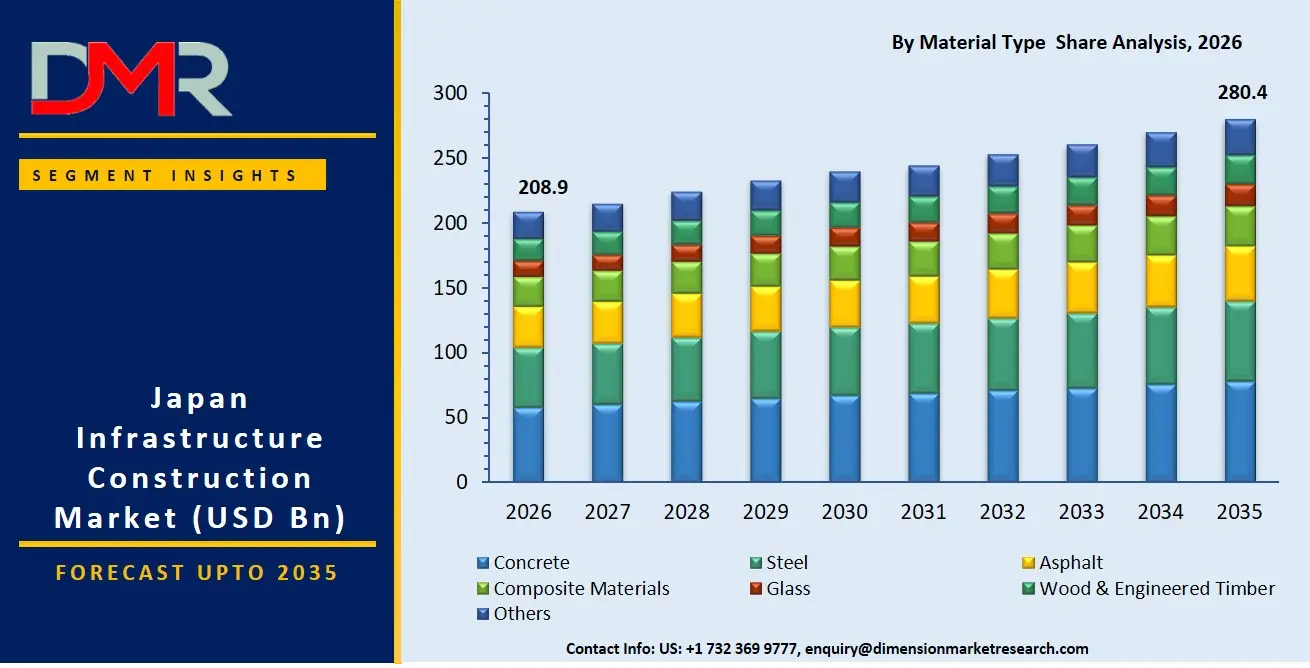
Concrete is poised to dominate the material segment because it serves as the primary construction material for roads, bridges, tunnels, dams, ports, railways, and public buildings throughout Japan. Its durability, structural strength, seismic performance, and long service life make it highly suitable for infrastructure projects in an earthquake-prone country.
ℹ
To learn more about this report –
Download Your Free Sample Report Here
Continuous investments in resilient transportation and flood-control infrastructure sustain strong demand for high-performance concrete. Advances in low-carbon concrete technologies and durable formulations further support market growth. Owing to its versatility and widespread application across virtually every infrastructure category, concrete remains the most extensively used construction material in Japan.
By Procurement Method Analysis
Design-Bid-Build is anticipated to dominate Japan's procurement market because it remains the traditional and widely adopted project delivery method for public infrastructure developments. This approach provides clear separation between design and construction responsibilities while promoting transparent and competitive contractor selection. Government agencies frequently utilize this procurement model for transportation, water, and public facility projects to ensure regulatory compliance and cost accountability. Established legal frameworks, standardized bidding procedures, and familiarity among contractors further reinforce its widespread adoption. Although integrated delivery methods are increasing, Design-Bid-Build continues to account for the largest share of infrastructure procurement activities across Japan.
By Application Analysis
Urban infrastructure is projected to dominate the application segment due to Japan's highly urbanized population and continuous investment in metropolitan development. Major cities require ongoing upgrades to transportation systems, utilities, public facilities, telecommunications networks, and resilient infrastructure to accommodate economic activity and population density. Smart city initiatives, transit-oriented developments, disaster mitigation projects, and sustainable urban planning further stimulate construction activity. Redevelopment of aging urban assets also contributes significantly to infrastructure investment. As Tokyo, Osaka, Nagoya, and other metropolitan regions remain Japan's primary economic centers, urban infrastructure continues representing the largest application segment within the construction market.
By End User Analysis
The government and public sector is expected to dominate Japan's infrastructure construction market because national and local authorities finance and oversee most transportation, water, energy, disaster prevention, healthcare, education, and public utility projects. Long-term infrastructure investment programs prioritize economic development, public safety, climate resilience, and modernization of aging assets. Government agencies also support regional connectivity through highways, railways, flood-control systems, and smart infrastructure initiatives. Public funding remains the primary source for major infrastructure developments, while private participation complements selected projects. Consequently, government and public sector organizations continue accounting for the largest share of infrastructure construction expenditure in Japan.
The Japan Infrastructure Construction Market Report is segmented on the basis of the following:
By Infrastructure Type
- Transportation Infrastructure
- Roads & Highways
- Railways & Metro
- Airports
- Ports & Harbors
- Bridges & Tunnels
- Energy Infrastructure
- Power Generation Facilities
- Transmission & Distribution Networks
- Renewable Energy Infrastructure
- Oil & Gas Infrastructure
- Water & Wastewater Infrastructure
- Water Supply Systems
- Wastewater Treatment Plants
- Drainage & Flood Control Systems
- Social Infrastructure
- Educational Buildings
- Healthcare Facilities
- Government Buildings
- Public Safety Infrastructure
- Telecommunications Infrastructure
- Fiber Optic Networks
- Data Centers
- 5G Infrastructure
- Industrial Infrastructure
- Manufacturing Facilities
- Logistics & Warehousing
- Industrial Parks
- Commercial Infrastructure
- Office Buildings
- Retail Complexes
- Mixed-Use Developments
By Construction Type
- Maintenance & Repair
- New Construction
- Renovation & Refurbishment
- Expansion
By Project Size
- Large-Scale Projects
- Small-Scale Projects
- Medium-Scale Projects
By Material Type
- Concrete
- Steel
- Asphalt
- Composite Materials
- Glass
- Wood & Engineered Timber
- Others
By Procurement Method
- Design-Bid-Build
- Design-Build
- Engineering, Procurement & Construction (EPC)
- Construction Management
- Public-Private Partnership (PPP)
By Application
- Urban Infrastructure
- Rural Infrastructure
- Smart City Projects
- Disaster-Resilient Infrastructure
- Green & Sustainable Infrastructure
By End User
- Government & Public Sector
- Private Sector
- Public-Private Partnership (PPP)
Competitive Landscape
The nature of competition in the Japan infrastructure construction market is deeply rooted in the dominance of the "Big Five" general contractors—Taisei, Kajima, Obayashi, Shimizu, and Takenaka—whose competitive moats lie in their proprietary seismic isolation technologies and integrated R&D divisions. The market operates on a relationship-driven model where technological differentiation in seismic-proofing and tunneling automation is a primary order qualifier. Access to public works is heavily influenced by the ability to form specific joint ventures that allocate risk on mega-scale, long-duration projects. Global EPC heavyweights are increasingly challenging the traditional hierarchy in renewable energy and data center construction, introducing proprietary floating wind foundation designs and modular delivery platforms. This is steering the competitive landscape toward a "technological keiretsu" model, where design engineering and digital integration are more critical than pure installation capacity.
Some of the prominent players in the Japan Infrastructure Construction Market are:
- Obayashi Corporation
- Kajima Corporation
- Shimizu Corporation
- Taisei Corporation
- Takenaka Corporation
- Maeda Corporation
- Penta-Ocean Construction Co., Ltd.
- Toda Corporation
- Kumagai Gumi Co., Ltd.
- Nishimatsu Construction Co., Ltd.
- Tokyu Construction Co., Ltd.
- Hazama Ando Corporation
- Fujita Corporation
- Tekken Corporation
- Sumitomo Mitsui Construction Co., Ltd.
- JGC Holdings Corporation
- TOA Corporation
- Nippon Koei Co., Ltd.
- Mitsubishi Heavy Industries, Ltd.
- IHI Corporation
- Other Key Players
Recent Developments
- January 2026: Toda Corporation, together with ENEOS Renewable Energy, Osaka Gas, INPEX, Kansai Electric Power, and Chubu Electric Power, commenced commercial operations at Japan's first floating offshore wind farm in Goto City, advancing renewable energy and marine infrastructure construction.
- February 2026: Obayashi Corporation successfully conducted Japan's first on-site demonstration of a hydrogen fuel-cell-powered hydraulic excavator, supporting zero-emission construction equipment and accelerating decarbonization across infrastructure construction projects.
- April 2026: Japan accelerated investments in renewable energy, transportation infrastructure, and semiconductor manufacturing projects under its national infrastructure development strategy, supporting sustained construction activity and long-term industry growth.
Report Details
| Report Characteristics |
| Market Size (2026) |
USD 208.9 Bn |
| Forecast Value (2035) |
USD 280.4 Bn |
| CAGR (2026–2035) |
3.3% |
| Historical Data |
2021 – 2025 |
| Forecast Data |
2027 – 2035 |
| Base Year |
2025 |
| Estimate Year |
2026 |
| Segments Covered |
By Infrastructure Type, By Construction Type, By Project Size, By Material Type, By Procurement Method, By Application, By End User |
| Regional Coverage |
Japan |
Frequently Asked Questions
How big is the Japan Infrastructure Construction Market?
▾ The Japan Infrastructure Construction Market is poised to be valued at USD 208.9 billion in 2026 and is projected to reach USD 280.4 billion by 2035, driven by the universal need for seismic resilience and the systematic renewal of the aging post-war built environment.
What is the CAGR of the Japan Infrastructure Construction Market from 2026 to 2035?
▾ The market is expected to grow at a CAGR of 3.3% from 2026 to 2035, reflecting the sustained fiscal outlays on disaster mitigation and the productivity gains from construction technology integration.
What factors are driving the growth of the Japan Infrastructure Construction Market?
▾ Key drivers include the mandatory seismic retrofitting deadlines for legacy transport infrastructure, the development of offshore renewable energy hubs, and the national resilience strategy funding flood control and river management assets.
What are the major trends in the Japan Infrastructure Construction Market?
▾ Major trends include the shift toward off-site precast mega-element construction to address labor shortages, the integration of BIM/CIM digital twins for lifecycle asset management, and the use of carbon-sequestering concrete and green materials in public works.
Who are the key players in the Japan Infrastructure Construction Market?
▾ Key players in the Japan Infrastructure Construction Market include Taisei Corporation, Kajima Corporation, Obayashi Corporation, Shimizu Corporation, and Takenaka Corporation, alongside major EPC firms like JGC Holdings and Chiyoda Corporation, driving innovation through seismic research, automation, and civil engineering mega-projects.
How is the Japan Infrastructure Construction Market segmented?
▾ The market is segmented by Infrastructure Type, Construction Type, Project Size, Material Type, Procurement Method, Application, and End User.