Market Snapshot
- Market Size (2026): USD 347.8 Bn
- Forecast Value (2035): USD 478.2 Bn
- CAGR (2026-2035): 3.6%
- Leading Insurance Type (2026): Life, approximately 68%
- Leading Distribution Channel (2026): Agency, around 44%
- Key Players: Nippon Life, Tokio Marine Holdings, Japan Post Insurance and others
What is Japan Insurance Market and its Market Size?
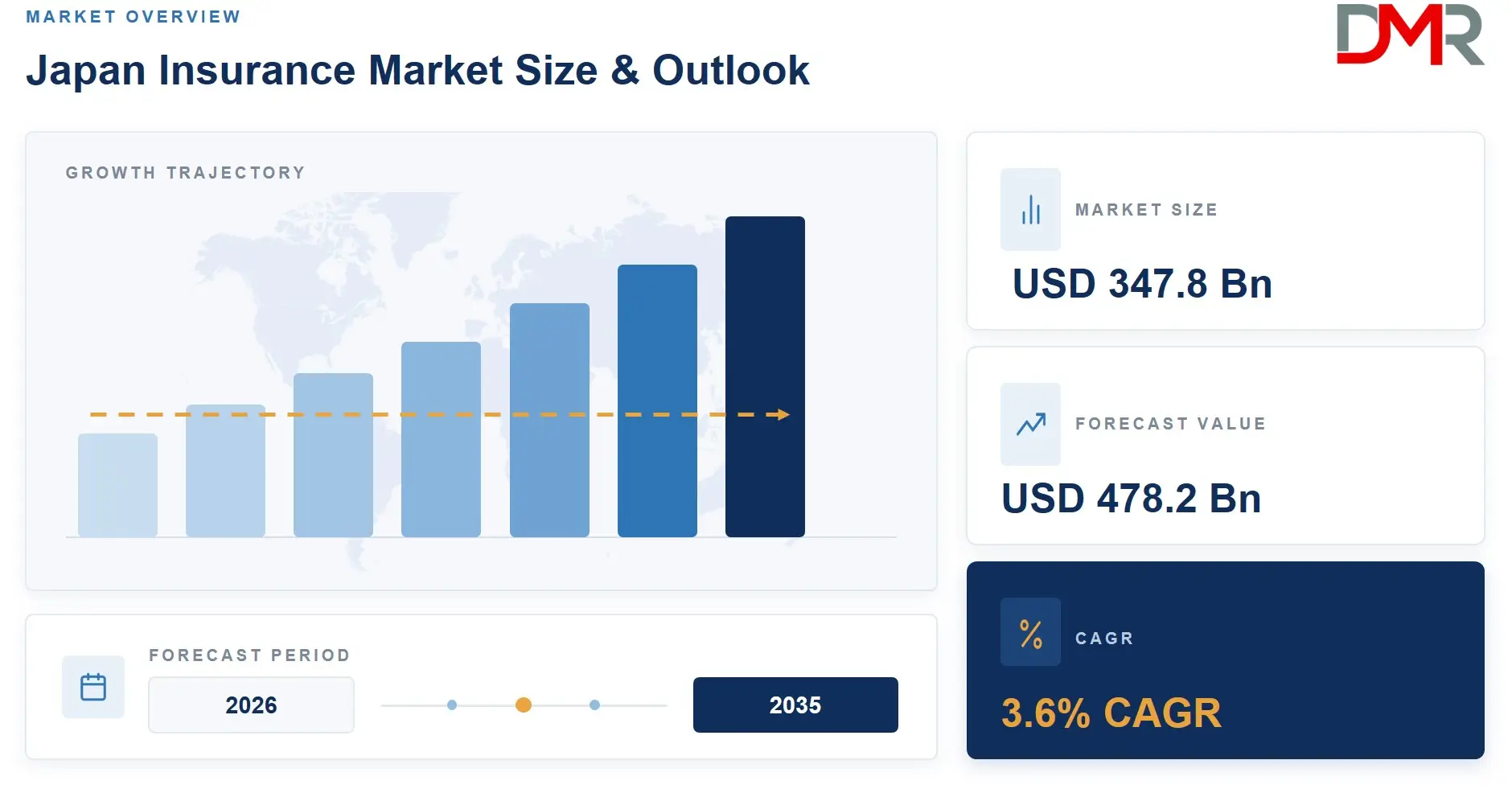
The Japan Insurance Market size is estimated to reach USD 347.8 Bn in 2026 and is further anticipated to reach USD 478.2 Bn by 2035, at a CAGR of 3.6%.
ℹ
To learn more about this report –
Download Your Free Sample Report Here
This report measures premium revenue generated from life, health, property, casualty, auto, commercial and specialty insurance purchased within Japan. It includes direct written premiums and relevant policy fees across personal and business products, while excluding banking deposits, securities and overseas premium booked outside the country.
Life insurers remain central because households use protection, savings-linked policies and annuities to manage longevity and income uncertainty. Non-life carriers serve compulsory motor coverage, property protection, corporate liability, marine, workers compensation and catastrophe exposure. Health products add a private layer around public medical and long-term care systems.
Demand is changing structurally rather than accelerating uniformly. Population ageing expands medical, annuity and care needs, while lower interest rates pressure traditional savings products. Digital servicing, telematics, catastrophe modelling, cyber coverage and embedded distribution are shifting underwriting and customer acquisition toward data-rich operating models.
Use Cases
- Household Protection: Families purchase term life, medical and income protection policies through advisers and banks to manage mortality, illness and retirement risks. The result is a broader protection mix, with policy design increasingly reflecting longevity and household balance-sheet pressures.
- Mobility Coverage: Motor insurers and fleet owners use compulsory and voluntary auto policies to transfer collision, bodily injury and theft exposure. Commercial telematics can align premiums with driving behaviour, while repair-network coordination changes claims handling and vehicle downtime.
- Industrial Risk Transfer: Manufacturers, exporters and logistics operators buy property, marine, liability and business interruption cover for plants and supply chains. Layered policies protect cash flow after earthquakes, floods, machinery failure or shipment disruption.
- Public Sector Resilience: Municipal bodies and infrastructure operators arrange catastrophe and liability protection for assets serving densely populated communities. Coverage supports recovery funding after severe weather events and encourages more explicit risk mapping before capital is committed.
Key Takeaways
- Market Size & Share: Premium revenue is estimated at USD 347.8 Bn in 2026 and is projected to reach USD 478.2 Bn by 2035.
- Insurance Type Analysis: Life insurance is expected to hold approximately 68% of 2026 revenue, supported by protection, savings and annuity demand.
- Demand Concentration: The Kanto cluster is expected to represent roughly 37% of domestic premium demand in 2026 because of population, corporate headquarters and financial distribution density.
- Demographic Rebalancing: Medical and long-term care products are forecast to expand at a CAGR of 5.8% from 2026 to 2035 as ageing increases claims and planning needs.
- Channel Modernisation: Digital distribution is forecast to grow at a CAGR of 8.7% as comparison, onboarding and renewal workflows move online.
- Risk Innovation: Cyber and climate-linked commercial products are expanding from small bases, creating specialist premium pools beyond conventional motor and property lines.
How AI/Gen AI is Transforming the Japan Insurance Market?
Artificial intelligence is being applied first to repetitive decisions with clear audit trails. Computer vision can classify vehicle and property damage from photographs, while predictive models improve fraud triage, lapse forecasting and catastrophe accumulation analysis. These systems support adjusters and underwriters rather than remove accountability from regulated decisions.
Generative AI is most useful around documents and conversations. Japanese-language LLM document processing can extract clauses, compare endorsements and draft internal summaries, but human review remains necessary for exclusions, claims disputes and customer explanations. The commercial value comes from reducing cycle time and improving consistency across large legacy portfolios.
- Claims Intake: Computer vision and speech analytics organise first-notice-of-loss information and route complex cases.
- Policy Administration: LLM document processing extracts renewal terms, endorsements and missing information from unstructured files.
- Portfolio Simulation: Digital twins model exposure concentrations across buildings, transport networks and industrial assets under disaster scenarios.
- Pricing Support: Reinforcement learning tests retention and service interventions while keeping approved pricing rules under governance controls.
Key Drivers in the Japan Insurance Market
Two forces are widening demand even as the overall market remains mature. Demographic needs are expanding personal coverage, while climate and operational volatility are raising the value of risk transfer for businesses.
- Ageing and Longevity Risk: Japan's older population increases demand for medical, care, annuity and inheritance-oriented products. Medical and long-term care products are expected to account for nearly 17% of 2026 premium revenue, with insurers adapting benefit design, distribution and claims support to longer lifespans. The mechanism is a larger pool of households planning for extended retirement and care obligations, not simply a rise in policy count. Carriers that combine protection with transparent savings and service features can defend persistency as conventional guaranteed-return products become harder to price.
- Climate and Business Interruption Exposure: Earthquakes, typhoons, flooding and concentrated supply chains increase the financial value of property, catastrophe, marine and interruption coverage. Commercial property and casualty products are projected to represent around 29% of 2026 premiums, supported by manufacturers, logistics companies and infrastructure owners. Better hazard maps and catastrophe models allow insurers to segment risk more precisely, although premiums may rise where physical exposure cannot be mitigated. This creates demand for prevention services alongside indemnity cover.
Restraints in the Japan Insurance Market
Structural constraints limit how quickly premium growth can translate into profit growth. Regulation, legacy systems and household affordability all shape product economics.
- Low-Yield Investment Pressure: Life insurers rely on long-duration assets to support savings and annuity promises. Persistent reinvestment at modest yields narrows the spread available after guarantees, capital charges and distribution costs. As a result, carriers must rebalance toward protection, fees and foreign assets without creating unacceptable currency or duration risk. Products with high savings content are expected to remain important in 2026, but their design becomes more conservative and less differentiated.
- Legacy Operations and Conduct Requirements: Large insurers operate complex policy-administration estates built through acquisitions and decades of product changes. Migration costs, data quality gaps and strict explanation duties slow automation. Digital distribution is forecast to grow at 8.7%, yet online acquisition cannot immediately replace trusted agents for older customers or complex policies. Insurers therefore carry parallel channels, increasing technology and compliance expense during the transition.
Growth Opportunities in the Japan Insurance Market
White space is concentrated in products that connect insurance with prevention, care and underserved commercial risks. The best opportunities solve a service problem as well as a financing problem.
- Care-Linked Protection: Insurers can combine medical, long-term care and retirement benefits with navigation services for families managing ageing relatives. Partnerships with clinics, care providers and employers can improve engagement while making benefits easier to understand. Growth is strongest where products are modular and premiums remain affordable for pre-retirement households.
- Small Business Cyber Cover: Smaller manufacturers, retailers and professional firms remain exposed to ransomware, payment fraud and operational interruption but often lack dedicated risk teams. Simplified questionnaires, managed security partnerships and incident-response access can make cyber insurance more practical. Bundling it with property or liability policies lowers acquisition costs.
- Regional Disaster Pools: Prefectures outside the largest metropolitan areas can support parametric or layered protection for agriculture, tourism, logistics and local infrastructure. Trigger-based payouts can provide rapid liquidity after measurable rainfall, wind or seismic events, while engineering advice reduces recurring loss ratios.
Trends in the Japan Insurance Market
Buyer behaviour is shifting toward measurable service value. Customers expect faster claims decisions, clearer policy comparisons and mobile access, while corporate buyers increasingly ask insurers to quantify resilience rather than only reimburse losses.
- Usage-Based Motor Insurance: Telematics and connected-car data are moving pricing discussions from broad driver classes toward mileage, braking and driving context. Adoption remains moderated by privacy concerns and the diversity of Japan's vehicle fleet.
- Embedded and Bank-Assisted Sales: Protection products are appearing closer to mortgages, travel, payments and workplace benefits. This lowers friction for simple covers, although advice-intensive life and retirement products still depend heavily on human channels.
Research Scope and Analysis
Segment performance is assessed across insurance type, distribution channel, customer type, end use, product and regional demand concentration. Each axis identifies where 2026 revenue is sitting and which buyer need is moving fastest through 2035, giving planners a view of both scale and changing economics.
ℹ
To learn more about this report –
Download Your Free Sample Report Here
By Insurance Type
Life insurance is expected to hold the largest share by insurance type in 2026, accounting for approximately 68% of premium revenue because protection, savings and annuity policies benefit from a deep household contract base. Growth, however, is concentrated in health insurance, expanding at a CAGR of 5.8% between 2026 and 2035 as ageing, care costs and product customisation increase demand. Non-life remains anchored by motor and property obligations, while other lines include travel, marine and specialty coverage. The mix favours carriers with both balance-sheet strength and distribution reach, but health products offer more room for service innovation, preventive partnerships and flexible benefit structures.
By Distribution Channel
Agency distribution is projected to retain the leading share in 2026, at around 44%, because advisers remain influential for life, retirement and complex household decisions. The steeper trajectory sits with digital channels, which are forecast to grow at a CAGR of 8.7% through 2035 as direct comparison, mobile onboarding and automated servicing lower transaction friction. Bancassurance continues to benefit from trusted financial relationships, while direct sales remain effective for simpler motor and travel products. Channel economics will depend on matching advice intensity to product complexity rather than forcing every policy into a single online journey.
By Customer Type
Individual customers are expected to account for close to 63% of 2026 premium revenue, reflecting the breadth of life, medical, motor and household policies across Japan. Growth, however, is concentrated in corporate customers, expanding at a CAGR of 4.9% from 2026 to 2035 as cyber, supply-chain, liability and climate risks receive more formal budgets. Government demand remains important for public assets and employee schemes but is shaped by procurement cycles. Corporate growth favours insurers that can combine underwriting with risk engineering, claims coordination and data-led resilience advice.
By End Use
Personal protection is projected to lead end use in 2026 with a share of roughly 39%, supported by life, medical and income-related policies purchased by households. Commercial risk is expanding faster, at a CAGR of 4.7%, as manufacturers, logistics operators and service companies address interruption, cyber and liability exposures. Retirement planning remains a major use, while property and casualty demand responds to physical risk and asset values. The fastest growth is therefore linked to business continuity and risk prevention, not only increased policy limits.
By Product
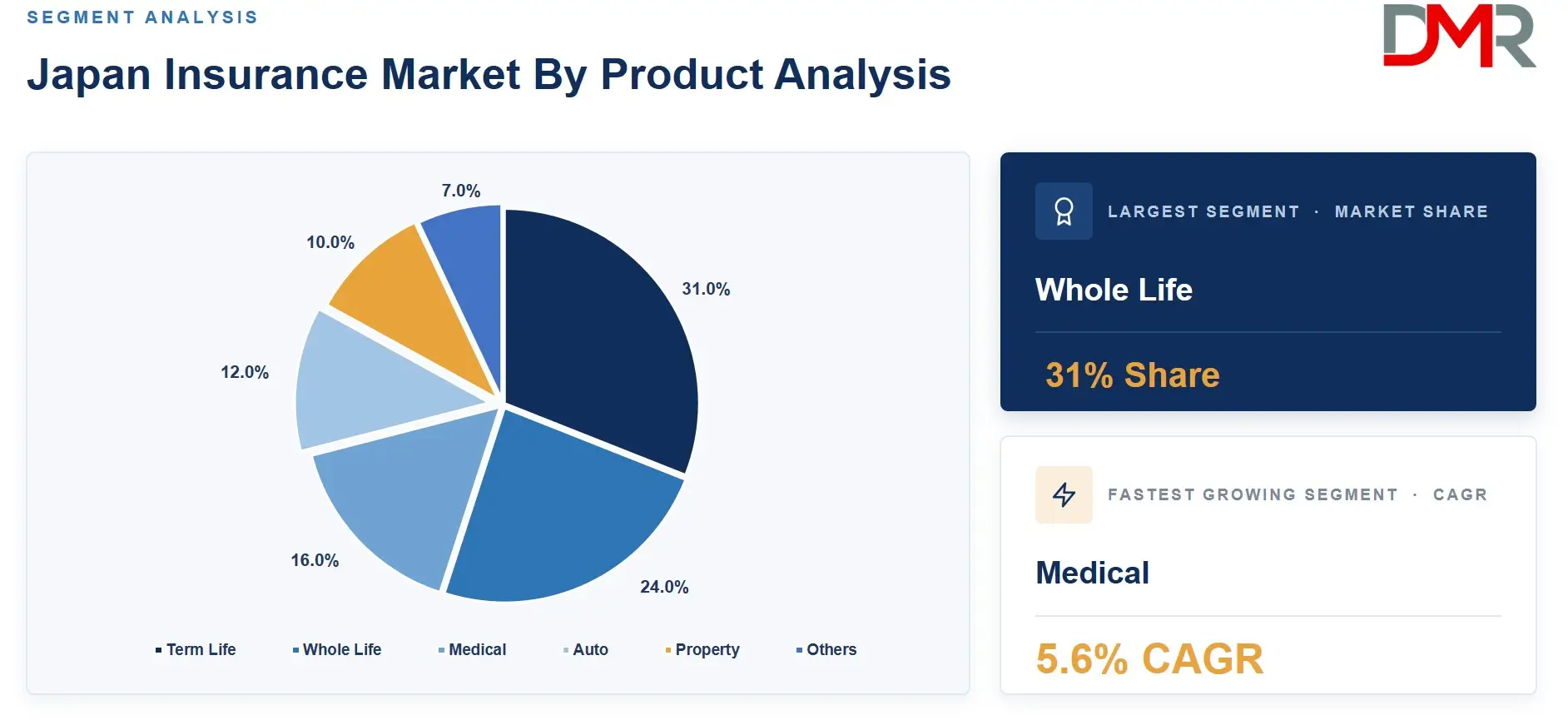
Whole life insurance is expected to retain the largest product share in 2026, close to 31%, due to its established role in protection, savings and inheritance planning. Medical insurance is forecast to grow at a CAGR of 5.6% through 2035 as households seek supplemental coverage and services around hospitalisation and care. Term life remains relevant for affordable protection, while auto and property products provide large recurring non-life pools. Product innovation is moving toward modular benefits, clearer exclusions and service-linked value.
By Region
Kanto is projected to carry the largest domestic demand share in 2026, approximately 37%, because Tokyo and adjacent prefectures combine population, financial institutions, corporate headquarters and high-value property. Growth, however, is concentrated in Kyushu and Okinawa, expanding at a CAGR of 4.4% between 2026 and 2035 as disaster exposure, tourism, healthcare needs and infrastructure renewal support new coverage. Kansai remains a substantial industrial and household market, while Chubu benefits from manufacturing and logistics. Regional insurers and national carriers compete through local advice, partner networks and claims response.
The Japan Insurance Market Report is Segmented Based on the Following
By Insurance Type
- Life
- Non-Life
- Health
- Other
By Distribution Channel
- Agency
- Bancassurance
- Direct
- Digital
- Other
By Customer Type
- Individual
- Corporate
- Government
- Other
By End Use
- Personal Protection
- Retirement
- Property and Casualty
- Commercial Risk
- Other
By Product
- Term Life
- Whole Life
- Medical
- Auto
- Property
- Other
By Region
- Kanto
- Kansai
- Chubu
- Kyushu and Okinawa
- Tohoku and Hokkaido
- Chugoku and Shikoku
- Other
Competitive Landscape
Competition is concentrated among large mutual and listed groups with deep agency networks, substantial investment portfolios and broad claims infrastructure. Differentiation is shifting toward service speed, capital efficiency, digital acquisition, catastrophe analytics and specialist commercial underwriting. Domestic scale remains valuable, but foreign carriers and focused InsurTech firms influence pricing, partnerships and product design in selected niches.
Some of the Prominent Players in the Japan Insurance Market Are,
- Nippon Life Insurance Company
- Japan Post Insurance Co., Ltd.
- Dai-ichi Life Holdings, Inc.
- Meiji Yasuda Life Insurance Company
- Sumitomo Life Insurance Company
- Tokio Marine Holdings, Inc.
- MS&AD Insurance Group Holdings, Inc.
- Sompo Holdings, Inc.
- Manulife Life Insurance Company
- MetLife Insurance K.K.
- Aflac Life Insurance Japan Ltd.
- Prudential Life Insurance Company of Japan
- Swiss Re Japan
- Munich Re Japan
- Chubb Insurance Japan
- Zurich Insurance Company Ltd., Japan Branch
- AXA Life Insurance Co., Ltd.
- Allianz Life Insurance Company of Japan
- Fukoku Mutual Life Insurance Company
- Asahi Life Insurance Company
- Daido Life Insurance Company
- Taiyo Life Insurance Company
- FWD Life Insurance Company, Limited
- Sony Life Insurance Co., Ltd.
- Lifenet Insurance Company
- Medicare Life Insurance Company
- Neo First Life Insurance Company, Limited
- ORIX Life Insurance Corporation
- Rakuten Life Insurance Co., Ltd.
- Japan Earthquake Reinsurance Co., Ltd.
- Mitsui Sumitomo Insurance Company, Limited
- Aioi Nissay Dowa Insurance Company, Limited
- Sompo Japan Insurance Inc.
- Tokio Marine & Nichido Fire Insurance Co., Ltd.
- Toa Reinsurance Company, Limited
- Japan Asia Group
- Secom Insurance Service Inc.
- Jibai Agency Co., Ltd.
- NTT DATA Corporation
- Fujitsu Limited
- Other Key Players
Recent Developments
- In June 2026, a major Japanese life insurer expanded digital health guidance linked to medical coverage, moving the proposition beyond claims reimbursement toward earlier intervention and recurring customer engagement.
- In April 2026, a domestic non-life group broadened catastrophe analytics for corporate property portfolios, supporting more granular underwriting in flood and earthquake exposed areas.
- In November 2025, Japanese insurers increased collaboration with technology providers on generative AI document workflows, targeting policy servicing and internal knowledge retrieval under controlled review.
- In August 2025, leading carriers advanced connected-vehicle partnerships for usage-based motor insurance, creating more data-driven options for drivers and fleets.
Report Details
| Report Characteristics |
| Market Size (2026) |
USD 347.8 Bn |
| Forecast Value (2035) |
USD 478.2 Bn |
| CAGR (2026–2035) |
3.6% |
| Historical Data |
2021–2025 |
| Forecast Data |
2026–2035 |
| Base Year |
2025 |
| Segments Covered |
By Insurance Type, By Distribution Channel, By Customer Type, By End Use, By Product and By Region |
| Regional Coverage |
Japan |
Frequently Asked Questions
How big is the Japan Insurance Market?
▾ The Japan Insurance Market is estimated to reach USD 347.8 Bn in 2026, measured by premium revenue generated from life, non-life, health, property, casualty and related insurance products purchased within Japan.
What is the growth rate of the Japan Insurance Market?
▾ The market is forecast to grow at a CAGR of 3.6% from 2026 to 2035, reaching USD 478.2 Bn by 2035. Growth is supported by ageing-related coverage, commercial risk transfer and digital servicing rather than broad-based volume expansion.
Which area holds the largest share in the Japan Insurance Market?
▾ Kanto holds the largest domestic demand concentration, accounting for approximately 37% of 2026 premium activity. Tokyo's population density, high property values, corporate headquarters and concentration of financial distribution give the area a durable advantage over other Japanese regions.
Who are the key players in the Japan Insurance Market?
▾ Important participants include Nippon Life Insurance Company, Japan Post Insurance, Dai-ichi Life Holdings, Tokio Marine Holdings, MS&AD Insurance Group Holdings, Sompo Holdings and Aflac Life Insurance Japan. They compete with mutual insurers, foreign carriers, reinsurers, specialists and technology-enabled distributors.
Which insurance type leads the Japan Insurance Market?
▾ Life insurance leads the market, with approximately 68% of 2026 premium revenue. Its position reflects the size of the existing policy base and continued use of life, savings, annuity and inheritance-planning products by Japanese households.