What is the Japan Integration Platform as a Service Market Size?
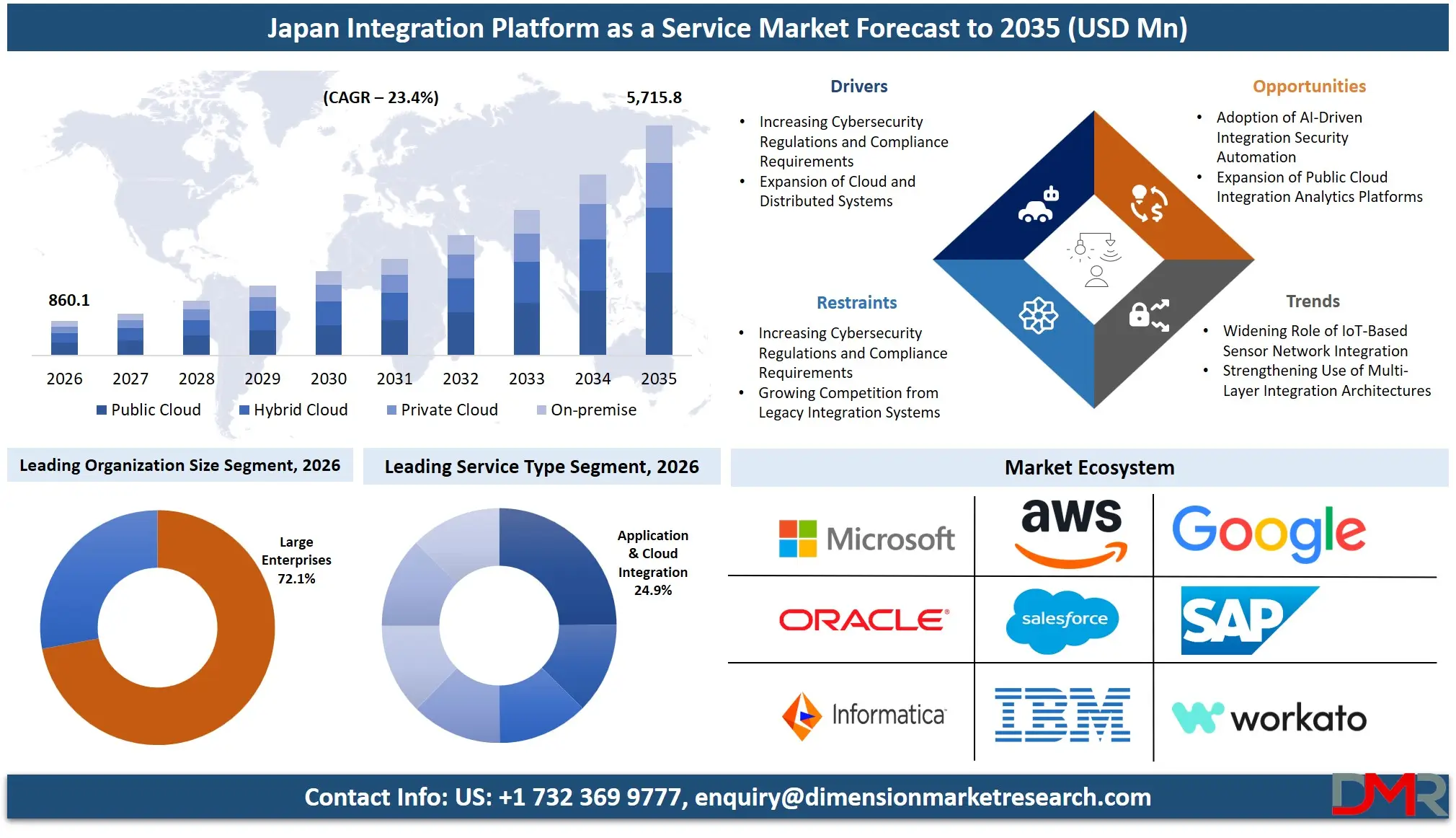
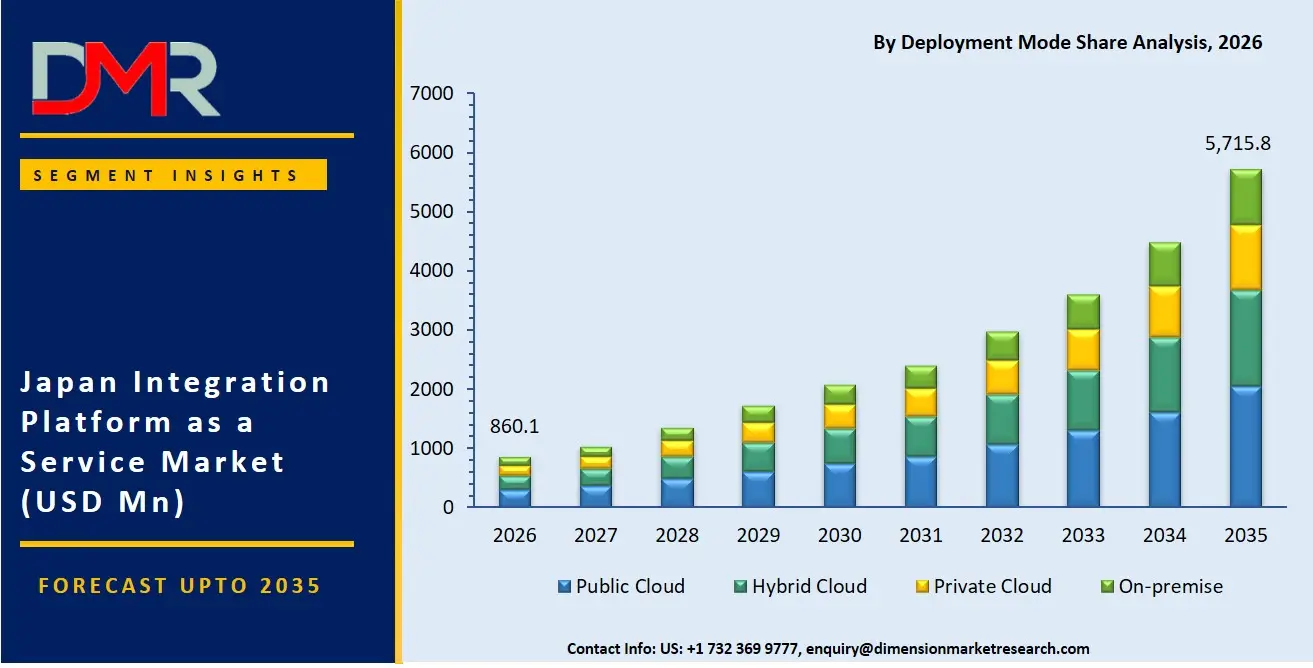
The Japan Integration Platform as a Service (iPaaS) Market is expected to reach a value of USD 860.1 million in 2026, and it is further anticipated to reach USD 5,715.8 million by 2035, growing at a CAGR of 23.4% during the forecast period.
ℹ
To learn more about this report –
Download Your Free Sample Report Here
The Integration Platform as a Service market has been showing consistent growth due to Japan's rising dependence on resilient digital ecosystems for effective and secure data integration. This includes several integration platforms and services that help enterprises and government bodies connect applications, data sources, and business processes. There has been a rising need for professional & support services owing to requirements for implementing secure integration workflows and maintaining operational continuity. Large enterprises have emerged as the largest consumer segment for iPaaS, with application & cloud integration being the most popular choice due to its reliability, while data integration & transformation services are growing rapidly.
ℹ
To learn more about this report –
Download Your Free Sample Report Here
Key Takeaways
- Market Size & Forecast: The Japan iPaaS market is forecasted to be valued at USD 860.1 million in 2026, growing to USD 5,715.8 million by 2035, driven by enterprise digital transformation and the need for secure, resilient integration technologies.
- Growth Rate & Outlook: Japan market is expected to grow at 23.4% CAGR, propelled by the need to manage multi-cloud integration complexity and orchestrate data flows across banking APIs, retail platforms, and industrial IoT systems.
- Primary Growth Drivers: Major drivers include the shift from monolithic IT architectures to integration-first distributed systems, the need for secure communication networks, and the implementation of integration governance frameworks.
- Key Market Trends: Key trends encompass the use of AI for integration security automation, machine learning for traffic forecasting, and increased focus on cybersecurity amid stricter regulations.
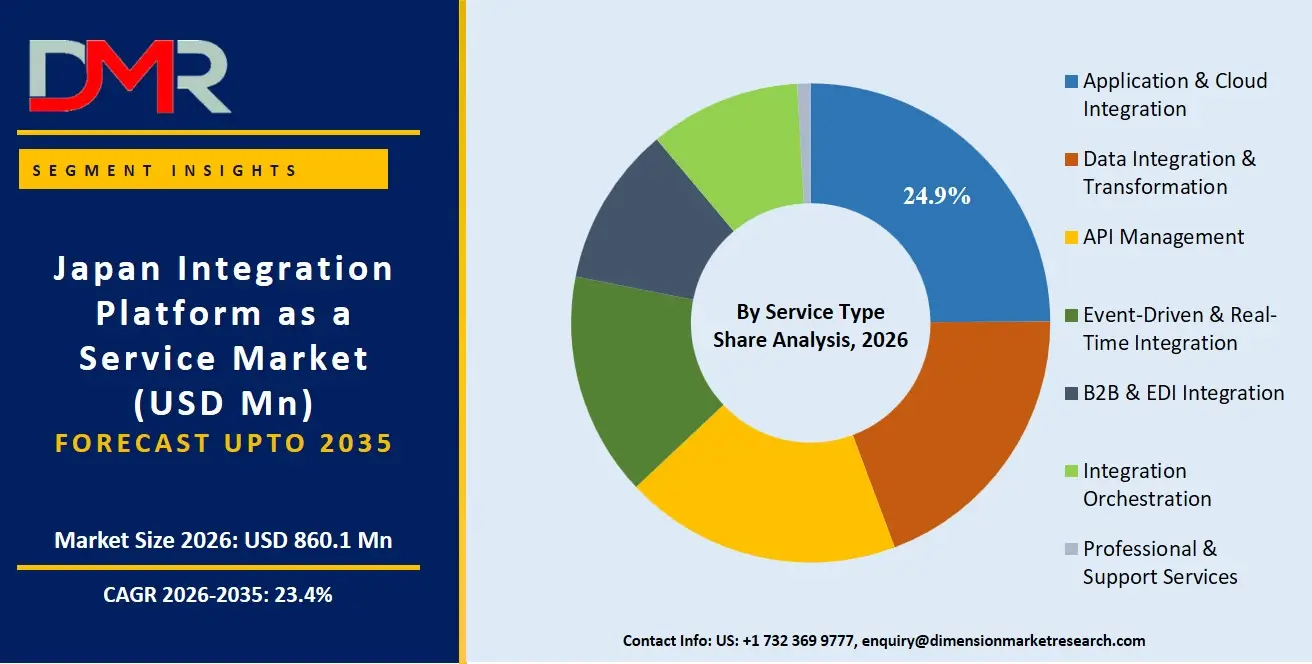
- By Service Type Analysis: The application & cloud integration segment is projected to dominate the Japan iPaaS Market due to high demand from large enterprises for scalable integration tools that support real-time monitoring, threat detection, and access control.
- By Deployment Mode Analysis: The public cloud segment is projected to dominate due to its scalability, remote access capabilities, and use in digital banking, e-government services, and smart manufacturing.
- By End User Analysis: The BFSI segment is anticipated to dominate as financial institutions adopt scalable integration platforms for real-time payments, open banking, and transaction continuity.
What is Integration Platform as a Service?
Integration Platform as a Service (iPaaS) refers to a suite of cloud-based tools and services utilized to create, run, and control integration processes for various applications, systems, and data sources. It involves functionalities like API management, data conversion, and event-based integration. Integration Platform as a Service enables businesses to integrate enterprise-level systems, streamline workflows, and secure their operations at the same time.
Use Cases
- Financial Data Resilience: Banks use iPaaS to connect open banking solutions with fraud detection systems, avoiding transaction interruptions and increasing operational trust.
- Hospital Data Reliability: Hospital networks rely on iPaaS platforms to securely integrate patient data across systems, ensuring compliance with regional health mandates in Japan.
- Public Infrastructure Services: Municipal authorities use integration dashboards to push traffic schedules and system notifications to central control centers in real time.
- Industrial IoT Response: Manufacturing organizations leverage event-driven integration to manage data throttling from IoT sensors during peak bandwidth usage periods.
How AI is Transforming the Integration Platform as a Service Market?
AI technology is contributing significantly to the growth of the iPaaS market through improved traffic forecasting and automated issue detection. These platforms feature AI-enabled systems capable of detecting issues related to data anomalies and workflow inefficiency, resolving such issues quickly in order to avoid any possible operational disruptions. AI-driven security solutions enable organizations to analyze traffic behavior, establish rate limits, and optimize outage planning. AI technologies can also be used for governing and securing data and applications, as well as compliance checks against Japan's cybersecurity requirements.
AI technology is further used to manage APIs, providing automatic discovery and documentation of undocumented endpoints. Event-driven integration pipelines are integrated with machine learning solutions in order to achieve predictive scaling of services before the occurrence of a traffic spike. Recommendation engines driven by AI technology will aid integration architects in finding an optimal path for data transformation, thus speeding up the integration development process. AI is anticipated to become an integral part of iPaaS software suites during the forecast period.
Market Dynamics
Key Drivers in the Japan Integration Platform as a Service Market
Rising Demand for Digital & Resilient Infrastructure
Japan-based companies have been stepping up their investment in technology infrastructures that will make them more resilient in the face of recent supply chain and cybersecurity disruptions. The use of iPaaS allows businesses to link their existing systems to new cloud-based applications to facilitate instant data transfer among formerly compartmentalized departments. AI capabilities will help in detecting traffic anomalies and security issues, thereby easing the task of internal IT staff. Professional services also offer monitoring technologies that will aid in adhering to Japanese regulations that have become increasingly stricter. Enterprises located in Tokyo, Osaka, and Nagoya have led the way in adopting iPaaS as they come under scrutiny by both regulatory bodies and their stakeholders regarding integration governance.
Expansion of Cloud and Distributed Systems
The growing popularity of cloud computing in Japan is increasing the need for iPaaS in the sectors of retail banking, logistics, manufacturing, and smart infrastructures. Enterprises are opting for distributed architectures as opposed to monolithic architectures because they require connectivity between cloud infrastructure, internal data centers, and edge devices. The iPaaS solutions facilitate intercommunication among different environments by offering the necessary middleware required for interoperable data handling, optimal load management, and compliance with laws and regulations. The growth in distributed IT architecture is necessitating the deployment of efficient and performant iPaaS solutions that can handle big volumes of data traffic automatically. Incentives from the Japanese government towards migration to the cloud through initiatives by the Digital Agency are contributing to this trend.
Restraints in the Japan Integration Platform as a Service Market
Increasing Cybersecurity Regulations and Compliance Requirements
Data protection laws and strict integration security standards in Japan pose a challenge to iPaaS service providers and businesses. Compliance with these regulations is expected from the regulatory body regarding issues relating to data consent, encryption policies, and secure communication in all integration processes. This becomes an added burden to companies since they have to make sure that every data transfer process and each API interaction adheres to these standards. Companies with smaller compliance departments find this task difficult since failure to comply leads to fines, delayed projects, and damage to business reputation. Despite being beneficial for security purposes, the regulations are a hindrance in the medium term for market growth because of the reluctance by some companies to initiate integration projects.
Growing Competition from Legacy Integration Systems
Many Japanese enterprises continue to rely on traditional IT infrastructure and EDI-based systems for routine operations, creating sustained competition for modern iPaaS platforms. These legacy systems are often preferred due to lower upfront costs, reduced integration complexity, and the comfort of established procedures. In stable environments where data volumes change slowly, conventional systems are easier to maintain by existing IT staff who lack training on cloud-native tools. Some organizations have made significant capital investments in on-premise middleware that has not yet been fully depreciated. While these legacy systems lack the agility of modern iPaaS, they continue to serve as a functional alternative for organizations with limited digital transformation ambitions, slowing iPaaS adoption in specific segments.
Growth Opportunities in the Japan Integration Platform as a Service Market
Adoption of AI-Driven Integration Security Automation
Many possibilities are there in relation to using AI-based integration security systems for lowering manual efforts in securing systems and faster threat responses. The use of AI can lead to threat detection in API traffic in real time, adaptive control based on traffic anomalies, and automated policy implementation. Japanese firms will see increased reliability of systems, faster identification of breached endpoints, and reduced operating costs. Regional banks in particular have already started evaluating such options as a means of enhancing cybersecurity. With advancements in telecommunications infrastructure via the introduction of 5G, more security applications can now be deployed effectively due to the lesser latency associated with them. Those vendors offering AI-driven security automation as part of iPaaS solutions have a lot going for them here.
Expansion of Public Cloud Integration Analytics Platforms
The integration of advanced analytics into public cloud-based iPaaS platforms is creating growth opportunities across multiple Japanese industry verticals. Enterprises are adopting public cloud solutions that support automated monitoring, intelligent throttling, and predictive maintenance of data pipelines and API gateways. AI and machine learning help organizations understand usage behavior patterns, optimize rate limits, and plan preventive maintenance before failures occur. For Japanese retail companies facing seasonal demand spikes, these analytics enable automatic scaling of integration resources. The growing availability of cost-effective public cloud infrastructure with local data centers in Japan reduces latency and addresses data sovereignty concerns, making these platforms increasingly attractive to BFSI, retail, and industrial sectors.
Trends in the Japan Integration Platform as a Service Market
Widening Role of IoT-Based Sensor Network Integration
Japanese enterprises are increasingly integrating IoT sensor networks with iPaaS platforms to enhance scalability and real-time monitoring across distributed operational environments. IoT telemetry from factory floors, logistics fleets, and smart buildings enables connectivity between device APIs, operational systems, and maintenance workflows without heavy infrastructure redesign. Key benefits include real-time asset tracking, API performance analytics that identify failing sensors, and improved multi-site coordination. With digital transformation initiatives driven by Japan's aging workforce, IoT-enabled integration is gaining traction. The manufacturing sector is the most active adopter, using IoT integration for predictive maintenance and quality control. As IoT sensor costs decline and 5G networks expand, the addressable market will grow beyond early adopters.
Strengthening Use of Multi-Layer Integration Architectures
Enterprises in Japan are adopting multi-layer integration architectures that combine public cloud, private cloud, on-premises systems, and AI-based routing into unified data fabrics. Organizations are moving away from single-deployment strategies, instead building heterogeneous integration ecosystems that ensure consistent performance across all environments. iPaaS platforms provide visibility, governance, and real-time fault resolution across these distributed systems. The retail banking sector has been an early adopter, connecting core systems with open banking APIs and mobile applications. Manufacturing companies are similarly deploying these architectures to integrate factory floors with cloud analytics. This trend increases integration complexity, which in turn drives demand for sophisticated iPaaS platforms with unified control planes and observability across all layers.
Research Scope and Analysis
The Japan iPaaS Market is segmented by service type, deployment mode, organization size, and end user. The market supports financial services, retail integration, industrial automation, and government infrastructure through public cloud, private cloud, hybrid cloud, and on-premise integration solutions.
ℹ
To learn more about this report –
Download Your Free Sample Report Here
By Service Type Analysis
Application & cloud integration is expected to lead the Japan iPaaS Market in 2026 with a projected share of 24.9% due to large enterprises' preference for scalable integration gateways and analytics platforms. Japanese enterprises favor application integration tools, API management, and data transformation for traffic tracking, threat detection, and real-time access control. Professional & support services hold second place due to rising demand for AI-driven analytics and integration optimization. Data integration & transformation, B2B/EDI integration, event-driven integration, and integration orchestration are expected to grow steadily. This growth is driven by digital modernization projects in Tokyo, Osaka, and Nagoya, where Japanese enterprises increasingly recognize that successful integration requires specialized consulting, implementation, and training services beyond just technology platforms.
By Deployment Mode Analysis
Public cloud deployment is projected to dominate the Japan iPaaS Market in 2026 with an estimated share of 43.6%, owing to its adoption in open banking, e-government services, and retail e-commerce integration. Japanese enterprises favor public cloud for its reliable remote access, high scalability, and low latency, avoiding significant upfront capital investment. On-premise deployment follows, driven by financial institutions and data sovereignty programs for regional banks and government agencies requiring strict data control. Hybrid cloud approaches are growing rapidly due to security requirements for integration-edge monitoring in rural and semi-urban areas. Japanese manufacturers with factory footprints across multiple prefectures are particularly drawn to hybrid models, keeping critical production data on-premise while leveraging cloud analytics for demand forecasting.
By Organization Size Analysis
Large enterprises are set to dominate the Japan iPaaS Market in 2026 with a projected share of 72.1%, thanks to high integration deployment penetration and government-backed digitalization programs. iPaaS solutions enable real-time integration and granular consumption analytics without additional hardware investment, making them attractive to large organizations with complex IT environments spanning hundreds of applications. Large Japanese enterprises in automotive, electronics, and financial services have been early adopters. Small and Medium-sized Enterprises (SMEs) will experience robust growth due to affordable public cloud-based integration platforms and growing awareness of integration benefits. Japanese SMEs face pressure from larger trading partners to provide real-time data access and automated order processing, driving adoption of cost-effective iPaaS solutions across regional business hubs.
By End User Analysis
The BFSI segment is projected to dominate the Japan iPaaS Market in 2026 with an expected share of 46.9%, driven by open banking mandates, digital payment participation, and reliance on real-time transaction management. Major banks in Tokyo and Osaka deploy iPaaS to connect core systems with mobile applications and fintech partners. The IT & Telecom segment is expected to see the fastest growth, supported by 5G network integration and edge computing initiatives. The Manufacturing segment follows closely, with Japanese industrial firms adopting iPaaS for IoT integration and supply chain connectivity. Government & Public Sector and Retail & E-commerce are also significant. All other end users, including Healthcare, Energy, Transportation, Logistics, Education, and Media, are grouped under "Others," representing a meaningful but smaller share of the Japan iPaaS market.
The Japan Integration Platform as a Service Market Report is segmented based on the following:
By Service Type
- Application & Cloud Integration
- Data Integration & Transformation
- API Management
- Event-Driven & Real-Time Integration
- B2B & EDI Integration
- Integration Orchestration
- Professional & Support Services
By Deployment Mode
- Public Cloud
- Private Cloud
- Hybrid Cloud
- On-premise
By Organization Size
- Large Enterprises
- Small & Medium-sized Enterprises (SMEs)
By End User
- Banking, Financial Services & Insurance (BFSI)
- Healthcare & Life Sciences
- Retail & E-commerce
- Manufacturing
- Information Technology & Telecommunications
- Government & Public Sector
- Energy & Utilities
- Transportation & Logistics
- Education
- Media & Entertainment
- Others
Competitive Landscape
Competition in the Japan iPaaS market is dynamic, with multinational technology providers, Japanese IT infrastructure aggregators, and specialized integration platform players. Success depends on strategic partnerships with cloud providers and financial institutions in Japan, which enable high-quality service delivery. Market consolidation is progressing, with established enterprise software and cloud providers acquiring specialized analytics platform vendors for AI forecasting capabilities. Proprietary AI-based predictive maintenance and load optimization engines are becoming more important than competitive pricing alone.
Some of the prominent players in the Japan Integration Platform as a Service Market are:
- Microsoft Corporation (Azure Integration Services)
- Amazon Web Services, Inc.
- Google LLC (Google Cloud Integration Services)
- Salesforce, Inc. (MuleSoft LLC)
- Oracle Corporation
- SAP SE
- IBM Corporation
- Informatica LLC
- Dell Technologies Inc. (Boomi LP)
- Workato, Inc.
- SnapLogic, Inc.
- TIBCO Software Inc.
- Software AG
- Jitterbit, Inc.
- Celigo, Inc.
- QlikTech International AB (Talend)
- Tray.ai, Inc.
- Zapier Inc.
- Asteria Corporation
- Saison Technology Co., Ltd. (HULFT)
- Other Key Players
Recent Developments
- May 2026: SAP SE announced at SAP Sapphire 2026 the launch of the SAP Business AI Platform and Autonomous Enterprise suite, deeply integrating SAP Integration Suite, Joule AI agents, and multi-cloud interoperability (AWS, Microsoft Azure, Google Cloud). This significantly enhances real-time integration, workflow automation, and agent-based orchestration across enterprise systems.
- May 2026: Salesforce, Inc. (MuleSoft LLC) expanded MuleSoft on Hyperforce in India, enabling locally compliant deployment of iPaaS workloads with secure data residency, scalable API integration, and AI-powered workflow automation, strengthening its enterprise-grade integration footprint across Asia-Pacific markets, including Japan.
- May 2026: Amazon Web Services, Inc. (AWS) expanded its enterprise integration and AI orchestration ecosystem through enhancements showcased at SAPPHIRE 2026 (SAP on AWS ecosystem updates), including deeper support for MCP-based agent connectivity, SAP Business Data Cloud integration with Amazon Athena, and Amazon Bedrock AgentCore interoperability.
- May 2025: Microsoft Corporation announced new enhancements to Azure Integration Services, expanding AI-assisted workflow orchestration through Copilot capabilities, improved API management, and deeper integration across hybrid and multi-cloud environments.
Report Details
| Report Characteristics |
| Market Size (2026) |
USD 860.1 Mn |
| Forecast Value (2035) |
USD 5,715.8 Mn |
| CAGR (2026–2035) |
23.4% |
| Historical Data |
2021 – 2025 |
| Forecast Data |
2027 – 2035 |
| Base Year |
2025 |
| Estimate Year |
2026 |
| Segments Covered |
By Service Type, By Deployment Mode, By Organization Size, By End User |
| Country Coverage |
Japan |
Frequently Asked Questions
How big is the Japan Integration Platform as a Service Market?
▾ The Japan Integration Platform as a Service Market is poised to be valued at USD 860.1 million in 2026 and is projected to reach USD 5,715.8 million by 2035.
What is the CAGR of the Japan Integration Platform as a Service Market from 2026 to 2035?
▾ The market is expected to grow at a CAGR of 23.4% from 2026 to 2035, reflecting the maturing nature of the Integration Platform as a Service Market and the accelerating complexity of multi-channel, interactive integration strategies.
What factors are driving the growth of the Japan Integration Platform as a Service Market?
▾ Key drivers include digital transformation, the need to modernize legacy IT systems, management of multi-directional integration orchestration, and demand for integration security amid evolving data laws.
What are the major trends in the Japan Integration Platform as a Service Market?
▾ Major trends include AI integration for traffic forecasting and predictive maintenance, security automation, and demand for vertical-specific analytics solutions.
Who are the key players in the Japan Integration Platform as a Service Market?
▾ Key players include Google LLC, Microsoft Corporation, IBM Corporation, Oracle Corporation, Salesforce, Inc., SAP SE, Kong Inc., and others.
How is the Japan Integration Platform as a Service Market segmented?
▾ The market is segmented by service type, deployment mode, organization size, and end user.