Market Overview
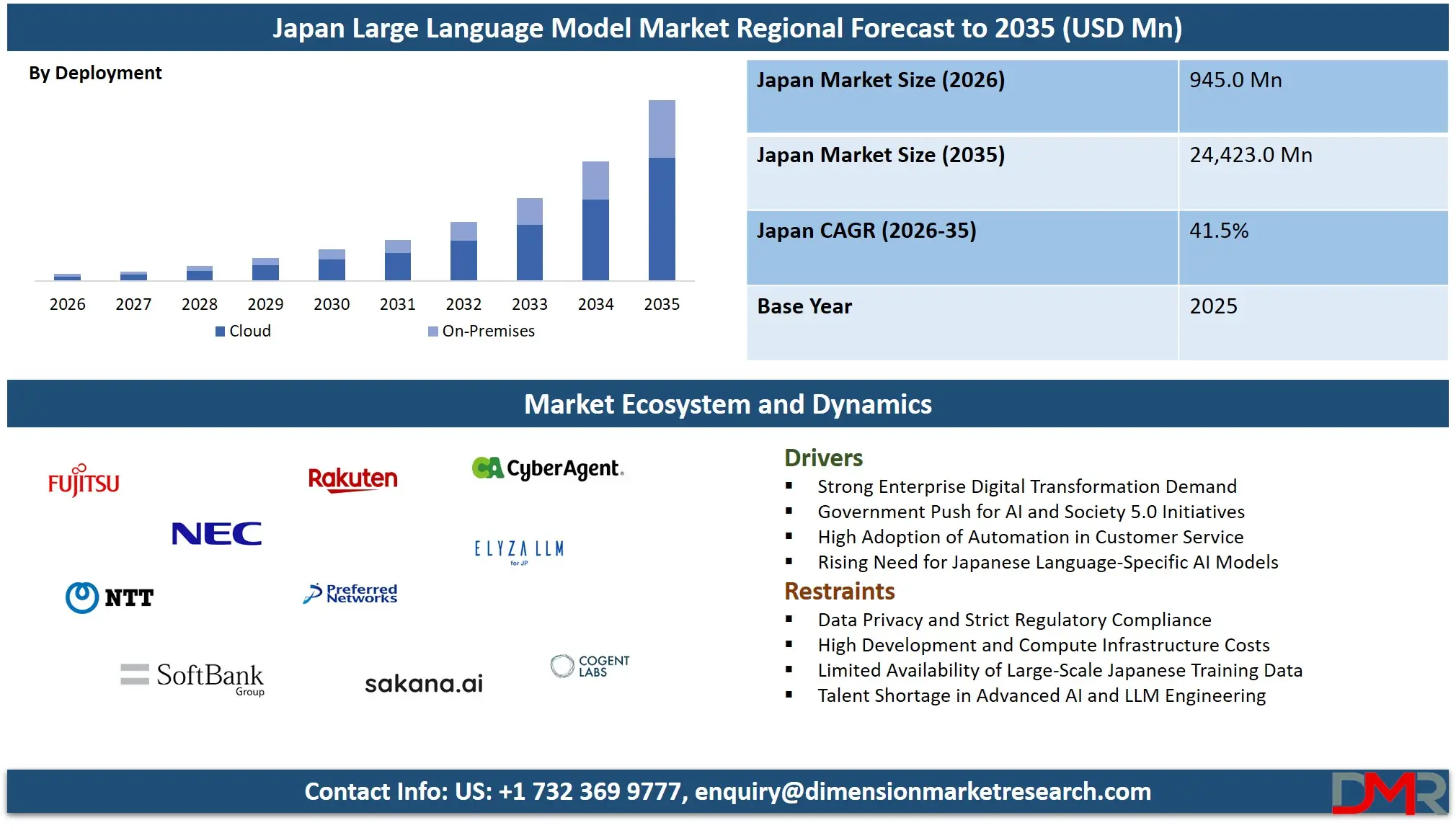
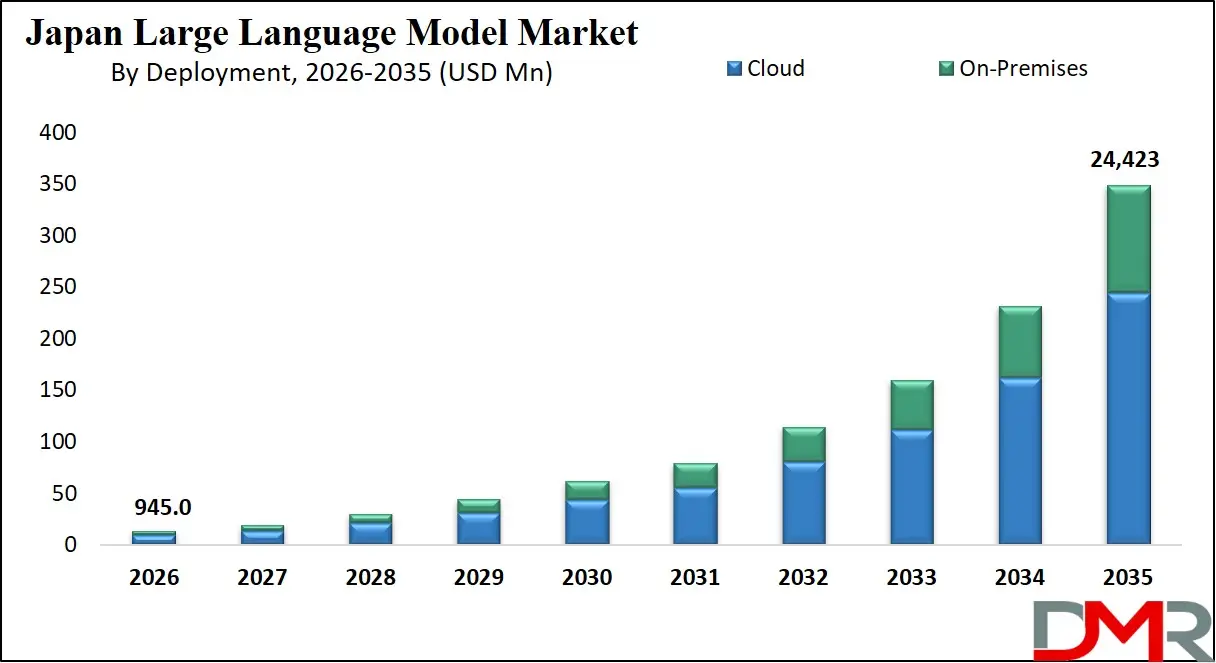
The Japan Large Language Model Market size is projected to reach USD 945.0 million in 2026 and is anticipated to grow at a 41.5% CAGR, reaching USD 24,423.0 million by 2035, driven by rising adoption of generative AI, natural language processing, and enterprise machine learning solutions.
ℹ
To learn more about this report –
Download Your Free Sample Report Here
Large Language Model refers to the advanced artificial intelligence technology based on deep learning and the use of the transformer architecture to enable the understanding and generation of human language for the creation of text, translation, summarization, and dialogue.
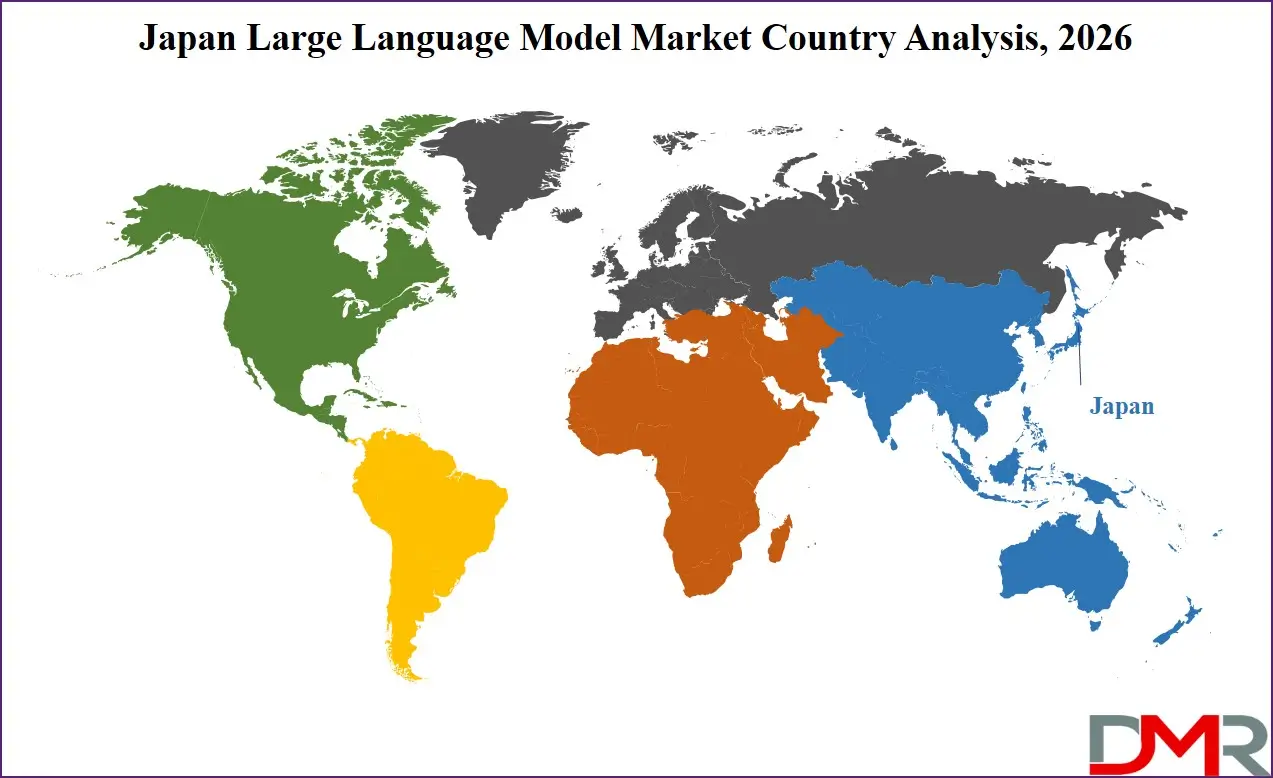
The Japan Large Language Model Market refers to the market in Japan focused on the development and use of the above-mentioned technology and the application of the same in different industries and sectors, considering the digital transformation in the country and the requirement for the Japanese language in different sectors such as finance, healthcare, and retail.
ℹ
To learn more about this report –
Download Your Free Sample Report Here
Japan Large Language Model Market: Key Takeaways and Other Influencing Factors
- Strong Market Expansion Outlook: Japan Large Language Model Market is projected to reach USD 945.0 million in 2026 and is anticipated to grow at a 41.5% CAGR to USD 24,423.0 million by 2035, reflecting strong long term generative AI and enterprise adoption momentum.
- Cloud Deployment Dominance: Cloud deployment is anticipated to dominate with around 70.0% share in 2026, driven by scalable infrastructure demand for natural language processing, generative AI, and enterprise machine learning workloads.
- Chatbot Application Leadership: Chatbots and virtual assistants are expected to capture nearly 36.0% share in 2026, supported by rising adoption of conversational AI for customer service automation and digital engagement across industries.
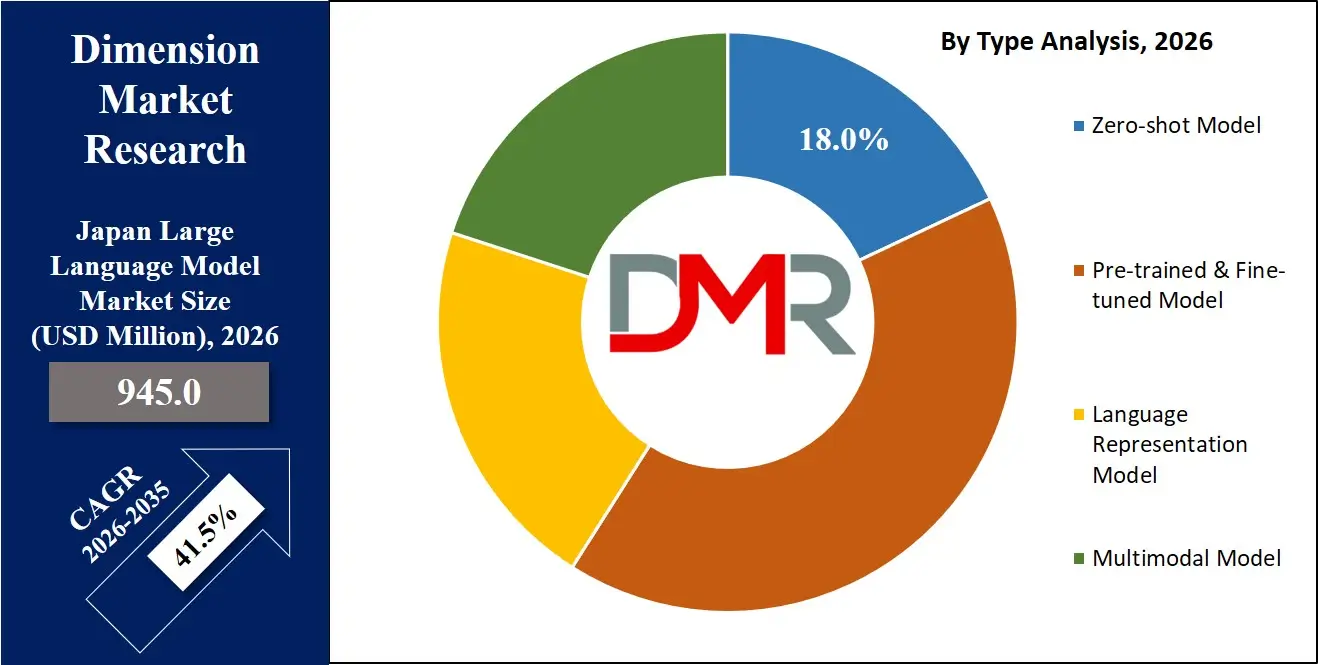
- Pre-trained Model Strength: Pre-trained and fine-tuned models are projected to hold about 41.0% share in 2026, driven by demand for Japanese language optimized AI solutions and enterprise focused deployment across key sectors.
- Ministry of Internal Affairs and Communications (MIC) Japan: Cloud deployment accounts for around 70.0% share in 2026, while generative AI usage reached 26.7% in 2024 and adoption among people in their 20s reached 44.7%, showing rapid AI penetration in Japan.
- Digital Agency Japan: Chatbots and virtual assistants hold nearly 36.0% share in 2026, reflecting strong adoption of conversational AI for customer service automation and enterprise digital transformation initiatives.
- National Institute of Advanced Industrial Science and Technology (AIST): Pre-trained and fine-tuned models account for about 41.0% share in 2026, supported by demand for Japanese language optimized AI systems and strengthened by ABCI 3.0 infrastructure with over 6,000 NVIDIA H200 GPUs.
Japan Large Language Model Market: Use Cases
- Customer Service Automation: Large language models in Japan power AI chatbots and virtual assistants, improving customer engagement, handling queries efficiently, and supporting multilingual communication in retail, banking, and telecom through natural language processing and conversational AI.
- Content Generation: LLMs are used for automated content creation, marketing copy, and product descriptions, enabling personalized campaigns, SEO optimization, and faster content workflows across e-commerce and media platforms.
- Healthcare Support: In healthcare, LLMs assist with clinical documentation, medical report summarization, and patient data analysis, reducing administrative workload and enhancing decision-making through advanced language processing.
- Code Generation: Japanese IT companies leverage LLMs for automated coding, debugging, and documentation, accelerating software development, improving productivity, and supporting digital transformation initiatives.
Impact of the Iran Conflict on the Japanese Large Language Model Market
The Iran conflict is anticipated to indirectly impact the Japan Large Language Model Market by increasing geopolitical risk and disrupting global semiconductor and cloud supply chains, which may slow AI infrastructure expansion and raise compute costs for model training and deployment, while also encouraging Japan to accelerate domestic AI and sovereign LLM development for technological resilience.
Japan Large Language Model Market: Market Dynamics
Driving Factors in the Japanese Large Language Model Market
Enterprise AI and Digital Transformation
The Japanese Large Language Model Market is driven by rapid enterprise digital transformation, where organizations are adopting generative AI, natural language processing, and machine learning-based language models to automate workflows, improve decision-making, and enhance customer engagement across sectors like finance, retail, and manufacturing.
Rising Demand for Conversational AI Solutions
Increasing usage of chatbots, virtual assistants, and intelligent customer support systems is accelerating LLM adoption in Japan, as businesses focus on improving user experience, reducing operational costs, and enabling multilingual communication through advanced AI-powered language models.
Restraints in the Japan Large Language Model Market
High Infrastructure and Training Costs
The market faces limitations due to high computational requirements for training large-scale models, along with expensive cloud computing and GPU infrastructure, which slows down widespread adoption among small and mid-sized enterprises.
Data Privacy and Language Dataset Constraints
Strict regulatory compliance and limited availability of large-scale Japanese language datasets restrict model training efficiency, making it challenging to develop highly accurate localized large language model solutions.
Opportunities in the Japanese Large Language Model Market
Expansion of Industry-Specific AI Applications
Growing deployment of LLMs in healthcare, legal services, and enterprise knowledge management is creating strong opportunities for customized generative AI solutions tailored to industry-specific workflows and natural language processing needs.
Growth of Sovereign and Localized AI Models
Japan is witnessing increasing investment in domestic AI development, creating opportunities for sovereign large language models optimized for Japanese language understanding, cultural context, and enterprise-grade security requirements.
Trends in the Japanese Large Language Model Market
Shift toward Multimodal and Fine-Tuned Models
There is a strong trend toward multimodal AI systems and fine-tuned domain-specific models that combine text, image, and structured data processing to improve accuracy and expand enterprise use cases.
Focus on Responsible and Secure AI Deployment
Organizations are increasingly prioritizing explainable AI, ethical model usage, and secure deployment frameworks to ensure compliance, trust, and reliability in enterprise-grade large language model applications.
Japan Large Language Model Market: Research Scope and Analysis
By Type Analysis
Pre-trained and fine-tuned models are anticipated to dominate the Japan Large Language Model Market by type, capturing about 41.0% share in 2026, driven by strong enterprise demand for adaptable and cost-efficient AI solutions optimized for Japanese language processing and industry-specific applications.
ℹ
To learn more about this report –
Download Your Free Sample Report Here
These models are widely used in finance, healthcare, and retail due to higher accuracy and faster deployment. Language representation models also play a key role by enabling deep contextual understanding of text, supporting applications like sentiment analysis, search systems, and enterprise knowledge management through advanced natural language processing capabilities.
By Deployment Analysis
Cloud deployment is anticipated to dominate the Japan Large Language Model Market, capturing around 70.0% share in 2026 due to increasing adoption of scalable, flexible, and cost-efficient AI infrastructure that supports generative AI, natural language processing, and enterprise-level machine learning workloads. Cloud platforms enable faster model training, seamless integration, and easy access to advanced computing resources, making them preferred for chatbots, content generation, and analytics applications. On-premises deployment continues to hold relevance, especially among banking, government, and healthcare organizations in Japan, where data security, regulatory compliance, and control over sensitive information drive the need for localized AI infrastructure and private model deployment.
By Application Analysis
Chatbots and virtual assistants are anticipated to dominate the Japan Large Language Model Market by application, capturing about 36.0% share in 2026 due to high adoption of conversational AI and customer service automation across retail, banking, telecom, and e-commerce, improving engagement and efficiency through natural language processing. Language translation is also a key application, enabling real-time multilingual communication and supporting global business operations using advanced large language models and machine learning-based language processing systems.
By End User Analysis
Retail and e-commerce are anticipated to dominate the Japan Large Language Model Market by end user, capturing around 22.0% share in 2026 due to growing use of generative AI, conversational agents, and recommendation systems that enhance customer engagement, personalize shopping experiences, and optimize digital marketing. These sectors widely adopt natural language processing for product descriptions, chatbots, and content automation. Financial services also represent a significant end-user segment in Japan, where banks and insurance companies use large language models for fraud detection, risk analysis, customer support automation, and report generation, improving efficiency, compliance, and decision-making through advanced AI-driven data processing.
The Japan Large Language Model Market Report is segmented on the basis of the following:
By Type
- Zero-shot Model
- Pre-trained & Fine-tuned Model
- Language Representation Model
- Multimodal Model
By Deployment
By Application
- Chatbots & Virtual Assistant
- Sentiment Analysis
- Language Translation
- Text Generation
- Content Rewriting & Summarization
- Content Personalization
- Code Generation
- Others
By End User
- Retail & E-commerce
- Financial Services
- Media & Entertainment
- Healthcare
- Legal Services
- Gaming
- Others(IT & ITES, Education)
Impact of Artificial Intelligence on the Japan Large Language Model Market
Artificial intelligence is driving rapid growth in the Japan Large Language Model Market by improving natural language processing, enhancing automation, and enabling advanced generative AI capabilities across industries, while increasing the adoption of chatbots and virtual assistants that strengthen customer engagement and operational efficiency in enterprises, further supporting the development of domain specific models for sectors such as finance, healthcare, and retail, ultimately accelerating market expansion through higher accuracy, scalability, and seamless enterprise integration.
Japan Large Language Model Market: Competitive Landscape
The Japan Large Language Model Market is highly competitive, driven by rapid advancements in generative AI, natural language processing, and machine learning technologies, where participants focus on developing Japanese language optimized models to enhance contextual understanding and enterprise adoption, while competition intensifies around innovation, accuracy, and scalable deployment across cloud and on premises environments, with increasing emphasis on strategic collaborations, research investments, and domain specific AI solutions shaping the overall market landscape.
ℹ
To learn more about this report –
Download Your Free Sample Report Here
Some of the prominent players in the Japan Large Language Model Market are:
- Fujitsu Limited
- NEC Corporation
- NTT (Nippon Telegraph and Telephone)
- SoftBank Group
- Rakuten Group
- Preferred Networks
- CyberAgent
- ELYZA Inc.
- Sakana AI
- Cogent Labs
- PKSHA Technology
- ABEJA Inc.
- HEROZ Inc.
- ExaWizards Inc.
- RICOH Company Ltd.
- Hitachi Ltd.
- LINE Yahoo Corporation
- Karakuri Inc.
- Kotoba Technologies
- Sakura Internet Inc.
- Other Key Players
Recent Developments in the Japanese Large Language Model Market
- November 2025: Sakana AI secured around USD 135 million in Series B funding, reaching a valuation of about USD 2.65 billion to scale its AI model development and enterprise applications in Japan.
- August 2025: KDDI acquired a majority stake in ELYZA, strengthening its position in Japan’s generative AI and large language model ecosystem to accelerate enterprise AI deployment and language technology development
- September 2024: Fujitsu launched "Takane," a large language model designed for enterprise use with advanced Japanese language processing capabilities and secure deployment for private and cloud environments.
Report Details
| Report Characteristics |
| Market Size (2026) |
USD 945.0 Mn |
| Forecast Value (2035) |
USD 24,423.0 Mn |
| CAGR (2026–2035) |
41.5% |
| Historical Data |
2021 – 2025 |
| Forecast Data |
2027 – 2035 |
| Base Year |
2025 |
| Estimate Year |
2026 |
| Report Coverage |
Market Revenue Estimation, Market Dynamics, Competitive Landscape, Growth Factors and etc. |
| Segments Covered |
By Type (Zero-shot Model, Pre-trained & Fine-tuned Model, Language Representation Model, and Multimodal Model), By Deployment (Cloud and On- Premises), By Application (Chatbots & Virtual Assistant, Sentiment Analysis, Language Translation, Text Generation, Content Rewriting & Summarization, Content Personalization, Code Generation, and Others), By End User (Retail & E- commerce, Financial Services, Media & Entertainment, Healthcare, Legal Services, Gaming, and Others) |
| Country Coverage |
Japan |
| Prominent Players |
Fujitsu Limited, NEC Corporation, NTT (Nippon Telegraph and Telephone), SoftBank Group, Rakuten Group, Preferred Networks, CyberAgent, ELYZA Inc., Sakana AI, Cogent Labs, PKSHA Technology, ABEJA Inc., HEROZ Inc., ExaWizards Inc., RICOH Company Ltd., Hitachi Ltd., LINE Yahoo Corporation, Karakuri Inc., Kotoba Technologies, Sakura Internet Inc., and Other Key Players |
| Purchase Options |
We have three licenses to opt for: Single User License (Limited to 1 user), Multi-User License (Up to 5 Users) and Corporate Use License (Unlimited User) along with free report customization equivalent to 0 analyst working days, 3 analysts working days and 5 analysts working days respectively. |
Frequently Asked Questions
How big is the Japan Large Language Model Market?
▾ The Japanese Large Language Model Market size is estimated to have a value of USD 945.0 million in 2026 and is expected to reach USD 24,423.0 million by the end of 2035.
What is the growth rate in the Japanese Large Language Model Market in 2026?
▾ The market is growing at a CAGR of 41.5% over the forecasted period of 2026.
Who are the key players in the Japan Large Language Model Market?
▾ Some of the major key players in the Japan Large Language Model Market are Fujitsu Limited, NEC Corporation, NTT (Nippon Telegraph and Telephone), SoftBank Group, Rakuten Group, Preferred Networks, CyberAgent, ELYZA Inc., Sakana AI, Cogent Labs, PKSHA Technology, ABEJA Inc., HEROZ Inc., ExaWizards Inc., and many others.