Market Overview
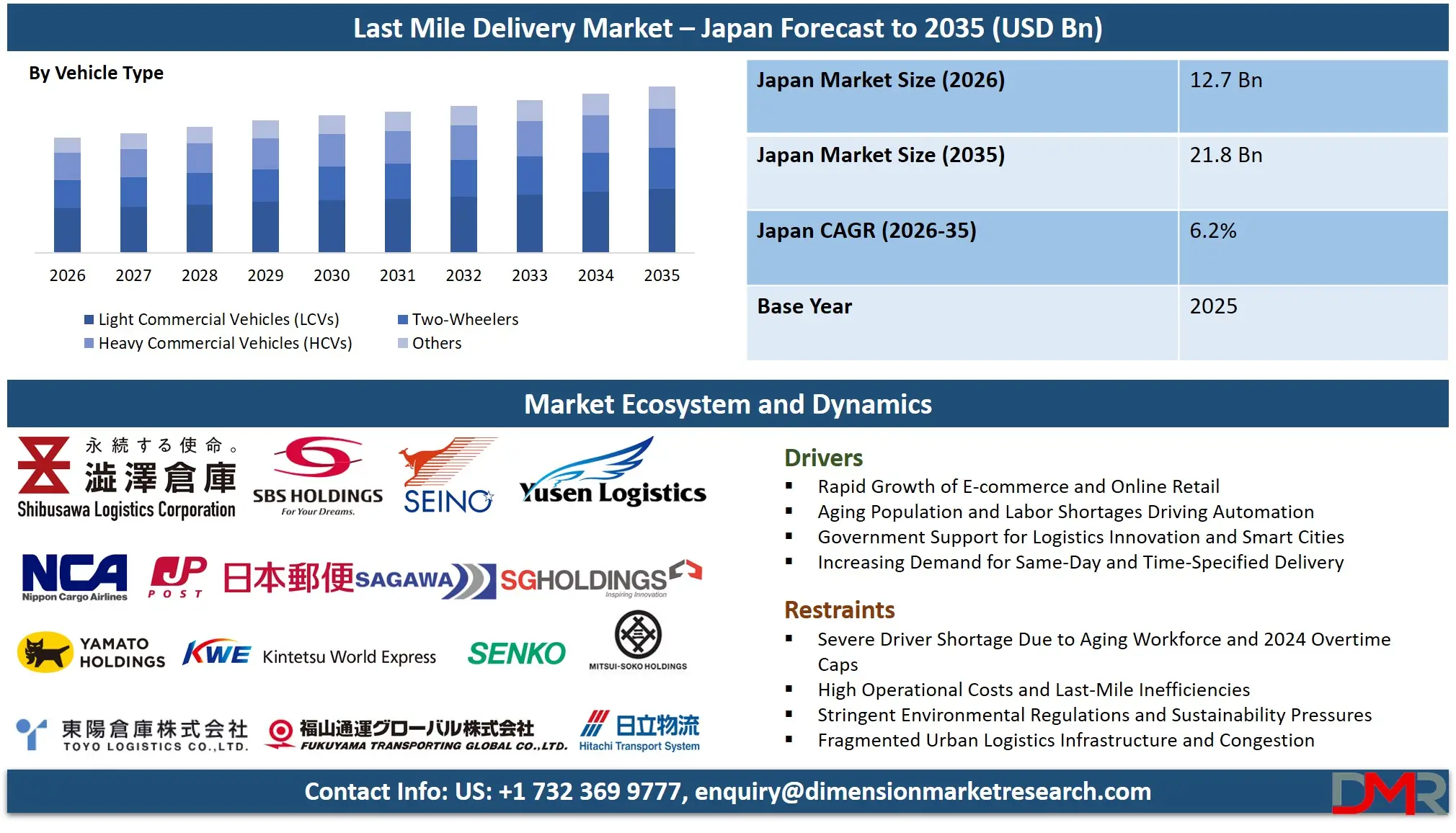
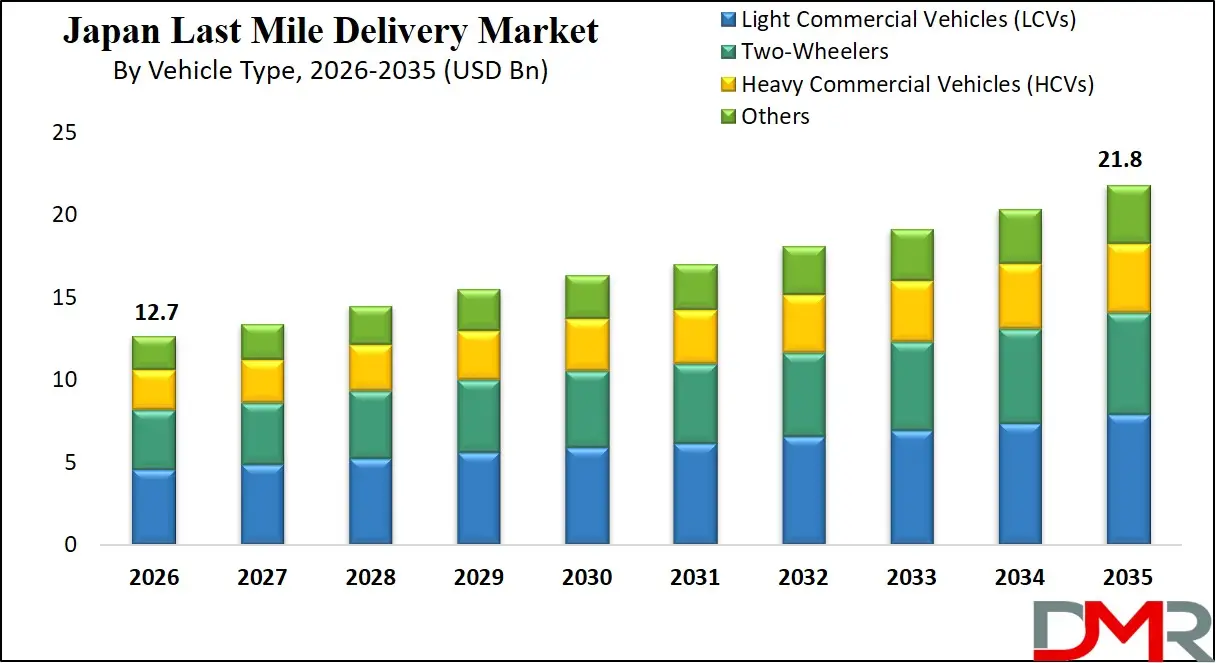
Japan last mile delivery market size is expected to reach a value of USD 12.7 billion in 2026, and it is further anticipated to reach a market value of USD 21.8 billion by 2035 at a CAGR of 6.2%.
ℹ
To learn more about this report –
Download Your Free Sample Report Here
The Japan last mile delivery market represents one of the most advanced and operationally efficient logistics ecosystems globally, driven by a combination of high urban density, technological sophistication, and strong consumer expectations for precision and reliability. Cities such as Tokyo, Yokohama, and Osaka serve as major hubs for last mile activity, where dense populations and compact infrastructure demand highly optimized delivery networks.
Last mile delivery in Japan is deeply integrated into daily life, supported by a culture that prioritizes punctuality, service quality, and operational excellence. Consumers expect narrow delivery windows, real-time tracking, and flexible redelivery options, prompting logistics providers to continuously innovate. The widespread presence of convenience stores and parcel lockers further enhances delivery flexibility, allowing consumers to collect packages at their convenience.
The market has undergone significant transformation in recent years due to rapid digitalization and automation. Technologies such as artificial intelligence, robotics, IoT-enabled tracking, and predictive analytics are being widely deployed to enhance delivery accuracy and efficiency. Additionally, Japan's leadership in robotics has enabled the development of autonomous delivery robots and smart logistics hubs, which are gradually being integrated into urban and suburban delivery networks.
E-commerce growth has been a major catalyst, with platforms such as Rakuten Group and Amazon Japan driving significant parcel volume increases. The pandemic further accelerated online shopping adoption, making last mile delivery a critical component of Japan's retail and logistics landscape.
Another defining feature of the Japanese market is its proactive approach to sustainability. Logistics providers are investing in electric delivery vehicles, low-emission transport solutions, and optimized route planning to reduce environmental impact. The government's push toward carbon neutrality is also influencing industry practices, encouraging the adoption of greener logistics models.
ℹ
To learn more about this report –
Download Your Free Sample Report Here
Despite its strengths, the market faces structural challenges, particularly related to labor shortages due to an aging population. This has intensified the need for automation and workforce optimization strategies. Additionally, the complexity of urban logistics, including narrow streets and high delivery density, requires continuous innovation in vehicle design and route management.
Overall, the Japan last mile delivery market is characterized by a balance of technological advancement, operational efficiency, and evolving consumer demands, positioning it as a key pillar of the country's economic and digital ecosystem.
Japan Last Mile Delivery Market: Key Takeaways
- Market Growth: The market size is projected to reach approximately USD 12.7 billion in 2026 and is expected to grow further to around USD 21.8 billion by 2035, reflecting a compound annual growth rate (CAGR) of 6.2% over the forecast period.
- By Delivery Mode: Ground transportation continues to dominate the market due to its extensive infrastructure and ability to handle high parcel volumes efficiently across urban and rural areas.
- By Vehicle Type: Light commercial vehicles, particularly compact vans, are the most widely used due to their adaptability to Japan's narrow streets and dense urban environments.
- By Service Type: The B2C segment leads the market, supported by the rapid expansion of online retail and direct-to-consumer business models.
- By Delivery Time Frame: Standard and next-day delivery remain dominant, while same-day delivery is gaining traction in metropolitan regions.
- By Application: E-commerce and retail applications account for the largest share, reflecting the growing importance of online shopping in Japan.
- By End-User: Large enterprises dominate the market, leveraging their scale and resources to invest in advanced logistics infrastructure and technology.
- Key Players: Prominent players include Yamato Transport, Sagawa Express, Japan Post Holdings, Rakuten Group, and Amazon Japan.
Impact of Iran Conflict on Japan Last Mile Delivery Market
- Energy Cost Escalation: Japan's reliance on imported oil makes it sensitive to Iran conflict-driven price fluctuations, increasing delivery costs and encouraging investment in alternative energy vehicles and optimized logistics operations.
- Import Dependency Disruptions: Interruptions in global supply chains delay imports of essential goods, impacting delivery schedules and prompting Japanese firms to expand domestic warehousing and improve inventory management systems.
- Maritime and Shipping Route Uncertainty: Geopolitical tensions affect key shipping lanes, causing delays in freight movement and requiring Japanese logistics providers to diversify routes and improve maritime tracking capabilities.
- Exchange Rate Fluctuations Impacting Costs: Currency volatility influences import costs and operational expenses, leading companies to adjust pricing strategies and adopt financial hedging mechanisms to stabilize last mile delivery operations.
- Increased Operational Risk Exposure: Higher geopolitical risks raise insurance and compliance costs, pushing Japanese logistics firms to implement stronger risk management frameworks and diversify supply chain partnerships.
Japan Last Mile Delivery Market: Use Cases
- Online Retail Order Fulfillment: E-commerce fulfillment represents the largest and most dynamic use case in the Japan last mile delivery market. Logistics providers are leveraging advanced technologies such as automated sorting systems, AI-driven demand forecasting, and real-time tracking to optimize delivery operations. The integration of fulfillment centers with last mile networks ensures seamless order processing and timely delivery to end customers.
- On-Demand Grocery and Meal Delivery Services: The grocery and food delivery segment has witnessed significant growth in recent years, driven by changing consumer lifestyles and the increasing demand for convenience. Companies are investing in temperature-controlled logistics systems and real-time tracking technologies to ensure the safe and timely delivery of perishable goods.
- Medical and Pharmaceutical Logistics: The healthcare segment requires highly reliable and secure delivery solutions for pharmaceuticals, medical devices, and diagnostic samples. Logistics providers are utilizing specialized packaging, temperature monitoring systems, and real-time tracking to ensure the integrity of shipments. The integration of digital technologies enables better coordination between healthcare facilities and delivery providers.
- Rapid Retail and Same-Day Delivery Solutions: Same-day retail distribution is becoming increasingly popular in Japan, particularly in urban areas. Retailers are leveraging local stores and micro-fulfillment centers to offer faster delivery services, enabling them to compete with e-commerce giants. The use of advanced routing algorithms and real-time data analytics ensures efficient delivery operations.
Japan Last Mile Delivery Market: Stats & Facts
Ministry of Land, Infrastructure, Transport and Tourism (MLIT), Japan
- Around 5 billion parcels were handled in Japan in fiscal year 2023, reflecting consistently high last mile delivery demand.
- The parcel redelivery rate stood at 8.4% in 2025, indicating inefficiencies and operational challenges in last mile delivery.
- Urban areas recorded a higher redelivery rate of 9.3%, compared to suburban and rural regions, highlighting urban delivery complexities.
- The government has set a target to reduce redelivery rates to 7.5%, emphasizing efficiency improvements in last mile logistics.
Japan Logistics System Association / National Logistics Data
- Japan's domestic freight volume reached approximately 4.19 billion tons, demonstrating the scale of goods movement supporting last mile delivery.
- Truck transportation accounts for the major share of domestic freight movement, reinforcing the dominance of ground delivery in last mile logistics.
Japan Post Holdings (Official Corporate & Industry Data)
- Japan Post handles around 1 billion parcel deliveries annually (Yu-Pack service), making it one of the largest last mile operators in the country.
- The company maintains a nationwide delivery network covering nearly all households, including rural and remote areas.
World Economic Forum (WEF) & Urban Logistics Insights
- E-commerce delivery volumes in central Tokyo are projected to increase by 85% by 2030, significantly impacting last mile demand.
- Delivery vehicle requirements in Tokyo are expected to increase by 71%, indicating rising infrastructure and fleet needs.
- Delivery-related travel distance is projected to increase by 25%, adding pressure on logistics efficiency.
- Carbon emissions from last mile delivery are expected to rise by 20%, highlighting sustainability challenges.
Consumer & Academic Research (Japan-based Studies)
- A study of over 4,000 Japanese consumers showed that delivery time, cost, and time slots are key decision factors in last mile delivery preferences.
- The median willingness to pay for faster delivery is relatively low, indicating cost sensitivity among consumers.
- Consumers show limited willingness to pay for shorter delivery time windows, suggesting flexibility in delivery timing.
Japan Last Mile Delivery Market: Market Dynamic
Driving Factors in Japan Last Mile Delivery Market
Aging Population and Labor Constraints
Japan's aging population remains one of the most significant structural drivers influencing the last mile delivery market. With a declining working-age population, the logistics sector faces persistent labor shortages, particularly in delivery and warehouse operations. This demographic challenge has compelled companies to adopt innovative solutions to sustain service levels and meet increasing demand.
Automation and robotics are being rapidly deployed to address these labor constraints. Companies are investing in autonomous delivery vehicles, robotic sorting systems, and AI-driven logistics platforms to reduce dependence on human labor. These technologies not only enhance efficiency but also improve workplace safety by minimizing physically demanding tasks.
Growth of E-commerce and Omnichannel Retail
The rapid expansion of e-commerce in Japan is a primary driver of growth in the last mile delivery market. Leading platforms such as Rakuten Group and Amazon Japan have significantly increased online retail penetration, resulting in higher parcel volumes and more complex delivery requirements. Consumers are increasingly expecting fast, reliable, and flexible delivery options, which places additional pressure on logistics providers to enhance their capabilities.
Omnichannel retail strategies are further amplifying the importance of last mile delivery. Retailers are integrating online and offline channels to provide seamless shopping experiences, including options such as click-and-collect, ship-from-store, and same-day delivery. This integration requires highly efficient and coordinated logistics networks capable of handling diverse delivery scenarios.
Restraints in Japan Last Mile Delivery Market
High Operational Costs
The Japan last mile delivery market faces significant challenges related to high operational costs. Expenses associated with fuel, labor, vehicle maintenance, and infrastructure development continue to rise, placing pressure on profit margins. Additionally, the need to invest in advanced technologies such as automation, AI, and electric vehicles further increases capital expenditure. Balancing cost efficiency with service quality remains a critical challenge for logistics providers. Consumers often expect fast and low-cost delivery options, which can be difficult to achieve given the high cost structure of last mile operations. Companies must continuously optimize their operations, leverage technology, and explore innovative business models to manage costs effectively while maintaining competitiveness.
Complex Urban Logistics
Japan's dense urban environment presents unique logistical challenges for last mile delivery. Cities are characterized by narrow streets, high population density, and limited parking space, which complicate delivery operations. These factors require specialized vehicles, precise route planning, and efficient coordination to ensure timely deliveries. Traffic congestion and strict regulations on vehicle access in certain areas further add to the complexity. Logistics providers must adopt advanced routing algorithms and real-time data analytics to navigate these challenges effectively. Additionally, the need to balance delivery efficiency with environmental considerations and urban planning constraints makes last mile logistics in Japan particularly complex and resource-intensive.
Opportunities in Japan Last Mile Delivery Market
Expansion of Autonomous and Drone Delivery
The development and commercialization of autonomous delivery vehicles and drone technology present significant growth opportunities for the Japan last mile delivery market. These technologies have the potential to revolutionize delivery operations by reducing labor costs, improving efficiency, and enabling faster delivery times. In rural and remote areas, where population density is low and delivery routes are less efficient, drones offer a viable solution for delivering essential goods such as medical supplies and groceries. Autonomous ground vehicles, including delivery robots and self-driving vans, are also being tested in urban environments to handle short-distance deliveries and reduce congestion.
Japan's supportive regulatory environment and strong technological capabilities provide a favorable landscape for the adoption of these innovations. As regulatory frameworks continue to evolve and technology becomes more cost-effective, the widespread deployment of autonomous and drone delivery solutions is expected to accelerate, creating new growth avenues for logistics providers.
Sustainable and Green Logistics
Sustainability has emerged as a key focus area in the Japan last mile delivery market, driven by environmental concerns, regulatory pressures, and changing consumer preferences. Logistics companies are increasingly adopting eco-friendly practices to reduce their carbon footprint and enhance operational efficiency. The transition to electric vehicles (EVs) and hybrid delivery fleets is gaining momentum, particularly in urban areas where emissions regulations are more stringent. Cargo bikes and other micromobility solutions are also being deployed to navigate congested city centers while minimizing environmental impact.
In addition to fleet electrification, companies are exploring innovative solutions such as route optimization to reduce fuel consumption, sustainable packaging materials, and reverse logistics systems for recycling and waste reduction.
Trends in Japan Last Mile Delivery Market
Automation and Robotics in Last Mile Delivery
Japan continues to position itself as a global leader in robotics and automation, and this technological advantage is significantly transforming the last mile delivery landscape. Logistics providers are increasingly deploying autonomous delivery robots, AI-powered sorting systems, and machine learning-based route optimization tools to streamline operations and improve delivery efficiency. These technologies enable real-time decision-making, reduce human error, and optimize delivery routes based on traffic patterns, weather conditions, and parcel density.
The growing adoption of robotics is also closely tied to Japan's labor shortage, particularly in physically demanding logistics roles. Autonomous delivery solutions, including sidewalk robots and self-driving vans, are being piloted and gradually integrated into urban delivery networks. Additionally, automated warehouses and fulfillment centers are enhancing order processing speed and accuracy.
Rise of Smart Logistics and Micro-Fulfillment
The emergence of smart logistics is reshaping the operational framework of last mile delivery in Japan. Logistics providers are leveraging IoT-enabled devices, cloud-based platforms, and advanced data analytics to gain real-time visibility into their supply chains. These technologies facilitate better coordination between warehouses, distribution centers, and delivery fleets, resulting in improved service reliability and reduced operational inefficiencies.
Micro-fulfillment centers are becoming a critical component of urban logistics strategies. Located close to densely populated areas, these facilities enable faster order processing and reduce the distance between inventory and end consumers. This proximity significantly lowers delivery times and transportation costs, making same-day and next-day delivery more feasible and economically viable.
Japan Last Mile Delivery Market: Research Scope and Analysis
By Delivery Mode Analysis
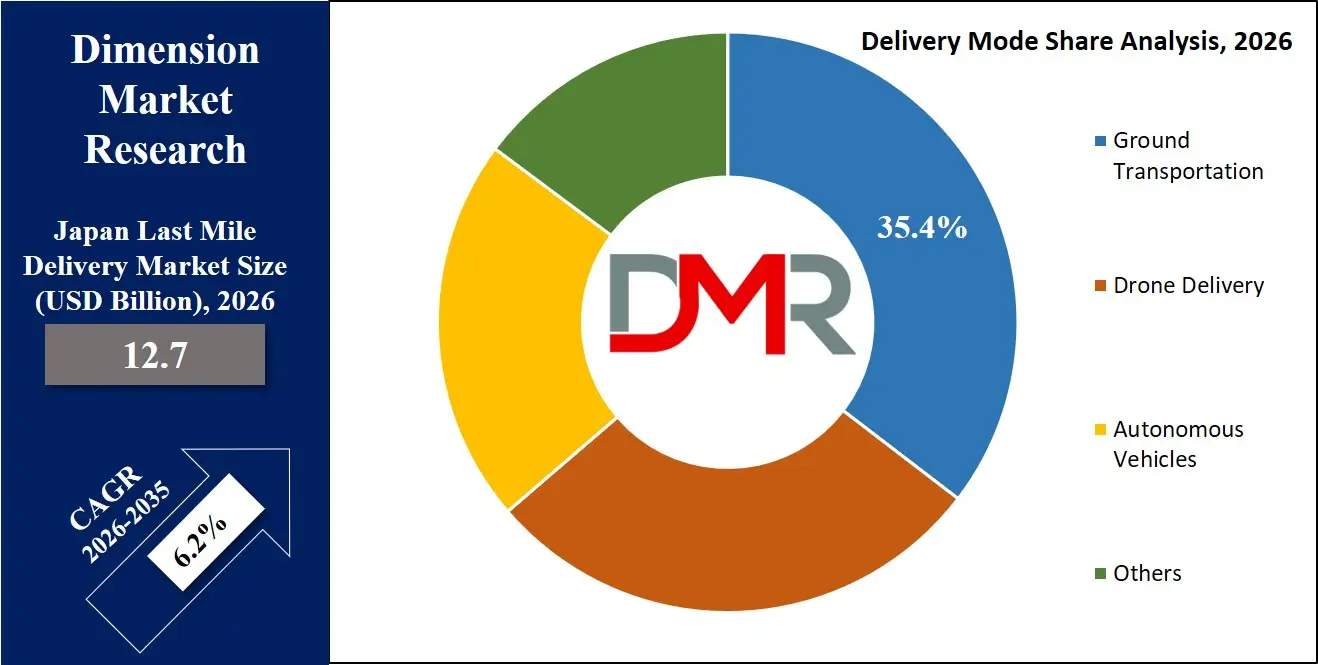
Ground transportation projected to continue to dominate the Japan last mile delivery market due to its unmatched reliability, scalability, and deeply entrenched infrastructure network. Japan's highly developed road systems, combined with efficient urban planning, enable seamless connectivity across metropolitan, suburban, and rural regions. Leading logistics providers such as Yamato Transport and Sagawa Express have built extensive nationwide delivery networks capable of handling high parcel volumes with precision and consistency. Their operations are supported by advanced routing technologies, real-time tracking systems, and optimized fleet management, which collectively ensure timely and accurate deliveries.
ℹ
To learn more about this report –
Download Your Free Sample Report Here
Ground transportation also offers flexibility in handling a wide variety of delivery requirements, ranging from small parcels to bulk shipments. It supports multiple service types, including B2C, B2B, and same-day deliveries, making it indispensable to the logistics ecosystem. Additionally, continuous investments in electric vehicles and fuel-efficient fleets are enhancing sustainability within this segment.
While alternative delivery modes such as drones and autonomous vehicles are gaining increasing attention, their adoption remains limited to pilot programs and niche use cases. Regulatory constraints, safety considerations, and technological limitations currently restrict their widespread deployment. However, ongoing advancements in robotics, artificial intelligence, and supportive government policies are expected to gradually expand the role of these emerging delivery modes, particularly in remote areas and specialized applications.
By Vehicle Type Analysis
Light commercial vehicles (LCVs) anticipated to serve as the backbone of last mile delivery operations in Japan, owing to their optimal balance between payload capacity, maneuverability, and operational efficiency. These vehicles are particularly well-suited to Japan's dense urban environments, where narrow streets and limited parking spaces present significant logistical challenges. LCVs enable efficient navigation through congested areas while maintaining the capacity required for high-volume parcel deliveries.
In addition to LCVs, two-wheelers and cargo bikes play a crucial role in urban logistics, especially in densely populated city centers. These vehicles offer enhanced agility and speed, allowing delivery personnel to bypass traffic congestion and access areas that may be difficult for larger vehicles to reach. The use of electric cargo bikes is also increasing, driven by sustainability goals and the need to reduce emissions in urban areas.
Heavy commercial vehicles (HCVs), on the other hand, are primarily utilized for transporting goods between distribution centers and regional hubs rather than for final delivery. Their role is essential in ensuring the efficient movement of bulk shipments within the broader supply chain. The integration of advanced telematics and fleet management systems across all vehicle types is further improving operational efficiency, enabling logistics providers to optimize routes, monitor performance, and reduce costs.
By Service Type Analysis
The B2C (business-to-consumer) segment is poised to dominate the Japan last mile delivery market, driven by the rapid expansion of e-commerce and evolving consumer preferences. This segment is characterized by high delivery volumes, frequent shipments, and diverse customer requirements, including flexible delivery windows and contactless options. The increasing demand for convenience and speed has compelled logistics providers to enhance their service offerings and invest in advanced technologies to meet customer expectations.
B2C deliveries often involve complex logistics, including precise scheduling, secure parcel handling, and efficient route optimization. Companies are leveraging artificial intelligence and data analytics to improve delivery accuracy and reduce failed delivery attempts. Additionally, the integration of smart lockers and pickup points has further enhanced convenience for consumers.
The B2B (business-to-business) segment remains a stable component of the market, supporting the movement of goods between businesses, such as retailers, wholesalers, and manufacturers. While it typically involves lower shipment frequency compared to B2C, B2B deliveries often require higher reliability and larger shipment volumes.
The C2C (consumer-to-consumer) segment, facilitated by online marketplaces and peer-to-peer platforms, is also contributing to market growth. However, its share remains relatively smaller. Overall, the continued expansion of e-commerce ensures that the B2C segment will maintain its dominance in the foreseeable future.
By Delivery Time Frame Analysis
Standard and next-day delivery options anticipated to dominate the Japan last mile delivery market, offering an optimal balance between cost efficiency and service reliability. These delivery options are widely preferred by consumers for non-urgent shipments, as they provide affordable and dependable service without the premium costs associated with faster delivery alternatives. For logistics providers, standard and next-day deliveries enable better route optimization, shipment consolidation, and resource utilization, contributing to overall operational efficiency.
Next-day delivery, in particular, has become a baseline expectation in Japan's highly competitive e-commerce landscape. Retailers and logistics companies have invested heavily in infrastructure and technology to meet these expectations, including automated sorting facilities and strategically located distribution centers.
Same-day delivery, while currently representing a smaller share of the market, is the fastest-growing segment. It is driven by increasing consumer demand for immediacy and convenience, particularly in urban areas. The rise of micro-fulfillment centers, advanced routing algorithms, and real-time data analytics is enabling logistics providers to offer same-day delivery services more efficiently.
However, same-day delivery presents challenges, including higher operational costs and increased complexity in route planning. Despite these challenges, ongoing technological advancements and infrastructure investments are expected to support the continued growth of this segment, particularly in densely populated regions.
By Application Analysis
E-commerce and retail applications is projected to account for the largest share of the Japan last mile delivery market, driven by the rapid growth of online shopping and the increasing adoption of omnichannel retail strategies. Consumers are increasingly purchasing a wide range of products online, from electronics and apparel to household goods, creating a consistent and growing demand for reliable delivery services. Logistics providers play a critical role in ensuring timely and accurate deliveries, which directly impact customer satisfaction and brand loyalty.
The integration of online and offline retail channels has further amplified the importance of last mile delivery. Retailers are offering services such as click-and-collect, ship-from-store, and same-day delivery to enhance the customer experience and remain competitive in the market.
In addition to e-commerce, other applications such as grocery and food delivery are experiencing significant growth. These services require specialized logistics capabilities, including temperature-controlled transportation and real-time tracking. Healthcare logistics is another important application, involving the delivery of pharmaceuticals, medical devices, and diagnostic samples, where reliability and compliance are critical.
Document and parcel delivery services also contribute to the market, supporting both personal and business needs. The diversity of applications highlights the versatility and importance of last mile delivery in Japan's logistics ecosystem.
By End-User Analysis
Large enterprises is poised to dominate the Japan last mile delivery market, leveraging their extensive financial resources, technological capabilities, and operational scale to deliver high-quality services. These organizations invest heavily in advanced logistics infrastructure, including automated warehouses, digital platforms, and optimized delivery networks. Their ability to integrate cutting-edge technologies such as artificial intelligence, robotics, and real-time tracking systems enables them to achieve high levels of efficiency and customer satisfaction.
Large enterprises also benefit from economies of scale, allowing them to negotiate favorable contracts, optimize resource utilization, and maintain competitive pricing. Their extensive networks enable them to serve a wide customer base, including both urban and rural areas, ensuring comprehensive market coverage.
Small and medium-sized enterprises (SMEs), while playing a crucial role in driving demand, often face limitations in terms of resources and infrastructure. As a result, they rely heavily on third-party logistics providers to manage their delivery operations. This reliance allows SMEs to focus on their core business activities while leveraging the expertise and capabilities of established logistics companies.
Despite their smaller scale, SMEs contribute significantly to market growth, particularly in niche segments and local markets. As digital platforms and logistics solutions become more accessible, SMEs are expected to play an increasingly important role in the evolving last mile delivery landscape.
Japan Last Mile Delivery Market Report is segmented on the basis of the following:
By Delivery Mode
- Ground Transportation
- Drone Delivery
- Autonomous Vehicles
- Others
By Vehicle Type
- Light Commercial Vehicles (LCVs)
- Two-Wheelers
- Heavy Commercial Vehicles (HCVs)
- Others
By Service Type
By Delivery Time Frame
- Next-day Delivery
- Same-day Delivery
- Standard (2-5 days)
By Application
- E-commerce/Retail
- Grocery & Food Delivery
- Healthcare & Pharmaceuticals
- Documents & Parcels
- Others
By End-User
- Retail Customers
- SMEs
- Large Enterprises
Impact of Artificial Intelligence in Japan Last Mile Delivery Market
- Advanced Route Optimization and Efficiency: AI-driven systems optimize delivery routes using real-time traffic, weather, and parcel density data, reducing delivery time, fuel consumption, and operational costs while improving overall efficiency and service reliability across urban and rural areas.
- Automation to Address Labor Shortages: Japan's aging population and workforce constraints are driving adoption of AI-powered automation, including robotics and smart logistics systems, which reduce reliance on human labor and ensure continuity and scalability in last-mile delivery operations.
- Autonomous Delivery and Robotics Adoption: AI enables deployment of delivery robots and autonomous vehicles, particularly in dense urban and remote regions, improving delivery speed, lowering costs, and supporting contactless delivery solutions in an increasingly digital and convenience-driven market.
- Predictive Analytics and Demand Forecasting: AI helps logistics providers forecast demand fluctuations, optimize inventory placement, and allocate delivery resources more efficiently, minimizing delays, reducing operational inefficiencies, and enhancing overall customer satisfaction.
- Warehouse and Fulfillment Optimization: AI-powered systems streamline warehouse operations through automated sorting, intelligent picking, and robotics, accelerating order processing, reducing errors, and enabling faster dispatch to support high-volume last-mile delivery demand.
Japan Last Mile Delivery Market: Competitive Landscape
The Japan last mile delivery market is characterized by intense competition, driven by a combination of well-established logistics providers and rapidly emerging technology-enabled players. Industry leaders such as Yamato Transport, Sagawa Express, and Japan Post Holdings maintain a dominant position due to their extensive nationwide networks, operational efficiency, and strong brand trust. These companies have built highly reliable delivery ecosystems supported by advanced infrastructure, enabling them to handle large parcel volumes across both urban and rural regions with consistent service quality.
ℹ
To learn more about this report –
Download Your Free Sample Report Here
At the same time, e-commerce giants such as Rakuten Group and Amazon Japan are increasingly influencing the competitive dynamics of the market. By investing heavily in proprietary logistics networks, fulfillment centers, and last mile delivery capabilities, these players are reducing dependence on third-party providers while enhancing delivery speed, flexibility, and customer experience. Their focus on integrated ecosystems allows seamless coordination between online platforms and delivery operations.
The competitive landscape is further shaped by continuous innovation and strategic collaborations. Companies are actively adopting advanced technologies such as artificial intelligence, robotics, and data analytics to optimize routing, improve delivery accuracy, and reduce operational costs. Additionally, sustainability initiatives, including the deployment of electric vehicles and eco-friendly delivery methods, are becoming key differentiators. As competition intensifies, the ability to combine technological innovation with operational excellence will remain critical for long-term success in Japan's evolving last mile delivery market.
Some of the prominent players in Japan Last Mile Delivery Market are:
- Yamato Holdings
- Sagawa Express
- Nippon Express Holdings
- SG Holdings
- Mitsui-Soko Holdings
- Kintetsu World Express
- Yusen Logistics
- Seino Holdings
- Fukuyama Transporting
- Japan Post Holdings
- Hitachi Transport System
- Nippon Cargo Airlines
- Toyo Logistics
- Senko Group Holdings
- SBS Holdings
- Shibusawa Logistics
- Maruzen Showa Unyu
- Transcosmos
- Hamakyorex
- Keihin
- Other Key Players
Recent Developments in Japan Last Mile Delivery Market
- February 2026: Yamato Holdings advanced its automation and digital logistics initiatives, focusing on improving last mile efficiency through AI-driven route optimization and warehouse automation systems.
- November 2025: Japan Post Holdings announced a strategic transformation plan to expand its logistics business, strengthening parcel delivery and integrated last mile capabilities across Japan.
- September 2025: The Ministry of Land, Infrastructure, Transport and Tourism introduced smart access solutions for residential buildings, enabling delivery personnel to complete last mile deliveries more efficiently in urban apartments.
- August 2025: Japan Post Holdings committed significant investment toward logistics infrastructure modernization, including sorting facilities and digital transformation.
- April 2025: Yamato Transport expanded its international delivery services, enhancing integration between cross-border logistics and domestic last mile delivery networks.
- January 2025: Sagawa Express partnered with automation technology providers to deploy AI-powered robotic systems for parcel handling and loading, improving operational efficiency.
- August 2024: Yamato Holdings collaborated with energy technology firms to introduce battery-swapping infrastructure for electric delivery vehicles, supporting sustainable last mile logistics.
Report Details
| Report Characteristics |
| Market Size (2026) |
USD 12.7 Bn |
| Forecast Value (2035) |
USD 21.8 Bn |
| CAGR (2026–2035) |
6.2% |
| Historical Data |
2021 – 2025 |
| Forecast Data |
2027 – 2035 |
| Base Year |
2025 |
| Estimate Year |
2026 |
| Report Coverage |
Market Revenue Estimation, Market Dynamics, Competitive Landscape, Growth Factors and etc. |
| Segments Covered |
By Component (Solutions and Services), By Size (Small & Medium-sized Enterprises and Large Enterprises), By Industry Vertical (Public Sector, Pharmaceuticals, Media & Entertainment, IT & Telecommunication, BFSI, and Others Industry Verticals), By Delivery Mode (Ground Transportation, Drone Delivery, Autonomous Vehicles, and Others), By Vehicle Type (Light Commercial Vehicles, Two-Wheelers, Heavy Commercial Vehicles, and Others), By Service Type (B2C, B2B, and C2C), By Delivery Time Frame (Next-day Delivery, Same-day Delivery, and Standard [2–5 days]), By Application (E-commerce/Retail, Grocery & Food Delivery, Healthcare & Pharmaceuticals, Documents & Parcels, and Others), and By End-User (Retail Customers, SMEs, and Large Enterprises) |
| Country Coverage |
Japan |
| Prominent Players |
Yamato Holdings, Sagawa Express, Nippon Express Holdings, SG Holdings, Mitsui-Soko Holdings, Kintetsu World Express, Yusen Logistics, Seino Holdings, Fukuyama Transporting, Japan Post, Hitachi Transport System, Nippon Cargo Airlines, Toyo Logistics, Senko Group Holdings, SBS Holdings, Shibusawa Logistics, Maruzen Showa Unyu, Transcosmos, Hamakyorex, Keihin, and Other Key Players |
| Purchase Options |
We have three licenses to opt for: Single User License (Limited to 1 user), Multi-User License (Up to 5 Users) and Corporate Use License (Unlimited User) along with free report customization equivalent to 0 analyst working days, 3 analysts working days and 5 analysts working days respectively. |
Frequently Asked Questions
How big is Japan Last Mile Delivery Market?
▾ Japan Last Mile Delivery Market size is estimated to have a value of USD 12.7 billion in 2026 and is expected to reach USD 21.8 billion by the end of 2035.
Who are the key players in Japan Last Mile Delivery Market?
▾ Some of the major key players in Japan Last Mile Delivery Market are Amazon Logistics, UPS, FedEx, USPS, DHL eCommerce, XPO Logistics, and many others.
What is the growth rate in Japan Last Mile Delivery Market?
▾ The market is growing at a CAGR of 6.2 percent over the forecasted period.