Market Snapshot
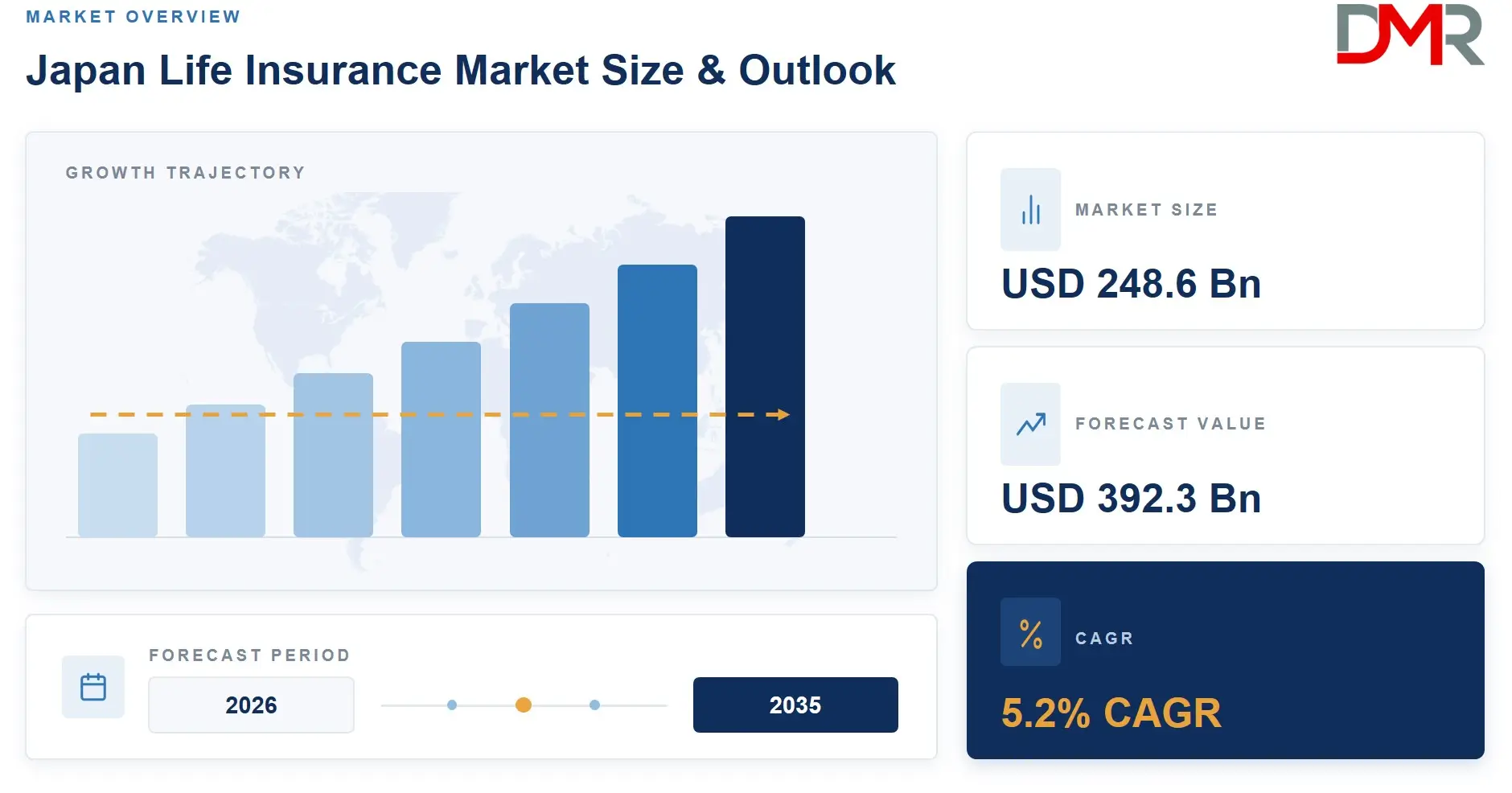
- Market Size (2026): USD 248.6 Bn
- Forecast Value (2035): USD 392.3 Bn
- CAGR (2026-2035): 5.2%
- Leading Product Type (2026): Term Life, approximately 39%
- Leading Distribution Channel (2026): Agency, around 46%
- Key Players: Nippon Life Insurance, Japan Post Insurance, Dai-ichi Life Holdings and others
What is Japan Life Insurance Market and its Market Size?
The Japan Life Insurance Market size is estimated to reach USD 248.6 Bn in 2026 and is further anticipated to reach USD 392.3 Bn by 2035, at a CAGR of 5.2%.
ℹ
To learn more about this report –
Download Your Free Sample Report Here
This market covers premiums and related underwriting services for individual life, medical, cancer, long-term care, annuity, group protection and savings-linked policies sold within Japan. It includes new business, renewals and policy servicing, while excluding non-life insurance, standalone investment products without an insurance wrapper, and overseas premium written by Japanese groups.
Life insurers convert mortality, longevity, morbidity and savings risks into contracts that pay benefits when defined events occur or when a policy reaches a maturity condition. Product design therefore combines actuarial pricing, reserving, asset-liability management and distribution economics. Yen-denominated guarantees, variable products, riders and third-sector health protection create distinct revenue pools.
Households buy protection for income replacement, medical expenses, inheritance planning and retirement income. Employers and lenders use group policies for employee welfare and credit protection. Insurers are changing the mix through digital onboarding, medical underwriting, reinsurance, wellness-linked propositions and greater use of market-consistent capital rules.
Japan remains a mature insurance economy, but maturity does not mean static demand. Population ageing supports annuities, health and long-term care coverage, while low birth rates constrain traditional family protection. Recent yield changes improve the economics of selected savings products, yet asset duration, lapse risk and distribution costs continue to shape the market forecast.
Use Cases
- Household Income Protection: Families purchase term and whole-life cover to replace earnings after premature death, fund education obligations and protect mortgage payments. The policy converts an uncertain household shock into a scheduled premium commitment, giving dependants liquidity when public benefits or accumulated savings would be insufficient.
- Retirement Income Planning: Older households and pre-retirees use fixed and variable annuities to convert accumulated assets into future income. Financial advisers match payout timing, inflation exposure and longevity risk, while insurers manage reserves and investment portfolios over long contract durations.
- Employer Benefits: Corporate human-resource departments arrange group term, welfare and pension-related insurance for employee retention and family security. Centralised underwriting lowers administration per insured person and gives employers a predictable benefits framework across multiple locations and workforce age bands.
- Mortgage Credit Protection: Banks and housing lenders attach group credit life insurance to mortgage lending so a qualifying death or disability event can discharge the remaining balance. The structure protects the lender's collateral position while preventing the borrower's family from inheriting an unaffordable repayment obligation.
Key Takeaways
- Market Size & Share: Premium and related life insurance activity is estimated at USD 248.6 Bn in 2026 and is projected to reach USD 392.3 Bn by 2035.
- Product Type Analysis: Term life is expected to account for approximately 39% of 2026 revenue, supported by broad protection use and large policy volumes.
- Demand Concentration: Agency distribution is projected to hold nearly 46% of 2026 channel revenue, although digital and bancassurance are expanding faster.
- Demographic Rebalancing: Health, cancer and long-term care products together are expected to represent close to 31% of 2026 revenue as households address longevity and medical-cost exposure.
- Capital Economics: Annuity and savings-linked products are set to grow at approximately 7.1% CAGR from 2026-2035 as yield conditions improve product competitiveness.
- Competitive Structure: The five largest domestic groups are estimated to control around 54% of 2026 premium activity, leaving room for specialists and digital entrants.
How AI/Gen AI is Transforming the Japan Life Insurance Market?
AI is being applied first to repeatable underwriting, service and claims tasks rather than to replace actuarial accountability. Computer vision can read medical documents and identity records, while predictive models rank applications for manual review. Japanese insurers also use natural-language systems to search policy wording, summarise customer interactions and support multilingual service operations.
Generative AI adds value where information is fragmented across forms, call transcripts and internal manuals. Controls remain important because explainability, privacy, consent and suitability obligations limit unsupervised recommendations. The commercial result is lower handling time, more consistent documentation and better allocation of experienced staff to complex cases.
- LLM Document Processing: Extracts structured facts from medical certificates, application forms and policy correspondence.
- Predictive Underwriting: Scores mortality and morbidity indicators to route straightforward cases and flag exceptions.
- Knowledge Assistants: Retrieves product rules and compliance guidance for agents and contact-centre staff.
- Fraud Analytics: Compares claim patterns, provider relationships and timing signals to prioritise investigation.
Key Drivers in the Japan Life Insurance Market
Two forces are reshaping demand: the need to fund longer lives and the return of pricing flexibility in savings-oriented products.
- Longevity and Medical Protection Needs: Japan's ageing household structure raises demand for annuity income, hospitalisation, cancer and long-term care protection. The medical and care-oriented pool is expected to approach approximately 31% of 2026 market revenue because customers increasingly supplement public coverage with private benefits. Insurers can sell riders and standalone policies to existing policyholders, reducing acquisition friction. The mechanism is demographic and financial: longer retirement periods increase the duration of income risk, while families seek predictable cash support for treatment and care. Product profitability still depends on morbidity experience and benefit inflation.
- Improving Economics of Yen-Denominated Savings: Higher domestic yields improve the appeal of fixed annuities and selected whole-life savings products relative to the ultra-low-yield period. Annuity products are projected to expand at a CAGR of 7.1% from 2026-2035, above the overall market rate, as credited rates and asset-liability matching become more workable. Banks and insurers can explain guaranteed income more easily when cash and bond yields are visible to customers. The force supports premium growth, but it also increases reinvestment and duration-management requirements.
Restraints in the Japan Life Insurance Market
Market constraints are structural rather than temporary. Insurers must balance customer affordability, capital intensity and the cost of maintaining human-led distribution.
- Population and Household Contraction: Fewer births reduce the future pool of new family-protection buyers, while older customers often require products with tighter medical and longevity assumptions. Traditional death-benefit demand is therefore under pressure even when the number of policies remains high. The term-life segment, estimated at approximately 39% of 2026 revenue, is large but exposed to lower coverage amounts and substitution by medical riders. Carriers must migrate existing relationships toward health, care and retirement products without creating suitability concerns or excessive replacement activity.
- Guarantee and Capital Pressure: Long-duration guarantees expose insurers to interest-rate, reinvestment and asset-liability mismatch risk. Market-consistent capital rules and reinsurance can improve resilience, but they also raise governance, data and hedging costs. Agency-led distribution, holding around 46% of 2026 channel revenue, adds recurring commissions and branch overhead that digital competitors do not carry at the same intensity. Claims automation reduces processing cost, yet complex medical and death claims still require skilled review and defensible decisions.
Growth Opportunities in the Japan Life Insurance Market
White space is concentrated in propositions that combine protection with retirement, care and digital servicing rather than simply adding another conventional death-benefit plan.
- Integrated Retirement and Care Contracts: Bundling annuity income with long-term care triggers can address the financial gap between longevity and dependency. Modular benefits let customers choose inflation exposure, payout timing and care thresholds, while insurers can price the risk through clearer underwriting and reinsurance.
- Regional Digital Advice: Online advice and assisted digital journeys can reach customers outside the largest metropolitan centres where branch density is harder to sustain. Hybrid models using local banks, mobile identity and remote medical underwriting can lower acquisition cost without removing human suitability checks.
Trends in the Japan Life Insurance Market
Distribution is moving from a single-agent relationship toward blended journeys in which customers research online, consult an adviser for complex choices and complete servicing through mobile portals. Bancassurance remains important for savings and retirement products, while direct channels gain ground for simpler protection and medical policies.
Product architecture is also becoming more modular. Riders for cancer, hospitalisation, specified diseases and care are being adjusted around household needs, and variable products are gaining attention where customers accept investment risk. Reinsurance is increasingly used as a capital-management tool, not only as catastrophe protection, while insurers invest in data governance and model validation.
Research Scope and Analysis
Segment performance is assessed across product type, distribution channel, customer type, policy structure and end use. Each axis identifies where 2026 revenue is concentrated and where demand is moving fastest through 2035, linking the result to underwriting, savings behaviour, regulation and channel economics.
ℹ
To learn more about this report –
Download Your Free Sample Report Here
By Product Type
Term life is projected to retain the largest product share in 2026, accounting for approximately 39% of revenue because it provides comparatively affordable income protection and remains embedded in household and credit needs. Growth, however, is concentrated in annuity products, expanding at a CAGR of 7.1% between 2026 and 2035 as ageing customers seek lifetime income and improved yields make guaranteed payouts easier to price. Whole life and medical products remain important cross-sell anchors, while endowment demand is more sensitive to household savings preferences. Variable life benefits from investment participation but faces suitability and volatility constraints. The market is therefore shifting toward products that combine protection with cash-flow planning rather than relying only on high death-benefit amounts.
By Distribution Channel
Agency distribution is expected to hold the leading share in 2026, around 46%, because long-term policy sales still require explanation, trust and periodic household review. The steeper trajectory sits with digital channels, growing at a CAGR of 9.3% from 2026-2035 as identity verification, electronic signatures and remote underwriting reduce friction for simpler products. Bancassurance remains strong for annuities and savings, while brokers serve corporate and high-net-worth needs. Direct channels can scale efficiently, but insurers must control lapse rates and ensure that online journeys explain exclusions, guarantees and surrender economics with the same clarity as face-to-face advice.
By Customer Type
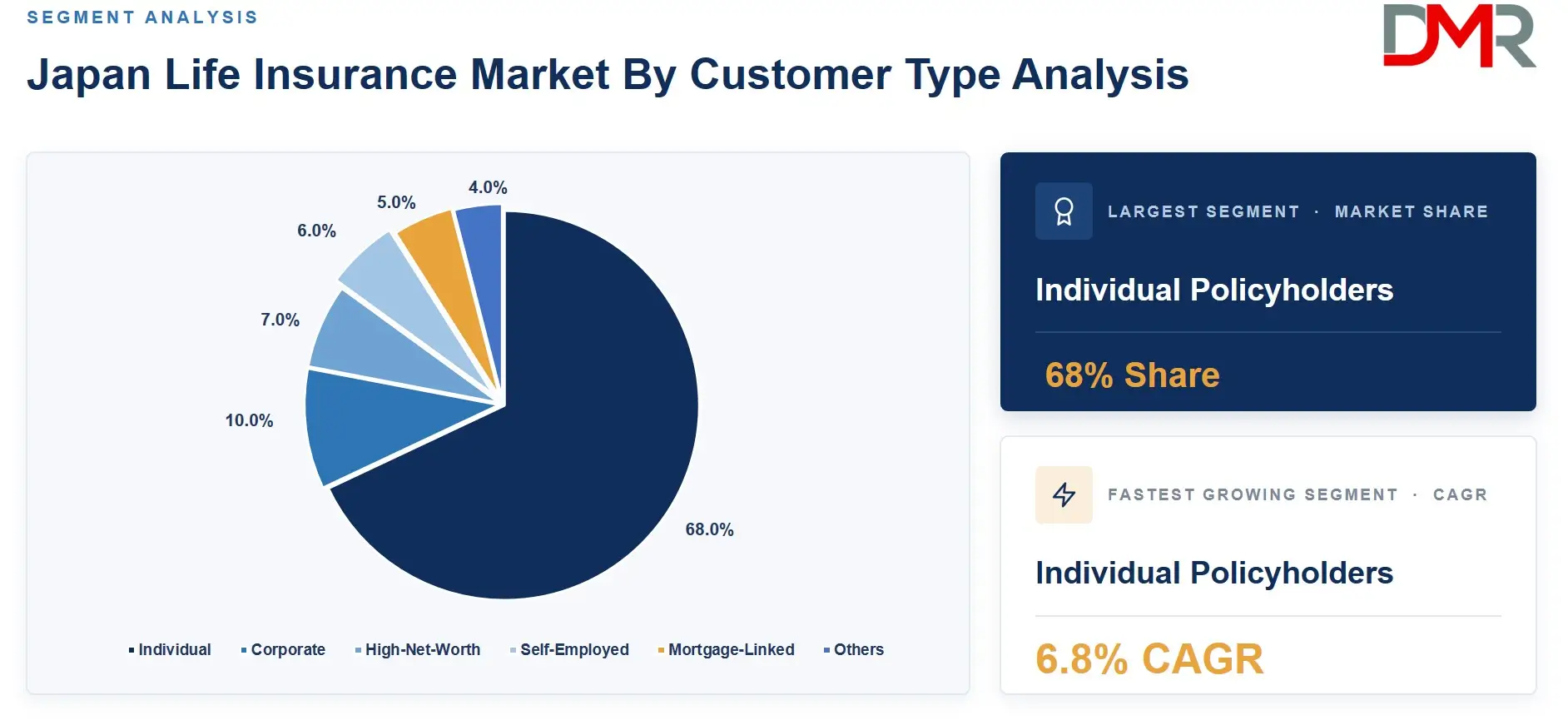
Individual policyholders are projected to account for nearly 68% of 2026 revenue, supported by the breadth of household protection, medical and savings contracts. Growth, however, is concentrated in senior and pre-retirement customers, expanding at a CAGR of 6.8% through 2035 as longevity risk becomes a larger financial planning issue. Corporate policyholders remain important through group term, welfare and pension arrangements, while mortgage-linked customers provide a stable credit-protection base. Younger households are harder to acquire through traditional products, making flexible premiums, app-based servicing and smaller initial cover important for future renewal value.
By Policy Structure
Standalone policies are expected to lead with approximately 61% of 2026 revenue because they provide clear benefit definitions and remain the standard unit for underwriting and administration. Riders are the faster-growing structure, advancing at a CAGR of 8.0% from 2026-2035 as insurers attach cancer, hospitalisation, specified-disease and care benefits to existing contracts. Bundled designs can increase customer retention and reduce repeated acquisition expense, but they also make comparison and suitability more difficult. Carriers are responding with modular menus and clearer disclosure so customers can adjust protection without surrendering the entire base policy.
By End Use
Household protection is projected to remain the largest end-use application in 2026, with a share close to 52%, reflecting income replacement, inheritance and mortgage obligations. Retirement income is expanding faster at a CAGR of 7.4% through 2035 as the population ages and customers seek predictable cash flow beyond public pensions. Medical and care spending create a second growth pocket, while employer benefits remain tied to workforce composition and benefit budgets. The end-use mix favours products that deliver a visible financial outcome, such as income or care funding, over policies marketed only through abstract mortality protection.
The Japan Life Insurance Market Report is Segmented Based on the Following
By Product Type
- Term Life
- Whole Life
- Health and Medical
- Annuity
- Endowment
- Variable Life
- Others
By Distribution Channel
- Agency
- Bancassurance
- Direct
- Digital
- Broker
- Others
By Customer Type
- Individual
- Corporate
- High-Net-Worth
- Self-Employed
- Mortgage-Linked
- Others
By Policy Structure
- Standalone
- Rider-Based
- Bundled
- Participating
- Non-Participating
- Others
By End Use
- Household Protection
- Retirement Income
- Medical and Care Funding
- Inheritance Planning
- Employee Benefits
- Others
Competitive Landscape
Competition is concentrated among large mutual and listed groups with extensive agency networks, trusted brands and sizeable investment portfolios. Banks, digital distributors and foreign specialists compete selectively in annuities, health protection, reinsurance and asset-linked products. The basis of competition is shifting from branch reach alone toward capital efficiency, product transparency, service speed, data governance and the ability to retain customers across life stages. Large carriers are diversifying overseas and using partnerships to supplement mature domestic demand, while specialists target medical, care, variable and digital niches.
Some of the Prominent Players in the Japan Life Insurance Market Are
- Nippon Life Insurance Company
- Japan Post Insurance Co., Ltd.
- Dai-ichi Life Holdings, Inc.
- Sumitomo Life Insurance Company
- Meiji Yasuda Life Insurance Company
- Tokio Marine Holdings, Inc.
- MS&AD Insurance Group Holdings, Inc.
- Sony Financial Group Inc.
- Manulife Life Insurance Company
- Prudential Life Insurance Company of Japan
- MetLife Insurance K.K.
- Aflac Life Insurance Japan Ltd.
- FWD Life Insurance Company, Limited
- Chubb Life Insurance Company Ltd.
- Zurich Life Insurance Company Ltd.
- BNP Paribas Cardif Life Insurance Company
- American Life Insurance Company
- Hana Financial Life Insurance
- Rakuten Life Insurance Co., Ltd.
- au Kabucom Securities Co., Ltd.
- LifeNet Insurance Company
- SBI Life Insurance Co., Ltd.
- Neo First Life Insurance Company, Limited
- Sompo Himawari Life Insurance Inc.
- Daido Life Insurance Company
- Taiyo Life Insurance Company
- Fukoku Mutual Life Insurance Company
- Asahi Life Insurance Company
- Prudential Gibraltar Financial Life Insurance Co., Ltd.
- Kyobo Life Insurance Co., Ltd.
- Japan Mutual Aid Association of Agriculture
- National Mutual Insurance Federation of Agricultural Cooperatives
- Japan Finance Corporation
- Mitsui Sumitomo Aioi Life Insurance Company, Limited
- Hitachi Insurance Services, Ltd.
- Marsh Japan, Inc.
- Aon Japan Ltd.
- Willis Towers Watson Japan
- Hoken Minaoshi Honpo Co., Ltd.
- Hoken no Madoguchi Group Co., Ltd.
- Other Key Players
Recent Developments
- In July 2026, Japan's insurance supervisors advanced market-consistent capital reforms for life insurers, increasing the importance of asset-liability measurement, internal controls and transparent risk disclosures.
- In June 2026, Japanese life insurers continued expanding reinsurance use to manage capital and longevity exposure, giving large carriers more flexibility in product design and balance-sheet allocation.
- In September 2025, major Japanese insurers increased attention on digital advice and electronic servicing, reducing paperwork in policy changes and improving access to retirement and medical products.
- In August 2025, the Life Insurance Association of Japan published updated industry statistics showing continued growth in individual policies in force and rising relevance of third-sector coverage.
Report Details
| Report Characteristics |
| Market Size (2026) |
USD 248.6 Bn |
| Forecast Value (2035) |
USD 392.3 Bn |
| CAGR (2026-2035) |
5.2% |
| Historical Data |
2021–2025 |
| Forecast Data |
2026–2035 |
| Base Year |
2025 |
| Segments Covered |
By Product Type, By Distribution Channel, By Customer Type, By Policy Structure, and By End Use |
| Regional Coverage |
Japan |
Frequently Asked Questions
How big is the Japan Life Insurance Market?
▾ The Japan Life Insurance Market is estimated at USD 248.6 Bn in 2026. The estimate covers premiums and related life insurance activity generated from customers and institutions inside Japan, including individual, group, medical, annuity and savings-linked policies.
What is the growth rate of the Japan Life Insurance Market?
▾ The market is projected to grow at a CAGR of 5.2% from 2026 to 2035, reaching USD 392.3 Bn by 2035. Annuities and retirement-oriented products are expected to expand faster than the overall market.
What is driving demand in the Japan Life Insurance Market?
▾ Demand is being supported primarily by population ageing, longer retirement periods and the need for private medical, care and retirement-income protection. More workable yields also improve the appeal of selected yen-denominated savings products and annuities.
Who are the key players in the Japan Life Insurance Market?
▾ Key players include Nippon Life Insurance, Japan Post Insurance, Dai-ichi Life Holdings, Sumitomo Life Insurance, Meiji Yasuda Life Insurance, Sony Financial Group and Aflac Life Insurance Japan.
Which product type leads the Japan Life Insurance Market?
▾ Term life is expected to lead by product type, holding approximately 39% of 2026 revenue. Its position reflects broad income-protection use, mortgage-related demand and comparatively accessible premiums.