Market Snapshot
- Market Size (2026): USD 0.9 Bn
- Forecast Value (2035): USD 2.9 Bn
- CAGR (2026-2035): 13.8%
- Leading Offering (2026): Warehouse Management Software, approximately 29%
- Leading Deployment (2026): Cloud, around 46%
- Key Players: Fujitsu, NEC, Hitachi and others
What is Japan Logistics Software Market and its Market Size?
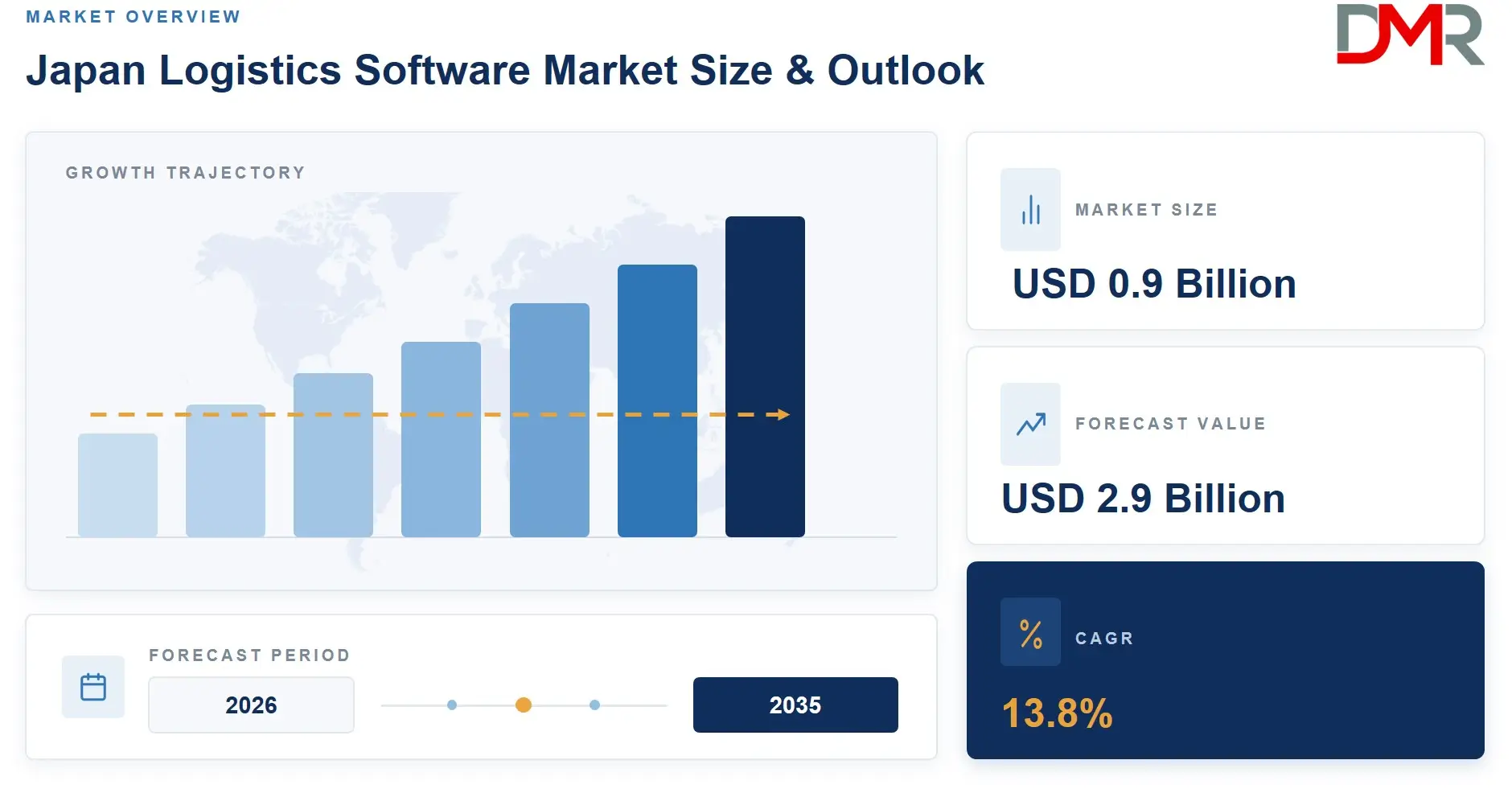
The Japan Logistics Software Market size is estimated to reach USD 0.9 Bn in 2026 and is further anticipated to reach USD 2.9 Bn by 2035, at a CAGR of 13.8%.
ℹ
To learn more about this report –
Download Your Free Sample Report Here
This assessment covers software revenue generated from logistics execution, planning, warehouse control, transport coordination, fleet operations, order orchestration and shipment visibility used inside Japan. It measures demand within Japan, not worldwide revenue booked by companies headquartered there.
These systems connect warehouse management, transportation management, enterprise resource planning, electronic data interchange, telematics and application programming interfaces. Buyers use them to coordinate inventory, labor, vehicles, carriers, delivery promises and compliance records across fragmented networks.
Retailers, manufacturers, third-party logistics providers, wholesalers, parcel operators and healthcare distributors are the principal users. Adoption is being pushed by labor scarcity, e-commerce complexity, tighter delivery planning and the need to integrate automation without replacing every legacy platform.
Use Cases
- Parcel Network Planning: National parcel operators deploy optimization software to balance depot capacity, line-haul schedules and delivery territories during seasonal peaks. The result is better use of existing vehicles and facilities without relying solely on additional labor.
- Factory Inbound Control: Automotive and electronics manufacturers coordinate supplier appointments, dock sequencing and returnable containers through shared logistics platforms. Procurement and plant logistics teams gain earlier exception signals, reducing production disruption caused by late or incomplete inbound shipments.
- Cold Chain Distribution: Food, pharmaceutical and laboratory distributors use temperature-aware transport workflows to assign shipments, record handoffs and escalate excursions. Quality managers receive a consistent audit trail while carriers can respond before a compromised load reaches the customer.
- Retail Replenishment: Multi-site retailers connect store demand, regional inventory and supplier lead times to prioritize replenishment. Merchandising and operations teams can reduce manual allocation work and direct scarce stock toward locations with the strongest immediate need.
Key Takeaways
- Market Size & Share: Japan demand is estimated at USD 0.9 Bn in 2026, with warehouse management software holding approximately 29%.
- Offering Analysis: Transportation management software is expected to expand at a CAGR of 16.2% through 2035.
- Demand Concentration: Kanto represents close to 38% of national demand in 2026 because headquarters, ports and parcel infrastructure cluster around Tokyo.
- Cloud Transition: Cloud deployment is projected to account for around 46% of 2026 revenue.
- Labor Economics: Automation-linked logistics software is gaining because operators must increase throughput without matching headcount growth.
- Buyer Behavior: Hybrid architectures remain important where large manufacturers require local control alongside hosted analytics.
How AI/Gen AI is Transforming the Japan Logistics Software Market?
AI is entering Japanese logistics software first through operational prediction rather than autonomous decision-making. Computer vision checks pallets, labels and loading conditions, while machine learning estimates arrival times from traffic, weather, historical routes and carrier behavior. These tools improve exception handling when data quality is sufficient.
Generative AI is more useful as an interface and documentation layer. It can summarize disruptions, translate operational instructions, retrieve contract clauses and draft regulatory records, but human planners still approve changes affecting safety, service commitments or inventory ownership.
- Computer Vision: Detects parcel and pallet anomalies at receiving points.
- LLM Document Processing: Extracts shipment details from Japanese forms, invoices and carrier messages.
- Digital Twins: Tests warehouse layouts, labor plans and dock policies before physical changes.
- RL Scheduling: Evaluates vehicle and dock sequences under changing constraints.
Key Drivers in the Japan Logistics Software Market
Demand is being shaped by labor economics and network complexity, not by software novelty alone.
- Labor-Constrained Throughput: Parcel, trucking and warehouse operators need more output from fixed teams. Software prioritizes work, sequences appointments and reduces telephone-based coordination, making productivity improvements measurable at the site level. Cloud deployment is projected to hold around 46% of 2026 revenue because smaller operators can access planning and visibility functions without building a large internal IT estate. As customers demand narrower delivery windows, operational data becomes a prerequisite for allocating scarce drivers and dock labor rather than an optional reporting layer.
- Multimodal Network Complexity: Japanese supply chains combine dense urban delivery, long-distance trucking, ports, factories and small subcontracted carriers. Transportation management and visibility tools connect these handoffs, allowing shippers to compare planned and actual movement. Transportation management software is expected to grow at a CAGR of 16.2% from 2026 to 2035 as manufacturers and retailers move from isolated fleet records toward shared execution workflows. The mechanism is integration, because each additional partner increases the cost of manual status collection and exception resolution.
Restraints in the Japan Logistics Software Market
Adoption still encounters structural friction inside conservative, heterogeneous operating environments.
- Legacy Integration Burden: Large manufacturers and logistics groups often operate customized ERP, warehouse controls, EDI links and depot applications. Replacing one layer can disrupt interfaces that have accumulated over decades, so buyers prefer phased deployments and middleware. That slows contract expansion and shifts budget toward implementation services. Cloud products can also face resistance where data residency, cybersecurity reviews or operational continuity requirements demand local controls, especially for facilities that cannot tolerate a failed connection during receiving or dispatch.
- Fragmented Carrier Capability: A shipper may coordinate many small transport firms with different telematics, scanning practices and levels of digital maturity. The platform therefore cannot deliver reliable visibility merely by adding a dashboard; partners must transmit standardized events. Onboarding costs, Japanese-language support and workflow customization raise the total cost of ownership. Smaller carriers may also view shared data as a negotiating risk, limiting coverage and reducing the value of network effects during the early years of a deployment.
Growth Opportunities in the Japan Logistics Software Market
White space is strongest where software can connect operationally important but poorly digitized participants.
- Regional Carrier Enablement: Lightweight mobile applications and usage-based pricing can bring smaller trucking companies into shipper visibility networks without demanding a full TMS installation. Vendors that bundle onboarding, Japanese support and telematics connectivity can sell through 3PLs and cooperatives, reducing the direct sales burden.
- Warehouse Robotics Orchestration: Distribution centers adding autonomous mobile robots, automated storage and retrieval systems or sortation need a coordination layer above individual equipment controls. A software-neutral orchestration product can link WMS priorities with robot fleets and labor workstations, creating an adjacency beyond conventional inventory records.
Trends in the Japan Logistics Software Market
Buyer priorities are shifting toward connected execution, measurable service performance and deployment flexibility.
- Composable Architecture: Enterprises increasingly prefer APIs and modular applications that preserve investments in ERP and warehouse controls. This favors vendors able to expose event streams, identity controls and workflow services rather than forcing a single replacement suite.
- Control-Tower Purchasing: Visibility is moving from periodic reporting toward exception-based management. Shippers want ETA confidence, inventory risk alerts and carrier performance views in one workspace, with alerts routed to the team that can act rather than simply displayed to executives.
Research Scope and Analysis
Segment performance is assessed across offering, deployment, application, end use industry and buyer channel. Each axis identifies where 2026 revenue is concentrated and which capability is expanding fastest through 2035, linking the pattern to Japan’s labor, network and integration conditions.
ℹ
To learn more about this report –
Download Your Free Sample Report Here
By Offering
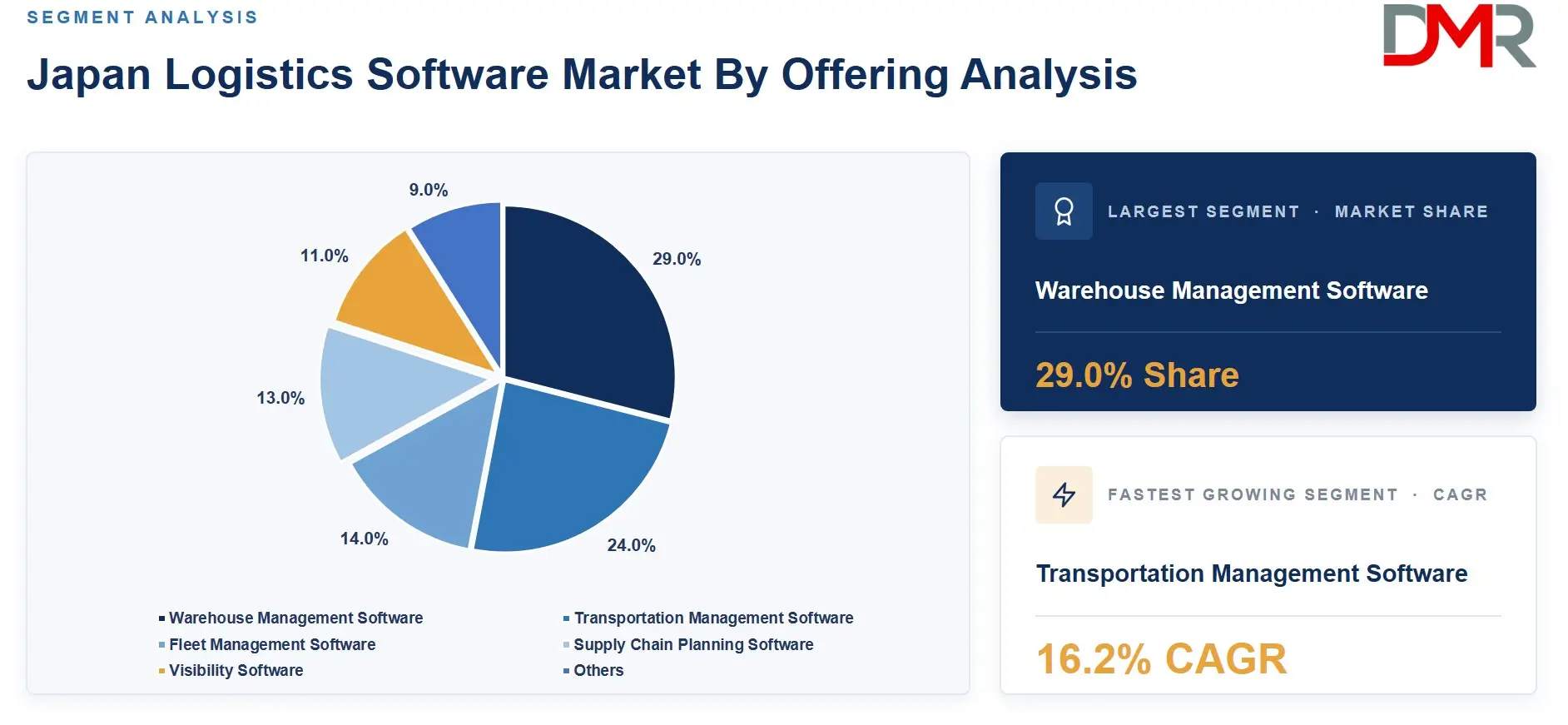
Warehouse Management Software holds the largest offering share in 2026, accounting for approximately 29% of revenue because distribution centers need inventory accuracy, slotting, receiving and fulfillment control. The installed base also creates recurring demand for extensions and integration. Growth, however, is concentrated in Transportation Management Software, advancing at a CAGR of 16.2% between 2026 and 2035 as shippers coordinate constrained carriers, delivery windows and multimodal handoffs. Visibility Software follows closely in strategic importance, but TMS has the clearer path to budget expansion where transport costs and service exceptions are visible to finance and operations leaders.
By Deployment
Cloud deployment is expected to represent around 46% of 2026 revenue, supported by subscription economics, remote access and faster updates for distributed logistics teams. It is particularly attractive to mid-sized 3PLs and retailers that lack extensive infrastructure staff. The steeper trajectory sits with Hybrid deployment, growing at a CAGR of 15.4% through 2035 as manufacturers retain local execution and connect selected analytics or collaboration workloads to hosted environments. Hybrid designs also accommodate facilities with intermittent connectivity, sensitive operational data or equipment interfaces that were not built for internet-native operation.
By Application
Inventory management is projected to lead applications in 2026 with a share of roughly 24%, reflecting the need to synchronize stock across plants, warehouses, stores and channels. Accuracy has direct effects on working capital and promised availability. Growth, however, is concentrated in route and delivery optimization, which is advancing at a CAGR of 17.1% as operators respond to dense urban routes, fuel costs and driver constraints. Better algorithms become more valuable when delivery windows narrow and when planners must combine subcontracted capacity with owned fleets.
By End Use Industry
Retail is set to hold close to 22% of 2026 demand, driven by omnichannel fulfillment, store replenishment and parcel-intensive commerce. Retailers require a common view of inventory and delivery commitments across many locations. The fastest expansion is expected in healthcare logistics, at a CAGR of 16.7%, as hospitals, laboratories and pharmaceutical distributors demand traceability, temperature records and dependable replenishment. Regulatory documentation and product criticality justify software investment even when shipment volumes are lower than in general merchandise.
By Distribution Channel
Direct enterprise sales are likely to account for nearly 41% of 2026 revenue because large manufacturers and 3PLs require process mapping, integration and change management. Complex buying committees favor vendors that can support multi-site rollouts. Growth, however, is concentrated in platform partnerships and 3PL channels, expanding at a CAGR of 15.8% as software firms use carriers, system integrators and logistics service providers to reach smaller shippers. Channel-led deployment reduces implementation friction and improves access to fragmented transport networks.
The Japan Logistics Software Market Report is Segmented Based on the Following
By Offering
- Warehouse Management Software
- Transportation Management Software
- Fleet Management Software
- Supply Chain Planning Software
- Visibility Software
- Others
By Deployment
- Cloud
- On-premise
- Hybrid
- Others
By Application
- Inventory Management
- Transport and Delivery Optimization
- Warehouse Operations
- Order Management
- Analytics and Visibility
- Others
By End Use Industry
- Retail
- Manufacturing
- Food and Beverage
- Healthcare
- Automotive
- Others
By Distribution Channel
- Direct Enterprise Sales
- System Integrators
- 3PL and Carrier Partnerships
- Cloud Marketplaces
- Resellers
- Others
Competitive Landscape
Competition is moderately fragmented between Japanese technology groups, global enterprise software vendors, logistics specialists and automation integrators. Large accounts prioritize integration depth, Japanese-language implementation and long support cycles, while smaller buyers value deployment speed and predictable subscription costs. Vendors compete through WMS and TMS breadth, visibility data, robotics connectivity, analytics and partnerships with carriers or 3PLs. Domestic providers retain credibility in legacy environments and local procurement, whereas international firms bring standardized cloud architectures and global supply-chain functionality.
Some of the Prominent Players in the Japan Logistics Software Market Are
- Fujitsu
- NEC Corporation
- Hitachi
- NTT DATA
- IBM
- SAP
- Oracle
- Manhattan Associates
- Blue Yonder
- JDA Software
- Descartes Systems Group
- Infor
- Kinaxis
- project44
- FourKites
- e2open
- o9 Solutions
- Coupa
- WiseTech Global
- C-NET
- Hacobu
- Logizard
- Loglass
- MonotaRO
- HIT-MALL
- Spiceworks
- Rakuten
- Yamato Holdings
- Sagawa Express
- Japan Post
- SG Holdings
- WMS Solutions
- Daifuku
- Geekplus
- Preferred Networks
- CyberLogitec
- Alibaba Cloud
- Samsung SDS
- Hyundai Glovis
- DHL Supply Chain
- Other Key Players
Recent Developments
- In March 2026, Japanese logistics technology vendors expanded AI-assisted planning and carrier collaboration functions, giving shippers more practical ways to manage constrained transport capacity.
- In January 2026, warehouse automation integrators increased software connections between robot fleets and execution systems, improving the commercial case for phased distribution-center upgrades.
- In August 2025, Japanese retailers and 3PLs continued deploying cloud logistics platforms for inventory and delivery coordination, increasing demand for implementation partners.
- In May 2025, transport operators tested data-sharing workflows for route and shipment visibility, helping establish more consistent event records across subcontracted fleets.
Report Details
| Report Characteristics |
| Market Size (2026) |
USD 0.9 Bn |
| Forecast Value (2035) |
USD 2.9 Bn |
| CAGR (2026–2035) |
13.8% |
| Historical Data |
2021 – 2025 |
| Forecast Data |
2026 – 2035 |
| Base Year |
2025 |
| Segments Covered |
By Offering, By Deployment, By Application, By End Use Industry, and By Distribution Channel |
| Regional Coverage |
The Japan |
Frequently Asked Questions
How big is the Japan Logistics Software Market?
▾ The Japan Logistics Software Market is estimated at USD 0.9 Bn in 2026 and is anticipated to reach USD 2.9 Bn by 2035. The estimate covers software demand inside Japan across logistics planning, execution, warehouse, transport, visibility and related operational workflows.
What is the growth rate of the Japan Logistics Software Market?
▾ The market is projected to expand at a CAGR of 13.8% from 2026 to 2035. Transportation management software is expected to grow faster, at 16.2%, as delivery constraints increase the value of coordinated planning and carrier data.
What is driving demand in the Japan Logistics Software Market?
▾ Labor scarcity is the strongest demand force. Operators are using workflow automation, route planning and shared shipment data to increase throughput without proportional headcount growth, while retailers and manufacturers need tighter control over inventory, delivery promises and subcontracted transport capacity.
Which offering leads the Japan Logistics Software Market?
▾ Warehouse Management Software leads with approximately 29% of 2026 revenue. Its position reflects the broad need to control receiving, storage, picking, replenishment and dispatch, including within facilities that are adding robotics or integrating with older enterprise systems.
Who are the key players in the Japan Logistics Software Market?
▾ Important participants include Fujitsu, NEC Corporation, Hitachi, NTT DATA, SAP, Oracle and Hacobu. The competitive field also includes warehouse automation companies, visibility specialists, Japanese logistics operators and system integrators serving domestic enterprise accounts.