Market Snapshot
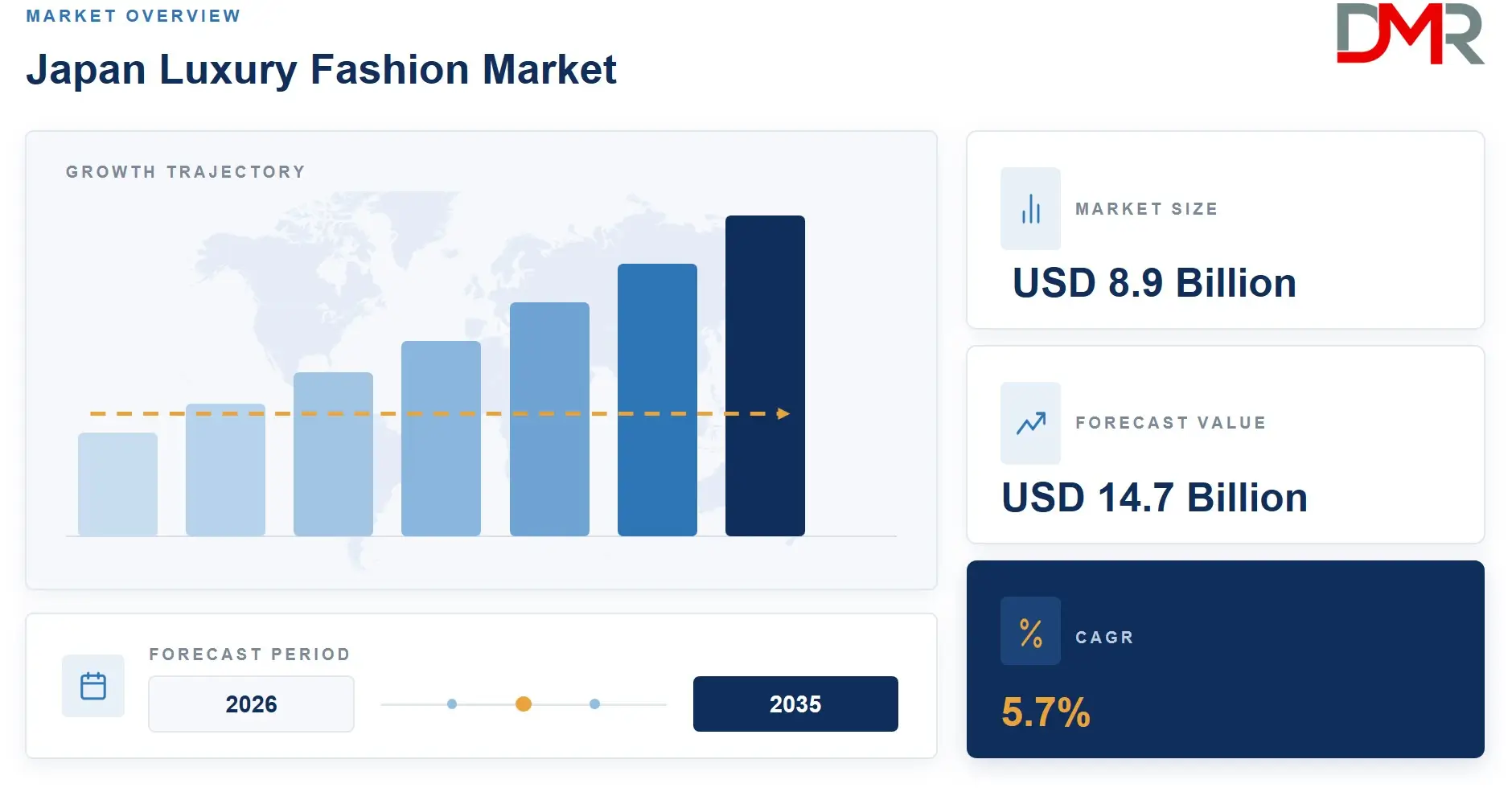
- Market Size (2026): USD 8.9 Bn
- Forecast Value (2035): USD 14.7 Bn
- CAGR (2026-2035): 5.7%
- Leading Product Type (2026): Apparel, around 34%
- Leading Consumer (2026): Women, close to 52%
- Key Players: Louis Vuitton, Chanel, Comme des Garçons and others
What is Japan Luxury Fashion Market and its Market Size?
The Japan Luxury Fashion Market size is estimated to reach USD 8.9 Bn in 2026 and is further anticipated to reach USD 14.7 Bn by 2035, at a CAGR of 5.7%.
ℹ
To learn more about this report –
Download Your Free Sample Report Here
Luxury fashion in this report covers high-end apparel, designer leather goods and bags, footwear and fashion accessories purchased inside Japan through brand-owned boutiques, department stores, select shops and digital channels. The sizing represents demand within Japan rather than worldwide revenue generated by Japanese fashion houses. It includes both resident purchases and spending by international visitors where the transaction occurs in the country.
Japan has a distinctive luxury demand structure. Tokyo and Osaka support dense networks of flagship stores, while department-store retail remains relevant for established clientele and curated select shops influence younger fashion buyers. Consumers typically place unusual weight on construction quality, service, provenance, limited editions and the cultural credibility of a house. That makes the market receptive to both European heritage brands and domestic designer labels with strong craft identities.
Structural change is coming from a broader mix of buyers, greater use of digital discovery, renewed visitor spending and the normalization of authenticated resale. Brands are responding with larger experiential stores, localized capsules, appointment-led clienteling and tighter integration between physical boutiques and online inventory. At the same time, price increases and currency movements are making value perception more important, pushing buyers to compare categories, channels and resale potential before committing to a purchase.
Use Cases
- Flagship Clienteling: Luxury houses use Ginza, Omotesando and central Osaka boutiques to serve high-value residents through private appointments, alterations, early access and limited releases. The store becomes a relationship platform rather than a simple transaction point, raising repeat purchase potential across apparel, bags, footwear and accessories.
- Department Store Luxury Floors: Department-store operators curate multiple designer houses for established shoppers who value service, loyalty benefits and convenient comparison. This format concentrates demand in one destination and gives brands access to customers who may prefer trusted retail institutions over standalone boutiques.
- Designer Select Shops: Select retailers and fashion-led specialty stores introduce domestic and international labels to younger consumers seeking scarcity, design credibility and cross-brand styling. Buyers use these stores to discover emerging designers, which can shift spending away from logo-led products toward craftsmanship and differentiated silhouettes.
- Visitor Shopping: International travelers purchase luxury fashion during trips to Tokyo, Osaka, Kyoto and other major destinations, often combining shopping with hospitality and cultural experiences. Brand availability, tax treatment, exchange rates and exclusive products influence conversion, making tourist traffic an important incremental demand pool for premium retail districts.
Key Takeaways
- Market Size & Share: Leather Goods & Bags are expected to represent approximately 29% of 2026 revenue, supported by high ticket values, gifting and durable brand icons.
- Distribution Channel Analysis: Mono-brand Boutiques are projected to hold roughly 46% of 2026 sales because leading houses protect assortment, service and client data through directly controlled stores.
- Demand Concentration: Domestic Residents are set to account for nearly 72% of 2026 spending, keeping local repeat clientele central even as visitor demand recovers.
- Digital Shift: Online Retail is forecast to expand at a CAGR of 9.1% through 2035 as digital discovery, reserve-in-store services and unified inventories reduce channel friction.
- Premiumization: Ultra-luxury is expected to grow at a CAGR of 7.4%, helped by scarcity, bespoke service and affluent buyers prioritizing distinctive products over broad logo visibility.
- Visitor Opportunity: International Visitors are projected to expand at a CAGR of 8.4% through 2035 as Japan remains a high-interest shopping destination for Asian and long-haul travelers.
How AI/Gen AI is Transforming the Japan Luxury Fashion Market?
AI is affecting luxury fashion in Japan mainly through merchandising, clienteling and operations rather than replacing the creative authority of designers. Demand forecasting models can combine store traffic, product attributes, local events and digital behavior to improve allocation across Tokyo, Osaka and regional stores. Computer vision can support product recognition and authentication workflows, while recommendation systems help client advisors narrow large assortments to items aligned with a shopper's purchase history.
Generative AI is also being used for controlled content adaptation, internal product knowledge and service support. Its value is highest when brand governance keeps generated material consistent with house codes and Japanese-language expectations. For luxury retailers, the commercial objective is less about automating the relationship and more about giving staff faster, better context before a customer interaction.
- Demand Forecasting: Machine-learning models improve size, color and store-level allocation for seasonal collections.
- Client Advisor Support: LLM-based knowledge tools summarize product stories, care instructions and customer preferences for staff.
- Authentication Assistance: Computer vision can flag visual inconsistencies in pre-owned bags, footwear and accessories for expert review.
- Content Localization: Generative systems accelerate draft translations and campaign variants while human teams retain final brand control.
Key Drivers in the Japan Luxury Fashion Market
Demand is being shaped by a combination of deep domestic luxury familiarity and Japan's role as a premium travel destination. The strongest drivers affect both purchase frequency and the value of each client relationship.
- Dense High-value Retail Ecosystems: Mono-brand Boutiques are expected to capture around 46% of 2026 revenue, reflecting the concentration of flagship retail in districts such as Ginza, Omotesando and Shinsaibashi. These locations combine brand architecture, private selling, repair services, hospitality and exclusive merchandise in a way that reinforces full-price purchasing. Japan also has sophisticated department stores and select shops, so consumers can move between controlled brand environments and curated multi-brand discovery. This density lowers the effort required to compare luxury products while raising service expectations, encouraging leading houses to keep investing in store quality and local clienteling.
- Resident Affluence and Luxury Literacy: Domestic Residents are projected to generate nearly 72% of 2026 spending. Japan has a long-established customer base that understands designer provenance, material quality and seasonal collections, which supports repeat purchasing beyond one-time status consumption. Mature buyers often value service continuity and craftsmanship, while younger consumers mix heritage brands with Japanese designers, streetwear and resale. This broadens the addressable audience without requiring the category to depend entirely on tourism. For brands, a resident-led base also makes CRM, appointment selling and after-sales service economically important because lifetime value can outweigh short-term footfall.
Restraints in the Japan Luxury Fashion Market
Growth is positive but constrained by affordability pressure and a highly demanding retail environment. These brakes can reduce unit volumes even when headline revenue benefits from higher prices.
- Price Inflation and Currency Sensitivity: Accessible Luxury is expected to represent about 39% of 2026 revenue, showing that a large share of demand still sits below the very top price tier. Repeated list-price increases can push aspirational buyers toward smaller accessories, domestic labels or authenticated resale rather than full-price bags and ready-to-wear. Currency movements also change Japan's relative attractiveness for visitors and affect imported merchandise economics. When perceived value diverges from price, consumers with strong product knowledge can delay purchases or switch houses, making indiscriminate price-led growth harder to sustain.
- High Cost of Physical Luxury Service: Department Stores are projected to hold close to 26% of 2026 sales, while brand-owned boutiques carry an even larger share. Both formats require premium locations, trained multilingual staff, inventory depth, visual merchandising and high-touch after-sales support. These fixed costs are difficult to dilute when footfall softens, and Japan's service standards make aggressive labor reduction risky. Smaller or emerging labels therefore face a distribution challenge: they need physical credibility to convert luxury customers, yet prime-space economics can absorb capital before a brand reaches sufficient scale.
Growth Opportunities in the Japan Luxury Fashion Market
White space is strongest where luxury service meets new buyer behavior. Digital commerce, visitor recovery and differentiated domestic design create routes to growth without relying only on additional conventional stores.
- Omnichannel Luxury Commerce: Online Retail is forecast to grow at a CAGR of 9.1% from 2026 to 2035, faster than the overall industry. The opportunity is not a pure shift to e-commerce; it is the connection of digital discovery with store inventory, appointment booking, remote clienteling and convenient returns. Luxury customers may research online and complete the transaction in a boutique where fit, material and service can be evaluated. Brands that unify customer profiles and inventory across channels can reduce lost sales while protecting the controlled experience that supports premium pricing.
- International Visitor Conversion: International Visitors are expected to expand at a CAGR of 8.4% through 2035. Tokyo and Osaka can capture more of this spending through multilingual service, destination flagships, Japan-exclusive products and coordinated hospitality experiences. Visitor demand is especially attractive for iconic leather goods, footwear and gifts because these categories travel easily and carry recognizable brand value. The opportunity also extends beyond transactions: a memorable Japan store experience can recruit clients who continue buying from the brand after returning home.
Trends in the Japan Luxury Fashion Market
Current shifts are changing what counts as luxury and how brands justify premium pricing. Craft, scarcity, resale awareness and experiential retail are becoming more visible in purchase decisions.
- Quiet Craft and Design Credibility: Men are expected to account for around 36% of 2026 revenue and are forecast to grow at a CAGR of 6.8% through 2035. Japanese consumers have strong exposure to designer menswear, technical construction and domestic labels, supporting demand for products where fabric, cut and finishing matter more than overt branding. This favors houses that can communicate provenance and material quality. It also gives Japanese designers room to compete with international luxury brands on cultural authority rather than advertising scale, particularly in apparel and footwear.
- Experiential Flagships and Cultural Collaboration: Apparel is projected to hold approximately 34% of 2026 revenue, but stores increasingly need to do more than display seasonal collections. Luxury houses are using exhibitions, food, architecture, artist partnerships and craft storytelling to turn flagships into destinations. In Japan, where retail presentation and cultural context carry unusual weight, these experiences can deepen brand meaning and encourage cross-category purchasing. The trend also supports localized capsules and collaborations that create scarcity without depending solely on logo-driven demand.
Research Scope and Analysis
Segment performance is assessed across product type, consumer, distribution channel, price tier and consumer group. Each axis identifies where 2026 revenue is concentrated and which sub-segment is moving fastest through 2035, with the commercial mechanism behind each position.
ℹ
To learn more about this report –
Download Your Free Sample Report Here
By Product Type
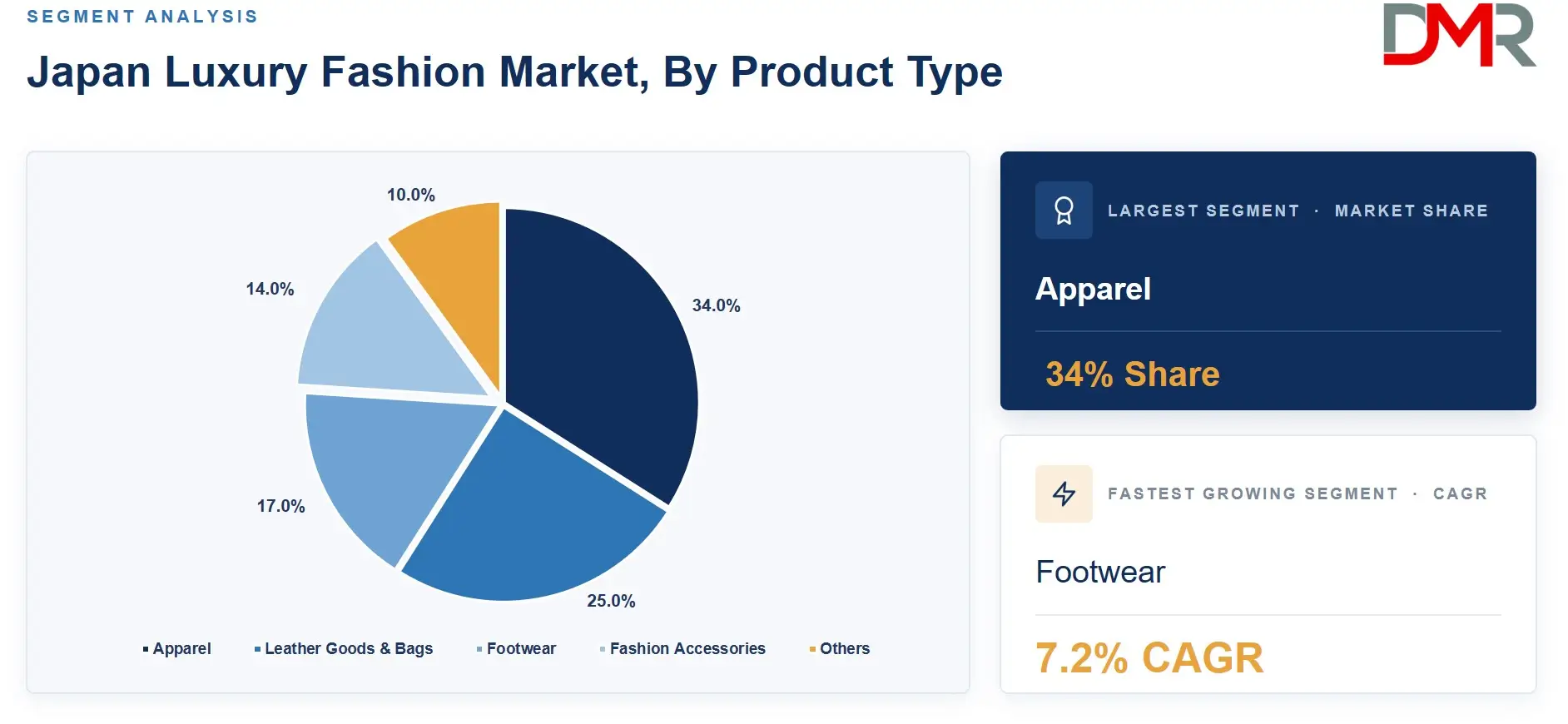
Apparel is projected to hold the largest share by product type in 2026, accounting for approximately 34% of revenue because Japan has a deep designer-clothing culture spanning international maisons, domestic luxury labels and influential select retail. Seasonal wardrobe purchases, tailoring and fashion-led menswear keep the category broad. Growth, however, is concentrated in Footwear, expanding at a CAGR of 7.2% between 2026 and 2035. Designer sneakers, loafers and fashion footwear sit at an accessible entry point relative to major leather goods, while collaborations and limited releases create repeat purchasing. Strong streetwear influence and the ease of mixing luxury shoes with non-luxury wardrobes further widen the buyer base.
By Consumer
Women are expected to remain the leading consumer segment in 2026 with close to 52% of revenue, supported by the breadth of women's ready-to-wear, handbags, footwear and accessories offered across major luxury houses. Established clienteling programs and department-store relationships also reinforce repeat purchases. The steeper trajectory sits with Men, growing at a CAGR of 6.8% through 2035. Japan's sophisticated menswear culture, designer awareness and acceptance of premium casualwear support category expansion beyond formal tailoring. International brands are also allocating more space to men's collections, while domestic labels create a strong discovery pipeline that keeps male consumers engaged with fashion as a recurring rather than occasional purchase.
By Distribution Channel
Mono-brand Boutiques are projected to lead distribution in 2026 with roughly 46% of sales because luxury houses prefer direct control over assortment, pricing, client data and service. Flagships in major shopping districts also act as brand media, making store investment part of customer acquisition. Growth, however, is concentrated in Online Retail, which is forecast to expand at a CAGR of 9.1% from 2026 to 2035. Digital channels increasingly support research, product reservation, remote selling and replenishment rather than functioning as isolated web shops. Better inventory visibility and mobile-first client communication allow brands to serve customers outside prime retail districts while still routing high-value interactions to physical stores when needed.
By Price Tier
Accessible Luxury is expected to account for around 39% of 2026 revenue, reflecting the importance of entry products such as small leather goods, scarves, fashion jewelry, sneakers and selected ready-to-wear. These products recruit younger or occasional buyers while preserving participation in premium brands. The fastest growth is expected in Ultra-luxury at a CAGR of 7.4% through 2035. Affluent clients are becoming more selective, but scarcity, bespoke service, rare materials and limited production can support spending at the top end even when aspirational demand is pressured. Brands with credible craftsmanship and private-client capabilities are therefore positioned to capture a larger share of wallet from fewer, higher-value transactions.
By Consumer Group
Domestic Residents are projected to contribute nearly 72% of 2026 revenue, giving Japan a resident-led demand base that supports year-round boutique economics and long-term clienteling. Local consumers also sustain categories that depend on fit, alterations and repeat seasonal engagement. Growth, however, is concentrated in International Visitors, expanding at a CAGR of 8.4% between 2026 and 2035. Japan's tourism appeal, dense luxury districts and reputation for service make fashion shopping part of the travel itinerary. Visitor conversion will still vary with exchange rates and tax rules, but exclusive products, multilingual service and destination retail can increase spending per trip and spread demand beyond the most obvious flagship locations.
The Japan Luxury Fashion Market Report is Segmented Based on the Following
By Product Type
- Apparel
- Leather Goods & Bags
- Footwear
- Fashion Accessories
- Others
By Consumer
- Women
- Men
- Unisex
- Children
- Others
By Distribution Channel
- Mono-brand Boutiques
- Department Stores
- Multi-brand & Select Shops
- Online Retail
- Others
By Price Tier
- Accessible Luxury
- Premium Luxury
- Ultra-luxury
- Others
By Consumer Group
- Domestic Residents
- International Visitors
- Others
Competitive Landscape
Competition in Japan combines international luxury groups with independent European houses, Japanese designer brands and influential domestic retailers. Scale matters for flagship investment, media visibility and clienteling technology, but design credibility can outweigh size in fashion-led niches. International houses compete through prime locations, limited editions, cultural collaborations and controlled distribution, while Japanese labels differentiate through fabrication, silhouette and local creative authority. Select shops and department stores remain important discovery and trust channels, particularly for brands without extensive standalone networks. Resale transparency is also raising the importance of product durability and secondary-market desirability. As a result, competitive advantage increasingly depends on a house's ability to protect scarcity while maintaining enough product flow, service quality and local relevance to support repeat purchasing.
Some of the Prominent Players in the Japan Luxury Fashion Market Are
- Louis Vuitton
- Dior
- Chanel
- Hermès
- Gucci
- Prada
- Bottega Veneta
- Saint Laurent
- Burberry
- Celine
- Loewe
- Fendi
- Giorgio Armani
- Moncler
- Valentino
- Balenciaga
- Brunello Cucinelli
- Dolce & Gabbana
- Salvatore Ferragamo
- Zegna
- Maison Margiela
- Comme des Garçons
- Issey Miyake
- Yohji Yamamoto
- Sacai
- A Bathing Ape
- Visvim
- Undercover
- Auralee
- Kolor
- Toga
- Ambush
- Human Made
- Mame Kurogouchi
- Onward Holdings
- Sanyo Shokai
- TSI Holdings
- Baycrew's
- United Arrows
- Beams
- Other Key Players
Recent Developments
- In July 2026, LVMH reported that Japan returned to growth in the first half, indicating firmer local luxury demand after the prior comparison period had been distorted by unusually strong tourist spending.
- In 2026, LVMH scheduled new Dior, Fendi, Chaumet and Bulgari openings in Osaka, reinforcing the city's role as a second major luxury hub alongside Tokyo and expanding directly controlled retail capacity.
- In 2025, LVMH expanded its Japan footprint with planned Tiffany & Co. and Loewe openings in Ginza, adding new high-profile locations in one of the country's most concentrated luxury shopping districts.
- In April 2025, Dior presented its Fall collection at Kyoto's To-ji Temple, using Japanese craft references and a destination runway format to deepen cultural positioning with local and international luxury audiences.
- In April 2025, LVMH participated as a major partner of the French Pavilion at the Osaka-Kansai Expo, where Louis Vuitton and Dior installations connected brand heritage with Japanese craft and cultural engagement.
Report Details
| Report Characteristics |
| Market Size (2026) |
USD 8.9 Bn |
| Forecast Value (2035) |
USD 14.7 Bn |
| CAGR (2026-2035) |
5.7% |
| Historical Data |
2021 - 2025 |
| Forecast Data |
2026 - 2035 |
| Base Year |
2025 |
| Segments Covered |
By Product Type, By Consumer, By Distribution Channel, By Price Tier and By Consumer Group |
| Regional Coverage |
Japan |
Frequently Asked Questions
How big is the Japan Luxury Fashion Market?
▾ The domestic market is estimated at USD 8.9 Bn in 2026. This figure covers luxury apparel, leather goods and bags, footwear and fashion accessories purchased in Japan through physical and digital channels. It includes transactions by residents and international visitors but excludes worldwide revenue earned by Japanese fashion companies outside the country.
What is the growth rate of the Japan Luxury Fashion Market?
▾ Industry revenue is forecast to expand at a CAGR of 5.7% from 2026 to 2035. Growth is supported by high-value resident clientele, visitor shopping, premium retail investment and faster digital channel adoption, while repeated price increases, currency movements and high store operating costs keep the trajectory below high-growth consumer technology categories.
What is driving demand in the Japan Luxury Fashion Market?
▾ Demand is driven by Japan's established luxury-buying culture, dense premium retail districts, high service expectations and the country's appeal to international travelers. Consumers value craftsmanship, provenance, limited availability and strong retail presentation. Brand investment in destination flagships and localized cultural activity also helps convert interest into full-price purchases and repeat client relationships.
Who are the key players in the Japan Luxury Fashion Market?
▾ Key participants include Louis Vuitton, Chanel, Hermès, Gucci, Comme des Garçons, Issey Miyake and Yohji Yamamoto. The competitive set combines international heritage houses with Japanese designer brands and domestic retail groups. Their strategies differ, but most compete through design authority, controlled distribution, flagship experience, clienteling and the ability to sustain product scarcity.
Which product type holds the largest share in the Japan Luxury Fashion Market?
▾ Apparel is expected to lead product type revenue with approximately 34% in 2026. Japan's strong designer-clothing culture, seasonal buying behavior and influential menswear and select-shop ecosystem support the category. Leather goods remain a major adjacent pool, while footwear is expected to grow faster as collaborations and premium casual dressing widen participation.
How important is online retail to luxury fashion sales in Japan?
▾ Online remains smaller than store-led luxury retail but is becoming strategically important because shoppers increasingly discover, compare and reserve products digitally. Growth is strongest where websites and mobile clienteling connect directly with boutique inventory and service. This allows brands to extend reach beyond prime shopping districts without giving up the controlled physical experience used for high-value conversion.
What will shape the Japan Luxury Fashion Market through 2035?
▾ The Japan Luxury Fashion Market will be shaped by the balance between premium pricing and perceived value, the recovery and composition of visitor spending, digital-to-store integration, resale awareness and demand for culturally credible craftsmanship. Houses that combine strong product identity with localized service and disciplined distribution are positioned to capture growth without relying only on store expansion.