Market Snapshot
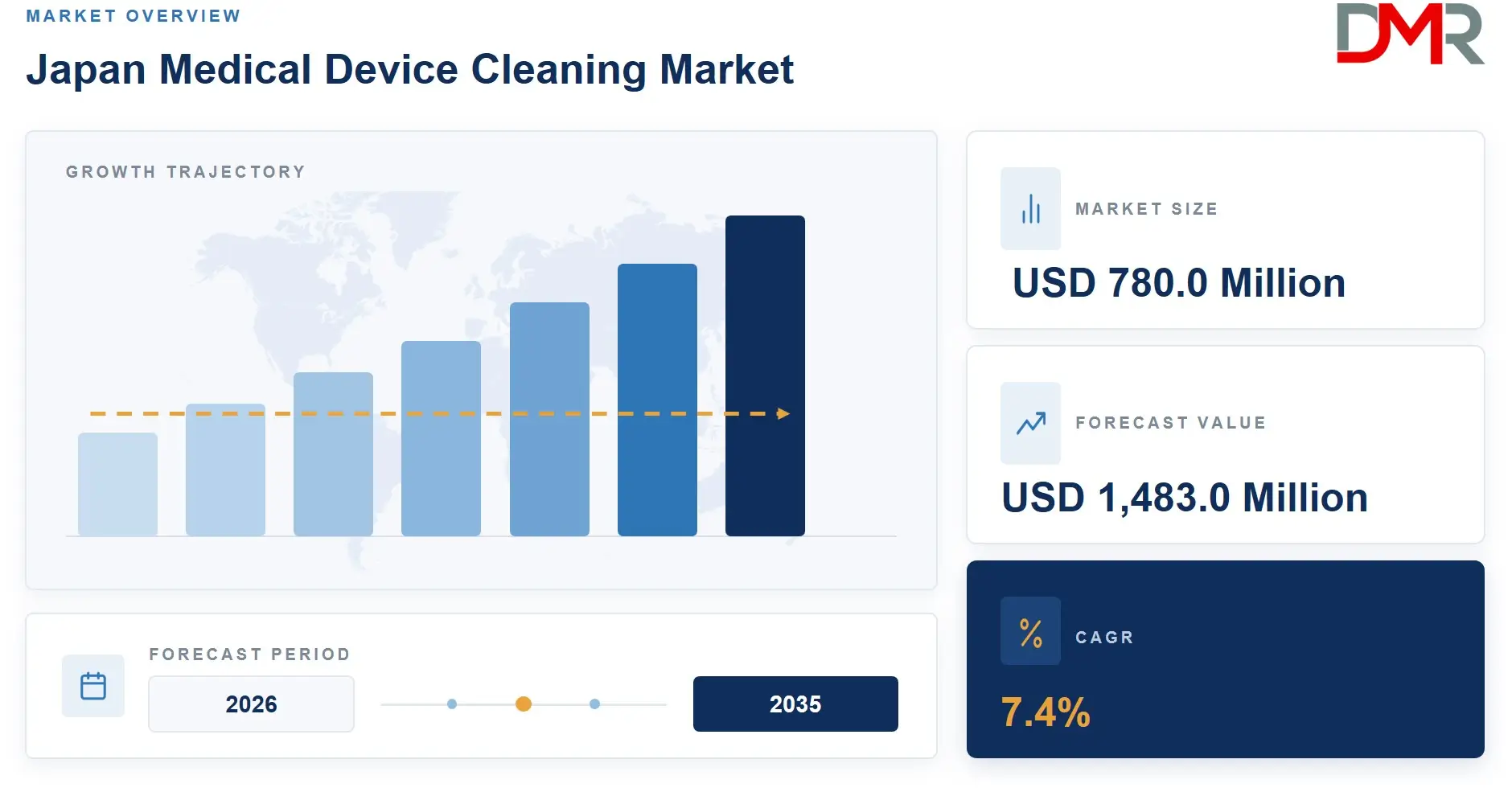
- Market Size (2026): USD 780.0 Mn
- Forecast Value (2035): USD 1,483.0 Mn
- CAGR (2026-2035): 7.4%
- Leading Device Type (2026): Critical devices, approximately 46%
- Leading Technique (2026): Disinfection, around 39%
- Key Players: Olympus Corporation, Getinge AB, STERIS plc and others
What is Japan Medical Device Cleaning Market and its Market Size?
The Japan Medical Device Cleaning Market size is estimated to reach USD 780.0 Mn in 2026 and is further anticipated to reach USD 1,483.0 Mn by 2035, at a CAGR of 7.4%. Medical device cleaning covers the removal of blood, tissue, biofilm, chemicals and other contamination from reusable instruments before disinfection or sterilization. The scope includes cleaning chemistries, automated washer-disinfectors, ultrasonic systems, point-of-use products, reprocessing support and associated services purchased for use inside Japan.
ℹ
To learn more about this report –
Download Your Free Sample Report Here
The figures represent demand generated by Japanese hospitals, clinics, dental facilities, ambulatory centers, laboratories and outsourced sterile processing organizations. They do not represent worldwide revenue of companies headquartered in Japan. The market boundary includes reusable surgical instruments, endoscopes, dental instruments, selected respiratory and diagnostic accessories, and other devices that require validated reprocessing between patient uses.
Demand is structurally linked to procedure volumes and to the need for consistent infection prevention in an aging healthcare system. Complex devices with narrow channels, hinges, lumens and heat-sensitive materials require more controlled cleaning than conventional metal instruments. This shifts spending from basic manual washing toward validated chemistries, automated cycles, drying, traceability and documentation that can support hospital quality management.
Operational pressure is also changing purchasing criteria. Hospitals increasingly evaluate cleaning equipment on throughput, water and energy use, cycle documentation, instrument compatibility and labor savings, not only acquisition price. Reprocessing therefore sits at the intersection of infection control, staff productivity, asset utilization and regulatory readiness, which supports steady replacement demand even where overall hospital capacity grows slowly.
Use Cases
- Central Sterile Supply Departments: Hospital CSSD teams deploy washer-disinfectors, enzymatic detergents and ultrasonic systems to remove soil from reusable surgical sets before sterilization, improving process repeatability while reducing dependence on manual scrubbing across high-volume instrument flows.
- Endoscopy Units: Gastroenterology and respiratory departments use point-of-use pre-cleaning, leak testing, automated reprocessing and drying workflows for flexible endoscopes, where long internal channels and heat sensitivity make validated cleaning especially important for contamination control and rapid scope turnaround.
- Dental Facilities: Dental hospitals and larger clinics process hand instruments, burs and reusable accessories through compact cleaning and disinfection systems, helping standardize instrument turnover in settings with limited sterile-processing space and frequent short-cycle treatment schedules.
- Outsourced Reprocessing Services: Third-party sterile processing providers clean, inspect, package and manage reusable instrument inventories for multiple facilities, allowing hospitals to shift fixed processing workloads externally while gaining more standardized traceability and capacity planning.
Key Takeaways
- Market Size & Share: Critical devices are projected to account for approximately 46% of 2026 revenue because invasive instruments require the most demanding validated cleaning before terminal sterilization.
- Device Type Analysis: Semi-critical devices are forecast to expand at a CAGR of 8.5% through 2035 as endoscopy volumes and heat-sensitive reusable devices increase reprocessing intensity.
- Demand Concentration: Japan is estimated internally to represent roughly 5.4% of the worldwide parent opportunity in 2026, reflecting a large installed base of advanced reusable medical equipment.
- Product Analysis: Chemistries are expected to hold close to 54% of 2026 product revenue because detergents and disinfectants are recurring consumables across nearly every reprocessing cycle.
- Automation Shift: Automated washer-disinfectors are expected to grow at a CAGR of 9.5% through 2035 as facilities seek repeatability, digital records and lower manual handling.
- End User Analysis: Hospitals are set to represent around 61% of 2026 demand due to their concentration of surgery, endoscopy, emergency care and centralized sterile processing workloads.
How AI/Gen AI is Transforming the Japan Medical Device Cleaning Market?
AI is influencing medical device cleaning mainly through workflow control rather than direct generation of cleaning protocols. Computer vision can support instrument recognition, tray verification and post-cleaning inspection, while anomaly detection models can flag unusual cycle temperatures, pressures, detergent dosing or equipment performance. In high-throughput sterile processing departments, these tools can reduce missed steps and direct technicians toward exceptions rather than requiring the same level of manual review for every cycle.
Generative AI has a narrower but practical role in documentation. Large language models can summarize service logs, convert equipment events into maintenance notes, support staff training content and help organize standard operating procedures around approved instructions for use. Digital twins and predictive models can also simulate equipment utilization and identify bottlenecks without changing validated cleaning parameters.
- Visual inspection assistance: Image models can help identify residual soil, corrosion or damaged instrument surfaces that need human review.
- Predictive maintenance: Machine learning can use pump, temperature and cycle data to anticipate washer-disinfector service needs and reduce unplanned downtime.
- Document processing: LLM systems can organize cleaning records, maintenance history and manufacturer instructions into searchable compliance workflows.
- Capacity scheduling: Optimization models can balance instrument demand, cycle duration and staff availability across CSSD operations.
Key Drivers in the Japan Medical Device Cleaning Market
Demand is supported by infection-control requirements and by the operating economics of reusable medical equipment. The strongest forces come from complex reprocessing needs and labor-sensitive hospital workflows.
- High Utilization of Reusable and Complex Devices: Critical devices are expected to account for approximately 46% of 2026 market revenue, showing how deeply spending is tied to instruments that enter sterile tissue or the vascular system. Surgical sets, minimally invasive instruments and accessories cannot be safely returned to service without effective soil removal before sterilization. Japan's mature surgical infrastructure creates a large installed base that must be processed every day. As device designs incorporate lumens, polymer components and delicate surfaces, hospitals need compatible detergents, validated contact times and controlled mechanical action, raising the value of specialized cleaning rather than general-purpose washing.
- Need to Reduce Manual Processing Burden: Hospitals are projected to hold around 61% of 2026 demand, concentrating cleaning workloads in institutions that also face staffing constraints and high documentation requirements. Automated washer-disinfectors can standardize cycle parameters and reduce repetitive manual handling, while digital records improve traceability for quality teams. The mechanism is operational rather than simply technological: when staff time is limited, each avoided manual step releases capacity for inspection, assembly and sterile distribution. This supports equipment upgrades, closed-loop dosing and reprocessing software that can show whether an instrument completed the required sequence.
Restraints in the Japan Medical Device Cleaning Market
Growth is moderated by replacement economics, device compatibility and the procedural discipline needed to validate changes. Hospitals cannot switch reprocessing methods solely because a new system appears more efficient.
- Capital Cost and Validation Friction: Equipment represents roughly 36% of 2026 product spending, but washer-disinfectors and associated infrastructure can require plumbing, utilities, ventilation, software integration and workflow redesign. A purchasing decision therefore extends beyond the machine price. Facilities must prove that cycles remain compatible with instrument manufacturers' instructions, staff practices and local infection-control procedures. Smaller hospitals and clinics may keep functional equipment longer or rely on manual processes where throughput is too low to justify automation, which slows replacement cycles and favors incremental upgrades over broad fleet renewal.
- Compatibility Limits Across Mixed Device Fleets: Disinfection is expected to account for around 39% of 2026 technique revenue, yet heat-sensitive polymers, optics, adhesives and narrow channels cannot all be processed identically. A chemistry effective for one device may be unsuitable for another material, while automated racks and connectors may need device-specific configuration. This creates a fragmented validation burden and raises training requirements. The result is persistent demand for multiple cleaning pathways rather than a single standardized platform, which can increase inventory complexity and make purchasing committees cautious about replacing established procedures.
Growth Opportunities in the Japan Medical Device Cleaning Market
White space is strongest where hospitals can combine infection prevention with measurable labor, throughput and traceability benefits. Vendors that integrate equipment, chemistry and workflow data are positioned to capture more of each reprocessing account.
- Automated Endoscope and Lumened-Device Workflows: Automated washer-disinfectors are forecast to grow at a CAGR of 9.5% through 2035, faster than the overall industry, because complex devices expose the limits of manual cleaning consistency. Opportunity extends beyond the core washer to channel irrigation, leak testing, drying, storage and digital traceability. Suppliers can differentiate through faster turnaround, validated connector sets and lower water or chemistry consumption. Endoscopy departments are especially attractive because device utilization is high, missed cleaning steps carry serious risk and hospitals can quantify the value of shorter turnaround when expensive scopes are used repeatedly during a procedure day.
- Outsourced and Networked Sterile Processing: Services represent about 10% of 2026 product-related revenue, leaving room for third-party processors, equipment-as-a-service models and remote workflow support. Hospitals with constrained sterile-processing space can shift selected workloads externally, while larger networks can centralize instrument tracking and maintenance. Vendors can participate through service contracts, consumables, data platforms and lifecycle management rather than one-time equipment sales. The commercial advantage is recurring revenue tied to processing volume, while buyers gain more predictable capacity and can avoid maintaining redundant equipment at every smaller facility.
Trends in the Japan Medical Device Cleaning Market
Technology purchases are moving toward connected workflows, resource efficiency and closed-loop traceability. These trends change how hospitals compare suppliers even when the underlying cleaning chemistry remains established.
- Digital Traceability from Dirty Receipt to Clean Release: Semi-critical devices are projected to grow at a CAGR of 8.5%, increasing the value of traceability in endoscopy and other high-turnover settings. Facilities are linking device IDs, washer cycles, operators and maintenance records so quality teams can reconstruct the reprocessing history of individual instruments. This favors scanners, software interfaces and cloud analytics that sit around the cleaning equipment. The trend also raises the importance of interoperable data, because hospitals increasingly expect equipment information to support audit, asset management and staffing decisions rather than remain isolated in a machine log.
- Lower-Resource Cleaning Cycles: Chemistries are expected to represent close to 54% of 2026 product revenue, making dosing efficiency and environmental burden commercially meaningful. Buyers are comparing concentrated detergents, lower-temperature cycles, controlled dosing and reduced rinse requirements to lower water, energy and chemical consumption. Equipment suppliers are responding with sensors and cycle optimization, while chemical suppliers are emphasizing compatibility with automated systems. Sustainability alone rarely drives a purchase, but when lower resource use also shortens cycle time or reduces handling, it strengthens the business case for changing established reprocessing practices.
Research Scope and Analysis
Segment performance is assessed across device type, technique, product, cleaning method and end user. Each axis shows where 2026 revenue is concentrated and which sub-segment is expected to expand fastest through 2035, together with the operational reasons behind those positions.
ℹ
To learn more about this report –
Download Your Free Sample Report Here
By Device Type
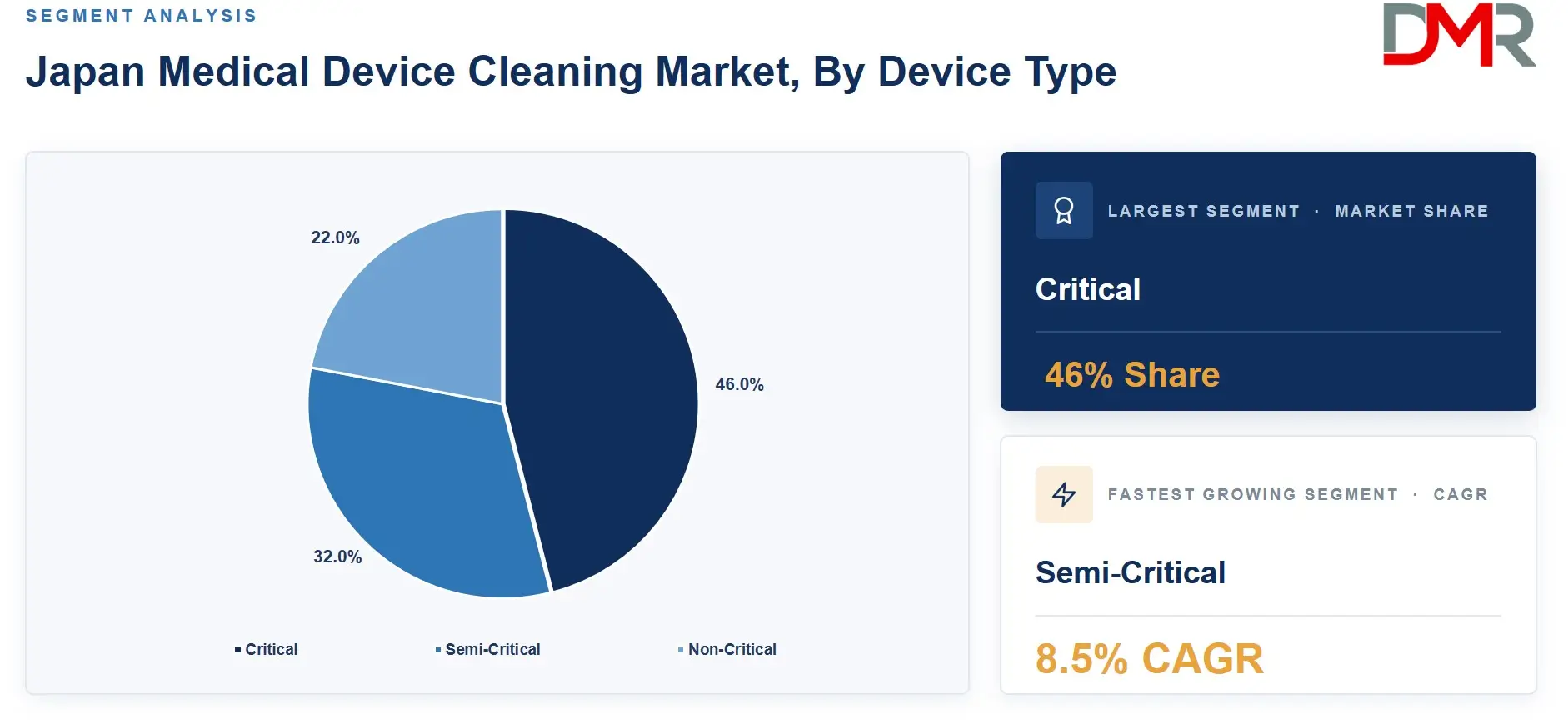
Critical devices are projected to hold the largest share by device type in 2026, accounting for approximately 46% of revenue, because instruments that contact sterile tissue demand rigorous pre-sterilization cleaning and inspection. Surgical sets and invasive reusable devices also create high repeat volumes in hospitals. Growth, however, is concentrated in semi-critical devices, expanding at a CAGR of 8.5% between 2026 and 2035 as endoscopy, respiratory and other mucosal-contact procedures increase the use of heat-sensitive reusable equipment. Their channels and complex surfaces require detailed pre-cleaning, high-level disinfection and controlled drying, which raises spending per reprocessing cycle and supports specialized consumables and automated systems.
By Technique
Disinfection is expected to lead the technique mix in 2026 with a share of roughly 39%, supported by recurring use of high-level and intermediate disinfection for semi-critical instruments and environmental contact components. Its position reflects the large installed base of reusable devices that cannot always tolerate terminal heat sterilization. The steeper trajectory sits with sterilization, forecast to grow at a CAGR of 8.4% from 2026 to 2035 as hospitals adopt more controlled low-temperature and validated terminal processes around complex instruments. Growth is also supported by tighter integration between cleaning verification and downstream sterilization records, making the full reprocessing sequence more measurable and reducing tolerance for incomplete upstream cleaning.
By Product
Chemistries are set to account for close to 54% of product revenue in 2026 because detergents, enzymatic cleaners and disinfectants are consumed repeatedly across manual and automated workflows. Recurring replacement keeps this category larger than capital equipment even when individual machines carry high unit values. Equipment is the fastest-growing product group, advancing at a CAGR of 9.1% through 2035 as hospitals replace aging washers and add automated systems for endoscopes, surgical instruments and compact care settings. The shift is supported by digital cycle records, controlled dosing and more predictable processing, which help buyers justify equipment spending through labor savings and quality consistency rather than through infection prevention alone.
By Cleaning Method
Manual cleaning is projected to retain the largest 2026 share at around 38%, since point-of-use wiping, brushing, flushing and hand treatment remain necessary for many instrument geometries before automated processing. It also remains common in lower-volume facilities where capital automation is difficult to justify. Growth, however, is concentrated in automated washer-disinfectors, which are forecast to expand at a CAGR of 9.5% between 2026 and 2035. Facilities are adopting them to standardize exposure time, temperature, mechanical action and chemistry dosing while reducing repetitive handling. Integration with tracking systems further improves their economics by turning each cycle into a recorded event that can support audit and instrument workflow management.
By End User
Hospitals are expected to command around 61% of end-user revenue in 2026 because they combine surgery, endoscopy, emergency care and inpatient procedures with centralized sterile processing infrastructure. Their scale supports both recurring chemistry purchases and investment in high-capacity washers, ultrasonic units and reprocessing software. The fastest expansion is expected in ambulatory surgical centers at a CAGR of 8.8% through 2035 as more procedures shift toward shorter-stay settings and dedicated specialty facilities. These centers require compact, fast-turnaround systems that fit constrained footprints while still supporting validated cleaning and documentation, creating demand for benchtop equipment, smaller automated washers and service packages tailored to lower instrument volumes.
The Japan Medical Device Cleaning Market Report is Segmented Based on the Following
By Device Type
- Critical
- Semi-Critical
- Non-Critical
By Technique
- Cleaning
- Disinfection
- Sterilization
By Product
- Chemistries
- Equipment
- Services
By Cleaning Method
- Manual Cleaning
- Automated Washer-Disinfectors
- Ultrasonic Cleaning
- Point-of-Use & Pre-Cleaning
By End User
- Hospitals
- Clinics
- Ambulatory Surgical Centers
- Dental Facilities
- Laboratories
- Others
Competitive Landscape
Competition combines large infection-prevention groups, Japanese medical technology manufacturers, specialist chemistry suppliers and sterile-processing equipment vendors. The market is not defined by a single technology, so suppliers compete on instrument compatibility, validated efficacy, service response, installed-base relationships, water and energy efficiency, and the ability to connect cleaning data with broader sterile-processing records. Japanese manufacturers retain an advantage in local clinical relationships and device knowledge, while multinational groups bring wide washer, sterilizer and consumables portfolios. Strategy is shifting toward bundled reprocessing workflows that combine equipment, detergents, tracking and maintenance. Vendors that can prove lower handling time and reliable cycle documentation are better positioned to defend accounts as hospitals scrutinize both infection-control performance and operating cost.
Some of the Prominent Players in the Japan Medical Device Cleaning Market Are
- Olympus Corporation
- HOYA Corporation
- Terumo Corporation
- Nipro Corporation
- Saraya Co., Ltd.
- AMTEC CO., LTD.
- Yoshida Pharmaceutical Co., Ltd.
- Clean Chemical Co., Ltd.
- Udono Limited
- Sakura Seiki Co., Ltd.
- Hogy Medical Co., Ltd.
- Kawamoto Corporation
- Hakuzo Medical Corporation
- Osaki Medical Corporation
- JMS Co., Ltd.
- Senko Medical Instrument Mfg. Co., Ltd.
- TOP Corporation
- Asahi Kasei Medical Co., Ltd.
- Toray Medical Co., Ltd.
- Nikkiso Co., Ltd.
- STERIS plc
- Getinge AB
- Advanced Sterilization Products
- Belimed AG
- Steelco S.p.A.
- MMM Group
- MELAG Medizintechnik GmbH & Co. KG
- Tuttnauer
- Miele & Cie. KG
- Ecolab Inc.
- Solventum Corporation
- Nanosonics Limited
- Tristel plc
- Germitec
- Shinva Medical Instrument Co., Ltd.
- KEN Hygiene Systems A/S
- W&H Dentalwerk Bürmoos GmbH
- Matachana Group
- COLTENE Group
- Metrex Research, LLC
- Other Key Players
Recent Developments
- In October 2025, Olympus began a domestic proof-of-concept for a cloud solution that collects and visualizes operating data from endoscopy systems and endoscope cleaning equipment, linking reprocessing utilization with equipment management and workflow optimization.
- In September 2025, Kagawa University issued a procurement notice for a washer-disinfector set for its university hospital, illustrating continued institutional replacement demand for automated medical instrument reprocessing equipment within Japan.
- In June 2025, NTT Medical Center Tokyo requested supplier materials for four washer-disinfectors capable of cleaning surgical and ward instruments while connecting to the facility's sterilization department system, highlighting demand for integrated high-acuity reprocessing workflows.
- In July 2024, medical bear partnered with Getinge to integrate the T-DOC sterile supply management system into its Japanese outsourcing operation, demonstrating how third-party reprocessing providers are using digital traceability to improve sterile workflow control.
Report Details
| Report Characteristics |
| Market Size (2026) |
USD 780.0 Mn |
| Forecast Value (2035) |
USD 1,483.0 Mn |
| CAGR (2026-2035) |
7.4% |
| Historical Data |
2021 - 2025 |
| Forecast Data |
2026 - 2035 |
| Base Year |
2025 |
| Segments Covered |
By Device Type, By Technique, By Product, By Cleaning Method, and By End User |
| Regional Coverage |
Japan |
Frequently Asked Questions
How big is the Japan Medical Device Cleaning Market?
▾ The domestic market is estimated at USD 780.0 Mn in 2026. This value covers cleaning chemistries, equipment and related reprocessing services purchased for reusable medical devices inside Japan, including hospital, clinic, dental, laboratory and ambulatory care demand. It excludes worldwide sales of Japanese manufacturers generated outside the country.
What is the growth rate of the Japan Medical Device Cleaning Market?
▾ Industry revenue is forecast to expand at a CAGR of 7.4% from 2026 to 2035. Growth is supported by automated reprocessing, rising endoscopy complexity, hospital labor constraints and the need for stronger traceability, while capital budgets and device-specific validation requirements keep expansion below frontier medical technology categories.
What is driving demand in the Japan Medical Device Cleaning Market?
▾ Demand is being driven by intensive reuse of surgical and endoscopic equipment, infection-control requirements and the need to standardize reprocessing despite staffing pressure. Critical devices account for approximately 46% of 2026 revenue, showing how much spending is connected to instruments that require thorough cleaning before disinfection or sterilization.
Who are the key players in the Japan Medical Device Cleaning Market?
▾ Key participants include Olympus Corporation, Getinge AB, STERIS plc, Advanced Sterilization Products, AMTEC CO., LTD., Saraya Co., Ltd. and Yoshida Pharmaceutical Co., Ltd. Competition spans equipment, detergents, disinfectants, digital sterile-processing systems and service support, so no single company type covers the entire reprocessing workflow.
Which product segment holds the largest share?
▾ Chemistries are expected to hold the largest product share in 2026 at close to 54%. Detergents, enzymatic cleaners and disinfectants are consumed during repeated cleaning cycles, creating recurring purchasing demand across both manual and automated workflows. Equipment remains strategically important, but its replacement cycle is substantially longer than that of consumable chemistry.
Which cleaning method is growing fastest?
▾ Automated washer-disinfectors are forecast to record the fastest growth at a CAGR of 9.5% from 2026 to 2035. Hospitals are adopting automation to improve repeatability, reduce manual handling and create digital cycle records. The strongest use cases occur where instrument throughput is high enough to convert labor savings and traceability into measurable operating value.
What will shape the Japan Medical Device Cleaning Market through 2035?
▾ The Japan Medical Device Cleaning Market will increasingly be shaped by connected reprocessing, automated cleaning, device-specific compatibility, resource-efficient cycles and outsourced sterile-processing models. Suppliers that combine validated cleaning performance with traceability, maintenance support and lower workflow burden are likely to gain share as hospitals seek safer instrument turnover without proportionally increasing staff.