What is the Japan Metaverse Market Size?
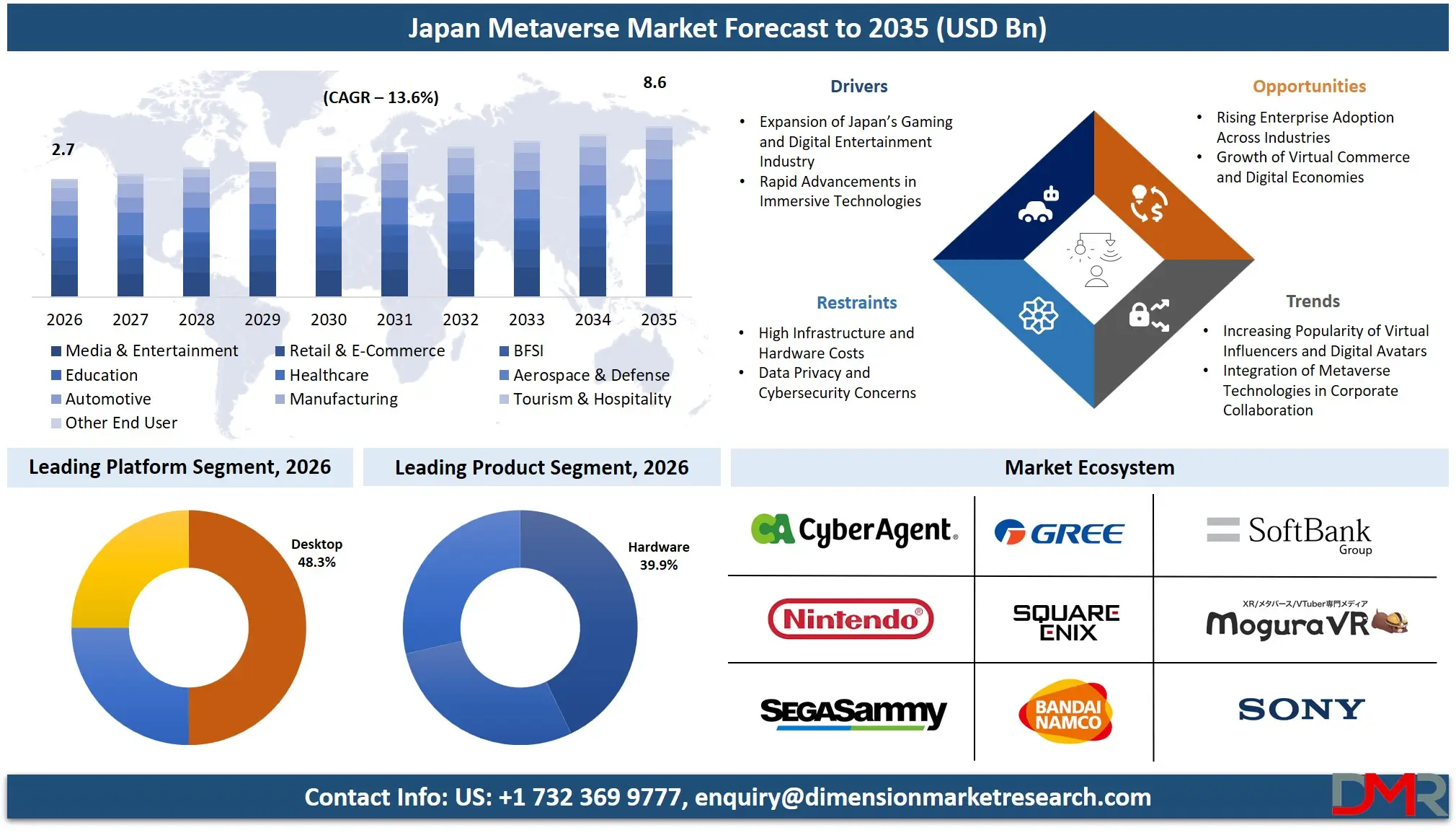
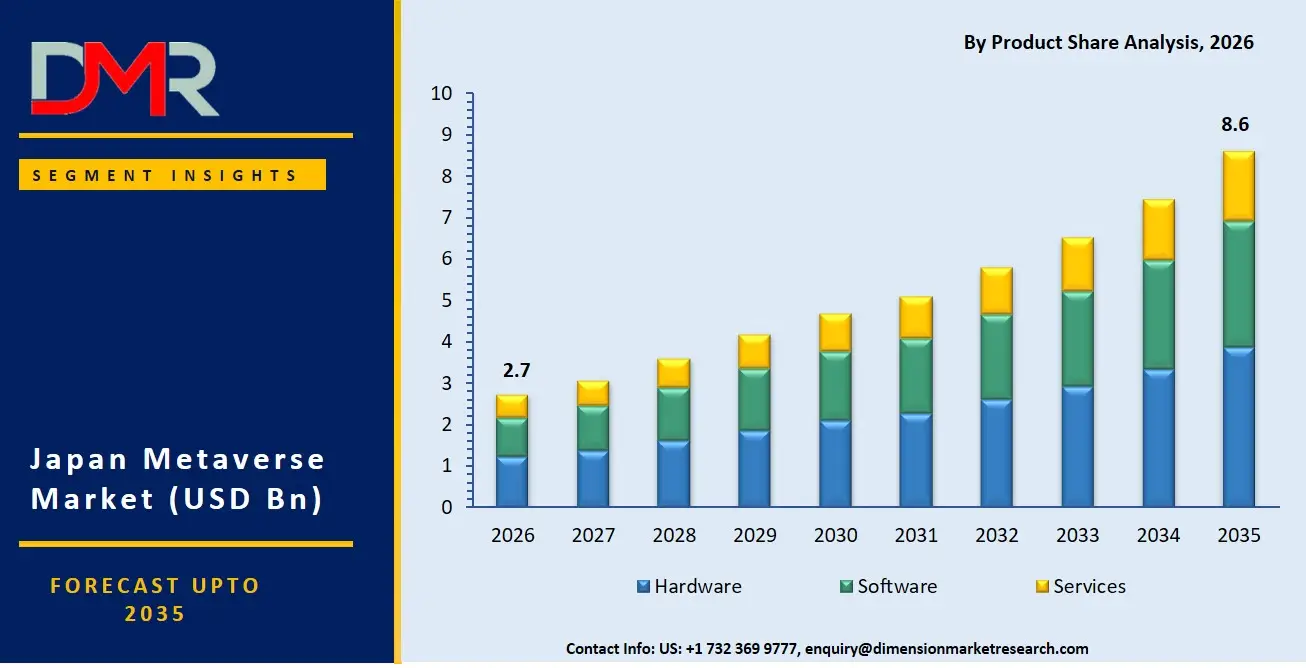
The Japan Metaverse Market is expected to reach a value of USD 2.7 billion in 2026, and it is further anticipated to reach USD 8.6 billion by 2035, growing at a CAGR of 13.6% during the forecast period.
ℹ
To learn more about this report –
Download Your Free Sample Report Here
The metaverse market in Japan is going through an interesting evolution cycle, characterized by the strong impact of its rich culture associated with gaming, anime, and advanced robotics. It involves hardware, software, and dedicated services used for the provision of immersive digital experiences, digital twins, and metaverse economics. In contrast to Western metaverses, which are dominated by social media leaders, metaverses in Japan are developing due to digital transformation (DX) initiatives in companies, avatar ecosystems, and the country's love for virtual interactions. Companies from the traditional manufacturing, retail, and entertainment industries are the strongest metaverse adopters in Japan, deploying such tools not only for consumers but also for solving industry problems.
ℹ
To learn more about this report –
Download Your Free Sample Report Here
Key Takeaways
- Market Size & Forecast: The Japan Metaverse market is predicted to reach a market value of USD 2.7 Billion in 2026 to grow further to USD 8.6 Billion by 2035, backed by the twin factors of uptake of digital twin solutions among businesses and the cultural acceptance of virtual economies initiated by the gaming industry and VTubers.
- Growth Rate & Outlook: Market growth is expected at a CAGR of 13.6%, driven by the urgent requirement of connecting Japan's manufacturing prowess with the new spatial interfaces as well as the increased challenges of running persistent real-time virtual worlds.
- Primary Growth Drivers: Key forces include the national initiative toward DX to address labor shortage through Virtual Training, Simulation & Testing solutions, technological advances from the existing AR/VR headset & device makers, and requirements related to game & simulation engines demanding dedicated 3D asset creation & design tools.
- Key Market Trends: Some of the significant trends observed in the market are the emergence of enterprise-focused Digital Twin Software for automation of factories, the emergence of Avatar Development Software using AI technology to develop life-like autonomous virtual beings that provide services, and Content Development Services as companies focus on building lasting virtual worlds than temporary marketing campaigns.
- By Product Analysis: The hardware segment dominates the Japan metaverse market due to rising demand for AR/VR headsets, XR devices, haptic wearables, and high-performance computing hardware. Advanced immersive experiences in gaming, enterprise training, and virtual collaboration continue driving hardware adoption across consumer and industrial applications.
- By Platform Analysis: The desktop platform is expected to be the leading platform in the Japan metaverse market owing to its capability in providing excellent graphics performance, powerful processing capabilities, and compatibility with virtual reality and metaverse applications.
What is the Metaverse?
Metaverse refers to an interconnected virtual digital environment that provides opportunities for people to engage with each other through digital avatars. Some technologies that make up the metaverse include VR, AR, artificial intelligence, blockchain, and high-speed internet. The metaverse provides people with various activities that include socializing, playing games, shopping, working, and interacting in other ways. People can join the metaverse using different technological tools such as VR headsets, smartphones, computers, and smart glasses. Metaverse has virtual economies in which users can buy, sell, trade, and transfer virtual assets including NFTs, digital lands, and products. Businesses from various industries like gaming, retail, healthcare, entertainment, and enterprise communication have been adopting metaverse technologies.
Use Cases
- Virtual Manufacturing & Digital Twins: Japanese automotive companies employ Digital Twin Software and Integration & Deployment Services for creating photorealistic recreations of manufacturing plants which enable engineers to conduct simulations of production process modifications, robot training through VR, and even anticipate maintenance requirements without halting production physically.
- Immersive Retail and Virtual Commerce: Big-name department stores team up with Content Development Services and Metaverse Platforms to establish fully immersive retail environments, applying AR technology from mobile devices for customers to experiment with clothing that is virtually modeled through bespoke avatars.
- Virtual Events & VTuber Concerts: Entertainment industry corporations adopt Game & Simulation Engines and advanced Motion Tracking Devices for holding large-scale real-time virtual events attended by millions of spectators, presenting VTuber avatars in ultra-realistic form interacting with a live audience of digital beings.
- Education and Simulation-Based Training: Medical institutions and construction organizations make use of Consulting & Strategy Services and Managed Services for developing high fidelity VR training courses. The simulation of complex surgeries or hazardous actions in the construction field is conducted using Haptic Sensors & Wearables.
How AI is Transforming the Metaverse Market?
Artificial intelligence technology is transforming the metaverse market in Japan by greatly accelerating the process of asset creation while enhancing user engagement. In 3D Asset Creation & Design Tools, the use of AI technologies allows automatic transformation of simple sketches done on paper or using manga/ anime designs into fully rigged 3D models and dynamic virtual environment design in a much shorter time frame than was previously possible. The second important application of AI in this context is that avatar development software enables businesses to create realistic NPCs that can communicate with people in Japanese using natural language processing, understand cultural norms and behaviors, and predict customer actions.
Finally, the role of AI technology in governance and content moderation in the metaverse space cannot be underestimated. In Managed Services, for example, AI monitoring agents ensure that users do not break company rules in digital communities and reproduce copyrighted character models, thereby providing safe corporate spaces consistent with Japan's strict intellectual property and privacy regulations. Another way in which AI can help companies leverage the opportunities provided by the metaverse space is by creating virtual crowds through simulation modeling and prediction of future virtual real estate usage.
Market Dynamics
Key Drivers in the Japan Metaverse Market
Expansion of Japan's Gaming and Digital Entertainment Industry
The Japanese gaming and entertainment industry, which is highly popular all around the world, is one of the key factors affecting the development of the metaverse market. It has an audience of consumers that regularly takes part in online games, anime, virtual communities, and other immersive experiences. There is also an increasing interest among the leading players in the entertainment industry to utilize VR technologies and virtual worlds, including esports and virtual storytelling. It results in a growing adoption rate of such trends as virtual gaming arcades, virtual concerts, and digital collectibles.
Rapid Advancements in Immersive Technologies
Continuous technological innovation within VR, AR, MR, AI, and fast connectivity technologies is boosting growth in the Japanese metaverse market. The Japanese technology firms are focusing intensely on immersive technology, spatial computing technology, and artificial intelligence for virtual spaces to improve realism and interaction in their operations. The implementation of advanced 5G technology will lead to a smooth real-time experience with lower latency levels and better connectivity. Further advancements in graphics processing technology and motion tracking systems will ensure that more immersive applications can be used in gaming, training, healthcare, and enterprise collaboration.
Restraints in the Japan Metaverse Market
High Infrastructure and Hardware Costs
The expensive nature of developing metaverse infrastructure and equipment is a significant constraint to the metaverse market in Japan. Expensive VR headsets, smart glasses, motion-sensing devices, and high-powered computers may pose significant financial constraints that limit their widespread use by many people and businesses. Moreover, companies deploying metaverse technologies also incur huge expenses in terms of software development, cloud computing infrastructure, security measures, and personnel training. While it is possible that technological costs may reduce over time, financial constraints persist in the present moment and limit adoption by organizations without adequate resources for digital transformation.
Data Privacy and Cybersecurity Concerns
Privacy issues, cyber threats, and the need for identity protection are restricting the growth prospects of the Japan metaverse market. Metaverse providers store a large amount of user data such as user behavior patterns, biometrics, and transactions conducted on the metaverse platform. There are risks associated with data theft and unapproved access, causing consumers and organizations to be wary of the dangers of identity theft and virtual fraud. Moreover, the stringent regulations imposed by the Japanese government for the protection of personal data create hurdles for metaverse operators.
Growth Opportunities in the Japan Metaverse Market
Rising Enterprise Adoption across Industries
The growing adoption of metaverse technology within enterprise industries is creating huge growth prospects for companies in Japan. There is an application of immersive technology in industries like manufacturing, health care, education, automotive, retail, and travel. There are applications of digital twin technology and virtual work spaces for enhancing efficiency and minimizing costs. The incorporation of virtual and augmented reality in educational institutions is used in providing interactive learning experience, while there are applications of immersive technology by health care providers in therapy and medical training programs.
Growth of Virtual Commerce and Digital Economies
With the fast rise in virtual commerce and digital economy, there is great potential in the Japan metaverse market. Users are buying more virtual goods, digital clothes, non-fungible tokens (NFTs), and entertainment experiences in the virtual realm. Brands are also adopting virtual retail shops as part of their strategy for engaging customers and building loyalty. The strong gaming and anime culture in Japan is likely to increase the need for customization of avatars and other virtual activities. The use of blockchain technology will also promote secure digital transactions, thus incentivizing businesses to explore monetization possibilities in metaverse.
Trends in the Japan Metaverse Market
Increasing Popularity of Virtual Influencers and Digital Avatars
Virtual Influencers and Digital Avatars Using Artificial Intelligence (AI) have become emerging trends in the Japan Metaverse market. Consumers from Japan have become interested in engaging with virtual characters through video games, entertainment, fashion, and social media. Brands in Japan have also used digital avatars for advertising purposes, virtual engagement with customers, and providing fans with interactive experiences. The trend can be seen to fit well into the Japanese market due to the presence of their existing anime and pop culture that consumers are familiar with. Technological developments such as AI have made it possible to create realistic avatars for consumers.
Integration of Metaverse Technologies in Corporate Collaboration
The use of metaverse technologies in the workplace is becoming more common among Japanese businesses as they adopt new ways of collaborating remotely. They are incorporating virtual meetings, immersive training programs, and collaboration tools to enhance the productivity and engagement of their employees. The trend started after the rise of the hybrid work model and the need for greater flexibility in operations. Digital twins and collaboration through simulations are some of the other uses of metaverse technologies that companies have tried out.
Research Scope and Analysis
The Japan metaverse market is segmented by product into hardware, software, and services, by platform into desktop, mobile, and other platforms, by technology into VR, AR, MR, blockchain, and AI, by application into gaming, commerce, and virtual events, and by end-users across multiple industries including healthcare, manufacturing, education, retail, BFSI, automotive, aerospace, tourism, and entertainment.
ℹ
To learn more about this report –
Download Your Free Sample Report Here
By Product Analysis
The hardware is projected to dominate the metaverse market in Japan because of high demands for immersive devices and computing infrastructure. AR/VR headsets and other types of XR hardware dominate because there is increasing investment by both consumers and firms in immersive devices for entertainment purposes such as games and educational activities. Moreover, the dominance in the hardware industry in Japan enhances investments in other technological categories including smart glasses, haptic wearables, and spatial computing equipment. Graphical hardware is another type of technology that firms are increasingly adopting. This category dominates because metaverse requires advanced hardware.
By Platform Analysis
The desktop platform is expected to dominate the Japan metaverse market owing to its powerful computing power, graphics processing capabilities, and compatibility with advanced immersive applications. Applications in gaming, simulation, and business are mainly utilized on desktop computers since they are capable of delivering high-resolution graphics and complex virtual interactions. Desktops are more compatible with virtual reality headsets, motion sensors, and other software used in the development of the metaverse environment. Mobile platforms are gaining prominence but cannot match the performance, content creation, and large virtual environments of desktop computing.
By Technology Analysis
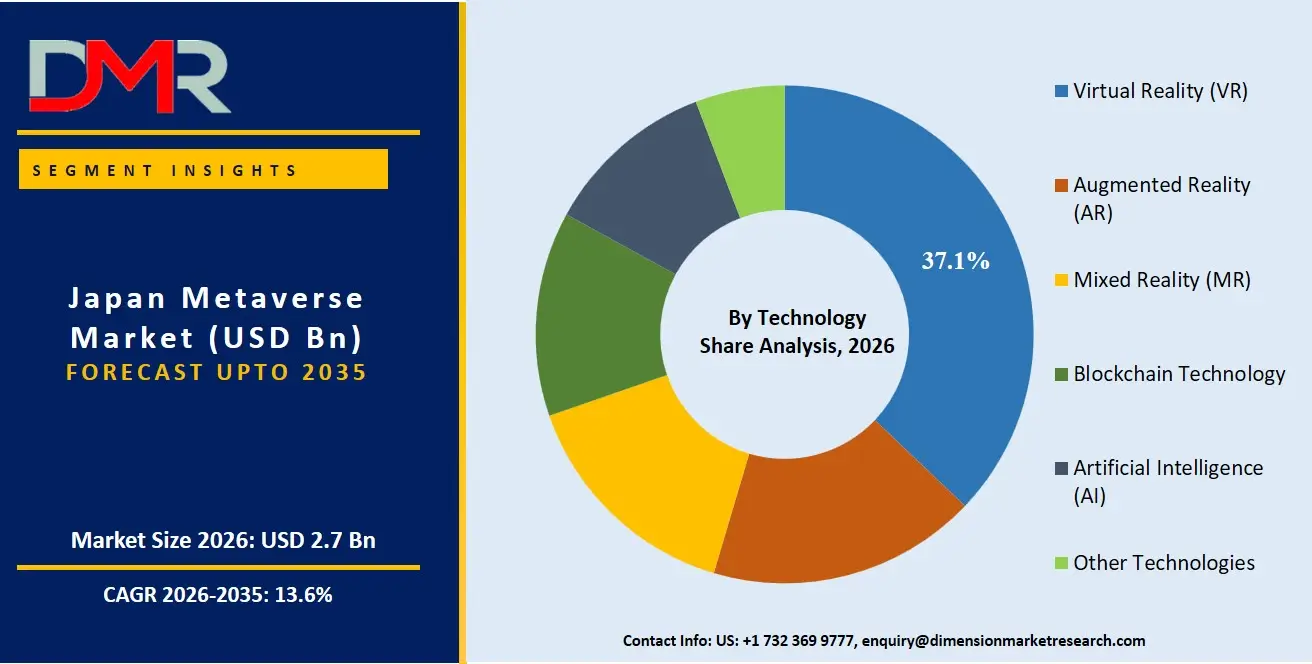
Virtual Reality (VR) technology is projected to take the lead in the Japanese metaverse market due to its prevalence in gaming, entertainment, education, and enterprise training use cases. VR technology provides a highly immersive environment that is consistent with the advanced gaming culture of Japan and technologically-inclined consumer behavior. Many businesses are now using VR to hold virtual conferences, conduct product demos, train employees through simulations, and offer digital tourism services. The presence of sophisticated VR headsets coupled with continuous innovation in immersive technologies ensures the continued dominance of VR in Japan.
By Application Analysis
Gaming & Esports is anticipated to dominate the market, with Japan's metaverse market led by its prominent global gaming industry. People from Japan are actively participating in online multiplayer virtual worlds, esports games, and other gaming applications, which is driving the growth of the metaverse in the region. Companies in the gaming sector are incorporating elements such as virtual economy, virtual avatars, NFTs, and socialization in their applications to retain users and maximize profits. The growth of virtual esports tournaments is further propelling the market towards new heights. Gaming is the leading application within the metaverse owing to the immersive nature of the platform.
By End-Use Analysis
Media & Entertainment is projected to account for most of the share of the metaverse market in Japan owing to the strong dominance of Japan in the gaming industry, anime industry, music industry, and digital content industry. Entertainment firms are increasingly embracing immersive technology to develop virtual performances, storytelling, fan interaction platforms, and media experiences in metaverses. There is an increase in demand for personalized and immersive entertainment products among consumers, and thus companies are investing in VR, AR, and virtual social networks. Japan's highly popular pop culture ecosystem facilitates the rise of digital avatars and virtual influencers in entertainment sectors.
The Japan Metaverse Market Report is segmented on the basis of the following:
By Product
- Hardware
- AR/VR Headsets & Devices
- Extended Reality (XR) Hardware
- Haptic Sensors & Wearables
- Smart Glasses
- Motion Tracking Devices
- Omni-Directional Treadmills
- Holographic Displays
- Spatial Computing Devices
- Edge & Graphics Processing Hardware
- Other Hardware
- Software
- Metaverse Platforms
- 3D Asset Creation & Design Tools
- Avatar Development Software
- Game & Simulation Engines
- Digital Twin Software
- Others
- Services
- Consulting & Strategy Services
- Integration & Deployment Services
- Managed Services
- Content Development Services
By Platform
- Desktop
- Mobile
- Other Platforms
By Technology
- Virtual Reality (VR)
- Augmented Reality (AR)
- Mixed Reality (MR)
- Blockchain Technology
- Artificial Intelligence (AI)
- Other Technologies
By Application
- Gaming & Esports
- Virtual Events & Conferences
- Social Media & Digital Communities
- Virtual Commerce & Online Shopping
- Digital Marketing & Advertising
- Content Creation
- Virtual Real Estate
- Training, Simulation & Testing
- Other Application
By End-User
- Media & Entertainment
- Retail & E-Commerce
- BFSI
- Education
- Healthcare
- Aerospace & Defense
- Automotive
- Manufacturing
- Tourism & Hospitality
- Other End User
Competitive Landscape
Competitive Dynamics of the Japan Metaverse Market can be seen as a dynamic combination of cutting-edge hardware providers who are among the best in the world, strong domestic game and entertainment developers, traditional IT companies, and emerging startups focused on avatar and spatial computation technologies. Competitive advantage can only be gained by the formation of deep strategic partnerships, usually involving global leaders in software platforms and national content kings using their intellectual property and advanced hardware design. There is an increased trend towards consolidation, where traditional IT service companies buy up niche VR software developers and boutique avatar creation centers based on artificial intelligence to create metaverse practices. Intellectual property is now a key differentiator, including proprietary 3D animation systems for anime, realistic haptic feedback mechanisms, and specific templates for automotive manufacturing industry digital twins.
Some of the prominent players in the Japan Metaverse Market are:
- Sony Group Corporation
- Nintendo Co., Ltd.
- Bandai Namco Holdings
- Square Enix Holdings Co., Ltd.
- SEGA Sammy Holdings
- CyberAgent, Inc.
- GREE, Inc.
- Mogura VR
- NTT Docomo
- KDDI Corporation
- SoftBank Group
- Rakuten Group
- Fujitsu Limited
- NEC Corporation
- Panasonic Holdings Corporation
- Meta Platforms, Inc.
- Microsoft Corporation
- Roblox Corporation
- Epic Games
- NVIDIA Corporation
- Other Key Players
Recent Developments
- January 2026: Bandai Namco Holdings announced a major expansion of its internal metaverse studio and launched professional services for partners in tourism, hospitality, and retail sectors to develop proprietary virtual worlds using advanced game engines and avatar development technologies.
- November 2025: Fujitsu strengthened its collaboration with Fanuc by introducing a mixed reality (MR) and digital twin solutions practice to support manufacturing clients in assembly-line monitoring and spatial computing transformation initiatives.
- October 2025: NTT Data acquired smart glasses startup QD Laser to strengthen its integration, deployment, and immersive content development services for aerospace, defense, and healthcare applications requiring hands-free spatial data visualization.
Report Details
| Report Characteristics |
| Market Size (2026) |
USD 2.7 Bn |
| Forecast Value (2035) |
USD 8.6 Bn |
| CAGR (2026–2035) |
13.6% |
| Historical Data |
2021 – 2025 |
| Forecast Data |
2027 – 2035 |
| Base Year |
2025 |
| Estimate Year |
2026 |
| Segments Covered |
By Product, By Platform, By Technology, By Application, and By End-User |
| Country Coverage |
Japan |
Frequently Asked Questions
How big is the Japan Metaverse Market?
▾ The Japan Metaverse market is poised to be valued at USD 2.7 billion in 2026 and is projected to reach USD 8.6 billion by 2035, driven by the universal demand for specialized hardware, culturally-native software platforms, and enterprise digital twin services.
What is the CAGR of the Japan Metaverse Market from 2026 to 2035?
▾ The market is expected to grow at a CAGR of 13.6% from 2026 to 2035, reflecting the accelerating convergence of Japan’s gaming culture with industrial applications and the growing complexity of building persistent, interoperable virtual economies.
What factors are driving the growth of the Japan Metaverse Market?
▾ Key drivers include the cultural prevalence of VTuber and avatar economies, the government's Society 5.0 initiative promoting digital twins for societal challenges, and the imperative to use VR/MR for Training, Simulation & Testing to address a severe industrial labor shortage.
Which segment held the largest share of the Japan Metaverse Market in 2026?
▾ The Media & Entertainment end-user segment, encompassing gaming, anime, and VTubers, held the largest market share in 2026, driven by deep consumer engagement and high demand for innovative Avatar Development Software and immersive Gaming & Esports experiences.
What are the major trends in the Japan Metaverse Market?
▾ Major trends include the blending of anime production pipelines with real-time game engines, the rise of hybrid physical-digital retail integrating holographic displays, and the application of Generative AI within 3D asset creation and autonomous virtual agent development.
Who are the key players in the Japan Metaverse Market?
▾ Key players in the Japan metaverse market include Sony Group, Bandai Namco Holdings, Fujitsu, NTT Data, CyberAgent, and GREE, driving innovation in immersive technologies, gaming, enterprise solutions, and virtual platforms.
How is the Japan Metaverse Market segmented?
▾ The market is segmented by Product, Platform, Technology, Application, and End-User.