Market Overview
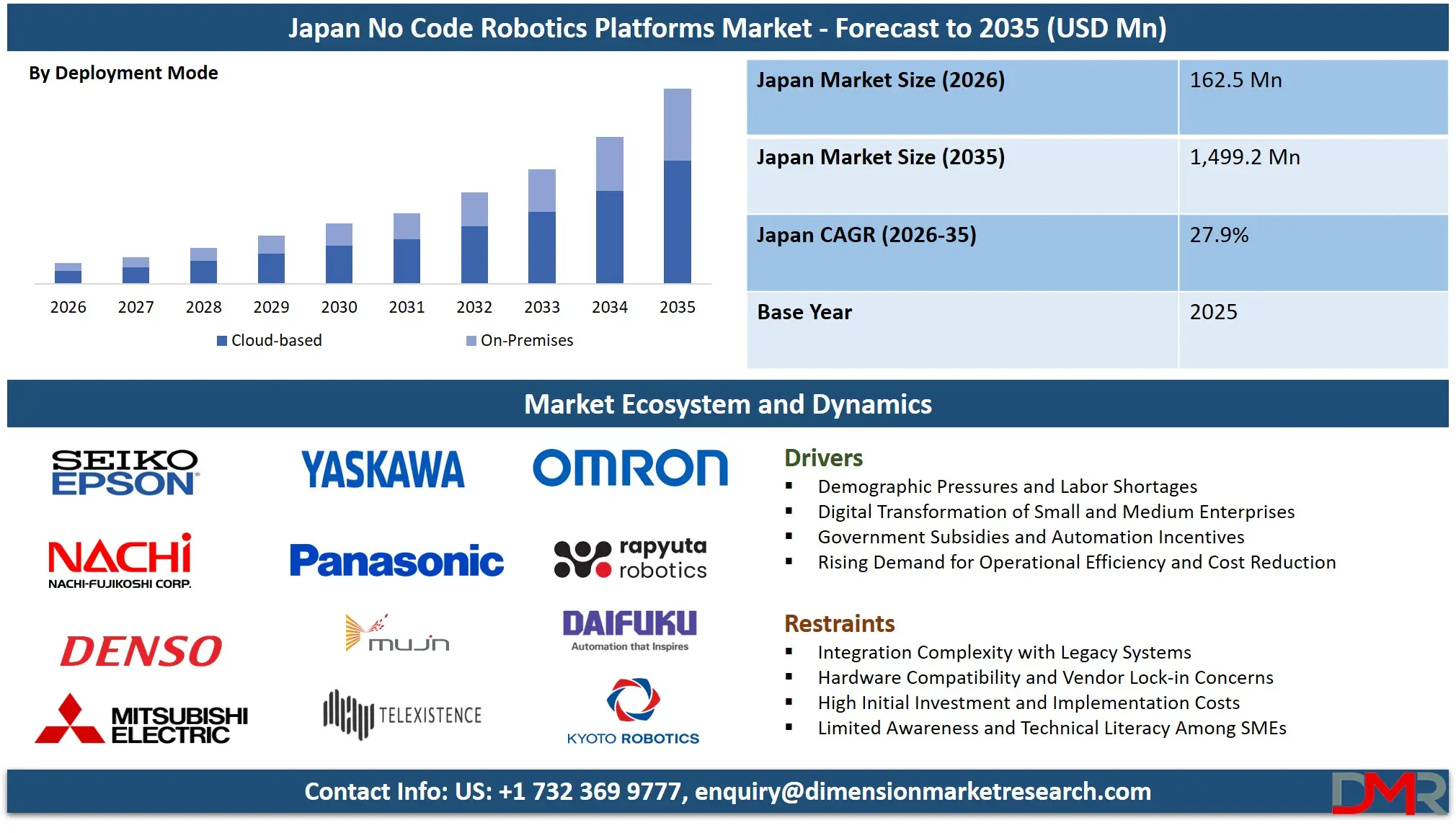
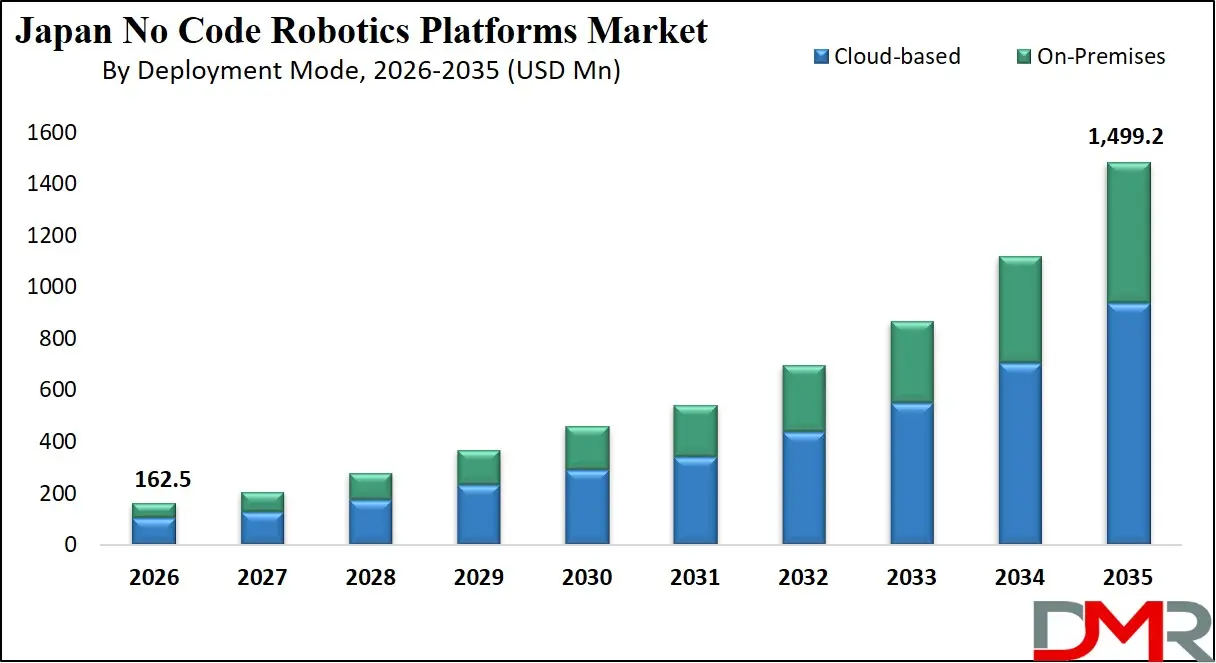
The Japan No-Code Robotics Platforms Market is anticipated to reach a value of USD 162.5 million in 2026 and is expected to grow significantly, reaching USD 1,499.2 million by 2035, advancing at a robust compound annual growth rate (CAGR) of 27.9% during the forecast period.
ℹ
To learn more about this report –
Download Your Free Sample Report Here
No-code robotics platforms refer to a set of software tools that can be used to program, operate, and control robots. No-code robotics platforms are gaining popularity in different industries, including automobile manufacturing, electronic device assembly, and healthcare, in Japan. The market for no-code robotics platforms in Japan is growing because of different factors, including the fact that Japan has a highly automated industry, an aging population, and a labor shortage; the fact that the Japanese government has undertaken initiatives to digitally transform Japan; and the fact that there has been a need for small and medium-sized businesses in Japan to have access to no-code robotics platforms, as this would allow them to be automated.
ℹ
To learn more about this report –
Download Your Free Sample Report Here
Japan No-Code Robotics Platforms Market: Key Takeaways & Other Influencing Factors
- Market Size Insights: The Japan No Code Robotics Platforms Market is estimated at USD 162.5 million in 2026 and is expected to reach USD 1,499.2 million by 2035.
- Market Growth Rate: The market is projected to grow at a CAGR of 27.9% from 2026 to 2035.
- Platforms as the Core Growth Driver: The Japan no code robotics platforms market is expected to see platform solutions, such as visual workflow builders and form-based configuration tools, as the key growth driver, owing to increased demand for intuitive programming interfaces.
- Industrial Automation as the Leading End User: Japan has a very established industrial sector, which means that industrial applications will always remain the largest end-user category. This is because of the need for industries such as the automobile, electronics, and machinery industries to address the looming labor shortages.
- JARA Data: More than 60% of Japanese manufacturing companies are using or planning to use robotic automation, with no-code technologies identified as a key enabler for companies with a lack of programming capabilities.
- SME Agency Data: SMEs represent 99.7% of total Japanese businesses, with over 70% showing a strong interest in using automation technologies, citing a lack of technical expertise as a barrier, indicating a significant potential market opportunity for no-code technologies.
- Global Rankings: Japan ranks in the top three in the world in terms of robot density in manufacturing, with 400 industrial robots per 10,000 employees, indicating a significant installed base for no-code programming interfaces.
- Workforce Decline Statistics: Japan, according to its Cabinet Office, will see a decline in its working-age population (ages 15-64) by over 4 million people by 2030, indicating a pressing need for no-code technologies in manufacturing, logistics, and service industries.
Impact of the Iran conflict on the Japan No Code Robotics Platforms Market
Regional issues with Iran have the potential to disrupt the stability of the price of energy, which could influence the price of operation for the automations in Japan. Issues in the supply chain for electronic components, like semiconductors and sensors, via international shipping routes could disrupt the availability of robotics platforms. However, this conflict will help in the strategy to diversify the supply chain, which will accelerate the domestic automations, having a positive influence on the no-code robotics market.
Japan No-Code Robotics Platforms Market: Use Cases
- Manufacturing Visual Workflow Deployment Supporting Production: Visual workflow-based robotics platforms are increasingly being used for assembly, inspection, and machine tending. This enables the manufacturing sector to work with robots without the need to program them. It also enables the workflow to be easily modified, which enhances efficiency.
- Logistics Form-Based Configuration for Warehouse Automation: Form-based robotics platforms are helping in the growth of automated warehouses and e-commerce operations. They allow for easier configuration of automated guided vehicles (AGVs) without programming difficulties. This helps in improving efficiency in operations without the need for programming skills.
- Inspection and Monitoring Solutions for Infrastructure Maintenance: No-code robotics platforms are becoming more popular for use in inspection of infrastructures through drones and ground robots. Visual programming allows for easier deployment of these robots. This helps in improving efficiency in monitoring infrastructures.
- Educational Robotics Platforms for STEM Workforce Development: No-code robotics platforms are becoming very popular in educational institutions for use in improving STEM education. They allow students to learn about robotics without programming skills. This helps in improving the quality of the future workforce.
Japan No-Code Robotics Platforms Market: Market Dynamics
Driving Factors in the Japan No-Code Robotics Platforms Market
Workforce Shortages Shaping Automation Demand
The declining population in the working age bracket continues to be an issue for businesses in Japan. This is where no-code robotics platforms are helping businesses in various sectors overcome the lack of programming expertise. These platforms enable workers on the factory floor as well as supervisors to program robots with the help of intuitive interfaces.
Rising Digital Adoption Among SMEs
The fact that Japan has a large number of small and medium-sized enterprises means that digital transformation is being widely accepted in Japan. However, most small and medium-sized enterprises in Japan do not have the resources to support traditional robotics solutions. The no-code solution has provided a viable option for SMEs, in addition to government initiatives.
Restraints in the Japan No-Code Robotics Platforms Market
Difficulties Integrating with Existing Systems
A considerable number of Japanese manufacturing facilities still use legacy systems that were not designed to work with the current robotics platforms. This is where the integration issue arises, which sometimes requires the use of additional middleware. This increases the cost for the end user.
Concerns Around Compatibility and Vendor Dependence
Another challenge for these platforms is to ensure compatibility among different robotic platforms. Most of the customers are also worried about becoming dependent on a single company’s ecosystem. Companies that can provide open platforms are more likely to gain the trust of customers.
Opportunities in the Japan No-Code Robotics Platforms Market
Growing Use of Robotics in Service Industries
The aging population of Japan is also a key driver for the use of robotics in service-based industries such as health care, hospitality, and elderly care. Robots are being increasingly deployed for assisting patients and customers. No-code solutions are also making it easier for non-technical personnel to work with these systems, thereby providing new opportunities for growth.
Demand for Industry-Specific Solutions
Currently, there is an increased interest in tailored robotics solutions that are geared towards certain sectors such as the automotive, electronics, and food industries. There is also an interest in business workflows that are ready to use, easily deployable with little modification. This is where businesses offering such specialized solutions can gain an advantage.
Trends in the Japan No-Code Robotics Platforms Market
Blending No-Code Platforms with AI Capabilities
No-code robotics platforms in Japan are increasingly incorporating artificial intelligence features. For example, computer vision and machine learning capabilities are being integrated into visual programming platforms. This is making the robots more "intelligent" in Japan.
Move Toward Open and Flexible Platform Ecosystems
It is evident that there is a shift towards a platform that can operate across various types of hardware in robots. There is a greater focus on flexibility and a lack of vendor lock-in by customers in Japan. As a result, there is a move towards open architecture and partnerships in developing a unified platform.
Japan No-Code Robotics Platforms Market: Research Scope and Analysis
By Component Analysis
The Platforms segment is expected to lead with an approximate 65.0% share in 2026, driven by Japan’s position as a global leader in industrial automation and increasing demand for intuitive programming interfaces. Visual workflow platforms using drag-and-drop interfaces are popular among manufacturing operators, while form-based platforms appeal to commercial enterprises. Services play an essential role in implementation, integration, and training, particularly among SMEs adopting automation for the first time.
By Deployment Mode Analysis
Cloud-based deployment is expected to lead, driven by flexibility, scalability, and minimal infrastructure needs in operations. Japanese companies are opting for a cloud-based solution due to ease of upgrade, accessibility, and management of multiple fleets. On-premise deployment is considered important for companies that have security needs, poor internet connectivity, and/or real-time latency issues.
By Application Analysis
ℹ
To learn more about this report –
Download Your Free Sample Report Here
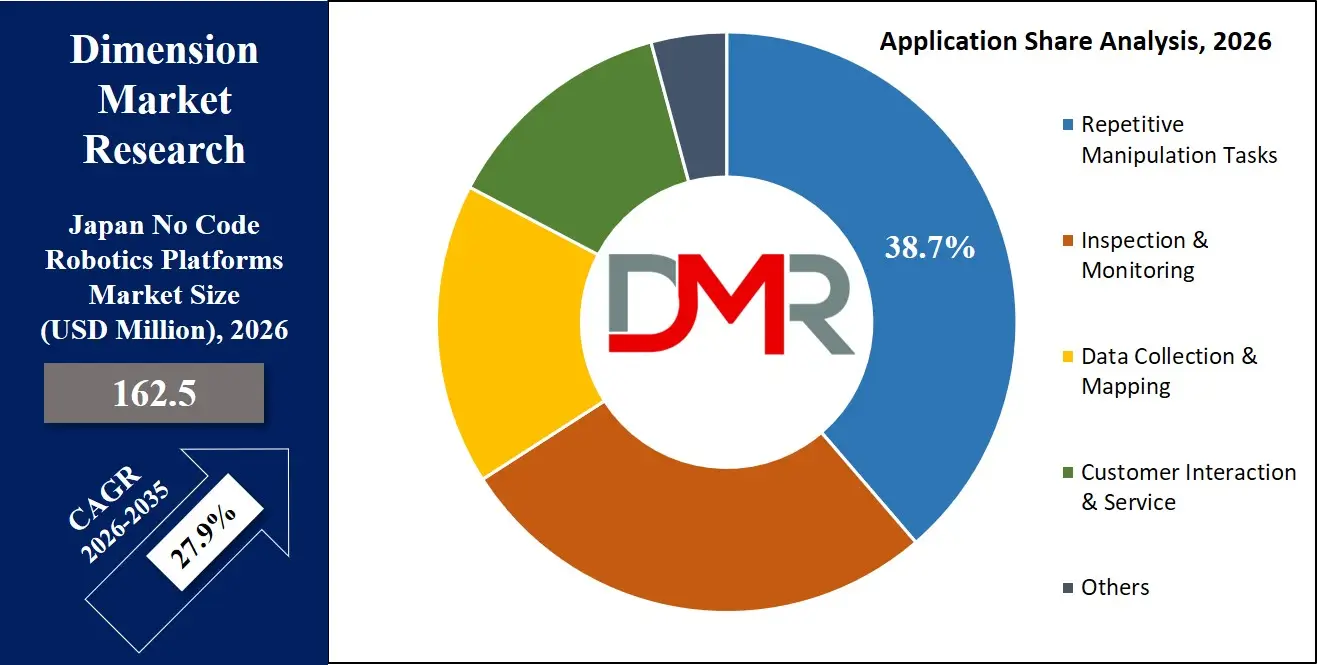
Repetitive manipulation tasks represent the largest application segment, driven by Japan’s strong manufacturing heritage in automotive, electronics, and machinery sectors. Inspection and monitoring applications are growing rapidly for infrastructure maintenance. Customer interaction and service applications are expanding in commercial sectors. Data collection and mapping support warehouse operations and facility management.
By Enterprise Size Analysis
Large enterprises are expected to lead due to high budgets and scale associated with these businesses, and some of the top automotive and electronics brands are expected to lead in no-code platform adoption. Small and medium enterprises are expected to grow at a high rate due to government initiatives in these areas and platforms designed specifically for these types of businesses.
By End User Analysis
Industrial end users are expected to drive the market because of Japan’s position as a global manufacturing hub and its high robot density in the automotive, electronics, and machinery industries. Commercial end users comprise the growing segment because of the expansion in the adoption of service robotics. Educational institutions rely on no-code technology for workforce development.
The Japan No-Code Robotics Platforms Market Report is segmented on the basis of the following:
By Component
- Platform
- Visual Workflow
- Form-based
- Others
- Services
- Professional Services
- Managed Services
By Deployment Mode
By Application
- Inspection & Monitoring
- Customer Interaction & Service
- Data Collection & Mapping
- Repetitive Manipulation Tasks
- Others
By Enterprise Size
- Small & Medium Enterprises
- Large Enterprises
By End User
- Industrial
- Commercial
- Educational
- Others
Impact of Artificial Intelligence in the Japan No-Code Robotics Platforms Market
The integration of artificial intelligence is also improving no-code robotics platforms in Japan, where various capabilities such as visual inspection, adaptive manipulation, and predictive maintenance can be achieved. This has been made possible through user-friendly interfaces, where no programming or knowledge of AI is necessary to manage such complex operations.
Furthermore, integration with machine learning has also been achieved, where real-time sensor information can be processed to improve robot performance. This has also been made possible to enhance decision-making, improve accuracy, and reduce programming complexities. Overall, AI has been integrated to improve no-code robotics platforms in Japan.
Japan No-Code Robotics Platforms Market: Competitive Landscape
The Japan no-code robotics platforms market is a highly competitive one due to the presence of strong players like FANUC Corporation, Yaskawa Electric Corporation, Denso Wave Incorporated, and Kawasaki Heavy Industries. These companies are using their expertise in industrial operations and integrating various automated systems into their offerings.
ℹ
To learn more about this report –
Download Your Free Sample Report Here
However, companies like Mujin Inc., Rapyuta Robotics Co. Ltd., and Telexistence Inc. are making a strong impact in the Japan no-code robotics platforms market by offering AI-based, user-friendly, and hardware-agnostic solutions. All these players in the Japan no-code robotics platforms market are currently focusing on improving their visual workflow systems, integrating various robots into their systems, and including various AI-based functionalities in their offerings. The growing trend of using cloud-based deployment systems is another factor that is making the Japan no-code robotics platforms market a highly competitive one.
Some of the prominent players in the Japan No-Code Robotics Platforms Market are:
- FANUC Corporation
- Yaskawa Electric Corporation
- Mitsubishi Electric Corporation
- Kawasaki Heavy Industries
- Omron Corporation
- Denso Corporation
- Seiko Epson Corporation
- Nachi-Fujikoshi Corp.
- Panasonic Corporation
- Mujin, Inc.
- Rapyuta Robotics
- Preferred Networks
- Telexistence Inc.
- Kyoto Robotics
- Connected Robotics Inc.
- Cyberdyne Inc.
- ZMP Inc.
- SoftBank Robotics
- Sony Robotics
- Daifuku Co., Ltd.
- Other Key Players
Recent Developments in the Japan No-Code Robotics Platforms Market
- March 2026: FANUC Corporation is investing around USD 90 million in its new production and distribution site with the aim of increasing the production capacity of robots, which is still in demand globally.
- March 2026: Yaskawa Electric Corporation is enhancing its robotics business by advancing its automation solutions and enhancing its software capabilities, with the aim of making it easier to program robots and enhancing the adoption of robots.
- September 2025: Rapyuta Robotics Co. Ltd. is enhancing its cloud robotics platform with the aim of enabling the management of its warehouse automation systems.
- May 2025: Mujin Inc. is enhancing its intelligent robotics solutions with the aim of enabling the development of intelligent robots that can easily handle complex picking operations using AI technology.
Report Details
| Report Characteristics |
| Market Size (2026) |
USD 162.5 Mn |
| Forecast Value (2035) |
USD 1,499.2 Mn |
| CAGR (2026–2035) |
27.9% |
| Historical Data |
2021 – 2025 |
| Forecast Data |
2027 – 2035 |
| Base Year |
2025 |
| Estimate Year |
2026 |
| Report Coverage |
Market Revenue Estimation, Market Dynamics, Competitive Landscape, Growth Factors and etc. |
| Segments Covered |
By Component (Platform and Services), By Deployment Mode (Cloud-based and On-Premises), By Application (Inspection & Monitoring, Customer Interaction & Service, Data Collection & Mapping, Repetitive Manipulation Tasks, and Others), By Enterprise Size (Small & Medium Enterprises and Large Enterprises), By End-User (Industrial, Commercial, Educational, and Others) |
| Country Coverage |
Japan |
| Prominent Players |
FANUC Corporation, Yaskawa Electric Corporation, Mitsubishi Electric Corporation, Kawasaki Heavy Industries, Omron Corporation, Denso Corporation, Seiko Epson Corporation, Nachi-Fujikoshi Corp., Panasonic Corporation, Mujin, Inc., Rapyuta Robotics, Preferred Networks, Telexistence Inc., Kyoto Robotics, Connected Robotics Inc., Cyberdyne Inc., ZMP Inc., SoftBank Robotics, Sony Robotics, Daifuku Co., Ltd., and Other Key Players |
| Purchase Options |
We have three licenses to opt for: Single User License (Limited to 1 user), Multi-User License (Up to 5 Users), and Corporate Use License (Unlimited User) along with free report customization equivalent to 0 analyst working days, 3 analysts working days and 5 analysts working days respectively. |
Frequently Asked Questions
How big is the Japan No-Code Robotics Platforms Market?
▾ The Japan No-Code Robotics Platforms Market size is estimated to have a value of USD 162.5 million in 2026 and is expected to reach USD 1,499.2 million by the end of 2035.
What is the growth rate in the Japan No-Code Robotics Platforms Market in 2026?
▾ The market is growing at a CAGR of 27.9% over the forecasted period of 2026.
Who are the key players in the Japan No-Code Robotics Platforms Market?
▾ Some of the major key players in the Japan No-Code Robotics Platforms Market are Omron Corporation, Denso Corporation, Seiko Epson Corporation, Nachi-Fujikoshi Corp., Panasonic Corporation, Mujin, Inc., and many others.