What is the Non-Fungible Token Market Size?
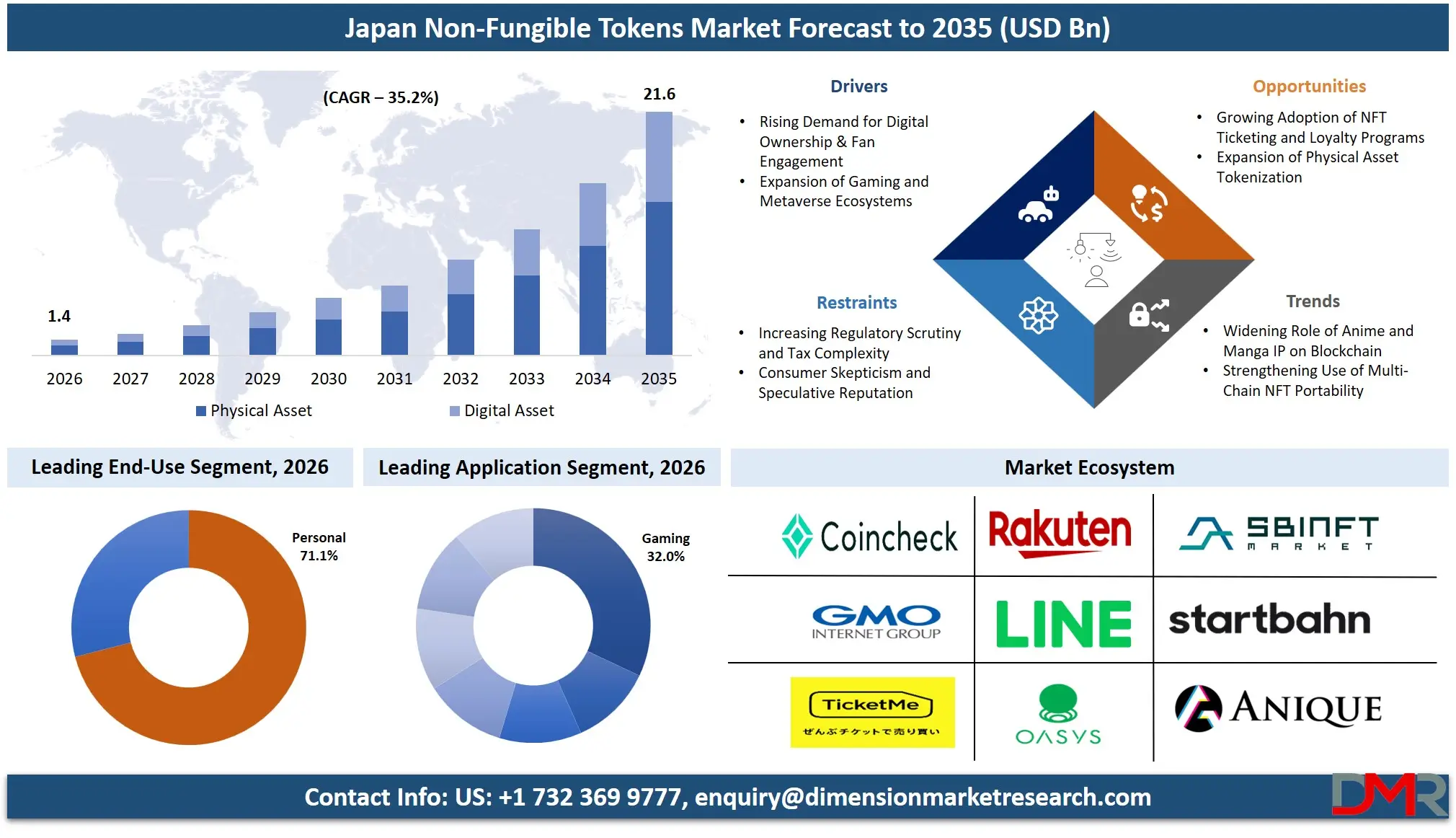
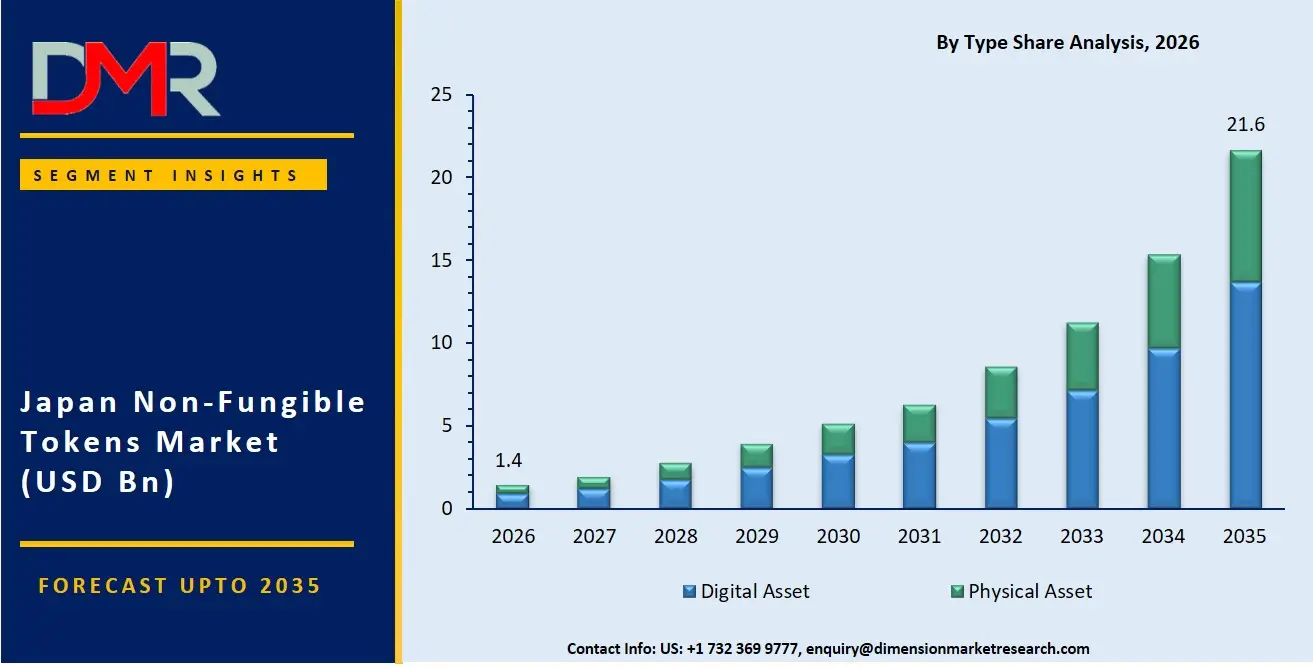
The Japan Non-Fungible Token (NFT) Market is expected to reach a value of USD 1.4 billion in 2026, and it is further anticipated to reach USD 21.6 billion by 2035, growing at a CAGR of 35.2% during the forecast period.
ℹ
To learn more about this report –
Download Your Free Sample Report Here
The Non-Fungible Token market has been showing consistent growth due to Japan's rising dependence on verifiable, decentralized, and IP-protected digital ownership systems for effective, secure, and scalable asset authentication. This includes several NFT minting platforms and expert services that help enterprises, creators, and government bodies deploy intelligent tokenization solutions for cultural, commercial, and entertainment purposes. There has been a rising need for professional minting and curation services owing to the requirements for implementing secure wallet infrastructure, ensuring operational continuity against cyber threats, and delivering high-performance analytics to collectors and IP holders. Individual consumers and collectors have emerged as the largest user segment for NFT platforms, with digital assets being the most popular choice due to their wide interoperability and ease of creation, while there has been rapid growth in gaming and anime IP integration services.
ℹ
To learn more about this report –
Download Your Free Sample Report Here
Key Takeaways
- Market Size & Forecast: The Japan NFT market is forecasted to be valued at USD 1.4 billion in 2026, growing incrementally to USD 21.6 billion by 2035, due to the joint efforts of digital content strategy deployment on the part of entertainment companies as well as the obligatory deployment of copyright protection and immutable ownership technologies.
- Growth Rate & Outlook: Japan market is expected to grow at 35.2% CAGR, propelled by the urgent need to mitigate emerging cross-chain interoperability challenges, alongside increasing demand for verifiable royalty flows from anime NFTs, gaming assets, and digital art platforms.
- Primary Growth Drivers: Major driving factors comprise the transition from traditional centralized content rights management towards modern NFT-first distribution systems, the necessity to deploy secure and transparent proof-of-ownership ledgers, as well as the implementation of NFT governance frameworks necessitating unique platform and legal expertise.
- Key Market Trends: Major trends encompass the introduction of AI-driven NFT provenance tracking through commercial marketplaces, usage of machine learning for rarity scoring and counterfeit detection, and increased focus on consumer protection amidst evolving guidance from the Japan Virtual and Crypto Assets Exchange Association (JVCEA).
- By Type Analysis: The digital asset segment is projected to dominate the Japan NFT Market due to high demand for scalable minting platforms and automated royalty management systems by creators and gaming studios.
- By Blockchain Analysis: The ethereum segment is projected to dominate the Japanese NFT Market due to its high security, robust developer ecosystem, and widespread use in digital art, gaming collectibles, and metaverse projects, supported by major Japanese marketplace integrations and institutional custody solutions.
- By End-Use Analysis: The personal segment is anticipated to lead the Japan NFT Market as individual collectors, gamers, and fans adopt systems that are accessible, self-custodial, and community-driven for purchasing digital art, trading in-game assets, collecting anime memorabilia, and participating in fan token ecosystems.
What are Non-Fungible Tokens (NFTs)?
Non-Fungible Tokens are unique cryptographic tokens stored in the blockchain, which act as evidence of the verified ownership of digital or tangible items. In contrast to cryptocurrencies, NFTs are not interchangeable tokens but an immutable source of evidence regarding the authenticity, origin, and scarcity of the tokenized objects. The NFT infrastructure comprises minting services that enable users to tokenize items, marketplaces for primary and resale transactions, digital wallets that allow users to store and display NFTs, and royalty enforcement protocols. In the context of the growing interest of Japanese entertainment organizations, gaming studios, and individual artists in digital monetization, NFTs offer numerous opportunities.
Use Cases
- Anime IP Monetization: Leading anime production companies leverage NFT-based platforms to mint unique digital collectibles, video clips, and artwork, facilitating automatic revenue share for artists and IP rights holders, as well as giving fans guaranteed ownership and exclusive access.
- Gaming Asset Ownership: Video game creators make use of NFT technology to allow gamers to have actual ownership over their in-game assets, characters, and cosmetic items, making peer-to-peer trading, interoperability across different games, and asset value generation possible.
- Fan Engagement & Loyalty: Entertainment firms and sports clubs issue fan tokens and digital membership tokens that grant exclusive perks such as access to exclusive content, votes in decision-making, meeting events with celebrities, and discounts on merchandise.
- Digital Art & Collectibles: Individual artists and museums mint NFTs to certify and sell digital artworks and art pieces, ranging from generative artworks to virtual gallery art pieces with a traceable sales history and automated royalties from secondary sales.
How AI is Transforming the Non-Fungible Token Market?
The integration of AI technologies into the NFT industry results in improved tracking of provenance, automated content moderation, and analysis of rarity. Using AI solutions allows spotting wash trading schemes, counterfeit, or plagiarized collections and verifying the metadata's accuracy on different platforms, which ensures that no fraud will take place. By evaluating asset rarity scores, AI enables assessing an asset's value according to its traits and history of sales. Moreover, using AI solutions allows artists to create generative art collections, optimize metadata, and forecast the demand for new assets. AI also proves highly valuable in moderating content and spotting any cases of content infringement prior to listing such NFTs on Japanese platforms. The process of minting is performed by professional services with the help of intelligent agents to ensure compliance with Japanese copyright legislation.
Market Dynamics
Key Drivers in the Japan Non-Fungible Token Market
Rising Demand for Digital Ownership & Fan Engagement
As Japanese consumers begin to favor NFTs to create direct and traceable connections between content creators and their audiences, the industry is witnessing an increasing uptake of NFTs among entertainment firms. Unlike conventional physical products and digital goods, NFTs offer undeniable authentication, making it especially relevant in cases where piracy of anime, manga, and gaming intellectual property is a huge problem. Platforms offering NFT creation services to content makers and entertainment agencies, which can be programmed to pay royalties automatically, have been adopted by many users. Fans get to enjoy clear second-hand sales markets, unique offerings, and true digital asset ownership.
Expansion of Gaming and Metaverse Ecosystems
The nation's cutting-edge video game sector is quickly embracing NFT and blockchain technologies that allow real ownership of digital assets. Large gaming companies are implementing NFT solutions in their games and allowing players to trade assets with each other in P2P fashion, transfer assets from one game to another, and even monetize time spent playing the game. The emergence of the Japanese metaverse with its virtual reality projects developed by native creators, also increases the popularity of NFT-based digital land plots, avatars, and accessories. Due to Japan's highly active gamer community and high spending per user, this country may be considered one of the best options for implementing gaming NFTs.
Restraints in the Japan Non-Fungible Token Market
Increasing Regulatory Scrutiny and Tax Complexity
The regulation concerning NFTs and crypto in Japan is still tough, but it is changing constantly. In that regard, there were guidelines on the management of crypto assets by the Japanese Virtual Currency Exchange Association and the Financial Services Agency (FSA). Moreover, in Japan, NFT trading is subject to the tax system, which categorizes the earnings from the sales of NFTs as miscellaneous income and subjects them to progressive tax rates of up to 55%. As a result, individuals who deal in NFTs are exposed to high costs because of taxes. Furthermore, enterprises face legal hurdles associated with NFT security classification guidelines.
Consumer Skepticism and Speculative Reputation
Despite increased usage, there is still much consumer hesitancy when it comes to using NFTs among the Japanese population owing to their ties to asset bubbles, market crashes, and instances of fraud. News reports have centered around their wild price fluctuations and money laundering capabilities instead of their usefulness and fan engagement. It is thus challenging for established firms in entertainment and other sectors to implement NFT projects due to the potential risk of backfire from fans. Utility-based examples, like tickets, reward points, and in-game objects that serve some purpose, are slowly eroding this hesitation.
Growth Opportunities in the Japan Non-Fungible Token Market
Growing Adoption of NFT Ticketing and Loyalty Programs
There are ample business opportunities arising out of the implementation of NFT technology in ticketing and loyalty program domains in Japan. The benefits include reducing frauds, reselling the tickets with fixed prices, and having the digital tickets as mementos after attending events. Many concert organizers, sports leagues, and amusement parks have started experimenting with NFT ticketing services to deliver better experience to the attendees while earning profits from the reselling process. Likewise, many retailers are now issuing NFT points and statuses that are easily transferable, compatible with all brands, and can be programmed for promotional purposes.
Expansion of Physical Asset Tokenization
Despite the fact that digital tokens are predominant within the realm of NFTs currently, there is an emerging trend in terms of tokenization of physical assets, which includes high-end goods, cars, real estate, as well as trading cards, among other items. Japanese customers place a premium on their ability to trace back the provenance of physical items, as well as any related certifications associated with the item's condition. Therefore, NFTs can help provide a sort of a digital twin where all such information can be stored.
Trends in the Japan Non-Fungible Token Market
Widening Role of Anime and Manga IP on Blockchain
Entertainment firms in Japan are beginning to introduce their anime and manga intellectual property into blockchain using NFT collections authorized by them. Contrary to other digital art, which lacks any fan following, recognizable characters, or plot-based rarity, anime NFTs take advantage of these features. Leading studios are releasing their collections featuring scene clips, artwork featuring characters, autographs of voice actors, and digital copies of illustrated books as NFTs with royalties payable to the original artist included. Other NFT projects even include the ability for the NFT owner to have a say in character designs or plot developments in the future.
Strengthening Use of Multi-Chain NFT Portability
Japanese NFT projects are now emerging on multiple blockchain networks (Ethereum, Polygon, Solana, Flow, and Astar). This is done to increase accessibility and decrease the gas fee cost for the end-user. Collectors are not interested in being restricted to one chain, as they would like to be able to transfer their assets across different chains, benefit from cheaper transaction fees on the sidechain, and interact with different marketplaces. As technology evolves, it is now possible for NFTs to be transferred from one chain to another without any wrapping and custody risks. Marketplace services in Japan are incorporating multi-chain capabilities, making it possible for NFTs from multiple chains to be listed, bought, and sold.
Research Scope and Analysis
The Japan Non-Fungible Token Market is segmented by type, blockchain, application, and end-use. The market supports digital art, gaming integration, anime IP management, and ticketing across individual collectors, commercial enterprises, entertainment studios, and technology companies through multi-chain and marketplace infrastructure.
ℹ
To learn more about this report –
Download Your Free Sample Report Here
By Type Analysis
Digital assets are expected to lead the Japan NFT Market in 2026 with a projected market share of 90.3% as a result of strong consumer and commercial preference for purely digital collectibles, gaming items, and art tokens. Japanese collectors and gamers have developed a preference for digital assets due to their instant delivery, programmable royalties, and seamless integration with online communities. The ability to instantly verify ownership and trade assets peer to peer without physical logistics has made digital assets far more attractive than physical linked alternatives. Digital NFTs can be displayed in virtual galleries, used within gaming ecosystems, and integrated into metaverse experiences. Major Japanese marketplaces have optimized their platforms for digital asset minting and trading, offering low-cost onboarding and mobile-first user experiences. Consequently, digital assets will remain the overwhelming majority of market value for the foreseeable future.
By Blockchain Analysis
Ethereum is projected to dominate the Japanese NFT Market in 2026, with an estimated share of 44.8%, owing to its widespread adoption in digital art, gaming collectibles, and metaverse projects, as well as support from major global and Japanese marketplaces. Japanese enterprises and creators favor Ethereum for its security, established developer tooling, and deep liquidity. The vast majority of high-value NFT collections from major anime studios and gaming companies have historically launched on Ethereum, creating network effects that are difficult for competitors to overcome. Most Japanese marketplace integrations first support Ethereum, and prominent wallet providers prioritize Ethereum compatibility. Ethereum's transition to proof of stake has addressed prior environmental concerns. The liquidity concentration on Ethereum means creators achieve better price discovery and secondary market activity compared to alternative chains.
By Application Analysis
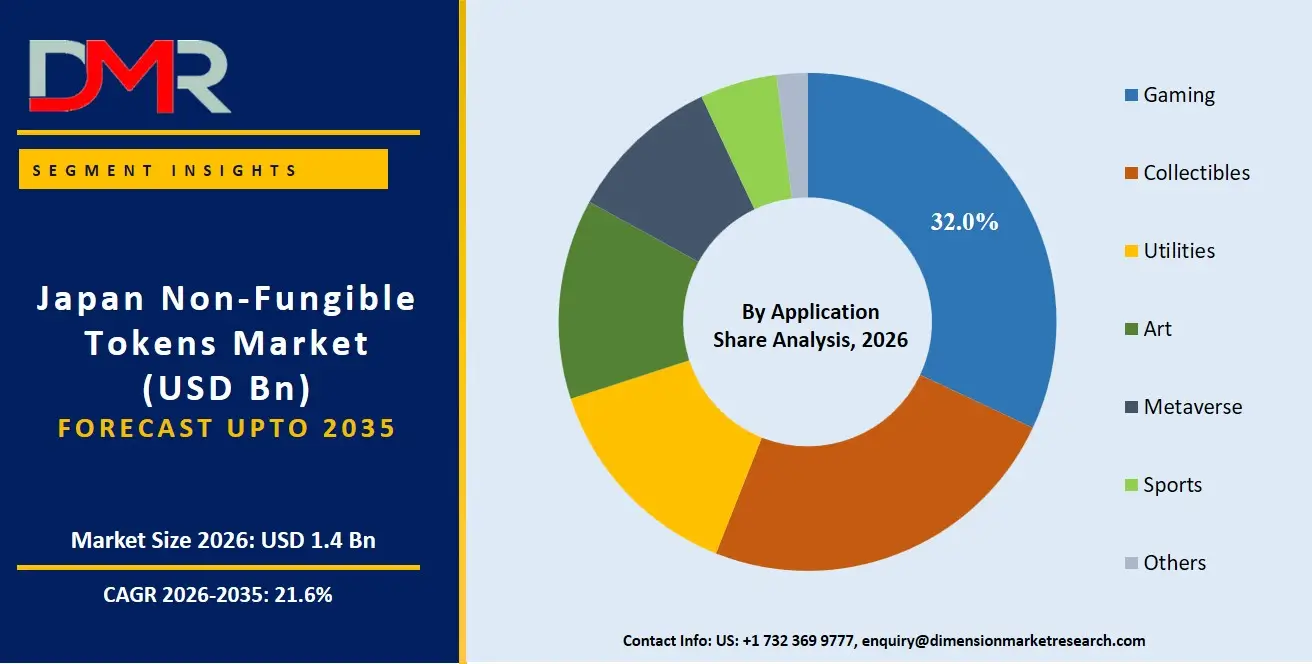
Gaming is set to dominate the Japan NFT Market in 2026 with a projected share of 32.0%, thanks to high NFT adoption in blockchain-based games, trading card games, and interoperable game asset platforms. Japan's deep gaming culture, combined with the rise of play and earn models that prioritize fun over financial speculation, positions gaming as the largest application segment. Major Japanese game publishers have launched NFT integrations into existing franchises, allowing players to truly own in-game items. Unlike collectibles or art, gaming NFTs offer functional utility within interactive environments, driving higher user engagement and repeat transactions. Japanese gamers are accustomed to spending on digital goods, making the transition to blockchain-based ownership a natural progression. Gaming is expected to remain the largest application segment in Japan throughout the forecast period.
By End Use Analysis
The personal segment is projected to dominate the NFT Market in Japan, with an expected market share of 71.1% in 2026, owing to robust consumer demand for gaming items, digital art, collectibles, and fan engagement tokens. Individual collectors, gamers, and fans are increasingly adopting NFT technologies to own assets they care about, trade peer to peer, and participate in community governance. The personal segment benefits from low barriers to entry, mobile first wallet infrastructure, and growing awareness of digital ownership benefits among Japanese consumers. Unlike commercial users who require compliance reviews and enterprise grade custody solutions, individual users can begin collecting NFTs within minutes. Japanese fans of anime and idol culture have demonstrated a strong willingness to pay for official digital memorabilia, especially when NFTs offer exclusive community access. Personal users will remain the primary demand driver for Japanese NFTs.
The Japan Non-Fungible Token Market Report is segmented based on the following:
By Type
- Physical Asset
- Digital Asset
By Blockchain
- Ethereum
- Polygon
- Solana
- Flow
- Binance Smart Chain
- Others
By Application
- Collectibles
- Art
- Gaming
- Utilities
- Metaverse
- Sports
- Others
By End-Use
Competitive Landscape
The dynamics of competition in the Japan NFT marketplace have developed to become increasingly dynamic, with a wide range of global marketplace operators, Japanese entertainment conglomerates, and specialized blockchain infrastructure providers. The essential ingredient for success is found in deep-seated strategic partnerships with anime studios, game publishers, and sports leagues in Japan, which provide exclusive IP access and established fan bases. Market consolidation trends are moving ahead, with major Japanese crypto exchanges and entertainment companies launching their own NFT platforms and marketplaces. Proprietary IP relationships, exclusive licensing agreements, and localized user experience hold increasing importance compared to generic marketplace features or cross-chain support alone.
Some of the prominent players in the Japan Non-Fungible Token Market are:
- Coincheck, Inc.
- SBINFT Co., Ltd.
- Rakuten Group, Inc.
- LINE Corporation
- GMO Internet Group, Inc.
- Financie, Inc.
- Startbahn, Inc.
- HEXA (MetaHexa Inc.)
- Anique, Inc.
- TicketMe, Inc.
- Astar Network (Startale Labs ecosystem)
- Oasys Pte. Ltd.
- HashPort, Inc.
- Ginco, Inc.
- Startale Labs Pte. Ltd.
- Progmat, Inc.
- JPYC Inc.
- Gaudiy, Inc.
- double jump.tokyo, Inc.
- YGG Japan Co., Ltd.
- Other Key Players
Recent Developments
- May 2026: SBINFT Co., Ltd. and SBI VC Trade Co., Ltd. announced a merger agreement to integrate NFT platform operations with crypto exchange infrastructure, marking a strategic shift from standalone NFT marketplaces toward unified blockchain financial ecosystems under the SBI Group.
- May 2026: Coincheck, Inc. expanded its digital asset ecosystem through a strategic alliance with KDDI Corporation to launch a non-custodial digital wallet inside the "au" mobile ecosystem, enabling seamless NFT and crypto asset usage for over 30 million telecom users in Japan.
- March 2026: Astar Network (Startale Labs ecosystem) advanced its NFT and Web3 infrastructure strategy through the rollout of the Soneium ecosystem in partnership with Sony Block Solutions Labs, focusing on consumer-facing blockchain applications including NFTs, gaming assets, and digital identity infrastructure.
- February 2026: Startale Labs and SBI Holdings advanced development of a yen-denominated stablecoin initiative (JPYSC), designed to support regulated on-chain settlement infrastructure that can be used for NFT transactions, tokenized assets, and digital economy payments in Japan.
Report Details
| Report Characteristics |
| Market Size (2026) |
USD 1.4 Bn |
| Forecast Value (2035) |
USD 21.6 Bn |
| CAGR (2026–2035) |
35.2% |
| Historical Data |
2021 – 2025 |
| Forecast Data |
2027 – 2035 |
| Base Year |
2025 |
| Estimate Year |
2026 |
| Segments Covered |
By Type, By Blockchain, By Application, By End-Use |
| Country Coverage |
Japan |
Frequently Asked Questions
How big is the Japan Non-Fungible Token Market?
▾ The Japan Non-Fungible Token Market is poised to be valued at USD 1.4 billion in 2026 and is projected to reach USD 21.6 billion by 2035.
What is the CAGR of the Japan Non-Fungible Token Market from 2026 to 2035?
▾ The market is expected to grow at a CAGR of 35.2% from 2026 to 2035, reflecting the NFT market's maturation and the accelerating complexity of multi-chain, interoperable ownership strategies.
What factors are driving the growth of the Japan Non-Fungible Token Market?
▾ Key drivers include the digital transformation imperative for IP monetization in anime and gaming, the need to modernize fan engagement and loyalty systems, the demand for verifiable digital ownership, and the surge in NFT adoption for ticketing and community building.
What are the major trends in the Japan Non-Fungible Token Market?
▾ Major trends include the integration of AI into provenance tracking and counterfeit detection, the rise of official anime and manga IP on blockchain, the expansion of NFT ticketing and loyalty programs, and the focus on user-friendly, low-fee consumer experiences.
Who are the key players in the Japan Non-Fungible Token Market?
▾ Key players include Coincheck NFT, SBI NFT, double jump.tokyo, Rakuten Group, Inc., LINE Corporation, Oasys Pte. Ltd., and many more.
How is the Japan Non-Fungible Token Market segmented?
▾ The market is segmented by type, blockchain, application, and end-use.