What is the Japan Oil Condition Monitoring Market Size?
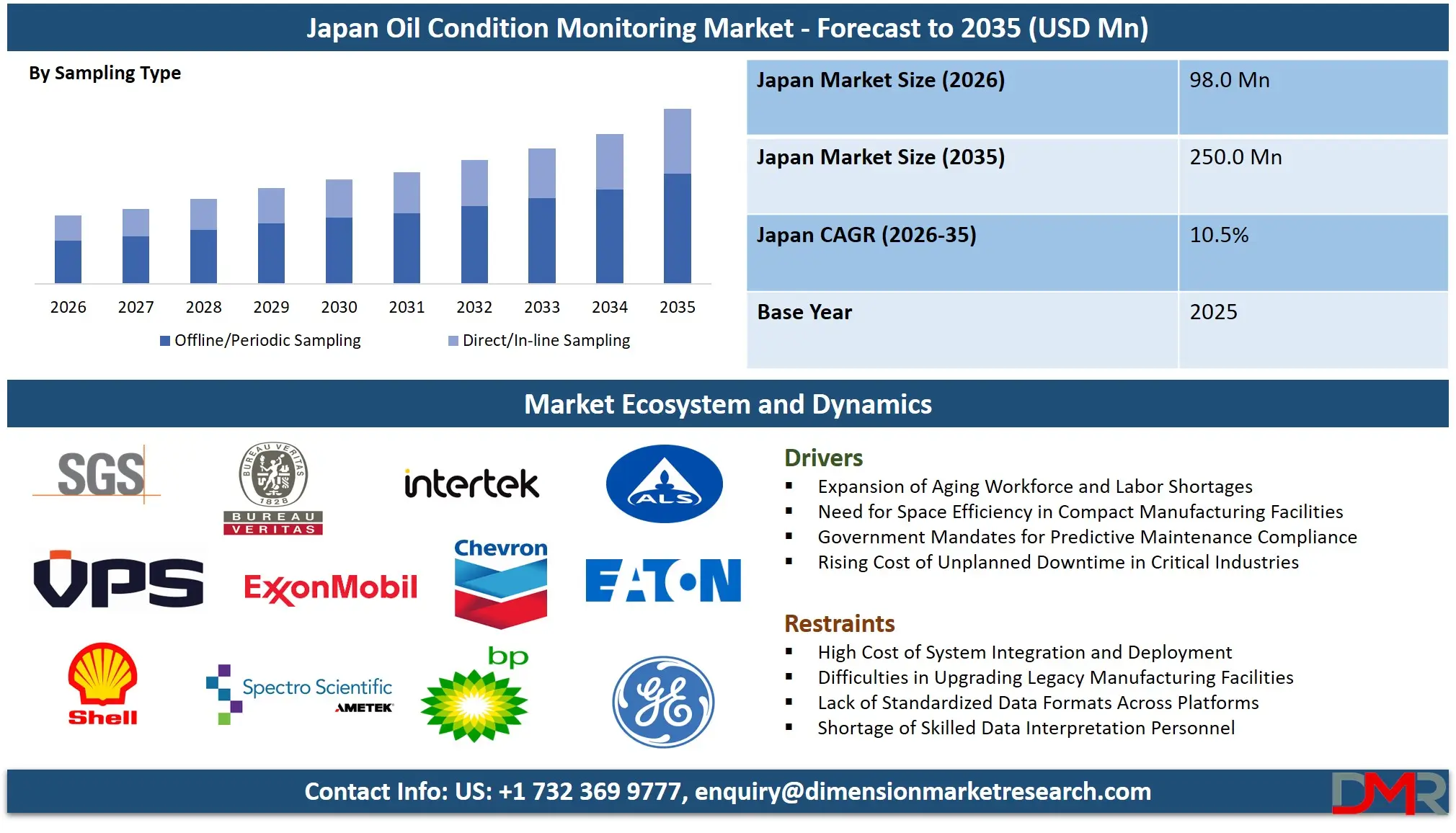
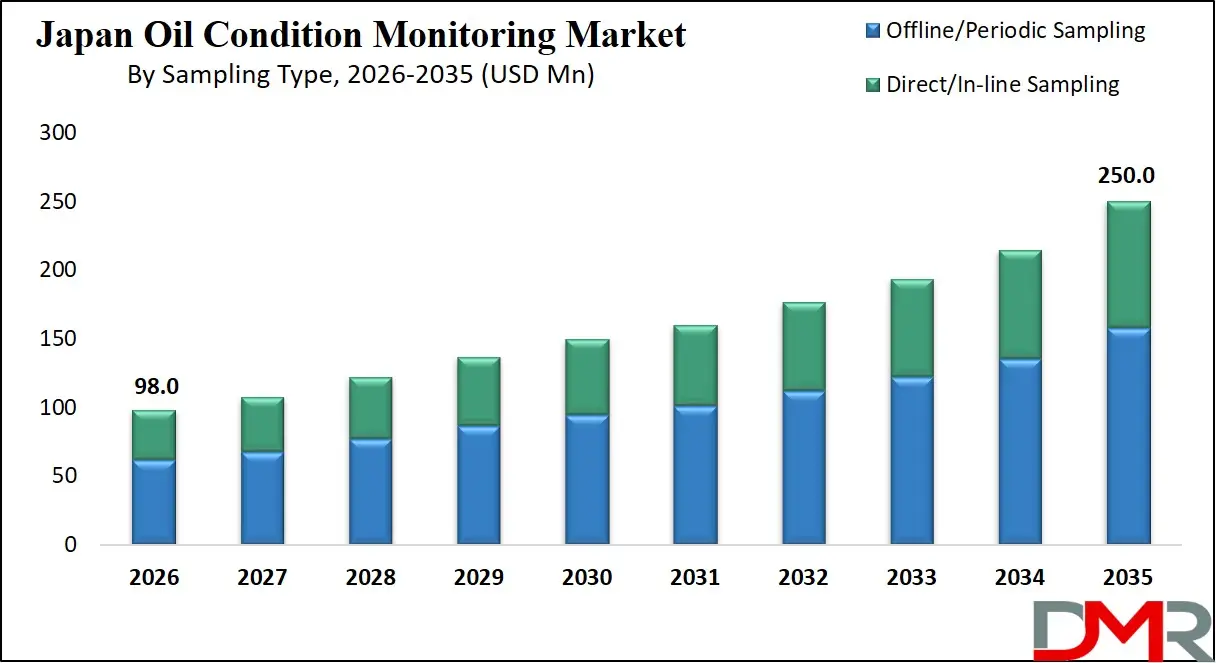
The Japan Oil Condition Monitoring Market size is estimated at USD 98.0 million in 2026 and is projected to reach USD 250.0 million by 2035, with a compound annual growth rate (CAGR) of 10.5% during the forecast period from 2026 to 2035.
ℹ
To learn more about this report –
Download Your Free Sample Report Here
The Japan oil condition monitoring market is registered with a solid growth since the industries are changing to proactive maintenance strategies instead of reactive maintenance strategies. In a desperate need of labor and an ageing workforce, the Japanese manufacture, power generation and transportation fleets are progressively using automated oil analysis services.
These systems are helpful in minimizing unforeseen equipment breakdown, increasing the life span of lubricants, and maximizing the maintenance timetable. Government campaigns to support the use of smart manufacturing and Industry 4.0 throughout the industrial base of Japan also contribute to the market.
ℹ
To learn more about this report –
Download Your Free Sample Report Here
Key Takeaways
- Market Size & Forecast: The Japan Oil Condition Monitoring Market is estimated at USD 98.0 million in 2026 and is projected to reach USD 250.0 million by the end of 2035.
- Growth Rate & Outlook: The market is projected to expand at a compound annual growth rate (CAGR) of 10.5% from 2026 to 2035, driven strongly by increasing demand for predictive maintenance across industries.
- Primary Growth Drivers: The alarming labor shortage and aging workforce in Japan is compelling manufacturers to quickly embrace automated oil condition monitoring solutions to critical equipment.
- Key Market Trends: AI-based spectrometric analysis and cloud-based real-time diagnostics are rapidly increasing the pace of the shift towards reactive to predictive maintenance strategies in Japan.
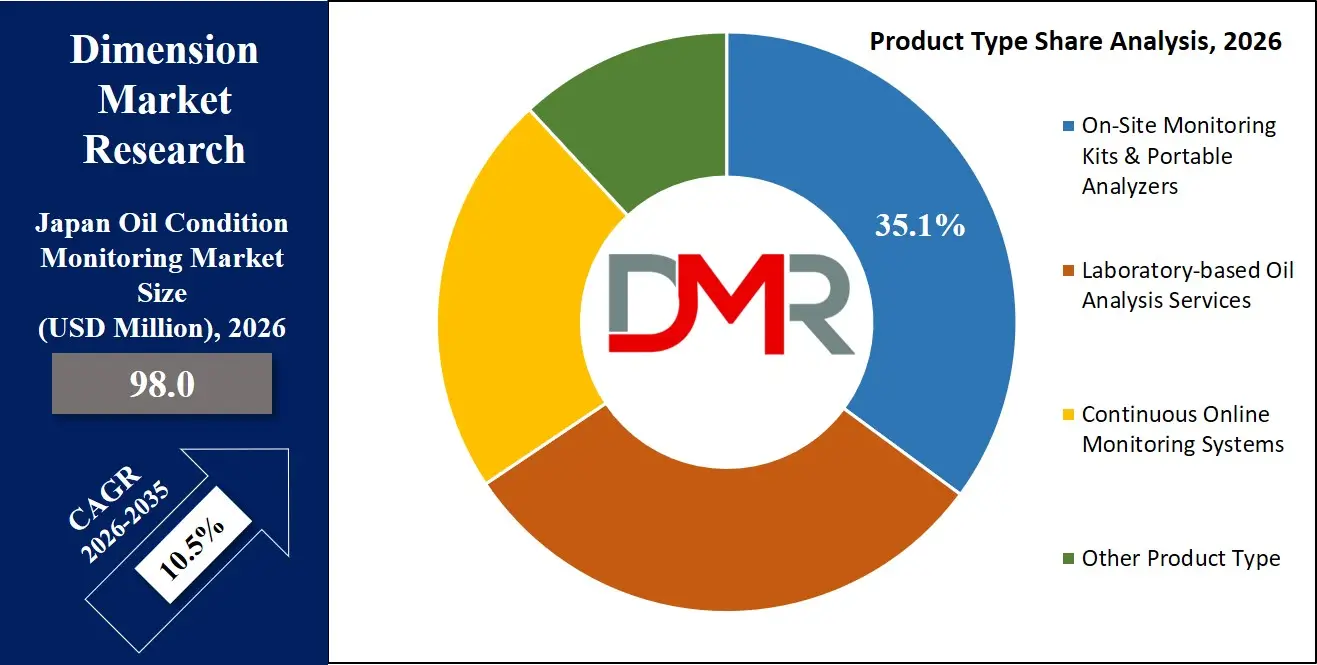
- By Product Type Analysis: On-site monitoring kits and portable analyzers lead the market with almost 35.1% market share in 2026 because it offers real-time field diagnostic applications.
- By Sampling Type Analysis: Offline and periodic sampling leads the market with a 44.8% share, primarily due to its seamless compatibility with existing maintenance workflows across industries.
- By Measurement Type Analysis: Physical properties including viscosity, density, and temperature, collectively hold a significant 40.1% share of the measurement type segment in 2026.
What is Oil Condition Monitoring?
Oil condition monitoring denotes a structured examination of lubricants, hydraulic fluids and industrial oil to evaluate equipment well-being, forecast failures and streamline the maintenance processes. It consists of physical property, wear debris, fluid contamination, and chemical parameters which measure the quality of oil and condition of machinery. The technology helps organizations minimize unexpected downtimes, increase the life of their assets, and decrease maintenance expenses by timely interventions using actual data on oil analyses.
Use Cases
- Automotive Fleet Maintenance: On-site oil kits detect wear debris in commercial vehicle engines, enabling just-in-time servicing and preventing costly breakdowns across large logistics fleets.
- Wind Turbine Gearbox Monitoring: Continuous online systems track viscosity and particle count in renewable energy assets, reducing catastrophic failures in remote offshore and onshore wind farms.
- Railway Hydraulic System Analysis: Portable analyzers are used to measure the hydraulic fluid of the Shinkansen trains, which is one of the measures to check the safety of operations and optimize the maintenance in the high-speed rail system in Japan.
- Industrial Heavy Machinery Diagnostics: In the manufacturing equipment, laboratory-level spectrometric analysis monitors TAN and TBN, greatly increasing the length of oil drain time and the total maintenance cost.
- Marine Engine Oil Testing: Using offline sampling, the dilution of fuel and water in ship engines is detected to prevent corrosion and guarantee reliability of the voyage of the Japanese commercial shipping fleet.
How AI Is Transforming the Japan Oil Condition Monitoring Market
Artificial intelligence has already changed the process of monitoring of oil conditions in Japan allowing predictive analytics and the use of AI in making decisions. The historical oil data is studied using advanced algorithms that predict equipment failures, which minimize unexpected downtime by about 15-25 percent. With sensor data, spectrometric data, and maintenance history, machine learning models constantly get better to enable transition to condition-based maintenance instead of scheduled maintenance.
Spectrometric and imaging AI-based systems facilitate the fast detection of contaminations and classification of wear debris during the online and routine sampling procedures. Cloud-linked applications facilitate remote monitoring, anomaly detection, and automatic maintenance warnings among plants. With the growth in the use of AI, Japanese industries enjoy the advantages of increased efficiency, reduced maintenance expenses, and increased equipment reliability.
Market Dynamics
Driving Factors in the Japan Oil Condition Monitoring Market
Expansion of Aging Workforce and Labor Shortages
With the escalating problem of labor shortage, particularly for manual inspection work, in Japan, the demand is rising for oil condition monitoring systems capable of performing repetitive, diagnostic work. In order to ensure high levels of uptime and fast changeover times as well as increased reliability, there has been an increasing trend for companies to use AI-guided portable analyzers, online sensors, and hybrid stand-alone monitoring units.
Need for Space Efficiency in Compact Manufacturing Facilities
Within the Japanese manufacturing environment, plants are forced to make use of compact and flexible monitoring cells with integrated sensors because there is no room for expansion of existing plants and high costs of property ownership. Modular sensor tooling and just-in-time oil analysis applications are becoming increasingly common as a means of maximizing available space usage.
Restraints in the Japan Oil Condition Monitoring Market
High Cost of System Integration and Deployment
The introduction of advanced online oil monitoring through the use of AI-driven spectrometric systems and real-time sensors entails high upfront costs. The costs associated with system integration, sensor calibration, and personnel training could hinder their adoption in small-scale manufacturing operations and older plants.
Difficulties in Upgrading Legacy Manufacturing Facilities
A significant number of manufacturing plants in Japan operate on an outdated lubrication schedule and controls that do not sufficiently support the installation of current online oil sensors and diagnostic systems. The modernization process is costly and cumbersome, posing obstacles to growth potential.
Opportunities in the Japan Oil Condition Monitoring Market
Growth in Hygienic and Cold Chain Monitoring Applications
The heightened focus on refrigerated and sanitized oil monitoring techniques for medical supply chain equipment and food processing machinery is creating possibilities for customized stainless-steel sensors and robots that can be easily washed. Another trend being adopted by factories in the production processes is the adoption of inventory management tools and intelligent sensor changers.
Rising Demand for Flexible Systems and Smart Production Cells
The demand for flexible/scalable systems and AI-driven production planning is growing due to the increased adoption of flexible and mobile monitoring cells. The advent of cloud computing and real-time data gathering, analysis, and maintenance techniques is opening up new market opportunities in Japan's industrial automation infrastructure.
Trends in the Japan Oil Condition Monitoring Market
Adoption of AI-Based Diagnostics and Connected Monitoring
There is a trend toward utilizing AI-driven spectrometric analysis and collaborative oil sensors, as it helps achieve greater flexibility in maintenance and improves worker safety. It allows one to increase changeover time, reduce equipment damages, and achieve more effective maintenance configuration in advanced manufacturing facilities.
Shift Toward Digital and Integrated Monitoring Technologies
Industrial manufacturers are becoming digital, and their operations include implementing sensor fleet monitoring, anomaly detection, and production monitoring through machine learning technologies. All of these new technologies can be combined with oil monitoring sensors in order to achieve better performance, sensor durability, and predictive maintenance.
Research Scope and Analysis
Product Type Analysis
The Japan oil condition monitoring market is dominated by on-site monitoring kits & portable analyzers, which occupy approximately 70.9% of the market in 2026 because of the extensive application in field-based, real-time diagnostics and rapid maintenance decision-making. This is followed by laboratory-based oil analysis services owing to their depth of chemical property analysis.
ℹ
To learn more about this report –
Download Your Free Sample Report Here
There is a growing popularity of the use of continuous online monitoring systems in energy & power generation applications. The presence of constant innovation in the technologies of spectrometric analysis and AI-based sensors also contributes to the superiority of on-site monitoring in the Japanese market.
By Sampling Type Analysis
Offline/periodic sampling leads with approximately 44.8% share in 2026, favored for its simplicity and compatibility with existing maintenance workflows. Direct/in-line sampling is widely used in continuous online systems and high-value assets. The shift toward real-time sampling combining offline flexibility with direct data flow is emerging as a key trend in next-generation oil condition monitoring.
By Measurement Type Analysis
Physical properties (viscosity, density, temperature) is expected to have a share of approximately 40.1% in 2026 because of the high volume of routine oil health checks in industrial machinery. Wear & contamination monitoring applications like wear debris analysis and particle counting still hold a large share. The rising popularity of chemical property analysis (TAN, TBN, oxidation) is also increasing the proportion of specialized spectrometric systems in Japan.
By Industry Vertical Analysis
Transportation represents the largest industry vertical with approximately 52.0% share in 2026, driven by complex fleet maintenance needs and long-term service contracts across automotive, aviation, marine, and railways. An aging Japanese industrial base with high technical requirements is expected to sustain demand for transportation-focused oil monitoring. The growing preference for end-to-end predictive maintenance solutions is further strengthening transportation as the preferred vertical for large-scale fleet clients.
The Japan Oil Condition Monitoring Market Report is segmented based on the following:
By Product Type
- On-Site Monitoring Kits & Portable Analyzers
- Laboratory-based Oil Analysis Services
- Continuous Online Monitoring Systems
- Other Product Type
By Sampling Type
- Offline/Periodic Sampling
- Direct/In-line Sampling
By Measurement Type
- Physical Properties
- Viscosity
- Density
- Temperature
- Wear & Contamination Monitoring
- Wear Debris Analysis
- Particle Counting
- Ferrous Density Measurement
- Fluid Contamination Analysis
- Water Content
- Fuel Dilution
- Soot & Insolubles
- Chemical Property Analysis
- Total Acid Number (TAN)
- Total Base Number (TBN)
- Oxidation & Nitration
- Additive Depletion
- Spectrometric Analysis
- Other Measurement Parameters
By Industry Vertical
- Transportation
- Automotive (Passenger & Commercial Vehicles)
- Aviation
- Marine
- Railways
- Energy & Power Generation
- Conventional Power (Coal, Gas, Nuclear)
- Renewable Energy (Wind Turbines, Hydropower)
- Industrial Manufacturing
- Heavy Machinery
- Process Industries
- Food & Beverage Equipment
- Mining & Construction Equipment
- Oil & Gas (Upstream, Midstream, Downstream)
- Other Industry Verticals
Competitive Landscape
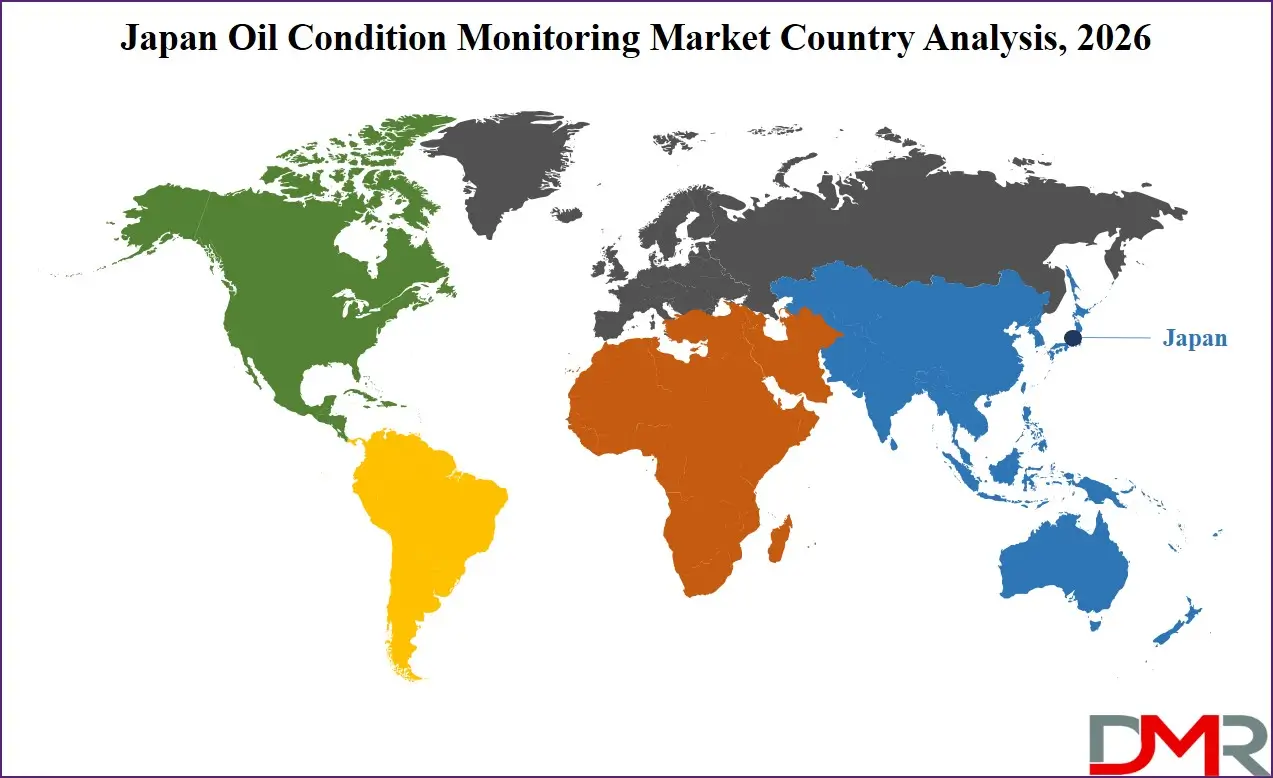
The Japan oil condition monitoring market is moderate in terms of level of consolidation and competition, with global and regional firms offering a full range of automated diagnostic equipment and sensor tooling solutions. Key players operating in the market include SGS S.A., Bureau Veritas S.A., Intertek Group plc, ALS Limited, Shell plc, ExxonMobil Corporation, Chevron Corporation, BP plc, TotalEnergies SE, and ENEOS Corporation. Competition is based on innovation, integration, simplicity, and end-to-end monitoring cells, including AI-guided and flexible/mobile systems.
ℹ
To learn more about this report –
Download Your Free Sample Report Here
The greatest needs are found in high-volume urban production centers where seismic compliance, engineering accuracy, and long-term system reliability are the distinguishing factors. Other competencies that companies employ to respond to different manufacturing and logistics needs are customization, cost efficiency, and ease of integration.
Some of the prominent players in the Japan Oil Condition Monitoring Market are:
- SGS S.A.
- Bureau Veritas S.A.
- Intertek Group plc
- ALS Limited
- Veritas Petroleum Services (VPS)
- Shell plc
- ExxonMobil Corporation
- Chevron Corporation
- BP plc
- TotalEnergies SE
- ENEOS Corporation
- Idemitsu Kosan Co., Ltd.
- Cosmo Energy Holdings Co., Ltd.
- Kyodo Yushi Co., Ltd.
- Parker Hannifin Corporation
- Eaton Corporation plc
- General Electric Company (GE Vernova)
- Spectro Scientific (AMETEK Inc.)
- Tan Delta Systems plc
- SKF Group
- Other Key Players
Recent Developments in the Japan Oil Condition Monitoring Market
- August 2025: Spectro Scientific enhanced its range of portable and integrated oil analysis solutions by concentrating on the fast, site-based diagnostics to diminish the dependence on centralized laboratory testing and complement predictive maintenance solutions.
- February 2025: ExxonMobil Corporation increased its digital and predictive maintenance with a further investment in innovative diagnostics and monitoring technologies of the industrial processes.
- January 2025: Bureau Veritas S.A. entered merger discussions with SGS S.A. to create a USD30 billion testing and certification giant, highlighting consolidation trends in the inspection and oil analysis services industry.
Report Details
| Report Characteristics |
| Market Size (2026) |
USD 98.0 Mn |
| Forecast Value (2035) |
USD 250.0 Mn |
| CAGR (2026–2035) |
10.5% |
| Historical Period |
2021 – 2025 |
| Forecast Period |
2027 – 2035 |
| Base Year |
2025 |
| Estimated Year |
2026 |
| Segments Covered |
By Product Type (On-Site Monitoring Kits & Portable Analyzers, Laboratory-based Oil Analysis Services, Continuous Online Monitoring Systems, Other Product Types), By Sampling Type (Offline/Periodic Sampling, Direct/In-line Sampling), By Measurement Type (Physical Properties, Wear & Contamination Monitoring, Fluid Contamination Analysis, Chemical Property Analysis, Other Measurement Parameters), By Industry Vertical (Transportation, Energy & Power Generation, Industrial Manufacturing, Mining & Construction Equipment, Oil & Gas, Other Industry Verticals) |
| Country Coverage |
Japan |
Frequently Asked Questions
How big is the Japan Oil Condition Monitoring Market?
▾ The Japan Oil Condition Monitoring Market size is estimated to have a value of USD 98.0 million in 2026 and is expected to reach USD 250.0 million by the end of 2035.
What is the CAGR of the Japan Oil Condition Monitoring Market from 2026 to 2035?
▾ The market is growing at a compound annual growth rate (CAGR) of 10.5% during the forecast period from 2026 to 2035.
What factors are driving the growth of the Japan Oil Condition Monitoring Market?
▾ Key drivers include Japan’s labor shortage, aging workforce, need for predictive maintenance, expansion of smart factories, and rising adoption of AI-based spectrometric analysis in industrial sectors.
What are the major trends in the Japan Oil Condition Monitoring Market?
▾ Major trends include AI-driven diagnostics and connected monitoring, cloud-based oil analysis, portable analyzers for field use, and integration of condition monitoring with IIoT platforms.
Who are the key players in the Japan Oil Condition Monitoring Market?
▾ Some of the major key players in the Japan Oil Condition Monitoring Market are SGS S.A., Bureau Veritas S.A., Intertek Group plc, ALS Limited, Veritas Petroleum Services (VPS), ENEOS Corporation, and many others.
How is the Japan Oil Condition Monitoring Market segmented?
▾ The market is segmented by Product Type, Sampling Type, Measurement Type, and Industry Vertical.